1
Routing in 2018
Geoff Huston
Chief Scientist, APNIC
22
Through the Routing Lens …
There are very few ways to assemble a
single view of the entire Internet
The lens of routing is one of the ways in
which information relating to the entire
reachable Internet is bought together
Even so, its not a perfect lens, but it can
provide some useful insights about the
entire scope of the Internet
33
1994: Introduction of CIDR
2001: The Great Internet Boom and Bust
2005: Consumer Market
2011: Address Exhaustion
25 Years of Routing the Internet
This is a view pulled together from
each of the routing peers of
Route-Views
44
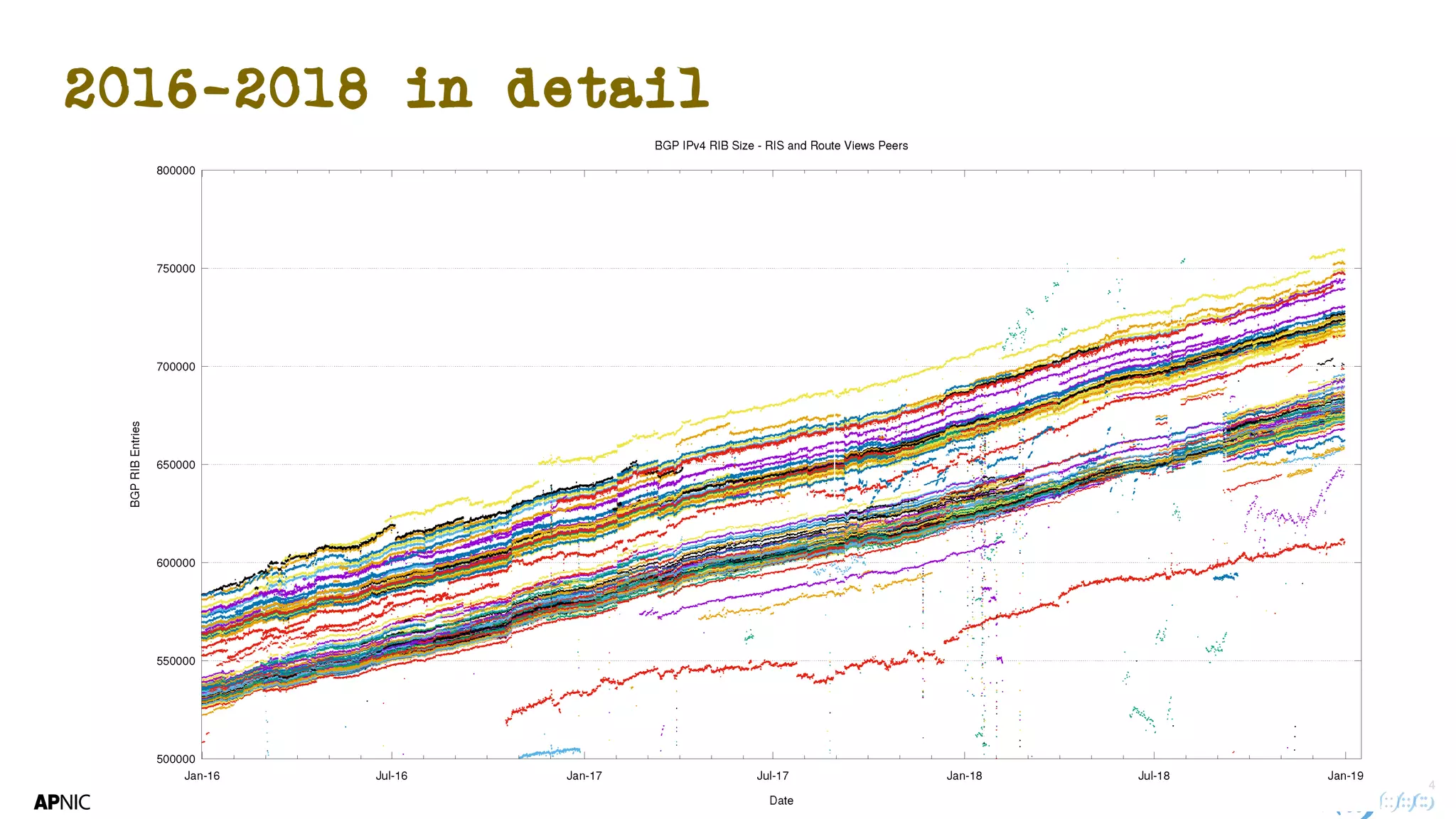
2016-2018 in detail
55
2016-2018 in detail
average growth trend
Route Views Peers
RIS Peers
66
Routing Indicators for IPv4
Routing prefixes – growing by
some 52,000 prefixes per year
AS Numbers– growing by some
3,400 prefixes per year
77
Routing Indicators for IPv4
More Specifics are still taking up
slightly more than one half of
the routing table
But the average size of a
routing advertisement continues
to shrink
88
Routing Indicators for IPv4
Address Exhaustion is now
visible in the extent of
advertised address space
The “shape” of inter-AS
interconnection appears to be
relatively steady
99
AS Adjacencies (AS131072)
4,144 AS6939 HURRICANE - Hurricane Electric, Inc., US
4.032 AS3356 LEVEL3 - Level 3 Communications, Inc., US
3,702 AS174 COGENT-174 - Cogent Communications, US
1,724 AS6461 ZAYO Bandwidth, US
1,646 AS7018 ATT-INTERNET4 - AT&T Services, Inc., US
1,618 AS3549 LVLT – Level 3 Parent, US
1,428 AS3257 GTT-Backbone, DE
1,377 AS2914 NTT America, US
1,208 AS209 CENTURYLINK, US
957 AS701 Verizon Business, US
51,613 out of 63,080 ASNs have 1 or 2 AS Adjacencies (82%)
1,803 ASNs have 10 or more adjacencies
9 ASNs have >1,000 adjacencies
Most networks are stub AS’s A small number of major connectors
1010
What happened in 2018 in V4?
Routing Business as usual – despite IPv4 address exhaustion!
– From the look of the growth plots, its business as usual, despite the increasing
pressures on IPv4 address availability
– The number of entries in the IPv4 default-free zone reached 750,000 by the
end of 2018
– The pace of growth of the routing table is still relatively constant at ~52,000
new entries and 3,400 new AS’s per year
• IPv4 address exhaustion is not changing this!
• Instead, we appear to be advertising shorter prefixes into the routing system
1111
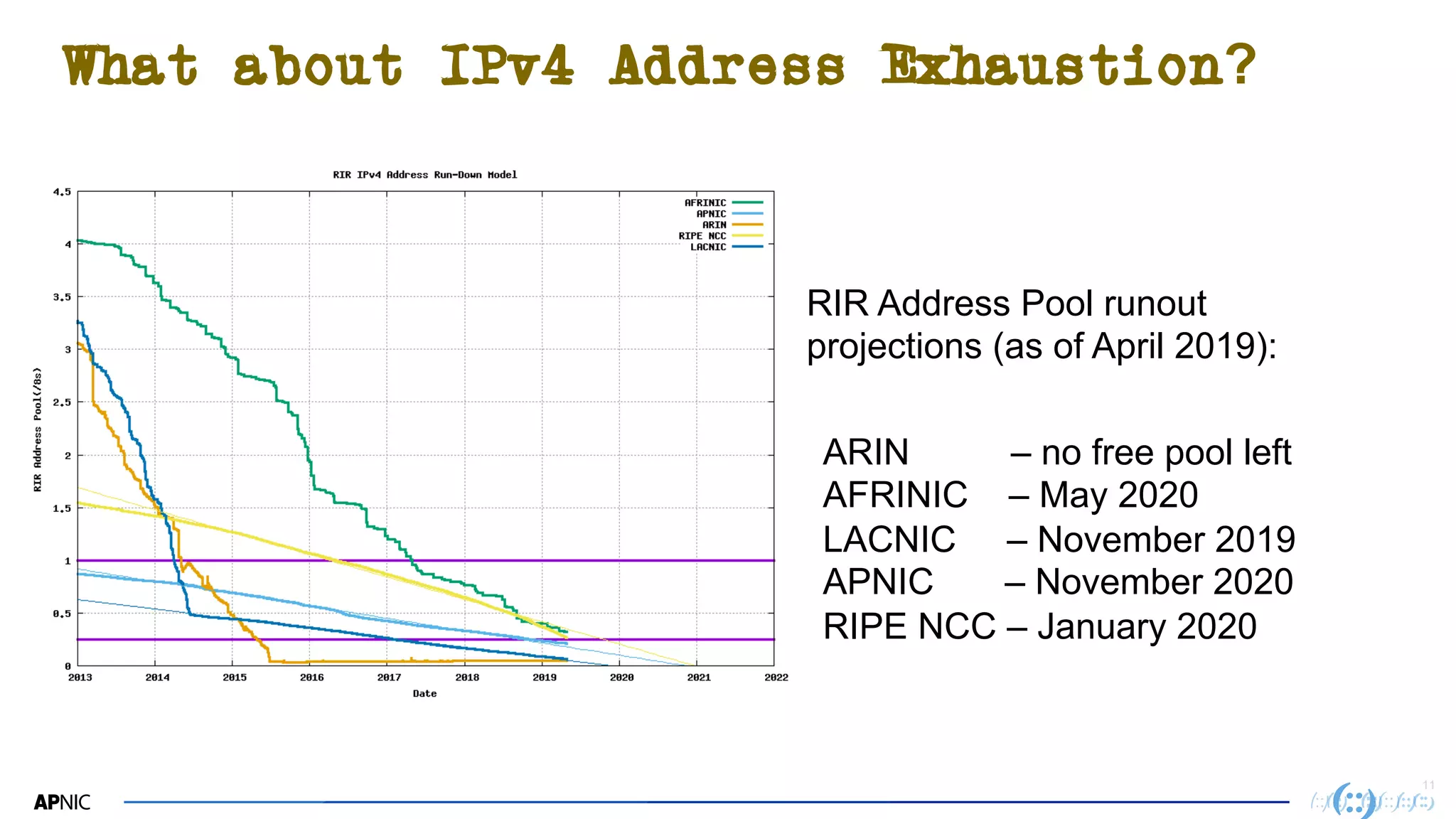
What about IPv4 Address Exhaustion?
ARIN – no free pool left
AFRINIC – May 2020
LACNIC – November 2019
APNIC – November 2020
RIPE NCC – January 2020
RIR Address Pool runout
projections (as of April 2019):
1212
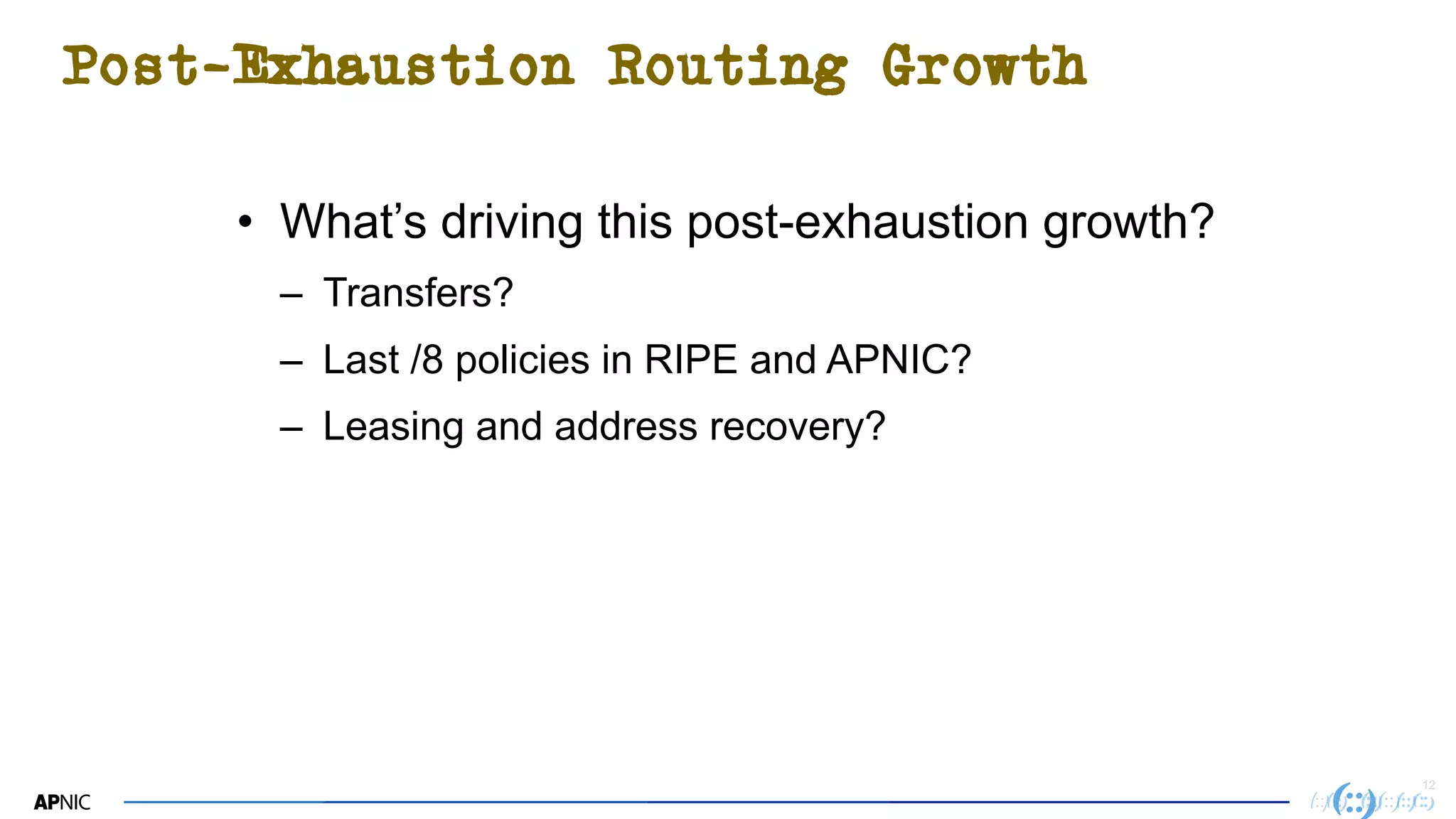
Post-Exhaustion Routing Growth
• What’s driving this post-exhaustion growth?
– Transfers?
– Last /8 policies in RIPE and APNIC?
– Leasing and address recovery?
1313
Advertised Address “Age”
80% of all new addresses announced in 2010
were allocated or assigned within the past 12
months
2% of all new addresses announced in 2010
were >= 20 years ‘old’ (legacy)
2010
1414
Advertised Address “Age”
20% of all new addresses announced in 2018 were
allocated or assigned within the past 12 months
48% of all new addresses announced in
2018 were >= 20 years ‘old’ (legacy)
2018
1515
2000 – 2018: IPv4 Advertised vs Unadvertised
1616
2000 – 2018: Unadvertised Addresses
Total volume of
“reclaimed” addresses
1717
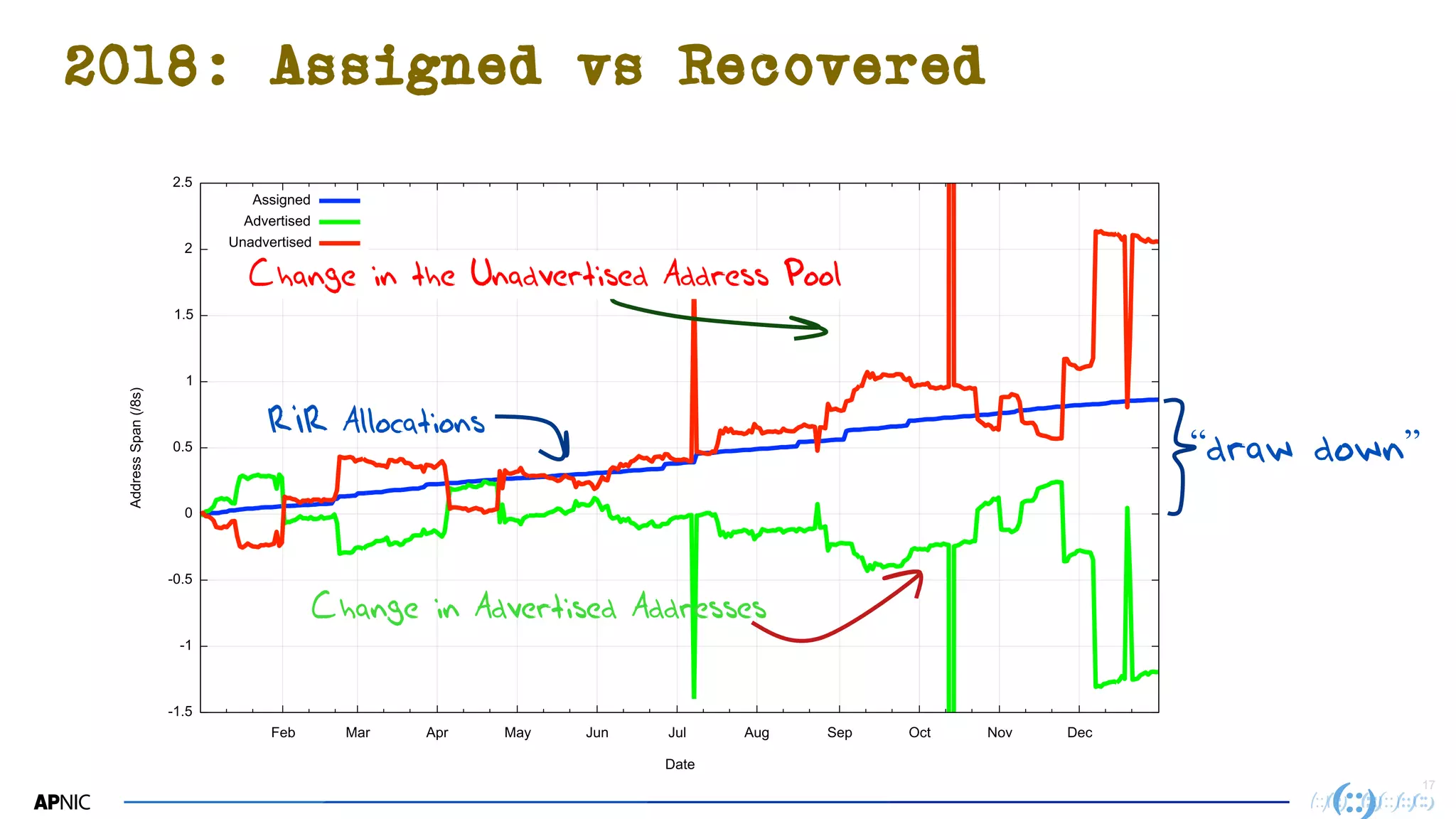
2018: Assigned vs Recovered
Change in Advertised Addresses
Change in the Unadvertised Address Pool
RIR Allocations
“draw down”
1818
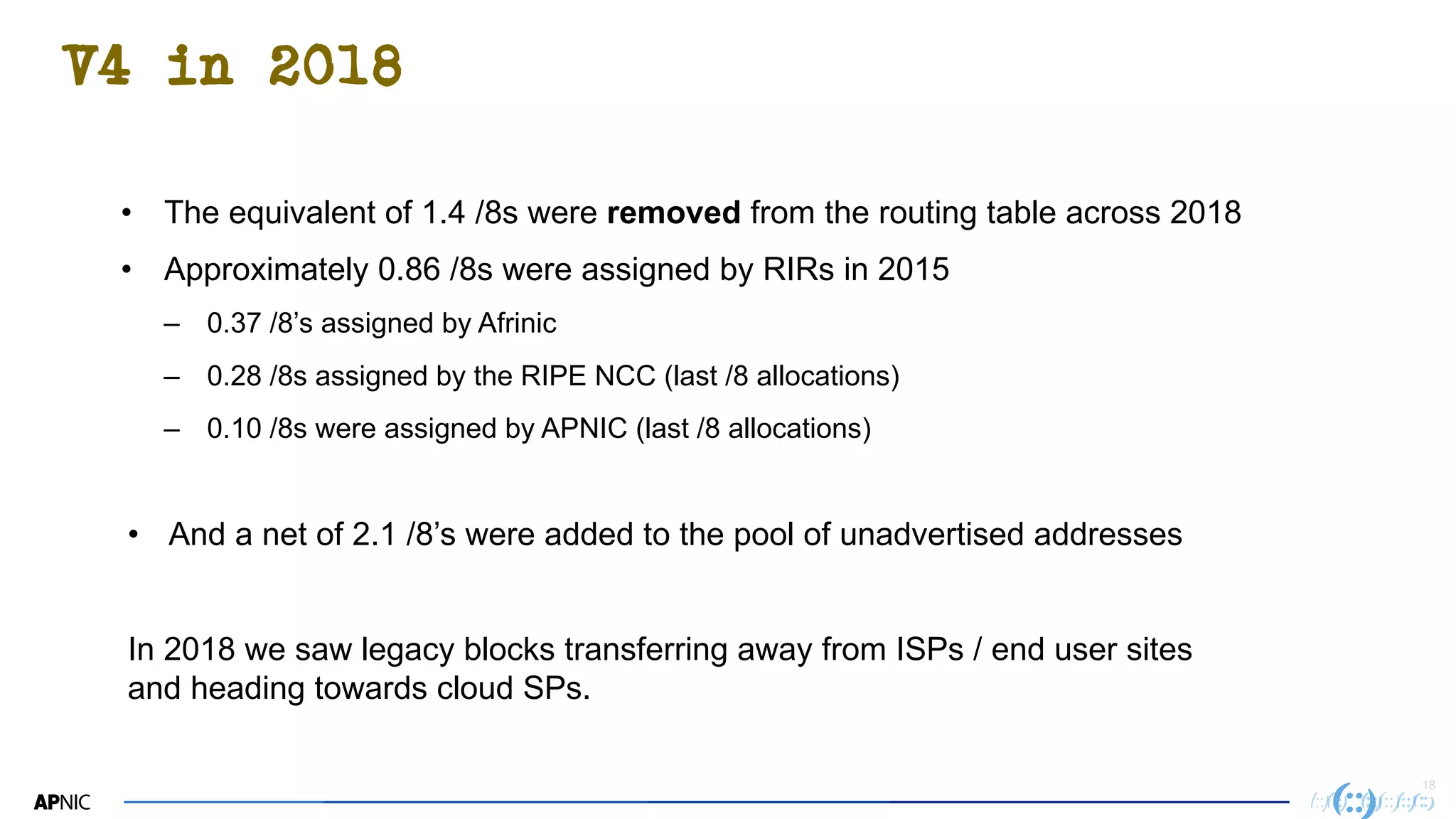
V4 in 2018
• The equivalent of 1.4 /8s were removed from the routing table across 2018
• Approximately 0.86 /8s were assigned by RIRs in 2015
– 0.37 /8’s assigned by Afrinic
– 0.28 /8s assigned by the RIPE NCC (last /8 allocations)
– 0.10 /8s were assigned by APNIC (last /8 allocations)
• And a net of 2.1 /8’s were added to the pool of unadvertised addresses
In 2018 we saw legacy blocks transferring away from ISPs / end user sites
and heading towards cloud SPs.
1919
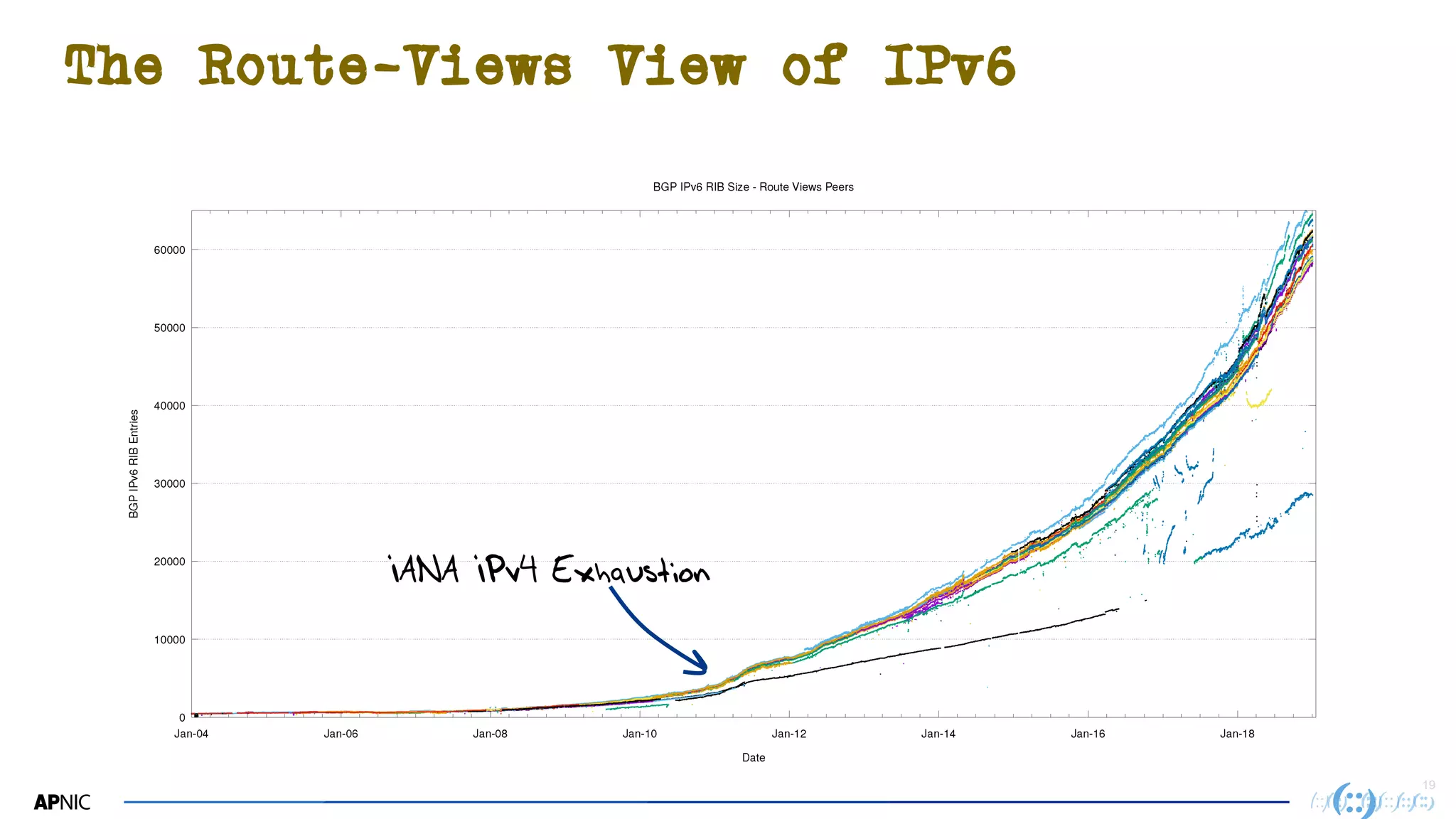
The Route-Views View of IPv6
IANA IPv4 Exhaustion
2020
2017-2018 in Detail
2121
Routing Indicators for IPv6
Routing prefixes – growing by
some 15,000 prefixes per year
AS Numbers– growing by some
2,000 ASNs per year (which is
60% the V4 growth)
2222
Routing Indicators for IPv6
More Specifics now take up more
than one third of the routing
table
The average size of a routing
advertisement is getting smaller
2323
Routing Indicators for IPv6
Advertised Address span is
growing at an exponential rate
The “shape” of inter-AS
interconnection in IPv6 is rising
slightly. Local connections appear
to be replacing overlay trunk
transits
2424
AS Adjacencies (AS131072)
13,095 out of 16,465 ASNs have 1 or 2 AS Adjacencies (79%)
573 ASNs have 10 or more adjacencies
2 ASNs have >1,000 adjacencies
4,295 AS6939 HURRICANE - Hurricane Electric, Inc., US
1,049 AS3356 LEVEL3 - Level 3 Communications, Inc., US
749 AS174 COGENT-174 - Cogent Communications, US
719 AS2915 NTT America, US
632 AS1299 Telia Carrier, SE
2525
V6 in 2018
• Overall IPv6 Internet growth in terms of BGP is still
increasing, and is currently at some 15,000 route entries
p.a.
2626
What to expect
2727
BGP Size Projections
How quickly is the routing space growing?
What are the projections of future BGP FIB size?
2828
V4 - Daily Growth Rates
Growth in the V4 network appears to be constant at a long term average of 140
additional routes per day, or some 52,000 additional routes per year
2929
V4 BGP Table Size Predictions
Jan 2017 646,000
2018 699,000
2019 755,000
2020 807,000
2021 859,000
2022 911,000
2023 963,000
2024 1,015,000
3030
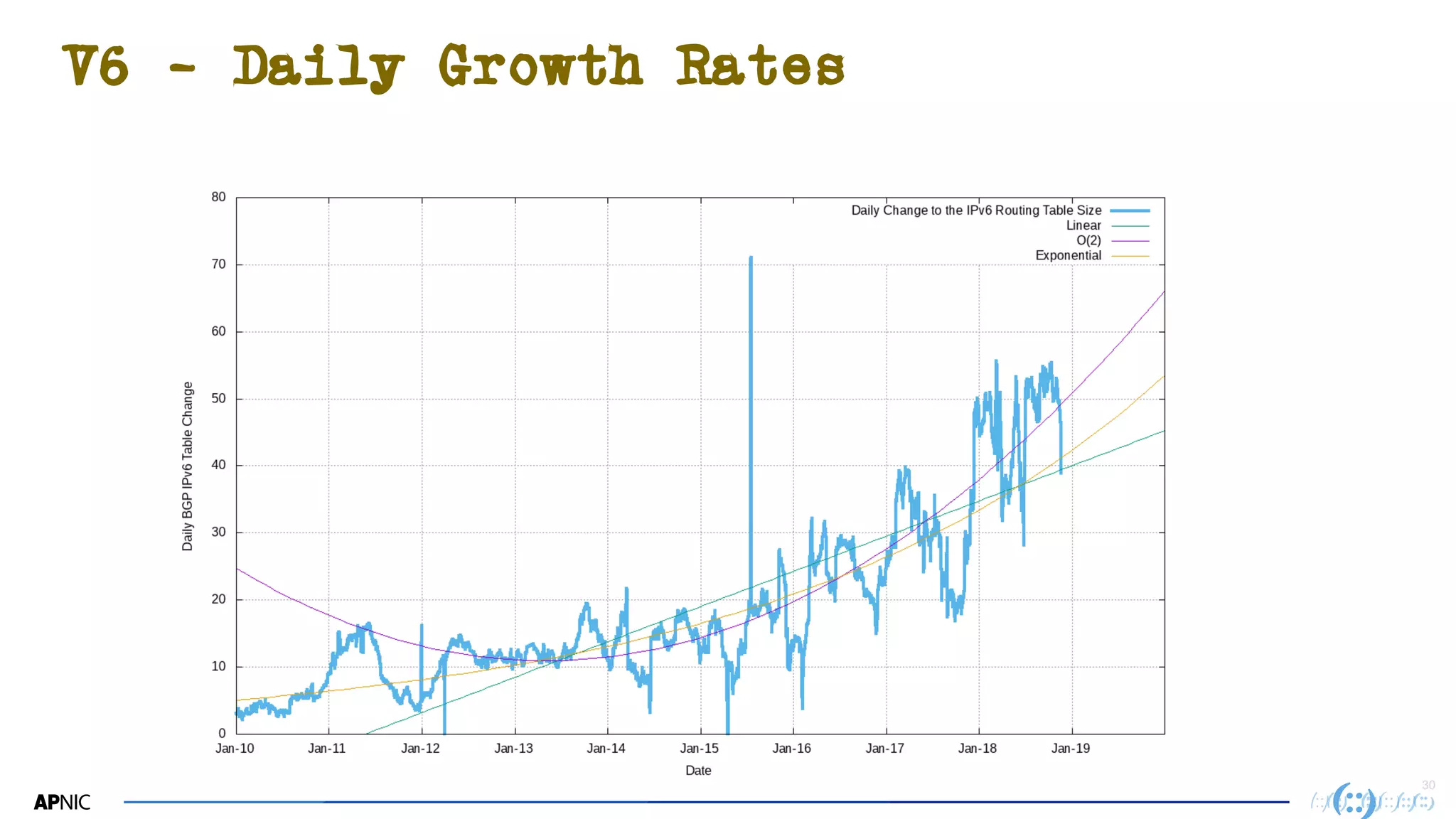
V6 - Daily Growth Rates
3131
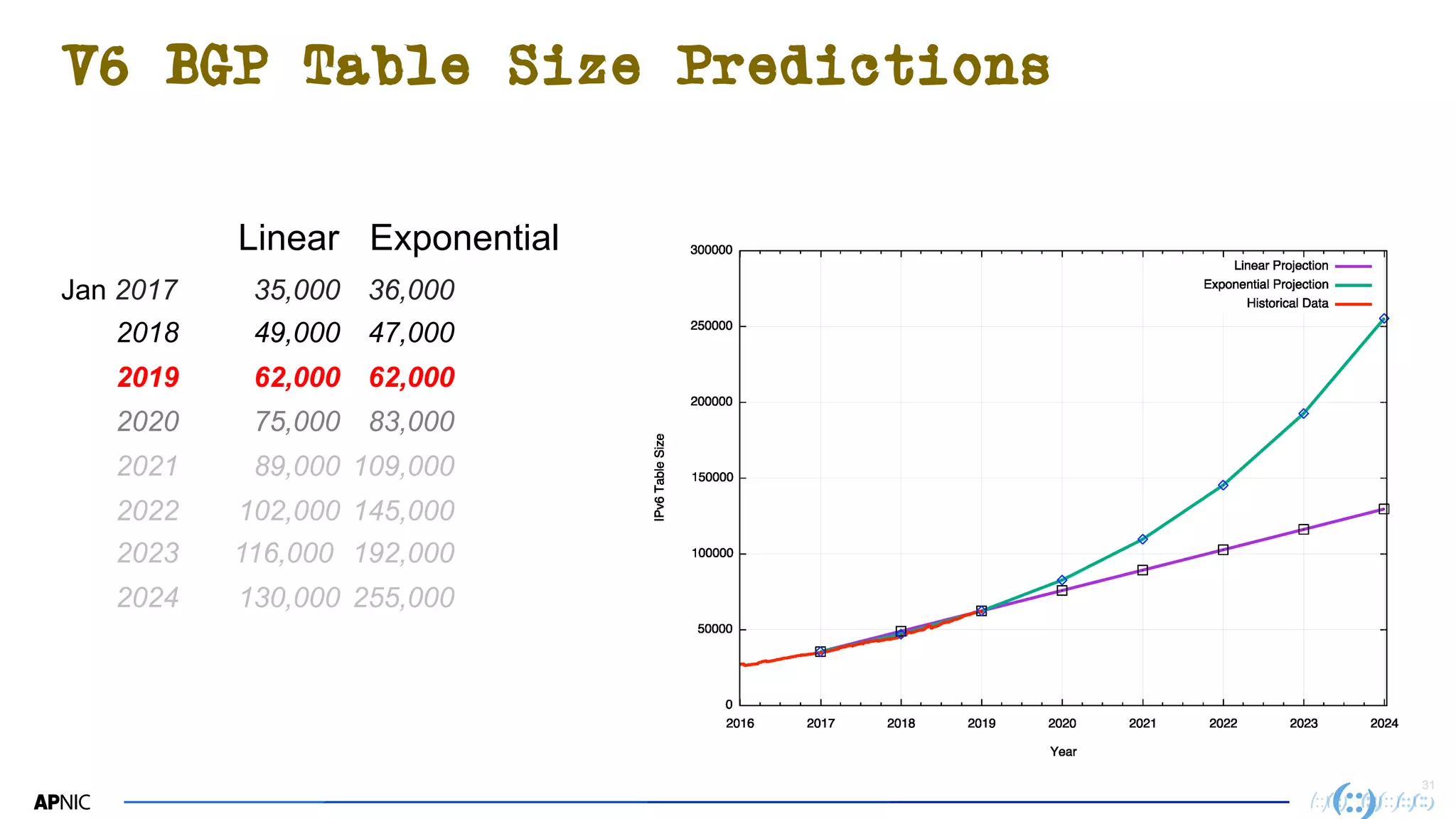
V6 BGP Table Size Predictions
Jan 2017 35,000 36,000
2018 49,000 47,000
2019 62,000 62,000
2020 75,000 83,000
2021 89,000 109,000
2022 102,000 145,000
2023 116,000 192,000
2024 130,000 255,000
Linear Exponential
3232
BGP Table Growth
The absolute size of the IPv6 routing table is growing much faster
than the IPv4 table
IPv6 will require the same memory size in around 5 years time,
given that each IPv6 entry is 4 times the memory size of an IPv4
entry
As long as we are prepared to live within the technical constraints
of the current routing paradigm, the Internet’s use of BGP will
continue to be viable for some time yet
3333
BGP Updates
• What about the level of updates in BGP?
3434
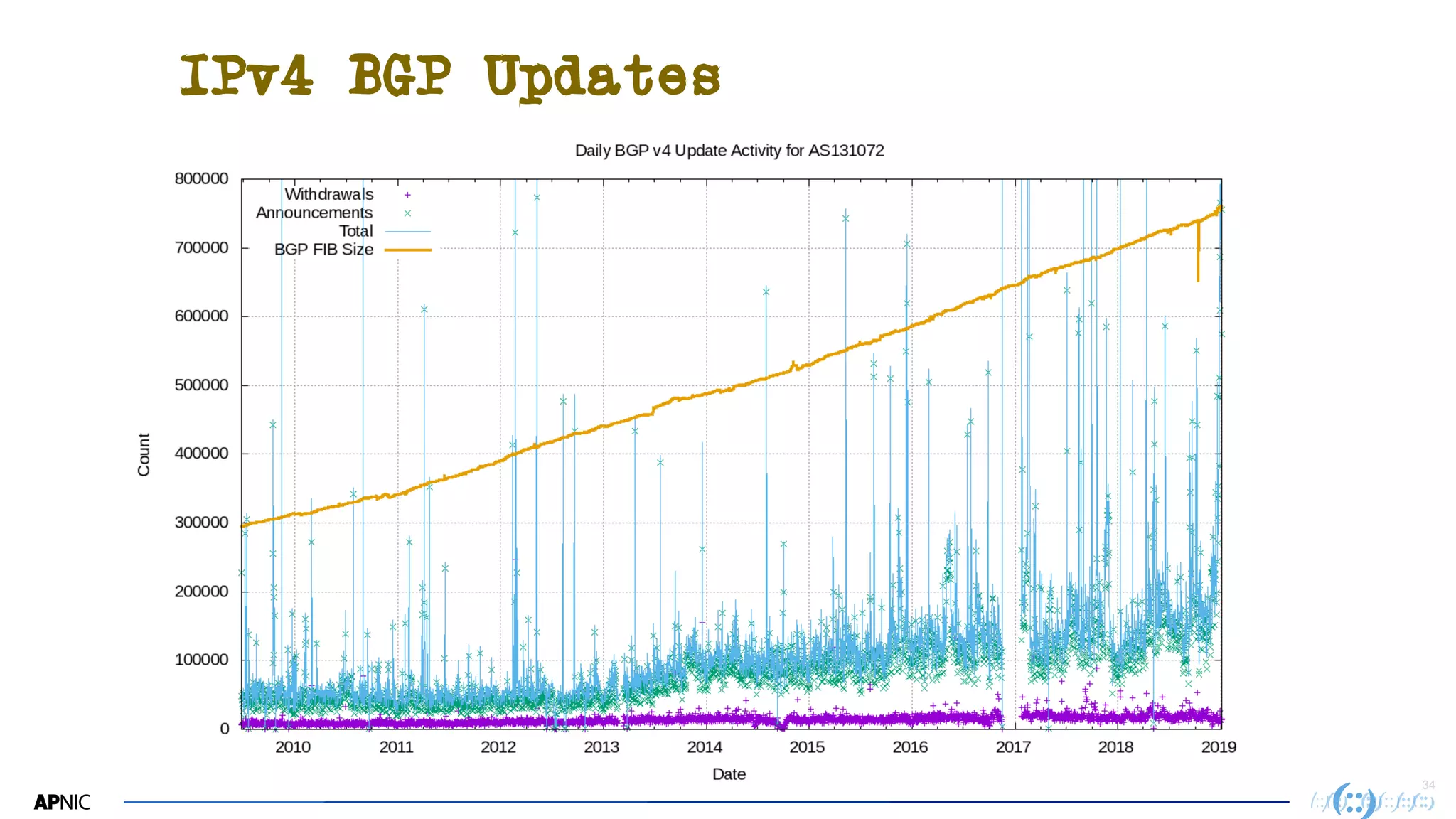
IPv4 BGP Updates
3535
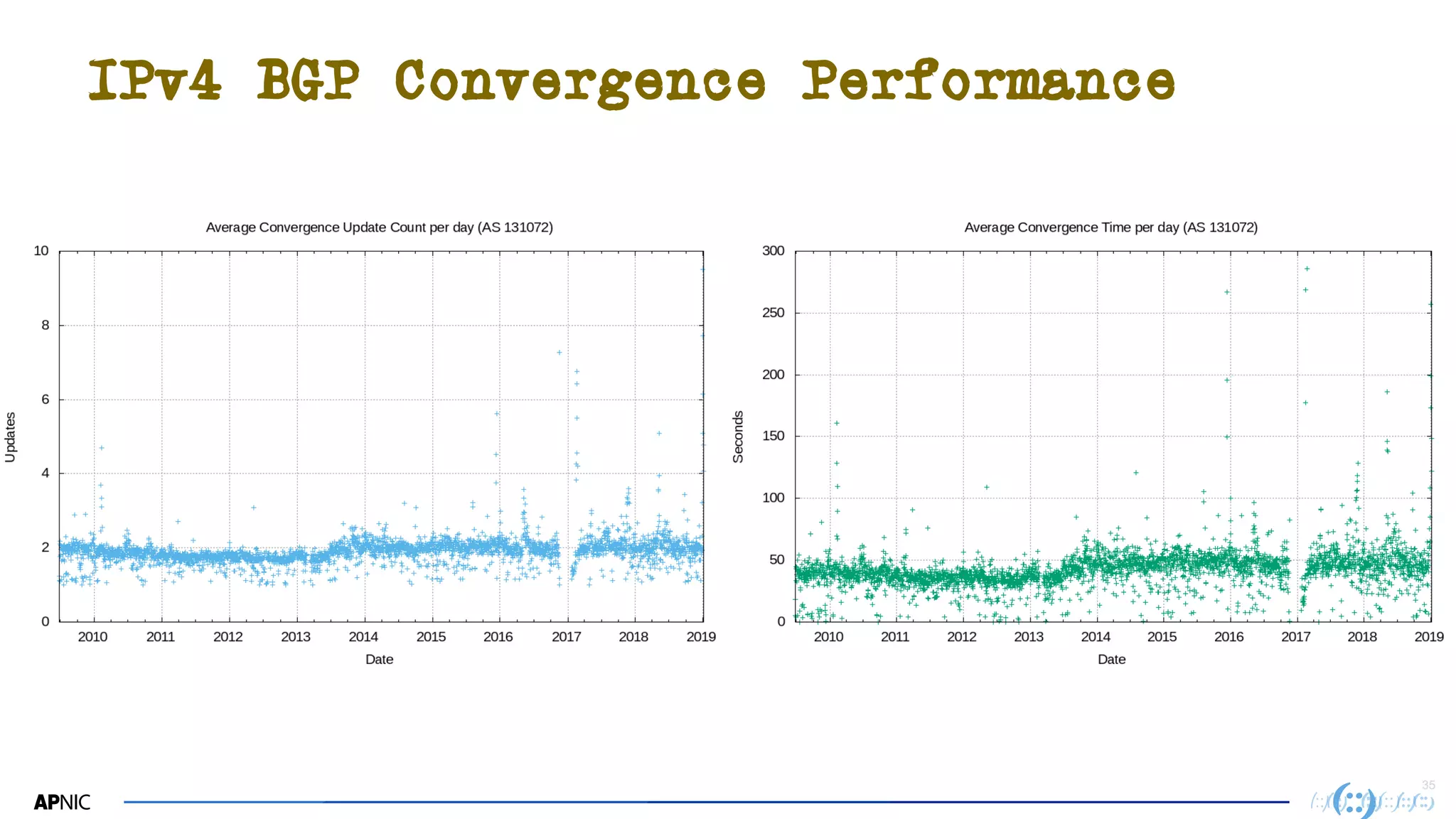
IPv4 BGP Convergence Performance
3636
Updates in IPv4 BGP
Still no great level of concern …
• The number of updates per instability event and the time to
converge has been relatively constant
• Likely contributors to this outcome are the damping effect of
widespread use of the MRAI interval by eBGP speakers, and the
compressed topology factor, as seen in the relatively constant
AS Path Length
3737
V6 BGP Updates
3838
V6 Convergence Performance
3939
Routing Futures
• There is little in the way of scaling pressure from BGP as a routing
protocol – the relatively compressed topology and stability of the
infrastructure links tend to ensure that BGP remains effective in routing
the internet
• The issues of FIB size, line speeds and equipment cost of line cards
represent a more significant issue for hardware suppliers – we can
expect cheaper line cards to to use far smaller LRU cache local FIBs in
the high speed switches and push less used routes to a slower / cheaper
lookup path. This approach may also become common in very high
speed line cards
4040
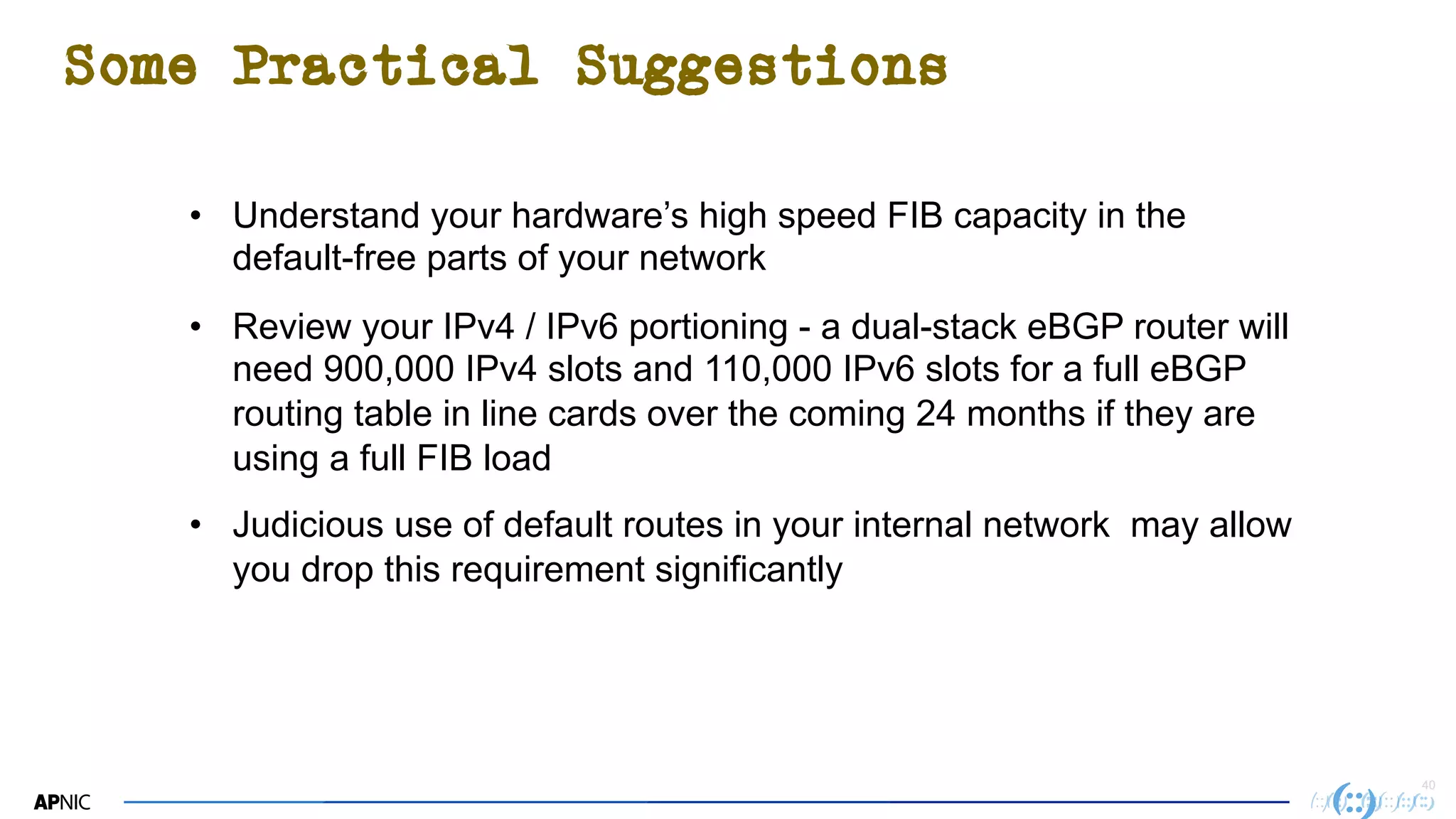
Some Practical Suggestions
• Understand your hardware’s high speed FIB capacity in the
default-free parts of your network
• Review your IPv4 / IPv6 portioning - a dual-stack eBGP router will
need 900,000 IPv4 slots and 110,000 IPv6 slots for a full eBGP
routing table in line cards over the coming 24 months if they are
using a full FIB load
• Judicious use of default routes in your internal network may allow
you drop this requirement significantly
41
That’s it!
Questions?

RIPE 78: Routing in 2018

  • 1.
    1 Routing in 2018 GeoffHuston Chief Scientist, APNIC
  • 2.
    22 Through the RoutingLens … There are very few ways to assemble a single view of the entire Internet The lens of routing is one of the ways in which information relating to the entire reachable Internet is bought together Even so, its not a perfect lens, but it can provide some useful insights about the entire scope of the Internet
  • 3.
    33 1994: Introduction ofCIDR 2001: The Great Internet Boom and Bust 2005: Consumer Market 2011: Address Exhaustion 25 Years of Routing the Internet This is a view pulled together from each of the routing peers of Route-Views
  • 4.
  • 5.
    55 2016-2018 in detail averagegrowth trend Route Views Peers RIS Peers
  • 6.
    66 Routing Indicators forIPv4 Routing prefixes – growing by some 52,000 prefixes per year AS Numbers– growing by some 3,400 prefixes per year
  • 7.
    77 Routing Indicators forIPv4 More Specifics are still taking up slightly more than one half of the routing table But the average size of a routing advertisement continues to shrink
  • 8.
    88 Routing Indicators forIPv4 Address Exhaustion is now visible in the extent of advertised address space The “shape” of inter-AS interconnection appears to be relatively steady
  • 9.
    99 AS Adjacencies (AS131072) 4,144AS6939 HURRICANE - Hurricane Electric, Inc., US 4.032 AS3356 LEVEL3 - Level 3 Communications, Inc., US 3,702 AS174 COGENT-174 - Cogent Communications, US 1,724 AS6461 ZAYO Bandwidth, US 1,646 AS7018 ATT-INTERNET4 - AT&T Services, Inc., US 1,618 AS3549 LVLT – Level 3 Parent, US 1,428 AS3257 GTT-Backbone, DE 1,377 AS2914 NTT America, US 1,208 AS209 CENTURYLINK, US 957 AS701 Verizon Business, US 51,613 out of 63,080 ASNs have 1 or 2 AS Adjacencies (82%) 1,803 ASNs have 10 or more adjacencies 9 ASNs have >1,000 adjacencies Most networks are stub AS’s A small number of major connectors
  • 10.
    1010 What happened in2018 in V4? Routing Business as usual – despite IPv4 address exhaustion! – From the look of the growth plots, its business as usual, despite the increasing pressures on IPv4 address availability – The number of entries in the IPv4 default-free zone reached 750,000 by the end of 2018 – The pace of growth of the routing table is still relatively constant at ~52,000 new entries and 3,400 new AS’s per year • IPv4 address exhaustion is not changing this! • Instead, we appear to be advertising shorter prefixes into the routing system
  • 11.
    1111 What about IPv4Address Exhaustion? ARIN – no free pool left AFRINIC – May 2020 LACNIC – November 2019 APNIC – November 2020 RIPE NCC – January 2020 RIR Address Pool runout projections (as of April 2019):
  • 12.
    1212 Post-Exhaustion Routing Growth •What’s driving this post-exhaustion growth? – Transfers? – Last /8 policies in RIPE and APNIC? – Leasing and address recovery?
  • 13.
    1313 Advertised Address “Age” 80%of all new addresses announced in 2010 were allocated or assigned within the past 12 months 2% of all new addresses announced in 2010 were >= 20 years ‘old’ (legacy) 2010
  • 14.
    1414 Advertised Address “Age” 20%of all new addresses announced in 2018 were allocated or assigned within the past 12 months 48% of all new addresses announced in 2018 were >= 20 years ‘old’ (legacy) 2018
  • 15.
    1515 2000 – 2018:IPv4 Advertised vs Unadvertised
  • 16.
    1616 2000 – 2018:Unadvertised Addresses Total volume of “reclaimed” addresses
  • 17.
    1717 2018: Assigned vsRecovered Change in Advertised Addresses Change in the Unadvertised Address Pool RIR Allocations “draw down”
  • 18.
    1818 V4 in 2018 •The equivalent of 1.4 /8s were removed from the routing table across 2018 • Approximately 0.86 /8s were assigned by RIRs in 2015 – 0.37 /8’s assigned by Afrinic – 0.28 /8s assigned by the RIPE NCC (last /8 allocations) – 0.10 /8s were assigned by APNIC (last /8 allocations) • And a net of 2.1 /8’s were added to the pool of unadvertised addresses In 2018 we saw legacy blocks transferring away from ISPs / end user sites and heading towards cloud SPs.
  • 19.
    1919 The Route-Views Viewof IPv6 IANA IPv4 Exhaustion
  • 20.
  • 21.
    2121 Routing Indicators forIPv6 Routing prefixes – growing by some 15,000 prefixes per year AS Numbers– growing by some 2,000 ASNs per year (which is 60% the V4 growth)
  • 22.
    2222 Routing Indicators forIPv6 More Specifics now take up more than one third of the routing table The average size of a routing advertisement is getting smaller
  • 23.
    2323 Routing Indicators forIPv6 Advertised Address span is growing at an exponential rate The “shape” of inter-AS interconnection in IPv6 is rising slightly. Local connections appear to be replacing overlay trunk transits
  • 24.
    2424 AS Adjacencies (AS131072) 13,095out of 16,465 ASNs have 1 or 2 AS Adjacencies (79%) 573 ASNs have 10 or more adjacencies 2 ASNs have >1,000 adjacencies 4,295 AS6939 HURRICANE - Hurricane Electric, Inc., US 1,049 AS3356 LEVEL3 - Level 3 Communications, Inc., US 749 AS174 COGENT-174 - Cogent Communications, US 719 AS2915 NTT America, US 632 AS1299 Telia Carrier, SE
  • 25.
    2525 V6 in 2018 •Overall IPv6 Internet growth in terms of BGP is still increasing, and is currently at some 15,000 route entries p.a.
  • 26.
  • 27.
    2727 BGP Size Projections Howquickly is the routing space growing? What are the projections of future BGP FIB size?
  • 28.
    2828 V4 - DailyGrowth Rates Growth in the V4 network appears to be constant at a long term average of 140 additional routes per day, or some 52,000 additional routes per year
  • 29.
    2929 V4 BGP TableSize Predictions Jan 2017 646,000 2018 699,000 2019 755,000 2020 807,000 2021 859,000 2022 911,000 2023 963,000 2024 1,015,000
  • 30.
    3030 V6 - DailyGrowth Rates
  • 31.
    3131 V6 BGP TableSize Predictions Jan 2017 35,000 36,000 2018 49,000 47,000 2019 62,000 62,000 2020 75,000 83,000 2021 89,000 109,000 2022 102,000 145,000 2023 116,000 192,000 2024 130,000 255,000 Linear Exponential
  • 32.
    3232 BGP Table Growth Theabsolute size of the IPv6 routing table is growing much faster than the IPv4 table IPv6 will require the same memory size in around 5 years time, given that each IPv6 entry is 4 times the memory size of an IPv4 entry As long as we are prepared to live within the technical constraints of the current routing paradigm, the Internet’s use of BGP will continue to be viable for some time yet
  • 33.
    3333 BGP Updates • Whatabout the level of updates in BGP?
  • 34.
  • 35.
  • 36.
    3636 Updates in IPv4BGP Still no great level of concern … • The number of updates per instability event and the time to converge has been relatively constant • Likely contributors to this outcome are the damping effect of widespread use of the MRAI interval by eBGP speakers, and the compressed topology factor, as seen in the relatively constant AS Path Length
  • 37.
  • 38.
  • 39.
    3939 Routing Futures • Thereis little in the way of scaling pressure from BGP as a routing protocol – the relatively compressed topology and stability of the infrastructure links tend to ensure that BGP remains effective in routing the internet • The issues of FIB size, line speeds and equipment cost of line cards represent a more significant issue for hardware suppliers – we can expect cheaper line cards to to use far smaller LRU cache local FIBs in the high speed switches and push less used routes to a slower / cheaper lookup path. This approach may also become common in very high speed line cards
  • 40.
    4040 Some Practical Suggestions •Understand your hardware’s high speed FIB capacity in the default-free parts of your network • Review your IPv4 / IPv6 portioning - a dual-stack eBGP router will need 900,000 IPv4 slots and 110,000 IPv6 slots for a full eBGP routing table in line cards over the coming 24 months if they are using a full FIB load • Judicious use of default routes in your internal network may allow you drop this requirement significantly
  • 41.