WHAT IS MINORITY
A group numerically inferior to the rest of the population of a State, in a non-
dominant position, whose members - being nationals of the State - possess
ethnic, religious or linguistic characteristics differing from those of the rest of
the population and show, if only implicitly, a sense of solidarity, directed
towards preserving their culture, traditions, religion or language.
CHARACTERISTICS OF MINORITIES
1. Physical and cultural traits
2. Unequal treatment
3. Ascribed status
4. Solidarity
5. In-group marriage
6. Subordination.
WHAT ARE MINORITY RIGHTS
Minority rights are individual and collective rights through which people
belonging to national minority groups are entitled to enjoy their own culture, to
use their own language, to profess and practice their own religion, to have the
right to freedom of expression and assembly, to have equal opportunities to
education and employment, and to enjoy full participation in public life.
MINORITY RIGHTS IN INTERNATIONAL
CHARTERS AND INTERNATIONAL LAW
United Nations Declaration on the Rights of Persons Belonging to National or Ethnic,
Religious and Linguistic Minorities
European Charter for Regional or Minority Languages and the Framework Convention for
the Protection of National Minorities
Article 27 of the International Covenant on Civil and Political Rights (ICCPR), adopted in 1966, is
the only universal legal binding provision on the rights of minorities, providing that ‘[i]n those
States in which ethnic, religious or linguistic minorities exist, persons belonging to such minorities
shall not be denied the right, in community with the other members of their group, to enjoy their
own culture, to profess and practise their own religion, or to use their own language’.
IMPORTANCE OF MINORITY RIGHTS
• Balanced enjoyment of human rights in a society
• Promotion and protection of identities, cultures, religions, and languages
• Ensure acceptance towards pluralism, and diversity
• An exercise of tolerance and intercultural dialogues
• Cause of achieving a durable peace
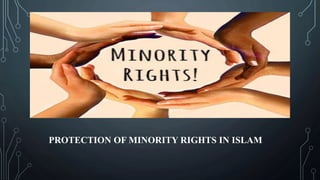
PROTECTION OF MINORITY RIGHTS IN ISLAM
CONTEXT OF QURAN
Quran (18:29)
“The truth is from your Lord, so whoever wills – let him believe; and whoever wills – let him
disbelieve.” “God does not forbid you from doing good and being just to those who have
neither fought you over your faith nor evicted you from your homes...”
Quran (9:6):
“And if anyone of the pagans seeketh asylum (O Mohammad), then give him asylum… and
afterwards convey him to his place of safety…”
Principle of Law
“There is no compulsion in religion” It
commands the prophet of Islam to tell the non-
believers: ―unto you your religion, and unto
me my religion.
Treaty of Hudaibiya
Monks of Najran
Treaty of Jerusalem
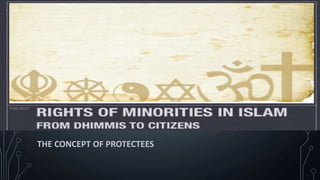
THE CONCEPT OF PROTECTEES
RIGHTS OF MINORITIES IN ISLAM
• Protection of life
• Protection of assets and property
• Equality before the law
• Political representation
• Economic protection
• Religious freedom
• Right of honor
• Availability of basic facilities
MINORITY RIGHTS IN PAKISTAN
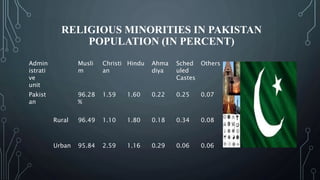
RELIGIOUS MINORITIES IN PAKISTAN
POPULATION (IN PERCENT)
Admin
istrati
ve
unit
Musli
m
Christi
an
Hindu Ahma
diya
Sched
uled
Castes
Others
Pakist
an
96.28
%
1.59 1.60 0.22 0.25 0.07
Rural 96.49 1.10 1.80 0.18 0.34 0.08
Urban 95.84 2.59 1.16 0.29 0.06 0.06
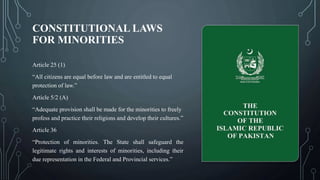
CONSTITUTIONAL LAWS
FOR MINORITIES
Article 25 (1)
“All citizens are equal before law and are entitled to equal
protection of law.”
Article 5/2 (A)
“Adequate provision shall be made for the minorities to freely
profess and practice their religions and develop their cultures.”
Article 36
“Protection of minorities. The State shall safeguard the
legitimate rights and interests of minorities, including their
due representation in the Federal and Provincial services.”
DISCRIMINATION UNDER THE CONSTITUTION
• Under General Zia Ul Haq’s rule (President from 1977 to 1988), the government
spared no efforts to bring Pakistan’s civil and criminal laws in line with Shari’a law,
thus creating legislation that limits the freedoms of non-Muslims.
• In 1979 the Hudood ordinances were adopted.
• In 1980, religiously-mandated punishments (which include hanging, amputations,
and other corporal punishments) were assigned to various violations under Shari’a
law, including drinking alcoholic beverages, theft, prostitution, adultery, and bearing
false witness.
• In 1982 and 1986, the blasphemy laws were adopted.
• in 1984 the Law of Evidence (Qanun-e-Shahadat) was adopted, which discriminates
against both non-Muslims and women with regards to evidence presented in court.
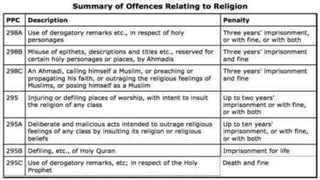
BLASPHEMY LAWS
• Although section 295-A of the PPC criminalizes the “deliberate and
malicious intention of outraging the religious feelings of “any” class of the
citizens of Pakistan,” the other offenses relating to religion outlined in the
PPC specifically protect Islam and Muslims, thus limiting the freedom of
expression of non-Muslims:
• Section 295-B states that “whoever willfully defiles, damages or desecrates a
copy of the Holy Qur’an or of an extract therefrom or uses it in any
derogatory manner or for any unlawful purpose shall be punishable with
imprisonment for life”.
• Section 295-C provides that “whoever by words, either spoken or written, or
by visible representation, or by any imputation, innuendo, or insinuation,
directly or indirectly, defiles the sacred name of the Holy Prophet (peace be
upon him) shall be punished with death or imprisonment for life, and shall
also be liable to fine.”
• In 1990, the Federal Shari’a Court (FSC) ruled that “the penalty for contempt
of the Holy Prophet (...) is death and nothing else,” and on 1 May 1991, the
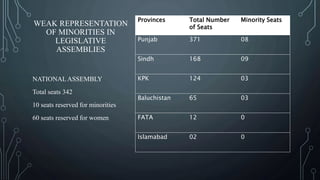
WEAK REPRESENTATION
OF MINORITIES IN
LEGISLATIVE
ASSEMBLIES
Provinces Total Number
of Seats
Minority Seats
Punjab 371 08
Sindh 168 09
KPK 124 03
Baluchistan 65 03
FATA 12 0
Islamabad 02 0
NATIONALASSEMBLY
Total seats 342
10 seats reserved for minorities
60 seats reserved for women
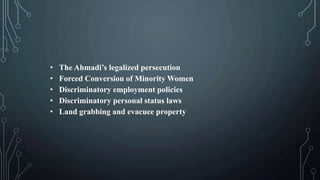
• The Ahmadi’s legalized persecution
• Forced Conversion of Minority Women
• Discriminatory employment policies
• Discriminatory personal status laws
• Land grabbing and evacuee property
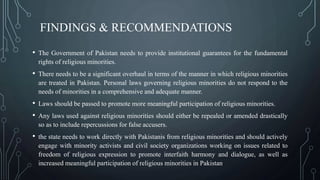
FINDINGS & RECOMMENDATIONS
• The Government of Pakistan needs to provide institutional guarantees for the fundamental
rights of religious minorities.
• There needs to be a significant overhaul in terms of the manner in which religious minorities
are treated in Pakistan. Personal laws governing religious minorities do not respond to the
needs of minorities in a comprehensive and adequate manner.
• Laws should be passed to promote more meaningful participation of religious minorities.
• Any laws used against religious minorities should either be repealed or amended drastically
so as to include repercussions for false accusers.
• the state needs to work directly with Pakistanis from religious minorities and should actively
engage with minority activists and civil society organizations working on issues related to
freedom of religious expression to promote interfaith harmony and dialogue, as well as
increased meaningful participation of religious minorities in Pakistan.
CO
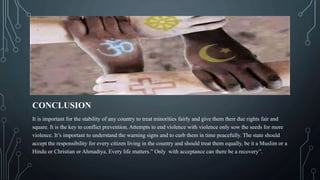
CONCLUSION
It is important for the stability of any country to treat minorities fairly and give them their due rights fair and
square. It is the key to conflict prevention. Attempts to end violence with violence only sow the seeds for more
violence. It’s important to understand the warning signs and to curb them in time peacefully. The state should
accept the responsibility for every citizen living in the country and should treat them equally, be it a Muslim or a
Hindu or Christian or Ahmadiya. Every life matters.” Only with acceptance can there be a recovery”.
THANK YOU

Human right problems

  • 2.
    WHAT IS MINORITY Agroup numerically inferior to the rest of the population of a State, in a non- dominant position, whose members - being nationals of the State - possess ethnic, religious or linguistic characteristics differing from those of the rest of the population and show, if only implicitly, a sense of solidarity, directed towards preserving their culture, traditions, religion or language.
  • 4.
    CHARACTERISTICS OF MINORITIES 1.Physical and cultural traits 2. Unequal treatment 3. Ascribed status 4. Solidarity 5. In-group marriage 6. Subordination.
  • 5.
    WHAT ARE MINORITYRIGHTS Minority rights are individual and collective rights through which people belonging to national minority groups are entitled to enjoy their own culture, to use their own language, to profess and practice their own religion, to have the right to freedom of expression and assembly, to have equal opportunities to education and employment, and to enjoy full participation in public life.
  • 6.
    MINORITY RIGHTS ININTERNATIONAL CHARTERS AND INTERNATIONAL LAW United Nations Declaration on the Rights of Persons Belonging to National or Ethnic, Religious and Linguistic Minorities European Charter for Regional or Minority Languages and the Framework Convention for the Protection of National Minorities Article 27 of the International Covenant on Civil and Political Rights (ICCPR), adopted in 1966, is the only universal legal binding provision on the rights of minorities, providing that ‘[i]n those States in which ethnic, religious or linguistic minorities exist, persons belonging to such minorities shall not be denied the right, in community with the other members of their group, to enjoy their own culture, to profess and practise their own religion, or to use their own language’.
  • 7.
    IMPORTANCE OF MINORITYRIGHTS • Balanced enjoyment of human rights in a society • Promotion and protection of identities, cultures, religions, and languages • Ensure acceptance towards pluralism, and diversity • An exercise of tolerance and intercultural dialogues • Cause of achieving a durable peace
  • 8.
    PROTECTION OF MINORITYRIGHTS IN ISLAM
  • 9.
    CONTEXT OF QURAN Quran(18:29) “The truth is from your Lord, so whoever wills – let him believe; and whoever wills – let him disbelieve.” “God does not forbid you from doing good and being just to those who have neither fought you over your faith nor evicted you from your homes...” Quran (9:6): “And if anyone of the pagans seeketh asylum (O Mohammad), then give him asylum… and afterwards convey him to his place of safety…”
  • 10.
    Principle of Law “Thereis no compulsion in religion” It commands the prophet of Islam to tell the non- believers: ―unto you your religion, and unto me my religion. Treaty of Hudaibiya Monks of Najran Treaty of Jerusalem
  • 11.
    THE CONCEPT OFPROTECTEES
  • 12.
    RIGHTS OF MINORITIESIN ISLAM • Protection of life • Protection of assets and property • Equality before the law • Political representation • Economic protection • Religious freedom • Right of honor • Availability of basic facilities
  • 13.
  • 15.
    RELIGIOUS MINORITIES INPAKISTAN POPULATION (IN PERCENT) Admin istrati ve unit Musli m Christi an Hindu Ahma diya Sched uled Castes Others Pakist an 96.28 % 1.59 1.60 0.22 0.25 0.07 Rural 96.49 1.10 1.80 0.18 0.34 0.08 Urban 95.84 2.59 1.16 0.29 0.06 0.06
  • 16.
    CONSTITUTIONAL LAWS FOR MINORITIES Article25 (1) “All citizens are equal before law and are entitled to equal protection of law.” Article 5/2 (A) “Adequate provision shall be made for the minorities to freely profess and practice their religions and develop their cultures.” Article 36 “Protection of minorities. The State shall safeguard the legitimate rights and interests of minorities, including their due representation in the Federal and Provincial services.”
  • 18.
    DISCRIMINATION UNDER THECONSTITUTION • Under General Zia Ul Haq’s rule (President from 1977 to 1988), the government spared no efforts to bring Pakistan’s civil and criminal laws in line with Shari’a law, thus creating legislation that limits the freedoms of non-Muslims. • In 1979 the Hudood ordinances were adopted. • In 1980, religiously-mandated punishments (which include hanging, amputations, and other corporal punishments) were assigned to various violations under Shari’a law, including drinking alcoholic beverages, theft, prostitution, adultery, and bearing false witness. • In 1982 and 1986, the blasphemy laws were adopted. • in 1984 the Law of Evidence (Qanun-e-Shahadat) was adopted, which discriminates against both non-Muslims and women with regards to evidence presented in court.
  • 19.
    BLASPHEMY LAWS • Althoughsection 295-A of the PPC criminalizes the “deliberate and malicious intention of outraging the religious feelings of “any” class of the citizens of Pakistan,” the other offenses relating to religion outlined in the PPC specifically protect Islam and Muslims, thus limiting the freedom of expression of non-Muslims: • Section 295-B states that “whoever willfully defiles, damages or desecrates a copy of the Holy Qur’an or of an extract therefrom or uses it in any derogatory manner or for any unlawful purpose shall be punishable with imprisonment for life”. • Section 295-C provides that “whoever by words, either spoken or written, or by visible representation, or by any imputation, innuendo, or insinuation, directly or indirectly, defiles the sacred name of the Holy Prophet (peace be upon him) shall be punished with death or imprisonment for life, and shall also be liable to fine.” • In 1990, the Federal Shari’a Court (FSC) ruled that “the penalty for contempt of the Holy Prophet (...) is death and nothing else,” and on 1 May 1991, the
  • 22.
    WEAK REPRESENTATION OF MINORITIESIN LEGISLATIVE ASSEMBLIES Provinces Total Number of Seats Minority Seats Punjab 371 08 Sindh 168 09 KPK 124 03 Baluchistan 65 03 FATA 12 0 Islamabad 02 0 NATIONALASSEMBLY Total seats 342 10 seats reserved for minorities 60 seats reserved for women
  • 23.
    • The Ahmadi’slegalized persecution • Forced Conversion of Minority Women • Discriminatory employment policies • Discriminatory personal status laws • Land grabbing and evacuee property
  • 24.
    FINDINGS & RECOMMENDATIONS •The Government of Pakistan needs to provide institutional guarantees for the fundamental rights of religious minorities. • There needs to be a significant overhaul in terms of the manner in which religious minorities are treated in Pakistan. Personal laws governing religious minorities do not respond to the needs of minorities in a comprehensive and adequate manner. • Laws should be passed to promote more meaningful participation of religious minorities. • Any laws used against religious minorities should either be repealed or amended drastically so as to include repercussions for false accusers. • the state needs to work directly with Pakistanis from religious minorities and should actively engage with minority activists and civil society organizations working on issues related to freedom of religious expression to promote interfaith harmony and dialogue, as well as increased meaningful participation of religious minorities in Pakistan.
  • 25.
    CO CONCLUSION It is importantfor the stability of any country to treat minorities fairly and give them their due rights fair and square. It is the key to conflict prevention. Attempts to end violence with violence only sow the seeds for more violence. It’s important to understand the warning signs and to curb them in time peacefully. The state should accept the responsibility for every citizen living in the country and should treat them equally, be it a Muslim or a Hindu or Christian or Ahmadiya. Every life matters.” Only with acceptance can there be a recovery”.
  • 26.