Acoustic Rhinometry
Overview
AHMED ELWALI
1
Briefly!
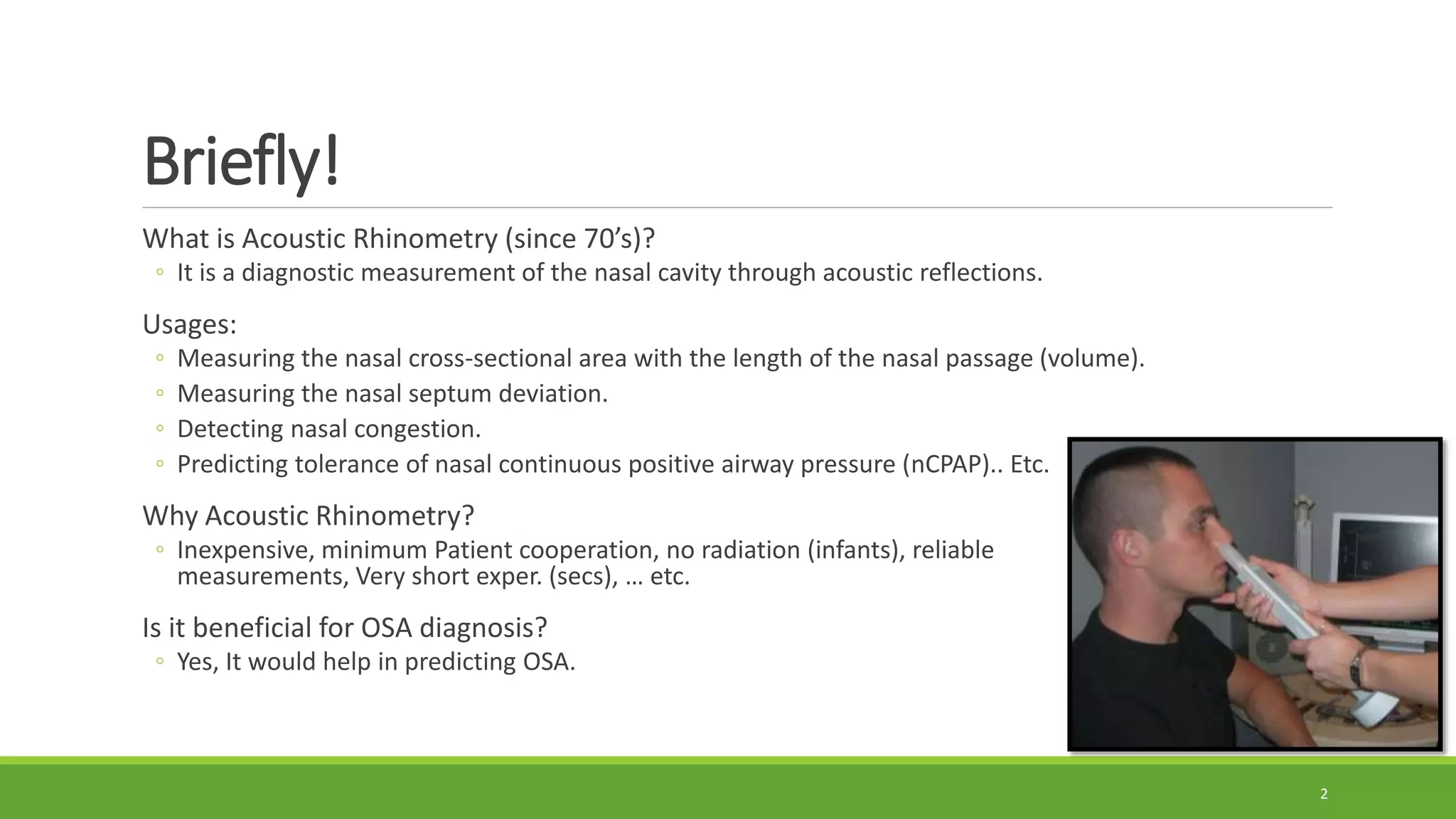
What is Acoustic Rhinometry (since 70’s)?
◦ It is a diagnostic measurement of the nasal cavity through acoustic reflections.
Usages:
◦ Measuring the nasal cross-sectional area with the length of the nasal passage (volume).
◦ Measuring the nasal septum deviation.
◦ Detecting nasal congestion.
◦ Predicting tolerance of nasal continuous positive airway pressure (nCPAP).. Etc.
Why Acoustic Rhinometry?
◦ Inexpensive, minimum Patient cooperation, no radiation (infants), reliable
measurements, Very short exper. (secs), … etc.
Is it beneficial for OSA diagnosis?
◦ Yes, It would help in predicting OSA.
2
Transition from Lumped system to
Transmission line system
“When the wavelength of the applied excitation becomes
comparable to any linear dimension of a tube along which
pressure waves travel, it is no longer appropriate to model
the system with lumped parameters.”
Different View of the nasal cavity!
3
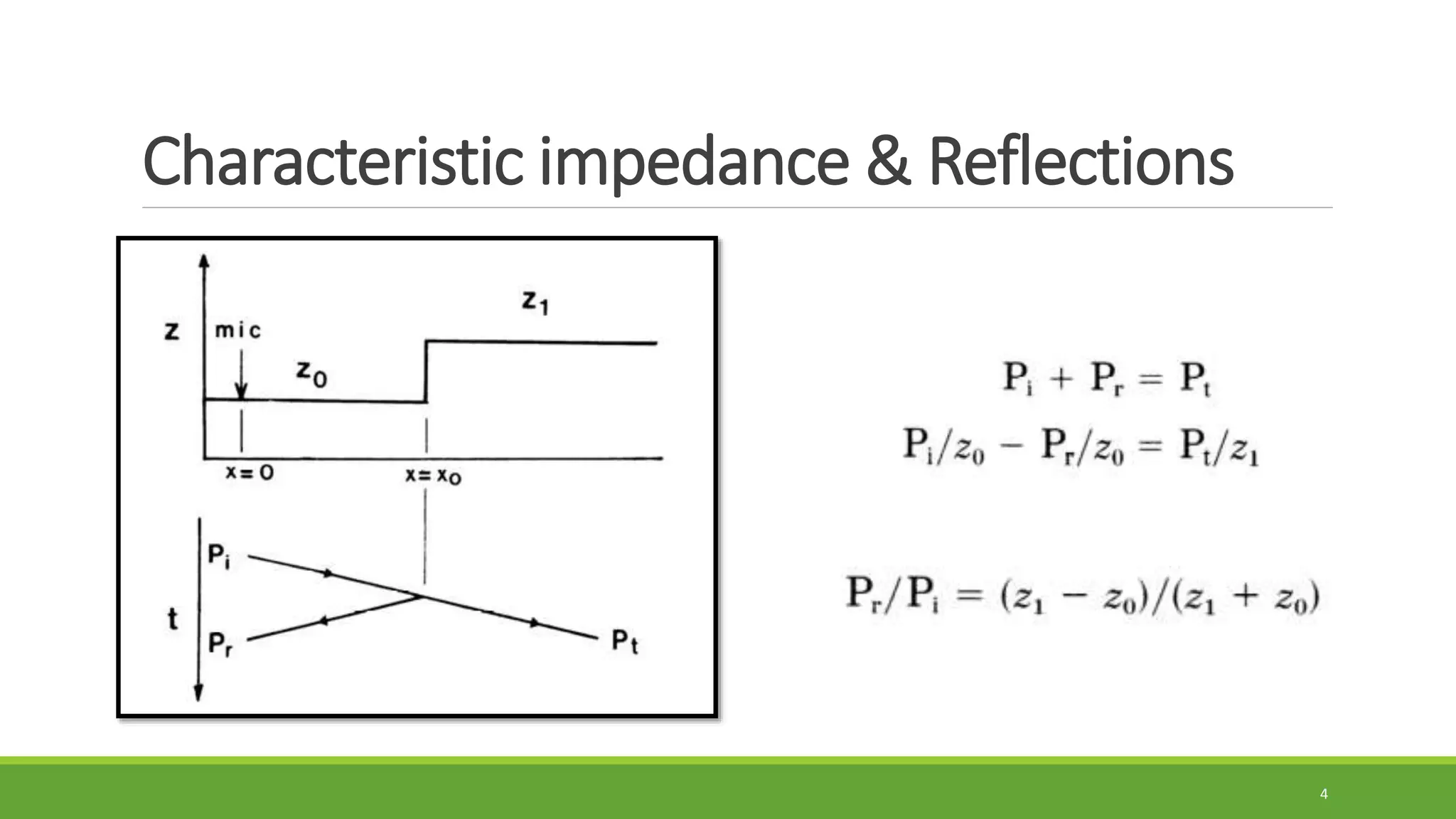
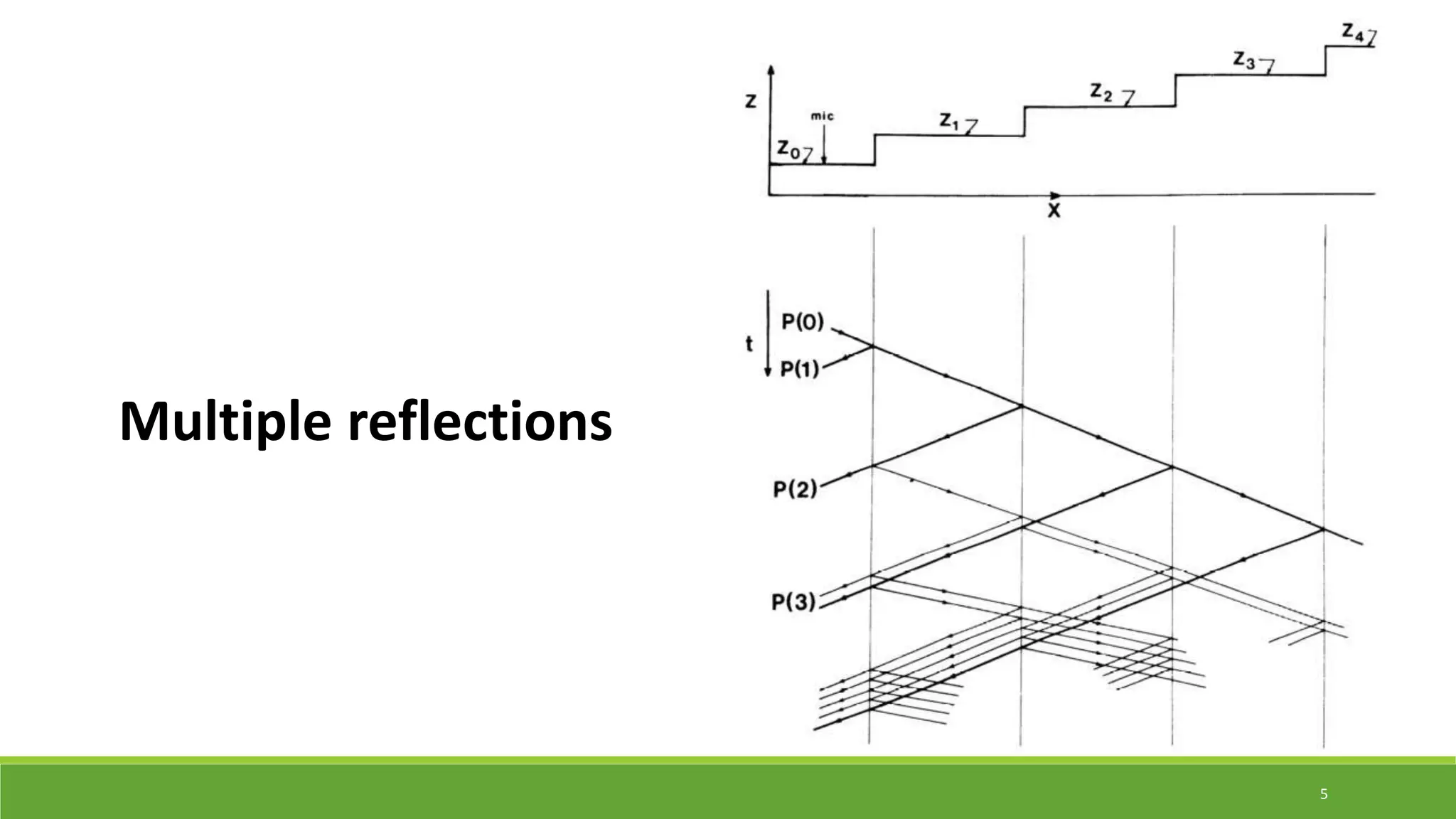
Characteristic impedance & Reflections
4
5
Multiple reflections
6
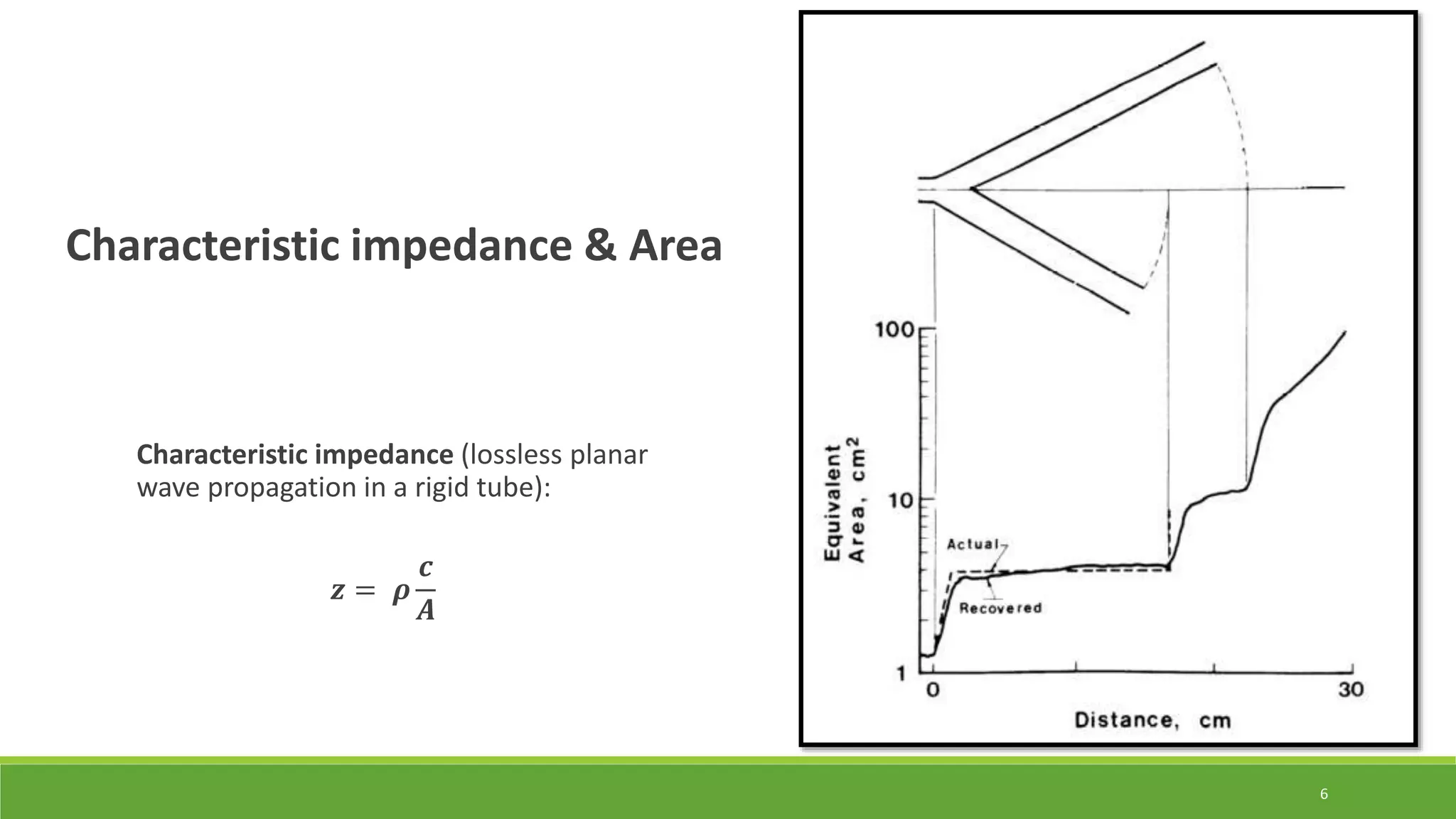
Characteristic impedance (lossless planar
wave propagation in a rigid tube):
𝒛 = 𝝆
𝒄
𝑨
Characteristic impedance & Area
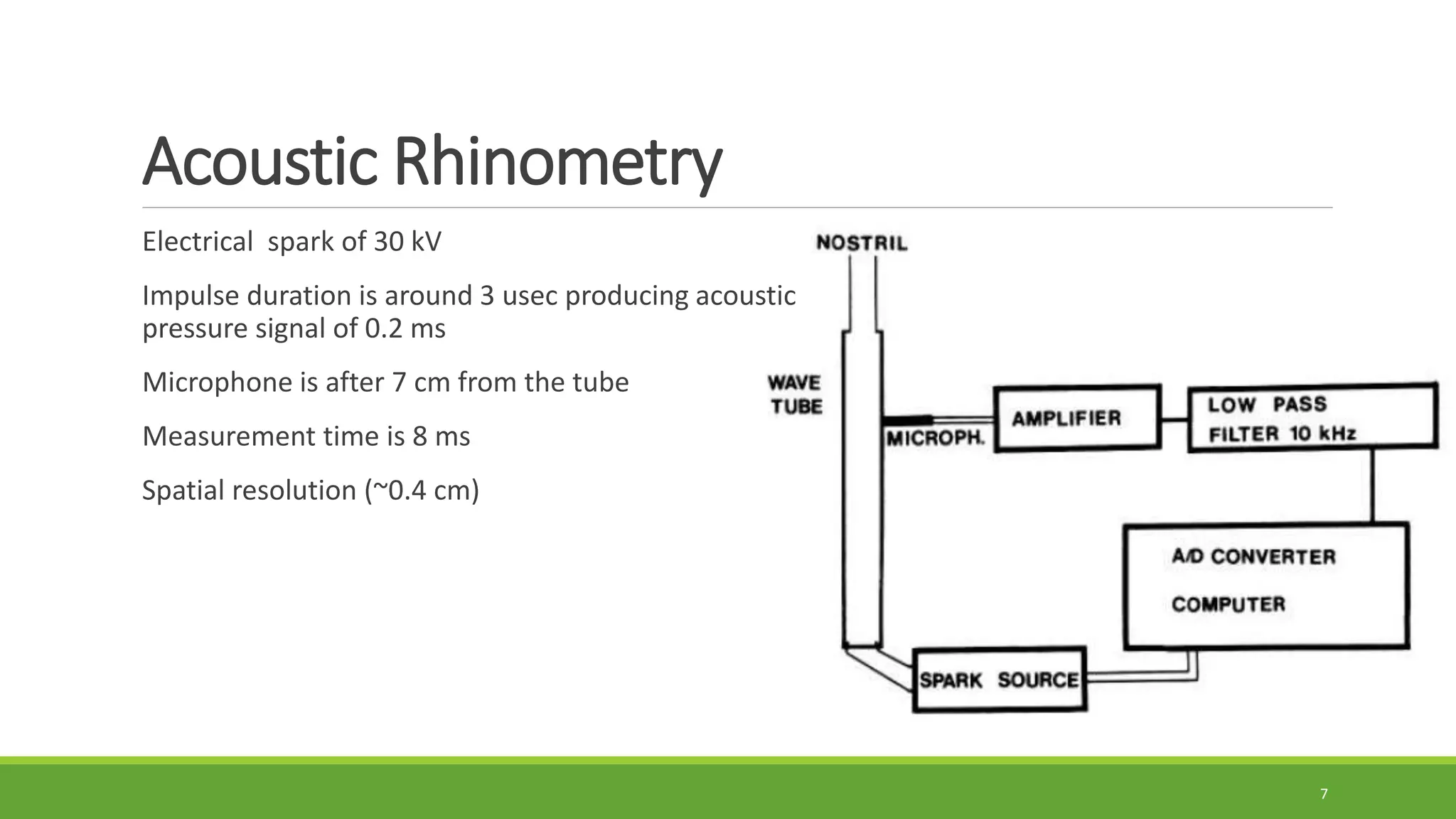
Acoustic Rhinometry
Electrical spark of 30 kV
Impulse duration is around 3 usec producing acoustic
pressure signal of 0.2 ms
Microphone is after 7 cm from the tube
Measurement time is 8 ms
Spatial resolution (~0.4 cm)
7
8
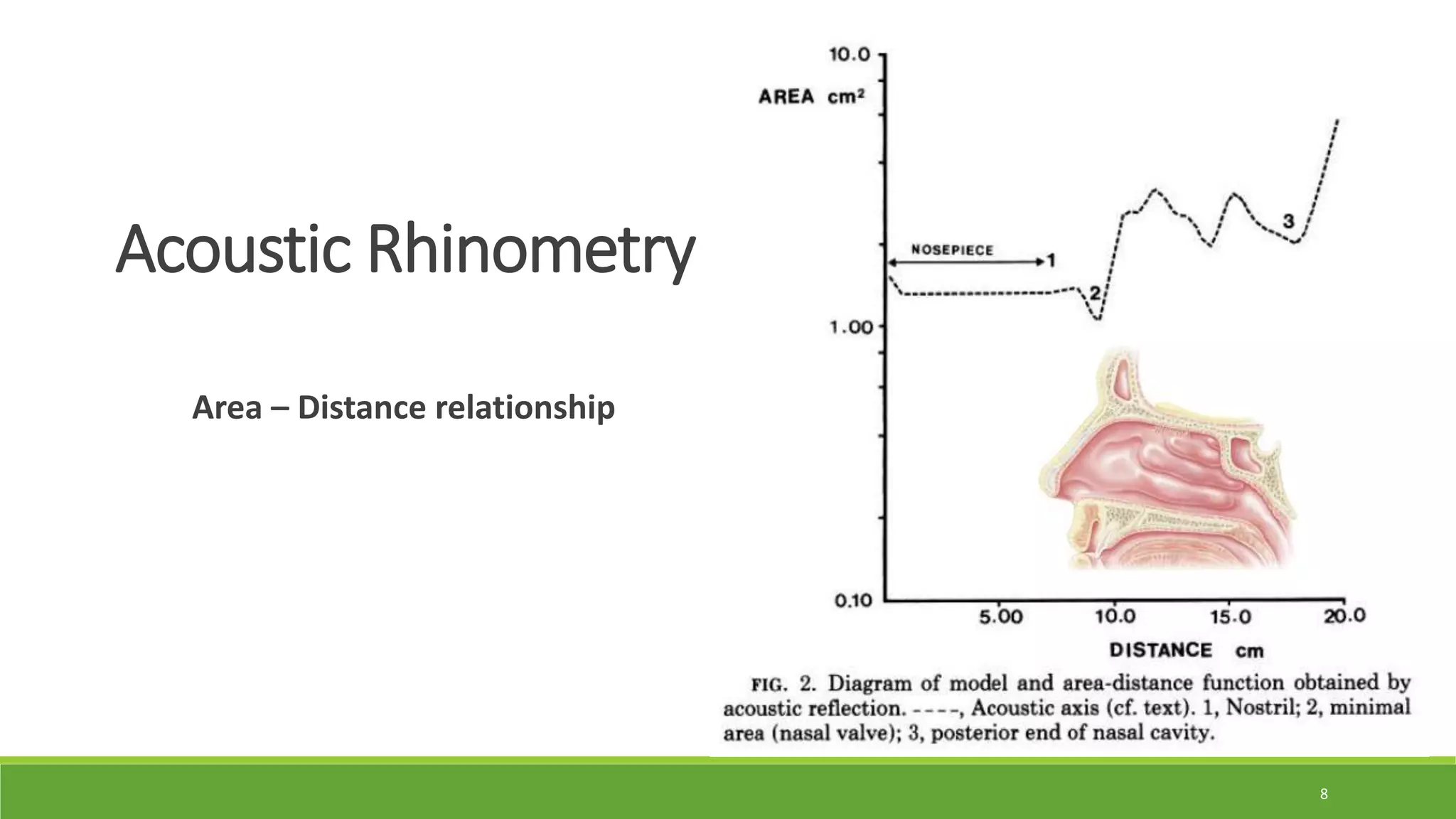
Acoustic Rhinometry
Area – Distance relationship
Some of Acoustic Rhinometry findings &
usages
A very strong correlation was found between the anterior nasal cross-sectional area calculated
from the radiographs, and the anterior nasal cross-sectional area and nasal volume from the
rhinometer.
It shows a potential clinical usefulness in the treatment of patients with sleep disordered
breathing (SDB), whereas it could be involved in all treatment stages ( initial screening,
evaluating nasal patency, determining mandibular posture that optimizes airway patency, .., etc.
It predicts tolerance of nCPAP, which that could lead to recommend nasal surgery to improve
nCPAP therapy.
It used to show the effect of nasal surgery on the Nasal cavity.
Show the effects of some nasal allergy on the nasal cavity.
And many other findings and usages.
9
Acoustic Rhinometry and OSA
“Acoustic rhinometry findings in patients with mild sleep apnea (2002)” …
paper
Hypothesis: the nasal obstruction produced by allergic rhinitis (inflammation of the mucous
membrane of the nose) may contribute to the development of OSA and can be easily assessed
with AR.
Objective: assessing the degree of nasal obstruction seen in allergic patients with and without
OSA.
10
Methodology
Subjects: 10 mild OSA and 40 non-OSA individuals.
Mild OSA patients have RDI ~14.5. RDI is respiratory disturbance index, and it includes
respiratory-effort related arousals (RERA) plus apnea and hypopnea events.
All patients were using topical nasal corticosteroids for the management of their allergies.
Non of them were taken any thing before the experiment.
Measurements are taken separately at baseline and after appropriate decongestion or shrinking
of the mucosa by α-sympathomimetic agents such as oxymetazoline (Neo-Synephrine).
Experiment has been done on each nose side (before and after decongestion).
11
Used parameters
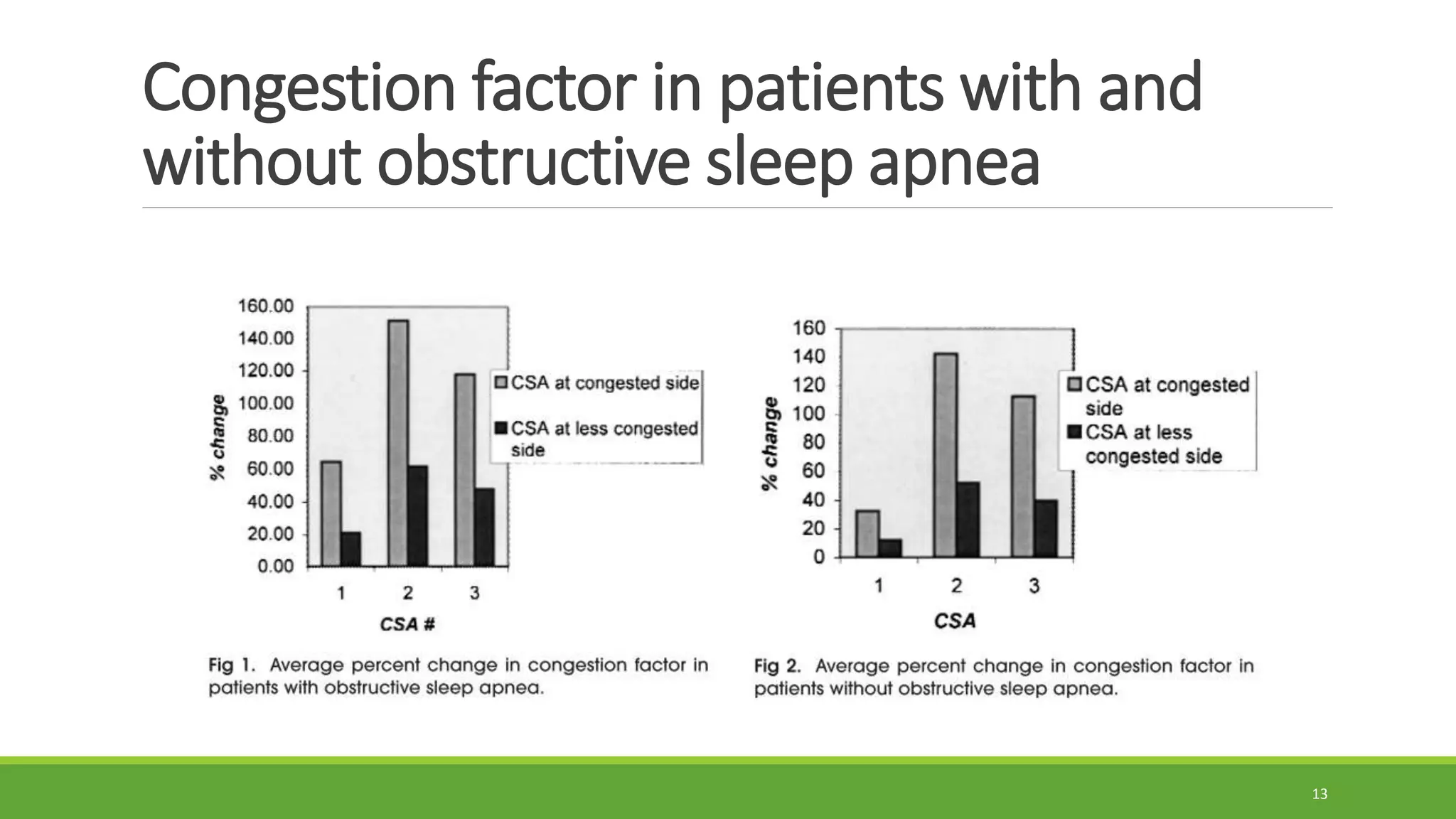
CSA1 (~2 cm) the anterior portion of the inferior turbinate
CSA2 (~4 cm) the anterior portion of the middle turbinate
CSA3 (~6 cm) the middle portion of the middle turbinate
Congestion factor (%) = [(congested – decongested)CSA] x 100
12
Congestion factor in patients with and
without obstructive sleep apnea
13
Mean Congestion factor
14
P = 0.03
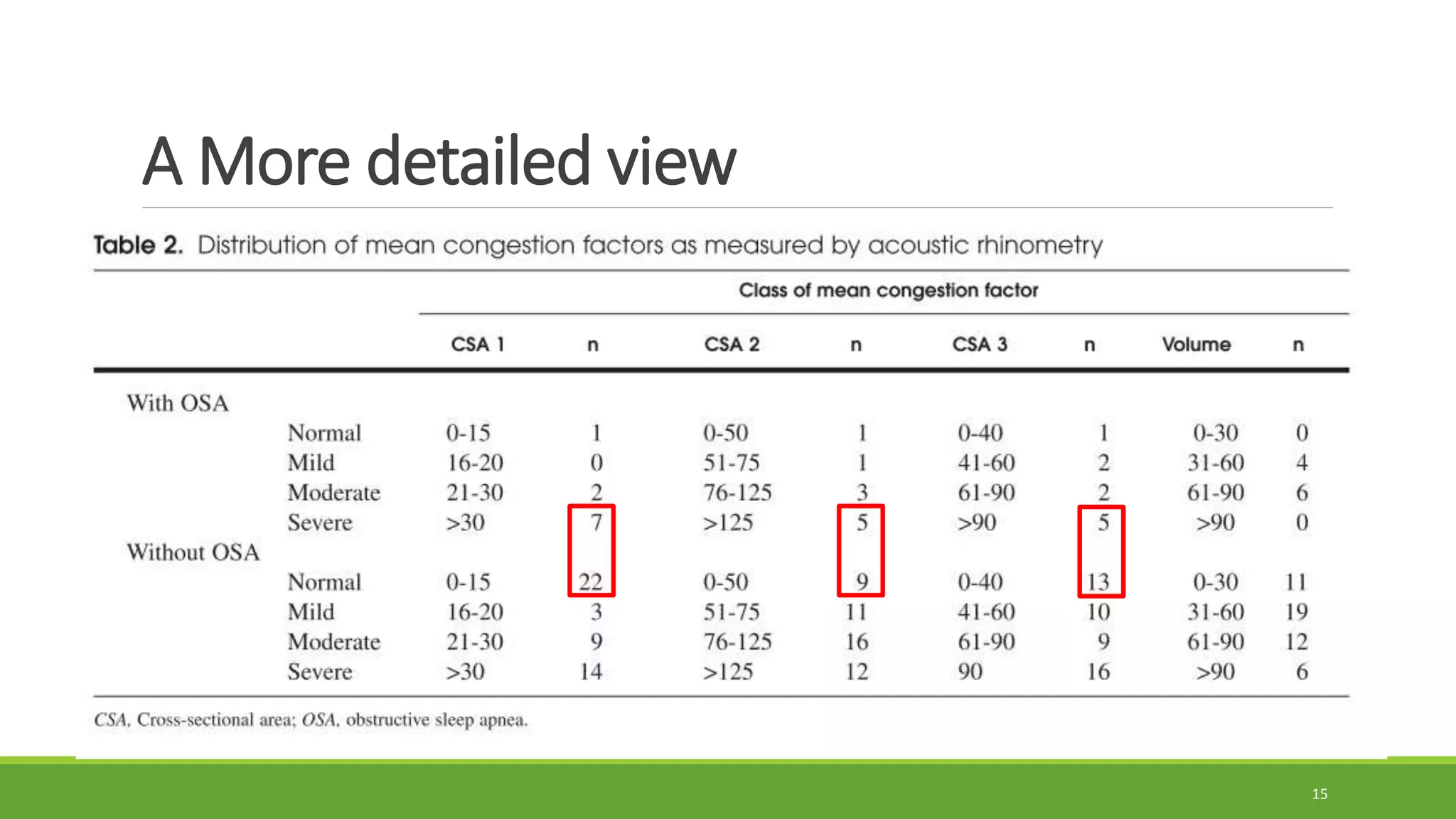
A More detailed view
15
Acoustic Rhinometry and OSA Paper’s
results
Mean congestion factor at first cross-sectional area (CSA1) is higher in OSA than non-OSA group
(p=0.03)
Change in the congestion factor is significant at CSA1, CSA2, CSA3 (<0.001, 0.031, and <0.001)
Non-OSA patients noted a significant subjective improvement in nasal congestion after topical
nasal decongestion, whereas the OSA patients did not (P <0.0001 and 0.064, respectively)
Main conclusion: the nasal obstruction associated with allergic rhinitis is associated with the
presence of mild OSA.
Significance: It has been shown that greater nasal congestion is related to the presence of OSA
in a population of patients with allergic rhinitis.
16
Conclusion
Nasal congestion affect the quality of sleep and could increase the probability of snoring and/or
having an OSA event during sleep.
Acoustic Rhinometry is a relaiable device with many advantages to measure the nasal cavity,
and It could be used in OSA investigation.
I’m wondering:
If OSA subjects are developing more congestion due to Rhinitis allergy, does that mean they
have bigger nasal cavity compared to non-OSA subjects to overcome the fact of having a
narrower and deformed UA?!
17
18

Rhinometry presentation

  • 1.
  • 2.
    Briefly! What is AcousticRhinometry (since 70’s)? ◦ It is a diagnostic measurement of the nasal cavity through acoustic reflections. Usages: ◦ Measuring the nasal cross-sectional area with the length of the nasal passage (volume). ◦ Measuring the nasal septum deviation. ◦ Detecting nasal congestion. ◦ Predicting tolerance of nasal continuous positive airway pressure (nCPAP).. Etc. Why Acoustic Rhinometry? ◦ Inexpensive, minimum Patient cooperation, no radiation (infants), reliable measurements, Very short exper. (secs), … etc. Is it beneficial for OSA diagnosis? ◦ Yes, It would help in predicting OSA. 2
  • 3.
    Transition from Lumpedsystem to Transmission line system “When the wavelength of the applied excitation becomes comparable to any linear dimension of a tube along which pressure waves travel, it is no longer appropriate to model the system with lumped parameters.” Different View of the nasal cavity! 3
  • 4.
  • 5.
  • 6.
    6 Characteristic impedance (losslessplanar wave propagation in a rigid tube): 𝒛 = 𝝆 𝒄 𝑨 Characteristic impedance & Area
  • 7.
    Acoustic Rhinometry Electrical sparkof 30 kV Impulse duration is around 3 usec producing acoustic pressure signal of 0.2 ms Microphone is after 7 cm from the tube Measurement time is 8 ms Spatial resolution (~0.4 cm) 7
  • 8.
    8 Acoustic Rhinometry Area –Distance relationship
  • 9.
    Some of AcousticRhinometry findings & usages A very strong correlation was found between the anterior nasal cross-sectional area calculated from the radiographs, and the anterior nasal cross-sectional area and nasal volume from the rhinometer. It shows a potential clinical usefulness in the treatment of patients with sleep disordered breathing (SDB), whereas it could be involved in all treatment stages ( initial screening, evaluating nasal patency, determining mandibular posture that optimizes airway patency, .., etc. It predicts tolerance of nCPAP, which that could lead to recommend nasal surgery to improve nCPAP therapy. It used to show the effect of nasal surgery on the Nasal cavity. Show the effects of some nasal allergy on the nasal cavity. And many other findings and usages. 9
  • 10.
    Acoustic Rhinometry andOSA “Acoustic rhinometry findings in patients with mild sleep apnea (2002)” … paper Hypothesis: the nasal obstruction produced by allergic rhinitis (inflammation of the mucous membrane of the nose) may contribute to the development of OSA and can be easily assessed with AR. Objective: assessing the degree of nasal obstruction seen in allergic patients with and without OSA. 10
  • 11.
    Methodology Subjects: 10 mildOSA and 40 non-OSA individuals. Mild OSA patients have RDI ~14.5. RDI is respiratory disturbance index, and it includes respiratory-effort related arousals (RERA) plus apnea and hypopnea events. All patients were using topical nasal corticosteroids for the management of their allergies. Non of them were taken any thing before the experiment. Measurements are taken separately at baseline and after appropriate decongestion or shrinking of the mucosa by α-sympathomimetic agents such as oxymetazoline (Neo-Synephrine). Experiment has been done on each nose side (before and after decongestion). 11
  • 12.
    Used parameters CSA1 (~2cm) the anterior portion of the inferior turbinate CSA2 (~4 cm) the anterior portion of the middle turbinate CSA3 (~6 cm) the middle portion of the middle turbinate Congestion factor (%) = [(congested – decongested)CSA] x 100 12
  • 13.
    Congestion factor inpatients with and without obstructive sleep apnea 13
  • 14.
  • 15.
  • 16.
    Acoustic Rhinometry andOSA Paper’s results Mean congestion factor at first cross-sectional area (CSA1) is higher in OSA than non-OSA group (p=0.03) Change in the congestion factor is significant at CSA1, CSA2, CSA3 (<0.001, 0.031, and <0.001) Non-OSA patients noted a significant subjective improvement in nasal congestion after topical nasal decongestion, whereas the OSA patients did not (P <0.0001 and 0.064, respectively) Main conclusion: the nasal obstruction associated with allergic rhinitis is associated with the presence of mild OSA. Significance: It has been shown that greater nasal congestion is related to the presence of OSA in a population of patients with allergic rhinitis. 16
  • 17.
    Conclusion Nasal congestion affectthe quality of sleep and could increase the probability of snoring and/or having an OSA event during sleep. Acoustic Rhinometry is a relaiable device with many advantages to measure the nasal cavity, and It could be used in OSA investigation. I’m wondering: If OSA subjects are developing more congestion due to Rhinitis allergy, does that mean they have bigger nasal cavity compared to non-OSA subjects to overcome the fact of having a narrower and deformed UA?! 17
  • 18.

Editor's Notes

  • #3 Compared to CT and MRI
  • #4 Explain this Idea, sound speed is around 343 m/sec
  • #8 Spatial resolution (~0.4 cm) .. Measurement time is 8 ms ... (microphone is after 7 cm from the tube) .. Spark (30kV) impulse duration is around 3 micro sec producing acoustic pressure signal of 0.2 ms.
  • #10 Confirming Nasal Airway Patency Observed on Panoramic and Posterior-Anterior Cephalometric Radiographs Using an Acoustic Rhinometer Acoustic Reflection: Review and Clinical Applications for sleep-Disordered Breathing Sleep and Breathing, 2002 Effect of Nasal Surgery on the Nasal Cavity as Determined by Acoustic Rhinometry Otolaryngology—Head and Neck Surgery, 1999