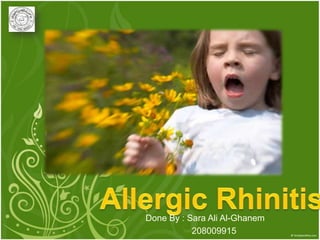


Done By : Sara Ali Al-Ghanem
           208009915
• What is rhinitis ?
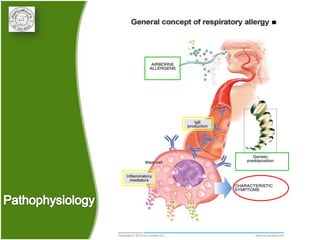
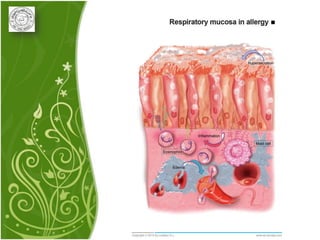
• Definition & pathophysiology of AR.
• Symptoms & signs of AR .
• AR in Saudi Arabia
• Triggering factors of AR.
• Investigations of AR.
• Differential diagnosis of AR
•  the New Guidelines for Classifying
  AR.
• Co morbidities of AR
• Management of AR
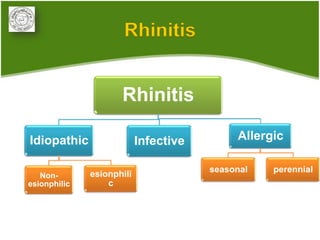
Rhinitis


                     Rhinitis

Idiopathic                 Infective        Allergic

                                       seasonal   perennial
   Non-       esionphili
esionphilic       c
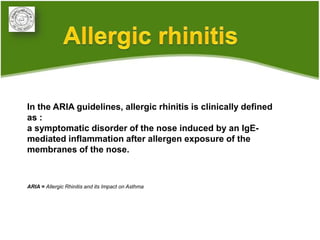
In the ARIA guidelines, allergic rhinitis is clinically defined
as :
a symptomatic disorder of the nose induced by an IgE-
mediated inflammation after allergen exposure of the
membranes of the nose.


ARIA = Allergic Rhinitis and its Impact on Asthma
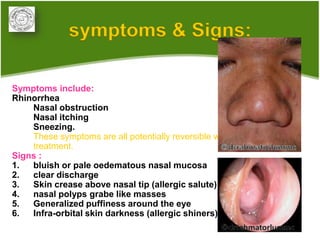
symptoms & Signs:

Symptoms include:
Rhinorrhea
    Nasal obstruction
    Nasal itching
    Sneezing.
    These symptoms are all potentially reversible with
    treatment.
Signs :
1.  bluish or pale oedematous nasal mucosa
2.  clear discharge
3.  Skin crease above nasal tip (allergic salute)
4.  nasal polyps grabe like masses
5.  Generalized puffiness around the eye
6.  Infra-orbital skin darkness (allergic shiners)
The WHO (World Health Organisation)
now classifies allergic disease as the
fourth most important chronic disease
in the world.


 AR affects 10  20% of population
Allergic Rhinitis is a
MAJOR chronic respiratory disease ?
Allergic Rhinitis is a
MAJOR chronic respiratory disease ?
Allergic Rhinitis in Saudi Arabia
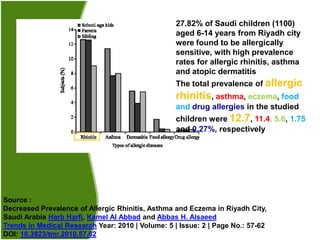
27.82% of Saudi children (1100)
                                                   aged 6-14 years from Riyadh city
                                                   were found to be allergically
                                                   sensitive, with high prevalence
                                                   rates for allergic rhinitis, asthma
                                                   and atopic dermatitis
                                                   The total prevalence of allergic
                                                   rhinitis, asthma, eczema, food
                                                   and drug allergies in the studied
                                                   children were 12.7, 11.4, 5.6, 1.75
                                                   and 0.27%, respectively


Source :
Decreased Prevalence of Allergic Rhinitis, Asthma and Eczema in Riyadh City,
Saudi Arabia Harb Harfi, Kamel Al Abbad and Abbas H. Alsaeed
Trends in Medical Research Year: 2010 | Volume: 5 | Issue: 2 | Page No.: 57-62
DOI: 10.3923/tmr.2010.57.62
Allergic Rhinitis in Al-Ahsa


  No available Researches
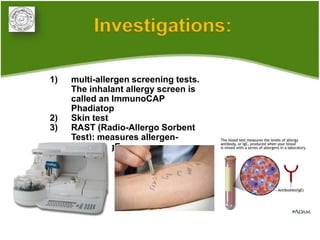
Investigations:

1)   multi-allergen screening tests.
     The inhalant allergy screen is
     called an ImmunoCAP
     Phadiatop
2)   Skin test
3)   RAST (Radio-Allergo Sorbent
     Test): measures allergen-
     specific IgE
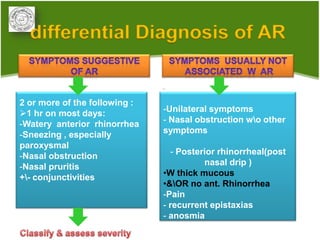
differential Diagnosis of AR

                               -
2 or more of the following :
1 hr on most days:            -Unilateral symptoms
-Watery anterior rhinorrhea    - Nasal obstruction wo other
-Sneezing , especially         symptoms
paroxysmal
-Nasal obstruction               - Posterior rhinorrheal(post
-Nasal pruritis                          nasal drip )
+- conjunctivities            •W thick mucous
                               •&OR no ant. Rhinorrhea
                               -Pain
                               - recurrent epistaxias
                               - anosmia
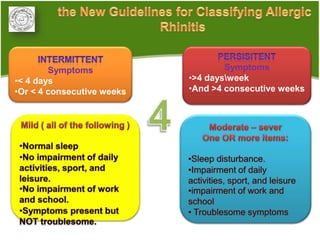
Symptoms                    Symptoms
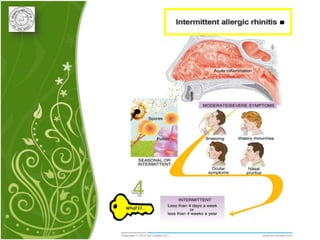
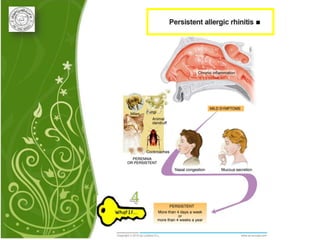
•< 4 days                   •>4 daysweek
•Or < 4 consecutive weeks   •And >4 consecutive weeks
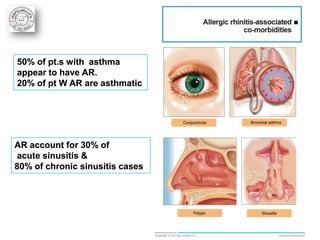
50% of pt.s with asthma
appear to have AR.
20% of pt W AR are asthmatic


AR account for 30% of
acute sinusitis &
80% of chronic sinusitis cases
Believe on what you are doing & appreciate it's value in your
                            life
                                              written by :Sara Al-
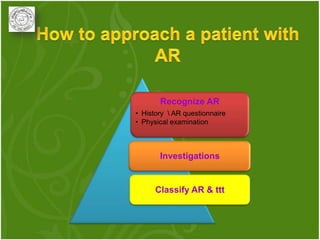
Recognize AR
• History  AR questionnaire
• Physical examination


       Investigations


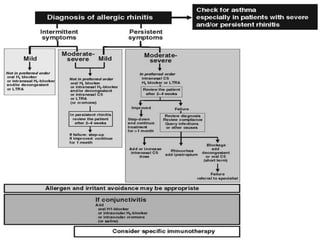
      Classify AR & ttt
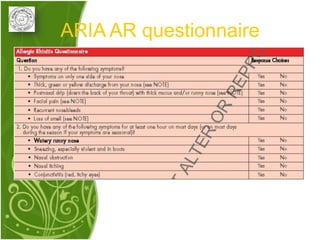
ARIA AR questionnaire
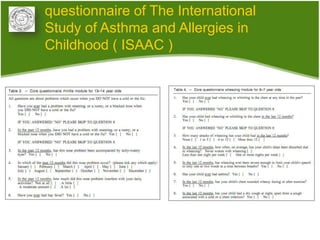
questionnaire of The International
Study of Asthma and Allergies in
Childhood ( ISAAC )
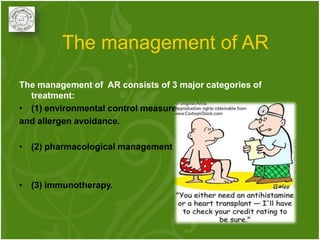
The management of AR
The management of AR consists of 3 major categories of
  treatment:
• (1) environmental control measures
and allergen avoidance.

• (2) pharmacological management


• (3) immunotherapy.
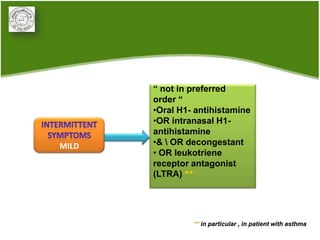
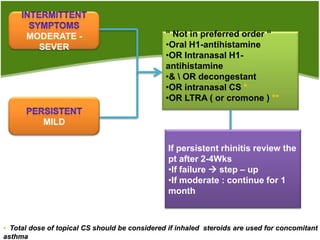
“ not in preferred
       order “
       •Oral H1- antihistamine
       •OR intranasal H1-
       antihistamine
MILD   •&  OR decongestant
       • OR leukotriene
       receptor antagonist
       (LTRA) **


                ** in particular , in patient with asthma
MODERATE -                               “ Not in preferred order “
        SEVER                                  •Oral H1-antihistamine
                                               •OR Intranasal H1-
                                               antihistamine
                                               •&  OR decongestant
                                               •OR intranasal CS *
                                               •OR LTRA ( or cromone ) **

           MILD

                                                If persistent rhinitis review the
                                                pt after 2-4Wks
                                                •If failure  step – up
                                                •If moderate : continue for 1
                                                month


• Total dose of topical CS should be considered if inhaled steroids are used for concomitant
asthma
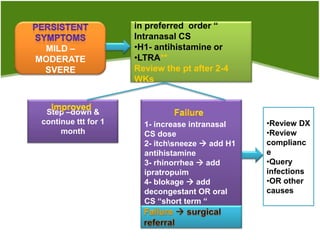
in preferred order “
                     Intranasal CS
 MILD –              •H1- antihistamine or
MODERATE             •LTRA**
 SVERE               Review the pt after 2-4
                     WKs


 Step –down &
continue ttt for 1     1- increase intranasal    •Review DX
     month             CS dose                   •Review
                       2- itchsneeze  add H1   complianc
                       antihistamine             e
                       3- rhinorrhea  add       •Query
                       ipratropuim               infections
                       4- blokage  add          •OR other
                       decongestant OR oral      causes
                       CS “short term “
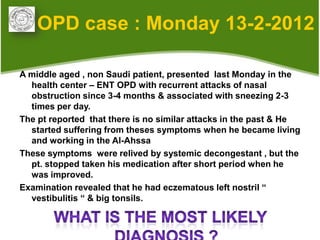
OPD case : Monday 13-2-2012

A middle aged , non Saudi patient, presented last Monday in the
  health center – ENT OPD with recurrent attacks of nasal
  obstruction since 3-4 months & associated with sneezing 2-3
  times per day.
The pt reported that there is no similar attacks in the past & He
  started suffering from theses symptoms when he became living
  and working in the Al-Ahssa
These symptoms were relived by systemic decongestant , but the
  pt. stopped taken his medication after short period when he
  was improved.
Examination revealed that he had eczematous left nostril “
  vestibulitis “ & big tonsils.
•
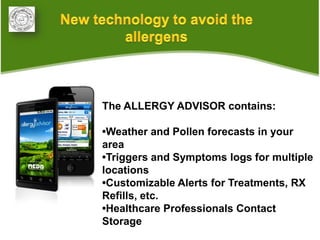
    The ALLERGY ADVISOR contains:

    •Weather and Pollen forecasts in your
    area
    •Triggers and Symptoms logs for multiple
    locations
    •Customizable Alerts for Treatments, RX
    Refills, etc.
    •Healthcare Professionals Contact
    Storage
Points to Remember

• AR is a major chronic respiratory disease
• AR is associated with co morbidities such as
  conjunctivitis
• AR should be considered as risk factor for asthma
  along with other known risk factors .
• A stepwise therapeutic approach depends on
  Severity of AR.
• The treatment of AR combines ( pharmacology ,
  immunotherapy & education )
• Pt with persistent AR should evaluate for asthma &
  Vice versa.
References
•    Books:
1.   Abou-Elhomad ENT book
•    Websites :
1.   Management of allergic rhinitis & its impact on asthma pocket guideline
     (http://www.whiar.org/docs/ARIA_PG_08_View_WM.pdf)
2.   Decreased Prevalence of Allergic Rhinitis, Asthma and Eczema in Riyadh City,
     Saudi Arabia Harb Harfi, Kamel Al Abbad and Abbas H. Alsaeed
     (http://scialert.net/qredirect.php?doi=tmr.2010.57.62&linkid=pdf )
3.    International study of asthma and allergies in childhood (ISAAC)
     http://erj.ersjournals.com/content/8/3/483.full.pdf
4.   OtoPhinolaryngology Portal
     (http://www.drrahmatorlummc.com/rhinitisallergy.htm )
5.   http://www.stallergenes.com/en/understanding-allergies/allergic-rhinitis.html
•    Apple store medical app s
1.   Ear , Nose & throat (ENT) Miniatlas ( app)
2.   Allergy advisor

Allergic rhinitis

  • 1.
    Done By :Sara Ali Al-Ghanem 208009915
  • 2.
    • What isrhinitis ? • Definition & pathophysiology of AR. • Symptoms & signs of AR . • AR in Saudi Arabia • Triggering factors of AR. • Investigations of AR. • Differential diagnosis of AR • the New Guidelines for Classifying AR. • Co morbidities of AR • Management of AR
  • 3.
    Rhinitis Rhinitis Idiopathic Infective Allergic seasonal perennial Non- esionphili esionphilic c
  • 4.
    In the ARIAguidelines, allergic rhinitis is clinically defined as : a symptomatic disorder of the nose induced by an IgE- mediated inflammation after allergen exposure of the membranes of the nose. ARIA = Allergic Rhinitis and its Impact on Asthma
  • 7.
    symptoms & Signs: Symptomsinclude: Rhinorrhea Nasal obstruction Nasal itching Sneezing. These symptoms are all potentially reversible with treatment. Signs : 1. bluish or pale oedematous nasal mucosa 2. clear discharge 3. Skin crease above nasal tip (allergic salute) 4. nasal polyps grabe like masses 5. Generalized puffiness around the eye 6. Infra-orbital skin darkness (allergic shiners)
  • 8.
    The WHO (WorldHealth Organisation) now classifies allergic disease as the fourth most important chronic disease in the world. AR affects 10  20% of population
  • 9.
    Allergic Rhinitis isa MAJOR chronic respiratory disease ?
  • 10.
    Allergic Rhinitis isa MAJOR chronic respiratory disease ?
  • 11.
  • 12.
    27.82% of Saudichildren (1100) aged 6-14 years from Riyadh city were found to be allergically sensitive, with high prevalence rates for allergic rhinitis, asthma and atopic dermatitis The total prevalence of allergic rhinitis, asthma, eczema, food and drug allergies in the studied children were 12.7, 11.4, 5.6, 1.75 and 0.27%, respectively Source : Decreased Prevalence of Allergic Rhinitis, Asthma and Eczema in Riyadh City, Saudi Arabia Harb Harfi, Kamel Al Abbad and Abbas H. Alsaeed Trends in Medical Research Year: 2010 | Volume: 5 | Issue: 2 | Page No.: 57-62 DOI: 10.3923/tmr.2010.57.62
  • 13.
    Allergic Rhinitis inAl-Ahsa No available Researches
  • 17.
    Investigations: 1) multi-allergen screening tests. The inhalant allergy screen is called an ImmunoCAP Phadiatop 2) Skin test 3) RAST (Radio-Allergo Sorbent Test): measures allergen- specific IgE
  • 18.
    differential Diagnosis ofAR - 2 or more of the following : 1 hr on most days: -Unilateral symptoms -Watery anterior rhinorrhea - Nasal obstruction wo other -Sneezing , especially symptoms paroxysmal -Nasal obstruction - Posterior rhinorrheal(post -Nasal pruritis nasal drip ) +- conjunctivities •W thick mucous •&OR no ant. Rhinorrhea -Pain - recurrent epistaxias - anosmia
  • 19.
    Symptoms Symptoms •< 4 days •>4 daysweek •Or < 4 consecutive weeks •And >4 consecutive weeks
  • 22.
    50% of pt.swith asthma appear to have AR. 20% of pt W AR are asthmatic AR account for 30% of acute sinusitis & 80% of chronic sinusitis cases
  • 23.
    Believe on whatyou are doing & appreciate it's value in your life written by :Sara Al-
  • 24.
    Recognize AR • History AR questionnaire • Physical examination Investigations Classify AR & ttt
  • 25.
  • 26.
    questionnaire of TheInternational Study of Asthma and Allergies in Childhood ( ISAAC )
  • 27.
    The management ofAR The management of AR consists of 3 major categories of treatment: • (1) environmental control measures and allergen avoidance. • (2) pharmacological management • (3) immunotherapy.
  • 29.
    “ not inpreferred order “ •Oral H1- antihistamine •OR intranasal H1- antihistamine MILD •& OR decongestant • OR leukotriene receptor antagonist (LTRA) ** ** in particular , in patient with asthma
  • 30.
    MODERATE - “ Not in preferred order “ SEVER •Oral H1-antihistamine •OR Intranasal H1- antihistamine •& OR decongestant •OR intranasal CS * •OR LTRA ( or cromone ) ** MILD If persistent rhinitis review the pt after 2-4Wks •If failure  step – up •If moderate : continue for 1 month • Total dose of topical CS should be considered if inhaled steroids are used for concomitant asthma
  • 31.
    in preferred order“ Intranasal CS MILD – •H1- antihistamine or MODERATE •LTRA** SVERE Review the pt after 2-4 WKs Step –down & continue ttt for 1 1- increase intranasal •Review DX month CS dose •Review 2- itchsneeze  add H1 complianc antihistamine e 3- rhinorrhea  add •Query ipratropuim infections 4- blokage  add •OR other decongestant OR oral causes CS “short term “
  • 32.
    OPD case :Monday 13-2-2012 A middle aged , non Saudi patient, presented last Monday in the health center – ENT OPD with recurrent attacks of nasal obstruction since 3-4 months & associated with sneezing 2-3 times per day. The pt reported that there is no similar attacks in the past & He started suffering from theses symptoms when he became living and working in the Al-Ahssa These symptoms were relived by systemic decongestant , but the pt. stopped taken his medication after short period when he was improved. Examination revealed that he had eczematous left nostril “ vestibulitis “ & big tonsils.
  • 33.
    The ALLERGY ADVISOR contains: •Weather and Pollen forecasts in your area •Triggers and Symptoms logs for multiple locations •Customizable Alerts for Treatments, RX Refills, etc. •Healthcare Professionals Contact Storage
  • 34.
    Points to Remember •AR is a major chronic respiratory disease • AR is associated with co morbidities such as conjunctivitis • AR should be considered as risk factor for asthma along with other known risk factors . • A stepwise therapeutic approach depends on Severity of AR. • The treatment of AR combines ( pharmacology , immunotherapy & education ) • Pt with persistent AR should evaluate for asthma & Vice versa.
  • 36.
    References • Books: 1. Abou-Elhomad ENT book • Websites : 1. Management of allergic rhinitis & its impact on asthma pocket guideline (http://www.whiar.org/docs/ARIA_PG_08_View_WM.pdf) 2. Decreased Prevalence of Allergic Rhinitis, Asthma and Eczema in Riyadh City, Saudi Arabia Harb Harfi, Kamel Al Abbad and Abbas H. Alsaeed (http://scialert.net/qredirect.php?doi=tmr.2010.57.62&linkid=pdf ) 3. International study of asthma and allergies in childhood (ISAAC) http://erj.ersjournals.com/content/8/3/483.full.pdf 4. OtoPhinolaryngology Portal (http://www.drrahmatorlummc.com/rhinitisallergy.htm ) 5. http://www.stallergenes.com/en/understanding-allergies/allergic-rhinitis.html • Apple store medical app s 1. Ear , Nose & throat (ENT) Miniatlas ( app) 2. Allergy advisor