Advanced
Communication
Skills
Unit 4
Argumentative
writing
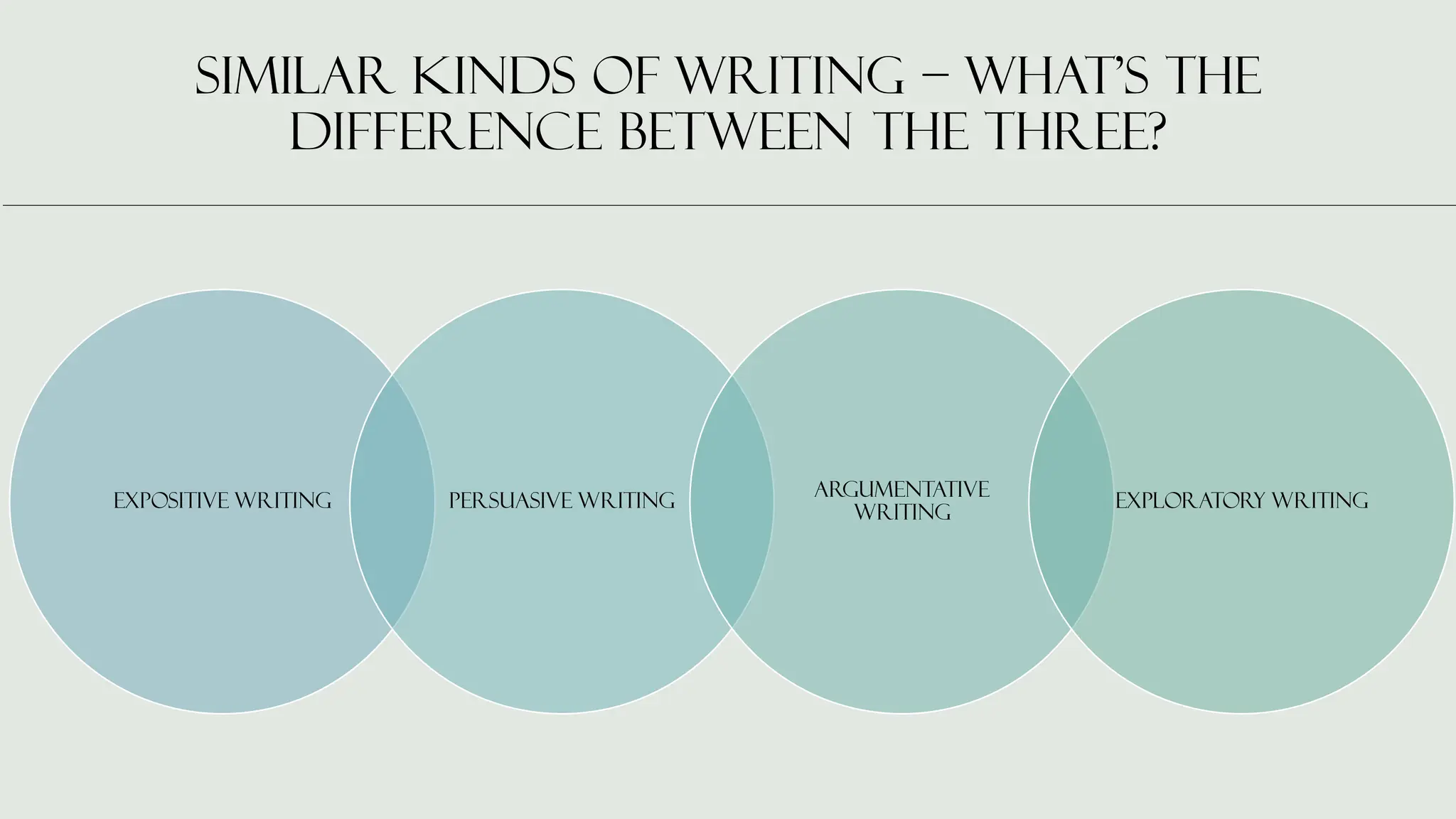
Similar kinds of writing – what's the
difference between the three?
Expositive Writing Persuasive writing
Argumentative
writing
Exploratory writing
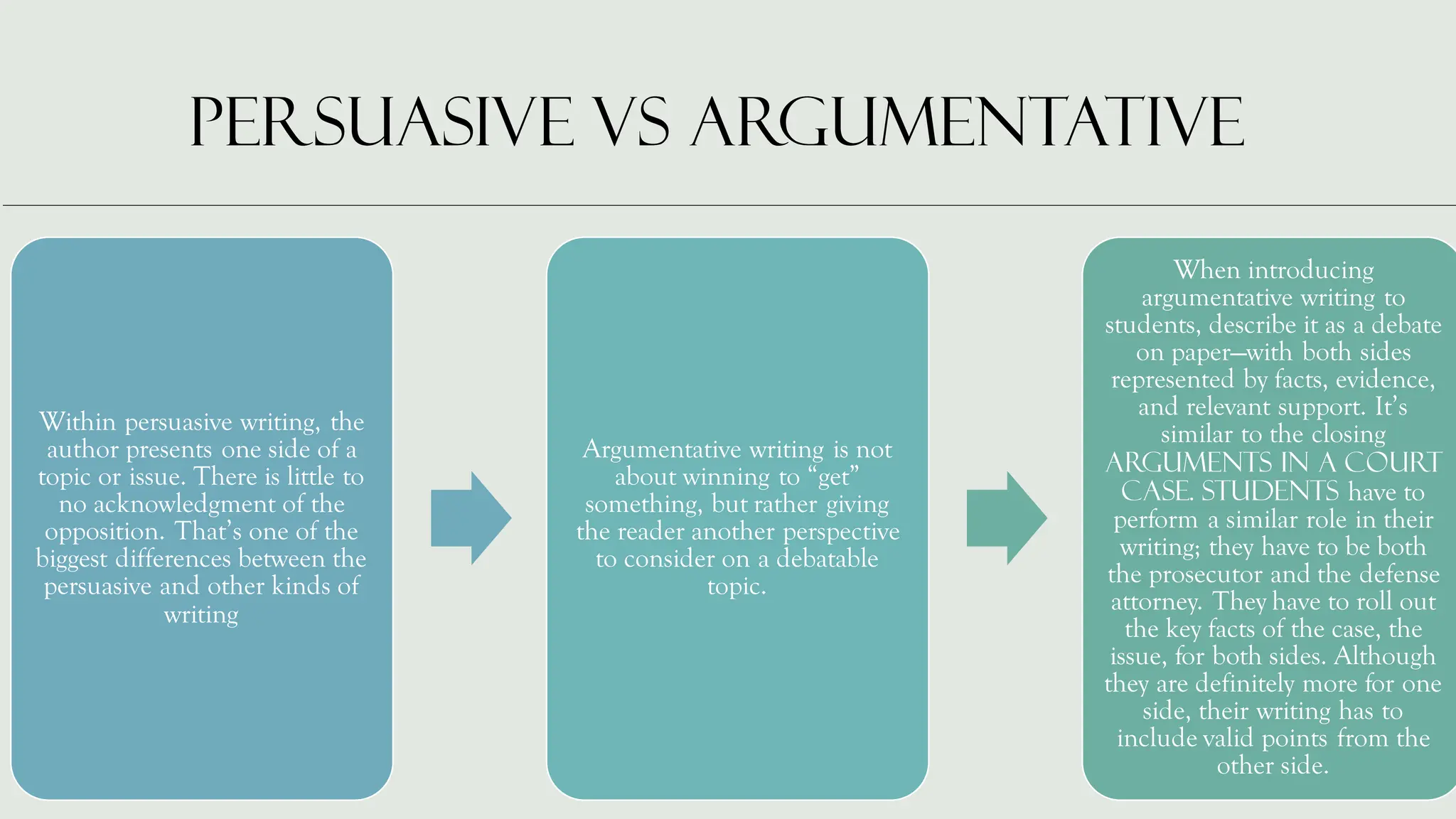
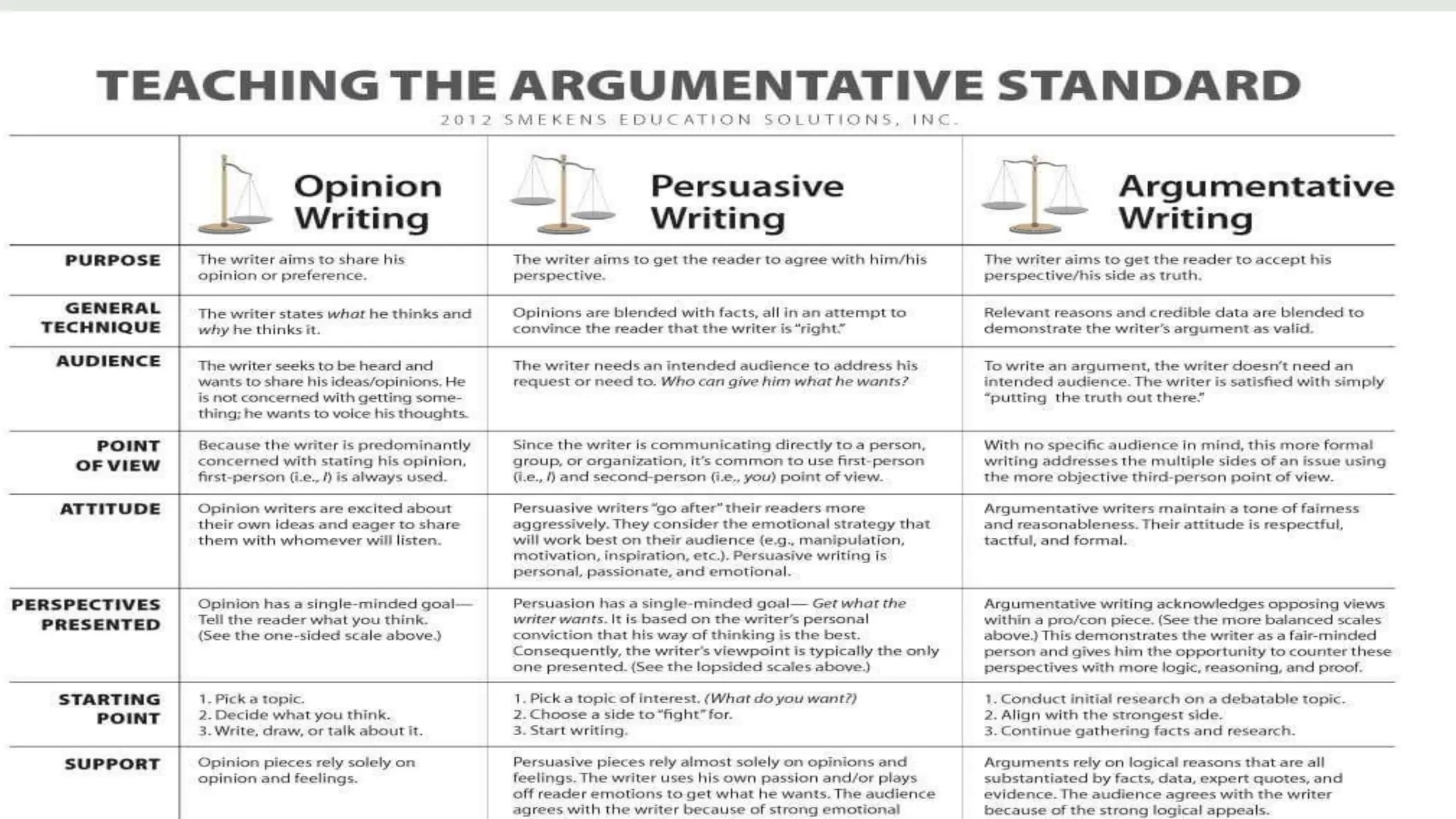
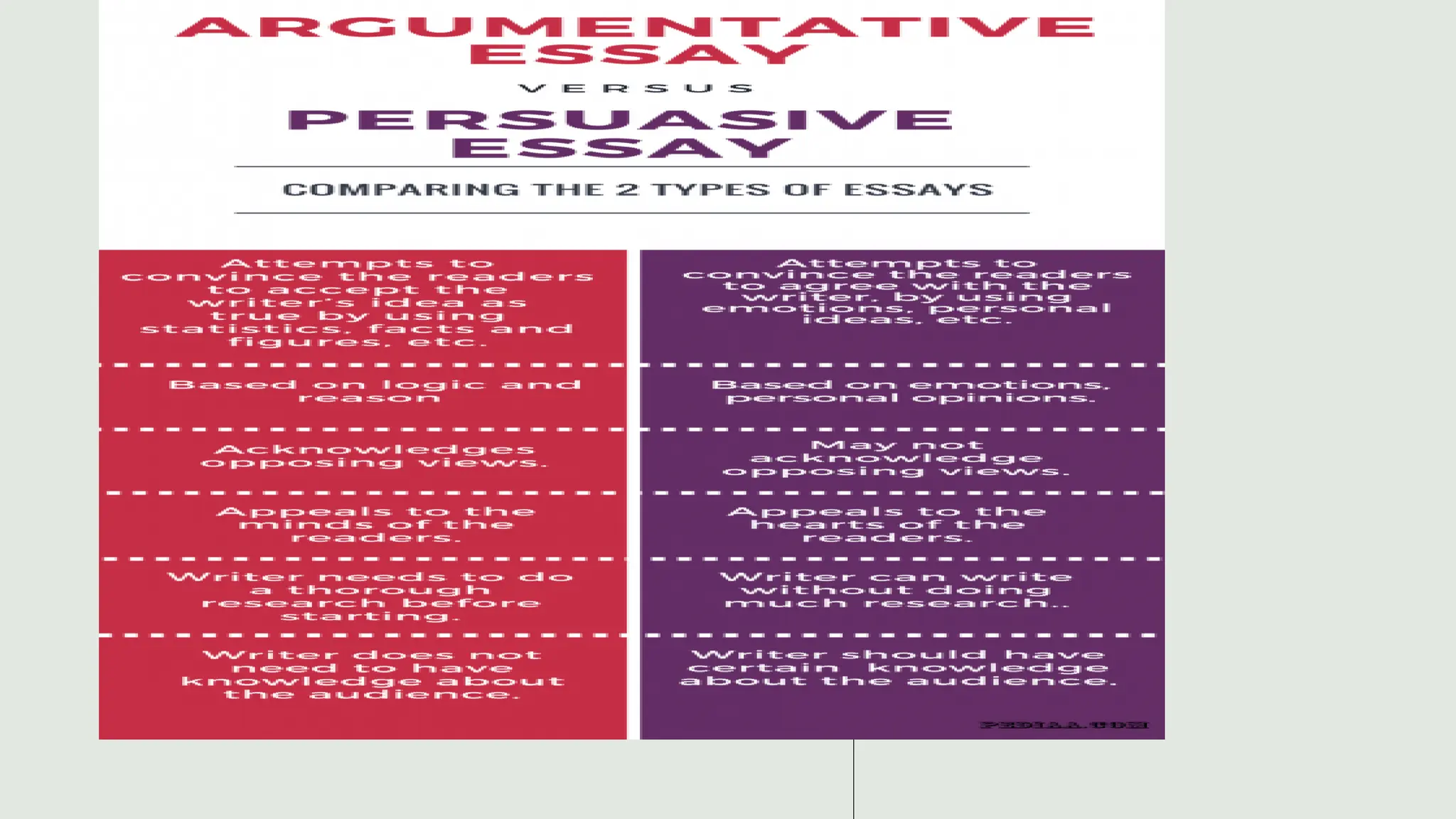
Persuasive vs argumentative
Within persuasive writing, the
author presents one side of a
topic or issue. There is little to
no acknowledgment of the
opposition. That’s one of the
biggest differences between the
persuasive and other kinds of
writing
Argumentative writing is not
about winning to “get”
something, but rather giving
the reader another perspective
to consider on a debatable
topic.
When introducing
argumentative writing to
students, describe it as a debate
on paper—with both sides
represented by facts, evidence,
and relevant support. It’s
similar to the closing
arguments in a court
case. Students have to
perform a similar role in their
writing; they have to be both
the prosecutor and the defense
attorney. They have to roll out
the key facts of the case, the
issue, for both sides. Although
they are definitely more for one
side, their writing has to
include valid points from the
other side.
Understanding
argumentative
writing
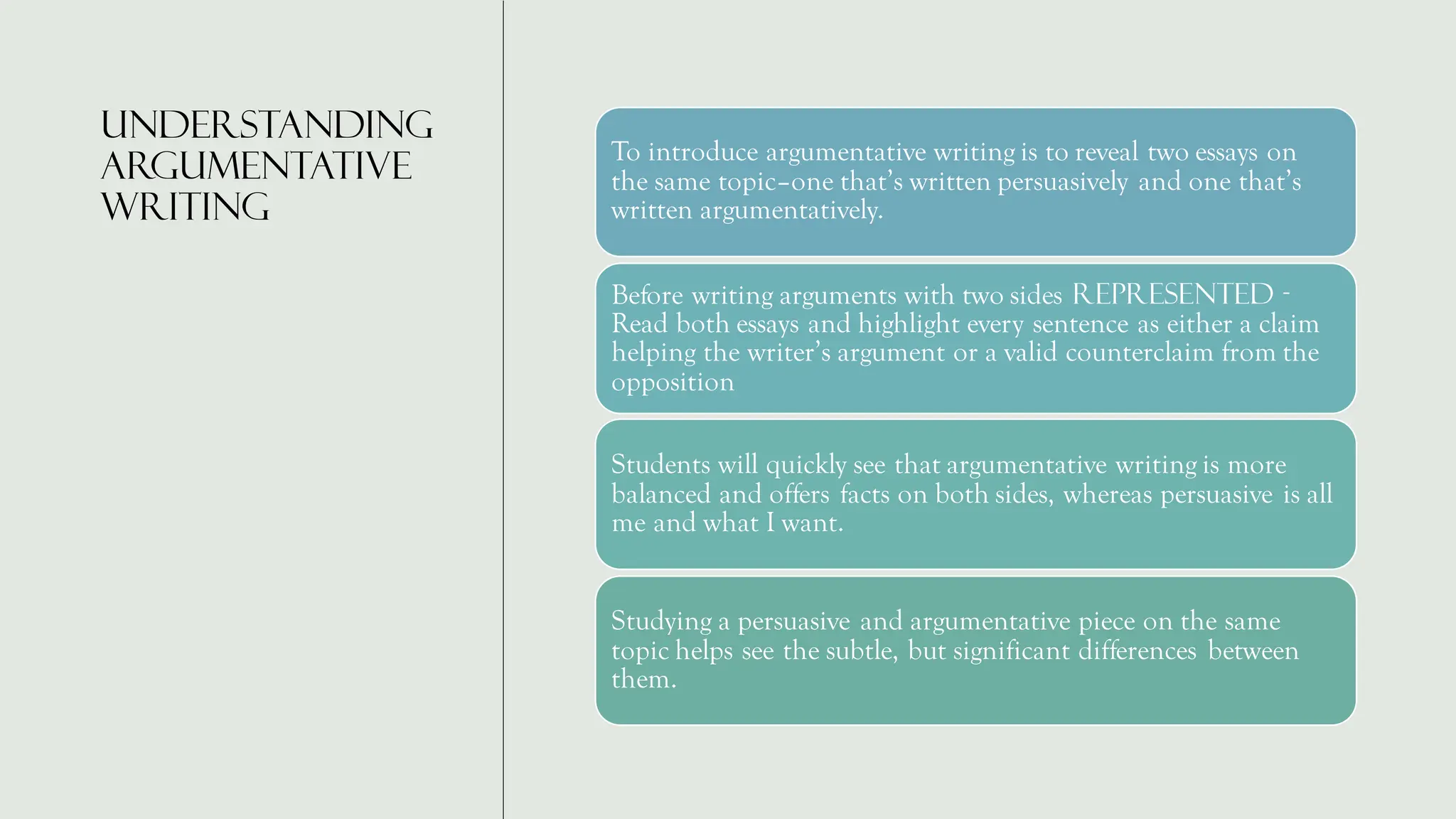
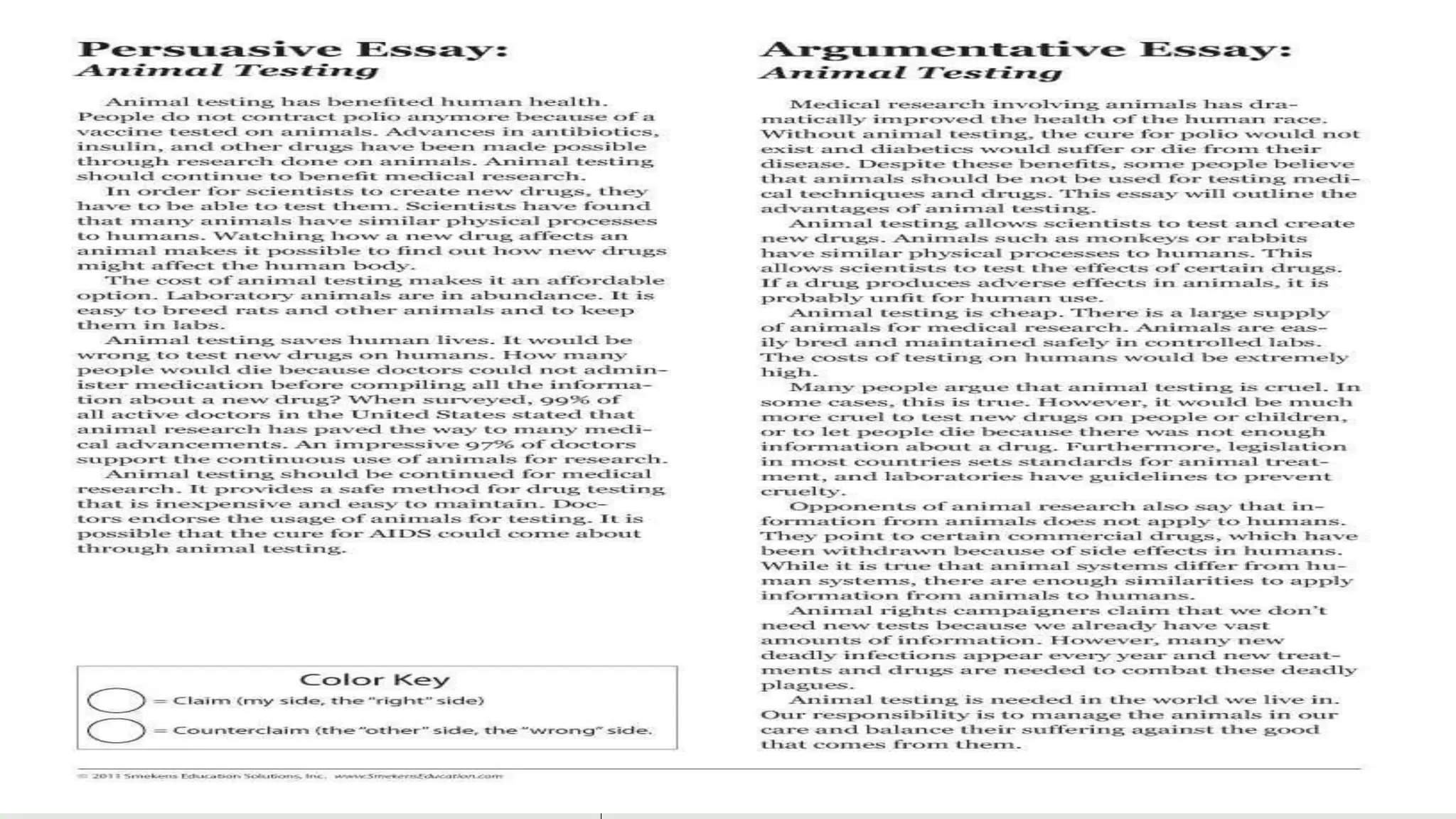
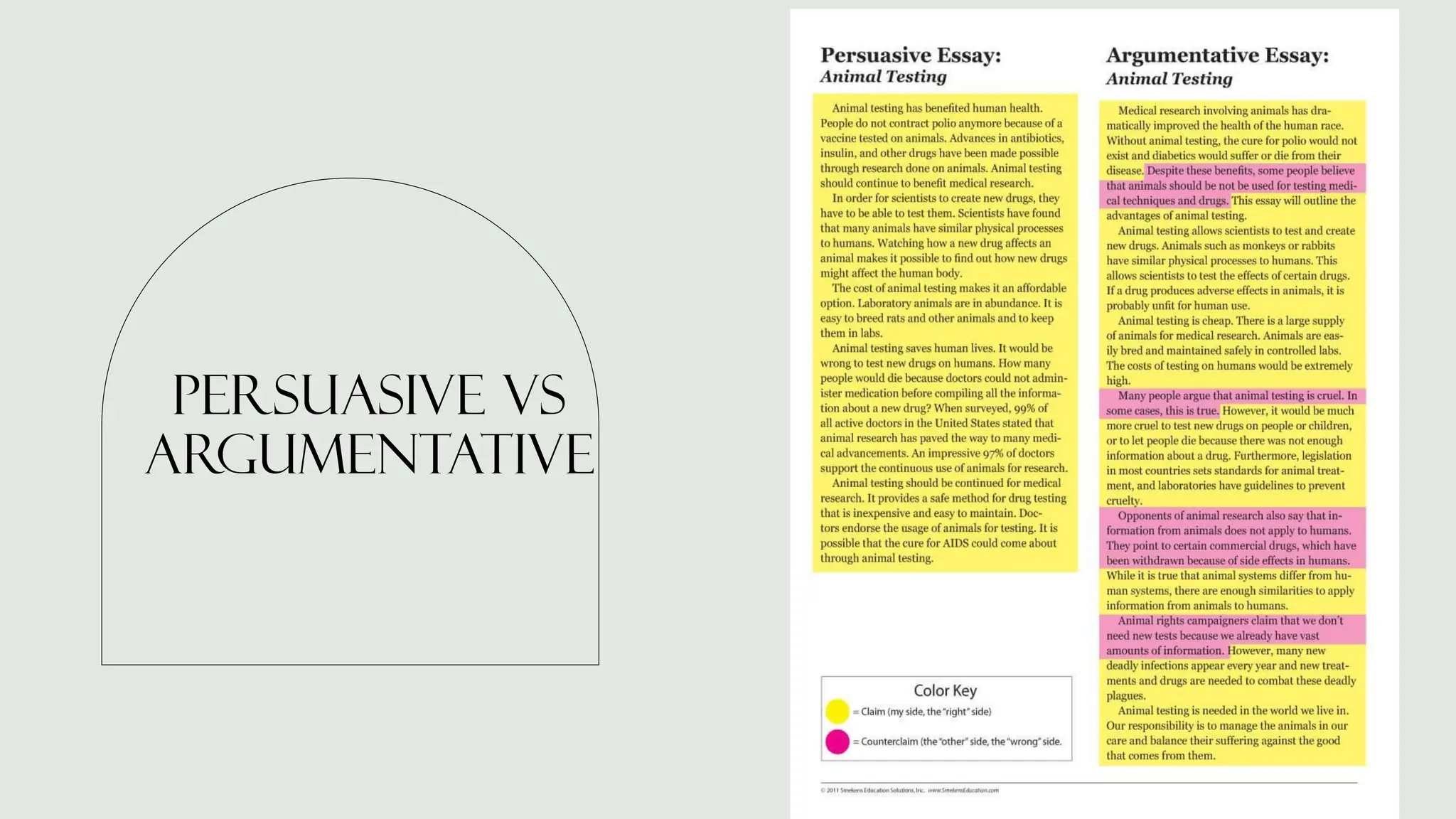
To introduce argumentative writing is to reveal two essays on
the same topic–one that’s written persuasively and one that’s
written argumentatively.
Before writing arguments with two sides represented -
Read both essays and highlight every sentence as either a claim
helping the writer’s argument or a valid counterclaim from the
opposition
Students will quickly see that argumentative writing is more
balanced and offers facts on both sides, whereas persuasive is all
me and what I want.
Studying a persuasive and argumentative piece on the same
topic helps see the subtle, but significant differences between
them.
TEACHING
ARGUMENT
WRITING BY
GORGE
HILLOCKS
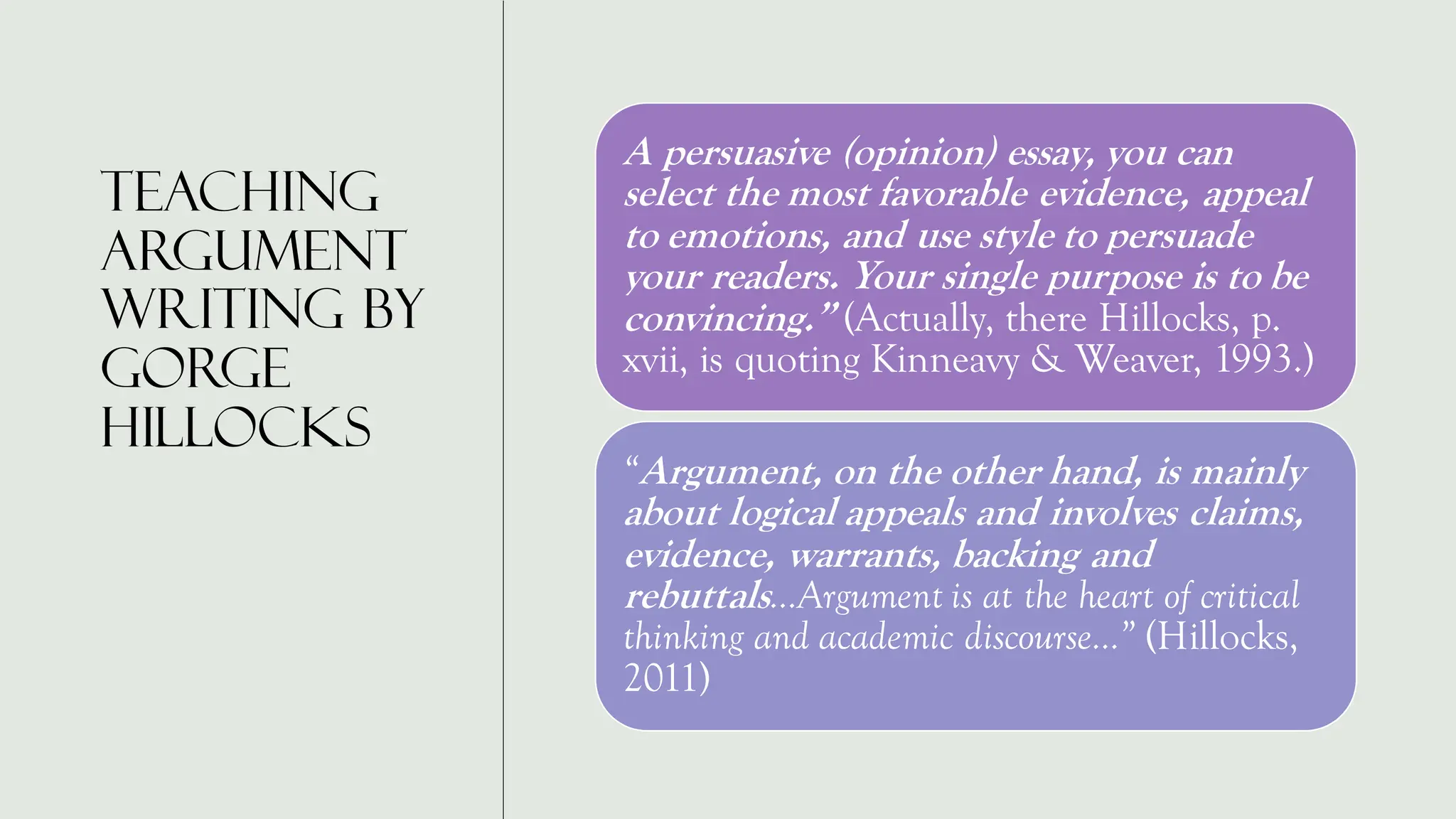
A persuasive (opinion) essay, you can
select the most favorable evidence, appeal
to emotions, and use style to persuade
your readers. Your single purpose is to be
convincing.” (Actually, there Hillocks, p.
xvii, is quoting Kinneavy & Weaver, 1993.)
“Argument, on the other hand, is mainly
about logical appeals and involves claims,
evidence, warrants, backing and
rebuttals…Argument is at the heart of critical
thinking and academic discourse…” (Hillocks,
2011)
Persuasive vs
argumentative
Persuasive vs
argumentative
EXpository
essay
Expository essay
vs
argumentative
Essay
(they are very
similar)
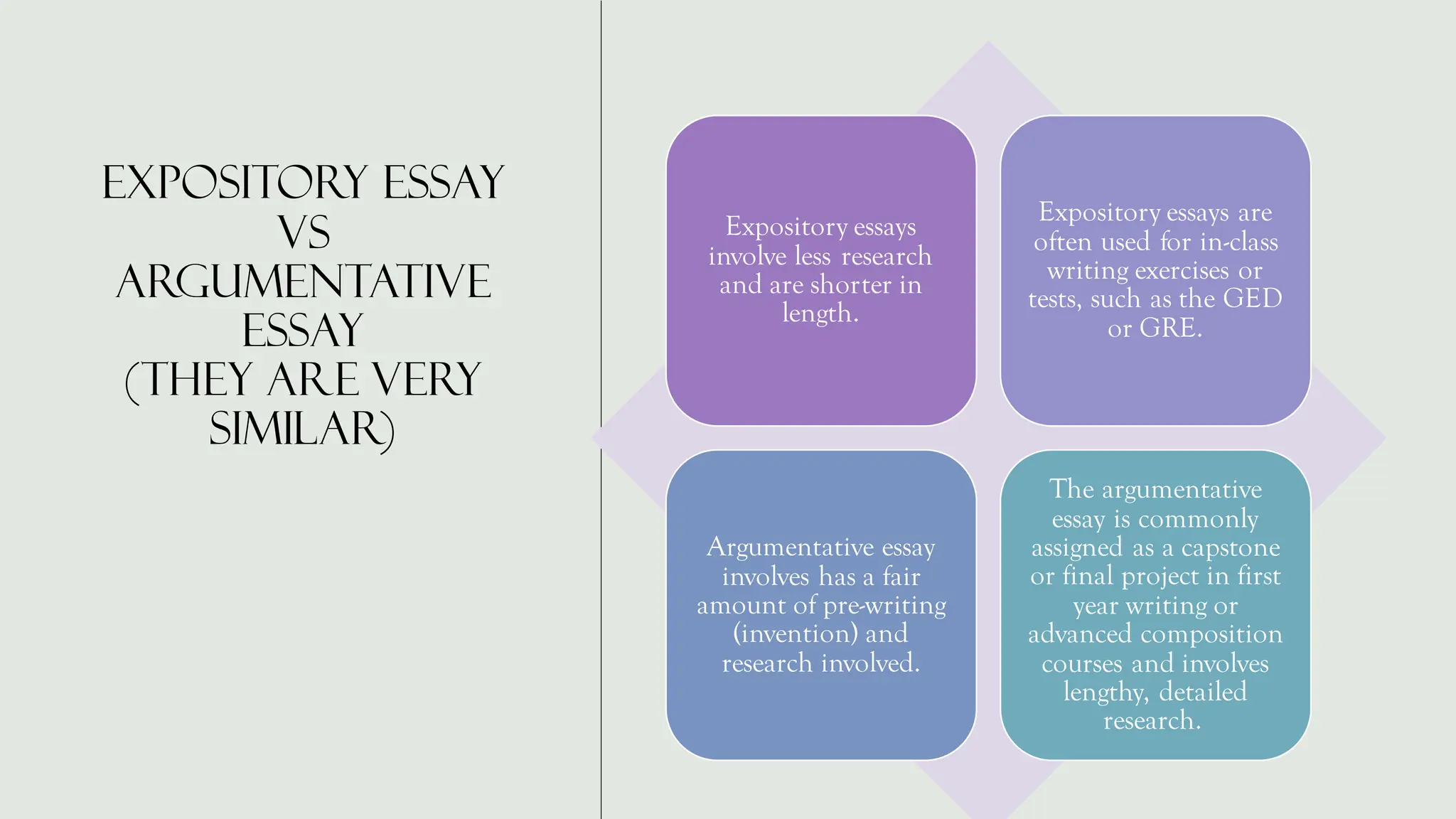
Expository essays
involve less research
and are shorter in
length.
Expository essays are
often used for in-class
writing exercises or
tests, such as the GED
or GRE.
Argumentative essay
involves has a fair
amount of pre-writing
(invention) and
research involved.
The argumentative
essay is commonly
assigned as a capstone
or final project in first
year writing or
advanced composition
courses and involves
lengthy, detailed
research.
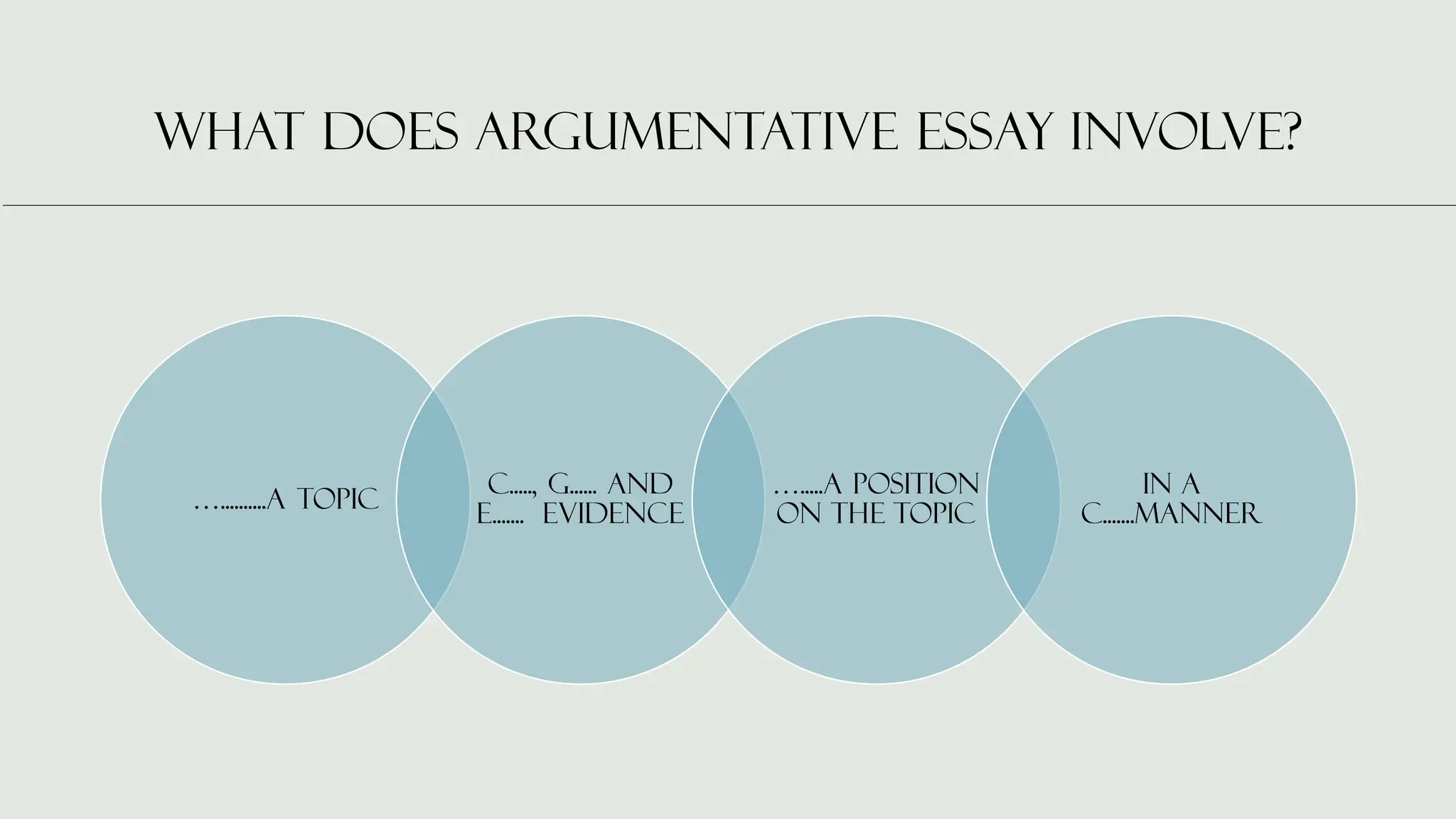
What does ArgumenTativE essay involve?
…..........a topic
c....., g...... and
e....... evidence
….....a position
on the topic
in a
c.......manner
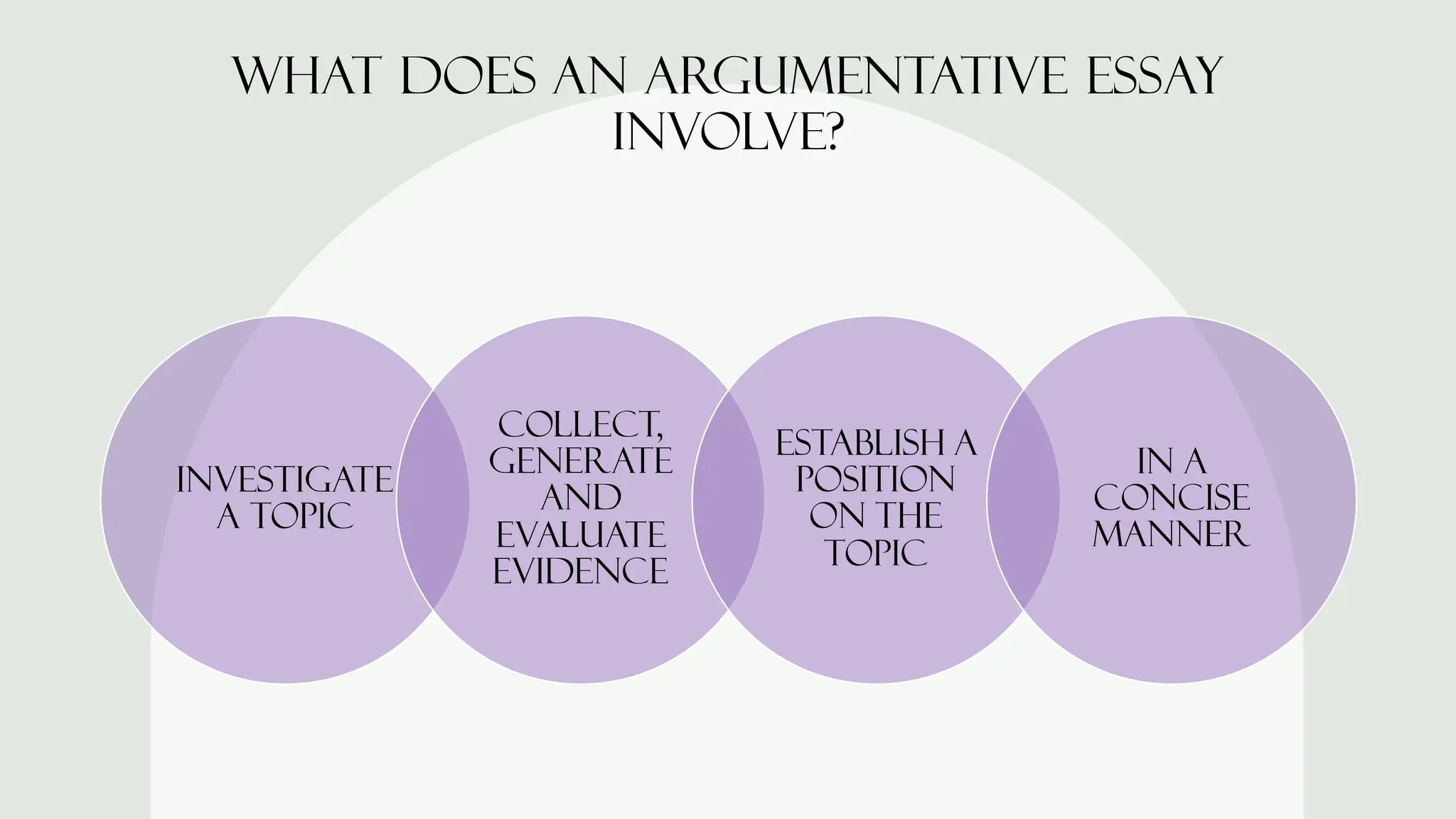
What does an argumentative essay
involve?
Investigate
a topic
Collect,
generate
and
evaluate
evidence
Establish a
position
on the
topic
in a
concise
manner
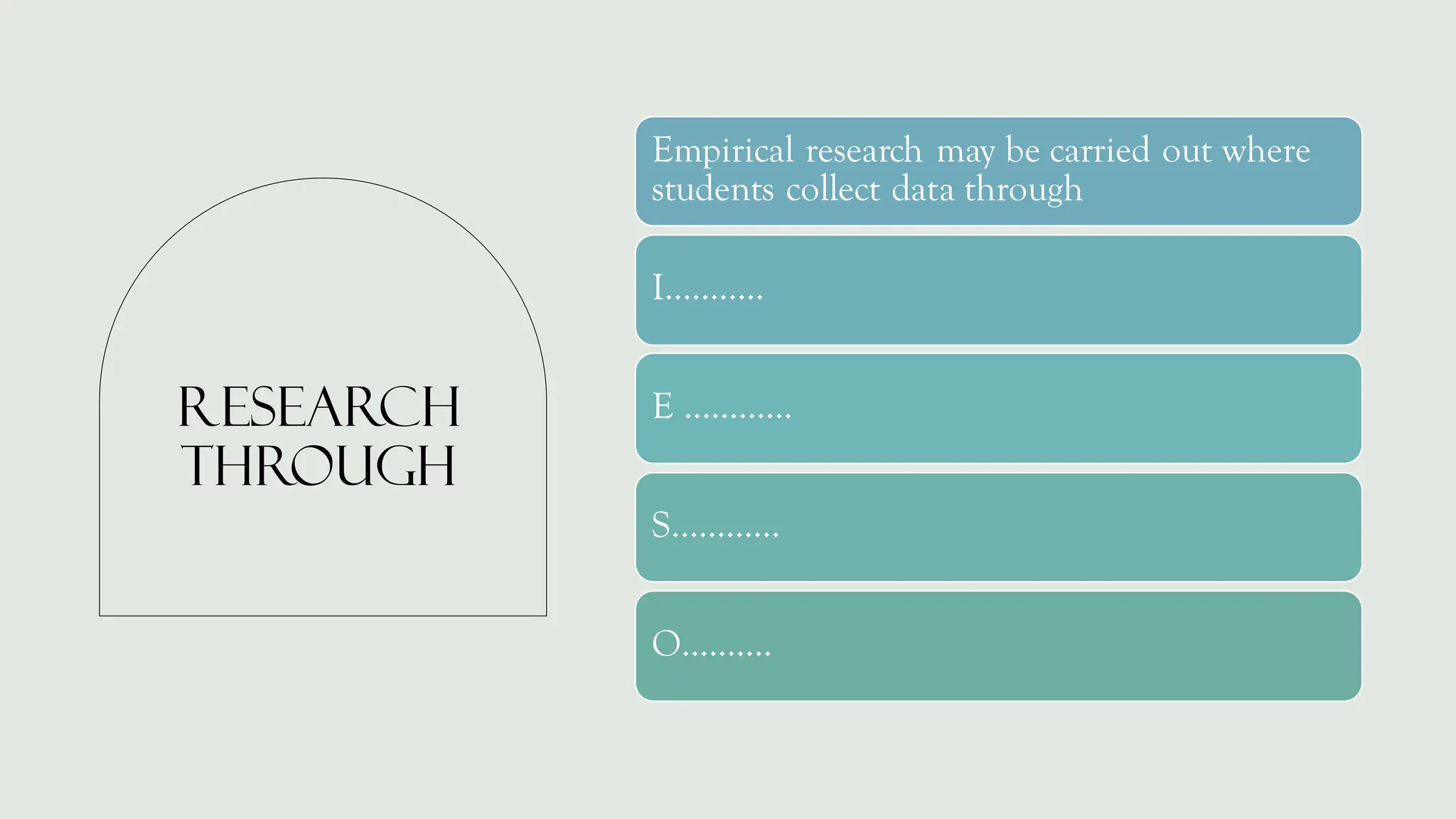
Research
through
Empirical research may be carried out where
students collect data through
I…........
E ….........
S….........
O….......
Research
through
Empirical research may be carried out
where students collect data through
Interviews
Experiments
Surveys.
Observations
The essay
should
have
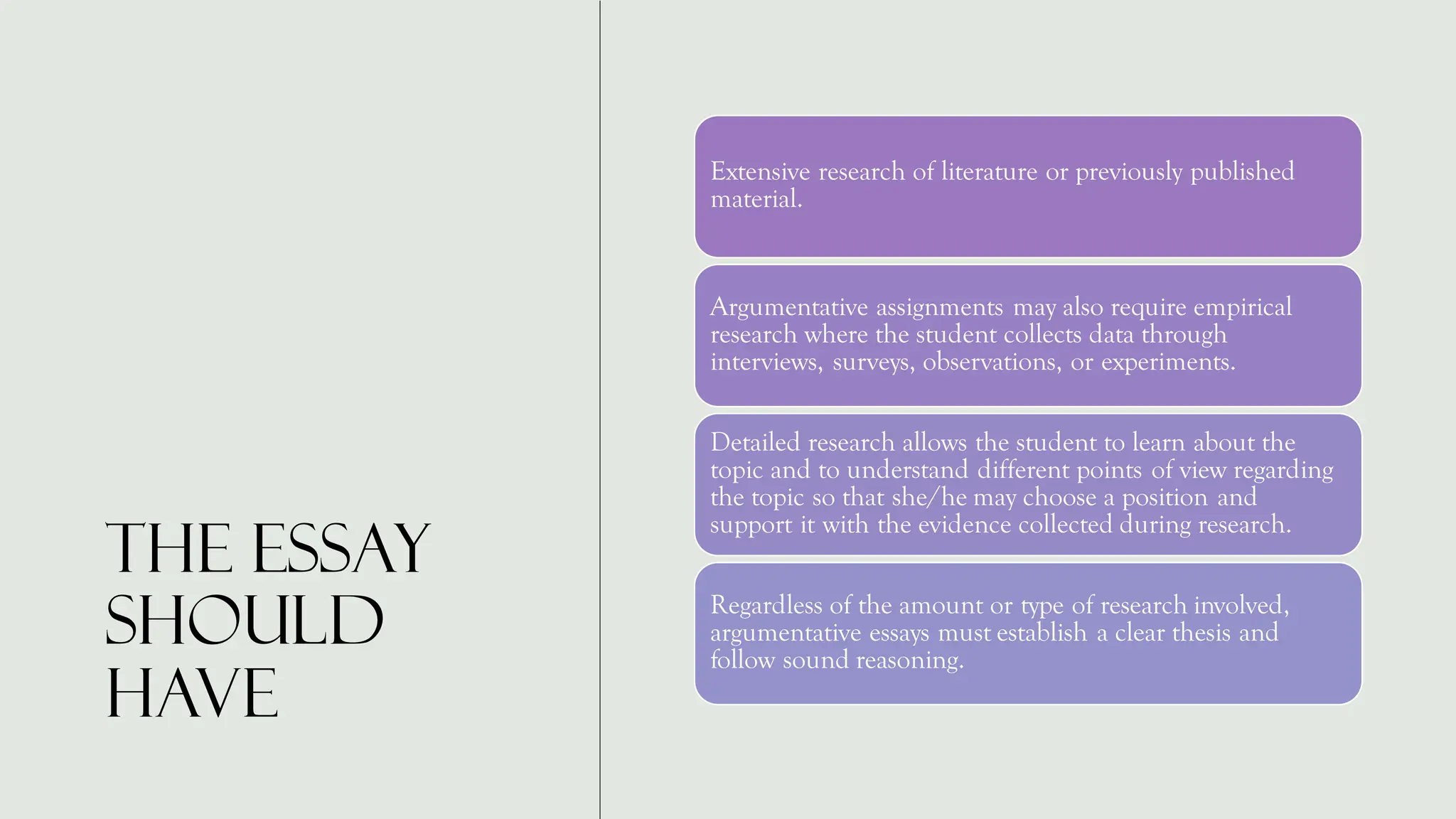
Extensive research of literature or previously published
material.
Argumentative assignments may also require empirical
research where the student collects data through
interviews, surveys, observations, or experiments.
Detailed research allows the student to learn about the
topic and to understand different points of view regarding
the topic so that she/he may choose a position and
support it with the evidence collected during research.
Regardless of the amount or type of research involved,
argumentative essays must establish a clear thesis and
follow sound reasoning.
The structure
of the
argumentative
essay
Structure
has 5
components
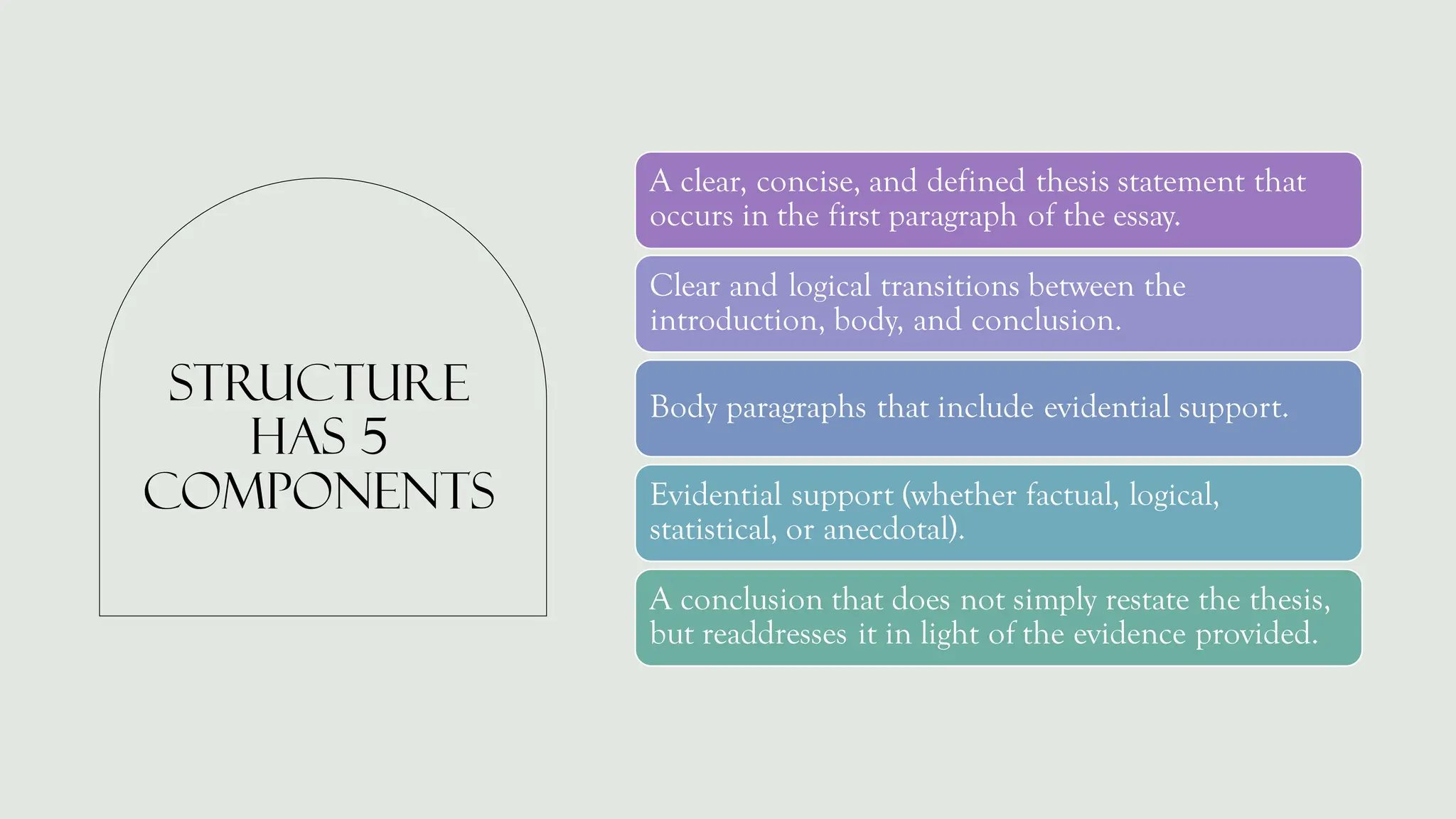
A clear, concise, and defined thesis statement that
occurs in the first paragraph of the essay.
Clear and logical transitions between the
introduction, body, and conclusion.
Body paragraphs that include evidential support.
Evidential support (whether factual, logical,
statistical, or anecdotal).
A conclusion that does not simply restate the thesis,
but readdresses it in light of the evidence provided.
A clear, concise,
and defined
thesis statement
that occurs in
the
first paragraph
of the essay.
In the first paragraph of an argument
essay, students should set the context by
reviewing the topic in a general way.
Next the author should explain why the
topic is important (exigence) or why
readers should care about the issue.
Lastly, students should present the thesis
statement.
It is essential that this thesis statement be
appropriately narrowed to follow the
guidelines set forth in the assignment.
This is a very important part of writing the
essay.
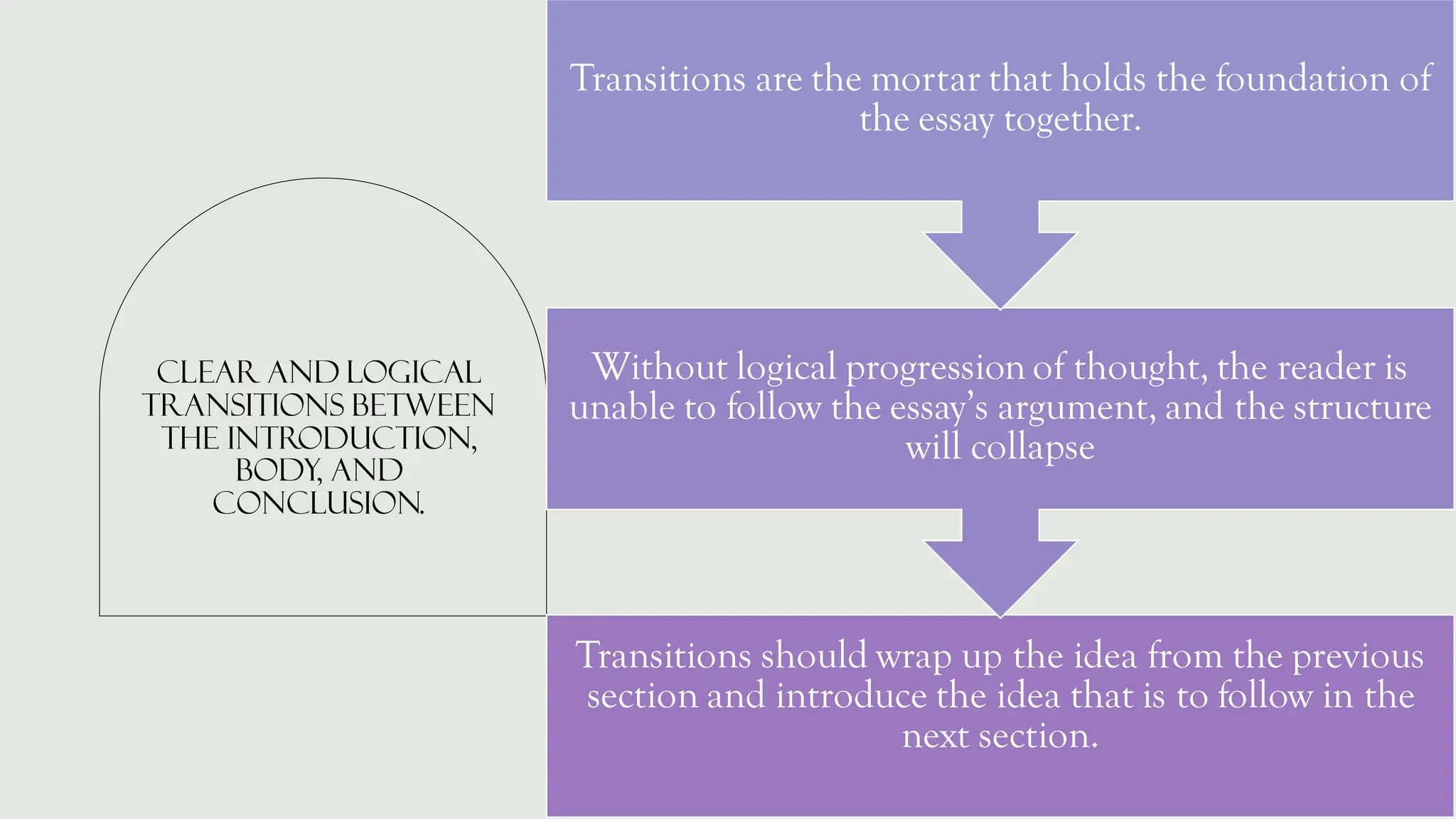
clear and logical
transitions between
the introduction,
body, and
conclusion.
Transitions should wrap up the idea from the previous
section and introduce the idea that is to follow in the
next section.
Without logical progression of thought, the reader is
unable to follow the essay’s argument, and the structure
will collapse
Transitions are the mortar that holds the foundation of
the essay together.
Body paragraphs that include
evidential support
Each paragraph should be limited to the discussion of one general idea.
This will allow for clarity and direction throughout the essay.
In addition, such conciseness creates an ease of readability for one’s audience.
It is important to note that each paragraph in the body of the essay must have some logical connection to the thesis statement in
the opening paragraph.
Some paragraphs will directly support the thesis statement with evidence collected during research.
It is also important to explain how and why the evidence supports the thesis (warrant).
VOICING CONFLICTING OPINIONS
However, argumentative
essays should also consider
and explain differing points
of view regarding the topic.
01
Depending on the length of
the assignment, students
should dedicate one or two
paragraphs of an
argumentative essay to
discussing conflicting
opinions on the topic.
02
Rather than explaining how
these differing opinions are
wrong outright, students
should note how opinions
that do not align with their
thesis might not be well
informed or how they might
be out of date
03
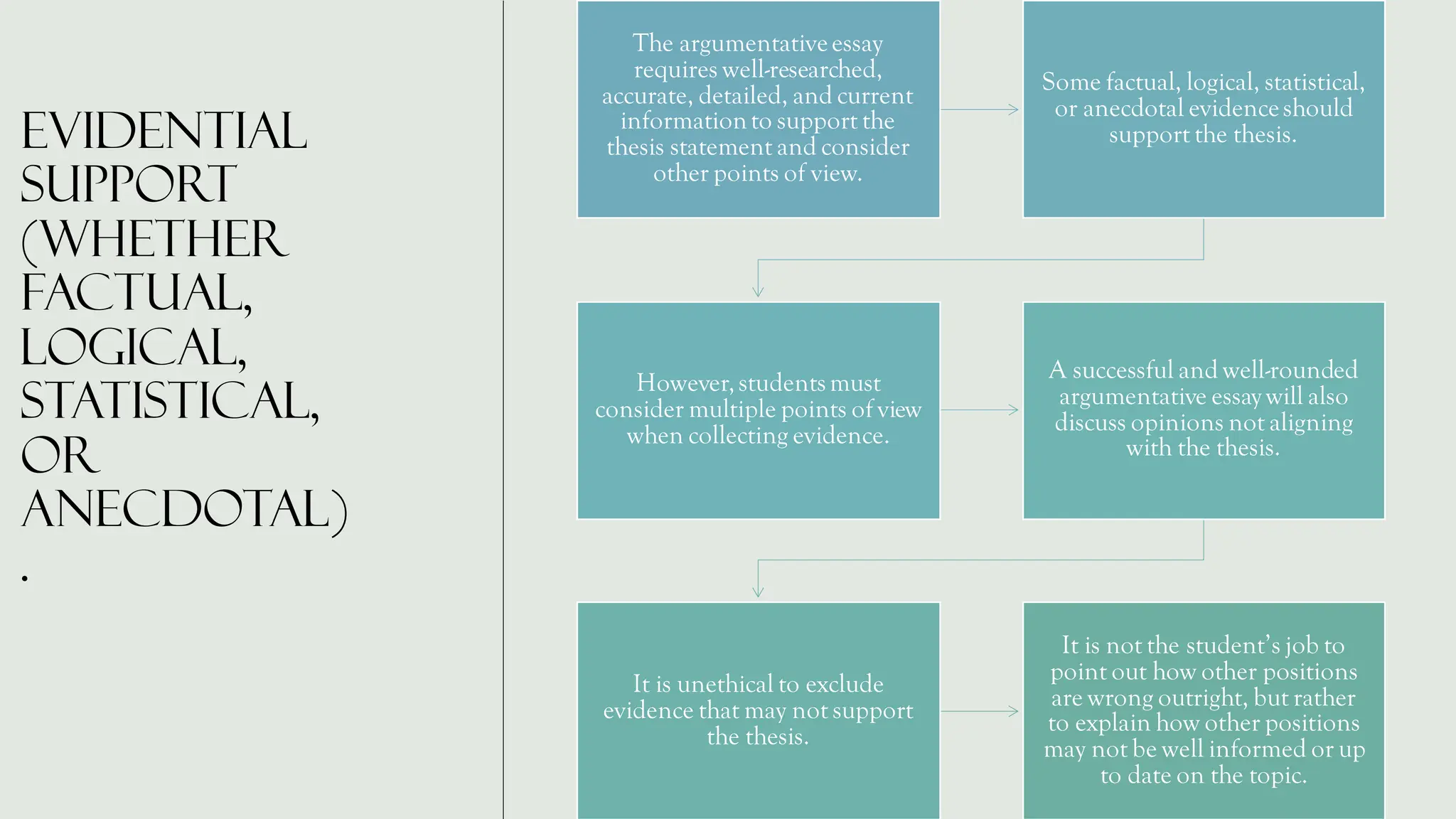
Evidential
support
(whether
factual,
logical,
statistical,
or
anecdotal)
.
The argumentativeessay
requires well-researched,
accurate, detailed, and current
informationto support the
thesis statement and consider
other points of view.
Some factual, logical, statistical,
or anecdotal evidenceshould
support the thesis.
However,studentsmust
consider multiple points of view
when collecting evidence.
A successful and well-rounded
argumentative essay will also
discuss opinions not aligning
with the thesis.
It is unethical to exclude
evidence that may not support
the thesis.
It is not the student’s job to
point out how other positions
are wrong outright, but rather
to explain how other positions
may not be well informed or up
to date on the topic.
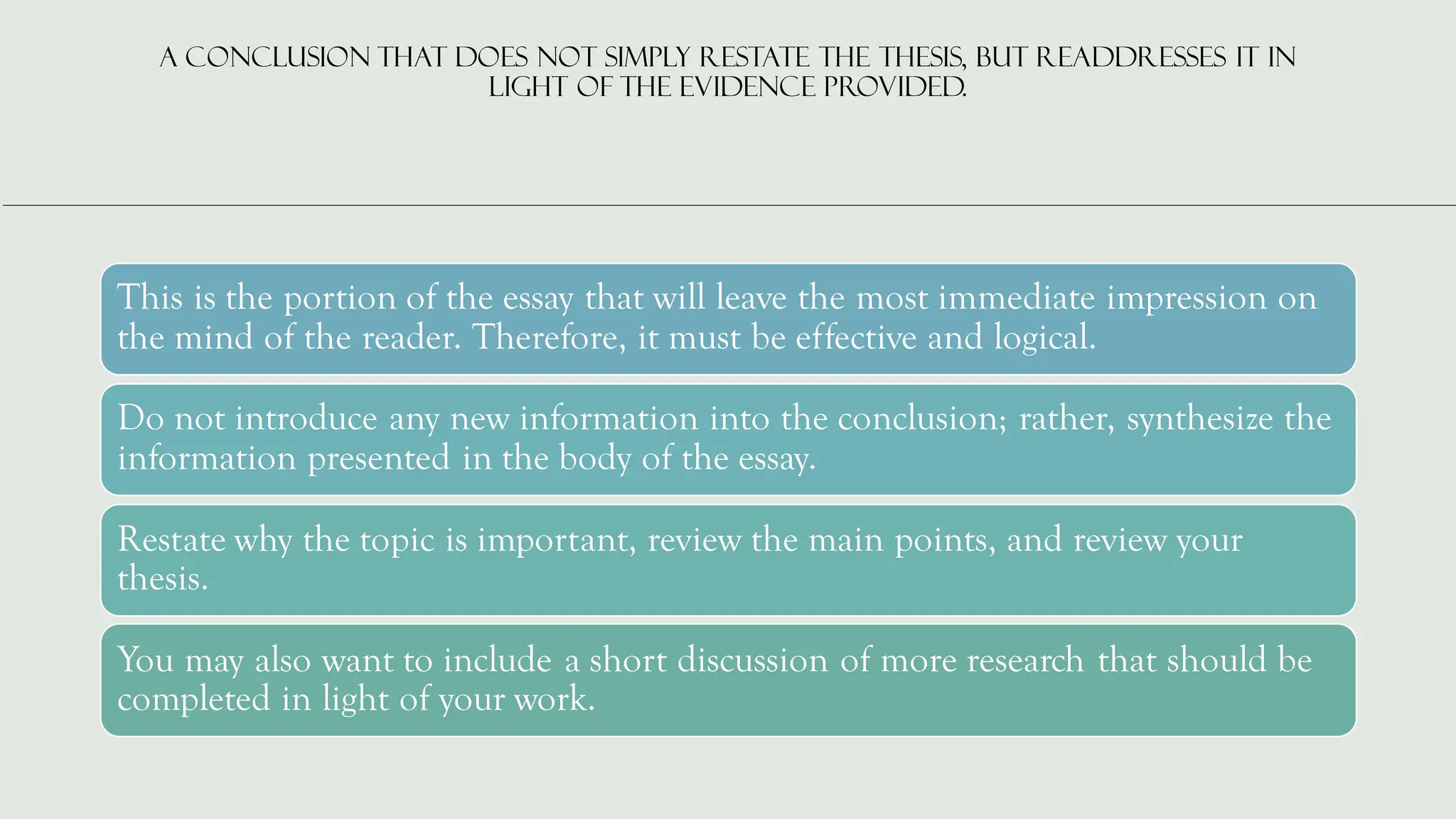
A conclusion that does not simply restate the thesis, but readdresses it in
light of the evidence provided.
This is the portion of the essay that will leave the most immediate impression on
the mind of the reader. Therefore, it must be effective and logical.
Do not introduce any new information into the conclusion; rather, synthesize the
information presented in the body of the essay.
Restate why the topic is important, review the main points, and review your
thesis.
You may also want to include a short discussion of more research that should be
completed in light of your work.
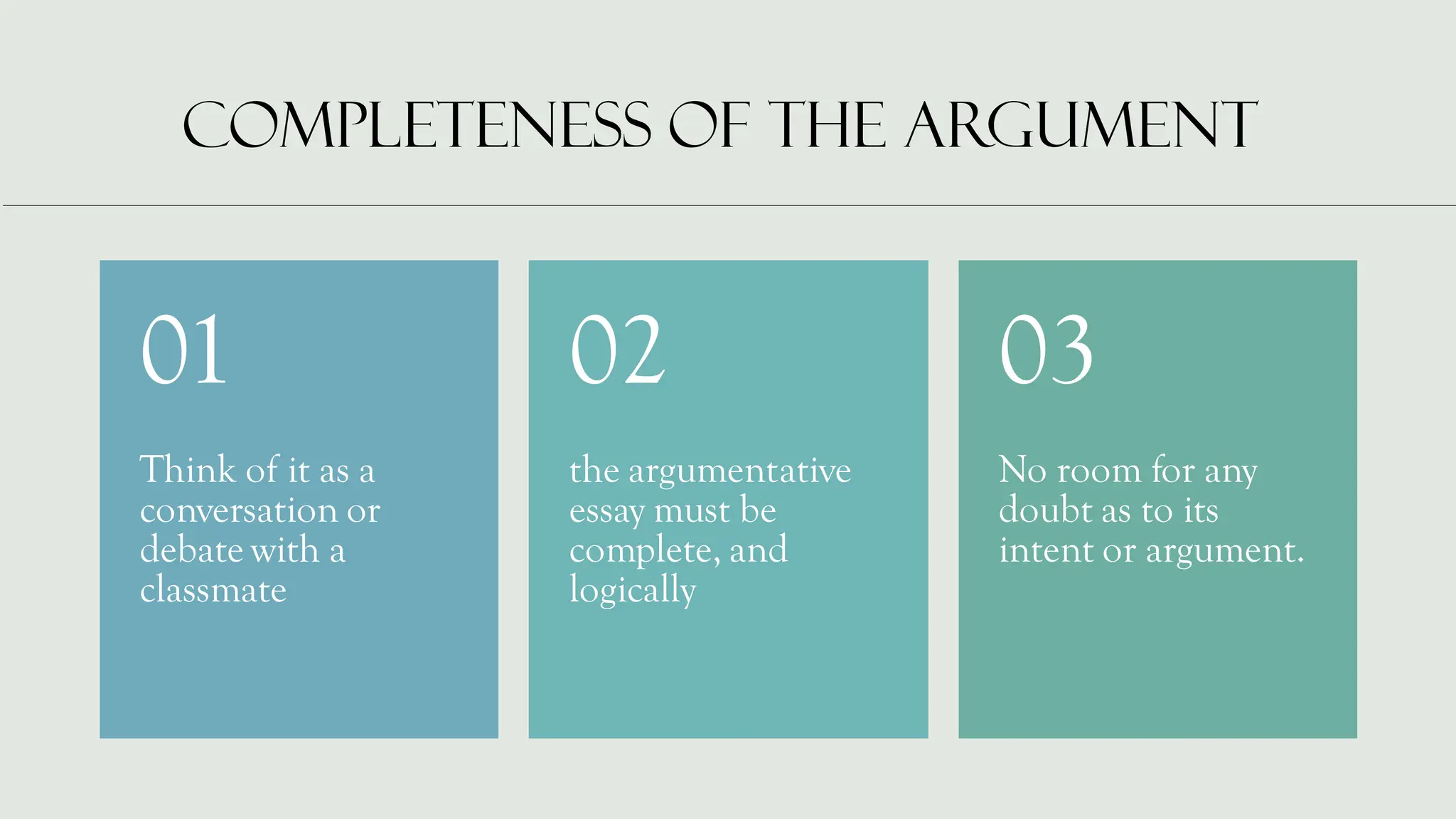
COMPLETENESS OF THE ARGUMENT
Think of it as a
conversation or
debate with a
classmate
01
the argumentative
essay must be
complete, and
logically
02
No room for any
doubt as to its
intent or argument.

03
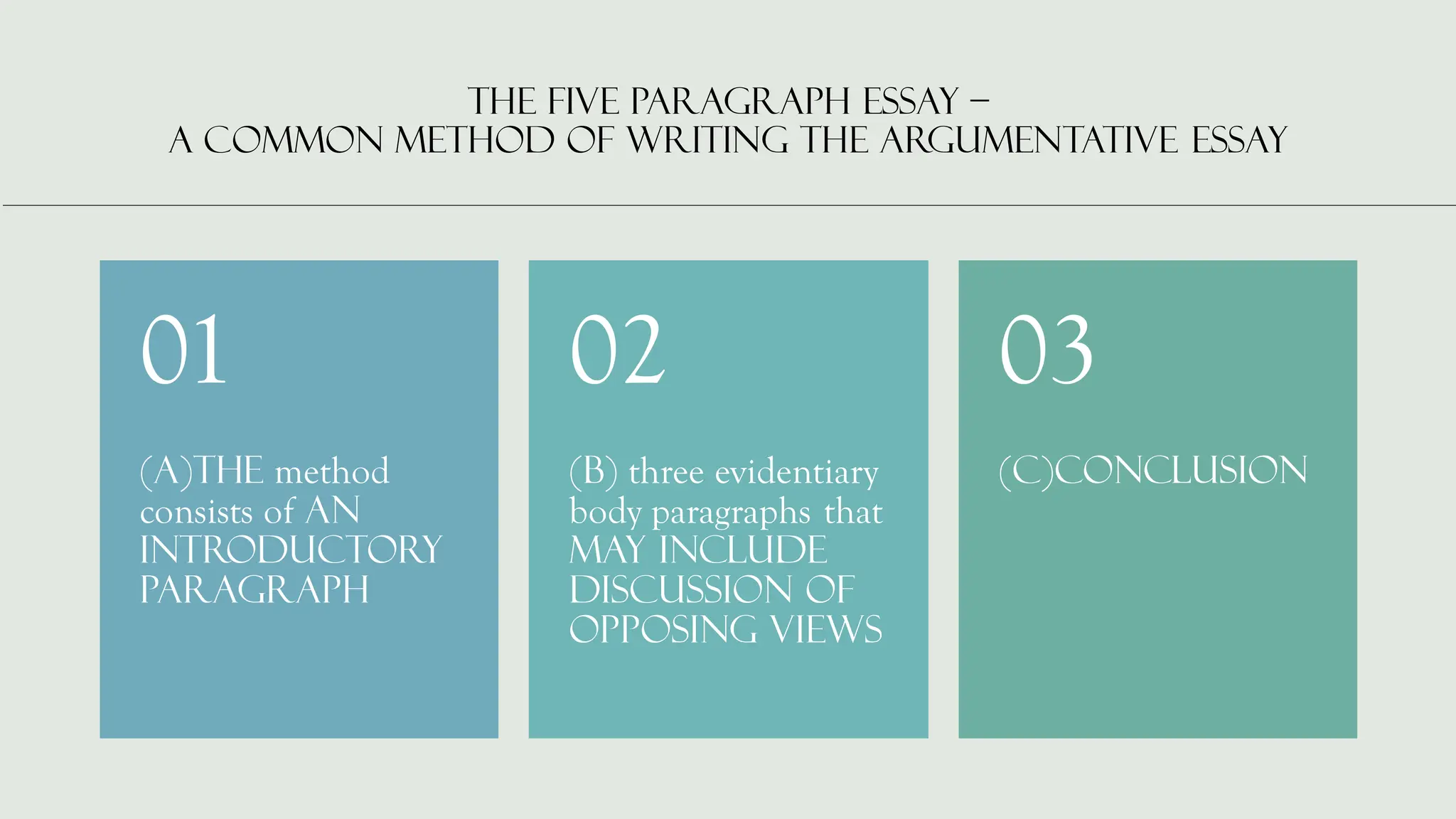
THE FIVE PARAGRAPH ESSAY –
a COMMON METHOD OF WRITING THE ARGUMENTATIVE ESSAY
(A)The method
consists of an
introductory
paragraph
01
(B) three evidentiary
body paragraphs that
may include
discussion of
opposing views
02
(C)Conclusion
03
Longer
argumentative
essay
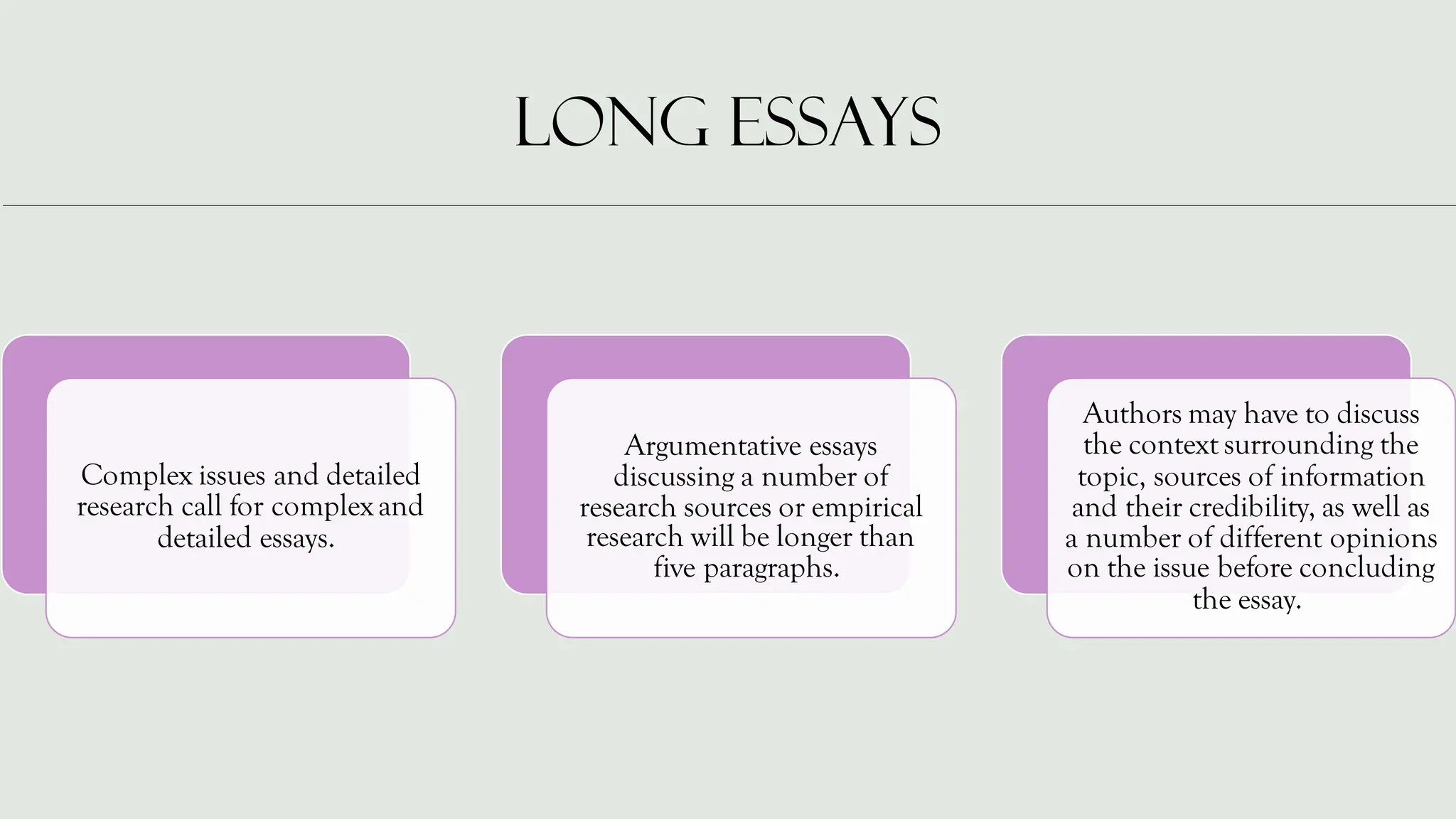
LONG ESSAYS
Complex issues and detailed
research call for complex and
detailed essays.
Argumentative essays
discussing a number of
research sources or empirical
research will be longer than
five paragraphs.
Authors may have to discuss
the context surrounding the
topic, sources of information
and their credibility, as well as
a number of different opinions
on the issue before concluding
the essay.
Source
• The content of the slides were taken from
the following websites
• https://owl.purdue.edu/owl/general_writ
ing/academic_writing/essay_writing/argu
mentative_essays.html#:~:text=What%20
is%20an%20argumentative%20essay,topi
c%20in%20a%20concise%20manner.
• https://www.smekenseducation.com/argu
mentative-v-persuasive-writ0/
ACS- Unit 4 - Part 2 slides Unit Unit000

ACS- Unit 4 - Part 2 slides Unit Unit000

  • 1.
  • 2.
  • 3.
    Similar kinds ofwriting – what's the difference between the three? Expositive Writing Persuasive writing Argumentative writing Exploratory writing
  • 4.
    Persuasive vs argumentative Withinpersuasive writing, the author presents one side of a topic or issue. There is little to no acknowledgment of the opposition. That’s one of the biggest differences between the persuasive and other kinds of writing Argumentative writing is not about winning to “get” something, but rather giving the reader another perspective to consider on a debatable topic. When introducing argumentative writing to students, describe it as a debate on paper—with both sides represented by facts, evidence, and relevant support. It’s similar to the closing arguments in a court case. Students have to perform a similar role in their writing; they have to be both the prosecutor and the defense attorney. They have to roll out the key facts of the case, the issue, for both sides. Although they are definitely more for one side, their writing has to include valid points from the other side.
  • 5.
    Understanding argumentative writing To introduce argumentativewriting is to reveal two essays on the same topic–one that’s written persuasively and one that’s written argumentatively. Before writing arguments with two sides represented - Read both essays and highlight every sentence as either a claim helping the writer’s argument or a valid counterclaim from the opposition Students will quickly see that argumentative writing is more balanced and offers facts on both sides, whereas persuasive is all me and what I want. Studying a persuasive and argumentative piece on the same topic helps see the subtle, but significant differences between them.
  • 7.
    TEACHING ARGUMENT WRITING BY GORGE HILLOCKS A persuasive(opinion) essay, you can select the most favorable evidence, appeal to emotions, and use style to persuade your readers. Your single purpose is to be convincing.” (Actually, there Hillocks, p. xvii, is quoting Kinneavy & Weaver, 1993.) “Argument, on the other hand, is mainly about logical appeals and involves claims, evidence, warrants, backing and rebuttals…Argument is at the heart of critical thinking and academic discourse…” (Hillocks, 2011)
  • 9.
  • 10.
  • 11.
  • 12.
    Expository essay vs argumentative Essay (they arevery similar) Expository essays involve less research and are shorter in length. Expository essays are often used for in-class writing exercises or tests, such as the GED or GRE. Argumentative essay involves has a fair amount of pre-writing (invention) and research involved. The argumentative essay is commonly assigned as a capstone or final project in first year writing or advanced composition courses and involves lengthy, detailed research.
  • 13.
    What does ArgumenTativEessay involve? …..........a topic c....., g...... and e....... evidence ….....a position on the topic in a c.......manner
  • 14.
    What does anargumentative essay involve? Investigate a topic Collect, generate and evaluate evidence Establish a position on the topic in a concise manner
  • 15.
    Research through Empirical research maybe carried out where students collect data through I…........ E …......... S…......... O….......
  • 16.
    Research through Empirical research maybe carried out where students collect data through Interviews Experiments Surveys. Observations
  • 17.
    The essay should have Extensive researchof literature or previously published material. Argumentative assignments may also require empirical research where the student collects data through interviews, surveys, observations, or experiments. Detailed research allows the student to learn about the topic and to understand different points of view regarding the topic so that she/he may choose a position and support it with the evidence collected during research. Regardless of the amount or type of research involved, argumentative essays must establish a clear thesis and follow sound reasoning.
  • 18.
  • 19.
    Structure has 5 components A clear,concise, and defined thesis statement that occurs in the first paragraph of the essay. Clear and logical transitions between the introduction, body, and conclusion. Body paragraphs that include evidential support. Evidential support (whether factual, logical, statistical, or anecdotal). A conclusion that does not simply restate the thesis, but readdresses it in light of the evidence provided.
  • 20.
    A clear, concise, anddefined thesis statement that occurs in the first paragraph of the essay. In the first paragraph of an argument essay, students should set the context by reviewing the topic in a general way. Next the author should explain why the topic is important (exigence) or why readers should care about the issue. Lastly, students should present the thesis statement. It is essential that this thesis statement be appropriately narrowed to follow the guidelines set forth in the assignment. This is a very important part of writing the essay.
  • 21.
    clear and logical transitionsbetween the introduction, body, and conclusion. Transitions should wrap up the idea from the previous section and introduce the idea that is to follow in the next section. Without logical progression of thought, the reader is unable to follow the essay’s argument, and the structure will collapse Transitions are the mortar that holds the foundation of the essay together.
  • 22.
    Body paragraphs thatinclude evidential support Each paragraph should be limited to the discussion of one general idea. This will allow for clarity and direction throughout the essay. In addition, such conciseness creates an ease of readability for one’s audience. It is important to note that each paragraph in the body of the essay must have some logical connection to the thesis statement in the opening paragraph. Some paragraphs will directly support the thesis statement with evidence collected during research. It is also important to explain how and why the evidence supports the thesis (warrant).
  • 23.
    VOICING CONFLICTING OPINIONS However,argumentative essays should also consider and explain differing points of view regarding the topic. 01 Depending on the length of the assignment, students should dedicate one or two paragraphs of an argumentative essay to discussing conflicting opinions on the topic. 02 Rather than explaining how these differing opinions are wrong outright, students should note how opinions that do not align with their thesis might not be well informed or how they might be out of date 03
  • 24.
    Evidential support (whether factual, logical, statistical, or anecdotal) . The argumentativeessay requires well-researched, accurate,detailed, and current informationto support the thesis statement and consider other points of view. Some factual, logical, statistical, or anecdotal evidenceshould support the thesis. However,studentsmust consider multiple points of view when collecting evidence. A successful and well-rounded argumentative essay will also discuss opinions not aligning with the thesis. It is unethical to exclude evidence that may not support the thesis. It is not the student’s job to point out how other positions are wrong outright, but rather to explain how other positions may not be well informed or up to date on the topic.
  • 25.
    A conclusion thatdoes not simply restate the thesis, but readdresses it in light of the evidence provided. This is the portion of the essay that will leave the most immediate impression on the mind of the reader. Therefore, it must be effective and logical. Do not introduce any new information into the conclusion; rather, synthesize the information presented in the body of the essay. Restate why the topic is important, review the main points, and review your thesis. You may also want to include a short discussion of more research that should be completed in light of your work.
  • 26.
    COMPLETENESS OF THEARGUMENT Think of it as a conversation or debate with a classmate 01 the argumentative essay must be complete, and logically 02 No room for any doubt as to its intent or argument. 03

  • 27.
    THE FIVE PARAGRAPHESSAY – a COMMON METHOD OF WRITING THE ARGUMENTATIVE ESSAY (A)The method consists of an introductory paragraph 01 (B) three evidentiary body paragraphs that may include discussion of opposing views 02 (C)Conclusion 03
  • 28.
  • 29.
    LONG ESSAYS Complex issuesand detailed research call for complex and detailed essays. Argumentative essays discussing a number of research sources or empirical research will be longer than five paragraphs. Authors may have to discuss the context surrounding the topic, sources of information and their credibility, as well as a number of different opinions on the issue before concluding the essay.
  • 30.
    Source • The contentof the slides were taken from the following websites • https://owl.purdue.edu/owl/general_writ ing/academic_writing/essay_writing/argu mentative_essays.html#:~:text=What%20 is%20an%20argumentative%20essay,topi c%20in%20a%20concise%20manner. • https://www.smekenseducation.com/argu mentative-v-persuasive-writ0/