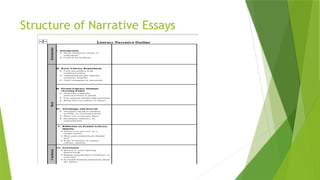
Types of Essays:Pieces within the
narrative genre
This I Believe” essays,
Epiphany Moment essays,
Personal narratives, or
Literacy narratives
Memoirs
share some common characteristics
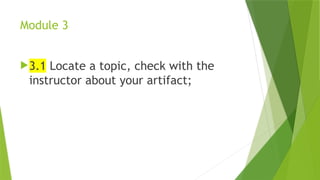
4.
“This I Believe”Essays
Purpose: To state and reflect on a deeply held personal
belief or value.
Content: The writer shares a core belief—often tied to life
experience—and explains how it shapes their actions or
worldview.
Structure: Usually begins with a clear statement of belief,
followed by one or two vivid, concrete examples that
illustrate how the belief has played out in real life.
Example Topic: “I believe in the power of small acts of
kindness.”
5.
Epiphany Moment Essays
Purpose: To capture a moment of sudden insight,
realization, or shift in perspective.
Content: Centers on a single turning point or “aha!”
moment, often sparked by a specific event or conversation.
Structure: Builds toward the moment of realization, then
unpacks its personal significance.
Example Topic: Realizing during a volunteer shift that
“helping” isn’t always about solving problems—it can be
about listening.
6.
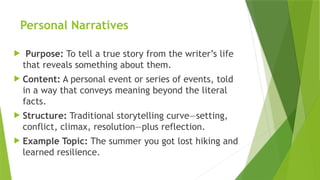
Personal Narratives
Purpose:To tell a true story from the writer’s life
that reveals something about them.
Content: A personal event or series of events, told
in a way that conveys meaning beyond the literal
facts.
Structure: Traditional storytelling curve—setting,
conflict, climax, resolution—plus reflection.
Example Topic: The summer you got lost hiking and
learned resilience.
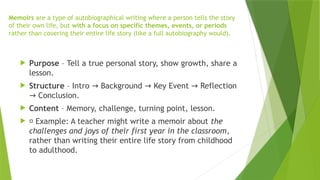
7.
Memoirs are atype of autobiographical writing where a person tells the story
of their own life, but with a focus on specific themes, events, or periods
rather than covering their entire life story (like a full autobiography would).
Purpose – Tell a true personal story, show growth, share a
lesson.
Structure – Intro Background Key Event Reflection
→ → →
Conclusion.
→
Content – Memory, challenge, turning point, lesson.
📘 Example: A teacher might write a memoir about the
challenges and joys of their first year in the classroom,
rather than writing their entire life story from childhood
to adulthood.
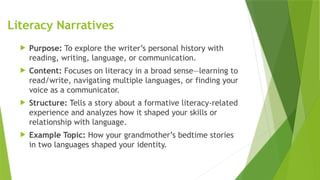
8.
Literacy Narratives
Purpose:To explore the writer’s personal history with
reading, writing, language, or communication.
Content: Focuses on literacy in a broad sense—learning to
read/write, navigating multiple languages, or finding your
voice as a communicator.
Structure: Tells a story about a formative literacy-related
experience and analyzes how it shaped your skills or
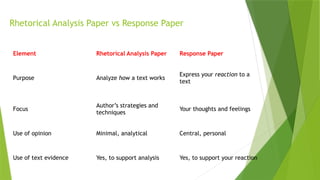
relationship with language.
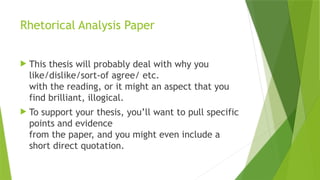
Example Topic: How your grandmother’s bedtime stories
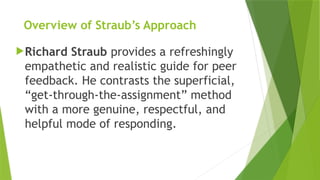
in two languages shaped your identity.
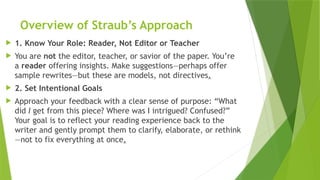
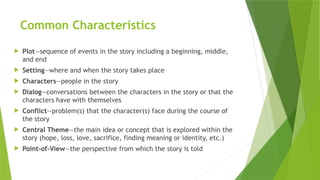
9.
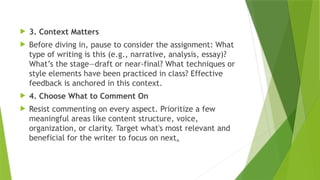
Common Characteristics
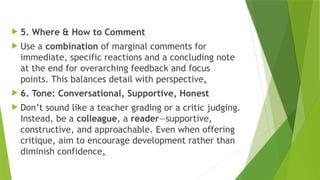
Plot—sequenceof events in the story including a beginning, middle,
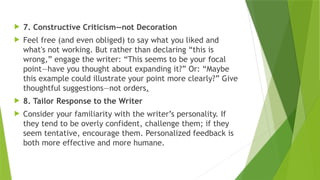
and end
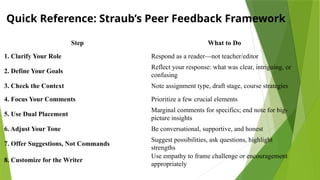
Setting—where and when the story takes place
Characters—people in the story
Dialog—conversations between the characters in the story or that the
characters have with themselves
Conflict—problem(s) that the character(s) face during the course of
the story
Central Theme—the main idea or concept that is explored within the
story (hope, loss, love, sacrifice, finding meaning or identity, etc.)
Point-of-View—the perspective from which the story is told
10.
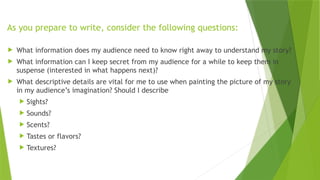
As you prepareto write, consider the following questions:
What information does my audience need to know right away to understand my story?
What information can I keep secret from my audience for a while to keep them in
suspense (interested in what happens next)?
What descriptive details are vital for me to use when painting the picture of my story
in my audience’s imagination? Should I describe
Sights?
Sounds?
Scents?
Tastes or flavors?
Textures?
11.
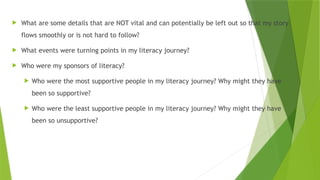
What aresome details that are NOT vital and can potentially be left out so that my story
flows smoothly or is not hard to follow?
What events were turning points in my literacy journey?
Who were my sponsors of literacy?
Who were the most supportive people in my literacy journey? Why might they have
been so supportive?
Who were the least supportive people in my literacy journey? Why might they have
been so unsupportive?
12.
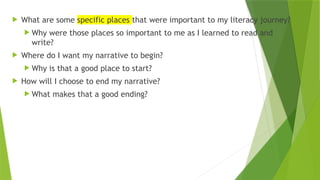
What aresome specific places that were important to my literacy journey?
Why were those places so important to me as I learned to read and
write?
Where do I want my narrative to begin?
Why is that a good place to start?
How will I choose to end my narrative?
What makes that a good ending?
13.
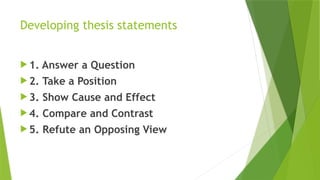
Developing thesis statements
1. Answer a Question
2. Take a Position
3. Show Cause and Effect
4. Compare and Contrast
5. Refute an Opposing View
14.
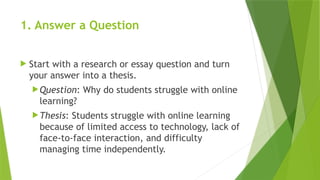
1. Answer aQuestion
Start with a research or essay question and turn
your answer into a thesis.
Question: Why do students struggle with online
learning?
Thesis: Students struggle with online learning
because of limited access to technology, lack of
face-to-face interaction, and difficulty
managing time independently.
15.
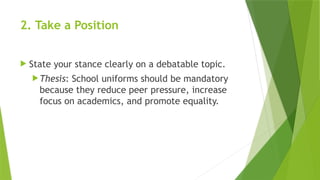
2. Take aPosition
State your stance clearly on a debatable topic.
Thesis: School uniforms should be mandatory
because they reduce peer pressure, increase
focus on academics, and promote equality.
16.
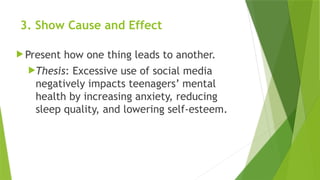
3. Show Causeand Effect
Present how one thing leads to another.
Thesis: Excessive use of social media
negatively impacts teenagers’ mental
health by increasing anxiety, reducing
sleep quality, and lowering self-esteem.
17.
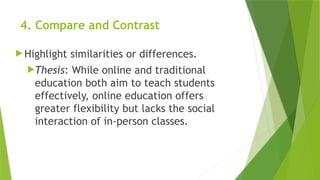
4. Compare andContrast
Highlight similarities or differences.
Thesis: While online and traditional
education both aim to teach students
effectively, online education offers
greater flexibility but lacks the social
interaction of in-person classes.
18.
5. Refute anOpposing View
Start with what “they say,” then state your
counterpoint.
Thesis: Although some argue that video games
are harmful, they actually improve problem-
solving skills, teamwork, and strategic thinking.
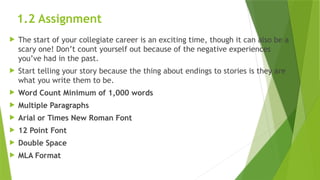
1.2 Assignment
Thestart of your collegiate career is an exciting time, though it can also be a
scary one! Don’t count yourself out because of the negative experiences
you’ve had in the past.
Start telling your story because the thing about endings to stories is they are
what you write them to be.
Word Count Minimum of 1,000 words
Multiple Paragraphs
Arial or Times New Roman Font
12 Point Font
Double Space
MLA Format
21.
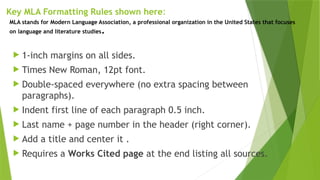
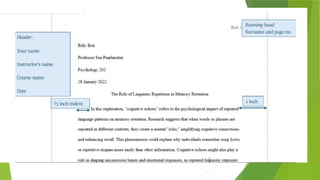
Key MLA FormattingRules shown here:
1-inch margins on all sides.
Times New Roman, 12pt font.
Double-spaced everywhere (no extra spacing between
paragraphs).
Indent first line of each paragraph 0.5 inch.
Last name + page number in the header (right corner).
Add a title and center it .
Requires a Works Cited page at the end listing all sources.
MLA stands for Modern Language Association, a professional organization in the United States that focuses
on language and literature studies.
23.
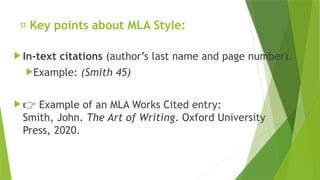
🔑 Key pointsabout MLA Style:
In-text citations (author’s last name and page number).
Example: (Smith 45)
👉 Example of an MLA Works Cited entry:
Smith, John. The Art of Writing. Oxford University
Press, 2020.
24.
Module 2
Aristotle's Definitionof Rhetoric
For the ancient Greeks, rhetoric was almost entirely connected to
public speaking.
Somebody was an effective rhetorician when he or she could figure out
what persuasive techniques were called for at what times to which
audiences regardless of the subject being discussed.
25.
Aristotle claims thatthere are three modes of persuasion.
Today we call these modes the rhetorical appeals.
Ethos—
Pathos
Logos
26.
Aristotle claims thatthere are three modes of persuasion.
Today we call these modes the rhetorical appeals.
Ethos—an appeal to the personal character, goodness, or expertise of the
speaker. The point, for Aristotle, is simply that people are persuaded by
the character of the speaker as well as the message, and your chances of
being persuasive go up if you can demonstrate that your message is coming
from a reliable messenger.
I believe Myrtle’s advice about my car because she has been a reliable
mechanic for twenty years.
27.
Pathos—an appeal tothe emotions of the audience but also being able
to put the audience into a particular state of mind.
Aristotle’s thinking here is that people reason
differently when they are in different states of mind.
For example, a person who is afraid—or who has
been scared into thinking—that crime is widespread
in the neighborhood, might be more easily persuaded
to buy a home security system from a door-to-door
salesperson or a telemarketer than someone who is
not afraid.
28.
Logos—the logic orreasoning of the speech itself
For Aristotle, the logic of a speech was the most
important mode of persuasion. But he acknowledged that
human nature was such that we are not always persuaded
by logic.
So he often says that one should start with a logical
argument and add the other modes to it to increase
persuasiveness, and he would never have recommended
attempting to persuade an audience of something that
was untrue.
29.
Two main wayslogic works in Aristotelian rhetoric
1. Enthymeme
2. An illustrative example
30.
Two main wayslogic works in Aristotelian rhetoric
1. Enthymeme (deduction used in
→
persuasion).
(e.g., All humans are mortal. Socrates
is a human. Therefore, Socrates is
mortal.).
31.
An illustrative example
Example Every coffee shop that I visited in my
→
hometown had music playing in the background. This
fact shows that music is integral to selling coffee.
Out of a series of examples, the writer induces a
principle.
32.
Kenneth Burke's Definition
Burke was interested in what motivated people to do certain
things, and he used the analogy of drama to analyze how
people interacting with one another use symbols to induce
cooperation.
The Dramatic Pentad: consists of the following five elements:
33.
Kenneth Burke’spentad :helps us analyze and
understand rhetorical situations. Here’s a
breakdown in simpler terms:
Burke’s pentad is a tool to ask:
Act: What happened (or what was said/written)?
Scene: Where and when did it happen?
Agent: Who did it?
Agency: How was it done?
Purpose: Why was it done?
34.
Here isan example:
Act—a music concert
Scene—a club in New York
Agent(s)—Talking Heads (a band from the
late 70’s through early 90’s)
Agency—musical instruments, the human
voice, electronic equipment
Purpose(s)—to entertain, to make money,
to express ideas
35.
Burke’s pentadhelps writers go beyond just what
was written to explore the deeper motives behind
writing—whether in others’ texts or in their own
essays.
36.
Berthoff’s Definition
•Berthoff’s agreesthat signs and interpretation
are central, but she shifts the focus. For her,
rhetoric is less about persuasion/cooperation and
more about making meaning—understanding the
world and our actions through language.
37.
Berthoff believesin the necessity to use language
(signs) to understand and convey ideas.
Phrasing your ideas in different ways will create
different effects on your audience, but it will also
help you clarify and articulate the meaning of the
information that you have created for yourself.
38.
One ofBerthoff’s favorite pieces of advice for student writers is to
think about your thinking or to write about your writing. The fancy
technical term for this is metacognition. We can also call
this reflection. She encourages students to ask themselves this
question: “How would it change my meaning if I put it this way?”
39.
👉 In short:
Burke= rhetoric persuasion
→
through signs (cooperation).
Berthoff = rhetoric meaning-
→
making through signs (reflection,
reinterpretation).
40.
In essays, persuasionrelies on several key elements that work together to convince the reader.
The main elements of persuasion are:
1. Ethos (Credibility) – Establishing the writer’s authority, trustworthiness, or expertise on the
subject. Readers are more likely to believe an argument when the writer shows knowledge,
fairness, and reliability.
2. Pathos (Emotion) – Appealing to the audience’s feelings, values, or experiences to create a
strong emotional connection. This could include storytelling, vivid language, or examples
that spark sympathy, anger, or inspiration.
3. Logos (Logic) – Using clear reasoning, facts, statistics, and evidence to support the
argument. Logical structure and well-organized ideas make the essay convincing and harder
to refute.
4. Kairos (Timeliness/Context) – Presenting the argument at the right time or within the right
context, showing why the issue matters now. This emphasizes urgency and relevance.
5. Clear Thesis and Purpose – A strong persuasive essay must clearly state its position and goal
so the reader understands exactly what is being argued.
6. Counterarguments and Refutation – Acknowledging opposing viewpoints and responding to
them strengthens credibility and shows fairness.
41.
Writers usually writewith one or more purposes in mind—to
inform, to persuade, to entertain, or to express
feelings/ideas.
When the purpose is to inform, the writing must be clear, factual, and organized so
the reader learns something new.
If the purpose is to persuade, the writer uses arguments, evidence, and appeals to
convince the audience to agree or take action.
Writing to entertain often uses creativity, storytelling, or humor to capture the
reader’s attention and enjoyment.
When the purpose is to express, the writing may be more personal, reflective, or
emotional, helping the writer share thoughts and feelings.
By identifying the purpose, a writer can choose the right style, structure, and
language to achieve the goal effectively.
42.
Understanding the IntendedAudience
It is crucial that a writer understands his or her intended audience.
When writers know their audience, they can choose the right tone,
vocabulary, and level of detail to make their ideas clear and
relatable. For example, the way you explain a concept to children
will be very different from how you present it to experts in the field.
Understanding the audience also helps the writer anticipate
questions, objections, or interests, which makes the writing more
persuasive and engaging. Without this awareness, writing can feel
disconnected, confusing, or irrelevant to readers.
In short, knowing the audience ensures that the message is
effective, meaningful, and impactful.
43.
Considerations
Take intoaccount the size of the audience
Take into account the audience’s familiarity with
the topic
Take into account the use of humor or formality
Take into account the time allotted for speaking
Take into account the opinions surrounding this
topic .
44.
2.1 Discussion
The elementsof writing include:
1. Purpose – The reason for writing (to inform, persuade, entertain, or explain).
2. Audience – The intended readers, which influence the tone, style, and level of detail.
3. Ideas/Content – The main message, details, and evidence that support the writing.
4. Organization – The structure and flow of the writing (introduction, body, conclusion; logical
sequencing).
5. Voice – The writer’s unique style, personality, and attitude expressed in the writing.
6. Word Choice – The use of precise, vivid, and appropriate language.
7. Sentence Fluency – The rhythm and flow of sentences, using variety and clarity.
8. Conventions – Grammar, spelling, punctuation, capitalization, and mechanics.
9. Presentation – The final appearance, including formatting, layout, and visuals (especially
important in formal or digital texts).
Module 3: RhetoricalAnalysis Essay:
Goal:
To analyze how an author presents their argument or
message—not what the author is saying, but how they say
it and whether it's effective.
Key Questions:
What is the author’s main argument?
Who is the intended audience?
How does the author use rhetorical strategies to persuade?
Is the argument effective or not? Why?
47.
Module 3: RhetoricalAnalysis Essay:
Focuses on:
Author’s purpose
Audience
Rhetorical appeals (ethos, pathos, logos)
Tone and style
Structure and organization
Use of evidence or persuasive techniques
48.
Module 3 RhetoricalAnalysis Essay:
Strong analysis:
Some kind of artifact (i.e., poem, song, book, and movie)
Introduction of what it is being interpreted (short description of the artifact itself,
perhaps give the historical, social, political, etc. relevance of the artifact itself)
Thorough descriptions of passages or phrases or scenes or messages in the artifact
(analysis and examples of the artifact’s contents and features)
Interesting and relevant elaborations that connect the artifact’s contents,
concepts, and features to other artifacts, concepts, people, places, issues, events,
and so forth.
Opinion in the closing paragraph—optional(of what the artifact’s message[s] are
conveying to you . . . limit bias or at least acknowledge it in your writing)
Effectively addressing the guiding questions listed earlier—optional
Design of the product (the writing that explains and analyzes the artifact)
49.
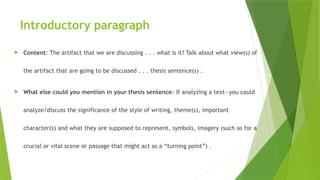
Introductory paragraph
Content:The artifact that we are discussing . . . what is it? Talk about what view(s) of
the artifact that are going to be discussed . . . thesis sentence(s) .
What else could you mention in your thesis sentence: If analyzing a text—you could
analyze/discuss the significance of the style of writing, theme(s), important
character(s) and what they are supposed to represent, symbols, imagery (such as for a
crucial or vital scene or passage that might act as a “turning point”) .
50.
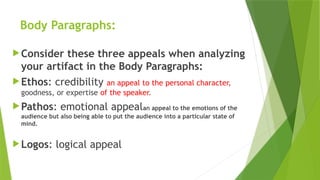
Body Paragraphs:
Consider thesethree appeals when analyzing
your artifact in the Body Paragraphs:
Ethos: credibility an appeal to the personal character,
goodness, or expertise of the speaker.
Pathos: emotional appealan appeal to the emotions of the
audience but also being able to put the audience into a particular state of
mind.
Logos: logical appeal
51.
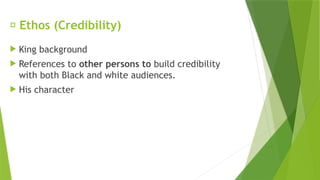
✅ Ethos (Credibility)
King background
References to other persons to build credibility
with both Black and white audiences.
His character
52.
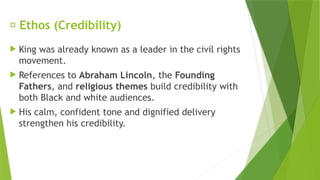
✅ Ethos (Credibility)
King was already known as a leader in the civil rights
movement.
References to Abraham Lincoln, the Founding
Fathers, and religious themes build credibility with
both Black and white audiences.
His calm, confident tone and dignified delivery
strengthen his credibility.
✅ Pathos (Emotion)
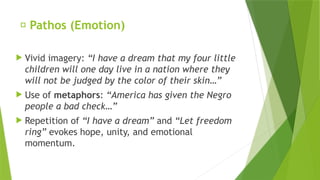
Vivid imagery: “I have a dream that my four little
children will one day live in a nation where they
will not be judged by the color of their skin…”
Use of metaphors: “America has given the Negro
people a bad check…”
Repetition of “I have a dream” and “Let freedom
ring” evokes hope, unity, and emotional
momentum.
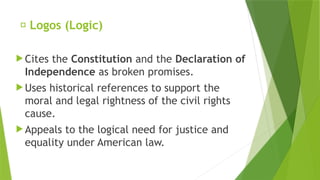
✅ Logos (Logic)
Cites the Constitution and the Declaration of
Independence as broken promises.
Uses historical references to support the
moral and legal rightness of the civil rights
cause.
Appeals to the logical need for justice and
equality under American law.
57.
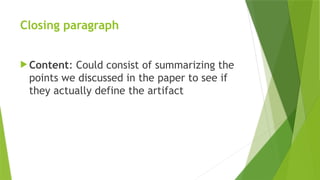
Closing paragraph
Content:Could consist of summarizing the
points we discussed in the paper to see if
they actually define the artifact
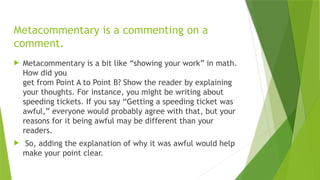
Metacommentary is acommenting on a
comment.
Metacommentary is a bit like “showing your work” in math.
How did you
get from Point A to Point B? Show the reader by explaining
your thoughts. For instance, you might be writing about
speeding tickets. If you say “Getting a speeding ticket was
awful,” everyone would probably agree with that, but your
reasons for it being awful may be different than your
readers.
So, adding the explanation of why it was awful would help
make your point clear.
60.
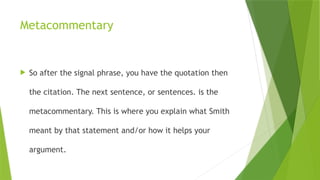
Metacommentary
So afterthe signal phrase, you have the quotation then
the citation. The next sentence, or sentences. is the
metacommentary. This is where you explain what Smith
meant by that statement and/or how it helps your
argument.
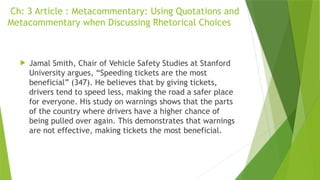
Ch: 3 Article: Metacommentary: Using Quotations and
Metacommentary when Discussing Rhetorical Choices
Jamal Smith, Chair of Vehicle Safety Studies at Stanford
University argues, “Speeding tickets are the most
beneficial” (347). He believes that by giving tickets,
drivers tend to speed less, making the road a safer place
for everyone. His study on warnings shows that the parts
of the country where drivers have a higher chance of
being pulled over again. This demonstrates that warnings
are not effective, making tickets the most beneficial.
63.
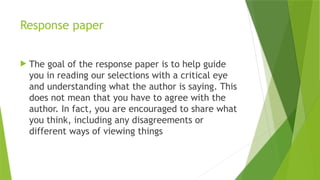
Response paper
Thegoal of the response paper is to help guide
you in reading our selections with a critical eye
and understanding what the author is saying. This
does not mean that you have to agree with the
author. In fact, you are encouraged to share what
you think, including any disagreements or
different ways of viewing things
64.
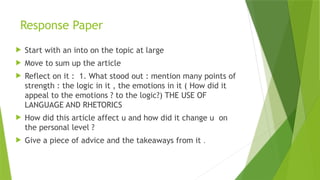
Response Paper
Startwith an into on the topic at large
Move to sum up the article
Reflect on it : 1. What stood out : mention many points of
strength : the logic in it , the emotions in it ( How did it
appeal to the emotions ? to the logic?) THE USE OF
LANGUAGE AND RHETORICS
How did this article affect u and how did it change u on
the personal level ?
Give a piece of advice and the takeaways from it .
65.
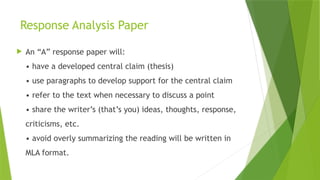
Response Analysis Paper
An “A” response paper will:
• have a developed central claim (thesis)
• use paragraphs to develop support for the central claim
• refer to the text when necessary to discuss a point
• share the writer’s (that’s you) ideas, thoughts, response,
criticisms, etc.
• avoid overly summarizing the reading will be written in
MLA format.
66.
Rhetorical Analysis Papervs Response Paper
Element Rhetorical Analysis Paper Response Paper
Purpose Analyze how a text works
Express your reaction to a
text
Focus
Author’s strategies and
techniques
Your thoughts and feelings
Use of opinion Minimal, analytical Central, personal
Use of text evidence Yes, to support analysis Yes, to support your reaction
67.
Rhetorical Analysis Paper
This thesis will probably deal with why you
like/dislike/sort-of agree/ etc.
with the reading, or it might an aspect that you
find brilliant, illogical.
To support your thesis, you’ll want to pull specific
points and evidence
from the paper, and you might even include a
short direct quotation.
68.
Overview of Straub’sApproach
Richard Straub provides a refreshingly
empathetic and realistic guide for peer
feedback. He contrasts the superficial,
“get-through-the-assignment” method
with a more genuine, respectful, and
helpful mode of responding.
69.
Overview of Straub’sApproach
1. Know Your Role: Reader, Not Editor or Teacher
You are not the editor, teacher, or savior of the paper. You’re
a reader offering insights. Make suggestions—perhaps offer
sample rewrites—but these are models, not directives.
2. Set Intentional Goals
Approach your feedback with a clear sense of purpose: “What
did I get from this piece? Where was I intrigued? Confused?”
Your goal is to reflect your reading experience back to the
writer and gently prompt them to clarify, elaborate, or rethink
—not to fix everything at once.
70.
3. ContextMatters
Before diving in, pause to consider the assignment: What
type of writing is this (e.g., narrative, analysis, essay)?
What’s the stage—draft or near-final? What techniques or
style elements have been practiced in class? Effective
feedback is anchored in this context.
4. Choose What to Comment On
Resist commenting on every aspect. Prioritize a few
meaningful areas like content structure, voice,
organization, or clarity. Target what's most relevant and
beneficial for the writer to focus on next.
71.
5. Where& How to Comment
Use a combination of marginal comments for
immediate, specific reactions and a concluding note
at the end for overarching feedback and focus
points. This balances detail with perspective.
6. Tone: Conversational, Supportive, Honest
Don’t sound like a teacher grading or a critic judging.
Instead, be a colleague, a reader—supportive,
constructive, and approachable. Even when offering
critique, aim to encourage development rather than
diminish confidence.
72.
7. ConstructiveCriticism—not Decoration
Feel free (and even obliged) to say what you liked and
what's not working. But rather than declaring “this is
wrong,” engage the writer: “This seems to be your focal
point—have you thought about expanding it?” Or: “Maybe
this example could illustrate your point more clearly?” Give
thoughtful suggestions—not orders.
8. Tailor Response to the Writer
Consider your familiarity with the writer’s personality. If
they tend to be overly confident, challenge them; if they
seem tentative, encourage them. Personalized feedback is
both more effective and more humane.
73.
Step What toDo
1. Clarify Your Role Respond as a reader—not teacher/editor
2. Define Your Goals
Reflect your response: what was clear, intriguing, or
confusing
3. Check the Context Note assignment type, draft stage, course strategies
4. Focus Your Comments Prioritize a few crucial elements
5. Use Dual Placement
Marginal comments for specifics; end note for big-
picture insights
6. Adjust Your Tone Be conversational, supportive, and honest
7. Offer Suggestions, Not Commands
Suggest possibilities, ask questions, highlight
strengths
8. Customize for the Writer
Use empathy to frame challenge or encouragement
appropriately
Quick Reference: Straub’s Peer Feedback Framework
Module 5: READCH 7,8,9
What is Multimodality?
Multimodality is an inter-disciplinary approach that
understands communication and representation to
be more than about language. It has been
developed over the past decade to systematically
address much-debated questions about changes in
society, for instance in relation to new media and
technologies
76.
What is Multimodality?
First, multimodality assumes that representation and
communication always draw on a multiplicity of modes, all
of which contribute to meaning. It focuses on analyzing
and describing the full repertoire of meaning-making
resources that people use (visual,spoken, gestural,
written, three-dimensional, and others, depending on the
domain of representation) in different contexts, and on
developing means that show how these are
organized to make meaning.
77.
What is Multimodality?
Second, multimodality assumes that resources are socially shaped over time to become
meaning making resources that articulate the (social, individual/affective) meanings
demanded by the requirements of different communities. These organized sets of
semiotic resources for making meaning are referred to as modes which realize
communicative work in distinct ways – making the choice of mode a central aspect of
interaction and meaning. The more a set of resources has been used in the social life of a
particular community, the more fully and finely articulated it will have become. In order
for something to ‘be a mode’ there needs to be a shared cultural sense within a
community of a set of resources and how these can be organized to realize meaning.
78.
5.1 assignment
Examplesof this assignment include combining one (or
more) forms of communication to present your argument:
Essay, Infographic, Instruction Manual or Video, E-Portfolio,
Meme(s). Students can even create a video to go along with
a written supplement to form the project



![Module 3 Rhetorical Analysis Essay:
Strong analysis:
Some kind of artifact (i.e., poem, song, book, and movie)
Introduction of what it is being interpreted (short description of the artifact itself,
perhaps give the historical, social, political, etc. relevance of the artifact itself)
Thorough descriptions of passages or phrases or scenes or messages in the artifact
(analysis and examples of the artifact’s contents and features)
Interesting and relevant elaborations that connect the artifact’s contents,
concepts, and features to other artifacts, concepts, people, places, issues, events,
and so forth.
Opinion in the closing paragraph—optional(of what the artifact’s message[s] are
conveying to you . . . limit bias or at least acknowledge it in your writing)
Effectively addressing the guiding questions listed earlier—optional
Design of the product (the writing that explains and analyzes the artifact)](https://image.slidesharecdn.com/module1undergradcomp1-250909105132-f416493f/85/module-1-undergrad-comp-1-pptx-An-English-presentation-48-320.jpg)