Writing Skills
Types of Essay
Topics
• Description
• Narration
• Compare and Contrast
• Argumentation
2
• In a description essay, you write about what a
person, place, or thing is like
• The aim of descriptive essays is to provide a vivid
picture of a person, location, object, event, or
debate.
• It will offer details that will enable the reader to
imagine the item described.
• You organize the essay by describing different
parts or aspects of the main subject
Description Essay
3
• This genre encourages the student’s ability to create
a written account of a particular experience
• This genre allows for a great deal of artistic freedom
(the goal of which is to paint an image that is vivid
and moving in the mind of the reader
Objective Description
• Precise, factual language with denotation
Subjective Description
• Rich suggestive language with connotations
Description Essay
4
Here are some guidelines for writing a descriptive
essay:
Take time to brainstorm
Use clear and concise & vivid language
Use your senses
Leave the reader with a clear impression
Be organized
Description Essay
5
To state the incident or event
• It is usually found in the feature writing sections of
newspaper or magazine
• If written as a story, the essay should include all
the parts of a story.
• The essay should have a purpose
• The essay should be written from a clear point of
view
• Use clear and concise language throughout the
essay
Narration
6
The use of the first person pronoun ‘I’ is welcomed.
As always, be organized
Like story telling, add narrative detail
Narrative variety
Verb tense consistent and accurate
Narration
7
An expository essay provides a clear, focused
explanation of a topic.
It doesn’t require an original argument, just a
balanced and well-organized view of the topic.
Expository essays test your familiarity with a topic
and your ability to organize and convey information.
Expository writing is defined as presenting reasons,
explanations, or steps in a process - Informational
writing
Expository Essay
8
• An expository essay should follow a logical
sequence and have three different main points
• Logic and coherence is the main focus of an
expository essay
• Expository Essay: There are three different types
of expository essays:
1) Essay that is developed with examples and/or
facts and statistics
2) Essay that is developed with steps in a process
3) Essay that is in a compare and contrast format
Expository Essay
9
Two Methods to Present Compare & Contrast
1. The block method.
Write everything about one topic or idea, and then in
a later paragraph or paragraphs you write entirely
about the other topic.
In the second topic, you must be sure to bring up
the same points and keep the same order as when
you discussed the first topic.
Expository Essay
10
Two Methods to Present Compare & Contrast
2. The point-by-point method
With this method, discuss one point and show
in one paragraph how both topics relate to this
point.
Then, in a new paragraph, you discuss the second
point and relate it to both topics, and so forth.
Expository Essay
11
Two Methods to Present Compare & Contrast
Example
Read the paragraph carefully and decide whether the
writer has used the point-by-point method or the block
method. Also decide whether the piece emphasizes
similarities or differences.
Expository Essay
12
Female infants speak sooner, have larger vocabularies, and
rarely demonstrate speech defects. (Stuttering, for instance,
occurs almost exclusively among boys.) Girls exceed boys
in language abilities, and this early linguistic bias often
prevails throughout life. Girls read sooner, learn foreign
languages more easily, and, as a result, are more likely to
enter occupations involving language mastery. Boys, in
contrast, show an early visual superiority. They are also
clumsier, performing poorly at something like arranging a
row of beads, but excel at other activities calling on total
body coordination. Their attentional mechanisms are also
different. A boy will react to an inanimate object as quickly
as he will to a person. A male baby will often ignore the
mother and babble to a blinking light, fixate on a geometric
figure
Example
13
The streets are littered with cigarette and cigar butts,
paper wrappings, particles of food, and dog droppings.
How long before they become indistinguishable from
the gutters of medieval towns when slop pails were
emptied from the second-story windows? Thousands of
New York women no longer attend evening services in
their churches. They fear assault as they walk the few
steps from bus or subway station to their apartment
houses.
Example
14
An essay to presents evidence intended to convince
the reader that the writer’s position is valid.
An argument is a position combined with its
supporting reasons.
Argumentative papers thus set out a main claim and
then provide reasons for thinking that the claim is true.
Acknowledging opposing views and either refuting
them or conceding to them is a common practice in
this form of essay.
Argumentation
15
The structure of the argumentative essay is held
together by the following:
• A clear, concise, and defined thesis statement that
occurs in the first paragraph of the essay.
• Clear and logical transitions between the
introduction, body, and conclusion.
• Body paragraphs that include evidential support.
• Evidential support (whether factual, logical,
statistical, or anecdotal).
• A conclusion that does not simply restate the
thesis, but readdresses it in light of the evidence
provided.
Argumentation
16
• Convince the reader about your opinion
• The writer may appeal to logic, emotions and
ethics
Argumentation
17
Give evidence or reasons for your beliefs
Show the wisdom of your logic by providing the best
evidence available- personal observation, facts,
statistics, expert opinion, and examples.
Use examples
Well-chosen examples are among the best evidence
for an argument.
People can identify with a specific example from real
life in a way that they cannot with an abstract idea.
Argumentation
18
Use opinions from recognized authorities to support
your points.
One of the oldest methods - use one or more
persons of authority (renown) to support your
position.
People will usually believe what well-known experts
claim.
However, be sure that your expert is someone who
is respected in the area you are discussing.
Argumentation
19
Be careful to avoid faulty logic
a. Do not appeal to fear or pity
For Example: If we do not double the police force,
innocent children die.
b. Do not make sweeping or false generalization
For Example: All women belong in the kitchen.
Argumentation
20
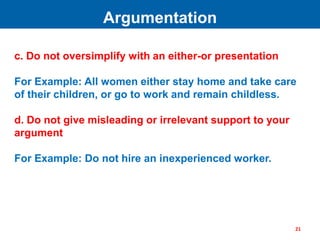
c. Do not oversimplify with an either-or presentation
For Example: All women either stay home and take care
of their children, or go to work and remain childless.
d. Do not give misleading or irrelevant support to your
argument
For Example: Do not hire an inexperienced worker.
Argumentation
21
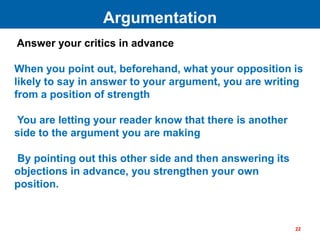
Answer your critics in advance
When you point out, beforehand, what your opposition is
likely to say in answer to your argument, you are writing
from a position of strength
You are letting your reader know that there is another
side to the argument you are making
By pointing out this other side and then answering its
objections in advance, you strengthen your own
position.
Argumentation
22
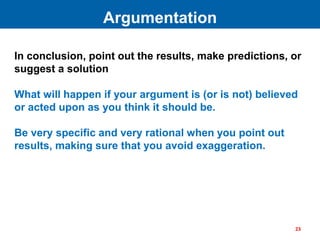
In conclusion, point out the results, make predictions, or
suggest a solution
What will happen if your argument is (or is not) believed
or acted upon as you think it should be.
Be very specific and very rational when you point out
results, making sure that you avoid exaggeration.
Argumentation
23
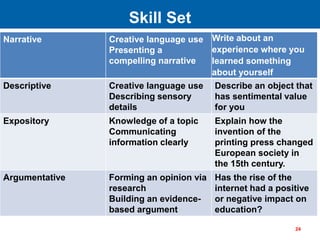
Skill Set
24
Narrative Creative language use
Presenting a
compelling narrative
Write about an
experience where you
learned something
about yourself
Descriptive Creative language use
Describing sensory
details
Describe an object that
has sentimental value
for you
Expository Knowledge of a topic
Communicating
information clearly
Explain how the
invention of the
printing press changed
European society in
the 15th century.
Argumentative Forming an opinion via
research
Building an evidence-
based argument
Has the rise of the
internet had a positive
or negative impact on
education?
25
THANK YOU

Functional English, Lecture 9, week 3.pptx

  • 1.
  • 2.
    Topics • Description • Narration •Compare and Contrast • Argumentation 2
  • 3.
    • In adescription essay, you write about what a person, place, or thing is like • The aim of descriptive essays is to provide a vivid picture of a person, location, object, event, or debate. • It will offer details that will enable the reader to imagine the item described. • You organize the essay by describing different parts or aspects of the main subject Description Essay 3
  • 4.
    • This genreencourages the student’s ability to create a written account of a particular experience • This genre allows for a great deal of artistic freedom (the goal of which is to paint an image that is vivid and moving in the mind of the reader Objective Description • Precise, factual language with denotation Subjective Description • Rich suggestive language with connotations Description Essay 4
  • 5.
    Here are someguidelines for writing a descriptive essay: Take time to brainstorm Use clear and concise & vivid language Use your senses Leave the reader with a clear impression Be organized Description Essay 5
  • 6.
    To state theincident or event • It is usually found in the feature writing sections of newspaper or magazine • If written as a story, the essay should include all the parts of a story. • The essay should have a purpose • The essay should be written from a clear point of view • Use clear and concise language throughout the essay Narration 6
  • 7.
    The use ofthe first person pronoun ‘I’ is welcomed. As always, be organized Like story telling, add narrative detail Narrative variety Verb tense consistent and accurate Narration 7
  • 8.
    An expository essayprovides a clear, focused explanation of a topic. It doesn’t require an original argument, just a balanced and well-organized view of the topic. Expository essays test your familiarity with a topic and your ability to organize and convey information. Expository writing is defined as presenting reasons, explanations, or steps in a process - Informational writing Expository Essay 8
  • 9.
    • An expositoryessay should follow a logical sequence and have three different main points • Logic and coherence is the main focus of an expository essay • Expository Essay: There are three different types of expository essays: 1) Essay that is developed with examples and/or facts and statistics 2) Essay that is developed with steps in a process 3) Essay that is in a compare and contrast format Expository Essay 9
  • 10.
    Two Methods toPresent Compare & Contrast 1. The block method. Write everything about one topic or idea, and then in a later paragraph or paragraphs you write entirely about the other topic. In the second topic, you must be sure to bring up the same points and keep the same order as when you discussed the first topic. Expository Essay 10
  • 11.
    Two Methods toPresent Compare & Contrast 2. The point-by-point method With this method, discuss one point and show in one paragraph how both topics relate to this point. Then, in a new paragraph, you discuss the second point and relate it to both topics, and so forth. Expository Essay 11
  • 12.
    Two Methods toPresent Compare & Contrast Example Read the paragraph carefully and decide whether the writer has used the point-by-point method or the block method. Also decide whether the piece emphasizes similarities or differences. Expository Essay 12
  • 13.
    Female infants speaksooner, have larger vocabularies, and rarely demonstrate speech defects. (Stuttering, for instance, occurs almost exclusively among boys.) Girls exceed boys in language abilities, and this early linguistic bias often prevails throughout life. Girls read sooner, learn foreign languages more easily, and, as a result, are more likely to enter occupations involving language mastery. Boys, in contrast, show an early visual superiority. They are also clumsier, performing poorly at something like arranging a row of beads, but excel at other activities calling on total body coordination. Their attentional mechanisms are also different. A boy will react to an inanimate object as quickly as he will to a person. A male baby will often ignore the mother and babble to a blinking light, fixate on a geometric figure Example 13
  • 14.
    The streets arelittered with cigarette and cigar butts, paper wrappings, particles of food, and dog droppings. How long before they become indistinguishable from the gutters of medieval towns when slop pails were emptied from the second-story windows? Thousands of New York women no longer attend evening services in their churches. They fear assault as they walk the few steps from bus or subway station to their apartment houses. Example 14
  • 15.
    An essay topresents evidence intended to convince the reader that the writer’s position is valid. An argument is a position combined with its supporting reasons. Argumentative papers thus set out a main claim and then provide reasons for thinking that the claim is true. Acknowledging opposing views and either refuting them or conceding to them is a common practice in this form of essay. Argumentation 15
  • 16.
    The structure ofthe argumentative essay is held together by the following: • A clear, concise, and defined thesis statement that occurs in the first paragraph of the essay. • Clear and logical transitions between the introduction, body, and conclusion. • Body paragraphs that include evidential support. • Evidential support (whether factual, logical, statistical, or anecdotal). • A conclusion that does not simply restate the thesis, but readdresses it in light of the evidence provided. Argumentation 16
  • 17.
    • Convince thereader about your opinion • The writer may appeal to logic, emotions and ethics Argumentation 17
  • 18.
    Give evidence orreasons for your beliefs Show the wisdom of your logic by providing the best evidence available- personal observation, facts, statistics, expert opinion, and examples. Use examples Well-chosen examples are among the best evidence for an argument. People can identify with a specific example from real life in a way that they cannot with an abstract idea. Argumentation 18
  • 19.
    Use opinions fromrecognized authorities to support your points. One of the oldest methods - use one or more persons of authority (renown) to support your position. People will usually believe what well-known experts claim. However, be sure that your expert is someone who is respected in the area you are discussing. Argumentation 19
  • 20.
    Be careful toavoid faulty logic a. Do not appeal to fear or pity For Example: If we do not double the police force, innocent children die. b. Do not make sweeping or false generalization For Example: All women belong in the kitchen. Argumentation 20
  • 21.
    c. Do notoversimplify with an either-or presentation For Example: All women either stay home and take care of their children, or go to work and remain childless. d. Do not give misleading or irrelevant support to your argument For Example: Do not hire an inexperienced worker. Argumentation 21
  • 22.
    Answer your criticsin advance When you point out, beforehand, what your opposition is likely to say in answer to your argument, you are writing from a position of strength You are letting your reader know that there is another side to the argument you are making By pointing out this other side and then answering its objections in advance, you strengthen your own position. Argumentation 22
  • 23.
    In conclusion, pointout the results, make predictions, or suggest a solution What will happen if your argument is (or is not) believed or acted upon as you think it should be. Be very specific and very rational when you point out results, making sure that you avoid exaggeration. Argumentation 23
  • 24.
    Skill Set 24 Narrative Creativelanguage use Presenting a compelling narrative Write about an experience where you learned something about yourself Descriptive Creative language use Describing sensory details Describe an object that has sentimental value for you Expository Knowledge of a topic Communicating information clearly Explain how the invention of the printing press changed European society in the 15th century. Argumentative Forming an opinion via research Building an evidence- based argument Has the rise of the internet had a positive or negative impact on education?
  • 25.