Rh Blood Group
System
Hammad Tariq BSML-FA20-001
Aoun Raza BSML-FA20-003
Ashraf Ali BSML-FA20-011
Umar Mustafa BSML-FA20-013
Contents:
Introduction
Historical development of the Rh-Hr
system
Mendelian inheritance of Rh-Hr
system
Punnett square of Rh-blood group
Rhesus factor incompatibility
Introduction:
• The Rh blood group system is one of the
most polymorphic and antigenic blood
group systems.
• It is second only to ABO in importance in
blood transfusion and is well known as a
primary cause of hemolytic disease of the
fetus and newborn (HDFN).
• The principal antigen is D, and the terms
Rh positive and Rh negative refer to the
absence of D antigen.
Historical development of the Rh-Hr
system:
• In 1939, Philip Levine and Rufus
Stetson described a hemolytic transfusion
reaction in an obstetric patient following
delivery of stillborn infant.
• The women required transfusion. Her
husband, who had the same ABO type,
was selected as her donor, after
transfusion the recipient, demonstrated
the classic symptoms of acute hemolytic
transfusion reaction.
• Subsequently an antibody was isolated from the
mother’s serum that react both at 37°C and 20 °C
with the father’s red cells.
• It was postulated that the fetus and the father
possessed a common factor that the mother
lacked.
• While the mother carry the fetus, the mother was
exposed to this factor and subsequently,
subsequently built up an antibody that reacted
against the transfused red cells from the father
and resulted in hemolytic transfusion reaction.
• Landsteiner and Wiener reported on an
antibody by guinea pigs and rabbits when
these animals were transfused with rhesus
monkey red cells.
• This antibody which agglutinated 85% of
human red cells was named Rh.
• The name Rh was retained for the human
produced antibody.
• Anti-rhesus formed by the animals was
renamed anti-LW (Landsteiner and
Wiener).
Mendelian Inheritance of Rh blood
group:
• The Rh blood group system is inherited in a
Mendelian manner (involves a dominant and
recessive pattern).
• There are two main alleles for the Rh factor: Rh-
positive (D or +) and Rh-negative (d or -).
• The inheritance follows an autosomal dominant
pattern. This means that if a person inherits at
least one Rh-positive allele from either parent,
they will express the Rh-positive blood type.
• For a person to be Rh-negative, they must inherit
two recessive Rh alleles.
• Rh factors are genetically determined.
• The Rh-positive gene is dominant (stronger) and
even when paired with an Rh-negative gene, the
positive gene takes over.
• If a person has the genes + +, the Rh factor in the
blood will be positive.
• If a person has the genes + -, the Rh factor will
also be positive.
• If a person has the genes - -, the Rh factor will be
negative.
• Rh status is inherited from our parents, separately
from our blood type.
• If you inherit the dominant Rhesus D antigen from
one or both of your parents, then you are Rh-
positive.
• If you do not inherit the Rhesus D antigen from
either parent, then you are Rh-negative.
• So, it is possible for two people who are Rh-
positive to produce a child that’s Rh-negative, but
only if neither parent passes along Rhesus D.
Punnett square of Rh-blood group:
• The simple Punnett square here
demonstrates how this is possible.
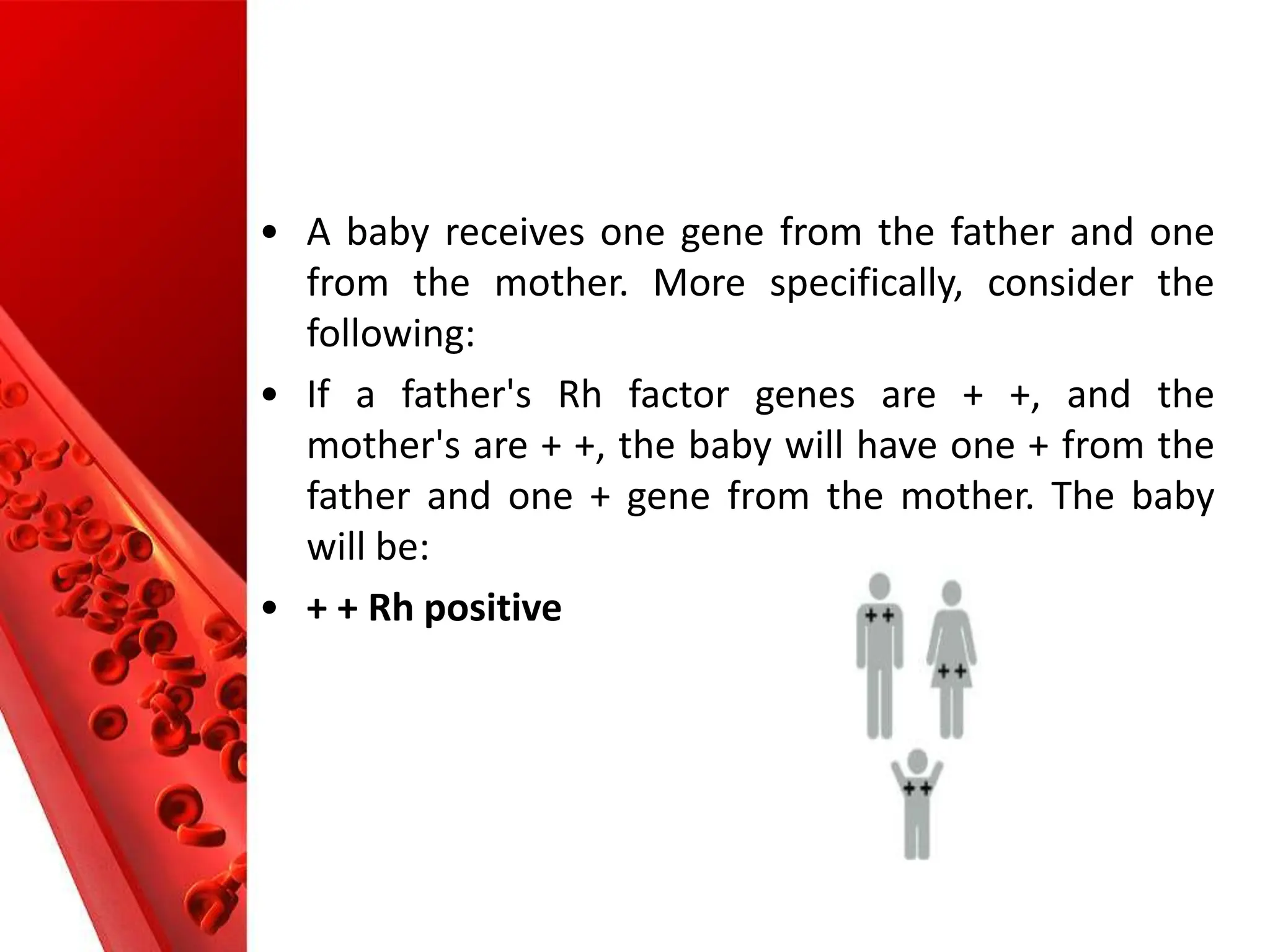
• A baby receives one gene from the father and one
from the mother. More specifically, consider the
following:
• If a father's Rh factor genes are + +, and the
mother's are + +, the baby will have one + from the
father and one + gene from the mother. The baby
will be:
• + + Rh positive
• If a father's Rh factor genes are + +, and
the mother's are - -, the baby will have one
+ from the father and one - gene from the
mother. The baby will be:
• + - Rh positive
• If the father's genes are + - Rh positive, and
the mother's are + - Rh positive, the baby
can be:
• + + Rh positive
• + - Rh positive
• - - Rh negative
• If the father's genes are - -, and the
mother's genes are + -, the baby can
be:
• + - Rh positive
• - - Rh negative
• If the father's genes are - -, and the
mother's genes are also - -, then baby
will be:
• - - Rh negative
Rhesus factor incompatibility:
• A medical problem can occur when a woman, who
is Rh-, is pregnant with a Rh+ fetus.
• The first child may have no difficulty, but
subsequent similar pregnancies may produce
severely anemic newborns.
• Exposure to the red blood cells of the first Rh+
fetus appears to protect the Rh- mother, thus
potentially preventing her from developing
antibodies that can cause brain damage in any
subsequent Rh+ fetus.
• Damage to the fetal brain can occur as a result of
the severe destruction of red blood cells.
• There are preventable measures available to
prevent the severe effects of Rh incompatibility by
transfusions to the fetus.
• Mother can receive Rh immunoglobulin
(RhoGAM) immediately after her first and any
subsequent pregnancies involving a Rh+ fetus.
• This immunoglobulin effectively destroys the fetal
red blood cells before the mother’s immune
system is stimulated.
• Therefore, the mother avoids becoming actively
immunized against the Rh antigen and will not
produce antibodies that could attack the red
blood cells of a future Rh+ fetus.
References:
• Hematology: Basic Principles and Practices
• https://www.bloodgroupgenomics.org/blog-blood-
experts/articles/history-rh-blood-group-how-genomics-changing-rhd-
typing/
• https://stanfordbloodcenter.org/can-two-rh-positive-parents-have-
an-rh-negative-child/
RH blood group system

RH blood group system

  • 1.
    Rh Blood Group System HammadTariq BSML-FA20-001 Aoun Raza BSML-FA20-003 Ashraf Ali BSML-FA20-011 Umar Mustafa BSML-FA20-013
  • 2.
    Contents: Introduction Historical development ofthe Rh-Hr system Mendelian inheritance of Rh-Hr system Punnett square of Rh-blood group Rhesus factor incompatibility
  • 3.
    Introduction: • The Rhblood group system is one of the most polymorphic and antigenic blood group systems. • It is second only to ABO in importance in blood transfusion and is well known as a primary cause of hemolytic disease of the fetus and newborn (HDFN). • The principal antigen is D, and the terms Rh positive and Rh negative refer to the absence of D antigen.
  • 4.
    Historical development ofthe Rh-Hr system: • In 1939, Philip Levine and Rufus Stetson described a hemolytic transfusion reaction in an obstetric patient following delivery of stillborn infant. • The women required transfusion. Her husband, who had the same ABO type, was selected as her donor, after transfusion the recipient, demonstrated the classic symptoms of acute hemolytic transfusion reaction.
  • 5.
    • Subsequently anantibody was isolated from the mother’s serum that react both at 37°C and 20 °C with the father’s red cells. • It was postulated that the fetus and the father possessed a common factor that the mother lacked. • While the mother carry the fetus, the mother was exposed to this factor and subsequently, subsequently built up an antibody that reacted against the transfused red cells from the father and resulted in hemolytic transfusion reaction.
  • 6.
    • Landsteiner andWiener reported on an antibody by guinea pigs and rabbits when these animals were transfused with rhesus monkey red cells. • This antibody which agglutinated 85% of human red cells was named Rh. • The name Rh was retained for the human produced antibody. • Anti-rhesus formed by the animals was renamed anti-LW (Landsteiner and Wiener).
  • 7.
    Mendelian Inheritance ofRh blood group: • The Rh blood group system is inherited in a Mendelian manner (involves a dominant and recessive pattern). • There are two main alleles for the Rh factor: Rh- positive (D or +) and Rh-negative (d or -). • The inheritance follows an autosomal dominant pattern. This means that if a person inherits at least one Rh-positive allele from either parent, they will express the Rh-positive blood type. • For a person to be Rh-negative, they must inherit two recessive Rh alleles.
  • 8.
    • Rh factorsare genetically determined. • The Rh-positive gene is dominant (stronger) and even when paired with an Rh-negative gene, the positive gene takes over. • If a person has the genes + +, the Rh factor in the blood will be positive. • If a person has the genes + -, the Rh factor will also be positive. • If a person has the genes - -, the Rh factor will be negative.
  • 9.
    • Rh statusis inherited from our parents, separately from our blood type. • If you inherit the dominant Rhesus D antigen from one or both of your parents, then you are Rh- positive. • If you do not inherit the Rhesus D antigen from either parent, then you are Rh-negative. • So, it is possible for two people who are Rh- positive to produce a child that’s Rh-negative, but only if neither parent passes along Rhesus D.
  • 10.
    Punnett square ofRh-blood group: • The simple Punnett square here demonstrates how this is possible.
  • 11.
    • A babyreceives one gene from the father and one from the mother. More specifically, consider the following: • If a father's Rh factor genes are + +, and the mother's are + +, the baby will have one + from the father and one + gene from the mother. The baby will be: • + + Rh positive
  • 12.
    • If afather's Rh factor genes are + +, and the mother's are - -, the baby will have one + from the father and one - gene from the mother. The baby will be: • + - Rh positive
  • 13.
    • If thefather's genes are + - Rh positive, and the mother's are + - Rh positive, the baby can be: • + + Rh positive • + - Rh positive • - - Rh negative
  • 14.
    • If thefather's genes are - -, and the mother's genes are + -, the baby can be: • + - Rh positive • - - Rh negative
  • 15.
    • If thefather's genes are - -, and the mother's genes are also - -, then baby will be: • - - Rh negative
  • 16.
    Rhesus factor incompatibility: •A medical problem can occur when a woman, who is Rh-, is pregnant with a Rh+ fetus. • The first child may have no difficulty, but subsequent similar pregnancies may produce severely anemic newborns. • Exposure to the red blood cells of the first Rh+ fetus appears to protect the Rh- mother, thus potentially preventing her from developing antibodies that can cause brain damage in any subsequent Rh+ fetus. • Damage to the fetal brain can occur as a result of the severe destruction of red blood cells.
  • 17.
    • There arepreventable measures available to prevent the severe effects of Rh incompatibility by transfusions to the fetus. • Mother can receive Rh immunoglobulin (RhoGAM) immediately after her first and any subsequent pregnancies involving a Rh+ fetus. • This immunoglobulin effectively destroys the fetal red blood cells before the mother’s immune system is stimulated. • Therefore, the mother avoids becoming actively immunized against the Rh antigen and will not produce antibodies that could attack the red blood cells of a future Rh+ fetus.
  • 18.
    References: • Hematology: BasicPrinciples and Practices • https://www.bloodgroupgenomics.org/blog-blood- experts/articles/history-rh-blood-group-how-genomics-changing-rhd- typing/ • https://stanfordbloodcenter.org/can-two-rh-positive-parents-have- an-rh-negative-child/