Matrices Algebra
5/22/2018 BBA 103 Business Mathematics 1
Slides outline
• Definition & Notation
• Types of Matrices
• Matrix operations
• Transpose of a Matrix
• Ad-joint Matrix
5/22/2018 BBA 103 Business Mathematics 2
What you should understand
• Basic concept of matrix
• Able to perform matrix opertaions
5/22/2018 BBA 103 Business Mathematics 3
Matrices - Introduction
Matrix algebra has at least two advantages:
•Reduces complicated systems of equations to simple
expressions
•Adaptable to systematic method of mathematical treatment
and well suited to computers
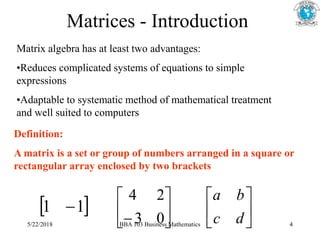
Definition:
A matrix is a set or group of numbers arranged in a square or
rectangular array enclosed by two brackets
 
1
1  





 0
3
2
4






d
c
b
a
5/22/2018 BBA 103 Business Mathematics 4
Matrices - Introduction
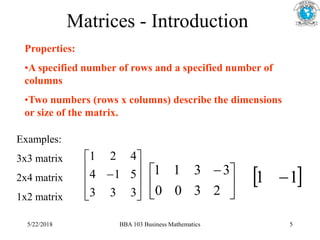
Properties:
•A specified number of rows and a specified number of
columns
•Two numbers (rows x columns) describe the dimensions
or size of the matrix.
Examples:
3x3 matrix
2x4 matrix
1x2 matrix 










3
3
3
5
1
4
4
2
1





 
2
3
3
3
0
1
0
1
 
1
1 
5/22/2018 BBA 103 Business Mathematics 5
Matrices - Introduction
A matrix is denoted by a bold capital letter and the elements
within the matrix are denoted by lower case letters
e.g. matrix [A] with elements aij














mn
ij
m
m
n
ij
in
ij
a
a
a
a
a
a
a
a
a
a
a
a
2
1
2
22
21
12
11
...
...




i goes from 1 to m
j goes from 1 to n
Amxn=
mAn
5/22/2018 BBA 103 Business Mathematics 6
Matrices - Introduction
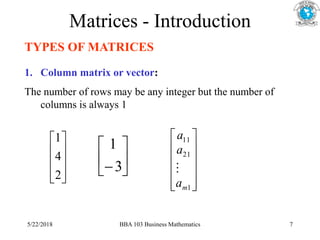
TYPES OF MATRICES
1. Column matrix or vector:
The number of rows may be any integer but the number of
columns is always 1










2
4
1






3
1












1
21
11
m
a
a
a

5/22/2018 BBA 103 Business Mathematics 7
Matrices - Introduction
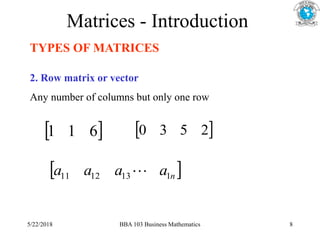
TYPES OF MATRICES
2. Row matrix or vector
Any number of columns but only one row
 
6
1
1  
2
5
3
0
 
n
a
a
a
a 1
13
12
11 
5/22/2018 BBA 103 Business Mathematics 8
Matrices - Introduction
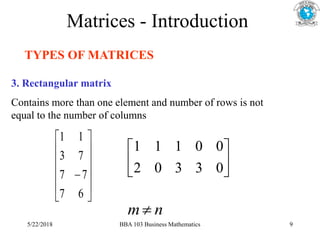
TYPES OF MATRICES
3. Rectangular matrix
Contains more than one element and number of rows is not
equal to the number of columns













6
7
7
7
7
3
1
1






0
3
3
0
2
0
0
1
1
1
n
m 
5/22/2018 BBA 103 Business Mathematics 9
Matrices - Introduction
TYPES OF MATRICES
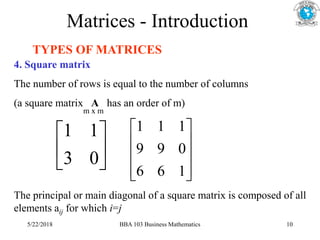
4. Square matrix
The number of rows is equal to the number of columns
(a square matrix A has an order of m)






0
3
1
1










1
6
6
0
9
9
1
1
1
m x m
The principal or main diagonal of a square matrix is composed of all
elements aij for which i=j
5/22/2018 BBA 103 Business Mathematics 10
Matrices - Introduction
TYPES OF MATRICES
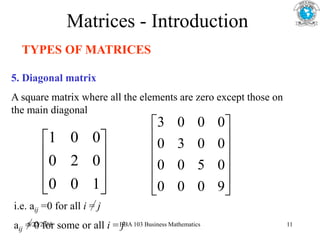
5. Diagonal matrix
A square matrix where all the elements are zero except those on
the main diagonal










1
0
0
0
2
0
0
0
1












9
0
0
0
0
5
0
0
0
0
3
0
0
0
0
3
i.e. aij =0 for all i = j
aij = 0 for some or all i = j
5/22/2018 BBA 103 Business Mathematics 11
Matrices - Introduction
TYPES OF MATRICES
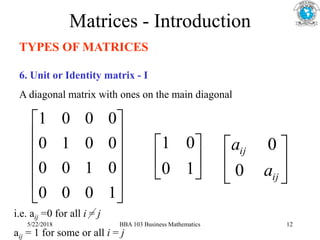
6. Unit or Identity matrix - I
A diagonal matrix with ones on the main diagonal












1
0
0
0
0
1
0
0
0
0
1
0
0
0
0
1






1
0
0
1
i.e. aij =0 for all i = j
aij = 1 for some or all i = j






ij
ij
a
a
0
0
5/22/2018 BBA 103 Business Mathematics 12
Matrices - Introduction
TYPES OF MATRICES
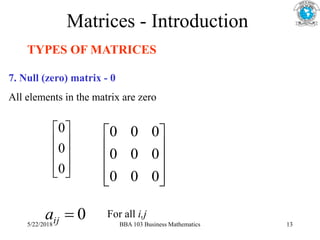
7. Null (zero) matrix - 0
All elements in the matrix are zero










0
0
0










0
0
0
0
0
0
0
0
0
0

ij
a For all i,j
5/22/2018 BBA 103 Business Mathematics 13
Matrices - Introduction
TYPES OF MATRICES
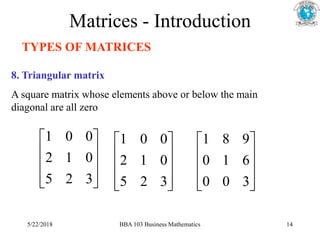
8. Triangular matrix
A square matrix whose elements above or below the main
diagonal are all zero










3
2
5
0
1
2
0
0
1










3
2
5
0
1
2
0
0
1










3
0
0
6
1
0
9
8
1
5/22/2018 BBA 103 Business Mathematics 14
Matrices - Introduction
TYPES OF MATRICES
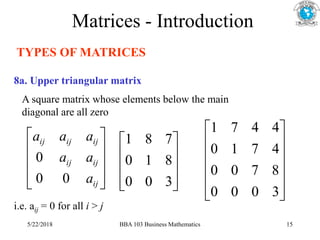
8a. Upper triangular matrix
A square matrix whose elements below the main
diagonal are all zero
i.e. aij = 0 for all i > j










3
0
0
8
1
0
7
8
1












3
0
0
0
8
7
0
0
4
7
1
0
4
4
7
1










ij
ij
ij
ij
ij
ij
a
a
a
a
a
a
0
0
0
5/22/2018 BBA 103 Business Mathematics 15
Matrices - Introduction
TYPES OF MATRICES
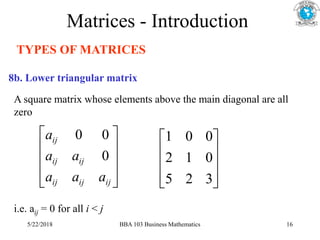
A square matrix whose elements above the main diagonal are all
zero
8b. Lower triangular matrix
i.e. aij = 0 for all i < j










3
2
5
0
1
2
0
0
1










ij
ij
ij
ij
ij
ij
a
a
a
a
a
a
0
0
0
5/22/2018 BBA 103 Business Mathematics 16
Matrices – Introduction
TYPES OF MATRICES
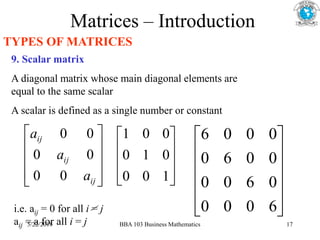
9. Scalar matrix
A diagonal matrix whose main diagonal elements are
equal to the same scalar
A scalar is defined as a single number or constant










1
0
0
0
1
0
0
0
1












6
0
0
0
0
6
0
0
0
0
6
0
0
0
0
6
i.e. aij = 0 for all i = j
aij = a for all i = j










ij
ij
ij
a
a
a
0
0
0
0
0
0
5/22/2018 BBA 103 Business Mathematics 17
Matrices
Matrix Operations
5/22/2018 BBA 103 Business Mathematics 18
Matrices - Operations
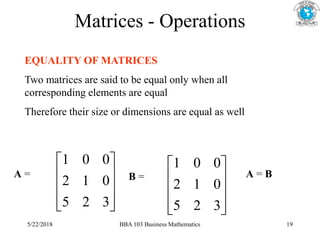
EQUALITY OF MATRICES
Two matrices are said to be equal only when all
corresponding elements are equal
Therefore their size or dimensions are equal as well










3
2
5
0
1
2
0
0
1










3
2
5
0
1
2
0
0
1
A = B = A = B
5/22/2018 BBA 103 Business Mathematics 19
Matrices - Operations
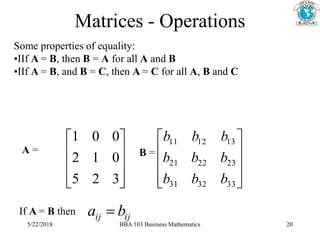
Some properties of equality:
•IIf A = B, then B = A for all A and B
•IIf A = B, and B = C, then A = C for all A, B and C










3
2
5
0
1
2
0
0
1
A = B =










33
32
31
23
22
21
13
12
11
b
b
b
b
b
b
b
b
b
If A = B then ij
ij b
a 
5/22/2018 BBA 103 Business Mathematics 20
Matrices - Operations
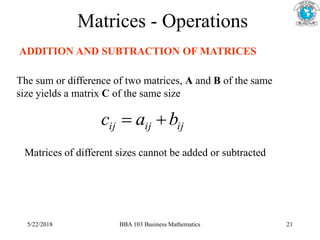
ADDITION AND SUBTRACTION OF MATRICES
The sum or difference of two matrices, A and B of the same
size yields a matrix C of the same size
ij
ij
ij b
a
c 

Matrices of different sizes cannot be added or subtracted
5/22/2018 BBA 103 Business Mathematics 21
Matrices - Operations
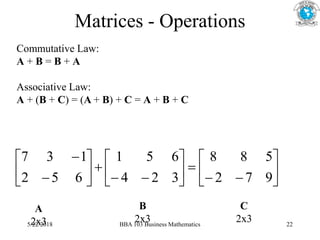
Commutative Law:
A + B = B + A
Associative Law:
A + (B + C) = (A + B) + C = A + B + C


























9
7
2
5
8
8
3
2
4
6
5
1
6
5
2
1
3
7
A
2x3
B
2x3
C
2x3
5/22/2018 BBA 103 Business Mathematics 22
Matrices - Operations
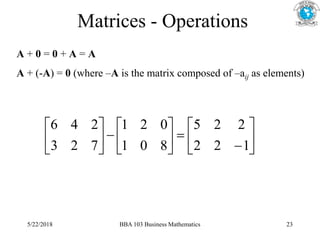
A + 0 = 0 + A = A
A + (-A) = 0 (where –A is the matrix composed of –aij as elements)





















1
2
2
2
2
5
8
0
1
0
2
1
7
2
3
2
4
6
5/22/2018 BBA 103 Business Mathematics 23
Matrices - Operations
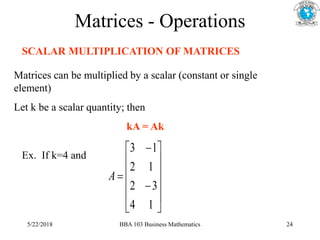
SCALAR MULTIPLICATION OF MATRICES
Matrices can be multiplied by a scalar (constant or single
element)
Let k be a scalar quantity; then
kA = Ak
Ex. If k=4 and















1
4
3
2
1
2
1
3
A
5/22/2018 BBA 103 Business Mathematics 24
Matrices - Operations














































4
16
12
8
4
8
4
12
4
1
4
3
2
1
2
1
3
1
4
3
2
1
2
1
3
4
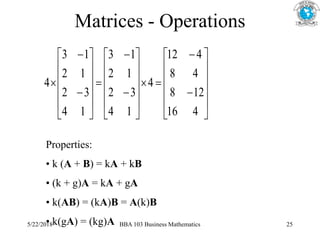
Properties:
• k (A + B) = kA + kB
• (k + g)A = kA + gA
• k(AB) = (kA)B = A(k)B
• k(gA) = (kg)A
5/22/2018 BBA 103 Business Mathematics 25
Matrices - Operations
MULTIPLICATION OF MATRICES
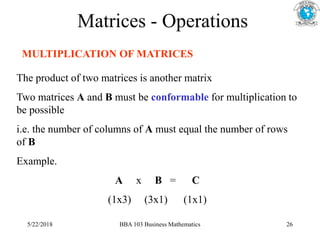
The product of two matrices is another matrix
Two matrices A and B must be conformable for multiplication to
be possible
i.e. the number of columns of A must equal the number of rows
of B
Example.
A x B = C
(1x3) (3x1) (1x1)
5/22/2018 BBA 103 Business Mathematics 26
Matrices - Operations
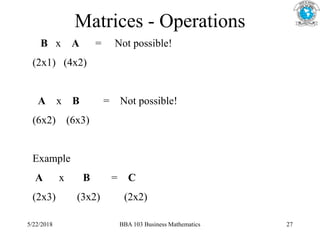
B x A = Not possible!
(2x1) (4x2)
A x B = Not possible!
(6x2) (6x3)
Example
A x B = C
(2x3) (3x2) (2x2)
5/22/2018 BBA 103 Business Mathematics 27
Matrices - Operations























22
21
12
11
32
31
22
21
12
11
23
22
21
13
12
11
c
c
c
c
b
b
b
b
b
b
a
a
a
a
a
a
22
32
23
22
22
12
21
21
31
23
21
22
11
21
12
32
13
22
12
12
11
11
31
13
21
12
11
11
)
(
)
(
)
(
)
(
)
(
)
(
)
(
)
(
)
(
)
(
)
(
)
(
c
b
a
b
a
b
a
c
b
a
b
a
b
a
c
b
a
b
a
b
a
c
b
a
b
a
b
a
























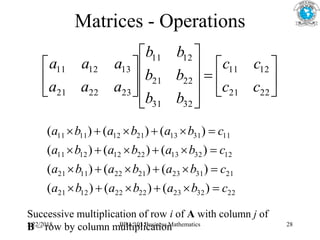
Successive multiplication of row i of A with column j of
B – row by column multiplication
5/22/2018 BBA 103 Business Mathematics 28
Matrices - Operations











































)
3
7
(
)
2
2
(
)
8
4
(
)
5
7
(
)
6
2
(
)
4
4
(
)
3
3
(
)
2
2
(
)
8
1
(
)
5
3
(
)
6
2
(
)
4
1
(
3
5
2
6
8
4
7
2
4
3
2
1







57
63
21
31
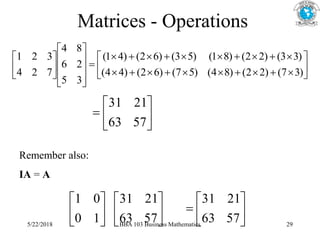
Remember also:
IA = A






1
0
0
1






57
63
21
31







57
63
21
31
5/22/2018 BBA 103 Business Mathematics 29
Matrices - Operations
Assuming that matrices A, B and C are conformable for
the operations indicated, the following are true:
1. AI = IA = A
2. A(BC) = (AB)C = ABC - (associative law)
3. A(B+C) = AB + AC - (first distributive law)
4. (A+B)C = AC + BC - (second distributive law)
Caution!
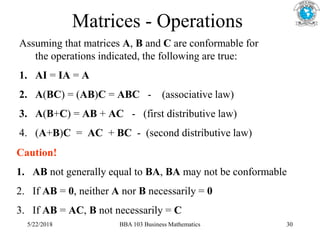
1. AB not generally equal to BA, BA may not be conformable
2. If AB = 0, neither A nor B necessarily = 0
3. If AB = AC, B not necessarily = C
5/22/2018 BBA 103 Business Mathematics 30
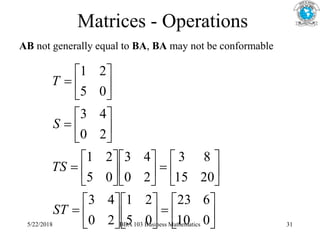
Matrices - Operations
AB not generally equal to BA, BA may not be conformable






















































0
10
6
23
0
5
2
1
2
0
4
3
20
15
8
3
2
0
4
3
0
5
2
1
2
0
4
3
0
5
2
1
ST
TS
S
T
5/22/2018 BBA 103 Business Mathematics 31
Matrices - Operations
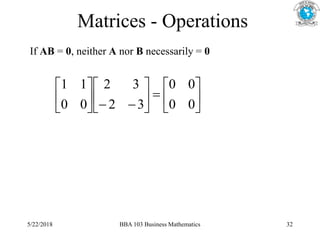
If AB = 0, neither A nor B necessarily = 0





















0
0
0
0
3
2
3
2
0
0
1
1
5/22/2018 BBA 103 Business Mathematics 32
Matrices - Operations
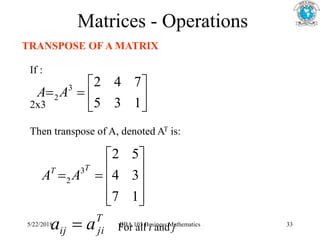
TRANSPOSE OF A MATRIX
If :








1
3
5
7
4
2
3
2 A
A
2x3












1
7
3
4
5
2
3
2
T
T
A
A
Then transpose of A, denoted AT is:
T
ji
ij a
a  For all i and j
5/22/2018 BBA 103 Business Mathematics 33
Matrices - Operations
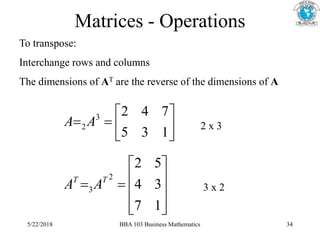
To transpose:
Interchange rows and columns
The dimensions of AT are the reverse of the dimensions of A








1
3
5
7
4
2
3
2 A
A












1
7
3
4
5
2
2
3
T
T
A
A
2 x 3
3 x 2
5/22/2018 BBA 103 Business Mathematics 34
Matrices - Operations
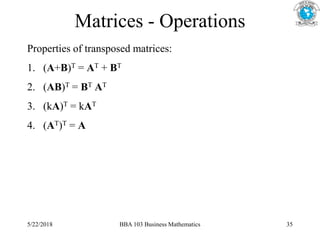
Properties of transposed matrices:
1. (A+B)T = AT + BT
2. (AB)T = BT AT
3. (kA)T = kAT
4. (AT)T = A
5/22/2018 BBA 103 Business Mathematics 35
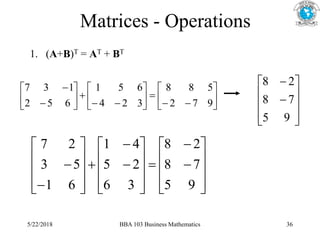
Matrices - Operations
1. (A+B)T = AT + BT


























9
7
2
5
8
8
3
2
4
6
5
1
6
5
2
1
3
7












9
5
7
8
2
8






































9
5
7
8
2
8
3
6
2
5
4
1
6
1
5
3
2
7
5/22/2018 BBA 103 Business Mathematics 36
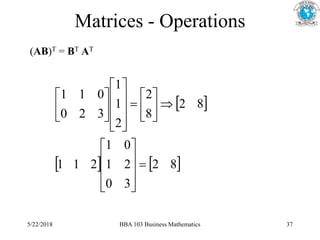
Matrices - Operations
(AB)T = BT AT
 
   
8
2
3
0
2
1
0
1
2
1
1
8
2
8
2
2
1
1
3
2
0
0
1
1



































5/22/2018 BBA 103 Business Mathematics 37
Matrices - Operations
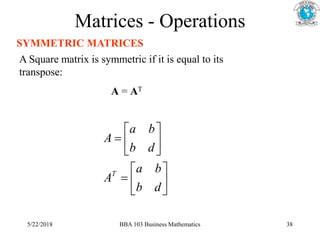
SYMMETRIC MATRICES
A Square matrix is symmetric if it is equal to its
transpose:
A = AT














d
b
b
a
A
d
b
b
a
A
T
5/22/2018 BBA 103 Business Mathematics 38
Matrices - Operations
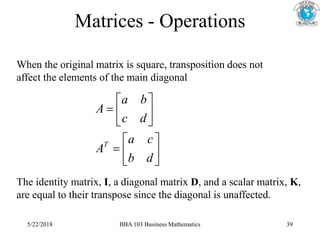
When the original matrix is square, transposition does not
affect the elements of the main diagonal














d
b
c
a
A
d
c
b
a
A
T
The identity matrix, I, a diagonal matrix D, and a scalar matrix, K,
are equal to their transpose since the diagonal is unaffected.
5/22/2018 BBA 103 Business Mathematics 39
Matrices - Operations
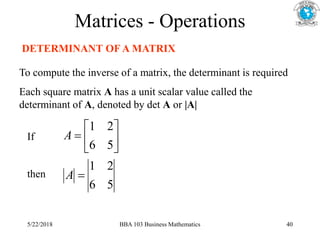
DETERMINANT OF A MATRIX
To compute the inverse of a matrix, the determinant is required
Each square matrix A has a unit scalar value called the
determinant of A, denoted by det A or |A|
5
6
2
1
5
6
2
1








A
A
If
then
5/22/2018 BBA 103 Business Mathematics 40
Matrices - Operations
If A = [A] is a single element (1x1), then the determinant is
defined as the value of the element
Then |A| =det A = a11
If A is (n x n), its determinant may be defined in terms of order
(n-1) or less.
5/22/2018 BBA 103 Business Mathematics 41
Matrices - Operations
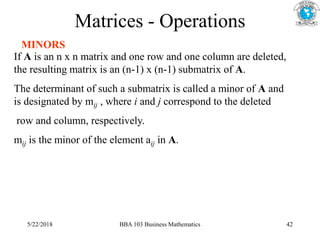
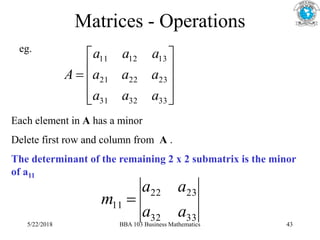
MINORS
If A is an n x n matrix and one row and one column are deleted,
the resulting matrix is an (n-1) x (n-1) submatrix of A.
The determinant of such a submatrix is called a minor of A and
is designated by mij , where i and j correspond to the deleted
row and column, respectively.
mij is the minor of the element aij in A.
5/22/2018 BBA 103 Business Mathematics 42
Matrices - Operations











33
32
31
23
22
21
13
12
11
a
a
a
a
a
a
a
a
a
A
Each element in A has a minor
Delete first row and column from A .
The determinant of the remaining 2 x 2 submatrix is the minor
of a11
eg.
33
32
23
22
11
a
a
a
a
m 
5/22/2018 BBA 103 Business Mathematics 43
Matrices - Operations
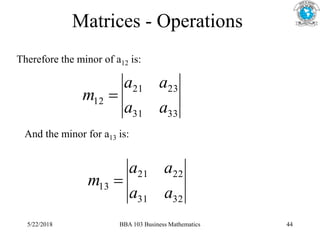
Therefore the minor of a12 is:
And the minor for a13 is:
33
31
23
21
12
a
a
a
a
m 
32
31
22
21
13
a
a
a
a
m 
5/22/2018 BBA 103 Business Mathematics 44
Matrices - Operations
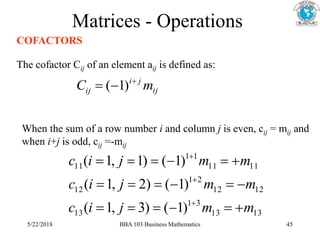
COFACTORS
The cofactor Cij of an element aij is defined as:
ij
j
i
ij m
C 

 )
1
(
When the sum of a row number i and column j is even, cij = mij and
when i+j is odd, cij =-mij
13
13
3
1
13
12
12
2
1
12
11
11
1
1
11
)
1
(
)
3
,
1
(
)
1
(
)
2
,
1
(
)
1
(
)
1
,
1
(
m
m
j
i
c
m
m
j
i
c
m
m
j
i
c





















5/22/2018 BBA 103 Business Mathematics 45
Matrices - Operations
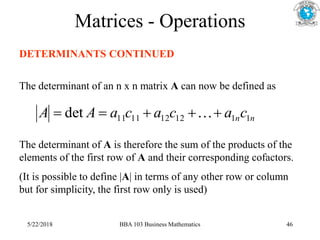
DETERMINANTS CONTINUED
The determinant of an n x n matrix A can now be defined as
n
nc
a
c
a
c
a
A
A 1
1
12
12
11
11
det 



 
The determinant of A is therefore the sum of the products of the
elements of the first row of A and their corresponding cofactors.
(It is possible to define |A| in terms of any other row or column
but for simplicity, the first row only is used)
5/22/2018 BBA 103 Business Mathematics 46
Matrices - Operations
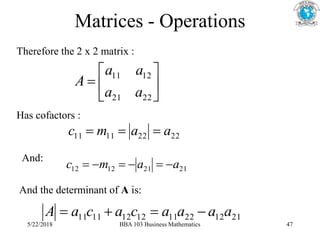
Therefore the 2 x 2 matrix :







22
21
12
11
a
a
a
a
A
Has cofactors :
22
22
11
11 a
a
m
c 


And:
21
21
12
12 a
a
m
c 





And the determinant of A is:
21
12
22
11
12
12
11
11 a
a
a
a
c
a
c
a
A 



5/22/2018 BBA 103 Business Mathematics 47
Matrices - Operations
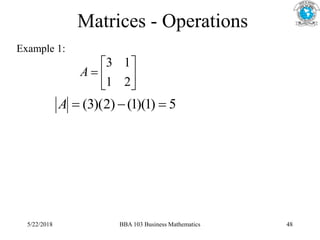
Example 1:







2
1
1
3
A
5
)
1
)(
1
(
)
2
)(
3
( 


A
5/22/2018 BBA 103 Business Mathematics 48
Matrices - Operations
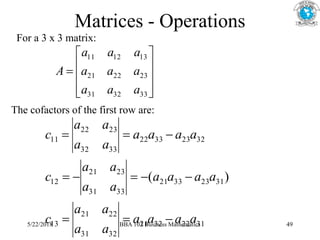
For a 3 x 3 matrix:











33
32
31
23
22
21
13
12
11
a
a
a
a
a
a
a
a
a
A
The cofactors of the first row are:
31
22
32
21
32
31
22
21
13
31
23
33
21
33
31
23
21
12
32
23
33
22
33
32
23
22
11
)
(
a
a
a
a
a
a
a
a
c
a
a
a
a
a
a
a
a
c
a
a
a
a
a
a
a
a
c











5/22/2018 BBA 103 Business Mathematics 49
Matrices - Operations
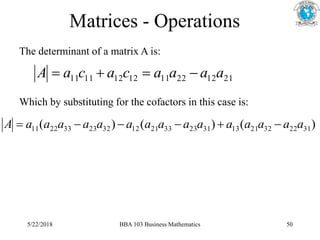
The determinant of a matrix A is:
21
12
22
11
12
12
11
11 a
a
a
a
c
a
c
a
A 



Which by substituting for the cofactors in this case is:
)
(
)
(
)
( 31
22
32
21
13
31
23
33
21
12
32
23
33
22
11 a
a
a
a
a
a
a
a
a
a
a
a
a
a
a
A 





5/22/2018 BBA 103 Business Mathematics 50
Matrices - Operations
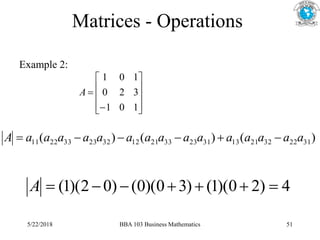
Example 2:












1
0
1
3
2
0
1
0
1
A
4
)
2
0
)(
1
(
)
3
0
)(
0
(
)
0
2
)(
1
( 






A
)
(
)
(
)
( 31
22
32
21
13
31
23
33
21
12
32
23
33
22
11 a
a
a
a
a
a
a
a
a
a
a
a
a
a
a
A 





5/22/2018 BBA 103 Business Mathematics 51
Matrices - Operations
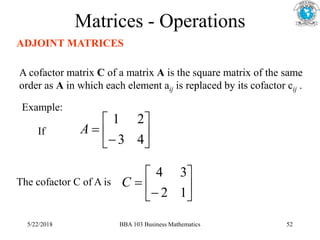
ADJOINT MATRICES
A cofactor matrix C of a matrix A is the square matrix of the same
order as A in which each element aij is replaced by its cofactor cij .
Example:








4
3
2
1
A








1
2
3
4
C
If
The cofactor C of A is
5/22/2018 BBA 103 Business Mathematics 52
Matrices - Operations
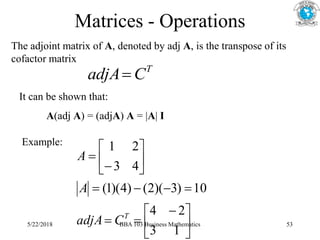
The adjoint matrix of A, denoted by adj A, is the transpose of its
cofactor matrix
T
C
adjA
It can be shown that:
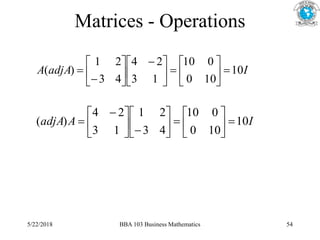
A(adj A) = (adjA) A = |A| I
Example:





 














1
3
2
4
10
)
3
)(
2
(
)
4
)(
1
(
4
3
2
1
T
C
adjA
A
A
5/22/2018 BBA 103 Business Mathematics 53
Matrices - Operations
I
adjA
A 10
10
0
0
10
1
3
2
4
4
3
2
1
)
( 












 








I
A
adjA 10
10
0
0
10
4
3
2
1
1
3
2
4
)
( 



















 

5/22/2018 BBA 103 Business Mathematics 54
Matrices - Operations
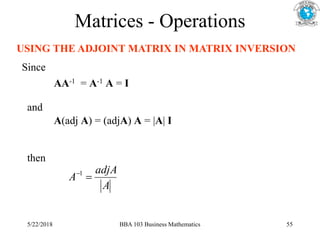
USING THE ADJOINT MATRIX IN MATRIX INVERSION
A
adjA
A 
1
Since
AA-1 = A-1 A = I
and
A(adj A) = (adjA) A = |A| I
then
5/22/2018 BBA 103 Business Mathematics 55
Matrices - Operations
The result can be checked using
AA-1 = A-1 A = I
The determinant of a matrix must not be zero for the inverse to
exist as there will not be a solution
Nonsingular matrices have non-zero determinants
Singular matrices have zero determinants
5/22/2018 BBA 103 Business Mathematics 56

1. matrix introduction

  • 1.
    Matrices Algebra 5/22/2018 BBA103 Business Mathematics 1
  • 2.
    Slides outline • Definition& Notation • Types of Matrices • Matrix operations • Transpose of a Matrix • Ad-joint Matrix 5/22/2018 BBA 103 Business Mathematics 2
  • 3.
    What you shouldunderstand • Basic concept of matrix • Able to perform matrix opertaions 5/22/2018 BBA 103 Business Mathematics 3
  • 4.
    Matrices - Introduction Matrixalgebra has at least two advantages: •Reduces complicated systems of equations to simple expressions •Adaptable to systematic method of mathematical treatment and well suited to computers Definition: A matrix is a set or group of numbers arranged in a square or rectangular array enclosed by two brackets   1 1         0 3 2 4       d c b a 5/22/2018 BBA 103 Business Mathematics 4
  • 5.
    Matrices - Introduction Properties: •Aspecified number of rows and a specified number of columns •Two numbers (rows x columns) describe the dimensions or size of the matrix. Examples: 3x3 matrix 2x4 matrix 1x2 matrix            3 3 3 5 1 4 4 2 1        2 3 3 3 0 1 0 1   1 1  5/22/2018 BBA 103 Business Mathematics 5
  • 6.
    Matrices - Introduction Amatrix is denoted by a bold capital letter and the elements within the matrix are denoted by lower case letters e.g. matrix [A] with elements aij               mn ij m m n ij in ij a a a a a a a a a a a a 2 1 2 22 21 12 11 ... ...     i goes from 1 to m j goes from 1 to n Amxn= mAn 5/22/2018 BBA 103 Business Mathematics 6
  • 7.
    Matrices - Introduction TYPESOF MATRICES 1. Column matrix or vector: The number of rows may be any integer but the number of columns is always 1           2 4 1       3 1             1 21 11 m a a a  5/22/2018 BBA 103 Business Mathematics 7
  • 8.
    Matrices - Introduction TYPESOF MATRICES 2. Row matrix or vector Any number of columns but only one row   6 1 1   2 5 3 0   n a a a a 1 13 12 11  5/22/2018 BBA 103 Business Mathematics 8
  • 9.
    Matrices - Introduction TYPESOF MATRICES 3. Rectangular matrix Contains more than one element and number of rows is not equal to the number of columns              6 7 7 7 7 3 1 1       0 3 3 0 2 0 0 1 1 1 n m  5/22/2018 BBA 103 Business Mathematics 9
  • 10.
    Matrices - Introduction TYPESOF MATRICES 4. Square matrix The number of rows is equal to the number of columns (a square matrix A has an order of m)       0 3 1 1           1 6 6 0 9 9 1 1 1 m x m The principal or main diagonal of a square matrix is composed of all elements aij for which i=j 5/22/2018 BBA 103 Business Mathematics 10
  • 11.
    Matrices - Introduction TYPESOF MATRICES 5. Diagonal matrix A square matrix where all the elements are zero except those on the main diagonal           1 0 0 0 2 0 0 0 1             9 0 0 0 0 5 0 0 0 0 3 0 0 0 0 3 i.e. aij =0 for all i = j aij = 0 for some or all i = j 5/22/2018 BBA 103 Business Mathematics 11
  • 12.
    Matrices - Introduction TYPESOF MATRICES 6. Unit or Identity matrix - I A diagonal matrix with ones on the main diagonal             1 0 0 0 0 1 0 0 0 0 1 0 0 0 0 1       1 0 0 1 i.e. aij =0 for all i = j aij = 1 for some or all i = j       ij ij a a 0 0 5/22/2018 BBA 103 Business Mathematics 12
  • 13.
    Matrices - Introduction TYPESOF MATRICES 7. Null (zero) matrix - 0 All elements in the matrix are zero           0 0 0           0 0 0 0 0 0 0 0 0 0  ij a For all i,j 5/22/2018 BBA 103 Business Mathematics 13
  • 14.
    Matrices - Introduction TYPESOF MATRICES 8. Triangular matrix A square matrix whose elements above or below the main diagonal are all zero           3 2 5 0 1 2 0 0 1           3 2 5 0 1 2 0 0 1           3 0 0 6 1 0 9 8 1 5/22/2018 BBA 103 Business Mathematics 14
  • 15.
    Matrices - Introduction TYPESOF MATRICES 8a. Upper triangular matrix A square matrix whose elements below the main diagonal are all zero i.e. aij = 0 for all i > j           3 0 0 8 1 0 7 8 1             3 0 0 0 8 7 0 0 4 7 1 0 4 4 7 1           ij ij ij ij ij ij a a a a a a 0 0 0 5/22/2018 BBA 103 Business Mathematics 15
  • 16.
    Matrices - Introduction TYPESOF MATRICES A square matrix whose elements above the main diagonal are all zero 8b. Lower triangular matrix i.e. aij = 0 for all i < j           3 2 5 0 1 2 0 0 1           ij ij ij ij ij ij a a a a a a 0 0 0 5/22/2018 BBA 103 Business Mathematics 16
  • 17.
    Matrices – Introduction TYPESOF MATRICES 9. Scalar matrix A diagonal matrix whose main diagonal elements are equal to the same scalar A scalar is defined as a single number or constant           1 0 0 0 1 0 0 0 1             6 0 0 0 0 6 0 0 0 0 6 0 0 0 0 6 i.e. aij = 0 for all i = j aij = a for all i = j           ij ij ij a a a 0 0 0 0 0 0 5/22/2018 BBA 103 Business Mathematics 17
  • 18.
    Matrices Matrix Operations 5/22/2018 BBA103 Business Mathematics 18
  • 19.
    Matrices - Operations EQUALITYOF MATRICES Two matrices are said to be equal only when all corresponding elements are equal Therefore their size or dimensions are equal as well           3 2 5 0 1 2 0 0 1           3 2 5 0 1 2 0 0 1 A = B = A = B 5/22/2018 BBA 103 Business Mathematics 19
  • 20.
    Matrices - Operations Someproperties of equality: •IIf A = B, then B = A for all A and B •IIf A = B, and B = C, then A = C for all A, B and C           3 2 5 0 1 2 0 0 1 A = B =           33 32 31 23 22 21 13 12 11 b b b b b b b b b If A = B then ij ij b a  5/22/2018 BBA 103 Business Mathematics 20
  • 21.
    Matrices - Operations ADDITIONAND SUBTRACTION OF MATRICES The sum or difference of two matrices, A and B of the same size yields a matrix C of the same size ij ij ij b a c   Matrices of different sizes cannot be added or subtracted 5/22/2018 BBA 103 Business Mathematics 21
  • 22.
    Matrices - Operations CommutativeLaw: A + B = B + A Associative Law: A + (B + C) = (A + B) + C = A + B + C                           9 7 2 5 8 8 3 2 4 6 5 1 6 5 2 1 3 7 A 2x3 B 2x3 C 2x3 5/22/2018 BBA 103 Business Mathematics 22
  • 23.
    Matrices - Operations A+ 0 = 0 + A = A A + (-A) = 0 (where –A is the matrix composed of –aij as elements)                      1 2 2 2 2 5 8 0 1 0 2 1 7 2 3 2 4 6 5/22/2018 BBA 103 Business Mathematics 23
  • 24.
    Matrices - Operations SCALARMULTIPLICATION OF MATRICES Matrices can be multiplied by a scalar (constant or single element) Let k be a scalar quantity; then kA = Ak Ex. If k=4 and                1 4 3 2 1 2 1 3 A 5/22/2018 BBA 103 Business Mathematics 24
  • 25.
  • 26.
    Matrices - Operations MULTIPLICATIONOF MATRICES The product of two matrices is another matrix Two matrices A and B must be conformable for multiplication to be possible i.e. the number of columns of A must equal the number of rows of B Example. A x B = C (1x3) (3x1) (1x1) 5/22/2018 BBA 103 Business Mathematics 26
  • 27.
    Matrices - Operations Bx A = Not possible! (2x1) (4x2) A x B = Not possible! (6x2) (6x3) Example A x B = C (2x3) (3x2) (2x2) 5/22/2018 BBA 103 Business Mathematics 27
  • 28.
  • 29.
  • 30.
    Matrices - Operations Assumingthat matrices A, B and C are conformable for the operations indicated, the following are true: 1. AI = IA = A 2. A(BC) = (AB)C = ABC - (associative law) 3. A(B+C) = AB + AC - (first distributive law) 4. (A+B)C = AC + BC - (second distributive law) Caution! 1. AB not generally equal to BA, BA may not be conformable 2. If AB = 0, neither A nor B necessarily = 0 3. If AB = AC, B not necessarily = C 5/22/2018 BBA 103 Business Mathematics 30
  • 31.
    Matrices - Operations ABnot generally equal to BA, BA may not be conformable                                                       0 10 6 23 0 5 2 1 2 0 4 3 20 15 8 3 2 0 4 3 0 5 2 1 2 0 4 3 0 5 2 1 ST TS S T 5/22/2018 BBA 103 Business Mathematics 31
  • 32.
    Matrices - Operations IfAB = 0, neither A nor B necessarily = 0                      0 0 0 0 3 2 3 2 0 0 1 1 5/22/2018 BBA 103 Business Mathematics 32
  • 33.
    Matrices - Operations TRANSPOSEOF A MATRIX If :         1 3 5 7 4 2 3 2 A A 2x3             1 7 3 4 5 2 3 2 T T A A Then transpose of A, denoted AT is: T ji ij a a  For all i and j 5/22/2018 BBA 103 Business Mathematics 33
  • 34.
    Matrices - Operations Totranspose: Interchange rows and columns The dimensions of AT are the reverse of the dimensions of A         1 3 5 7 4 2 3 2 A A             1 7 3 4 5 2 2 3 T T A A 2 x 3 3 x 2 5/22/2018 BBA 103 Business Mathematics 34
  • 35.
    Matrices - Operations Propertiesof transposed matrices: 1. (A+B)T = AT + BT 2. (AB)T = BT AT 3. (kA)T = kAT 4. (AT)T = A 5/22/2018 BBA 103 Business Mathematics 35
  • 36.
    Matrices - Operations 1.(A+B)T = AT + BT                           9 7 2 5 8 8 3 2 4 6 5 1 6 5 2 1 3 7             9 5 7 8 2 8                                       9 5 7 8 2 8 3 6 2 5 4 1 6 1 5 3 2 7 5/22/2018 BBA 103 Business Mathematics 36
  • 37.
    Matrices - Operations (AB)T= BT AT       8 2 3 0 2 1 0 1 2 1 1 8 2 8 2 2 1 1 3 2 0 0 1 1                                    5/22/2018 BBA 103 Business Mathematics 37
  • 38.
    Matrices - Operations SYMMETRICMATRICES A Square matrix is symmetric if it is equal to its transpose: A = AT               d b b a A d b b a A T 5/22/2018 BBA 103 Business Mathematics 38
  • 39.
    Matrices - Operations Whenthe original matrix is square, transposition does not affect the elements of the main diagonal               d b c a A d c b a A T The identity matrix, I, a diagonal matrix D, and a scalar matrix, K, are equal to their transpose since the diagonal is unaffected. 5/22/2018 BBA 103 Business Mathematics 39
  • 40.
    Matrices - Operations DETERMINANTOF A MATRIX To compute the inverse of a matrix, the determinant is required Each square matrix A has a unit scalar value called the determinant of A, denoted by det A or |A| 5 6 2 1 5 6 2 1         A A If then 5/22/2018 BBA 103 Business Mathematics 40
  • 41.
    Matrices - Operations IfA = [A] is a single element (1x1), then the determinant is defined as the value of the element Then |A| =det A = a11 If A is (n x n), its determinant may be defined in terms of order (n-1) or less. 5/22/2018 BBA 103 Business Mathematics 41
  • 42.
    Matrices - Operations MINORS IfA is an n x n matrix and one row and one column are deleted, the resulting matrix is an (n-1) x (n-1) submatrix of A. The determinant of such a submatrix is called a minor of A and is designated by mij , where i and j correspond to the deleted row and column, respectively. mij is the minor of the element aij in A. 5/22/2018 BBA 103 Business Mathematics 42
  • 43.
    Matrices - Operations            33 32 31 23 22 21 13 12 11 a a a a a a a a a A Eachelement in A has a minor Delete first row and column from A . The determinant of the remaining 2 x 2 submatrix is the minor of a11 eg. 33 32 23 22 11 a a a a m  5/22/2018 BBA 103 Business Mathematics 43
  • 44.
    Matrices - Operations Thereforethe minor of a12 is: And the minor for a13 is: 33 31 23 21 12 a a a a m  32 31 22 21 13 a a a a m  5/22/2018 BBA 103 Business Mathematics 44
  • 45.
    Matrices - Operations COFACTORS Thecofactor Cij of an element aij is defined as: ij j i ij m C    ) 1 ( When the sum of a row number i and column j is even, cij = mij and when i+j is odd, cij =-mij 13 13 3 1 13 12 12 2 1 12 11 11 1 1 11 ) 1 ( ) 3 , 1 ( ) 1 ( ) 2 , 1 ( ) 1 ( ) 1 , 1 ( m m j i c m m j i c m m j i c                      5/22/2018 BBA 103 Business Mathematics 45
  • 46.
    Matrices - Operations DETERMINANTSCONTINUED The determinant of an n x n matrix A can now be defined as n nc a c a c a A A 1 1 12 12 11 11 det       The determinant of A is therefore the sum of the products of the elements of the first row of A and their corresponding cofactors. (It is possible to define |A| in terms of any other row or column but for simplicity, the first row only is used) 5/22/2018 BBA 103 Business Mathematics 46
  • 47.
    Matrices - Operations Thereforethe 2 x 2 matrix :        22 21 12 11 a a a a A Has cofactors : 22 22 11 11 a a m c    And: 21 21 12 12 a a m c       And the determinant of A is: 21 12 22 11 12 12 11 11 a a a a c a c a A     5/22/2018 BBA 103 Business Mathematics 47
  • 48.
    Matrices - Operations Example1:        2 1 1 3 A 5 ) 1 )( 1 ( ) 2 )( 3 (    A 5/22/2018 BBA 103 Business Mathematics 48
  • 49.
    Matrices - Operations Fora 3 x 3 matrix:            33 32 31 23 22 21 13 12 11 a a a a a a a a a A The cofactors of the first row are: 31 22 32 21 32 31 22 21 13 31 23 33 21 33 31 23 21 12 32 23 33 22 33 32 23 22 11 ) ( a a a a a a a a c a a a a a a a a c a a a a a a a a c            5/22/2018 BBA 103 Business Mathematics 49
  • 50.
    Matrices - Operations Thedeterminant of a matrix A is: 21 12 22 11 12 12 11 11 a a a a c a c a A     Which by substituting for the cofactors in this case is: ) ( ) ( ) ( 31 22 32 21 13 31 23 33 21 12 32 23 33 22 11 a a a a a a a a a a a a a a a A       5/22/2018 BBA 103 Business Mathematics 50
  • 51.
    Matrices - Operations Example2:             1 0 1 3 2 0 1 0 1 A 4 ) 2 0 )( 1 ( ) 3 0 )( 0 ( ) 0 2 )( 1 (        A ) ( ) ( ) ( 31 22 32 21 13 31 23 33 21 12 32 23 33 22 11 a a a a a a a a a a a a a a a A       5/22/2018 BBA 103 Business Mathematics 51
  • 52.
    Matrices - Operations ADJOINTMATRICES A cofactor matrix C of a matrix A is the square matrix of the same order as A in which each element aij is replaced by its cofactor cij . Example:         4 3 2 1 A         1 2 3 4 C If The cofactor C of A is 5/22/2018 BBA 103 Business Mathematics 52
  • 53.
    Matrices - Operations Theadjoint matrix of A, denoted by adj A, is the transpose of its cofactor matrix T C adjA It can be shown that: A(adj A) = (adjA) A = |A| I Example:                      1 3 2 4 10 ) 3 )( 2 ( ) 4 )( 1 ( 4 3 2 1 T C adjA A A 5/22/2018 BBA 103 Business Mathematics 53
  • 54.
    Matrices - Operations I adjA A10 10 0 0 10 1 3 2 4 4 3 2 1 ) (                        I A adjA 10 10 0 0 10 4 3 2 1 1 3 2 4 ) (                        5/22/2018 BBA 103 Business Mathematics 54
  • 55.
    Matrices - Operations USINGTHE ADJOINT MATRIX IN MATRIX INVERSION A adjA A  1 Since AA-1 = A-1 A = I and A(adj A) = (adjA) A = |A| I then 5/22/2018 BBA 103 Business Mathematics 55
  • 56.
    Matrices - Operations Theresult can be checked using AA-1 = A-1 A = I The determinant of a matrix must not be zero for the inverse to exist as there will not be a solution Nonsingular matrices have non-zero determinants Singular matrices have zero determinants 5/22/2018 BBA 103 Business Mathematics 56