Renal functions tests
Objectives of this lab
• Describe RFT types and their parameters .
• Definition of urea, creatinine and uric acid,
and principle of measurement by
spectrometry.
• Practical laboratory work
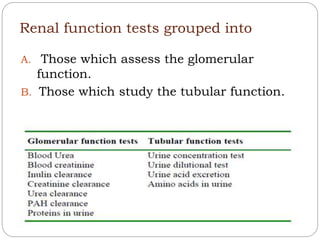
Renal function tests grouped into
A. Those which assess the glomerular
function.
B. Those which study the tubular function.
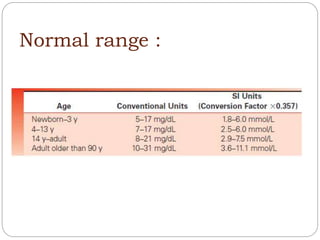
Serum urea (Blood Urea Nitrogen ;BUN)
 Urea is the detoxification product of the ammonia
 concentration of urea in the body depends upon:
1.The rate of production by the liver
2.The rate of removal by the kidneys
 changes in urea levels are more dependent upon kidney
function rather than on liver function.
 BUN is measured as a screening test for renal disease,
more specifically glomerular filtration.
Normal range :
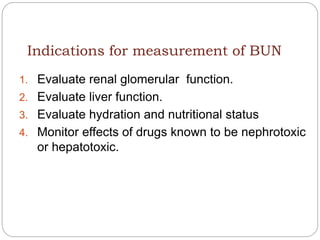
Indications for measurement of BUN
1. Evaluate renal glomerular function.
2. Evaluate liver function.
3. Evaluate hydration and nutritional status
4. Monitor effects of drugs known to be nephrotoxic
or hepatotoxic.
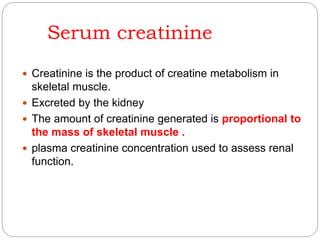
Serum creatinine
 Creatinine is the product of creatine metabolism in
skeletal muscle.
 Excreted by the kidney
 The amount of creatinine generated is proportional to
the mass of skeletal muscle .
 plasma creatinine concentration used to assess renal
function.
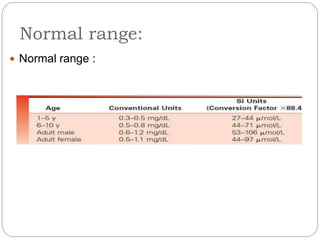
Normal range:
 Normal range :
Indications of creatinine measurement:
 Assess a known or suspected muscles disorder
 Evaluate renal function.
Uric acid (Urate)
 Uric is derived from the breakdown of nucleic
acids(purine nucleosides ) that are ingested or come
from the destruction of tissue cells
 The measurement of serum uric acid is not used as a
primary test for the evaluation of kidney function
because creatinine and urea serve this purpose much
better.
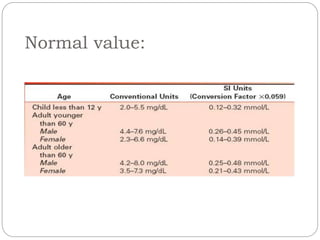
Normal value:
Indications:
1.Assist in the diagnosis of gout (hyperuricemia)
2.Determine the cause of renal calculi.
3.Evaluate the extent of tissue destruction
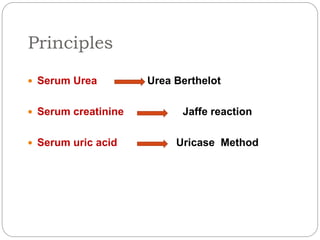
Principles
 Serum Urea Urea Berthelot
 Serum creatinine Jaffe reaction
 Serum uric acid Uricase Method
Thank you

RFT new.pptx renal function test biochemistry lab

  • 1.
  • 2.
    Objectives of thislab • Describe RFT types and their parameters . • Definition of urea, creatinine and uric acid, and principle of measurement by spectrometry. • Practical laboratory work
  • 3.
    Renal function testsgrouped into A. Those which assess the glomerular function. B. Those which study the tubular function.
  • 4.
    Serum urea (BloodUrea Nitrogen ;BUN)  Urea is the detoxification product of the ammonia  concentration of urea in the body depends upon: 1.The rate of production by the liver 2.The rate of removal by the kidneys  changes in urea levels are more dependent upon kidney function rather than on liver function.  BUN is measured as a screening test for renal disease, more specifically glomerular filtration.
  • 5.
  • 6.
    Indications for measurementof BUN 1. Evaluate renal glomerular function. 2. Evaluate liver function. 3. Evaluate hydration and nutritional status 4. Monitor effects of drugs known to be nephrotoxic or hepatotoxic.
  • 7.
    Serum creatinine  Creatinineis the product of creatine metabolism in skeletal muscle.  Excreted by the kidney  The amount of creatinine generated is proportional to the mass of skeletal muscle .  plasma creatinine concentration used to assess renal function.
  • 8.
  • 9.
    Indications of creatininemeasurement:  Assess a known or suspected muscles disorder  Evaluate renal function.
  • 10.
    Uric acid (Urate) Uric is derived from the breakdown of nucleic acids(purine nucleosides ) that are ingested or come from the destruction of tissue cells  The measurement of serum uric acid is not used as a primary test for the evaluation of kidney function because creatinine and urea serve this purpose much better.
  • 11.
  • 12.
    Indications: 1.Assist in thediagnosis of gout (hyperuricemia) 2.Determine the cause of renal calculi. 3.Evaluate the extent of tissue destruction
  • 13.
    Principles  Serum UreaUrea Berthelot  Serum creatinine Jaffe reaction  Serum uric acid Uricase Method
  • 14.