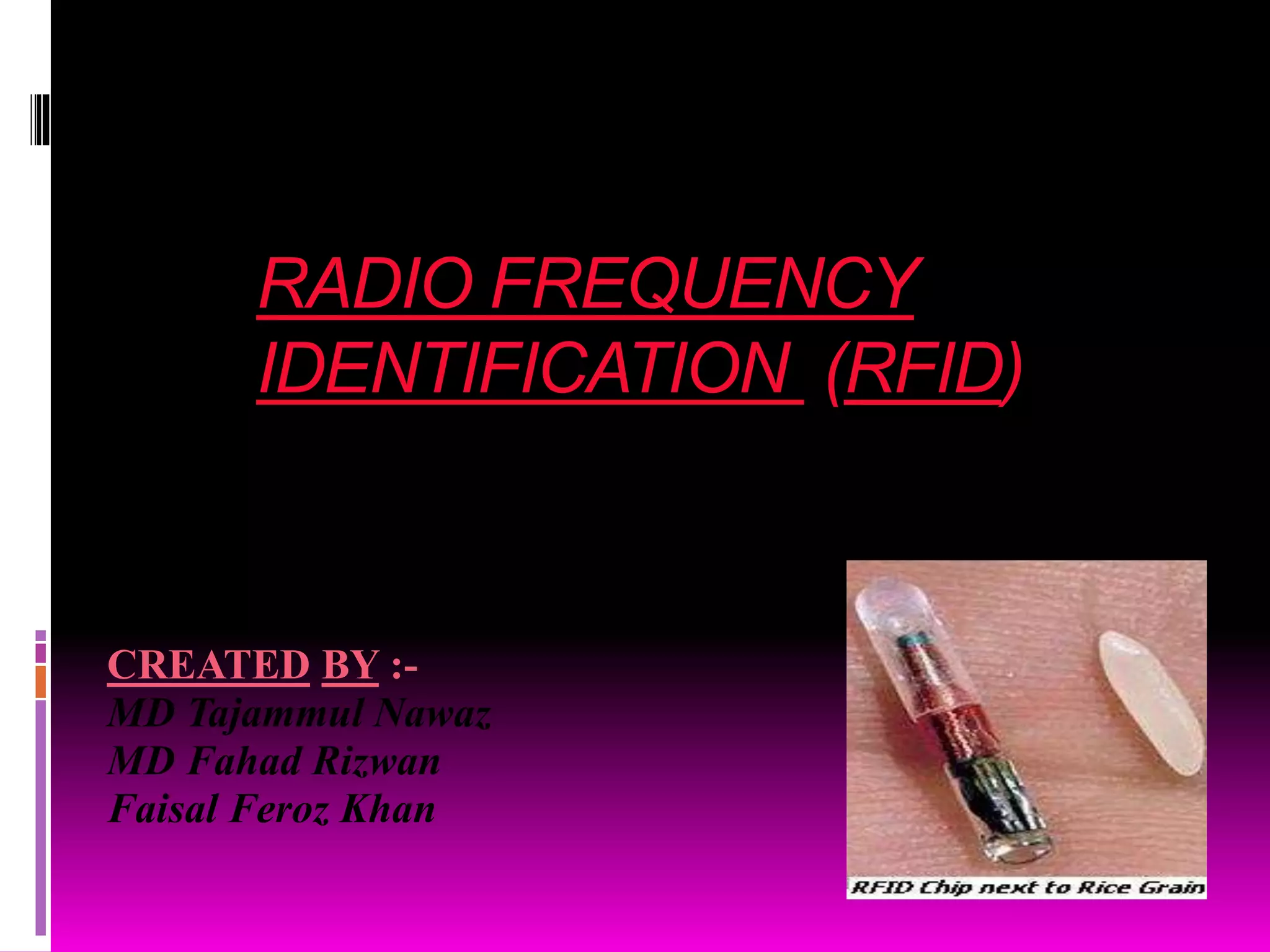
RADIO FREQUENCY 
IDENTIFICATION (RFID) 
CREATED BY :- 
MD Tajammul Nawaz 
MD Fahad Rizwan 
Faisal Feroz Khan
RADIO FREQUENCY IDENTIFICATION 
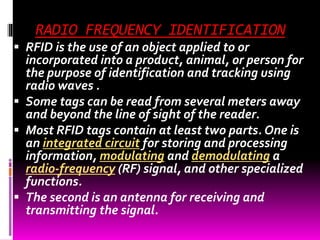
 RFID is the use of an object applied to or 
incorporated into a product, animal, or person for 
the purpose of identification and tracking using 
radio waves . 
 Some tags can be read from several meters away 
and beyond the line of sight of the reader. 
 Most RFID tags contain at least two parts. One is 
an integrated circuit for storing and processing 
information, modulating and demodulating a 
radio-frequency (RF) signal, and other specialized 
functions. 
 The second is an antenna for receiving and 
transmitting the signal.
HISTORY 
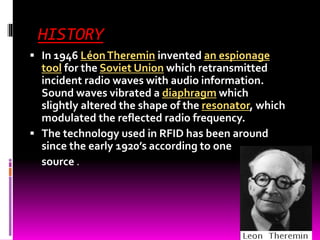
 In 1946 Léon Theremin invented an espionage 
tool for the Soviet Union which retransmitted 
incident radio waves with audio information. 
Sound waves vibrated a diaphragm which 
slightly altered the shape of the resonator, which 
modulated the reflected radio frequency. 
 The technology used in RFID has been around 
since the early 1920’s according to one 
source .
TYPES OF RFID 
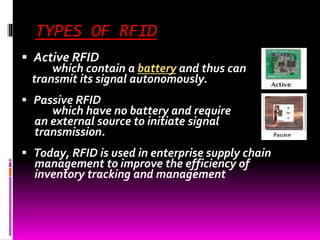
 Active RFID 
which contain a battery and thus can 
transmit its signal autonomously. 
 Passive RFID 
which have no battery and require 
an external source to initiate signal 
transmission. 
 Today, RFID is used in enterprise supply chain 
management to improve the efficiency of 
inventory tracking and management
MINIATURIZATION 
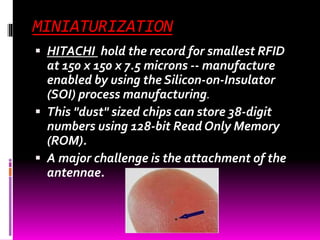
 HITACHI hold the record for smallest RFID 
at 150 x 150 x 7.5 microns -- manufacture 
enabled by using the Silicon-on-Insulator 
(SOI) process manufacturing. 
 This "dust" sized chips can store 38-digit 
numbers using 128-bit Read Only Memory 
(ROM). 
 A major challenge is the attachment of the 
antennae.
CURRENT USES 
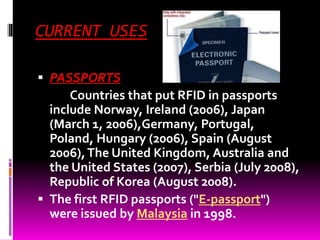
 PASSPORTS 
Countries that put RFID in passports 
include Norway, Ireland (2006), Japan 
(March 1, 2006),Germany, Portugal, 
Poland, Hungary (2006), Spain (August 
2006), The United Kingdom, Australia and 
the United States (2007), Serbia (July 2008), 
Republic of Korea (August 2008). 
 The first RFID passports ("E-passport") 
were issued by Malaysia in 1998.
CURRENT USES 
TRANSPORTATION PAYMENTS 
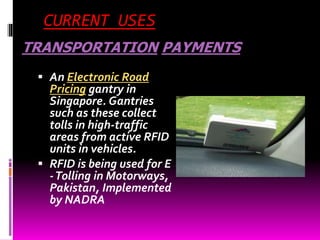
 An Electronic Road 
Pricing gantry in 
Singapore. Gantries 
such as these collect 
tolls in high-traffic 
areas from active RFID 
units in vehicles. 
 RFID is being used for E 
-Tolling in Motorways, 
Pakistan, Implemented 
by NADRA
CURRENT USES 
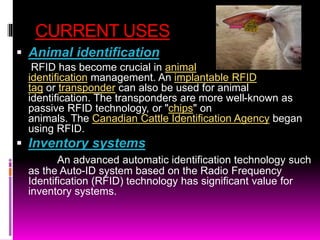
 Animal identification 
RFID has become crucial in animal 
identification management. An implantable RFID 
tag or transponder can also be used for animal 
identification. The transponders are more well-known as 
passive RFID technology, or "chips" on 
animals. The Canadian Cattle Identification Agency began 
using RFID. 
 Inventory systems 
An advanced automatic identification technology such 
as the Auto-ID system based on the Radio Frequency 
Identification (RFID) technology has significant value for 
inventory systems.
HUMAN IMPLANTS 
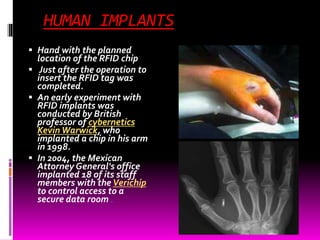
 Hand with the planned 
location of the RFID chip 
 Just after the operation to 
insert the RFID tag was 
completed. 
 An early experiment with 
RFID implants was 
conducted by British 
professor of cybernetics 
Kevin Warwick, who 
implanted a chip in his arm 
in 1998. 
 In 2004, the Mexican 
Attorney General's office 
implanted 18 of its staff 
members with the Verichip 
to control access to a 
secure data room .
LIBRARIES 
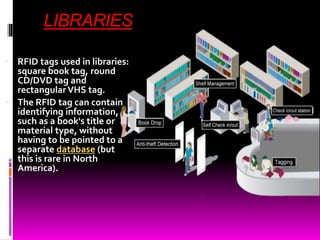
 RFID tags used in libraries: 
square book tag, round 
CD/DVD tag and 
rectangular VHS tag. 
 The RFID tag can contain 
identifying information, 
such as a book's title or 
material type, without 
having to be pointed to a 
separate database (but 
this is rare in North 
America).
REPLACING BARCODES 
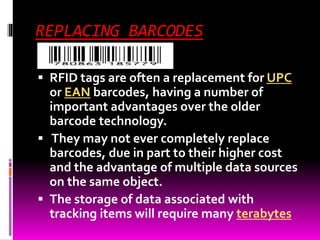
 RFID tags are often a replacement for UPC 
or EAN barcodes, having a number of 
important advantages over the older 
barcode technology. 
 They may not ever completely replace 
barcodes, due in part to their higher cost 
and the advantage of multiple data sources 
on the same object. 
 The storage of data associated with 
tracking items will require many terabytes
PROBLEMS AND CONCERNS 
 Global standardization 
 Security concerns 
 Passports
CONTROVERSIES 
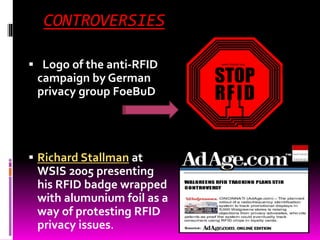
 Logo of the anti-RFID 
campaign by German 
privacy group FoeBuD 
 Richard Stallman at 
WSIS 2005 presenting 
his RFID badge wrapped 
with alumunium foil as a 
way of protesting RFID 
privacy issues.
CONTROVERSIES 
PRIVACY 
The use of RFID technology has engendered considerable 
controversy and even product boycotts by consumer 
privacy advocates. 
HUMAN IMPLANTATION 
The Baja Beach nightclub in Barcelona. This has provoked 
concerns into privacy of individuals as they can potentially 
be tracked wherever they go by an identifier unique to 
them. 
On July 22, 2006, Reuters reported that two hackers, 
Newitz and Westhues, at a conference in New York City 
showed that they could clone the RFID signal from a 
human implanted RFID chip, showing that the chip is not 
hack-proof as was previously told.
Thank You 
/FaisalFerozKhan

RFID - Radio frequency identification Device

  • 1.
    RADIO FREQUENCY IDENTIFICATION(RFID) CREATED BY :- MD Tajammul Nawaz MD Fahad Rizwan Faisal Feroz Khan
  • 2.
    RADIO FREQUENCY IDENTIFICATION  RFID is the use of an object applied to or incorporated into a product, animal, or person for the purpose of identification and tracking using radio waves .  Some tags can be read from several meters away and beyond the line of sight of the reader.  Most RFID tags contain at least two parts. One is an integrated circuit for storing and processing information, modulating and demodulating a radio-frequency (RF) signal, and other specialized functions.  The second is an antenna for receiving and transmitting the signal.
  • 3.
    HISTORY  In1946 Léon Theremin invented an espionage tool for the Soviet Union which retransmitted incident radio waves with audio information. Sound waves vibrated a diaphragm which slightly altered the shape of the resonator, which modulated the reflected radio frequency.  The technology used in RFID has been around since the early 1920’s according to one source .
  • 4.
    TYPES OF RFID  Active RFID which contain a battery and thus can transmit its signal autonomously.  Passive RFID which have no battery and require an external source to initiate signal transmission.  Today, RFID is used in enterprise supply chain management to improve the efficiency of inventory tracking and management
  • 5.
    MINIATURIZATION  HITACHIhold the record for smallest RFID at 150 x 150 x 7.5 microns -- manufacture enabled by using the Silicon-on-Insulator (SOI) process manufacturing.  This "dust" sized chips can store 38-digit numbers using 128-bit Read Only Memory (ROM).  A major challenge is the attachment of the antennae.
  • 6.
    CURRENT USES PASSPORTS Countries that put RFID in passports include Norway, Ireland (2006), Japan (March 1, 2006),Germany, Portugal, Poland, Hungary (2006), Spain (August 2006), The United Kingdom, Australia and the United States (2007), Serbia (July 2008), Republic of Korea (August 2008).  The first RFID passports ("E-passport") were issued by Malaysia in 1998.
  • 7.
    CURRENT USES TRANSPORTATIONPAYMENTS  An Electronic Road Pricing gantry in Singapore. Gantries such as these collect tolls in high-traffic areas from active RFID units in vehicles.  RFID is being used for E -Tolling in Motorways, Pakistan, Implemented by NADRA
  • 8.
    CURRENT USES Animal identification RFID has become crucial in animal identification management. An implantable RFID tag or transponder can also be used for animal identification. The transponders are more well-known as passive RFID technology, or "chips" on animals. The Canadian Cattle Identification Agency began using RFID.  Inventory systems An advanced automatic identification technology such as the Auto-ID system based on the Radio Frequency Identification (RFID) technology has significant value for inventory systems.
  • 9.
    HUMAN IMPLANTS Hand with the planned location of the RFID chip  Just after the operation to insert the RFID tag was completed.  An early experiment with RFID implants was conducted by British professor of cybernetics Kevin Warwick, who implanted a chip in his arm in 1998.  In 2004, the Mexican Attorney General's office implanted 18 of its staff members with the Verichip to control access to a secure data room .
  • 10.
    LIBRARIES  RFIDtags used in libraries: square book tag, round CD/DVD tag and rectangular VHS tag.  The RFID tag can contain identifying information, such as a book's title or material type, without having to be pointed to a separate database (but this is rare in North America).
  • 11.
    REPLACING BARCODES RFID tags are often a replacement for UPC or EAN barcodes, having a number of important advantages over the older barcode technology.  They may not ever completely replace barcodes, due in part to their higher cost and the advantage of multiple data sources on the same object.  The storage of data associated with tracking items will require many terabytes
  • 12.
    PROBLEMS AND CONCERNS  Global standardization  Security concerns  Passports
  • 13.
    CONTROVERSIES  Logoof the anti-RFID campaign by German privacy group FoeBuD  Richard Stallman at WSIS 2005 presenting his RFID badge wrapped with alumunium foil as a way of protesting RFID privacy issues.
  • 14.
    CONTROVERSIES PRIVACY Theuse of RFID technology has engendered considerable controversy and even product boycotts by consumer privacy advocates. HUMAN IMPLANTATION The Baja Beach nightclub in Barcelona. This has provoked concerns into privacy of individuals as they can potentially be tracked wherever they go by an identifier unique to them. On July 22, 2006, Reuters reported that two hackers, Newitz and Westhues, at a conference in New York City showed that they could clone the RFID signal from a human implanted RFID chip, showing that the chip is not hack-proof as was previously told.
  • 15.