PUBLIC
PAUL HART
SVP AND GM OF RADIO FREQUENCY
NXP SEMICONDUCTORS
5G TECHNOLOGY SUMMIT
SHANGHAI, CHINA
JULY 21, 2016
RF POWER AMPLIFIER SOLUTIONS FOR 5G
PUBLIC1
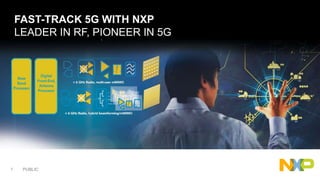
FAST-TRACK 5G WITH NXP
LEADER IN RF, PIONEER IN 5G
PUBLIC2
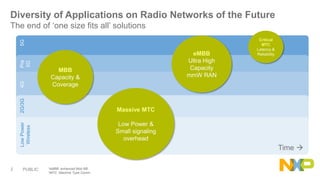
Diversity of Applications on Radio Networks of the Future
The end of ‘one size fits all’ solutions
LowPower
Wireless
2G/3G4GPre
5G
5G
Massive MTC
Low Power &
Small signaling
overhead
MBB
Capacity &
Coverage
Critical
MTC
Latency &
ReliabilityeMBB
Ultra High
Capacity
mmW RAN
Time 
*eMBB: enhanced Mob BB
*MTC: Machine Type Comm
PUBLIC3
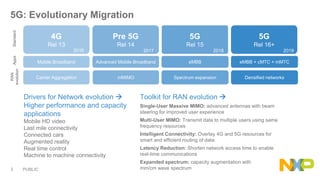
5G: Evolutionary Migration
4G
Rel 13
Pre 5G
Rel 14
5G
Rel 15
5G
Rel 16+
Mobile Broadband Advanced Mobile Broadband eMBB eMBB + cMTC + mMTC
2016 2017 2018 2019
Carrier Aggregation mMIMO Spectrum expansion Densified networks
AppsStandard
RAN
evolution
Drivers for Network evolution 
Higher performance and capacity
applications
Mobile HD video
Last mile connectivity
Connected cars
Augmented reality
Real time control
Machine to machine connectivity
Toolkit for RAN evolution 
Single-User Massive MIMO: advanced antennas with beam
steering for improved user experience
Multi-User MIMO: Transmit data to multiple users using same
frequency resources
Intelligent Connectivity: Overlay 4G and 5G resources for
smart and efficient routing of data
Latency Reduction: Shorten network access time to enable
real-time communications
Expanded spectrum: capacity augmentation with
mm/cm wave spectrum
PUBLIC4
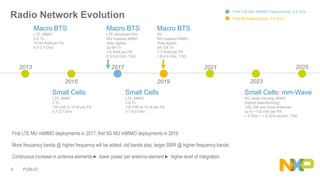
Radio Network Evolution
2015 2019 2023
2013 2017 2021 2025
First LTE MU mMIMO deployments in 2017, first 5G MU mMIMO deployments in 2019
More frequency bands @ higher frequency will be added, old bands stay, larger SBW @ higher frequency bands
Continuous increase in antenna elements ► lower power per antenna element ► higher level of integration
Macro BTS
LTE, MIMO
2-8 Tx
10-40 Watt per PA
0.7-2.7 GHz
Macro BTS
LTE Advanced Pro
MU massive MIMO
(fully digital)
32-64 Tx
3-5 Watt per PA
2.3-3.8 GHz, TDD
Macro BTS
5G
MU massive MIMO
(fully digital)
64-128 Tx
1-3 Watt per PA
1.8-6.0 GHz, TDD
Small Cells
LTE, MIMO
2 Tx
100 mW to 10 W per PA
0.7-2.7 GHz
Small Cells
LTE, MIMO
2-8 Tx
100 mW to 10 W per PA
0.7-6.0 GHz
Small Cells: mm-Wave
5G, beam forming, MIMO
(hybrid beamforming)
128, 256 and more antennas
up to ~100 mW per PA
> 6 GHz + < 6 GHz anchor, TDD
First LTE MU mMIMO Deployments, 2.6 GHz
First 5G Deployments, 3.5 GHz
PUBLIC5
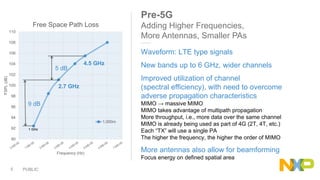
Pre-5G
Adding Higher Frequencies,
More Antennas, Smaller PAs
Waveform: LTE type signals
New bands up to 6 GHz, wider channels
Improved utilization of channel
(spectral efficiency), with need to overcome
adverse propagation characteristics
MIMO → massive MIMO
MIMO takes advantage of multipath propagation
More throughput, i.e., more data over the same channel
MIMO is already being used as part of 4G (2T, 4T, etc.)
Each “TX” will use a single PA
The higher the frequency, the higher the order of MIMO
More antennas also allow for beamforming
Focus energy on defined spatial area
90
92
94
96
98
100
102
104
106
108
110
FSPL(dB)
Frequency (Hz)
Free Space Path Loss
1,000m
9 dB
5 dB
1 GHz
2.7 GHz
4.5 GHz
PUBLIC6
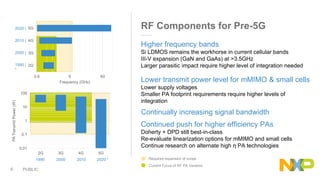
RF Components for Pre-5G
Higher frequency bands
Si LDMOS remains the workhorse in current cellular bands
III-V expansion (GaN and GaAs) at >3.5GHz
Larger parasitic impact require higher level of integration needed
Lower transmit power level for mMIMO & small cells
Lower supply voltages
Smaller PA footprint requirements require higher levels of
integration
Continually increasing signal bandwidth
Continued push for higher efficiency PAs
Doherty + DPD still best-in-class
Re-evaluate linearization options for mMIMO and small cells
Continue research on alternate high η PA technologies
0.6 6 60
2G
3G
4G
5G
Frequency (GHz)
2020 |
2010 |
2000 |
1990 |
*
0.01
0.1
1
10
100
2G 3G 4G 5G
PATransmitPower(W)
1990 2000 2010 2020 * Required expansion of scope
Current Focus of RF PA Vendors
PUBLIC7
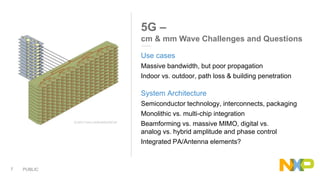
5G –
cm & mm Wave Challenges and Questions
Use cases
Massive bandwidth, but poor propagation
Indoor vs. outdoor, path loss & building penetration
System Architecture
Semiconductor technology, interconnects, packaging
Monolithic vs. multi-chip integration
Beamforming vs. massive MIMO, digital vs.
analog vs. hybrid amplitude and phase control
Integrated PA/Antenna elements?
PUBLIC8
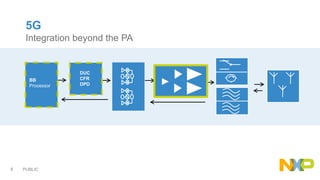
5G
Integration beyond the PA
BB
Processor
DUC
CFR
DPD
PUBLIC9
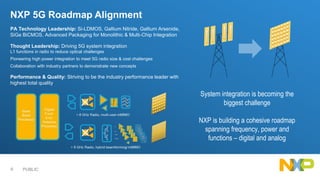
NXP 5G Roadmap Alignment
PA Technology Leadership: Si-LDMOS, Gallium Nitride, Gallium Arsenide,
SiGe BiCMOS, Advanced Packaging for Monolithic & Multi-Chip Integration
Thought Leadership: Driving 5G system integration
L1 functions in radio to reduce optical challenges
Pioneering high power integration to meet 5G radio size & cost challenges
Collaboration with industry partners to demonstrate new concepts
Performance & Quality: Striving to be the industry performance leader with
highest total quality
System integration is becoming the
biggest challenge
NXP is building a cohesive roadmap
spanning frequency, power and
functions – digital and analog
PUBLIC10
Thank You.
RF Power Amplifier Solutions for 5G

RF Power Amplifier Solutions for 5G

  • 1.
    PUBLIC PAUL HART SVP ANDGM OF RADIO FREQUENCY NXP SEMICONDUCTORS 5G TECHNOLOGY SUMMIT SHANGHAI, CHINA JULY 21, 2016 RF POWER AMPLIFIER SOLUTIONS FOR 5G
  • 2.
    PUBLIC1 FAST-TRACK 5G WITHNXP LEADER IN RF, PIONEER IN 5G
  • 3.
    PUBLIC2 Diversity of Applicationson Radio Networks of the Future The end of ‘one size fits all’ solutions LowPower Wireless 2G/3G4GPre 5G 5G Massive MTC Low Power & Small signaling overhead MBB Capacity & Coverage Critical MTC Latency & ReliabilityeMBB Ultra High Capacity mmW RAN Time  *eMBB: enhanced Mob BB *MTC: Machine Type Comm
  • 4.
    PUBLIC3 5G: Evolutionary Migration 4G Rel13 Pre 5G Rel 14 5G Rel 15 5G Rel 16+ Mobile Broadband Advanced Mobile Broadband eMBB eMBB + cMTC + mMTC 2016 2017 2018 2019 Carrier Aggregation mMIMO Spectrum expansion Densified networks AppsStandard RAN evolution Drivers for Network evolution  Higher performance and capacity applications Mobile HD video Last mile connectivity Connected cars Augmented reality Real time control Machine to machine connectivity Toolkit for RAN evolution  Single-User Massive MIMO: advanced antennas with beam steering for improved user experience Multi-User MIMO: Transmit data to multiple users using same frequency resources Intelligent Connectivity: Overlay 4G and 5G resources for smart and efficient routing of data Latency Reduction: Shorten network access time to enable real-time communications Expanded spectrum: capacity augmentation with mm/cm wave spectrum
  • 5.
    PUBLIC4 Radio Network Evolution 20152019 2023 2013 2017 2021 2025 First LTE MU mMIMO deployments in 2017, first 5G MU mMIMO deployments in 2019 More frequency bands @ higher frequency will be added, old bands stay, larger SBW @ higher frequency bands Continuous increase in antenna elements ► lower power per antenna element ► higher level of integration Macro BTS LTE, MIMO 2-8 Tx 10-40 Watt per PA 0.7-2.7 GHz Macro BTS LTE Advanced Pro MU massive MIMO (fully digital) 32-64 Tx 3-5 Watt per PA 2.3-3.8 GHz, TDD Macro BTS 5G MU massive MIMO (fully digital) 64-128 Tx 1-3 Watt per PA 1.8-6.0 GHz, TDD Small Cells LTE, MIMO 2 Tx 100 mW to 10 W per PA 0.7-2.7 GHz Small Cells LTE, MIMO 2-8 Tx 100 mW to 10 W per PA 0.7-6.0 GHz Small Cells: mm-Wave 5G, beam forming, MIMO (hybrid beamforming) 128, 256 and more antennas up to ~100 mW per PA > 6 GHz + < 6 GHz anchor, TDD First LTE MU mMIMO Deployments, 2.6 GHz First 5G Deployments, 3.5 GHz
  • 6.
    PUBLIC5 Pre-5G Adding Higher Frequencies, MoreAntennas, Smaller PAs Waveform: LTE type signals New bands up to 6 GHz, wider channels Improved utilization of channel (spectral efficiency), with need to overcome adverse propagation characteristics MIMO → massive MIMO MIMO takes advantage of multipath propagation More throughput, i.e., more data over the same channel MIMO is already being used as part of 4G (2T, 4T, etc.) Each “TX” will use a single PA The higher the frequency, the higher the order of MIMO More antennas also allow for beamforming Focus energy on defined spatial area 90 92 94 96 98 100 102 104 106 108 110 FSPL(dB) Frequency (Hz) Free Space Path Loss 1,000m 9 dB 5 dB 1 GHz 2.7 GHz 4.5 GHz
  • 7.
    PUBLIC6 RF Components forPre-5G Higher frequency bands Si LDMOS remains the workhorse in current cellular bands III-V expansion (GaN and GaAs) at >3.5GHz Larger parasitic impact require higher level of integration needed Lower transmit power level for mMIMO & small cells Lower supply voltages Smaller PA footprint requirements require higher levels of integration Continually increasing signal bandwidth Continued push for higher efficiency PAs Doherty + DPD still best-in-class Re-evaluate linearization options for mMIMO and small cells Continue research on alternate high η PA technologies 0.6 6 60 2G 3G 4G 5G Frequency (GHz) 2020 | 2010 | 2000 | 1990 | * 0.01 0.1 1 10 100 2G 3G 4G 5G PATransmitPower(W) 1990 2000 2010 2020 * Required expansion of scope Current Focus of RF PA Vendors
  • 8.
    PUBLIC7 5G – cm &mm Wave Challenges and Questions Use cases Massive bandwidth, but poor propagation Indoor vs. outdoor, path loss & building penetration System Architecture Semiconductor technology, interconnects, packaging Monolithic vs. multi-chip integration Beamforming vs. massive MIMO, digital vs. analog vs. hybrid amplitude and phase control Integrated PA/Antenna elements?
  • 9.
    PUBLIC8 5G Integration beyond thePA BB Processor DUC CFR DPD
  • 10.
    PUBLIC9 NXP 5G RoadmapAlignment PA Technology Leadership: Si-LDMOS, Gallium Nitride, Gallium Arsenide, SiGe BiCMOS, Advanced Packaging for Monolithic & Multi-Chip Integration Thought Leadership: Driving 5G system integration L1 functions in radio to reduce optical challenges Pioneering high power integration to meet 5G radio size & cost challenges Collaboration with industry partners to demonstrate new concepts Performance & Quality: Striving to be the industry performance leader with highest total quality System integration is becoming the biggest challenge NXP is building a cohesive roadmap spanning frequency, power and functions – digital and analog
  • 11.