RF Optimisation

Safe harbor
• Neither the information nor any opinion expressed in this presentation constitutes an offer, or invitation to make an offer, or to buy any security issued by the company. This presentation contains
predictions, estimates or other information regarding the Company's operations which are forward looking in nature. While these forward looking statements represent our best current judgment on what the
future holds, they are subject to risks and uncertainties that could cause actual results to differ materially and may involve risk and uncertainty. This presentation is prepared for general purposes only and
does not have any regard to the specific investment objectives, financial situation and particular needs of any specific person. No liability for any loss will arise with the company as a result of the action
taken on the basis of information contained herein.
•For a discussion of the risks and uncertainties that may cause results to differ, you should review GTL’s filings with stock exchanges, including the annual report and quarterly disclosures.
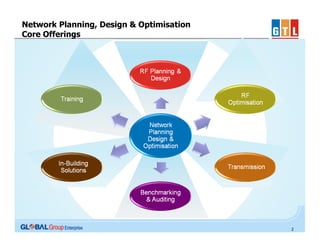
Network Planning, Design & Optimisation
Core Offerings

2
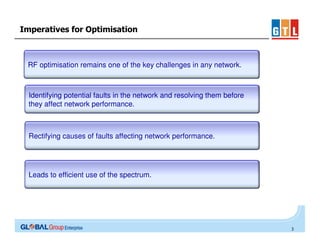
Imperatives for Optimisation

RF optimisation remains one of the key challenges in any network.

Identifying potential faults in the network and resolving them before
they affect network performance.

Rectifying causes of faults affecting network performance.

Leads to efficient use of the spectrum.

3
Optimisation Overview

4
Need for optimisation
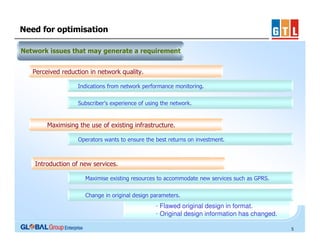
Network issues that may generate a requirement
Perceived reduction in network quality.
Indications from network performance monitoring.
Subscriber's experience of using the network.

Maximising the use of existing infrastructure.
Operators wants to ensure the best returns on investment.

Introduction of new services.
Maximise existing resources to accommodate new services such as GPRS.
Change in original design parameters.

▪ Flawed original design in format.
▪ Original design information has changed.
5
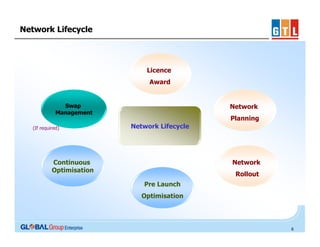
Network Lifecycle

Licence
Award

Swap
Management
(If required)

Network
Planning
Network Lifecycle

Continuous
Optimisation

Network
Rollout
Pre Launch
Optimisation

6
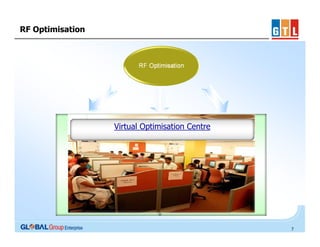
RF Optimisation

Pre Launch Virtual Continuous Centre
Swap
Optimisation
Optimisation
Optimisation
Management
(If required)

- BTS upgrade

Virtual Optimisation Centre
- BTS re-homing
- BSC re-parenting
- Transmission Re-engineering

7
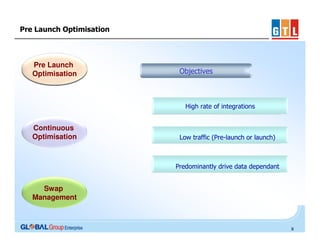
Pre Launch Optimisation

Pre Launch
Optimisation

Objectives

High rate of integrations

Continuous
Optimisation

Low traffic (Pre-launch or launch)

Predominantly drive data dependant

Swap
Management

8
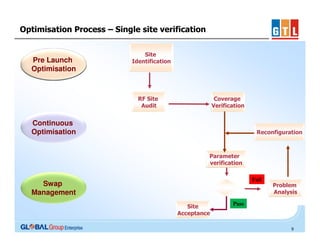
Optimisation Process – Single site verification

Pre Launch
Optimisation

Site
Identification

RF Site
Audit

Coverage
Verification

Continuous
Optimisation

Reconfiguration

Parameter
verification
Fail

Swap
Management

Problem
Analysis
Site
Acceptance

Pass

9
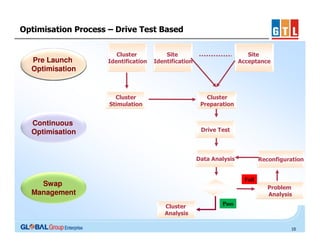
Optimisation Process – Drive Test Based

Pre Launch
Optimisation

Cluster
Identification

Site
Identification

Cluster
Stimulation

Site
Acceptance

Cluster
Preparation

Continuous
Optimisation

Drive Test

Data Analysis

Reconfiguration

Fail

Swap
Management

Problem
Analysis
Cluster
Analysis

Pass

10
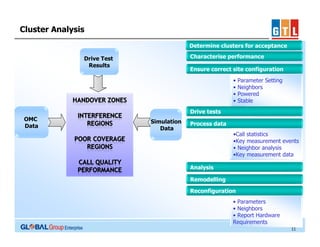
Cluster Analysis
Determine clusters for acceptance
Characterise performance

Drive Test
Results

Ensure correct site configuration
•
•
•
•

Parameter Setting
Neighbors
Powered
Stable

Drive tests
OMC
Data

Simulation
Data

Process data
•Call statistics
•Key measurement events
• Neighbor analysis
•Key measurement data
Analysis
Remodelling
Reconfiguration
• Parameters
• Neighbors
• Report Hardware
Requirements
11
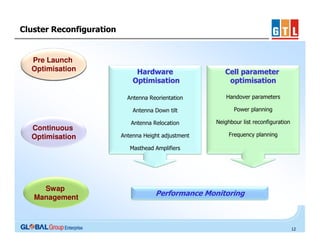
Cluster Reconfiguration

Pre Launch
Optimisation

Cell parameter
optimisation

Antenna Reorientation

Handover parameters

Antenna Down tilt

Continuous
Optimisation

Hardware
Optimisation

Power planning

Antenna Relocation

Neighbour list reconfiguration

Antenna Height adjustment

Frequency planning

Masthead Amplifiers

Swap
Management

Performance Monitoring

12
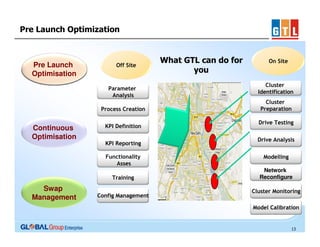
Pre Launch Optimization

Pre Launch
Optimisation

Off Site

Parameter
Analysis
Process Creation

Continuous
Optimisation

KPI Definition
KPI Reporting
Functionality
Asses
Training

Swap
Management

Config Management

What GTL can do for
you

On Site

Cluster
Identification
Cluster
Preparation
Drive Testing
Drive Analysis
Modelling
Network
Reconfigure
Cluster Monitoring
Model Calibration

13
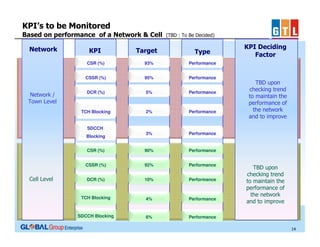
KPI’s to be Monitored
Based on performance of a Network & Cell
Network

KPI

Target

(TBD : To Be Decided)

Type

CSR (%)

Performance

CSSR (%)

95%

Performance

DCR (%)

5%

Performance

TCH Blocking

2%

Performance

3%

Performance

CSR (%)

90%

Performance

CSSR (%)

Network /
Town Level

93%

92%

Performance

DCR (%)

10%

Performance

TCH Blocking

4%

Performance

SDCCH Blocking

6%

KPI Deciding
Factor

Performance

TBD upon
checking trend
to maintain the
performance of
the network
and to improve

SDCCH
Blocking

Cell Level

TBD upon
checking trend
to maintain the
performance of
the network
and to improve

14
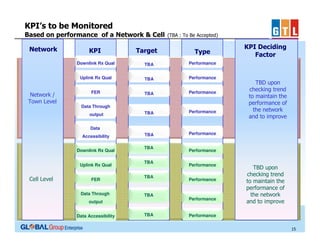
KPI’s to be Monitored
Based on performance of a Network & Cell
Network

KPI

Target

(TBA : To Be Accepted)

Type

Downlink Rx Qual

Performance

Uplink Rx Qual

Network /
Town Level

TBA
TBA

Performance

FER

TBA

Performance

TBA

Performance

TBA

KPI Deciding
Factor

Performance

Data Through
output

TBD upon
checking trend
to maintain the
performance of
the network
and to improve

Data
Accessibility
Downlink Rx Qual
Uplink Rx Qual

Cell Level

FER
Data Through

TBA
TBA
TBA

TBA

output
Data Accessibility

TBA

Performance
Performance
Performance

Performance

TBD upon
checking trend
to maintain the
performance of
the network
and to improve

Performance
15
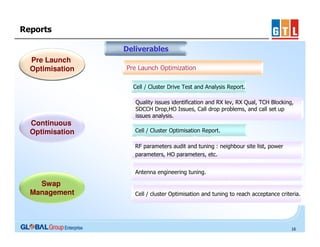
Reports
Deliverables
Pre Launch
Optimisation

Pre Launch Optimization
Cell / Cluster Drive Test and Analysis Report.
Quality issues identification and RX lev, RX Qual, TCH Blocking,
SDCCH Drop,HO Issues, Call drop problems, and call set up
issues analysis.

Continuous
Optimisation

Cell / Cluster Optimisation Report.
RF parameters audit and tuning : neighbour site list, power
parameters, HO parameters, etc.
Antenna engineering tuning.

Swap
Management

Cell / cluster Optimisation and tuning to reach acceptance criteria.

16
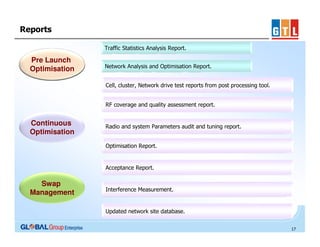
Reports
Traffic Statistics Analysis Report.

Pre Launch
Optimisation

Network Analysis and Optimisation Report.
Cell, cluster, Network drive test reports from post processing tool.
RF coverage and quality assessment report.

Continuous
Optimisation

Radio and system Parameters audit and tuning report.
Optimisation Report.

Acceptance Report.

Swap
Management

Interference Measurement.

Updated network site database.
17
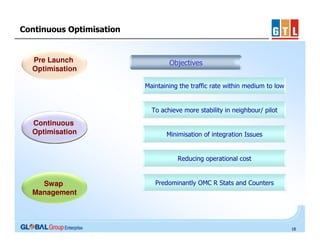
Continuous Optimisation

Pre Launch
Optimisation

Objectives
Maintaining the traffic rate within medium to low

To achieve more stability in neighbour/ pilot

Continuous
Optimisation

Minimisation of integration Issues

Reducing operational cost

Swap
Management

Predominantly OMC R Stats and Counters

18
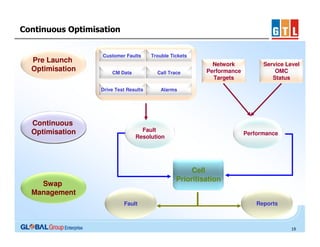
Continuous Optimisation

Pre Launch
Optimisation

Customer Faults

Trouble Tickets

Call Trace

Drive Test Results

Continuous
Optimisation

CM Data

Network
Performance
Targets

Service Level
OMC
Status

Alarms

Fault
Resolution

Performance

Cell
Prioritisation

Swap
Management
Fault

Reports

19
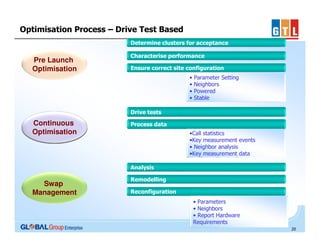
Optimisation Process – Drive Test Based
Determine clusters for acceptance

Pre Launch
Optimisation

Characterise performance
Ensure correct site configuration
•
•
•
•

Parameter Setting
Neighbors
Powered
Stable

Drive tests

Continuous
Optimisation

Process data
•Call statistics
•Key measurement events
• Neighbor analysis
•Key measurement data
Analysis

Swap
Management

Remodelling
Reconfiguration
• Parameters
• Neighbors
• Report Hardware
Requirements
20
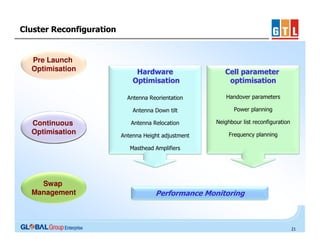
Cluster Reconfiguration

Pre Launch
Optimisation

Cell parameter
optimisation

Antenna Reorientation

Handover parameters

Antenna Down tilt

Continuous
Optimisation

Hardware
Optimisation

Power planning

Antenna Relocation

Neighbour list reconfiguration

Antenna Height adjustment

Frequency planning

Masthead Amplifiers

Swap
Management

Performance Monitoring

21
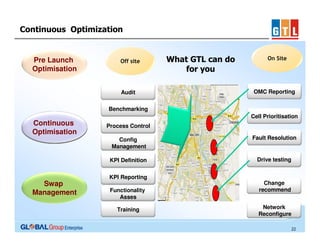
Continuous Optimization

Pre Launch
Optimisation

Off site

Audit

What GTL can do
for you

On Site

OMC Reporting

Benchmarking
Cell Prioritisation

Continuous
Optimisation

Process Control
Config
Management

Fault Resolution

KPI Definition

Drive testing

KPI Reporting

Swap
Management

Functionality
Asses
Training

Change
recommend
Network
Reconfigure
22
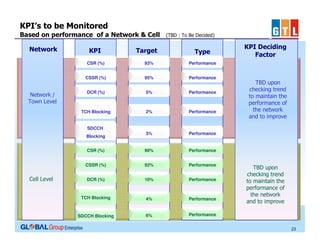
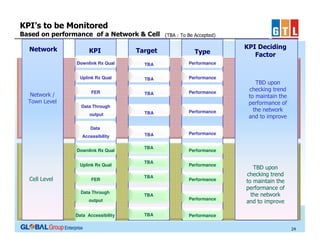
KPI’s to be Monitored
Based on performance of a Network & Cell
Network

KPI

Target

(TBD : To Be Decided)

Type

CSR (%)

Performance

CSSR (%)

95%

Performance

DCR (%)

5%

Performance

TCH Blocking

2%

Performance

3%

Performance

CSR (%)

90%

Performance

CSSR (%)

Network /
Town Level

93%

92%

Performance

DCR (%)

10%

Performance

TCH Blocking

4%

Performance

SDCCH Blocking

6%

KPI Deciding
Factor

Performance

TBD upon
checking trend
to maintain the
performance of
the network
and to improve

SDCCH
Blocking

Cell Level

TBD upon
checking trend
to maintain the
performance of
the network
and to improve

23
KPI’s to be Monitored
Based on performance of a Network & Cell
Network

KPI

Target

(TBA : To Be Accepted)

Type

Downlink Rx Qual

Performance

Uplink Rx Qual

Network /
Town Level

TBA
TBA

Performance

FER

TBA

Performance

TBA

Performance

TBA

KPI Deciding
Factor

Performance

Data Through
output

TBD upon
checking trend
to maintain the
performance of
the network
and to improve

Data
Accessibility
Downlink Rx Qual
Uplink Rx Qual

Cell Level

FER
Data Through

TBA
TBA
TBA

TBA

output
Data Accessibility

TBA

Performance
Performance
Performance

Performance

TBD upon
checking trend
to maintain the
performance of
the network
and to improve

Performance
24
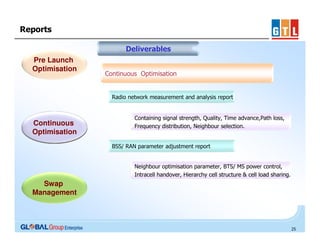
Reports
Deliverables
Pre Launch
Optimisation

Continuous Optimisation

Radio network measurement and analysis report

Continuous
Optimisation

Containing signal strength, Quality, Time advance,Path loss,
Frequency distribution, Neighbour selection.

BSS/ RAN parameter adjustment report

Neighbour optimisation parameter, BTS/ MS power control,
Intracell handover, Hierarchy cell structure & cell load sharing.

Swap
Management

25
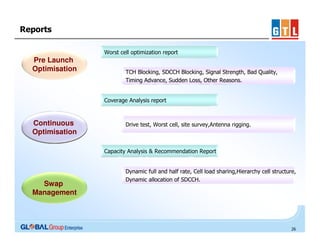
Reports
Worst cell optimization report

Pre Launch
Optimisation

TCH Blocking, SDCCH Blocking, Signal Strength, Bad Quality,
Timing Advance, Sudden Loss, Other Reasons.

Coverage Analysis report

Continuous
Optimisation

Drive test, Worst cell, site survey,Antenna rigging.

Capacity Analysis & Recommendation Report

Swap
Management

Dynamic full and half rate, Cell load sharing,Hierarchy cell structure,
Dynamic allocation of SDCCH.

26
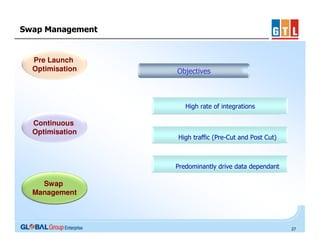
Swap Management

Pre Launch
Optimisation

Objectives

High rate of integrations

Continuous
Optimisation

High traffic (Pre-Cut and Post Cut)

Predominantly drive data dependant

Swap
Management

27
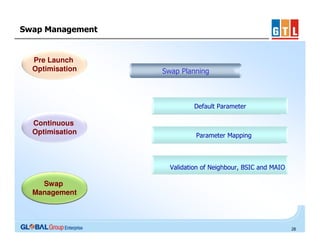
Swap Management

Pre Launch
Optimisation

Swap Planning

Default Parameter

Continuous
Optimisation

Parameter Mapping

Validation of Neighbour, BSIC and MAIO

Swap
Management

28
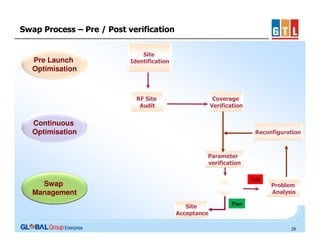
Swap Process – Pre / Post verification

Pre Launch
Optimisation

Site
Identification

RF Site
Audit

Coverage
Verification

Continuous
Optimisation

Reconfiguration

Parameter
verification
Fail

Swap
Management

Problem
Analysis
Site
Acceptance

Pass

29
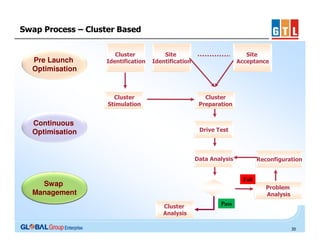
Swap Process – Cluster Based

Pre Launch
Optimisation

Cluster
Identification

Site
Identification

Cluster
Stimulation

Site
Acceptance

Cluster
Preparation

Continuous
Optimisation

Drive Test

Data Analysis

Reconfiguration

Fail

Swap
Management

Problem
Analysis
Cluster
Analysis

Pass

30
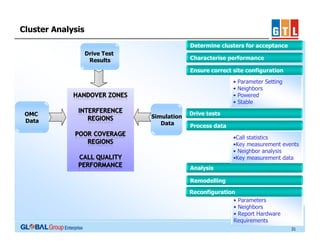
Cluster Analysis
Determine clusters for acceptance
Drive Test
Results

Characterise performance
Ensure correct site configuration
•
•
•
•

OMC
Data

Simulation
Data

Parameter Setting
Neighbors
Powered
Stable

Drive tests
Process data
•Call statistics
•Key measurement events
• Neighbor analysis
•Key measurement data
Analysis
Remodelling
Reconfiguration
• Parameters
• Neighbors
• Report Hardware
Requirements
31
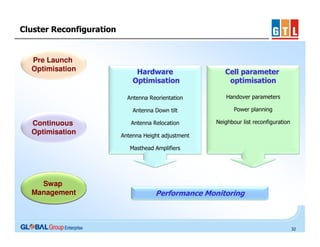
Cluster Reconfiguration

Pre Launch
Optimisation

Cell parameter
optimisation

Antenna Reorientation

Handover parameters

Antenna Down tilt

Continuous
Optimisation

Hardware
Optimisation

Power planning

Antenna Relocation

Neighbour list reconfiguration

Antenna Height adjustment
Masthead Amplifiers

Swap
Management

Performance Monitoring

32
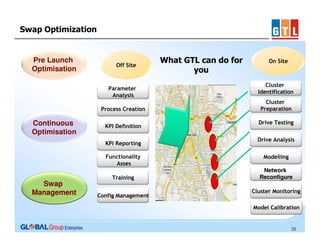
Swap Optimization

Pre Launch
Optimisation

Off Site

Parameter
Analysis
Process Creation

Continuous
Optimisation

KPI Definition
KPI Reporting
Functionality
Asses

Swap
Management

Training
Config Management

What GTL can do for
you

On Site

Cluster
Identification
Cluster
Preparation
Drive Testing
Drive Analysis
Modelling
Network
Reconfigure
Cluster Monitoring
Model Calibration

33
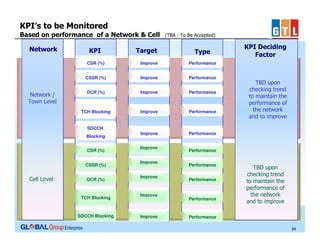
KPI’s to be Monitored
Based on performance of a Network & Cell
Network

KPI

Target

(TBA : To Be Accepted)

Type

CSR (%)

Performance

CSSR (%)

Improve

Performance

DCR (%)

Improve

Performance

TCH Blocking

Network /
Town Level

Improve

Improve

Performance

Improve

KPI Deciding
Factor

Performance

TBD upon
checking trend
to maintain the
performance of
the network
and to improve

SDCCH
Blocking
CSR (%)
CSSR (%)

Cell Level

DCR (%)

TCH Blocking

SDCCH Blocking

Improve
Improve
Improve

Improve

Improve

Performance
Performance
Performance

Performance

TBD upon
checking trend
to maintain the
performance of
the network
and to improve

Performance
34
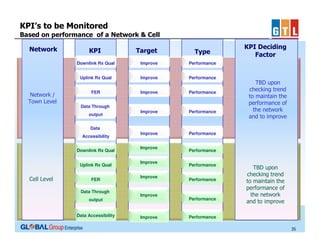
KPI’s to be Monitored
Based on performance of a Network & Cell
Network

KPI

Target

Type

Downlink Rx Qual

Performance

Uplink Rx Qual

Network /
Town Level

Improve
Improve

Performance

FER

Improve

Performance

Improve

Performance

Improve

KPI Deciding
Factor

Performance

Data Through
output

TBD upon
checking trend
to maintain the
performance of
the network
and to improve

Data
Accessibility
Downlink Rx Qual
Uplink Rx Qual

Cell Level

FER
Data Through

Improve
Improve
Improve

Improve

output

Data Accessibility

Improve

Performance
Performance
Performance

Performance

TBD upon
checking trend
to maintain the
performance of
the network
and to improve

Performance
35
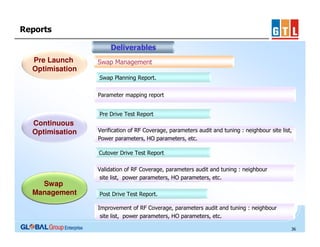
Reports
Deliverables
Pre Launch
Optimisation

Swap Management
Swap Planning Report.
Parameter mapping report
Pre Drive Test Report

Continuous
Optimisation

Verification of RF Coverage, parameters audit and tuning : neighbour site list,
Power parameters, HO parameters, etc.
Cutover Drive Test Report
Validation of RF Coverage, parameters audit and tuning : neighbour
site list, power parameters, HO parameters, etc.

Swap
Management

Post Drive Test Report.
Improvement of RF Coverage, parameters audit and tuning : neighbour
site list, power parameters, HO parameters, etc.
36
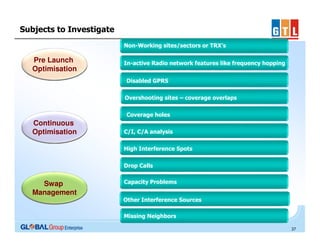
Subjects to Investigate
Non-Working sites/sectors or TRX’s

Pre Launch
Optimisation

In-active Radio network features like frequency hopping
•Disabled GPRS
Overshooting sites – coverage overlaps
•Coverage holes

Continuous
Optimisation

C/I, C/A analysis
High Interference Spots
Drop Calls

Swap
Management

Capacity Problems
Other Interference Sources
Missing Neighbors
37
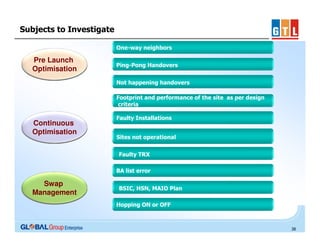
Subjects to Investigate
One-way neighbors

Pre Launch
Optimisation

Ping-Pong Handovers
Not happening handovers
Footprint and performance of the site as per design
criteria

Continuous
Optimisation

Faulty Installations
Sites not operational
•Faulty TRX
BA list error

Swap
Management

•BSIC, HSN, MAIO Plan
Hopping ON or OFF

38
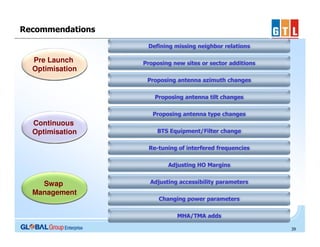
Recommendations
Defining missing neighbor relations

Pre Launch
Optimisation

Proposing new sites or sector additions
Proposing antenna azimuth changes
Proposing antenna tilt changes
Proposing antenna type changes

Continuous
Optimisation

BTS Equipment/Filter change
Re-tuning of interfered frequencies
Adjusting HO Margins

Swap
Management

Adjusting accessibility parameters
Changing power parameters
MHA/TMA adds
39
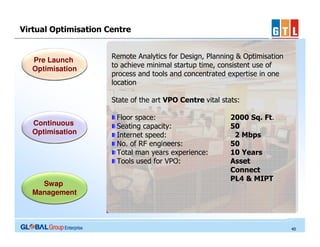
Virtual Optimisation Centre

Pre Launch
Optimisation

Remote Analytics for Design, Planning & Optimisation
to achieve minimal startup time, consistent use of
process and tools and concentrated expertise in one
location
State of the art VPO Centre vital stats:

Continuous
Optimisation

Swap
Management

Floor space:
Seating capacity:
Internet speed:
No. of RF engineers:
Total man years experience:
Tools used for VPO:

2000 Sq. Ft.
50
2 Mbps
50
10 Years
Asset
Connect
PL4 & MIPT

40
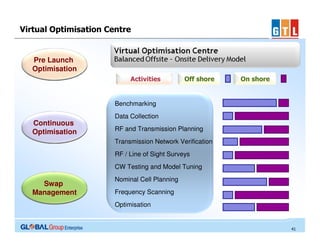
Virtual Optimisation Centre

Pre Launch
Optimisation
Activities

Off shore

On shore

Benchmarking
Data Collection

Continuous
Optimisation

RF and Transmission Planning
Transmission Network Verification
RF / Line of Sight Surveys
CW Testing and Model Tuning

Swap
Management

Nominal Cell Planning
Frequency Scanning
Optimisation

41
Virtual Optimisation Centre
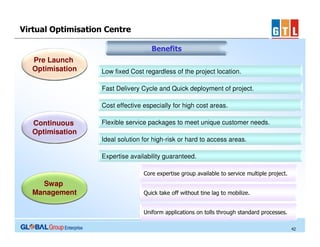
Benefits
Pre Launch
Optimisation

Low fixed Cost regardless of the project location.
Fast Delivery Cycle and Quick deployment of project.
Cost effective especially for high cost areas.

Continuous
Optimisation

Flexible service packages to meet unique customer needs.
Ideal solution for high-risk or hard to access areas.
Expertise availability guaranteed.
Core expertise group available to service multiple project.

Swap
Management

Quick take off without tine lag to mobilize.
Uniform applications on tolls through standard processes.
42
Value Proposition
Risk Sharing - KPI & SLA Based Commitments
End to End RF solution provider
RF Planning, Design and Optimisation done for
31 networks
–

Experience across 15 geographies

–

Covering 2G, 2.5G, 3G technologies

–

Across standards such as GSM, Edge/GPRS,
CDMA, UMTS and WiMAX

Long Standing relations With OEMs At Global
Level
Unique combination of tasks carried out Offshore
and Onshore that give cost efficiencies
Technology and vendor agnostic skill set
43
Case Studies & Capabilities

44
Case Study 1
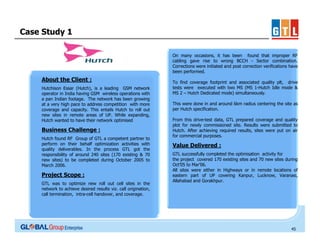
On many occasions, it has been found that improper RF
cabling gave rise to wrong BCCH - Sector combination.
Corrections were initiated and post correction verifications have
been performed.

About the Client :
Hutchison Essar (Hutch), is a leading GSM network
operator in India having GSM wireless operations with
a pan Indian footage. The network has been growing
at a very high pace to address competition with more
coverage and capacity. This entails Hutch to roll out
new sites in remote areas of UP. While expanding,
Hutch wanted to have their network optimised

Business Challenge :
Hutch found RF Group of GTL a competent partner to
perform on their behalf optimization activities with
quality deliverables. In the process GTL got the
responsibility of around 240 sites (170 existing & 70
new sites) to be completed during October 2005 to
March 2006.

Project Scope :
GTL was to optimize new roll out cell sites in the
network to achieve desired results viz. call origination,
call termination, intra-cell handover, and coverage.

To find coverage footprint and associated quality plt, drive
tests were executed with two MS (MS 1-Hutch Idle mode &
MS 2 – Hutch Dedicated mode) simultaneously.
This were done in and around 6km radius centering the site as
per Hutch specification.
From this drive-test data, GTL prepared coverage and quality
plot for newly commissioned site. Results were submitted to
Hutch. After achieving required results, sites were put on air
for commercial purposes.

Value Delivered :
GTL successfully completed the optimisation activity for
the project covered 170 existing sites and 70 new sites during
Oct’05 to Mar’06.
All sites were either in Highways or in remote locations of
eastern part of UP covering Kanpur, Lucknow, Varanasi,
Allahabad and Gorakhpur.

45
Case Study 2
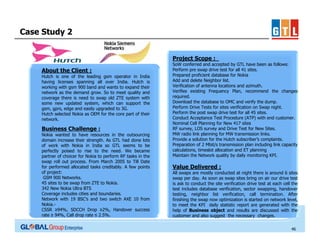
Project Scope :
About the Client :
Hutch is one of the leading gsm operator in India
having licenses spanning all over India. Hutch is
working with gsm 900 band and wants to expand their
network as the demand grow. So to meet quality and
coverage there is need to swap old ZTE system with
some new updated system, which can support the
gsm, gprs, edge and easily upgraded to 3G.
Hutch selected Nokia as OEM for the core part of their
network.

Business Challenge :
Nokia wanted to have resources in the outsourcing
domain increase their strength. As GTL had done lots
of work with Nokia in India so GTL seems to be
perfectly poised to rise to the need. We became
partner of choicer for Nokia to perform RF tasks in the
swap roll out process. From March 2005 to Till Date
for performed allocated tasks creditably. A few points
of project:
GSM 900 Networks.
45 sites to be swap from ZTE to Nokia.
342 New Nokia Ultra BTS
Coverage includes cities and boundaries.
Network with 19 BSC’s and two switch AXE 10 from
Nokia.CSSR ≥94%, SDCCH Drop ≥2%, Handover success
rate ≥ 94%, Call drop rate ≤ 2.5%.

SoW conferred and accepted by GTL have been as follows:
Perform pre swap drive test for all 41 sites.
Prepared proficient database for Nokia
Add and delete Neighbor list.
Verification of antenna locations and azimuth.
Verifies existing Frequency Plan, recommend the changes
required.
Download the database to OMC and verify the dump.
Perform Drive Tests for sites verification on Swap night.
Perform the post swap drive test for all 45 sites.
Conduct Acceptance Test Procedure (ATP) with end customer.
Nominal Cell Planning for New 417 sites
RF survey, LOS survey and Drive Test for New Sites.
MW radio link planning for MW transmission links.
Provide a solution for the Hutch subscriber’s complaints.
Preparation of 2 Mbit/s transmission plan including link capacity
calculations, timeslot allocation and ET planning
Maintain the Network quality by daily monitoring KPI.

Value Delivered :
All swaps are mostly conducted at night there is around 6 sites
swap per day. As soon as swap sites bring on air our drive test
is ask to conduct the site verification drive test at each cell the
test includes database verification, sector swapping, handover
testing, neighbor list verification, call termination. After
finishing the swap now optimization is started on network level,
to meet the KPI daily statistic report are generated with the
help of Business object and results are discussed with the
customer and also suggest the necessary changes.
46
GTL's Network Customer Engagement

Government Of
Maharashtra

Power Grid
Corp

47
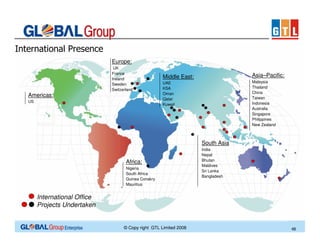
International Presence
Europe:
UK
France
Ireland
Sweden
Switzerland

Americas:
US

Middle East:

Asia–Pacific:

UAE
KSA
Oman
Qatar
Kuwait

Malaysia
Thailand
China
Taiwan
Indonesia
Australia
Singapore
Philippines
New Zealand

South Asia
Africa:
Nigeria
South Africa
Guinea Conakry
Mauritius

India
Nepal
Bhutan
Maldives
Sri Lanka
Bangladesh

International Office
Projects Undertaken

© Copy right GTL Limited 2008

48
Thank you

Rf optimisation

  • 1.
    RF Optimisation Safe harbor •Neither the information nor any opinion expressed in this presentation constitutes an offer, or invitation to make an offer, or to buy any security issued by the company. This presentation contains predictions, estimates or other information regarding the Company's operations which are forward looking in nature. While these forward looking statements represent our best current judgment on what the future holds, they are subject to risks and uncertainties that could cause actual results to differ materially and may involve risk and uncertainty. This presentation is prepared for general purposes only and does not have any regard to the specific investment objectives, financial situation and particular needs of any specific person. No liability for any loss will arise with the company as a result of the action taken on the basis of information contained herein. •For a discussion of the risks and uncertainties that may cause results to differ, you should review GTL’s filings with stock exchanges, including the annual report and quarterly disclosures.
  • 2.
    Network Planning, Design& Optimisation Core Offerings 2
  • 3.
    Imperatives for Optimisation RFoptimisation remains one of the key challenges in any network. Identifying potential faults in the network and resolving them before they affect network performance. Rectifying causes of faults affecting network performance. Leads to efficient use of the spectrum. 3
  • 4.
  • 5.
    Need for optimisation Networkissues that may generate a requirement Perceived reduction in network quality. Indications from network performance monitoring. Subscriber's experience of using the network. Maximising the use of existing infrastructure. Operators wants to ensure the best returns on investment. Introduction of new services. Maximise existing resources to accommodate new services such as GPRS. Change in original design parameters. ▪ Flawed original design in format. ▪ Original design information has changed. 5
  • 6.
    Network Lifecycle Licence Award Swap Management (If required) Network Planning NetworkLifecycle Continuous Optimisation Network Rollout Pre Launch Optimisation 6
  • 7.
    RF Optimisation Pre LaunchVirtual Continuous Centre Swap Optimisation Optimisation Optimisation Management (If required) - BTS upgrade Virtual Optimisation Centre - BTS re-homing - BSC re-parenting - Transmission Re-engineering 7
  • 8.
    Pre Launch Optimisation PreLaunch Optimisation Objectives High rate of integrations Continuous Optimisation Low traffic (Pre-launch or launch) Predominantly drive data dependant Swap Management 8
  • 9.
    Optimisation Process –Single site verification Pre Launch Optimisation Site Identification RF Site Audit Coverage Verification Continuous Optimisation Reconfiguration Parameter verification Fail Swap Management Problem Analysis Site Acceptance Pass 9
  • 10.
    Optimisation Process –Drive Test Based Pre Launch Optimisation Cluster Identification Site Identification Cluster Stimulation Site Acceptance Cluster Preparation Continuous Optimisation Drive Test Data Analysis Reconfiguration Fail Swap Management Problem Analysis Cluster Analysis Pass 10
  • 11.
    Cluster Analysis Determine clustersfor acceptance Characterise performance Drive Test Results Ensure correct site configuration • • • • Parameter Setting Neighbors Powered Stable Drive tests OMC Data Simulation Data Process data •Call statistics •Key measurement events • Neighbor analysis •Key measurement data Analysis Remodelling Reconfiguration • Parameters • Neighbors • Report Hardware Requirements 11
  • 12.
    Cluster Reconfiguration Pre Launch Optimisation Cellparameter optimisation Antenna Reorientation Handover parameters Antenna Down tilt Continuous Optimisation Hardware Optimisation Power planning Antenna Relocation Neighbour list reconfiguration Antenna Height adjustment Frequency planning Masthead Amplifiers Swap Management Performance Monitoring 12
  • 13.
    Pre Launch Optimization PreLaunch Optimisation Off Site Parameter Analysis Process Creation Continuous Optimisation KPI Definition KPI Reporting Functionality Asses Training Swap Management Config Management What GTL can do for you On Site Cluster Identification Cluster Preparation Drive Testing Drive Analysis Modelling Network Reconfigure Cluster Monitoring Model Calibration 13
  • 14.
    KPI’s to beMonitored Based on performance of a Network & Cell Network KPI Target (TBD : To Be Decided) Type CSR (%) Performance CSSR (%) 95% Performance DCR (%) 5% Performance TCH Blocking 2% Performance 3% Performance CSR (%) 90% Performance CSSR (%) Network / Town Level 93% 92% Performance DCR (%) 10% Performance TCH Blocking 4% Performance SDCCH Blocking 6% KPI Deciding Factor Performance TBD upon checking trend to maintain the performance of the network and to improve SDCCH Blocking Cell Level TBD upon checking trend to maintain the performance of the network and to improve 14
  • 15.
    KPI’s to beMonitored Based on performance of a Network & Cell Network KPI Target (TBA : To Be Accepted) Type Downlink Rx Qual Performance Uplink Rx Qual Network / Town Level TBA TBA Performance FER TBA Performance TBA Performance TBA KPI Deciding Factor Performance Data Through output TBD upon checking trend to maintain the performance of the network and to improve Data Accessibility Downlink Rx Qual Uplink Rx Qual Cell Level FER Data Through TBA TBA TBA TBA output Data Accessibility TBA Performance Performance Performance Performance TBD upon checking trend to maintain the performance of the network and to improve Performance 15
  • 16.
    Reports Deliverables Pre Launch Optimisation Pre LaunchOptimization Cell / Cluster Drive Test and Analysis Report. Quality issues identification and RX lev, RX Qual, TCH Blocking, SDCCH Drop,HO Issues, Call drop problems, and call set up issues analysis. Continuous Optimisation Cell / Cluster Optimisation Report. RF parameters audit and tuning : neighbour site list, power parameters, HO parameters, etc. Antenna engineering tuning. Swap Management Cell / cluster Optimisation and tuning to reach acceptance criteria. 16
  • 17.
    Reports Traffic Statistics AnalysisReport. Pre Launch Optimisation Network Analysis and Optimisation Report. Cell, cluster, Network drive test reports from post processing tool. RF coverage and quality assessment report. Continuous Optimisation Radio and system Parameters audit and tuning report. Optimisation Report. Acceptance Report. Swap Management Interference Measurement. Updated network site database. 17
  • 18.
    Continuous Optimisation Pre Launch Optimisation Objectives Maintainingthe traffic rate within medium to low To achieve more stability in neighbour/ pilot Continuous Optimisation Minimisation of integration Issues Reducing operational cost Swap Management Predominantly OMC R Stats and Counters 18
  • 19.
    Continuous Optimisation Pre Launch Optimisation CustomerFaults Trouble Tickets Call Trace Drive Test Results Continuous Optimisation CM Data Network Performance Targets Service Level OMC Status Alarms Fault Resolution Performance Cell Prioritisation Swap Management Fault Reports 19
  • 20.
    Optimisation Process –Drive Test Based Determine clusters for acceptance Pre Launch Optimisation Characterise performance Ensure correct site configuration • • • • Parameter Setting Neighbors Powered Stable Drive tests Continuous Optimisation Process data •Call statistics •Key measurement events • Neighbor analysis •Key measurement data Analysis Swap Management Remodelling Reconfiguration • Parameters • Neighbors • Report Hardware Requirements 20
  • 21.
    Cluster Reconfiguration Pre Launch Optimisation Cellparameter optimisation Antenna Reorientation Handover parameters Antenna Down tilt Continuous Optimisation Hardware Optimisation Power planning Antenna Relocation Neighbour list reconfiguration Antenna Height adjustment Frequency planning Masthead Amplifiers Swap Management Performance Monitoring 21
  • 22.
    Continuous Optimization Pre Launch Optimisation Offsite Audit What GTL can do for you On Site OMC Reporting Benchmarking Cell Prioritisation Continuous Optimisation Process Control Config Management Fault Resolution KPI Definition Drive testing KPI Reporting Swap Management Functionality Asses Training Change recommend Network Reconfigure 22
  • 23.
    KPI’s to beMonitored Based on performance of a Network & Cell Network KPI Target (TBD : To Be Decided) Type CSR (%) Performance CSSR (%) 95% Performance DCR (%) 5% Performance TCH Blocking 2% Performance 3% Performance CSR (%) 90% Performance CSSR (%) Network / Town Level 93% 92% Performance DCR (%) 10% Performance TCH Blocking 4% Performance SDCCH Blocking 6% KPI Deciding Factor Performance TBD upon checking trend to maintain the performance of the network and to improve SDCCH Blocking Cell Level TBD upon checking trend to maintain the performance of the network and to improve 23
  • 24.
    KPI’s to beMonitored Based on performance of a Network & Cell Network KPI Target (TBA : To Be Accepted) Type Downlink Rx Qual Performance Uplink Rx Qual Network / Town Level TBA TBA Performance FER TBA Performance TBA Performance TBA KPI Deciding Factor Performance Data Through output TBD upon checking trend to maintain the performance of the network and to improve Data Accessibility Downlink Rx Qual Uplink Rx Qual Cell Level FER Data Through TBA TBA TBA TBA output Data Accessibility TBA Performance Performance Performance Performance TBD upon checking trend to maintain the performance of the network and to improve Performance 24
  • 25.
    Reports Deliverables Pre Launch Optimisation Continuous Optimisation Radionetwork measurement and analysis report Continuous Optimisation Containing signal strength, Quality, Time advance,Path loss, Frequency distribution, Neighbour selection. BSS/ RAN parameter adjustment report Neighbour optimisation parameter, BTS/ MS power control, Intracell handover, Hierarchy cell structure & cell load sharing. Swap Management 25
  • 26.
    Reports Worst cell optimizationreport Pre Launch Optimisation TCH Blocking, SDCCH Blocking, Signal Strength, Bad Quality, Timing Advance, Sudden Loss, Other Reasons. Coverage Analysis report Continuous Optimisation Drive test, Worst cell, site survey,Antenna rigging. Capacity Analysis & Recommendation Report Swap Management Dynamic full and half rate, Cell load sharing,Hierarchy cell structure, Dynamic allocation of SDCCH. 26
  • 27.
    Swap Management Pre Launch Optimisation Objectives Highrate of integrations Continuous Optimisation High traffic (Pre-Cut and Post Cut) Predominantly drive data dependant Swap Management 27
  • 28.
    Swap Management Pre Launch Optimisation SwapPlanning Default Parameter Continuous Optimisation Parameter Mapping Validation of Neighbour, BSIC and MAIO Swap Management 28
  • 29.
    Swap Process –Pre / Post verification Pre Launch Optimisation Site Identification RF Site Audit Coverage Verification Continuous Optimisation Reconfiguration Parameter verification Fail Swap Management Problem Analysis Site Acceptance Pass 29
  • 30.
    Swap Process –Cluster Based Pre Launch Optimisation Cluster Identification Site Identification Cluster Stimulation Site Acceptance Cluster Preparation Continuous Optimisation Drive Test Data Analysis Reconfiguration Fail Swap Management Problem Analysis Cluster Analysis Pass 30
  • 31.
    Cluster Analysis Determine clustersfor acceptance Drive Test Results Characterise performance Ensure correct site configuration • • • • OMC Data Simulation Data Parameter Setting Neighbors Powered Stable Drive tests Process data •Call statistics •Key measurement events • Neighbor analysis •Key measurement data Analysis Remodelling Reconfiguration • Parameters • Neighbors • Report Hardware Requirements 31
  • 32.
    Cluster Reconfiguration Pre Launch Optimisation Cellparameter optimisation Antenna Reorientation Handover parameters Antenna Down tilt Continuous Optimisation Hardware Optimisation Power planning Antenna Relocation Neighbour list reconfiguration Antenna Height adjustment Masthead Amplifiers Swap Management Performance Monitoring 32
  • 33.
    Swap Optimization Pre Launch Optimisation OffSite Parameter Analysis Process Creation Continuous Optimisation KPI Definition KPI Reporting Functionality Asses Swap Management Training Config Management What GTL can do for you On Site Cluster Identification Cluster Preparation Drive Testing Drive Analysis Modelling Network Reconfigure Cluster Monitoring Model Calibration 33
  • 34.
    KPI’s to beMonitored Based on performance of a Network & Cell Network KPI Target (TBA : To Be Accepted) Type CSR (%) Performance CSSR (%) Improve Performance DCR (%) Improve Performance TCH Blocking Network / Town Level Improve Improve Performance Improve KPI Deciding Factor Performance TBD upon checking trend to maintain the performance of the network and to improve SDCCH Blocking CSR (%) CSSR (%) Cell Level DCR (%) TCH Blocking SDCCH Blocking Improve Improve Improve Improve Improve Performance Performance Performance Performance TBD upon checking trend to maintain the performance of the network and to improve Performance 34
  • 35.
    KPI’s to beMonitored Based on performance of a Network & Cell Network KPI Target Type Downlink Rx Qual Performance Uplink Rx Qual Network / Town Level Improve Improve Performance FER Improve Performance Improve Performance Improve KPI Deciding Factor Performance Data Through output TBD upon checking trend to maintain the performance of the network and to improve Data Accessibility Downlink Rx Qual Uplink Rx Qual Cell Level FER Data Through Improve Improve Improve Improve output Data Accessibility Improve Performance Performance Performance Performance TBD upon checking trend to maintain the performance of the network and to improve Performance 35
  • 36.
    Reports Deliverables Pre Launch Optimisation Swap Management SwapPlanning Report. Parameter mapping report Pre Drive Test Report Continuous Optimisation Verification of RF Coverage, parameters audit and tuning : neighbour site list, Power parameters, HO parameters, etc. Cutover Drive Test Report Validation of RF Coverage, parameters audit and tuning : neighbour site list, power parameters, HO parameters, etc. Swap Management Post Drive Test Report. Improvement of RF Coverage, parameters audit and tuning : neighbour site list, power parameters, HO parameters, etc. 36
  • 37.
    Subjects to Investigate Non-Workingsites/sectors or TRX’s Pre Launch Optimisation In-active Radio network features like frequency hopping •Disabled GPRS Overshooting sites – coverage overlaps •Coverage holes Continuous Optimisation C/I, C/A analysis High Interference Spots Drop Calls Swap Management Capacity Problems Other Interference Sources Missing Neighbors 37
  • 38.
    Subjects to Investigate One-wayneighbors Pre Launch Optimisation Ping-Pong Handovers Not happening handovers Footprint and performance of the site as per design criteria Continuous Optimisation Faulty Installations Sites not operational •Faulty TRX BA list error Swap Management •BSIC, HSN, MAIO Plan Hopping ON or OFF 38
  • 39.
    Recommendations Defining missing neighborrelations Pre Launch Optimisation Proposing new sites or sector additions Proposing antenna azimuth changes Proposing antenna tilt changes Proposing antenna type changes Continuous Optimisation BTS Equipment/Filter change Re-tuning of interfered frequencies Adjusting HO Margins Swap Management Adjusting accessibility parameters Changing power parameters MHA/TMA adds 39
  • 40.
    Virtual Optimisation Centre PreLaunch Optimisation Remote Analytics for Design, Planning & Optimisation to achieve minimal startup time, consistent use of process and tools and concentrated expertise in one location State of the art VPO Centre vital stats: Continuous Optimisation Swap Management Floor space: Seating capacity: Internet speed: No. of RF engineers: Total man years experience: Tools used for VPO: 2000 Sq. Ft. 50 2 Mbps 50 10 Years Asset Connect PL4 & MIPT 40
  • 41.
    Virtual Optimisation Centre PreLaunch Optimisation Activities Off shore On shore Benchmarking Data Collection Continuous Optimisation RF and Transmission Planning Transmission Network Verification RF / Line of Sight Surveys CW Testing and Model Tuning Swap Management Nominal Cell Planning Frequency Scanning Optimisation 41
  • 42.
    Virtual Optimisation Centre Benefits PreLaunch Optimisation Low fixed Cost regardless of the project location. Fast Delivery Cycle and Quick deployment of project. Cost effective especially for high cost areas. Continuous Optimisation Flexible service packages to meet unique customer needs. Ideal solution for high-risk or hard to access areas. Expertise availability guaranteed. Core expertise group available to service multiple project. Swap Management Quick take off without tine lag to mobilize. Uniform applications on tolls through standard processes. 42
  • 43.
    Value Proposition Risk Sharing- KPI & SLA Based Commitments End to End RF solution provider RF Planning, Design and Optimisation done for 31 networks – Experience across 15 geographies – Covering 2G, 2.5G, 3G technologies – Across standards such as GSM, Edge/GPRS, CDMA, UMTS and WiMAX Long Standing relations With OEMs At Global Level Unique combination of tasks carried out Offshore and Onshore that give cost efficiencies Technology and vendor agnostic skill set 43
  • 44.
    Case Studies &Capabilities 44
  • 45.
    Case Study 1 Onmany occasions, it has been found that improper RF cabling gave rise to wrong BCCH - Sector combination. Corrections were initiated and post correction verifications have been performed. About the Client : Hutchison Essar (Hutch), is a leading GSM network operator in India having GSM wireless operations with a pan Indian footage. The network has been growing at a very high pace to address competition with more coverage and capacity. This entails Hutch to roll out new sites in remote areas of UP. While expanding, Hutch wanted to have their network optimised Business Challenge : Hutch found RF Group of GTL a competent partner to perform on their behalf optimization activities with quality deliverables. In the process GTL got the responsibility of around 240 sites (170 existing & 70 new sites) to be completed during October 2005 to March 2006. Project Scope : GTL was to optimize new roll out cell sites in the network to achieve desired results viz. call origination, call termination, intra-cell handover, and coverage. To find coverage footprint and associated quality plt, drive tests were executed with two MS (MS 1-Hutch Idle mode & MS 2 – Hutch Dedicated mode) simultaneously. This were done in and around 6km radius centering the site as per Hutch specification. From this drive-test data, GTL prepared coverage and quality plot for newly commissioned site. Results were submitted to Hutch. After achieving required results, sites were put on air for commercial purposes. Value Delivered : GTL successfully completed the optimisation activity for the project covered 170 existing sites and 70 new sites during Oct’05 to Mar’06. All sites were either in Highways or in remote locations of eastern part of UP covering Kanpur, Lucknow, Varanasi, Allahabad and Gorakhpur. 45
  • 46.
    Case Study 2 ProjectScope : About the Client : Hutch is one of the leading gsm operator in India having licenses spanning all over India. Hutch is working with gsm 900 band and wants to expand their network as the demand grow. So to meet quality and coverage there is need to swap old ZTE system with some new updated system, which can support the gsm, gprs, edge and easily upgraded to 3G. Hutch selected Nokia as OEM for the core part of their network. Business Challenge : Nokia wanted to have resources in the outsourcing domain increase their strength. As GTL had done lots of work with Nokia in India so GTL seems to be perfectly poised to rise to the need. We became partner of choicer for Nokia to perform RF tasks in the swap roll out process. From March 2005 to Till Date for performed allocated tasks creditably. A few points of project: GSM 900 Networks. 45 sites to be swap from ZTE to Nokia. 342 New Nokia Ultra BTS Coverage includes cities and boundaries. Network with 19 BSC’s and two switch AXE 10 from Nokia.CSSR ≥94%, SDCCH Drop ≥2%, Handover success rate ≥ 94%, Call drop rate ≤ 2.5%. SoW conferred and accepted by GTL have been as follows: Perform pre swap drive test for all 41 sites. Prepared proficient database for Nokia Add and delete Neighbor list. Verification of antenna locations and azimuth. Verifies existing Frequency Plan, recommend the changes required. Download the database to OMC and verify the dump. Perform Drive Tests for sites verification on Swap night. Perform the post swap drive test for all 45 sites. Conduct Acceptance Test Procedure (ATP) with end customer. Nominal Cell Planning for New 417 sites RF survey, LOS survey and Drive Test for New Sites. MW radio link planning for MW transmission links. Provide a solution for the Hutch subscriber’s complaints. Preparation of 2 Mbit/s transmission plan including link capacity calculations, timeslot allocation and ET planning Maintain the Network quality by daily monitoring KPI. Value Delivered : All swaps are mostly conducted at night there is around 6 sites swap per day. As soon as swap sites bring on air our drive test is ask to conduct the site verification drive test at each cell the test includes database verification, sector swapping, handover testing, neighbor list verification, call termination. After finishing the swap now optimization is started on network level, to meet the KPI daily statistic report are generated with the help of Business object and results are discussed with the customer and also suggest the necessary changes. 46
  • 47.
    GTL's Network CustomerEngagement Government Of Maharashtra Power Grid Corp 47
  • 48.
    International Presence Europe: UK France Ireland Sweden Switzerland Americas: US Middle East: Asia–Pacific: UAE KSA Oman Qatar Kuwait Malaysia Thailand China Taiwan Indonesia Australia Singapore Philippines NewZealand South Asia Africa: Nigeria South Africa Guinea Conakry Mauritius India Nepal Bhutan Maldives Sri Lanka Bangladesh International Office Projects Undertaken © Copy right GTL Limited 2008 48
  • 49.