CONTENTS
 Introduction
 Background
 Literature Review
 Optimization Objectives
 Proposed Methodology
 Expected Outcomes
 Discussion on Results
 Conclusion
 Reference
SYNOPSIS
   In this presentation, you will learn how the GSM
    network planning is done.

   Drive testing to gather radio statistics

   Analyze the network performance

   Proposed solutions to resolve issue or meet KPI
    benchmark
MOTIVATION

   Challenging area of research

   Comprehensive knowledge on the subject

   Day-to-day learning
LITERATURE REVIEW
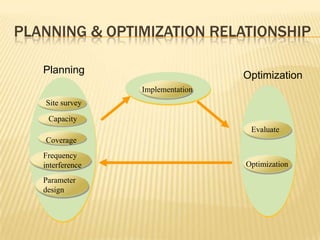
PLANNING & OPTIMIZATION RELATIONSHIP

   Planning                        Optimization
                  Implementation
   Site survey

    Capacity
                                    Evaluate
   Coverage
   Frequency
   interference                    Optimization

   Parameter
   design
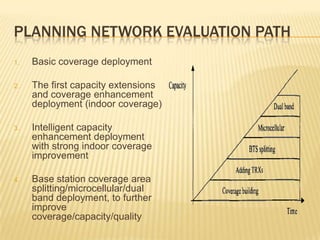
PLANNING NETWORK EVALUATION PATH
1.   Basic coverage deployment

2.   The first capacity extensions
     and coverage enhancement
     deployment (indoor coverage)

3.   Intelligent capacity
     enhancement deployment
     with strong indoor coverage
     improvement

4.   Base station coverage area
     splitting/microcellular/dual
     band deployment, to further
     improve
     coverage/capacity/quality
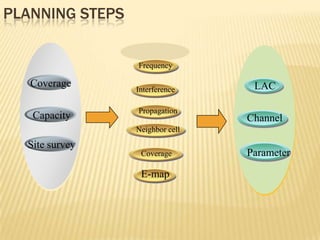
PLANNING STEPS


                 Frequency

   Coverage                       LAC
                 Interference

                 Propagation
   Capacity                      Channel
                 Neighbor cell
  Site survey
                  Coverage       Parameter

                  E-map
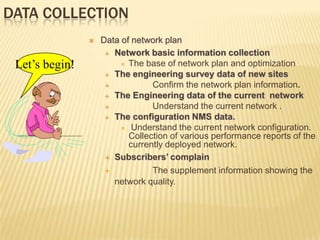
DATA COLLECTION
                   Data of network plan
                      Network basic information collection

 Let’s begin!             The base of network plan and optimization

                      The engineering survey data of new sites

                                Confirm the network plan information.
                      The Engineering data of the current network

                                Understand the current network .
                      The configuration NMS data.

                          Understand the current network configuration.
                           Collection of various performance reports of the
                           currently deployed network.
                      Subscribers’ complain

                                The supplement information showing the
                       network quality.
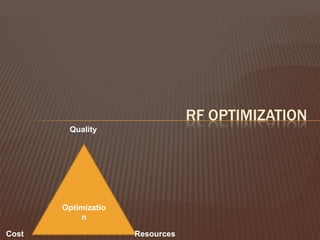
RF OPTIMIZATION
        Quality


       Optimizatio
           n

Cost                 Resources
OPTIMIZATION OBJECTIVES
   Finding and correcting any existing problems after site
    implementation and integration.

   Meeting the network quality criteria agreed in the contract.

   Optimization will be continuous and iterative process of
    improving overall network quality.

   Optimization can not reduce the performance of the rest
    of the network.

   Area of interest is divided in smaller areas called clusters
    to make optimization and follow up processes easier to
    handle.
PROPOSED METHODOLOGY
 Problem Analysis
 Conduct Drive testing
     Gather  statistics
     Subject to investigage (Faulty TRX, Coverage
      overlaps, drop calls, capacity & interference
      issues)
 Simulate real-time scenario on TEMS (after
  DT)
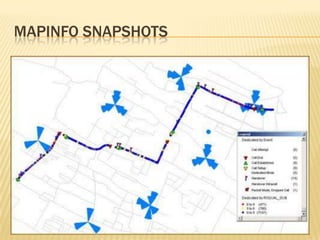
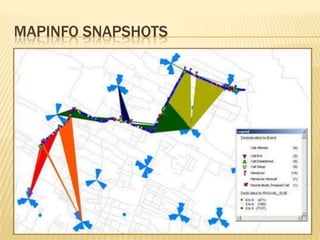
 Export into MAPInfo to check cell overshoot
  coverage, etc
 Propose solution
EXPECTED OUTCOMES

   Good signal coverage at macro and micro
    sites

   Rx Quality level should be good

   No interference issue
DISCUSSION ON RESULTS
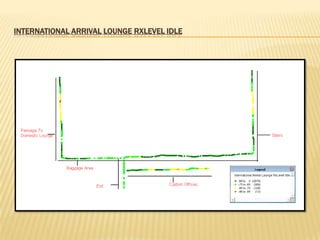
INTERNATIONAL ARRIVAL LOUNGE RXLEVEL IDLE
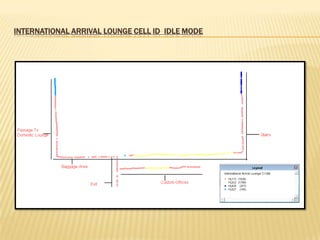
INTERNATIONAL ARRIVAL LOUNGE CELL ID IDLE MODE
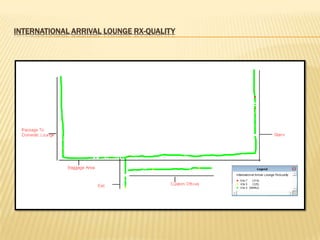
INTERNATIONAL ARRIVAL LOUNGE RX-QUALITY
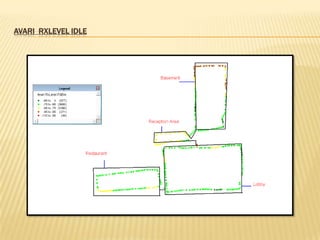
AVARI RXLEVEL IDLE
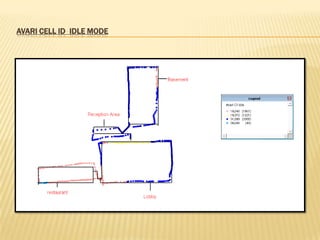
AVARI CELL ID IDLE MODE
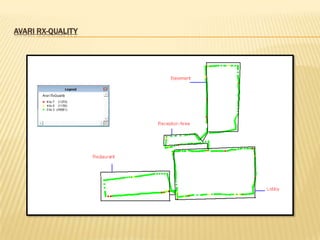
AVARI RX-QUALITY
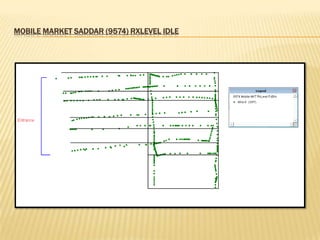
MOBILE MARKET SADDAR (9574) RXLEVEL IDLE
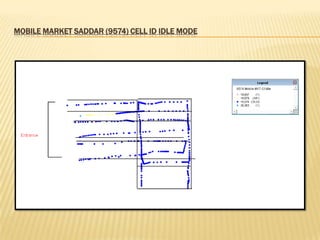
MOBILE MARKET SADDAR (9574) CELL ID IDLE MODE
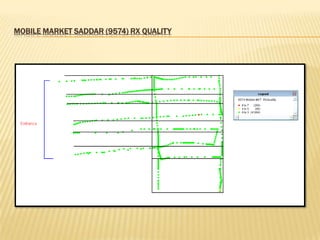
MOBILE MARKET SADDAR (9574) RX QUALITY
MAPINFO SNAPSHOTS
MAPINFO SNAPSHOTS
CONCLUSION

•   Satisfactory coverage and quality were found

•   In most of the location, additional walk test
    has been carried out where Operator hasn’t
    deployed micro layer

•   Macro sites should provide coverage to
    mobile users located in open environment
RF Planning & Optimization

RF Planning & Optimization

  • 2.
    CONTENTS  Introduction  Background Literature Review  Optimization Objectives  Proposed Methodology  Expected Outcomes  Discussion on Results  Conclusion  Reference
  • 3.
    SYNOPSIS  In this presentation, you will learn how the GSM network planning is done.  Drive testing to gather radio statistics  Analyze the network performance  Proposed solutions to resolve issue or meet KPI benchmark
  • 4.
    MOTIVATION  Challenging area of research  Comprehensive knowledge on the subject  Day-to-day learning
  • 5.
  • 6.
    PLANNING & OPTIMIZATIONRELATIONSHIP Planning Optimization Implementation Site survey Capacity Evaluate Coverage Frequency interference Optimization Parameter design
  • 7.
    PLANNING NETWORK EVALUATIONPATH 1. Basic coverage deployment 2. The first capacity extensions and coverage enhancement deployment (indoor coverage) 3. Intelligent capacity enhancement deployment with strong indoor coverage improvement 4. Base station coverage area splitting/microcellular/dual band deployment, to further improve coverage/capacity/quality
  • 8.
    PLANNING STEPS Frequency Coverage LAC Interference Propagation Capacity Channel Neighbor cell Site survey Coverage Parameter E-map
  • 9.
    DATA COLLECTION  Data of network plan  Network basic information collection Let’s begin!  The base of network plan and optimization  The engineering survey data of new sites  Confirm the network plan information.  The Engineering data of the current network  Understand the current network .  The configuration NMS data.  Understand the current network configuration. Collection of various performance reports of the currently deployed network.  Subscribers’ complain  The supplement information showing the network quality.
  • 10.
    RF OPTIMIZATION Quality Optimizatio n Cost Resources
  • 11.
    OPTIMIZATION OBJECTIVES  Finding and correcting any existing problems after site implementation and integration.  Meeting the network quality criteria agreed in the contract.  Optimization will be continuous and iterative process of improving overall network quality.  Optimization can not reduce the performance of the rest of the network.  Area of interest is divided in smaller areas called clusters to make optimization and follow up processes easier to handle.
  • 12.
    PROPOSED METHODOLOGY  ProblemAnalysis  Conduct Drive testing  Gather statistics  Subject to investigage (Faulty TRX, Coverage overlaps, drop calls, capacity & interference issues)  Simulate real-time scenario on TEMS (after DT)  Export into MAPInfo to check cell overshoot coverage, etc  Propose solution
  • 13.
    EXPECTED OUTCOMES  Good signal coverage at macro and micro sites  Rx Quality level should be good  No interference issue
  • 14.
  • 15.
  • 16.
  • 17.
  • 18.
  • 19.
    AVARI CELL IDIDLE MODE
  • 20.
  • 21.
    MOBILE MARKET SADDAR(9574) RXLEVEL IDLE
  • 22.
    MOBILE MARKET SADDAR(9574) CELL ID IDLE MODE
  • 23.
    MOBILE MARKET SADDAR(9574) RX QUALITY
  • 24.
  • 25.
  • 26.
    CONCLUSION • Satisfactory coverage and quality were found • In most of the location, additional walk test has been carried out where Operator hasn’t deployed micro layer • Macro sites should provide coverage to mobile users located in open environment