

Indian Liquor Market
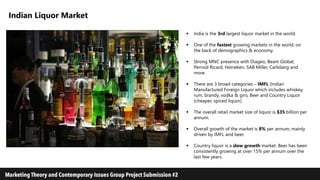
 India is the 3rd largest liquor market in the world.
 One of the fastest growing markets in the world, on
the back of demographics & economy.
 Strong MNC presence with Diageo, Beam Global,
Pernod Ricard, Heineken, SAB Miller, Carlsberg and
more.
 There are 3 broad categories – IMFL (Indian
Manufactured Foreign Liquor which includes whiskey,
rum, brandy, vodka & gin), Beer and Country Liquor
(cheaper, spiced liquor).
 The overall retail market size of liquor is $35 billion per
annum.
 Overall growth of the market is 8% per annum, mainly
driven by IMFL and beer.
 Country liquor is a slow growth market. Beer has been
consistently growing at over 15% per annum over the
last few years.
Indian Liquor Market
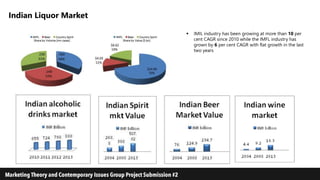
 IMIL industry has been growing at more than 10 per
cent CAGR since 2010 while the IMFL industry has
grown by 6 per cent CAGR with flat growth in the last
two years
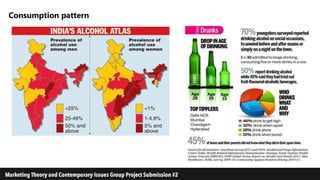
Liquor consumption in India
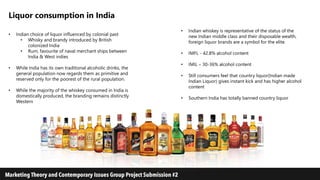
• Indian choice of liquor influenced by colonial past
• Whisky and brandy introduced by British
colonized India
• Rum, favourite of naval merchant ships between
India & West indies
• While India has its own traditional alcoholic drinks, the
general population now regards them as primitive and
reserved only for the poorest of the rural population.
• While the majority of the whiskey consumed in India is
domestically produced, the branding remains distinctly
Western
• Indian whiskey is representative of the status of the
new Indian middle class and their disposable wealth,
foreign liquor brands are a symbol for the elite.
• IMFL - 42.8% alcohol content
• IMIL – 30-36% alcohol content
• Still consumers feel that country liquor(Indian made
Indian Liquor) gives instant kick and has higher alcohol
content
• Southern India has totally banned country liquor
Consumption pattern
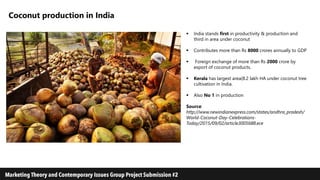
Coconut production in India
 India stands first in productivity & production and
third in area under coconut
 Contributes more than Rs 8000 crores annually to GDP
 Foreign exchange of more than Rs 2000 crore by
export of coconut products.
 Kerala has largest area(8.2 lakh HA under coconut tree
cultivation in India.
 Also No 1 in production
Source:
http://www.newindianexpress.com/states/andhra_pradesh/
World-Coconut-Day-Celebrations-
Today/2015/09/02/article3005688.ece
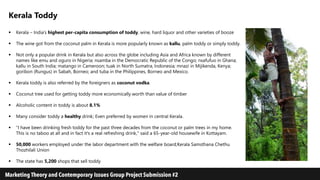
Kerala Toddy
 Kerala – India’s highest per-capita consumption of toddy, wine, hard liquor and other varieties of booze
 The wine got from the coconut palm in Kerala is more popularly known as kallu, palm toddy or simply toddy.
 Not only a popular drink in Kerala but also across the globe including Asia and Africa known by different
names like emu and oguro in Nigeria; nsamba in the Democratic Republic of the Congo; nsafufuo in Ghana;
kallu in South India; matango in Cameroon; tuak in North Sumatra, Indonesia; mnazi in Mijikenda, Kenya;
goribon (Rungus) in Sabah, Borneo; and tuba in the Philippines, Borneo and Mexico.
 Kerala toddy is also referred by the foreigners as coconut vodka.
 Coconut tree used for getting toddy more economically worth than value of timber
 Alcoholic content in toddy is about 8.1%
 Many consider toddy a healthy drink; Even preferred by women in central Kerala.
 “I have been drinking fresh toddy for the past three decades from the coconut or palm trees in my home.
This is no taboo at all and in fact it's a real refreshing drink," said a 65-year-old housewife in Kottayam.
 50,000 workers employed under the labor department with the welfare board;Kerala Samsthana Chethu
Thozhilali Union
 The state has 5,200 shops that sell toddy
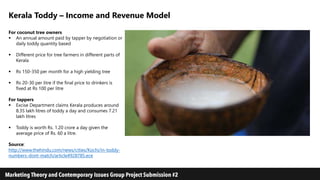
Kerala Toddy – Income and Revenue Model
For coconut tree owners
 An annual amount paid by tapper by negotiation or
daily toddy quantity based
 Different price for tree farmers in different parts of
Kerala
 Rs 150-350 per month for a high yielding tree
 Rs 20-30 per litre if the final price to drinkers is
fixed at Rs 100 per litre
For tappers
 Excise Department claims Kerala produces around
8.35 lakh litres of toddy a day and consumes 7.21
lakh litres
 Toddy is worth Rs. 1.20 crore a day given the
average price of Rs. 60 a litre.
Source:
http://www.thehindu.com/news/cities/Kochi/in-toddy-
numbers-dont-match/article4928785.ece
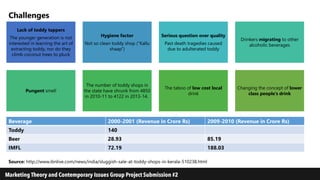
Challenges
Lack of toddy tappers
The younger generation is not
interested in learning the art of
extracting toddy, nor do they
climb coconut trees to pluck
Hygiene factor
Not so clean toddy shop (“Kallu
shaap”)
Serious question over quality
Past death tragedies caused
due to adulterated toddy
Drinkers migrating to other
alcoholic beverages
Pungent smell
The number of toddy shops in
the state have shrunk from 4850
in 2010-11 to 4122 in 2013-14.
The taboo of low cost local
drink
Changing the concept of lower
class people’s drink
Beverage 2000-2001 (Revenue in Crore Rs) 2009-2010 (Revenue in Crore Rs)
Toddy 140
Beer 28.93 85.19
IMFL 72.19 188.03
Source: http://www.ibnlive.com/news/india/sluggish-sale-at-toddy-shops-in-kerala-510238.html
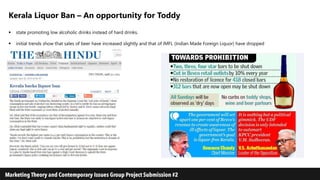
Kerala Liquor Ban – An opportunity for Toddy
 state promoting low alcoholic drinks instead of hard drinks.
 initial trends show that sales of beer have increased slightly and that of IMFL (Indian Made Foreign Liquor) have dropped
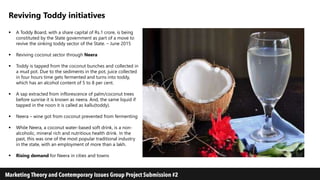
Reviving Toddy initiatives
 A Toddy Board, with a share capital of Rs.1 crore, is being
constituted by the State government as part of a move to
revive the sinking toddy sector of the State. – June 2015
 Reviving coconut sector through Neera
 Toddy is tapped from the coconut bunches and collected in
a mud pot. Due to the sediments in the pot, juice collected
in four hours time gets fermented and turns into toddy,
which has an alcohol content of 5 to 8 per cent.
 A sap extracted from inflorescence of palm/coconut trees
before sunrise it is known as neera. And, the same liquid if
tapped in the noon it is called as kallu(toddy).
 Neera – wine got from coconut prevented from fermenting
 While Neera, a coconut water-based soft drink, is a non-
alcoholic, mineral rich and nutritious health drink. In the
past, this was one of the most popular traditional industry
in the state, with an employment of more than a lakh.
 Rising demand for Neera in cities and towns
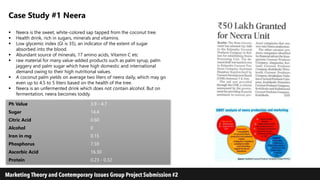
Case Study #1 Neera
 Neera is the sweet, white-colored sap tapped from the coconut tree.
 Health drink, rich in sugars, minerals and vitamins.
 Low glycemic index (GI is 35), an indicator of the extent of sugar
absorbed into the blood.
 Abundant source of minerals, 17 amino acids, Vitamin C etc
 raw material for many value-added products such as palm syrup, palm
jaggery and palm sugar which have high domestic and international
demand owing to their high nutritional values.
 A coconut palm yields on average two liters of neera daily, which may go
even up to 4.5 to 5 liters based on the health of the tree.
 Neera is an unfermented drink which does not contain alcohol. But on
fermentation, neera becomes toddy.
Ph Value 3.9 - 4.7
Sugar 14.4
Citric Acid 0.60
Alcohol 0
Iron in mg 0.15
Phosphorus 7.59
Ascorbic Acid 16.30
Protein 0.23 - 0.32
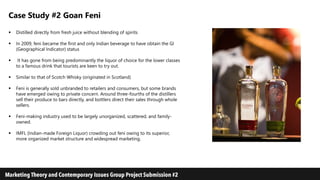
Case Study #2 Goan Feni
 Distilled directly from fresh juice without blending of spirits
 In 2009, feni became the first and only Indian beverage to have obtain the GI
(Geographical Indicator) status
 It has gone from being predominantly the liquor of choice for the lower classes
to a famous drink that tourists are keen to try out.
 Similar to that of Scotch Whisky (originated in Scotland)
 Feni is generally sold unbranded to retailers and consumers, but some brands
have emerged owing to private concern. Around three-fourths of the distillers
sell their produce to bars directly, and bottlers direct their sales through whole
sellers.
 Feni-making industry used to be largely unorganized, scattered, and family-
owned.
 IMFL (Indian-made Foreign Liquor) crowding out feni owing to its superior,
more organized market structure and widespread marketing.
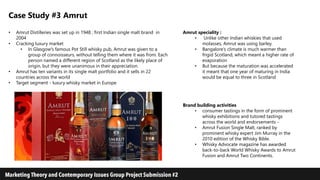
Case Study #3 Amrut
• Amrut Distilleries was set up in 1948 ; first Indian single malt brand in
2004
• Cracking luxury market
• In Glasgow's famous Pot Still whisky pub, Amrut was given to a
group of connoisseurs, without telling them where it was from. Each
person named a different region of Scotland as the likely place of
origin, but they were unanimous in their appreciation.
• Amrut has ten variants in its single malt portfolio and it sells in 22
countries across the world
• Target segment - luxury whisky market in Europe
Amrut speciality :
• Unlike other Indian whiskies that used
molasses, Amrut was using barley.
• Bangalore’s climate is much warmer than
frigid Scotland, which meant a higher rate of
evaporation
• But because the maturation was accelerated
it meant that one year of maturing in India
would be equal to three in Scotland
Brand building activities
• consumer tastings in the form of prominent
whisky exhibitions and tutored tastings
across the world and endorsements -
• Amrut Fusion Single Malt, ranked by
prominent whisky expert Jim Murray in the
2010 edition of the Whisky Bible.
• Whisky Advocate magazine has awarded
back-to-back World Whisky Awards to Amrut
Fusion and Amrut Two Continents.
Product Concept | Product & Competitive Framework
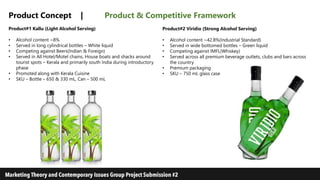
Product#1 Kallu (Light Alcohol Serving)
• Alcohol content ~8%
• Served in long cylindrical bottles – White liquid
• Competing against Beers(Indian & Foreign)
• Served in All Hotel/Motel chains, House boats and shacks around
tourist spots – Kerala and primarily south India during introductory
phase
• Promoted along with Kerala Cuisine
• SKU – Bottle – 650 & 330 mL, Can – 500 mL
Product#2 Viridio (Strong Alcohol Serving)
• Alcohol content ~42.8%(Industrial Standard)
• Served in wide bottomed bottles – Green liquid
• Competing against IMFL(Whiskey)
• Served across all premium beverage outlets, clubs and bars across
the country
• Premium packaging
• SKU – 750 mL glass case
Product Concept | Target Audience
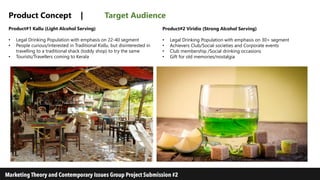
Product#1 Kallu (Light Alcohol Serving)
• Legal Drinking Population with emphasis on 22-40 segment
• People curious/interested in Traditional Kallu, but disinterested in
travelling to a traditional shack (toddy shop) to try the same
• Tourists/Travellers coming to Kerala
Product#2 Viridio (Strong Alcohol Serving)
• Legal Drinking Population with emphasis on 30+ segment
• Achievers Club/Social societies and Corporate events
• Club membership /Social drinking occasions
• Gift for old memories/nostalgia
Product Concept | Positioning
Product#1 Kallu (Light Alcohol Serving)
• Premium beverage alternative for beer
• Healthy and strong; tastes better
• Connect with nature: beaches & backwaters - Coconut
• Social drinking icon: youthful and stylish
• Family acceptance-”drink to be shared with your family”
Product#2 Viridio (Strong Alcohol Serving)
• Status symbol and epitome of power
• Strong serving for the elite
• Macho image of the tough guy
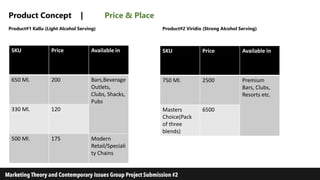
Product Concept | Price & Place
Product#1 Kallu (Light Alcohol Serving) Product#2 Viridio (Strong Alcohol Serving)
SKU Price Available in
650 Ml. 200 Bars,Beverage
Outlets,
Clubs, Shacks,
Pubs
330 Ml. 120
500 Ml. 175 Modern
Retail/Speciali
ty Chains
SKU Price Available in
750 Ml. 2500 Premium
Bars, Clubs,
Resorts etc.
Masters
Choice(Pack
of three
blends)
6500
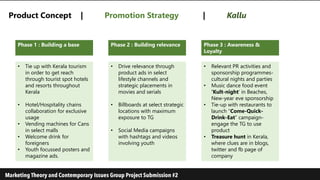
Product Concept | Promotion Strategy | Kallu
Phase 2 : Building relevance Phase 3 : Awareness &
Loyalty
Phase 1 : Building a base
• Drive relevance through
product ads in select
lifestyle channels and
strategic placements in
movies and serials
• Billboards at select strategic
locations with maximum
exposure to TG
• Social Media campaigns
with hashtags and videos
involving youth
• Relevant PR activities and
sponsorship programmes-
cultural nights and parties
• Music dance food event
‘Kult-night’ in Beaches,
New-year eve sponsorship
• Tie-up with restaurants to
launch “Come-Quick-
Drink-Eat” campaign-
engage the TG to use
product
• Treasure hunt in Kerala,
where clues are in blogs,
twitter and fb page of
company
• Tie up with Kerala tourism
in order to get reach
through tourist spot hotels
and resorts throughout
Kerala
• Hotel/Hospitality chains
collaboration for exclusive
usage
• Vending machines for Cans
in select malls
• Welcome drink for
foreigners
• Youth focussed posters and
magazine ads.
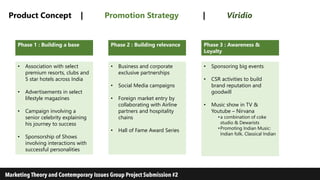
Product Concept | Promotion Strategy | Viridio
Phase 2 : Building relevance Phase 3 : Awareness &
Loyalty
Phase 1 : Building a base
• Business and corporate
exclusive partnerships
• Social Media campaigns
• Foreign market entry by
collaborating with Airline
partners and hospitality
chains
• Hall of Fame Award Series
• Sponsoring big events
• CSR activities to build
brand reputation and
goodwill
• Music show in TV &
Youtube – Nirvana
•a combination of coke
studio & Dewarists
•Promoting Indian Music:
Indian folk, Classical Indian
• Association with select
premium resorts, clubs and
5 star hotels across India
• Advertisements in select
lifestyle magazines
• Campaign involving a
senior celebrity explaining
his journey to success
• Sponsorship of Shows
involving interactions with
successful personalities
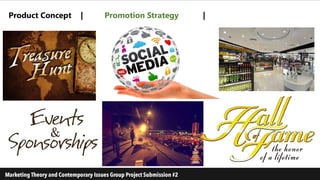
Product Concept | Promotion Strategy |
Future Impact
Social Impact:
• Employment Opportunities to receding sector of coconut
planters, toddy tappers
• 1% Coconut plantation Kerala create 1 Lakh job
opportunities
• Woman Empowerment: Job opportunities in distilleries
(exploiting traditional expertise)
Economic Impact:
• Employment Opportunities to receding sector of coconut planters,
toddy tappers
• 1% Coconut plantation Kerala create 1 Lakh job
opportunities
• Positive impact on Kerala tourism: with current ban on liquor, Kallu
can be the next best choice for tourists
Cultural Impact:
• Authentic alcohol drink of Kerala gets a national and thereafter
international exposure
• Rising image of Toddy, Indian made
•
• Positive impact on Indian food: being served along, gives ‘The
Indian Feel’
References
• http://www.newindianexpress.com/states/andhra_pradesh/World-Coconut-Day-Celebrations-
Today/2015/09/02/article3005688.ece
• http://www.amrutdistilleries.com/validated/pages/aismw.html
• http://www.coconutboard.nic.in/
• ccs.in/internship_papers/2012/261_feni-industry_raunaq-sahu.pdf
• http://www.futuremarketinsights.com/reports/indian-alcohol-market
• http://www.thehindu.com/news/national/andhra-pradesh/kerala-backs-liquor-
ban/article7156166.ece
Reviving Kerala Toddy | IIMC | MTCI

Reviving Kerala Toddy | IIMC | MTCI

  • 2.
    Indian Liquor Market India is the 3rd largest liquor market in the world.  One of the fastest growing markets in the world, on the back of demographics & economy.  Strong MNC presence with Diageo, Beam Global, Pernod Ricard, Heineken, SAB Miller, Carlsberg and more.  There are 3 broad categories – IMFL (Indian Manufactured Foreign Liquor which includes whiskey, rum, brandy, vodka & gin), Beer and Country Liquor (cheaper, spiced liquor).  The overall retail market size of liquor is $35 billion per annum.  Overall growth of the market is 8% per annum, mainly driven by IMFL and beer.  Country liquor is a slow growth market. Beer has been consistently growing at over 15% per annum over the last few years.
  • 3.
    Indian Liquor Market IMIL industry has been growing at more than 10 per cent CAGR since 2010 while the IMFL industry has grown by 6 per cent CAGR with flat growth in the last two years
  • 4.
    Liquor consumption inIndia • Indian choice of liquor influenced by colonial past • Whisky and brandy introduced by British colonized India • Rum, favourite of naval merchant ships between India & West indies • While India has its own traditional alcoholic drinks, the general population now regards them as primitive and reserved only for the poorest of the rural population. • While the majority of the whiskey consumed in India is domestically produced, the branding remains distinctly Western • Indian whiskey is representative of the status of the new Indian middle class and their disposable wealth, foreign liquor brands are a symbol for the elite. • IMFL - 42.8% alcohol content • IMIL – 30-36% alcohol content • Still consumers feel that country liquor(Indian made Indian Liquor) gives instant kick and has higher alcohol content • Southern India has totally banned country liquor
  • 5.
  • 6.
    Coconut production inIndia  India stands first in productivity & production and third in area under coconut  Contributes more than Rs 8000 crores annually to GDP  Foreign exchange of more than Rs 2000 crore by export of coconut products.  Kerala has largest area(8.2 lakh HA under coconut tree cultivation in India.  Also No 1 in production Source: http://www.newindianexpress.com/states/andhra_pradesh/ World-Coconut-Day-Celebrations- Today/2015/09/02/article3005688.ece
  • 7.
    Kerala Toddy  Kerala– India’s highest per-capita consumption of toddy, wine, hard liquor and other varieties of booze  The wine got from the coconut palm in Kerala is more popularly known as kallu, palm toddy or simply toddy.  Not only a popular drink in Kerala but also across the globe including Asia and Africa known by different names like emu and oguro in Nigeria; nsamba in the Democratic Republic of the Congo; nsafufuo in Ghana; kallu in South India; matango in Cameroon; tuak in North Sumatra, Indonesia; mnazi in Mijikenda, Kenya; goribon (Rungus) in Sabah, Borneo; and tuba in the Philippines, Borneo and Mexico.  Kerala toddy is also referred by the foreigners as coconut vodka.  Coconut tree used for getting toddy more economically worth than value of timber  Alcoholic content in toddy is about 8.1%  Many consider toddy a healthy drink; Even preferred by women in central Kerala.  “I have been drinking fresh toddy for the past three decades from the coconut or palm trees in my home. This is no taboo at all and in fact it's a real refreshing drink," said a 65-year-old housewife in Kottayam.  50,000 workers employed under the labor department with the welfare board;Kerala Samsthana Chethu Thozhilali Union  The state has 5,200 shops that sell toddy
  • 8.
    Kerala Toddy –Income and Revenue Model For coconut tree owners  An annual amount paid by tapper by negotiation or daily toddy quantity based  Different price for tree farmers in different parts of Kerala  Rs 150-350 per month for a high yielding tree  Rs 20-30 per litre if the final price to drinkers is fixed at Rs 100 per litre For tappers  Excise Department claims Kerala produces around 8.35 lakh litres of toddy a day and consumes 7.21 lakh litres  Toddy is worth Rs. 1.20 crore a day given the average price of Rs. 60 a litre. Source: http://www.thehindu.com/news/cities/Kochi/in-toddy- numbers-dont-match/article4928785.ece
  • 9.
    Challenges Lack of toddytappers The younger generation is not interested in learning the art of extracting toddy, nor do they climb coconut trees to pluck Hygiene factor Not so clean toddy shop (“Kallu shaap”) Serious question over quality Past death tragedies caused due to adulterated toddy Drinkers migrating to other alcoholic beverages Pungent smell The number of toddy shops in the state have shrunk from 4850 in 2010-11 to 4122 in 2013-14. The taboo of low cost local drink Changing the concept of lower class people’s drink Beverage 2000-2001 (Revenue in Crore Rs) 2009-2010 (Revenue in Crore Rs) Toddy 140 Beer 28.93 85.19 IMFL 72.19 188.03 Source: http://www.ibnlive.com/news/india/sluggish-sale-at-toddy-shops-in-kerala-510238.html
  • 10.
    Kerala Liquor Ban– An opportunity for Toddy  state promoting low alcoholic drinks instead of hard drinks.  initial trends show that sales of beer have increased slightly and that of IMFL (Indian Made Foreign Liquor) have dropped
  • 11.
    Reviving Toddy initiatives A Toddy Board, with a share capital of Rs.1 crore, is being constituted by the State government as part of a move to revive the sinking toddy sector of the State. – June 2015  Reviving coconut sector through Neera  Toddy is tapped from the coconut bunches and collected in a mud pot. Due to the sediments in the pot, juice collected in four hours time gets fermented and turns into toddy, which has an alcohol content of 5 to 8 per cent.  A sap extracted from inflorescence of palm/coconut trees before sunrise it is known as neera. And, the same liquid if tapped in the noon it is called as kallu(toddy).  Neera – wine got from coconut prevented from fermenting  While Neera, a coconut water-based soft drink, is a non- alcoholic, mineral rich and nutritious health drink. In the past, this was one of the most popular traditional industry in the state, with an employment of more than a lakh.  Rising demand for Neera in cities and towns
  • 12.
    Case Study #1Neera  Neera is the sweet, white-colored sap tapped from the coconut tree.  Health drink, rich in sugars, minerals and vitamins.  Low glycemic index (GI is 35), an indicator of the extent of sugar absorbed into the blood.  Abundant source of minerals, 17 amino acids, Vitamin C etc  raw material for many value-added products such as palm syrup, palm jaggery and palm sugar which have high domestic and international demand owing to their high nutritional values.  A coconut palm yields on average two liters of neera daily, which may go even up to 4.5 to 5 liters based on the health of the tree.  Neera is an unfermented drink which does not contain alcohol. But on fermentation, neera becomes toddy. Ph Value 3.9 - 4.7 Sugar 14.4 Citric Acid 0.60 Alcohol 0 Iron in mg 0.15 Phosphorus 7.59 Ascorbic Acid 16.30 Protein 0.23 - 0.32
  • 13.
    Case Study #2Goan Feni  Distilled directly from fresh juice without blending of spirits  In 2009, feni became the first and only Indian beverage to have obtain the GI (Geographical Indicator) status  It has gone from being predominantly the liquor of choice for the lower classes to a famous drink that tourists are keen to try out.  Similar to that of Scotch Whisky (originated in Scotland)  Feni is generally sold unbranded to retailers and consumers, but some brands have emerged owing to private concern. Around three-fourths of the distillers sell their produce to bars directly, and bottlers direct their sales through whole sellers.  Feni-making industry used to be largely unorganized, scattered, and family- owned.  IMFL (Indian-made Foreign Liquor) crowding out feni owing to its superior, more organized market structure and widespread marketing.
  • 14.
    Case Study #3Amrut • Amrut Distilleries was set up in 1948 ; first Indian single malt brand in 2004 • Cracking luxury market • In Glasgow's famous Pot Still whisky pub, Amrut was given to a group of connoisseurs, without telling them where it was from. Each person named a different region of Scotland as the likely place of origin, but they were unanimous in their appreciation. • Amrut has ten variants in its single malt portfolio and it sells in 22 countries across the world • Target segment - luxury whisky market in Europe Amrut speciality : • Unlike other Indian whiskies that used molasses, Amrut was using barley. • Bangalore’s climate is much warmer than frigid Scotland, which meant a higher rate of evaporation • But because the maturation was accelerated it meant that one year of maturing in India would be equal to three in Scotland Brand building activities • consumer tastings in the form of prominent whisky exhibitions and tutored tastings across the world and endorsements - • Amrut Fusion Single Malt, ranked by prominent whisky expert Jim Murray in the 2010 edition of the Whisky Bible. • Whisky Advocate magazine has awarded back-to-back World Whisky Awards to Amrut Fusion and Amrut Two Continents.
  • 15.
    Product Concept |Product & Competitive Framework Product#1 Kallu (Light Alcohol Serving) • Alcohol content ~8% • Served in long cylindrical bottles – White liquid • Competing against Beers(Indian & Foreign) • Served in All Hotel/Motel chains, House boats and shacks around tourist spots – Kerala and primarily south India during introductory phase • Promoted along with Kerala Cuisine • SKU – Bottle – 650 & 330 mL, Can – 500 mL Product#2 Viridio (Strong Alcohol Serving) • Alcohol content ~42.8%(Industrial Standard) • Served in wide bottomed bottles – Green liquid • Competing against IMFL(Whiskey) • Served across all premium beverage outlets, clubs and bars across the country • Premium packaging • SKU – 750 mL glass case
  • 16.
    Product Concept |Target Audience Product#1 Kallu (Light Alcohol Serving) • Legal Drinking Population with emphasis on 22-40 segment • People curious/interested in Traditional Kallu, but disinterested in travelling to a traditional shack (toddy shop) to try the same • Tourists/Travellers coming to Kerala Product#2 Viridio (Strong Alcohol Serving) • Legal Drinking Population with emphasis on 30+ segment • Achievers Club/Social societies and Corporate events • Club membership /Social drinking occasions • Gift for old memories/nostalgia
  • 17.
    Product Concept |Positioning Product#1 Kallu (Light Alcohol Serving) • Premium beverage alternative for beer • Healthy and strong; tastes better • Connect with nature: beaches & backwaters - Coconut • Social drinking icon: youthful and stylish • Family acceptance-”drink to be shared with your family” Product#2 Viridio (Strong Alcohol Serving) • Status symbol and epitome of power • Strong serving for the elite • Macho image of the tough guy
  • 18.
    Product Concept |Price & Place Product#1 Kallu (Light Alcohol Serving) Product#2 Viridio (Strong Alcohol Serving) SKU Price Available in 650 Ml. 200 Bars,Beverage Outlets, Clubs, Shacks, Pubs 330 Ml. 120 500 Ml. 175 Modern Retail/Speciali ty Chains SKU Price Available in 750 Ml. 2500 Premium Bars, Clubs, Resorts etc. Masters Choice(Pack of three blends) 6500
  • 19.
    Product Concept |Promotion Strategy | Kallu Phase 2 : Building relevance Phase 3 : Awareness & Loyalty Phase 1 : Building a base • Drive relevance through product ads in select lifestyle channels and strategic placements in movies and serials • Billboards at select strategic locations with maximum exposure to TG • Social Media campaigns with hashtags and videos involving youth • Relevant PR activities and sponsorship programmes- cultural nights and parties • Music dance food event ‘Kult-night’ in Beaches, New-year eve sponsorship • Tie-up with restaurants to launch “Come-Quick- Drink-Eat” campaign- engage the TG to use product • Treasure hunt in Kerala, where clues are in blogs, twitter and fb page of company • Tie up with Kerala tourism in order to get reach through tourist spot hotels and resorts throughout Kerala • Hotel/Hospitality chains collaboration for exclusive usage • Vending machines for Cans in select malls • Welcome drink for foreigners • Youth focussed posters and magazine ads.
  • 20.
    Product Concept |Promotion Strategy | Viridio Phase 2 : Building relevance Phase 3 : Awareness & Loyalty Phase 1 : Building a base • Business and corporate exclusive partnerships • Social Media campaigns • Foreign market entry by collaborating with Airline partners and hospitality chains • Hall of Fame Award Series • Sponsoring big events • CSR activities to build brand reputation and goodwill • Music show in TV & Youtube – Nirvana •a combination of coke studio & Dewarists •Promoting Indian Music: Indian folk, Classical Indian • Association with select premium resorts, clubs and 5 star hotels across India • Advertisements in select lifestyle magazines • Campaign involving a senior celebrity explaining his journey to success • Sponsorship of Shows involving interactions with successful personalities
  • 21.
    Product Concept |Promotion Strategy |
  • 22.
    Future Impact Social Impact: •Employment Opportunities to receding sector of coconut planters, toddy tappers • 1% Coconut plantation Kerala create 1 Lakh job opportunities • Woman Empowerment: Job opportunities in distilleries (exploiting traditional expertise) Economic Impact: • Employment Opportunities to receding sector of coconut planters, toddy tappers • 1% Coconut plantation Kerala create 1 Lakh job opportunities • Positive impact on Kerala tourism: with current ban on liquor, Kallu can be the next best choice for tourists Cultural Impact: • Authentic alcohol drink of Kerala gets a national and thereafter international exposure • Rising image of Toddy, Indian made • • Positive impact on Indian food: being served along, gives ‘The Indian Feel’
  • 23.
    References • http://www.newindianexpress.com/states/andhra_pradesh/World-Coconut-Day-Celebrations- Today/2015/09/02/article3005688.ece • http://www.amrutdistilleries.com/validated/pages/aismw.html •http://www.coconutboard.nic.in/ • ccs.in/internship_papers/2012/261_feni-industry_raunaq-sahu.pdf • http://www.futuremarketinsights.com/reports/indian-alcohol-market • http://www.thehindu.com/news/national/andhra-pradesh/kerala-backs-liquor- ban/article7156166.ece