SALES AND DISTRIBUTION LIVE PROJECT | GROUP 2 1
CONTENTS
PROJECT OBJECTIVES..................................................................................................................................................... 2
Tyre industry in india .........................................................................................................................................................3
Indian Tyre Industry- Highlights ....................................................................................................................................3
Industry Growth Drivers............................................................................................................................................... 4
Replacement Segment ................................................................................................................................................ 4
Apollo Tyres..................................................................................................................................................................5
Competitive landscape................................................................................................................................................. 6
MRF Tyres............................................................................................................................................................... 6
JK Tyres .................................................................................................................................................................. 6
CEAT Tyres ............................................................................................................................................................. 6
Apollo Sales Organisation.............................................................................................................................................7
PRIMARY RESEARCH-INSIGHTS FROM INDEPTH INTERVIEWS with sales managers .......................................................7
OVERVIEW & PURPOSE ...............................................................................................................................................7
HIGHLIGHTS ................................................................................................................................................................7
PRIMARY RESEARCH-INSIGHTS FROM INDEPTH INTERVIEWS with tyre dealers............................................................ 8
Haralalka Tyre Agencies............................................................................................................................................... 8
Indo Tyres.................................................................................................................................................................... 9
Maya Tyres.................................................................................................................................................................. 9
PRIMARY RESEARCH-INSIGHTS FROM INDEPTH INTERVIEWS with truck fleets............................................................10
Speed Ways Logistics..................................................................................................................................................10
S N Transport..............................................................................................................................................................10
Rajeev Transports.......................................................................................................................................................11
Key takeaways from ground interactions:...............................................................................................................11
MOTIVATORS & barriers FOR DEALERS .........................................................................................................................12
Characteristics of Dealers:...........................................................................................................................................12
Identifying Dealer Needs:............................................................................................................................................12
Motivators for dealers.................................................................................................................................................12
Effort building motivators ......................................................................................................................................12
Efficiency building Motivators ................................................................................................................................13
Consistency building Motivators.............................................................................................................................13
Barriers for dealers to sell or push Apollo Tyres ...........................................................................................................13
MOTIVATORS & barriers FOR FLEET OWNERS...............................................................................................................13
Characteristics of Truck Fleet Owners: ........................................................................................................................13
Channel design for truck fleet replacement tyre segment ................................................................................................14
Identifying the target segment:...................................................................................................................................14
Consumer Buying behaviour & service requirements...................................................................................................15
Evaluating the current channel....................................................................................................................................16
Identify the gaps.........................................................................................................................................................16
Identify possible alternative channels and their structure, competencies, service levels...............................................17
apollo fleet assist and lifeline channel specifics............................................................................................................17
CHALLENGES AHEAD ...........................................................................................................................................18
COMPETITIVE LANDSCAPE of fleet management in india..........................................................................................18
Channel Conflict: ........................................................................................................................................................19
Source of Channel Power............................................................................................................................................19
Expanding Apollo Tyres existing Dealer Network ............................................................................................................20
Locating potential dealers...........................................................................................................................................20
Continuous engagement.............................................................................................................................................20
Avoiding channel conflict............................................................................................................................................21
SECONDARY RESEARCH ON INVESTMENTS FOR DEALERSHIP ....................................................................................21
ANNEXURE.....................................................................................................................................................................22
SALES AND DISTRIBUTION LIVE PROJECT | GROUP 2 2
PROJECT OBJECTIVES
This project has three broad objectives from a marketing as well as sales & distribution
point of view- Increase the sales of Apollo Tyres in Eastern Region (Particularly in Kolkata) by
1) Identifying Motivators and Barriers for existing dealers
2) Conceptualizing a sales and distribution strategy to motivate Emerging segment 'Truck fleet'
3) Study on Go to Market strategies of competitor companies
SALES AND DISTRIBUTION LIVE PROJECT | GROUP 2 3
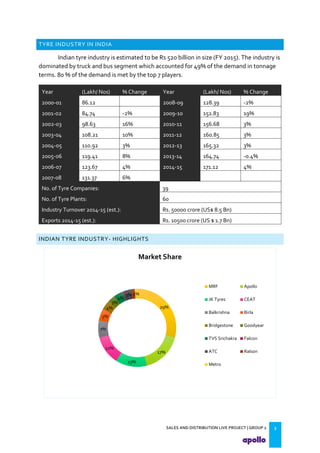
TYRE INDUSTRY IN INDIA
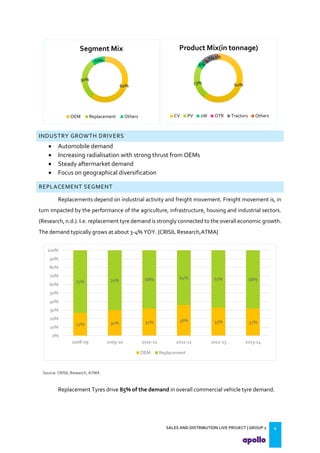
Indian tyre industry is estimated to be Rs 520 billion in size (FY 2015). The industry is
dominated by truck and bus segment which accounted for 49% of the demand in tonnage
terms. 80 % of the demand is met by the top 7 players.
Year (Lakh/ Nos) % Change Year (Lakh/ Nos) % Change
2000-01 86.12 2008-09 128.39 -2%
2001-02 84.74 -2% 2009-10 152.83 19%
2002-03 98.63 16% 2010-11 156.68 3%
2003-04 108.21 10% 2011-12 160.85 3%
2004-05 110.92 3% 2012-13 165.32 3%
2005-06 119.41 8% 2013-14 164.74 -0.4%
2006-07 123.67 4% 2014-15 171.12 4%
2007-08 131.37 6%
No. of Tyre Companies: 39
No. of Tyre Plants: 60
Industry Turnover 2014-15 (est.): Rs. 50000 crore (US$ 8.5 Bn)
Exports 2014-15 (est.): Rs. 10500 crore (US $ 1.7 Bn)
INDIAN TYRE INDUSTRY- HIGHLIGHTS
29%
17%
13%
12%
7%
5%
4%
3%
4%
3% 1%
Market Share
MRF Apollo
JK Tyres CEAT
Balkrishna Birla
Bridgestone Goodyear
TVS Srichakra Falcon
ATC Ralson
Metro
SALES AND DISTRIBUTION LIVE PROJECT | GROUP 2 4
INDUSTRY GROWTH DRIVERS
 Automobile demand
 Increasing radialisation with strong thrust from OEMs
 Steady aftermarket demand
 Focus on geographical diversification
REPLACEMENT SEGMENT
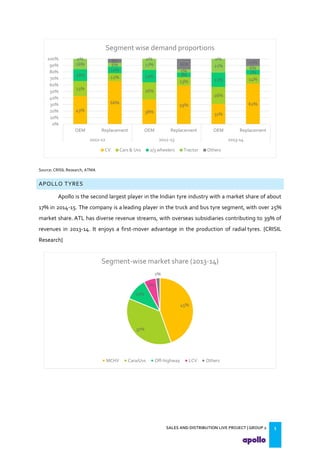
Replacements depend on industrial activity and freight movement. Freight movement is, in
turn impacted by the performance of the agriculture, infrastructure, housing and industrial sectors.
(Research, n.d.). I.e. replacement tyre demand is strongly connected to the overall economic growth.
The demand typically grows at about 3-4% YOY. {CRISIL Research,ATMA}
Replacement Tyres drive 85% of the demand in overall commercial vehicle tyre demand.
60%
30%
10%
Segment Mix
OEM Replacement Others
60%23%
6%
1%
9%1%
Product Mix(in tonnage)
CV PV 2W OTR Tractors Others
27% 30% 32% 36% 33% 32%
73% 70% 68% 64% 67% 68%
0%
10%
20%
30%
40%
50%
60%
70%
80%
90%
100%
2008-09 2009-10 2010-11 2011-12 2012-13 2013-14
OEM Replacement
Source: CRISIL Research, ATMA
SALES AND DISTRIBUTION LIVE PROJECT | GROUP 2 5
Source: CRISIL Research, ATMA
APOLLO TYRES
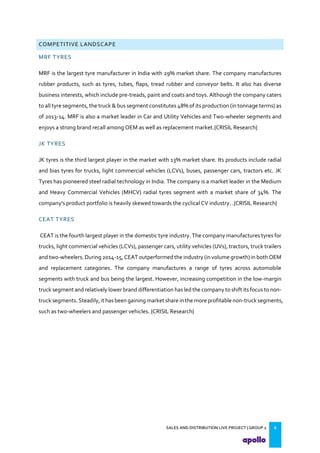
Apollo is the second largest player in the Indian tyre industry with a market share of about
17% in 2014-15. The company is a leading player in the truck and bus tyre segment, with over 25%
market share. ATL has diverse revenue streams, with overseas subsidiaries contributing to 39% of
revenues in 2013-14. It enjoys a first-mover advantage in the production of radial tyres. {CRISIL
Research}
43%
66%
38%
59%
31%
62%
23%
12%
26%
13%
26%
14%
18%
10%
19% 7%
22%
7%
16% 6% 17%
5%
21% 6%
0% 6% 0%
16%
0%
12%
0%
10%
20%
30%
40%
50%
60%
70%
80%
90%
100%
OEM Replacement OEM Replacement OEM Replacement
2011-12 2012-13 2013-14
Segment wise demand proportions
CV Cars & Uvs 2/3 wheelers Tractor Others
45%
37%
11%
6%
2%
Segment-wise market share (2013-14)
MCHV Cara/Uvs Off-highway LCV Others
SALES AND DISTRIBUTION LIVE PROJECT | GROUP 2 6
COMPETITIVE LANDSCAPE
MRF TYRES
MRF is the largest tyre manufacturer in India with 29% market share. The company manufactures
rubber products, such as tyres, tubes, flaps, tread rubber and conveyor belts. It also has diverse
business interests, which include pre-treads, paint and coats and toys. Although the company caters
to all tyre segments, the truck & bus segment constitutes 48% of its production (in tonnage terms) as
of 2013-14. MRF is also a market leader in Car and Utility Vehicles and Two-wheeler segments and
enjoys a strong brand recall among OEM as well as replacement market.{CRISIL Research}
JK TYRES
JK tyres is the third largest player in the market with 13% market share. Its products include radial
and bias tyres for trucks, light commercial vehicles (LCVs), buses, passenger cars, tractors etc. JK
Tyres has pioneered steel radial technology in India. The company is a market leader in the Medium
and Heavy Commercial Vehicles (MHCV) radial tyres segment with a market share of 34%. The
company's product portfolio is heavily skewed towards the cyclical CV industry. .{CRISIL Research}
CEAT TYRES
CEAT is the fourth largest player in the domestic tyre industry. The company manufactures tyres for
trucks, light commercial vehicles (LCVs), passenger cars, utility vehicles (UVs), tractors, truck trailers
and two-wheelers. During 2014-15, CEAT outperformed the industry (in volume growth) in both OEM
and replacement categories. The company manufactures a range of tyres across automobile
segments with truck and bus being the largest. However, increasing competition in the low-margin
truck segment and relatively lower brand differentiation has led the company to shift its focus to non-
truck segments.Steadily,it has been gaining market share inthe more profitablenon-truck segments,
such as two-wheelers and passenger vehicles. {CRISIL Research}
SALES AND DISTRIBUTION LIVE PROJECT | GROUP 2 7
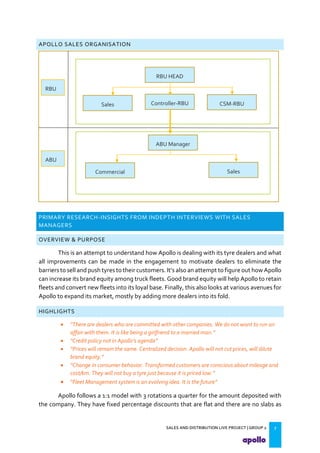
APOLLO SALES ORGANISATION
PRIMARY RESEARCH-INSIGHTS FROM INDEPTH INTERVIEWS WITH SALES
MANAGERS
OVERVIEW & PURPOSE
This is an attempt to understand how Apollo is dealing with its tyre dealers and what
all improvements can be made in the engagement to motivate dealers to eliminate the
barriers to sell and push tyres to their customers. It s also an attempt to figure out how Apollo
can increase its brand equity among truck fleets. Good brand equity will help Apollo to retain
fleets and convert new fleets into its loyal base. Finally, this also looks at various avenues for
Apollo to expand its market, mostly by adding more dealers into its fold.
HIGHLIGHTS
 There are dealers who are committed with other companies. We do not want to run an
affair with them. It is like being a girlfriend to a married man.
 Credit policy not in Apollo’s agenda
 Prices will remain the same. Centralized decision. Apollo will not cut prices, will dilute
brand equity.
 Change in consumer behavior. Transformed customers are conscious about mileage and
cost/km. They will not buy a tyre just because it is priced low.
 Fleet Management system is an evolving idea. It is the future
Apollo follows a 1:1 model with 3 rotations a quarter for the amount deposited with
the company. They have fixed percentage discounts that are flat and there are no slabs as
RBU HEAD
Controller-RBU CSM-RBUSales
ABU Manager
Commercial Sales
RBU
ABU
SALES AND DISTRIBUTION LIVE PROJECT | GROUP 2 8
compared to Ceat or JK tyres. The discount last year was 1.85% of sales. In addition to this
flat discount, Apollo runs schemes which vary throughout the year. Since it s a flat discount,
both large and small dealers are benefitted in a similar fashion and hence, small dealers can
compete with large dealers of Apollo. This is the reason why Apollo is welcomed by dealers
in all ranges of scale. On the other hand, CEAT increases the discount % as the volume of
sales increases and hence large dealers have an advantage over small dealers. They can sell
the tyre at a lower price than small dealers. So CEAT and JK tyres will have a few large dealers.
CEAT and JK have flexible credit system and hence project an image of being a less
strict company. Apollo has no intention to provide a credit system and it implements its
policies uniformly all across the country to avoid being put in the same bracket. It is hence
not ready to dilute it and let the ball to be in dealers court.
Segments of tyres
Truck Car radial Non truck
MRF tyres are perceived to be of better quality. For a sales revenue of 1 cr, MRF will
generate 35 lakhs from truck and the rest is from the passenger car segment. For Apollo
however, 60 lakhs will come from truck and for Ceat almost 80 % is from truck.
Truck fleets demand higher credit from the dealers all the time. When the dealer is
unable to increase the credit any further, the truck fleet will approach another dealer. So it is
not uncommon to find truck fleets buying tyres from more than 1 dealer.
Dealer Schemes: Credit notes, free tyres, Gold coins, foreign trips (to dealers)
Fleet management system: in introductory phase
PRIMARY RESEARCH-INSIGHTS FROM INDEPTH INTERVIEWS WITH TYRE DEALERS
HARALALKA TYRE AGENCIES
• Started in 1982.
• Companies served: CEAT, Apollo, Continental, Michelin, JK
• Margin varies from company to company, but it is usually around 1%
• Indian companies give better margins than foreign ones (Michelin)
• Categories of tyres served: all categories
• Most sold category: truck
• Buying behavior:
o Order taking through phones
o Retail sales in 2 methods: consultative selling and traditional selling
• Maximum order size sold: 2000 pieces in a single order- (which happened in truck
fleet category)
• Sales around 5 crores per quarter
• 4000 pieces monthly sales
• There are 25 fleet owners who buy from him
SALES AND DISTRIBUTION LIVE PROJECT | GROUP 2 9
• 5 to 6 months credit period to fleets
• Dealer takestyrefrom the company after depositing afixed amount at thecompany s
account. They are supposed to make sales worth that much. Incentives like discounts
are provided by the companies for reaching specific milestones
• No incentives or bonuses for displaying the boards of companies at the stores
• Apollo has started sacrificing margin because they are losing out in the market
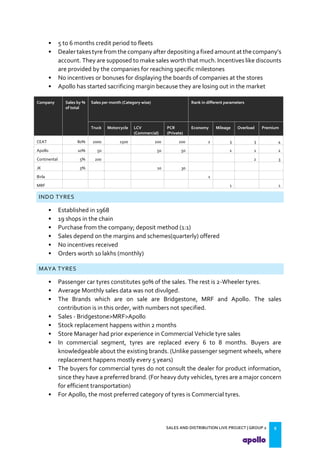
Company Sales by %
of total
Sales per month (Category wise) Rank in different parameters
Truck Motorcycle LCV
(Commercial)
PCR
(Private)
Economy Mileage Overload Premium
CEAT 80% 2000 1500 200 200 2 3 3 4
Apollo 10% 50 50 50 2 1 2
Continental 5% 200 2 3
JK 5% 10 30
Birla 1
MRF 1 1
INDO TYRES
• Established in 1968
• 19 shops in the chain
• Purchase from the company; deposit method (1:1)
• Sales depend on the margins and schemes(quarterly) offered
• No incentives received
• Orders worth 10 lakhs (monthly)
MAYA TYRES
• Passenger car tyres constitutes 90% of the sales. The rest is 2-Wheeler tyres.
• Average Monthly sales data was not divulged.
• The Brands which are on sale are Bridgestone, MRF and Apollo. The sales
contribution is in this order, with numbers not specified.
• Sales - Bridgestone>MRF>Apollo
• Stock replacement happens within 2 months
• Store Manager had prior experience in Commercial Vehicle tyre sales
• In commercial segment, tyres are replaced every 6 to 8 months. Buyers are
knowledgeable about the existing brands. (Unlike passenger segment wheels, where
replacement happens mostly every 5 years)
• The buyers for commercial tyres do not consult the dealer for product information,
since they have a preferred brand. (For heavy duty vehicles, tyres are a major concern
for efficient transportation)
• For Apollo, the most preferred category of tyres is Commercial tyres.
SALES AND DISTRIBUTION LIVE PROJECT | GROUP 2 10
PRIMARY RESEARCH-INSIGHTS FROM INDEPTH INTERVIEWS WITH TRUCK FLEETS
We have conducted on the ground interviews with several truck fleet owners to know
more about their tyre procurement strategies.Wecovered the KolkataPort Trust area,home
to a huge fleet network owing to the proximity of the port.
SPEED WAYS LOGISTICS
 Areas Served- Only Bengal
 Tyre Dealer: CAMAC Tyres; Sometimes done directly deals with the company (i.e. JK,
CEAT, Apollo or any other brand) but delivery (or routing) happens only through dealer
 Tyre Types Used: 18 Ply and 16 Ply
 Brands Used: JK Tyre, CEAT; Tries using other brands as well but finds JK to be the best
 Factors influencing purchase decision:
o Durability
o Credit and Period of Repayment
o Timely Delivery
o Expects discounts but values quality much more
 Price: Approximately 13000, Discounts in the range of 1000-1500
 Credit Period: 1-2 months
 Duration of purchase: Once a month mostly
 Quantity: 70-80; 85% JK Tyres, 10%- CEAT, Rest-5%
 Delivery: Camac Tyres in Camac Street usually delivers within an hour of order placed
 Delivery Charges borne by the dealer
S N TRANSPORT
 Dealer from whom tyres are bought: Eastern Distributors, Mohammed Ali Park
 Tyres bought as of now: CEAT, Apollo
 Order quantity: 30 tyres per month
 Tyres last for 7 to 8 months, 18 ply
 Discounts and gifts are available with bulk orders (which they look forward to)
SALES AND DISTRIBUTION LIVE PROJECT | GROUP 2 11
 Dealer delivers the tyres within half an hour after placing the order through a phone call
 They value quality of the tyres more than the price. Will not shift to a low priced tyre if the
quality of the tyre is not good.
 Since the quality of the tyre is important to them, they trust only branded tyres which they
believe are of high quality
RAJEEV TRANSPORTS
 Tyres bought: CEAT, MRF, Apollo
 Tyre lasts for 12 months if it is overload and 18 months if it is under- load (depending on the
truck); 16 ply on average
 8 tyres per order
 If it is Apollo, cost comes to around 39k, and if it is CEAT, cost comes to around 30k
 CEAT is the more preferred tyre since it is economical and of good quality
 CEAT gives around Rs. 100 discount for every tyre purchased
 Lead time is half an hour after after placing the order with the dealer
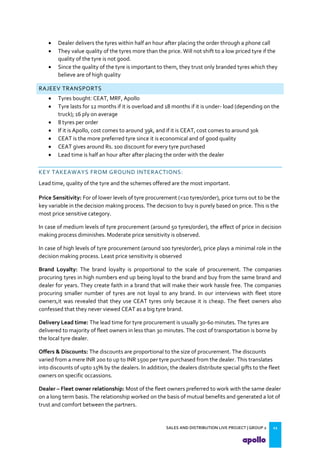
KEY TAKEAWAYS FROM GROUND INTERACTIONS:
Lead time, quality of the tyre and the schemes offered are the most important.
Price Sensitivity: For of lower levels of tyre procurement (<10 tyres/order), price turns out to be the
key variable in the decision making process. The decision to buy is purely based on price. This is the
most price sensitive category.
In case of medium levels of tyre procurement (around 50 tyres/order), the effect of price in decision
making process diminishes. Moderate price sensitivity is observed.
In case of high levels of tyre procurement (around 100 tyres/order), price plays a minimal role in the
decision making process. Least price sensitivity is observed
Brand Loyalty: The brand loyalty is proportional to the scale of procurement. The companies
procuring tyres in high numbers end up being loyal to the brand and buy from the same brand and
dealer for years. They create faith in a brand that will make their work hassle free. The companies
procuring smaller number of tyres are not loyal to any brand. In our interviews with fleet store
owners,it was revealed that they use CEAT tyres only because it is cheap. The fleet owners also
confessed that they never viewed CEAT as a big tyre brand.
Delivery Lead time: The lead time for tyre procurement is usually 30-60 minutes. The tyres are
delivered to majority of fleet owners in less than 30 minutes. The cost of transportation is borne by
the local tyre dealer.
Offers & Discounts: The discounts are proportional to the size of procurement. The discounts
varied from a mere INR 200 to up to INR 1500 per tyre purchased from the dealer. This translates
into discounts of upto 15% by the dealers. In addition, the dealers distribute special gifts to the fleet
owners on specific occassions.
Dealer – Fleet owner relationship: Most of the fleet owners preferred to work with the same dealer
on a long term basis. The relationship worked on the basis of mutual benefits and generated a lot of
trust and comfort between the partners.
SALES AND DISTRIBUTION LIVE PROJECT | GROUP 2 12
MOTIVATORS & BARRIERS FOR DEALERS
CHARACTERISTICS OF DEALERS:
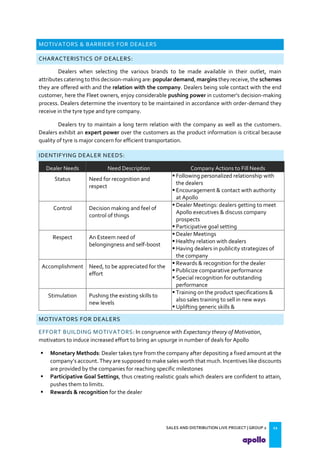
Dealers when selecting the various brands to be made available in their outlet, main
attributes catering to this decision-making are: popular demand, margins they receive, the schemes
they are offered with and the relation with the company. Dealers being sole contact with the end
customer, here the Fleet owners, enjoy considerable pushing power in customer s decision-making
process. Dealers determine the inventory to be maintained in accordance with order-demand they
receive in the tyre type and tyre company.
Dealers try to maintain a long term relation with the company as well as the customers.
Dealers exhibit an expert power over the customers as the product information is critical because
quality of tyre is major concern for efficient transportation.
IDENTIFYING DEALER NEEDS:
Dealer Needs Need Description Company Actions to Fill Needs
Status Need for recognition and
respect
 Following personalized relationship with
the dealers
 Encouragement & contact with authority
at Apollo
Control Decision making and feel of
control of things
 Dealer Meetings: dealers getting to meet
Apollo executives & discuss company
prospects
 Participative goal setting
Respect An Esteem need of
belongingness and self-boost
 Dealer Meetings
 Healthy relation with dealers
 Having dealers in publicity strategizes of
the company
Accomplishment Need, to be appreciated for the
effort
 Rewards & recognition for the dealer
 Publicize comparative performance
 Special recognition for outstanding
performance
Stimulation Pushing the existing skills to
new levels
 Training on the product specifications &
also sales training to sell in new ways
 Uplifting generic skills &
MOTIVATORS FOR DEALERS
EFFORT BUILDING MOTIVATORS: In congruence with Expectancy theory of Motivation,
motivators to induce increased effort to bring an upsurge in number of deals for Apollo
 Monetary Methods: Dealer takes tyre from the company after depositing a fixed amount at the
company s account. They are supposed to make sales worth that much. Incentives like discounts
are provided by the companies for reaching specific milestones
 Participative Goal Settings, thus creating realistic goals which dealers are confident to attain,
pushes them to limits.
 Rewards & recognition for the dealer
SALES AND DISTRIBUTION LIVE PROJECT | GROUP 2 13
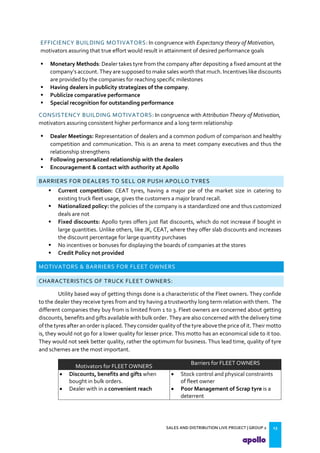
EFFICIENCY BUILDING MOTIVATORS: In congruence with Expectancy theory of Motivation,
motivators assuring that true effort would result in attainment of desired performance goals
 Monetary Methods: Dealer takes tyre from the company after depositing a fixed amount at the
company s account. They are supposed to make sales worth that much. Incentives like discounts
are provided by the companies for reaching specific milestones
 Having dealers in publicity strategizes of the company.
 Publicize comparative performance
 Special recognition for outstanding performance
CONSISTENCY BUILDING MOTIVATORS: In congruence with Attribution Theory of Motivation,
motivators assuring consistent higher performance and a long term relationship
 Dealer Meetings: Representation of dealers and a common podium of comparison and healthy
competition and communication. This is an arena to meet company executives and thus the
relationship strengthens
 Following personalized relationship with the dealers
 Encouragement & contact with authority at Apollo
BARRIERS FOR DEALERS TO SELL OR PUSH APOLLO TYRES
 Current competition: CEAT tyres, having a major pie of the market size in catering to
existing truck fleet usage, gives the customers a major brand recall.
 Nationalized policy: the policies of the company is a standardized one and thus customized
deals are not
 Fixed discounts: Apollo tyres offers just flat discounts, which do not increase if bought in
large quantities. Unlike others, like JK, CEAT, where they offer slab discounts and increases
the discount percentage for large quantity purchases
 No incentives or bonuses for displaying the boards of companies at the stores
 Credit Policy not provided
MOTIVATORS & BARRIERS FOR FLEET OWNERS
CHARACTERISTICS OF TRUCK FLEET OWNERS:
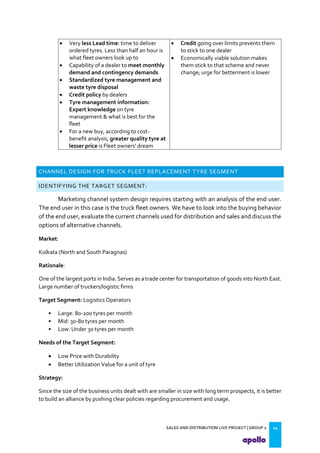
Utility based way of getting things done is a characteristic of the Fleet owners. They confide
to the dealer they receive tyres from and try having a trustworthy long term relation with them. The
different companies they buy from is limited from 1 to 3. Fleet owners are concerned about getting
discounts, benefits and gifts available with bulk order. They are also concerned with the delivery time
ofthe tyres after an order is placed. They consider quality of the tyre above the price of it. Their motto
is, they would not go for a lower quality for lesser price. This motto has an economical side to it too.
They would not seek better quality, rather the optimum for business. Thus lead time, quality of tyre
and schemes are the most important.
Motivators for FLEET OWNERS
Barriers for FLEET OWNERS
 Discounts, benefits and gifts when
bought in bulk orders.
 Dealer with in a convenient reach
 Stock control and physical constraints
of fleet owner
 Poor Management of Scrap tyre is a
deterrent
SALES AND DISTRIBUTION LIVE PROJECT | GROUP 2 14
 Very less Lead time: time to deliver
ordered tyres. Less than half an hour is
what fleet owners look up to
 Capability of a dealer to meet monthly
demand and contingency demands
 Standardized tyre management and
waste tyre disposal
 Credit policy by dealers
 Tyre management information:
Expert knowledge on tyre
management & what is best for the
fleet
 For a new buy, according to cost-
benefit analysis, greater quality tyre at
lesser price is Fleet owners dream
 Credit going over limits prevents them
to stick to one dealer
 Economically viable solution makes
them stick to that scheme and never
change; urge for betterment is lower
CHANNEL DESIGN FOR TRUCK FLEET REPLACEMENT TYRE SEGMENT
IDENTIFYING THE TARGET SEGMENT:
Marketing channel system design requires starting with an analysis of the end user.
The end user in this case is the truck fleet owners. We have to look into the buying behavior
of the end user, evaluate the current channels used for distribution and sales and discuss the
options of alternative channels.
Market:
Kolkata (North and South Paragnas)
Rationale:
One of the largest ports in India. Serves as a trade center for transportation of goods into North East.
Large number of truckers/logistic firms
Target Segment: Logistics Operators
• Large: 80-200 tyres per month
• Mid: 30-80 tyres per month
• Low: Under 30 tyres per month
Needs of the Target Segment:
 Low Price with Durability
 Better Utilization Value for a unit of tyre
Strategy:
Since the size of the business units dealt with are smaller in size with long term prospects, it is better
to build an alliance by pushing clear policies regarding procurement and usage.
SALES AND DISTRIBUTION LIVE PROJECT | GROUP 2 15
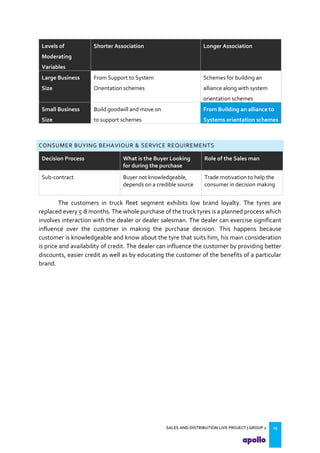
Levels of
Moderating
Variables
Shorter Association Longer Association
Large Business
Size
From Support to System
Orientation schemes
Schemes for building an
alliance along with system
orientation schemes
Small Business
Size
Build goodwill and move on
to support schemes
From Building an alliance to
Systems orientation schemes
CONSUMER BUYING BEHAVIOUR & SERVICE REQUIREMENTS
Decision Process What is the Buyer Looking
for during the purchase
Role of the Sales man
Sub-contract Buyer not knowledgeable,
depends on a credible source
Trade motivation to help the
consumer in decision making
The customers in truck fleet segment exhibits low brand loyalty. The tyres are
replaced every 5-8 months. The whole purchase of the truck tyres is a planned process which
involves interaction with the dealer or dealer salesman. The dealer can exercise significant
influence over the customer in making the purchase decision. This happens because
customer is knowledgeable and know about the tyre that suits him, his main consideration
is price and availability of credit. The dealer can influence the customer by providing better
discounts, easier credit as well as by educating the customer of the benefits of a particular
brand.
SALES AND DISTRIBUTION LIVE PROJECT | GROUP 2 16
EVALUATING THE CURRENT CHANNEL
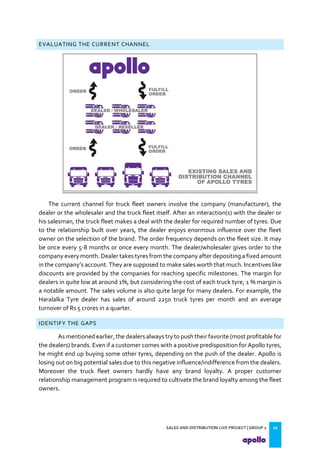
The current channel for truck fleet owners involve the company (manufacturer), the
dealer or the wholesaler and the truck fleet itself. After an interaction(s) with the dealer or
his salesman, the truck fleet makes a deal with the dealer for required number of tyres. Due
to the relationship built over years, the dealer enjoys enormous influence over the fleet
owner on the selection of the brand. The order frequency depends on the fleet size. It may
be once every 5-8 months or once every month. The dealer/wholesaler gives order to the
company every month. Dealer takes tyres from the company after depositing a fixed amount
in the company s account. They are supposed to make sales worth that much. Incentives like
discounts are provided by the companies for reaching specific milestones. The margin for
dealers in quite low at around 1%, but considering the cost of each truck tyre, 1 % margin is
a notable amount. The sales volume is also quite large for many dealers. For example, the
Haralalka Tyre dealer has sales of around 2250 truck tyres per month and an average
turnover of Rs 5 crores in a quarter.
IDENTIFY THE GAPS
As mentioned earlier, the dealers always try to push their favorite (most profitable for
the dealers) brands. Even if a customer comes with a positive predisposition for Apollo tyres,
he might end up buying some other tyres, depending on the push of the dealer. Apollo is
losing out on big potential sales due to this negative influence/indifference from the dealers.
Moreover the truck fleet owners hardly have any brand loyalty. A proper customer
relationship management program is required to cultivate the brand loyalty among the fleet
owners.
SALES AND DISTRIBUTION LIVE PROJECT | GROUP 2 17
IDENTIFY POSSIBLE ALTERNATIVE CHANNELS AND THEIR STRUCTURE,
COMPETENCIES, SERVICE LEVELS
APOLLO FLEET ASSIST AND LIFELINE CHANNEL SPECIFICS
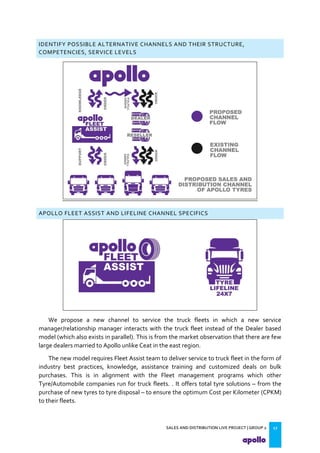
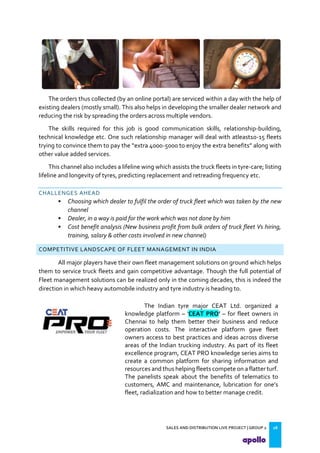
We propose a new channel to service the truck fleets in which a new service
manager/relationship manager interacts with the truck fleet instead of the Dealer based
model (which also exists in parallel). This is from the market observation that there are few
large dealers married to Apollo unlike Ceat in the east region.
The new model requires Fleet Assist team to deliver service to truck fleet in the form of
industry best practices, knowledge, assistance training and customized deals on bulk
purchases. This is in alignment with the Fleet management programs which other
Tyre/Automobile companies run for truck fleets. . It offers total tyre solutions – from the
purchase of new tyres to tyre disposal – to ensure the optimum Cost per Kilometer (CPKM)
to their fleets.
SALES AND DISTRIBUTION LIVE PROJECT | GROUP 2 18
The orders thus collected (by an online portal) are serviced within a day with the help of
existing dealers (mostly small). This also helps in developing the smaller dealer network and
reducing the risk by spreading the orders across multiple vendors.
The skills required for this job is good communication skills, relationship-building,
technical knowledge etc. One such relationship manager will deal with atleast10-15 fleets
trying to convince them to pay the extra 000- 000 to enjoy the extra benefits along with
other value added services.
This channel also includes a lifeline wing which assists the truck fleets in tyre-care; listing
lifeline and longevity of tyres, predicting replacement and retreading frequency etc.
CHALLENGES AHEAD
• Choosing which dealer to fulfil the order of truck fleet which was taken by the new
channel
• Dealer, in a way is paid for the work which was not done by him
• Cost benefit analysis (New business profit from bulk orders of truck fleet Vs hiring,
training, salary & other costs involved in new channel)
COMPETITIVE LANDSCAPE OF FLEET MANAGEMENT IN INDIA
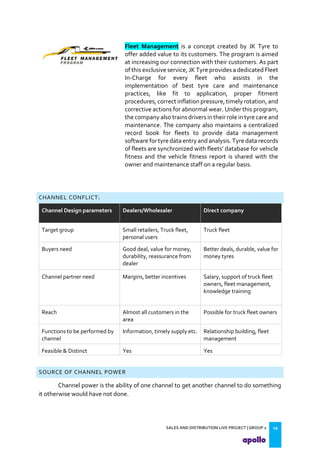
All major players have their own fleet management solutions on ground which helps
them to service truck fleets and gain competitive advantage. Though the full potential of
Fleet management solutions can be realized only in the coming decades, this is indeed the
direction in which heavy automobile industry and tyre industry is heading to.
The Indian tyre major CEAT Ltd. organized a
knowledge platform – CEAT PRO’ – for fleet owners in
Chennai to help them better their business and reduce
operation costs. The interactive platform gave fleet
owners access to best practices and ideas across diverse
areas of the Indian trucking industry. As part of its fleet
excellence program, CEAT PRO knowledge series aims to
create a common platform for sharing information and
resources and thus helping fleets compete on a flatter turf.
The panelists speak about the benefits of telematics to
customers, AMC and maintenance, lubrication for one s
fleet, radialization and how to better manage credit.
SALES AND DISTRIBUTION LIVE PROJECT | GROUP 2 19
Fleet Management is a concept created by JK Tyre to
offer added value to its customers. The program is aimed
at increasing our connection with their customers. As part
of this exclusive service, JK Tyre provides a dedicated Fleet
In-Charge for every fleet who assists in the
implementation of best tyre care and maintenance
practices, like fit to application, proper fitment
procedures, correct inflation pressure, timely rotation, and
corrective actions for abnormal wear. Under this program,
the company also trainsdrivers in their role in tyre care and
maintenance. The company also maintains a centralized
record book for fleets to provide data management
software for tyredata entry and analysis.Tyre datarecords
of fleets are synchronized with fleets database for vehicle
fitness and the vehicle fitness report is shared with the
owner and maintenance staff on a regular basis.
CHANNEL CONFLICT:
Channel Design parameters Dealers/Wholesaler Direct company
Target group Small retailers, Truck fleet,
personal users
Truck fleet
Buyers need Good deal, value for money,
durability, reassurance from
dealer
Better deals, durable, value for
money tyres
Channel partner need Margins, better incentives Salary, support of truck fleet
owners, fleet management,
knowledge training
Reach Almost all customers in the
area
Possible for truck fleet owners
Functions to be performed by
channel
Information, timely supply etc. Relationship building, fleet
management
Feasible & Distinct Yes Yes
SOURCE OF CHANNEL POWER
Channel power is the ability of one channel to get another channel to do something
it otherwise would have not done.
SALES AND DISTRIBUTION LIVE PROJECT | GROUP 2 20
Type of Power Dealers/Wholesaler Direct channel Company
Reward No Yes Yes
Legitimate No No No
Coercion No No Yes
Expert Yes Yes Yes
Referent No Yes No
The source of channel power clearly indicates that if we start the new channel of
direct sales/ relationship management with the fleet owners, this particular channel will
enjoy more power than the existing dealers. If we look deeply, we can see that the new
channel can totally replace the dealer channel for truck fleet tyre replacement segment. But
we cannot totally replace the dealers who gives us considerable amount of sales.
The solution is to let the new channel focus on relationship building with truck fleet
owners through well designed fleet management and persuading and assisting the owners
to give orders to Apollo through this channel at the proper time. But the delivery can be done
through the dealers. So the dealers still gets the margin, they obtained earlier. This helps in
avoiding channel conflict.
EXPANDING APOLLO TYRES EXISTING DEALER NETWORK
Apollo Tyres already has a sophisticated network of dealers in Eastern region.
Nevertheless there is always a scope for improvement. Apart from the truck fleet customers,
there are a lot of other standalone customers who are either resellers, service stations or
garages. Currently, some of them are regularly serviced by the existing large dealers or these
dealers run their own reseller chains to cater to the needs of this market. It is always
profitable for Apollo to expand its direct business to this untapped market.
LOCATING POTENTIAL DEALERS
To accomplish a new dealership, Apollo Tyres should map all the dealer locations first
on a map. Now, imprint demand data onto this map. Demand data will clearly show the
locations where the there is enough demand to sustain Apollo Tyres policy of minimum
lakh deposit a month for dealing truck tyres exclusively and x rupees deposit for the other
kinds of dealership. Apollo should then identify existing resellers, service stations, garages
who can be converted to a dealer. Apollo may also nurture an individual as a dealer if he has
the caliber to sustain and grow its business in that locality.
CONTINUOUS ENGAGEMENT
Apollo Tyres should constantly engage potential dealers through its sales managers
and relationship managers and convince them to enlist as a dealer.
SALES AND DISTRIBUTION LIVE PROJECT | GROUP 2 21
AVOIDING CHANNEL CONFLICT
Extreme care to be taken not to approach existing resellers serviced by our dealers
to avoid chances for channel conflict.
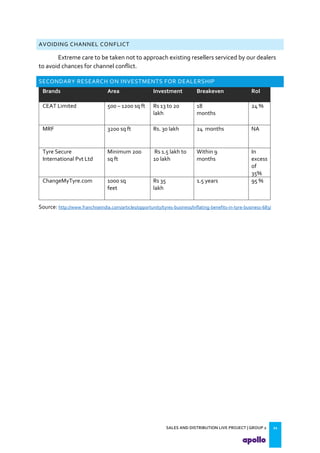
SECONDARY RESEARCH ON INVESTMENTS FOR DEALERSHIP
Brands Area Investment Breakeven RoI
CEAT Limited 500 – 1200 sq ft Rs 13 to 20
lakh
18
months
24 %
MRF 3200 sq ft Rs. 30 lakh 24 months NA
Tyre Secure
International Pvt Ltd
Minimum 200
sq ft
Rs 1.5 lakh to
10 lakh
Within 9
months
In
excess
of
35%
ChangeMyTyre.com 1000 sq
feet
Rs 35
lakh
1.5 years 95 %
Source: http://www.franchiseindia.com/articles/opportunity/tyres-business/Inflating-benefits-in-tyre-business-683/
SALES AND DISTRIBUTION LIVE PROJECT | GROUP 2 22
ANNEXURE
Apollo Tyres | IIMC | Sales & Distribution

Apollo Tyres | IIMC | Sales & Distribution

  • 2.
    SALES AND DISTRIBUTIONLIVE PROJECT | GROUP 2 1 CONTENTS PROJECT OBJECTIVES..................................................................................................................................................... 2 Tyre industry in india .........................................................................................................................................................3 Indian Tyre Industry- Highlights ....................................................................................................................................3 Industry Growth Drivers............................................................................................................................................... 4 Replacement Segment ................................................................................................................................................ 4 Apollo Tyres..................................................................................................................................................................5 Competitive landscape................................................................................................................................................. 6 MRF Tyres............................................................................................................................................................... 6 JK Tyres .................................................................................................................................................................. 6 CEAT Tyres ............................................................................................................................................................. 6 Apollo Sales Organisation.............................................................................................................................................7 PRIMARY RESEARCH-INSIGHTS FROM INDEPTH INTERVIEWS with sales managers .......................................................7 OVERVIEW & PURPOSE ...............................................................................................................................................7 HIGHLIGHTS ................................................................................................................................................................7 PRIMARY RESEARCH-INSIGHTS FROM INDEPTH INTERVIEWS with tyre dealers............................................................ 8 Haralalka Tyre Agencies............................................................................................................................................... 8 Indo Tyres.................................................................................................................................................................... 9 Maya Tyres.................................................................................................................................................................. 9 PRIMARY RESEARCH-INSIGHTS FROM INDEPTH INTERVIEWS with truck fleets............................................................10 Speed Ways Logistics..................................................................................................................................................10 S N Transport..............................................................................................................................................................10 Rajeev Transports.......................................................................................................................................................11 Key takeaways from ground interactions:...............................................................................................................11 MOTIVATORS & barriers FOR DEALERS .........................................................................................................................12 Characteristics of Dealers:...........................................................................................................................................12 Identifying Dealer Needs:............................................................................................................................................12 Motivators for dealers.................................................................................................................................................12 Effort building motivators ......................................................................................................................................12 Efficiency building Motivators ................................................................................................................................13 Consistency building Motivators.............................................................................................................................13 Barriers for dealers to sell or push Apollo Tyres ...........................................................................................................13 MOTIVATORS & barriers FOR FLEET OWNERS...............................................................................................................13 Characteristics of Truck Fleet Owners: ........................................................................................................................13 Channel design for truck fleet replacement tyre segment ................................................................................................14 Identifying the target segment:...................................................................................................................................14 Consumer Buying behaviour & service requirements...................................................................................................15 Evaluating the current channel....................................................................................................................................16 Identify the gaps.........................................................................................................................................................16 Identify possible alternative channels and their structure, competencies, service levels...............................................17 apollo fleet assist and lifeline channel specifics............................................................................................................17 CHALLENGES AHEAD ...........................................................................................................................................18 COMPETITIVE LANDSCAPE of fleet management in india..........................................................................................18 Channel Conflict: ........................................................................................................................................................19 Source of Channel Power............................................................................................................................................19 Expanding Apollo Tyres existing Dealer Network ............................................................................................................20 Locating potential dealers...........................................................................................................................................20 Continuous engagement.............................................................................................................................................20 Avoiding channel conflict............................................................................................................................................21 SECONDARY RESEARCH ON INVESTMENTS FOR DEALERSHIP ....................................................................................21 ANNEXURE.....................................................................................................................................................................22
  • 3.
    SALES AND DISTRIBUTIONLIVE PROJECT | GROUP 2 2 PROJECT OBJECTIVES This project has three broad objectives from a marketing as well as sales & distribution point of view- Increase the sales of Apollo Tyres in Eastern Region (Particularly in Kolkata) by 1) Identifying Motivators and Barriers for existing dealers 2) Conceptualizing a sales and distribution strategy to motivate Emerging segment 'Truck fleet' 3) Study on Go to Market strategies of competitor companies
  • 4.
    SALES AND DISTRIBUTIONLIVE PROJECT | GROUP 2 3 TYRE INDUSTRY IN INDIA Indian tyre industry is estimated to be Rs 520 billion in size (FY 2015). The industry is dominated by truck and bus segment which accounted for 49% of the demand in tonnage terms. 80 % of the demand is met by the top 7 players. Year (Lakh/ Nos) % Change Year (Lakh/ Nos) % Change 2000-01 86.12 2008-09 128.39 -2% 2001-02 84.74 -2% 2009-10 152.83 19% 2002-03 98.63 16% 2010-11 156.68 3% 2003-04 108.21 10% 2011-12 160.85 3% 2004-05 110.92 3% 2012-13 165.32 3% 2005-06 119.41 8% 2013-14 164.74 -0.4% 2006-07 123.67 4% 2014-15 171.12 4% 2007-08 131.37 6% No. of Tyre Companies: 39 No. of Tyre Plants: 60 Industry Turnover 2014-15 (est.): Rs. 50000 crore (US$ 8.5 Bn) Exports 2014-15 (est.): Rs. 10500 crore (US $ 1.7 Bn) INDIAN TYRE INDUSTRY- HIGHLIGHTS 29% 17% 13% 12% 7% 5% 4% 3% 4% 3% 1% Market Share MRF Apollo JK Tyres CEAT Balkrishna Birla Bridgestone Goodyear TVS Srichakra Falcon ATC Ralson Metro
  • 5.
    SALES AND DISTRIBUTIONLIVE PROJECT | GROUP 2 4 INDUSTRY GROWTH DRIVERS  Automobile demand  Increasing radialisation with strong thrust from OEMs  Steady aftermarket demand  Focus on geographical diversification REPLACEMENT SEGMENT Replacements depend on industrial activity and freight movement. Freight movement is, in turn impacted by the performance of the agriculture, infrastructure, housing and industrial sectors. (Research, n.d.). I.e. replacement tyre demand is strongly connected to the overall economic growth. The demand typically grows at about 3-4% YOY. {CRISIL Research,ATMA} Replacement Tyres drive 85% of the demand in overall commercial vehicle tyre demand. 60% 30% 10% Segment Mix OEM Replacement Others 60%23% 6% 1% 9%1% Product Mix(in tonnage) CV PV 2W OTR Tractors Others 27% 30% 32% 36% 33% 32% 73% 70% 68% 64% 67% 68% 0% 10% 20% 30% 40% 50% 60% 70% 80% 90% 100% 2008-09 2009-10 2010-11 2011-12 2012-13 2013-14 OEM Replacement Source: CRISIL Research, ATMA
  • 6.
    SALES AND DISTRIBUTIONLIVE PROJECT | GROUP 2 5 Source: CRISIL Research, ATMA APOLLO TYRES Apollo is the second largest player in the Indian tyre industry with a market share of about 17% in 2014-15. The company is a leading player in the truck and bus tyre segment, with over 25% market share. ATL has diverse revenue streams, with overseas subsidiaries contributing to 39% of revenues in 2013-14. It enjoys a first-mover advantage in the production of radial tyres. {CRISIL Research} 43% 66% 38% 59% 31% 62% 23% 12% 26% 13% 26% 14% 18% 10% 19% 7% 22% 7% 16% 6% 17% 5% 21% 6% 0% 6% 0% 16% 0% 12% 0% 10% 20% 30% 40% 50% 60% 70% 80% 90% 100% OEM Replacement OEM Replacement OEM Replacement 2011-12 2012-13 2013-14 Segment wise demand proportions CV Cars & Uvs 2/3 wheelers Tractor Others 45% 37% 11% 6% 2% Segment-wise market share (2013-14) MCHV Cara/Uvs Off-highway LCV Others
  • 7.
    SALES AND DISTRIBUTIONLIVE PROJECT | GROUP 2 6 COMPETITIVE LANDSCAPE MRF TYRES MRF is the largest tyre manufacturer in India with 29% market share. The company manufactures rubber products, such as tyres, tubes, flaps, tread rubber and conveyor belts. It also has diverse business interests, which include pre-treads, paint and coats and toys. Although the company caters to all tyre segments, the truck & bus segment constitutes 48% of its production (in tonnage terms) as of 2013-14. MRF is also a market leader in Car and Utility Vehicles and Two-wheeler segments and enjoys a strong brand recall among OEM as well as replacement market.{CRISIL Research} JK TYRES JK tyres is the third largest player in the market with 13% market share. Its products include radial and bias tyres for trucks, light commercial vehicles (LCVs), buses, passenger cars, tractors etc. JK Tyres has pioneered steel radial technology in India. The company is a market leader in the Medium and Heavy Commercial Vehicles (MHCV) radial tyres segment with a market share of 34%. The company's product portfolio is heavily skewed towards the cyclical CV industry. .{CRISIL Research} CEAT TYRES CEAT is the fourth largest player in the domestic tyre industry. The company manufactures tyres for trucks, light commercial vehicles (LCVs), passenger cars, utility vehicles (UVs), tractors, truck trailers and two-wheelers. During 2014-15, CEAT outperformed the industry (in volume growth) in both OEM and replacement categories. The company manufactures a range of tyres across automobile segments with truck and bus being the largest. However, increasing competition in the low-margin truck segment and relatively lower brand differentiation has led the company to shift its focus to non- truck segments.Steadily,it has been gaining market share inthe more profitablenon-truck segments, such as two-wheelers and passenger vehicles. {CRISIL Research}
  • 8.
    SALES AND DISTRIBUTIONLIVE PROJECT | GROUP 2 7 APOLLO SALES ORGANISATION PRIMARY RESEARCH-INSIGHTS FROM INDEPTH INTERVIEWS WITH SALES MANAGERS OVERVIEW & PURPOSE This is an attempt to understand how Apollo is dealing with its tyre dealers and what all improvements can be made in the engagement to motivate dealers to eliminate the barriers to sell and push tyres to their customers. It s also an attempt to figure out how Apollo can increase its brand equity among truck fleets. Good brand equity will help Apollo to retain fleets and convert new fleets into its loyal base. Finally, this also looks at various avenues for Apollo to expand its market, mostly by adding more dealers into its fold. HIGHLIGHTS  There are dealers who are committed with other companies. We do not want to run an affair with them. It is like being a girlfriend to a married man.  Credit policy not in Apollo’s agenda  Prices will remain the same. Centralized decision. Apollo will not cut prices, will dilute brand equity.  Change in consumer behavior. Transformed customers are conscious about mileage and cost/km. They will not buy a tyre just because it is priced low.  Fleet Management system is an evolving idea. It is the future Apollo follows a 1:1 model with 3 rotations a quarter for the amount deposited with the company. They have fixed percentage discounts that are flat and there are no slabs as RBU HEAD Controller-RBU CSM-RBUSales ABU Manager Commercial Sales RBU ABU
  • 9.
    SALES AND DISTRIBUTIONLIVE PROJECT | GROUP 2 8 compared to Ceat or JK tyres. The discount last year was 1.85% of sales. In addition to this flat discount, Apollo runs schemes which vary throughout the year. Since it s a flat discount, both large and small dealers are benefitted in a similar fashion and hence, small dealers can compete with large dealers of Apollo. This is the reason why Apollo is welcomed by dealers in all ranges of scale. On the other hand, CEAT increases the discount % as the volume of sales increases and hence large dealers have an advantage over small dealers. They can sell the tyre at a lower price than small dealers. So CEAT and JK tyres will have a few large dealers. CEAT and JK have flexible credit system and hence project an image of being a less strict company. Apollo has no intention to provide a credit system and it implements its policies uniformly all across the country to avoid being put in the same bracket. It is hence not ready to dilute it and let the ball to be in dealers court. Segments of tyres Truck Car radial Non truck MRF tyres are perceived to be of better quality. For a sales revenue of 1 cr, MRF will generate 35 lakhs from truck and the rest is from the passenger car segment. For Apollo however, 60 lakhs will come from truck and for Ceat almost 80 % is from truck. Truck fleets demand higher credit from the dealers all the time. When the dealer is unable to increase the credit any further, the truck fleet will approach another dealer. So it is not uncommon to find truck fleets buying tyres from more than 1 dealer. Dealer Schemes: Credit notes, free tyres, Gold coins, foreign trips (to dealers) Fleet management system: in introductory phase PRIMARY RESEARCH-INSIGHTS FROM INDEPTH INTERVIEWS WITH TYRE DEALERS HARALALKA TYRE AGENCIES • Started in 1982. • Companies served: CEAT, Apollo, Continental, Michelin, JK • Margin varies from company to company, but it is usually around 1% • Indian companies give better margins than foreign ones (Michelin) • Categories of tyres served: all categories • Most sold category: truck • Buying behavior: o Order taking through phones o Retail sales in 2 methods: consultative selling and traditional selling • Maximum order size sold: 2000 pieces in a single order- (which happened in truck fleet category) • Sales around 5 crores per quarter • 4000 pieces monthly sales • There are 25 fleet owners who buy from him
  • 10.
    SALES AND DISTRIBUTIONLIVE PROJECT | GROUP 2 9 • 5 to 6 months credit period to fleets • Dealer takestyrefrom the company after depositing afixed amount at thecompany s account. They are supposed to make sales worth that much. Incentives like discounts are provided by the companies for reaching specific milestones • No incentives or bonuses for displaying the boards of companies at the stores • Apollo has started sacrificing margin because they are losing out in the market Company Sales by % of total Sales per month (Category wise) Rank in different parameters Truck Motorcycle LCV (Commercial) PCR (Private) Economy Mileage Overload Premium CEAT 80% 2000 1500 200 200 2 3 3 4 Apollo 10% 50 50 50 2 1 2 Continental 5% 200 2 3 JK 5% 10 30 Birla 1 MRF 1 1 INDO TYRES • Established in 1968 • 19 shops in the chain • Purchase from the company; deposit method (1:1) • Sales depend on the margins and schemes(quarterly) offered • No incentives received • Orders worth 10 lakhs (monthly) MAYA TYRES • Passenger car tyres constitutes 90% of the sales. The rest is 2-Wheeler tyres. • Average Monthly sales data was not divulged. • The Brands which are on sale are Bridgestone, MRF and Apollo. The sales contribution is in this order, with numbers not specified. • Sales - Bridgestone>MRF>Apollo • Stock replacement happens within 2 months • Store Manager had prior experience in Commercial Vehicle tyre sales • In commercial segment, tyres are replaced every 6 to 8 months. Buyers are knowledgeable about the existing brands. (Unlike passenger segment wheels, where replacement happens mostly every 5 years) • The buyers for commercial tyres do not consult the dealer for product information, since they have a preferred brand. (For heavy duty vehicles, tyres are a major concern for efficient transportation) • For Apollo, the most preferred category of tyres is Commercial tyres.
  • 11.
    SALES AND DISTRIBUTIONLIVE PROJECT | GROUP 2 10 PRIMARY RESEARCH-INSIGHTS FROM INDEPTH INTERVIEWS WITH TRUCK FLEETS We have conducted on the ground interviews with several truck fleet owners to know more about their tyre procurement strategies.Wecovered the KolkataPort Trust area,home to a huge fleet network owing to the proximity of the port. SPEED WAYS LOGISTICS  Areas Served- Only Bengal  Tyre Dealer: CAMAC Tyres; Sometimes done directly deals with the company (i.e. JK, CEAT, Apollo or any other brand) but delivery (or routing) happens only through dealer  Tyre Types Used: 18 Ply and 16 Ply  Brands Used: JK Tyre, CEAT; Tries using other brands as well but finds JK to be the best  Factors influencing purchase decision: o Durability o Credit and Period of Repayment o Timely Delivery o Expects discounts but values quality much more  Price: Approximately 13000, Discounts in the range of 1000-1500  Credit Period: 1-2 months  Duration of purchase: Once a month mostly  Quantity: 70-80; 85% JK Tyres, 10%- CEAT, Rest-5%  Delivery: Camac Tyres in Camac Street usually delivers within an hour of order placed  Delivery Charges borne by the dealer S N TRANSPORT  Dealer from whom tyres are bought: Eastern Distributors, Mohammed Ali Park  Tyres bought as of now: CEAT, Apollo  Order quantity: 30 tyres per month  Tyres last for 7 to 8 months, 18 ply  Discounts and gifts are available with bulk orders (which they look forward to)
  • 12.
    SALES AND DISTRIBUTIONLIVE PROJECT | GROUP 2 11  Dealer delivers the tyres within half an hour after placing the order through a phone call  They value quality of the tyres more than the price. Will not shift to a low priced tyre if the quality of the tyre is not good.  Since the quality of the tyre is important to them, they trust only branded tyres which they believe are of high quality RAJEEV TRANSPORTS  Tyres bought: CEAT, MRF, Apollo  Tyre lasts for 12 months if it is overload and 18 months if it is under- load (depending on the truck); 16 ply on average  8 tyres per order  If it is Apollo, cost comes to around 39k, and if it is CEAT, cost comes to around 30k  CEAT is the more preferred tyre since it is economical and of good quality  CEAT gives around Rs. 100 discount for every tyre purchased  Lead time is half an hour after after placing the order with the dealer KEY TAKEAWAYS FROM GROUND INTERACTIONS: Lead time, quality of the tyre and the schemes offered are the most important. Price Sensitivity: For of lower levels of tyre procurement (<10 tyres/order), price turns out to be the key variable in the decision making process. The decision to buy is purely based on price. This is the most price sensitive category. In case of medium levels of tyre procurement (around 50 tyres/order), the effect of price in decision making process diminishes. Moderate price sensitivity is observed. In case of high levels of tyre procurement (around 100 tyres/order), price plays a minimal role in the decision making process. Least price sensitivity is observed Brand Loyalty: The brand loyalty is proportional to the scale of procurement. The companies procuring tyres in high numbers end up being loyal to the brand and buy from the same brand and dealer for years. They create faith in a brand that will make their work hassle free. The companies procuring smaller number of tyres are not loyal to any brand. In our interviews with fleet store owners,it was revealed that they use CEAT tyres only because it is cheap. The fleet owners also confessed that they never viewed CEAT as a big tyre brand. Delivery Lead time: The lead time for tyre procurement is usually 30-60 minutes. The tyres are delivered to majority of fleet owners in less than 30 minutes. The cost of transportation is borne by the local tyre dealer. Offers & Discounts: The discounts are proportional to the size of procurement. The discounts varied from a mere INR 200 to up to INR 1500 per tyre purchased from the dealer. This translates into discounts of upto 15% by the dealers. In addition, the dealers distribute special gifts to the fleet owners on specific occassions. Dealer – Fleet owner relationship: Most of the fleet owners preferred to work with the same dealer on a long term basis. The relationship worked on the basis of mutual benefits and generated a lot of trust and comfort between the partners.
  • 13.
    SALES AND DISTRIBUTIONLIVE PROJECT | GROUP 2 12 MOTIVATORS & BARRIERS FOR DEALERS CHARACTERISTICS OF DEALERS: Dealers when selecting the various brands to be made available in their outlet, main attributes catering to this decision-making are: popular demand, margins they receive, the schemes they are offered with and the relation with the company. Dealers being sole contact with the end customer, here the Fleet owners, enjoy considerable pushing power in customer s decision-making process. Dealers determine the inventory to be maintained in accordance with order-demand they receive in the tyre type and tyre company. Dealers try to maintain a long term relation with the company as well as the customers. Dealers exhibit an expert power over the customers as the product information is critical because quality of tyre is major concern for efficient transportation. IDENTIFYING DEALER NEEDS: Dealer Needs Need Description Company Actions to Fill Needs Status Need for recognition and respect  Following personalized relationship with the dealers  Encouragement & contact with authority at Apollo Control Decision making and feel of control of things  Dealer Meetings: dealers getting to meet Apollo executives & discuss company prospects  Participative goal setting Respect An Esteem need of belongingness and self-boost  Dealer Meetings  Healthy relation with dealers  Having dealers in publicity strategizes of the company Accomplishment Need, to be appreciated for the effort  Rewards & recognition for the dealer  Publicize comparative performance  Special recognition for outstanding performance Stimulation Pushing the existing skills to new levels  Training on the product specifications & also sales training to sell in new ways  Uplifting generic skills & MOTIVATORS FOR DEALERS EFFORT BUILDING MOTIVATORS: In congruence with Expectancy theory of Motivation, motivators to induce increased effort to bring an upsurge in number of deals for Apollo  Monetary Methods: Dealer takes tyre from the company after depositing a fixed amount at the company s account. They are supposed to make sales worth that much. Incentives like discounts are provided by the companies for reaching specific milestones  Participative Goal Settings, thus creating realistic goals which dealers are confident to attain, pushes them to limits.  Rewards & recognition for the dealer
  • 14.
    SALES AND DISTRIBUTIONLIVE PROJECT | GROUP 2 13 EFFICIENCY BUILDING MOTIVATORS: In congruence with Expectancy theory of Motivation, motivators assuring that true effort would result in attainment of desired performance goals  Monetary Methods: Dealer takes tyre from the company after depositing a fixed amount at the company s account. They are supposed to make sales worth that much. Incentives like discounts are provided by the companies for reaching specific milestones  Having dealers in publicity strategizes of the company.  Publicize comparative performance  Special recognition for outstanding performance CONSISTENCY BUILDING MOTIVATORS: In congruence with Attribution Theory of Motivation, motivators assuring consistent higher performance and a long term relationship  Dealer Meetings: Representation of dealers and a common podium of comparison and healthy competition and communication. This is an arena to meet company executives and thus the relationship strengthens  Following personalized relationship with the dealers  Encouragement & contact with authority at Apollo BARRIERS FOR DEALERS TO SELL OR PUSH APOLLO TYRES  Current competition: CEAT tyres, having a major pie of the market size in catering to existing truck fleet usage, gives the customers a major brand recall.  Nationalized policy: the policies of the company is a standardized one and thus customized deals are not  Fixed discounts: Apollo tyres offers just flat discounts, which do not increase if bought in large quantities. Unlike others, like JK, CEAT, where they offer slab discounts and increases the discount percentage for large quantity purchases  No incentives or bonuses for displaying the boards of companies at the stores  Credit Policy not provided MOTIVATORS & BARRIERS FOR FLEET OWNERS CHARACTERISTICS OF TRUCK FLEET OWNERS: Utility based way of getting things done is a characteristic of the Fleet owners. They confide to the dealer they receive tyres from and try having a trustworthy long term relation with them. The different companies they buy from is limited from 1 to 3. Fleet owners are concerned about getting discounts, benefits and gifts available with bulk order. They are also concerned with the delivery time ofthe tyres after an order is placed. They consider quality of the tyre above the price of it. Their motto is, they would not go for a lower quality for lesser price. This motto has an economical side to it too. They would not seek better quality, rather the optimum for business. Thus lead time, quality of tyre and schemes are the most important. Motivators for FLEET OWNERS Barriers for FLEET OWNERS  Discounts, benefits and gifts when bought in bulk orders.  Dealer with in a convenient reach  Stock control and physical constraints of fleet owner  Poor Management of Scrap tyre is a deterrent
  • 15.
    SALES AND DISTRIBUTIONLIVE PROJECT | GROUP 2 14  Very less Lead time: time to deliver ordered tyres. Less than half an hour is what fleet owners look up to  Capability of a dealer to meet monthly demand and contingency demands  Standardized tyre management and waste tyre disposal  Credit policy by dealers  Tyre management information: Expert knowledge on tyre management & what is best for the fleet  For a new buy, according to cost- benefit analysis, greater quality tyre at lesser price is Fleet owners dream  Credit going over limits prevents them to stick to one dealer  Economically viable solution makes them stick to that scheme and never change; urge for betterment is lower CHANNEL DESIGN FOR TRUCK FLEET REPLACEMENT TYRE SEGMENT IDENTIFYING THE TARGET SEGMENT: Marketing channel system design requires starting with an analysis of the end user. The end user in this case is the truck fleet owners. We have to look into the buying behavior of the end user, evaluate the current channels used for distribution and sales and discuss the options of alternative channels. Market: Kolkata (North and South Paragnas) Rationale: One of the largest ports in India. Serves as a trade center for transportation of goods into North East. Large number of truckers/logistic firms Target Segment: Logistics Operators • Large: 80-200 tyres per month • Mid: 30-80 tyres per month • Low: Under 30 tyres per month Needs of the Target Segment:  Low Price with Durability  Better Utilization Value for a unit of tyre Strategy: Since the size of the business units dealt with are smaller in size with long term prospects, it is better to build an alliance by pushing clear policies regarding procurement and usage.
  • 16.
    SALES AND DISTRIBUTIONLIVE PROJECT | GROUP 2 15 Levels of Moderating Variables Shorter Association Longer Association Large Business Size From Support to System Orientation schemes Schemes for building an alliance along with system orientation schemes Small Business Size Build goodwill and move on to support schemes From Building an alliance to Systems orientation schemes CONSUMER BUYING BEHAVIOUR & SERVICE REQUIREMENTS Decision Process What is the Buyer Looking for during the purchase Role of the Sales man Sub-contract Buyer not knowledgeable, depends on a credible source Trade motivation to help the consumer in decision making The customers in truck fleet segment exhibits low brand loyalty. The tyres are replaced every 5-8 months. The whole purchase of the truck tyres is a planned process which involves interaction with the dealer or dealer salesman. The dealer can exercise significant influence over the customer in making the purchase decision. This happens because customer is knowledgeable and know about the tyre that suits him, his main consideration is price and availability of credit. The dealer can influence the customer by providing better discounts, easier credit as well as by educating the customer of the benefits of a particular brand.
  • 17.
    SALES AND DISTRIBUTIONLIVE PROJECT | GROUP 2 16 EVALUATING THE CURRENT CHANNEL The current channel for truck fleet owners involve the company (manufacturer), the dealer or the wholesaler and the truck fleet itself. After an interaction(s) with the dealer or his salesman, the truck fleet makes a deal with the dealer for required number of tyres. Due to the relationship built over years, the dealer enjoys enormous influence over the fleet owner on the selection of the brand. The order frequency depends on the fleet size. It may be once every 5-8 months or once every month. The dealer/wholesaler gives order to the company every month. Dealer takes tyres from the company after depositing a fixed amount in the company s account. They are supposed to make sales worth that much. Incentives like discounts are provided by the companies for reaching specific milestones. The margin for dealers in quite low at around 1%, but considering the cost of each truck tyre, 1 % margin is a notable amount. The sales volume is also quite large for many dealers. For example, the Haralalka Tyre dealer has sales of around 2250 truck tyres per month and an average turnover of Rs 5 crores in a quarter. IDENTIFY THE GAPS As mentioned earlier, the dealers always try to push their favorite (most profitable for the dealers) brands. Even if a customer comes with a positive predisposition for Apollo tyres, he might end up buying some other tyres, depending on the push of the dealer. Apollo is losing out on big potential sales due to this negative influence/indifference from the dealers. Moreover the truck fleet owners hardly have any brand loyalty. A proper customer relationship management program is required to cultivate the brand loyalty among the fleet owners.
  • 18.
    SALES AND DISTRIBUTIONLIVE PROJECT | GROUP 2 17 IDENTIFY POSSIBLE ALTERNATIVE CHANNELS AND THEIR STRUCTURE, COMPETENCIES, SERVICE LEVELS APOLLO FLEET ASSIST AND LIFELINE CHANNEL SPECIFICS We propose a new channel to service the truck fleets in which a new service manager/relationship manager interacts with the truck fleet instead of the Dealer based model (which also exists in parallel). This is from the market observation that there are few large dealers married to Apollo unlike Ceat in the east region. The new model requires Fleet Assist team to deliver service to truck fleet in the form of industry best practices, knowledge, assistance training and customized deals on bulk purchases. This is in alignment with the Fleet management programs which other Tyre/Automobile companies run for truck fleets. . It offers total tyre solutions – from the purchase of new tyres to tyre disposal – to ensure the optimum Cost per Kilometer (CPKM) to their fleets.
  • 19.
    SALES AND DISTRIBUTIONLIVE PROJECT | GROUP 2 18 The orders thus collected (by an online portal) are serviced within a day with the help of existing dealers (mostly small). This also helps in developing the smaller dealer network and reducing the risk by spreading the orders across multiple vendors. The skills required for this job is good communication skills, relationship-building, technical knowledge etc. One such relationship manager will deal with atleast10-15 fleets trying to convince them to pay the extra 000- 000 to enjoy the extra benefits along with other value added services. This channel also includes a lifeline wing which assists the truck fleets in tyre-care; listing lifeline and longevity of tyres, predicting replacement and retreading frequency etc. CHALLENGES AHEAD • Choosing which dealer to fulfil the order of truck fleet which was taken by the new channel • Dealer, in a way is paid for the work which was not done by him • Cost benefit analysis (New business profit from bulk orders of truck fleet Vs hiring, training, salary & other costs involved in new channel) COMPETITIVE LANDSCAPE OF FLEET MANAGEMENT IN INDIA All major players have their own fleet management solutions on ground which helps them to service truck fleets and gain competitive advantage. Though the full potential of Fleet management solutions can be realized only in the coming decades, this is indeed the direction in which heavy automobile industry and tyre industry is heading to. The Indian tyre major CEAT Ltd. organized a knowledge platform – CEAT PRO’ – for fleet owners in Chennai to help them better their business and reduce operation costs. The interactive platform gave fleet owners access to best practices and ideas across diverse areas of the Indian trucking industry. As part of its fleet excellence program, CEAT PRO knowledge series aims to create a common platform for sharing information and resources and thus helping fleets compete on a flatter turf. The panelists speak about the benefits of telematics to customers, AMC and maintenance, lubrication for one s fleet, radialization and how to better manage credit.
  • 20.
    SALES AND DISTRIBUTIONLIVE PROJECT | GROUP 2 19 Fleet Management is a concept created by JK Tyre to offer added value to its customers. The program is aimed at increasing our connection with their customers. As part of this exclusive service, JK Tyre provides a dedicated Fleet In-Charge for every fleet who assists in the implementation of best tyre care and maintenance practices, like fit to application, proper fitment procedures, correct inflation pressure, timely rotation, and corrective actions for abnormal wear. Under this program, the company also trainsdrivers in their role in tyre care and maintenance. The company also maintains a centralized record book for fleets to provide data management software for tyredata entry and analysis.Tyre datarecords of fleets are synchronized with fleets database for vehicle fitness and the vehicle fitness report is shared with the owner and maintenance staff on a regular basis. CHANNEL CONFLICT: Channel Design parameters Dealers/Wholesaler Direct company Target group Small retailers, Truck fleet, personal users Truck fleet Buyers need Good deal, value for money, durability, reassurance from dealer Better deals, durable, value for money tyres Channel partner need Margins, better incentives Salary, support of truck fleet owners, fleet management, knowledge training Reach Almost all customers in the area Possible for truck fleet owners Functions to be performed by channel Information, timely supply etc. Relationship building, fleet management Feasible & Distinct Yes Yes SOURCE OF CHANNEL POWER Channel power is the ability of one channel to get another channel to do something it otherwise would have not done.
  • 21.
    SALES AND DISTRIBUTIONLIVE PROJECT | GROUP 2 20 Type of Power Dealers/Wholesaler Direct channel Company Reward No Yes Yes Legitimate No No No Coercion No No Yes Expert Yes Yes Yes Referent No Yes No The source of channel power clearly indicates that if we start the new channel of direct sales/ relationship management with the fleet owners, this particular channel will enjoy more power than the existing dealers. If we look deeply, we can see that the new channel can totally replace the dealer channel for truck fleet tyre replacement segment. But we cannot totally replace the dealers who gives us considerable amount of sales. The solution is to let the new channel focus on relationship building with truck fleet owners through well designed fleet management and persuading and assisting the owners to give orders to Apollo through this channel at the proper time. But the delivery can be done through the dealers. So the dealers still gets the margin, they obtained earlier. This helps in avoiding channel conflict. EXPANDING APOLLO TYRES EXISTING DEALER NETWORK Apollo Tyres already has a sophisticated network of dealers in Eastern region. Nevertheless there is always a scope for improvement. Apart from the truck fleet customers, there are a lot of other standalone customers who are either resellers, service stations or garages. Currently, some of them are regularly serviced by the existing large dealers or these dealers run their own reseller chains to cater to the needs of this market. It is always profitable for Apollo to expand its direct business to this untapped market. LOCATING POTENTIAL DEALERS To accomplish a new dealership, Apollo Tyres should map all the dealer locations first on a map. Now, imprint demand data onto this map. Demand data will clearly show the locations where the there is enough demand to sustain Apollo Tyres policy of minimum lakh deposit a month for dealing truck tyres exclusively and x rupees deposit for the other kinds of dealership. Apollo should then identify existing resellers, service stations, garages who can be converted to a dealer. Apollo may also nurture an individual as a dealer if he has the caliber to sustain and grow its business in that locality. CONTINUOUS ENGAGEMENT Apollo Tyres should constantly engage potential dealers through its sales managers and relationship managers and convince them to enlist as a dealer.
  • 22.
    SALES AND DISTRIBUTIONLIVE PROJECT | GROUP 2 21 AVOIDING CHANNEL CONFLICT Extreme care to be taken not to approach existing resellers serviced by our dealers to avoid chances for channel conflict. SECONDARY RESEARCH ON INVESTMENTS FOR DEALERSHIP Brands Area Investment Breakeven RoI CEAT Limited 500 – 1200 sq ft Rs 13 to 20 lakh 18 months 24 % MRF 3200 sq ft Rs. 30 lakh 24 months NA Tyre Secure International Pvt Ltd Minimum 200 sq ft Rs 1.5 lakh to 10 lakh Within 9 months In excess of 35% ChangeMyTyre.com 1000 sq feet Rs 35 lakh 1.5 years 95 % Source: http://www.franchiseindia.com/articles/opportunity/tyres-business/Inflating-benefits-in-tyre-business-683/
  • 23.
    SALES AND DISTRIBUTIONLIVE PROJECT | GROUP 2 22 ANNEXURE