Language P1 and 2
TUESDAY 5th June
FRIDAY 8th June
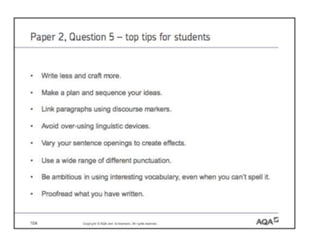
STRATEGY: Q5 on P1
1) Do this questions first so that you have the full time. If you
want to skim read the text to give you some ideas, then do.
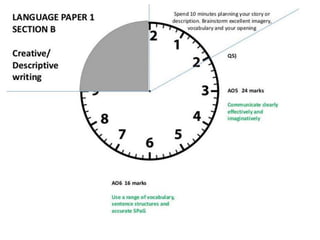
2) Spend 8-10 minutes planning - write this on your paper. For
narrative, decide what will happen in the beginning (set up the
character/s, the location, the problem), in the middle (develop
character, location, explore the problem in more detail) and
end (how will you leave it? what resolution? what twist? what
enigma?)
3) Decide what crafted sentences you will use - what hook to
open your story? where can you use sentences giving you a
range of punctuation? where can you use appropriate
metaphors and personification?
4) Write a sentence - read it back. Write another sentence - read
them both back. Write another sentence - read everything you
have written. Keep doing this and edit as you write 2 ½ sides -
NO MORE! Take the time to do it well.
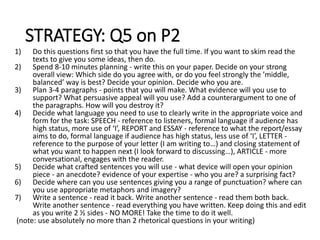
STRATEGY: Q5 on P2
1) Do this questions first so that you have the full time. If you want to skim read the
texts to give you some ideas, then do.
2) Spend 8-10 minutes planning - write this on your paper. Decide on your strong
overall view: Which side do you agree with, or do you feel strongly the ’middle,
balanced’ way is best? Decide your opinion. Decide who you are.
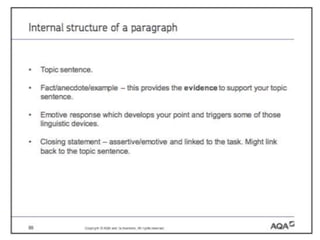
3) Plan 3-4 paragraphs - points that you will make. What evidence will you use to
support? What persuasive appeal will you use? Add a counterargument to one of
the paragraphs. How will you destroy it?
4) Decide what language you need to use to clearly write in the appropriate voice and
form for the task: SPEECH - reference to listeners, formal language if audience has
high status, more use of ‘I’, REPORT and ESSAY - reference to what the report/essay
aims to do, formal language if audience has high status, less use of ‘I’, LETTER -
reference to the purpose of your letter (I am writing to…) and closing statement of
what you want to happen next (I look forward to discussing…), ARTICLE - more
conversational, engages with the reader.
5) Decide what crafted sentences you will use - what device will open your opinion
piece - an anecdote? evidence of your expertise - who you are? a surprising fact?
6) Decide where can you use sentences giving you a range of punctuation? where can
you use appropriate metaphors and imagery?
7) Write a sentence - read it back. Write another sentence - read them both back.
Write another sentence - read everything you have written. Keep doing this and edit
as you write 2 ½ sides - NO MORE! Take the time to do it well.
(note: use absolutely no more than 2 rhetorical questions in your writing)
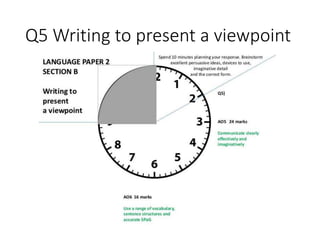
Q5 Writing to present a viewpoint
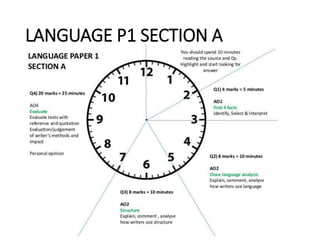
LANGUAGE P1 SECTION A
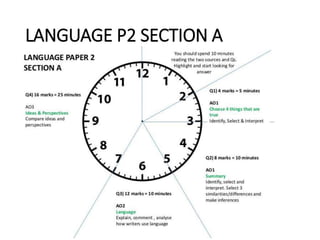
LANGUAGE P2 SECTION A
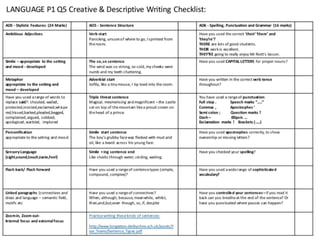
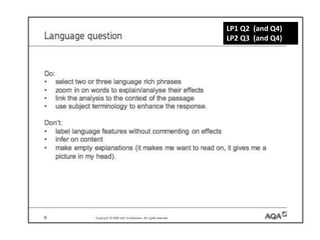
LP1 Q2 (and Q4)
LP2 Q3 (and Q4)
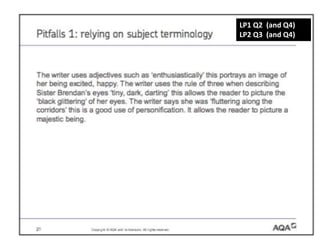
LP1 Q2 (and Q4)
LP2 Q3 (and Q4)
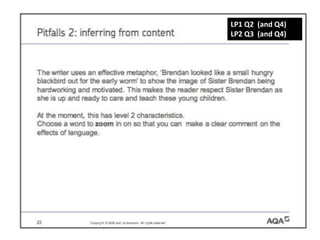
LP1 Q2 (and Q4)
LP2 Q3 (and Q4)
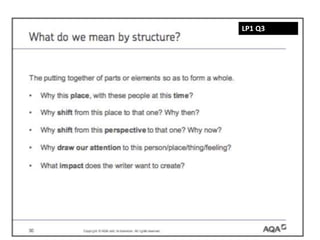
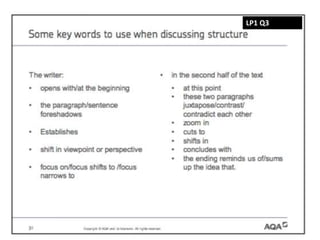
LP1 Q3
LP1 Q3
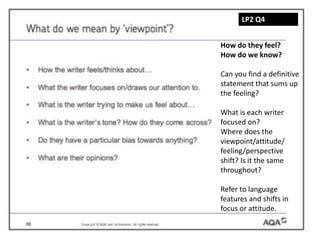
LP2 Q4
How do they feel?
How do we know?
Can you find a definitive
statement that sums up
the feeling?
What is each writer
focused on?
Where does the
viewpoint/attitude/
feeling/perspective
shift? Is it the same
throughout?
Refer to language
features and shifts in
focus or attitude.

Revision Language P1 and P2 2018

  • 1.
    Language P1 and2 TUESDAY 5th June FRIDAY 8th June
  • 2.
    STRATEGY: Q5 onP1 1) Do this questions first so that you have the full time. If you want to skim read the text to give you some ideas, then do. 2) Spend 8-10 minutes planning - write this on your paper. For narrative, decide what will happen in the beginning (set up the character/s, the location, the problem), in the middle (develop character, location, explore the problem in more detail) and end (how will you leave it? what resolution? what twist? what enigma?) 3) Decide what crafted sentences you will use - what hook to open your story? where can you use sentences giving you a range of punctuation? where can you use appropriate metaphors and personification? 4) Write a sentence - read it back. Write another sentence - read them both back. Write another sentence - read everything you have written. Keep doing this and edit as you write 2 ½ sides - NO MORE! Take the time to do it well.
  • 9.
    STRATEGY: Q5 onP2 1) Do this questions first so that you have the full time. If you want to skim read the texts to give you some ideas, then do. 2) Spend 8-10 minutes planning - write this on your paper. Decide on your strong overall view: Which side do you agree with, or do you feel strongly the ’middle, balanced’ way is best? Decide your opinion. Decide who you are. 3) Plan 3-4 paragraphs - points that you will make. What evidence will you use to support? What persuasive appeal will you use? Add a counterargument to one of the paragraphs. How will you destroy it? 4) Decide what language you need to use to clearly write in the appropriate voice and form for the task: SPEECH - reference to listeners, formal language if audience has high status, more use of ‘I’, REPORT and ESSAY - reference to what the report/essay aims to do, formal language if audience has high status, less use of ‘I’, LETTER - reference to the purpose of your letter (I am writing to…) and closing statement of what you want to happen next (I look forward to discussing…), ARTICLE - more conversational, engages with the reader. 5) Decide what crafted sentences you will use - what device will open your opinion piece - an anecdote? evidence of your expertise - who you are? a surprising fact? 6) Decide where can you use sentences giving you a range of punctuation? where can you use appropriate metaphors and imagery? 7) Write a sentence - read it back. Write another sentence - read them both back. Write another sentence - read everything you have written. Keep doing this and edit as you write 2 ½ sides - NO MORE! Take the time to do it well. (note: use absolutely no more than 2 rhetorical questions in your writing)
  • 10.
    Q5 Writing topresent a viewpoint
  • 14.
  • 15.
  • 16.
    LP1 Q2 (andQ4) LP2 Q3 (and Q4)
  • 17.
    LP1 Q2 (andQ4) LP2 Q3 (and Q4)
  • 18.
    LP1 Q2 (andQ4) LP2 Q3 (and Q4)
  • 19.
  • 20.
  • 21.
    LP2 Q4 How dothey feel? How do we know? Can you find a definitive statement that sums up the feeling? What is each writer focused on? Where does the viewpoint/attitude/ feeling/perspective shift? Is it the same throughout? Refer to language features and shifts in focus or attitude.