English/ English Language Exam Higher
       What you need to know
Two sections to the Exam
       Unit 1 - Reading
       Unit 2 - Writing
Unit 1 – Reading
There are three reading sources on which the
 questions are based. All three reading sources
 are used in the exam and all three are „unseen‟.
 There are four questions.
The Unit 1 Assessment Objectives
(AO2) are:
II. Read and understand texts, selecting material
  appropriate to purpose, collating from different
  sources and making comparisons and cross-
  references as appropriate.
III. Explain and evaluate how writers use
  linguistic, grammatical, structural and
  presentational features to achieve effects and
  engage and influence the reader, supporting
  their comments with detailed textual references.
The Unit 1 Assessment Objectives
(AO2) are:
II. Read and understand texts, selecting material
  appropriate to purpose, collating from
  different sources and making comparisons
  and cross-references as appropriate.
III. Explain and evaluate how writers use
  linguistic, grammatical, structural and
  presentational features to achieve effects
  and engage and influence the
  reader, supporting their comments with
  detailed textual references.
Q1 – 8 marks
Question 1 refers to the first source, called Item
 1, and will test the candidates‟ ability to retrieve
 information and ideas from the source text.

What the examiners are looking for:
“information/understanding/inference”
Q1 – 8 marks
Question 1 refers to the first source, called Item
 1, and will test the candidates‟ ability to
 retrieve information and ideas from the
 source text.

What the examiners are looking for:
“Information/understanding/inference”
Reading Skill   Select appropriate information and show
     1                       understanding
Example Q1


Note: it doesn‟t tell you you need to include a
 direct reference but you must.
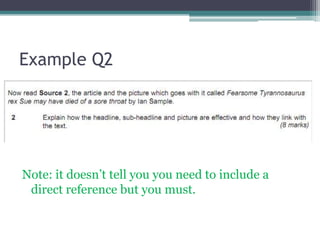
Q2 - 8 marks
Question 2 refers to the second of the
 sources, called Item 2, and will test candidates‟
 ability to understand and interpret
 presentational          features      such    as
 headline, sub-headline, pictures and captions
 from the source text. (AO2iii)
Q2 - 8 marks
When       thinking      about    the uses   of
  presentational and linguistic devices, you
  should have in mind the following:
- the need to make a direct reference or
  quotation to illustrate the device
- the need to explain why they think the writer
  has used the device (purpose)
- the need to explain or analyse the effect that
  the use of the device has on the reader
  (audience)
                            PEE+
Q2
What the examiners say:
“Q2 is about linking presentational aspects
 to the texts so do some work on pictures
 and headlines and captions”


Reading Skill
     2
                Understand and interpret (PEE+)
Example Q2


Note: it doesn‟t tell you you need to include a
 direct reference but you must.
Q3 – 8 marks
Question 3 refers to the third source, called Item
 3, and will test the candidates‟ ability to
 understand and interpret meaning in
 the source text.
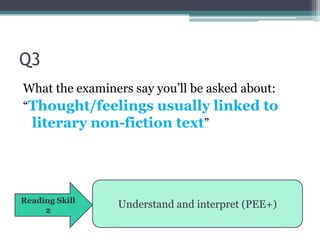
Q3
What the examiners say you‟ll be asked about:
“Thought/feelings usually linked to
 literary non-fiction text”


Reading Skill
     2
                Understand and interpret (PEE+)
Q3 Example


             USE QUOTES!
Q4 – 16 marks

Question 4 refers to the third source together with
 one of the other sources chosen by the candidate.
 This tests the candidates‟ ability to compare
 the effectiveness of language used by the
 writers in the source texts.
Q4
What the examiners say:
“Q4 is the comparative element and
  here the comparison is between the
  language features of two of the
  sources”

Reading Skill
     3
                Understand, interpret and compare
Q4 Example
Q4 - 16 marks (like Q2)
When       thinking      about    the uses   of
  presentational and linguistic devices, you
  should have in mind the following:
- the need to make a direct reference or
  quotation to illustrate the device
- the need to explain why they think the writer
  has used the device (purpose)
- the need to explain or analyse the effect that
  the use of the device has on the reader
  (audience)
The Essentials...
• read the entire question paper through once
• read each source text a second time before attempting to
  write an answer
• note the allocation of marks – some questions carry
  more marks than others
• allocate time; rushed or unfinished answers will lose
  marks
• focus your response on the question which is actually
  being asked
• present your own comments, explanations and analysis
  about the texts in your answers
• support all of their ideas with appropriate quotations
  from the text, making sure they quote in full.
Mark Scheme
Band 1, 1-2 marks, key word: Limited.
Candidates whose answer falls within this band will
  have shown limited engagement with the
  texts, limited ability to interpret meaning and will
  have been unable to support their views with helpful
  quotations.
Band 2, 3-4 marks, key words: Some, Attempts.
In this mark band candidates will have shown some
  evidence that the texts are understood and will have
  attempted to support their views with references and
  quotations. They will have attempted to interpret
  meaning, explain ideas and words and made some
  comparisons between the texts for question 4.
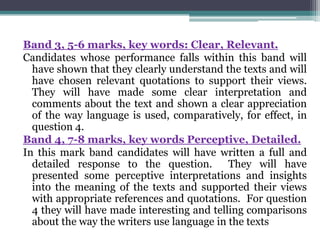
Band 3, 5-6 marks, key words: Clear, Relevant.
Candidates whose performance falls within this band will
  have shown that they clearly understand the texts and will
  have chosen relevant quotations to support their views.
  They will have made some clear interpretation and
  comments about the text and shown a clear appreciation
  of the way language is used, comparatively, for effect, in
  question 4.
Band 4, 7-8 marks, key words Perceptive, Detailed.
In this mark band candidates will have written a full and
  detailed response to the question.        They will have
  presented some perceptive interpretations and insights
  into the meaning of the texts and supported their views
  with appropriate references and quotations. For question
  4 they will have made interesting and telling comparisons
  about the way the writers use language in the texts
Writing
          Section B 1 hour

          Two Questions

          Q1 – 25 minutes
          Q2 – 35 minutes
How the Paper is structured
• the first writing question is focused on writing
  to inform, explain or describe (not a choice)
                      16 Marks
• the second writing question is focused on writing
  to persuade or to argue a point of view
                      24 Marks
You are marked on
• Content – what you‟ve got in it

• Organisation – how you‟ve structured it

• Accuracy – range of sentences correctly
  punctuated
Writing
For each writing question two thirds of marks
 available are allocated for Content and
 Organisation.
The remaining one third of marks is allocated for
 Accuracy.
The Assessment Objectives are:

I. Communicate clearly, effectively and
  imaginatively, using and adapting forms and
  selecting vocabulary appropriate to task and
  purpose in ways which engage the reader
II. Organise information and ideas into structured
  and sequenced sentences, paragraphs and whole
  texts, using a variety of linguistic and structural
  features to support cohesion and overall coherence
III. Use a range of sentence structures for
  clarity, purpose and effect, with accurate
  punctuation and spelling
The Assessment Objectives are:

I. Communicate clearly, effectively and
  imaginatively, using and adapting forms and
  selecting vocabulary appropriate to task and
  purpose in ways which engage the reader
II. Organise information and ideas into structured
  and sequenced sentences, paragraphs and
  whole texts, using a variety of linguistic and
  structural features to support cohesion and
  overall coherence
III. Use a range of sentence structures for
  clarity, purpose and effect, with accurate
  punctuation and spelling
Q1 in Section B: an example
Q2 in Section B: an example
Essential information:
 • read both questions through carefully and
   understand what is being asked
 • Consider who is the audience or reader
 • note that Question 1 earns a possible 16
   marks, Question 2 earns 24 so allocate time
   carefully between the questions, including time for
   planning
 • remember that there are three ways to get marks;
   content, organisation, accuracy
 • decide on the voice, register, tone of the writing and
   keep it going, this might be different for each
   question
 • make a plan for each piece of writing, paragraph by
   paragraph, including a conclusion.

Language exam higher

  • 1.
    English/ English LanguageExam Higher What you need to know
  • 2.
    Two sections tothe Exam Unit 1 - Reading Unit 2 - Writing
  • 3.
    Unit 1 –Reading There are three reading sources on which the questions are based. All three reading sources are used in the exam and all three are „unseen‟. There are four questions.
  • 4.
    The Unit 1Assessment Objectives (AO2) are: II. Read and understand texts, selecting material appropriate to purpose, collating from different sources and making comparisons and cross- references as appropriate. III. Explain and evaluate how writers use linguistic, grammatical, structural and presentational features to achieve effects and engage and influence the reader, supporting their comments with detailed textual references.
  • 5.
    The Unit 1Assessment Objectives (AO2) are: II. Read and understand texts, selecting material appropriate to purpose, collating from different sources and making comparisons and cross-references as appropriate. III. Explain and evaluate how writers use linguistic, grammatical, structural and presentational features to achieve effects and engage and influence the reader, supporting their comments with detailed textual references.
  • 6.
    Q1 – 8marks Question 1 refers to the first source, called Item 1, and will test the candidates‟ ability to retrieve information and ideas from the source text. What the examiners are looking for: “information/understanding/inference”
  • 7.
    Q1 – 8marks Question 1 refers to the first source, called Item 1, and will test the candidates‟ ability to retrieve information and ideas from the source text. What the examiners are looking for: “Information/understanding/inference” Reading Skill Select appropriate information and show 1 understanding
  • 8.
    Example Q1 Note: itdoesn‟t tell you you need to include a direct reference but you must.
  • 9.
    Q2 - 8marks Question 2 refers to the second of the sources, called Item 2, and will test candidates‟ ability to understand and interpret presentational features such as headline, sub-headline, pictures and captions from the source text. (AO2iii)
  • 10.
    Q2 - 8marks When thinking about the uses of presentational and linguistic devices, you should have in mind the following: - the need to make a direct reference or quotation to illustrate the device - the need to explain why they think the writer has used the device (purpose) - the need to explain or analyse the effect that the use of the device has on the reader (audience) PEE+
  • 11.
    Q2 What the examinerssay: “Q2 is about linking presentational aspects to the texts so do some work on pictures and headlines and captions” Reading Skill 2 Understand and interpret (PEE+)
  • 12.
    Example Q2 Note: itdoesn‟t tell you you need to include a direct reference but you must.
  • 13.
    Q3 – 8marks Question 3 refers to the third source, called Item 3, and will test the candidates‟ ability to understand and interpret meaning in the source text.
  • 14.
    Q3 What the examinerssay you‟ll be asked about: “Thought/feelings usually linked to literary non-fiction text” Reading Skill 2 Understand and interpret (PEE+)
  • 15.
    Q3 Example USE QUOTES!
  • 16.
    Q4 – 16marks Question 4 refers to the third source together with one of the other sources chosen by the candidate. This tests the candidates‟ ability to compare the effectiveness of language used by the writers in the source texts.
  • 17.
    Q4 What the examinerssay: “Q4 is the comparative element and here the comparison is between the language features of two of the sources” Reading Skill 3 Understand, interpret and compare
  • 18.
  • 19.
    Q4 - 16marks (like Q2) When thinking about the uses of presentational and linguistic devices, you should have in mind the following: - the need to make a direct reference or quotation to illustrate the device - the need to explain why they think the writer has used the device (purpose) - the need to explain or analyse the effect that the use of the device has on the reader (audience)
  • 20.
    The Essentials... • readthe entire question paper through once • read each source text a second time before attempting to write an answer • note the allocation of marks – some questions carry more marks than others • allocate time; rushed or unfinished answers will lose marks • focus your response on the question which is actually being asked • present your own comments, explanations and analysis about the texts in your answers • support all of their ideas with appropriate quotations from the text, making sure they quote in full.
  • 21.
    Mark Scheme Band 1,1-2 marks, key word: Limited. Candidates whose answer falls within this band will have shown limited engagement with the texts, limited ability to interpret meaning and will have been unable to support their views with helpful quotations. Band 2, 3-4 marks, key words: Some, Attempts. In this mark band candidates will have shown some evidence that the texts are understood and will have attempted to support their views with references and quotations. They will have attempted to interpret meaning, explain ideas and words and made some comparisons between the texts for question 4.
  • 22.
    Band 3, 5-6marks, key words: Clear, Relevant. Candidates whose performance falls within this band will have shown that they clearly understand the texts and will have chosen relevant quotations to support their views. They will have made some clear interpretation and comments about the text and shown a clear appreciation of the way language is used, comparatively, for effect, in question 4. Band 4, 7-8 marks, key words Perceptive, Detailed. In this mark band candidates will have written a full and detailed response to the question. They will have presented some perceptive interpretations and insights into the meaning of the texts and supported their views with appropriate references and quotations. For question 4 they will have made interesting and telling comparisons about the way the writers use language in the texts
  • 23.
    Writing Section B 1 hour Two Questions Q1 – 25 minutes Q2 – 35 minutes
  • 24.
    How the Paperis structured • the first writing question is focused on writing to inform, explain or describe (not a choice) 16 Marks • the second writing question is focused on writing to persuade or to argue a point of view 24 Marks
  • 25.
    You are markedon • Content – what you‟ve got in it • Organisation – how you‟ve structured it • Accuracy – range of sentences correctly punctuated
  • 26.
    Writing For each writingquestion two thirds of marks available are allocated for Content and Organisation. The remaining one third of marks is allocated for Accuracy.
  • 27.
    The Assessment Objectivesare: I. Communicate clearly, effectively and imaginatively, using and adapting forms and selecting vocabulary appropriate to task and purpose in ways which engage the reader II. Organise information and ideas into structured and sequenced sentences, paragraphs and whole texts, using a variety of linguistic and structural features to support cohesion and overall coherence III. Use a range of sentence structures for clarity, purpose and effect, with accurate punctuation and spelling
  • 28.
    The Assessment Objectivesare: I. Communicate clearly, effectively and imaginatively, using and adapting forms and selecting vocabulary appropriate to task and purpose in ways which engage the reader II. Organise information and ideas into structured and sequenced sentences, paragraphs and whole texts, using a variety of linguistic and structural features to support cohesion and overall coherence III. Use a range of sentence structures for clarity, purpose and effect, with accurate punctuation and spelling
  • 29.
    Q1 in SectionB: an example
  • 30.
    Q2 in SectionB: an example
  • 31.
    Essential information: •read both questions through carefully and understand what is being asked • Consider who is the audience or reader • note that Question 1 earns a possible 16 marks, Question 2 earns 24 so allocate time carefully between the questions, including time for planning • remember that there are three ways to get marks; content, organisation, accuracy • decide on the voice, register, tone of the writing and keep it going, this might be different for each question • make a plan for each piece of writing, paragraph by paragraph, including a conclusion.