International Journal of Scientific Research and Engineering Development-– Volume 2 Issue 5, Sep – Oct 2019
Available at www.ijsred.com
ISSN : 2581-7175 ©IJSRED: All Rights are Reserved Page 848
Review Grid Connected Wind Photovoltaic Cogeneration Using
Back to Back Voltage Source Converters
Navin Vamne Pramod Kumar Rathore A.K.Jhala
M.Tech Student Professor Associate Professor
Electrical & Electronics Engineering
Department
Electrical & Electronics Engineering
Department
Electrical & Electronics Engineering
Department
RKDF College of Engineering, Bhopal, M.P. RKDF College of Engineering, Bhopal,
M.P.
RKDF College of Engineering, Bhopal,
M.P.
Abstract:
With developing concerns, in renewable energy sources can improve which is an increasing amount. This paper reviews both
the vitality of the wind and the photovoltaic (PV) energy conversion strategies. and theirmaximum-power-point tracking
(MPPT) methods.Then, a new Grid tied wind–PV cogeneration generation using back to back voltage source converters
system is proposed.For the wind power generationpermanent-magnet synchronous machine is used to capture the maximum
wind power byusing optimum speed control. For the PV power generation boost converter is adopted to harnessthe
maximum solar power by tuning the duty cycle. Simulation validations are providing to fiancée of proposed system.
Keywords:-Boost Converter, Controller, MPPT, Solar Power System, Wind energy, utility Grid and Voltage Source Inverter
I. INTRODUCTION
Because of the preferences of nature natural energy
sources practically no pollutants, renewable energy
wellsprings need pulled in broad consideration. Wind energy
is a standout amongst the renewable energy guaranteeing
clean energy sources on account of it might be effectively
caught toward a wind generator for delivering power into
electric energy. Photovoltaic (PV) control is an alternate
guaranteeing clean energy wellspring a result it will be
worldwide Furthermore could a chance to be utilized
without utilizing a rotational generator. Clinched alongside
fact, wind energy the more PV control need aid to some
degree reciprocal Similarly as solid winds happen basically
toward evening and shady days same time sunny days need
aid frequently cool for powerless winds [1].
To change over wind energy to electrical energy,
two type of wind turbines need aid employed; altered
variable velocity wind turbines introduced or Fixed velocity
[4]. Fixed speed wind turbines, the control generator is
straightforwardly associated with the control grid. Therefore,
the generator works during an consistent recurrence What's
more pace. Those dynamic Furthermore sensitive force
control from claiming these turbines may be portrayed
in control [5, 6]. Variable pace wind turbine (VSWT)
will be utilized for more excellent fascination of vitality
starting with wind. VSWT, which attracts.
10–15% more energy, has lower mechanical
stress and less power fluctuation in comparison with the
fixed speed ones. To addition, wind turbines are
separated under two significant classes:horizontal wind
turbines and vertical, more Sherbious are those
practically popular verticalaxis wind turbines (VAWT).
Those air motion facilitating effectiveness of the VAWT
will be more level over that of the level of horizontal yet
the multifaceted nature Furthermore cost for these is
low [7].
A standout amongst those the greater part
significant investigations in the VSWT is the requisition
about Different control schemes for a few purposes in
the plant. There need aid some techniques with control
VSWT. These systems would used to track those
greatest power, will control those voltage Also
RESEARCH ARTICLE OPEN ACCESS
International Journal of Scientific Research and Engineering Development-– Volume 2 Issue 5, Sep – Oct 2019
Available at www.ijsred.com
ISSN : 2581-7175 ©IJSRED: All Rights are Reserved Page 849
recurrence of the load Also diminish control variance [8–
10]. Pitch control is a system will control concentrated
starting with the VSWT [11]. Most extreme energy
fascination starting with those VSWT may be attained
utilizing straight control; fuzzy logic control furthermorehill
claim searching (HCS) strategy [12–15].
Due to efficient and economical utilization of
renewable energies, some of renewable energy resources such as
wind turbine and solar array are integrated [16]. Because of
dependency on wind speed and sun irradiance in such systems,
their reliability in satisfying the load demands decreases under
all conditions. Hence, some studies propose the combination of
a diesel generator as a back up and wind/solar power generation
systems [17, 18].
This effectiveness expansion of the PV energy
preparing system will be futile In the MPPT control doesn't
guarantee that greatest energy may be concentrated starting
with those PV array, both toward an enduring state and under
fluctuating climatic states. In fact, the total efficiency of the
power processing system is almost the product of the
conversion efficiencies, which must be maximized by taking
into account the extremely variable operating conditions
throughout the day [19] as well as the MPPT efficiency.
There are multiple MPPT techniques [20] that could
be compared using different criteria (Table 1). The main
techniques are dP/dV or dP/dI feedback control, incremental
conductance (IncCond), and hill climbing {or perturbation–
observation (P&O)}.
Table 1
MPPT Comparision for Photovoltaic System
On photovoltaic framework a front-end support
converter will be by and large obliged toward the enter
about inverter will match the load prerequisites.
Previously, such DC-AC alternately DC-DC AC energy
converters, there will be An likelihood for concurrent
exchanging from claiming switches (IGBTs/MOSFETs)
of the same leg(s) from claiming inverter because of
EMI effect, inappropriate terminating of switches,
aggravation out breaking and nonattendance of cross-
conduction security inside the gate-drivers itself and so
on. This prompts shorting from claiming wellspring
alternately dc connection capacitor through the
shortedleg(s) of inverter, causing a large current flow
and damage tothe system. A voltage source inverter is
one of the examples.
Proposed system is designed for maximum
energy captured from the wind turbine / solar array and
deliver to utility grid. This paper is organized as
follows: descriptionof the proposed system is illustrated
in Section 3. Section 4 describesthe control system
design. Optimal design and economicanalysis is fulfilled
in Section 5. Simulation results and discussionare
presented in Section 6. Section 7 is the conclusions
II. PROPOSED SYSTEM DESCRIPTION
The proposed hybrid energy generation system is
depicted inFig. 1. This system consists of a horizontal
axis and variable speedwind turbine, a solar array,
permanent magnet synchronous generators, sinusoidal
pulse width modulation (SPWM)converters, DC/DC
converters, an adaptive feedback linearizationcontroller,
Fig. 1 Proposed System modeling
International Journal of Scientific Research and Engineering Development-– Volume 2 Issue 5, Sep – Oct 2019
Available at www.ijsred.com
ISSN : 2581-7175 ©IJSRED: All Rights are Reserved Page 850
III. MPPT CONTROL FOR SOLAR ENERGY
CONVERSION SYSTEM
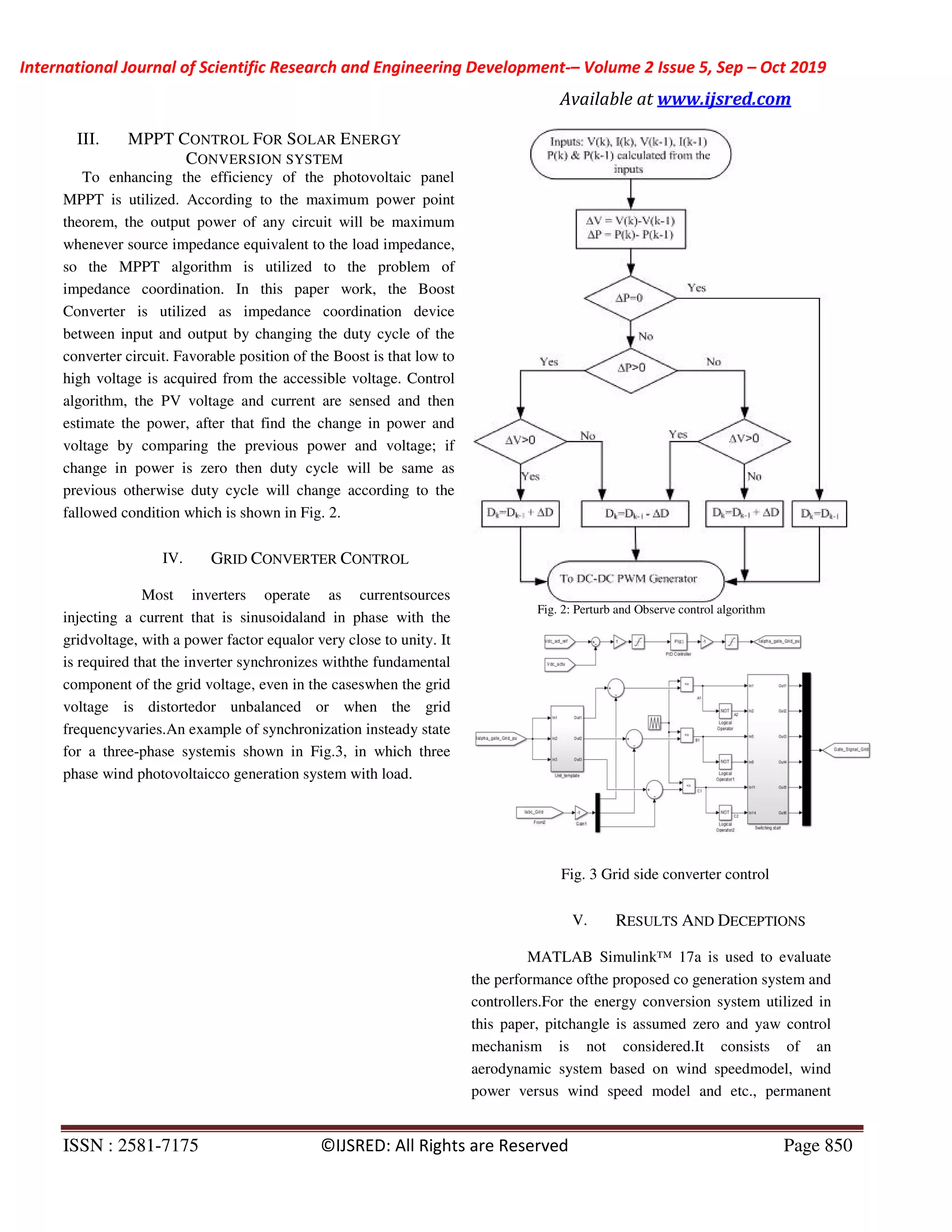
To enhancing the efficiency of the photovoltaic panel
MPPT is utilized. According to the maximum power point
theorem, the output power of any circuit will be maximum
whenever source impedance equivalent to the load impedance,
so the MPPT algorithm is utilized to the problem of
impedance coordination. In this paper work, the Boost
Converter is utilized as impedance coordination device
between input and output by changing the duty cycle of the
converter circuit. Favorable position of the Boost is that low to
high voltage is acquired from the accessible voltage. Control
algorithm, the PV voltage and current are sensed and then
estimate the power, after that find the change in power and
voltage by comparing the previous power and voltage; if
change in power is zero then duty cycle will be same as
previous otherwise duty cycle will change according to the
fallowed condition which is shown in Fig. 2.
IV. GRID CONVERTER CONTROL
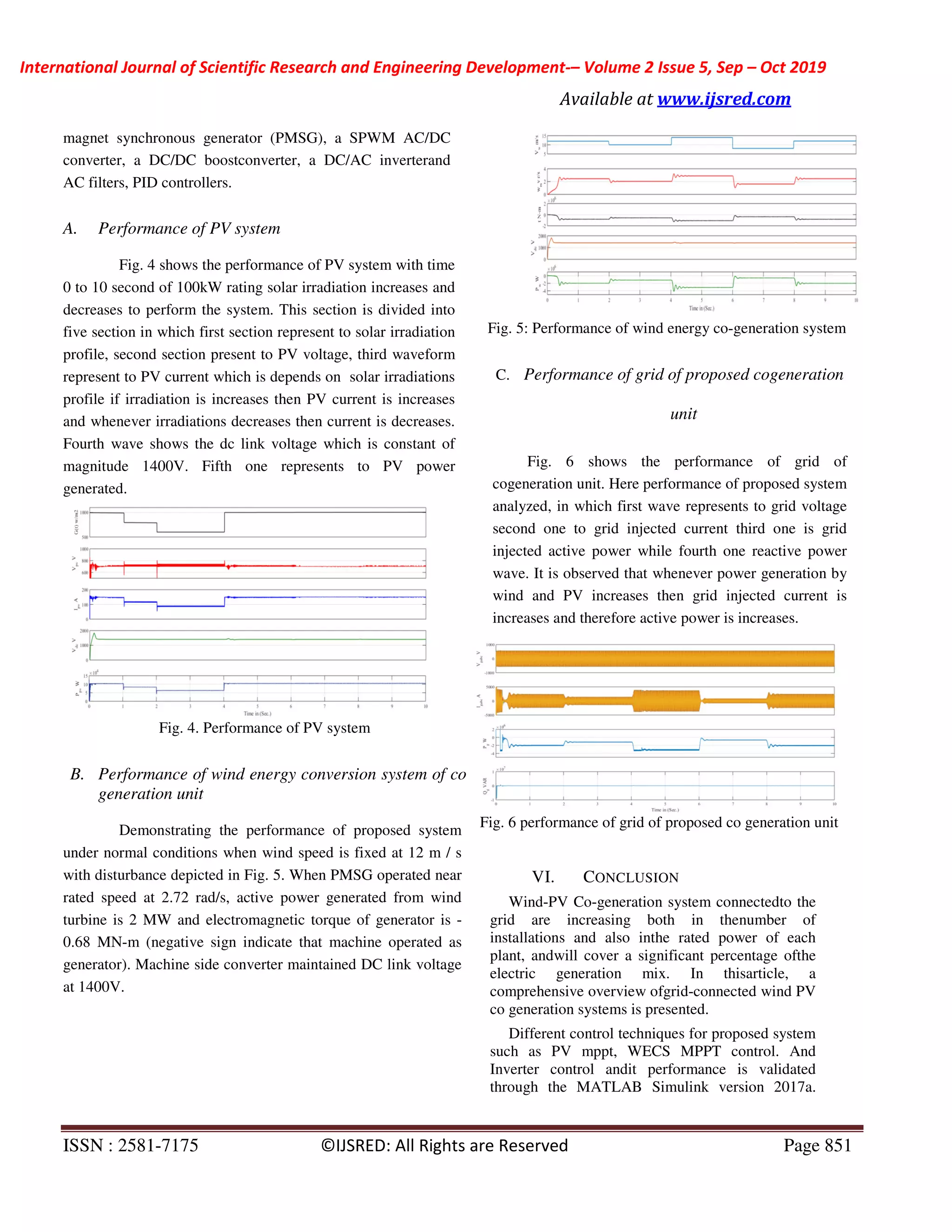
Most inverters operate as currentsources
injecting a current that is sinusoidaland in phase with the
gridvoltage, with a power factor equalor very close to unity. It
is required that the inverter synchronizes withthe fundamental
component of the grid voltage, even in the caseswhen the grid
voltage is distortedor unbalanced or when the grid
frequencyvaries.An example of synchronization insteady state
for a three-phase systemis shown in Fig.3, in which three
phase wind photovoltaicco generation system with load.
Fig. 2: Perturb and Observe control algorithm
Fig. 3 Grid side converter control
V. RESULTS AND DECEPTIONS
MATLAB Simulink™ 17a is used to evaluate
the performance ofthe proposed co generation system and
controllers.For the energy conversion system utilized in
this paper, pitchangle is assumed zero and yaw control
mechanism is not considered.It consists of an
aerodynamic system based on wind speedmodel, wind
power versus wind speed model and etc., permanent
International Journal of Scientific Research and Engineering Development-– Volume 2 Issue 5, Sep – Oct 2019
Available at www.ijsred.com
ISSN : 2581-7175 ©IJSRED: All Rights are Reserved Page 851
magnet synchronous generator (PMSG), a SPWM AC/DC
converter, a DC/DC boostconverter, a DC/AC inverterand
AC filters, PID controllers.
A. Performance of PV system
Fig. 4 shows the performance of PV system with time
0 to 10 second of 100kW rating solar irradiation increases and
decreases to perform the system. This section is divided into
five section in which first section represent to solar irradiation
profile, second section present to PV voltage, third waveform
represent to PV current which is depends on solar irradiations
profile if irradiation is increases then PV current is increases
and whenever irradiations decreases then current is decreases.
Fourth wave shows the dc link voltage which is constant of
magnitude 1400V. Fifth one represents to PV power
generated.
Fig. 4. Performance of PV system
B. Performance of wind energy conversion system of co
generation unit
Demonstrating the performance of proposed system
under normal conditions when wind speed is fixed at 12 m / s
with disturbance depicted in Fig. 5. When PMSG operated near
rated speed at 2.72 rad/s, active power generated from wind
turbine is 2 MW and electromagnetic torque of generator is -
0.68 MN-m (negative sign indicate that machine operated as
generator). Machine side converter maintained DC link voltage
at 1400V.
Fig. 5: Performance of wind energy co-generation system
C. Performance of grid of proposed cogeneration
unit
Fig. 6 shows the performance of grid of
cogeneration unit. Here performance of proposed system
analyzed, in which first wave represents to grid voltage
second one to grid injected current third one is grid
injected active power while fourth one reactive power
wave. It is observed that whenever power generation by
wind and PV increases then grid injected current is
increases and therefore active power is increases.
Fig. 6 performance of grid of proposed co generation unit
VI. CONCLUSION
Wind-PV Co-generation system connectedto the
grid are increasing both in thenumber of
installations and also inthe rated power of each
plant, andwill cover a significant percentage ofthe
electric generation mix. In thisarticle, a
comprehensive overview ofgrid-connected wind PV
co generation systems is presented.
Different control techniques for proposed system
such as PV mppt, WECS MPPT control. And
Inverter control andit performance is validated
through the MATLAB Simulink version 2017a.
International Journal of Scientific Research and Engineering Development-– Volume 2 Issue 5, Sep – Oct 2019
Available at www.ijsred.com
ISSN : 2581-7175 ©IJSRED: All Rights are Reserved Page 852
Grid side converter control is done to grid
synchronization with power (active and reactive)
control.
REFERENCES
[1] Y.-M. Cheng, Y.-C. Liu, S.-C. Hung, and C.-S. Cheng,
“Multi-input inverter for grid-connected hybrid PV/wind
power system,” IEEE Trans. Power Electron., vol. 22, no. 3,
pp. 1070–1076, May 2007.
[2] Snyder Brian, Kaiser Mark J. A comparison of offshore
wind power development in Europe and the US: patterns
and drivers of development. Appl Energy 2009:1845–56.
[3] KrichenLotfi, Francois Bruno, OualiAbderrazak. A fuzzy
logic supervisory for active and reactive power control of a
fixed speed wind energy conversion system. Electric Power
Syst Res 2007.
[4] Kamoji MA, Kedare SB, Prabhu SV. Experimental
investigations on single stage modified Savonius rotor. Appl
Energy 2009:1064–73.
[5] De Almeida Rogerio G, Castronuovo Edgardo D, Lopes JA.
Optimum generation control in wind parks when carrying out
system operator request. IEEE Trans Power Syst 2006.
[6] Tapia A, Tapia G, Ostolaza JX. Reactive power control of
wind farms for voltage control applications. Renew Energy
2004.
[7] ThirigerTorbojorn, Linders J. Control by variable rotor speed
of a fixed pitch wind turbine operation in a wide speed range.
IEEE Trans Energy Convers 1993;8(3):520–6.
[8] Nagai Baku M, AmekuKazumasa, Roy JitendroNath.
Performance of a 3 kW wind turbine generator with variable
pitch control system. Appl Energy 2009:1774–82.
[9] Simoes Marcelo Godoy, Bose Bimal K, Spiegel Roland J.
Fuzzy logic based intelligent control of a variable speed cage
machine wind generation system. IEEE Trans Power Electron
1997;12(1).
[10] Hilloowala Robin M. Rule based fuzzy logic control for a
PWM inverter in a stand-alone wind energy conversion
scheme. IEEE Trans IndAppl 1996:57–65.
[11] ChedidZriad B, Karaki Sami H, El-ChamaliChadi. Adaptive
fuzzy control for wind-diesel weak power system. IEEE Trans
Energy Convers 2000;15(1).
[12] Tanaka T, Toumiya T. Output control by hill-climbing method
for a small wind power generation system. Renew Energy
1997;12(4):389–400.
[13] Tina G, Gagliano S, Raiti S. Hybrid solar/wind power system
probabilistic modeling for long term performance assessment.
Solar Energy 2006;80: 578–88.
[14] S. Pradhan, B. Singh and B. K. Panigrahi, “A Digital
Disturbance Estimator (DDE) for Multiobjective Grid
Connected Solar PV Based Distributed Generating
System,” IEEE Trans. Ind. Appl., vol. 54, no. 5, pp. 5318-
5330, Sept.-Oct. 2018.
[15] Kalantar M, Tripathy SC, Balasubramanian R. Dynamic
and stability of wind and diesel turbine generators with
superconducting magnetic energy storage unit on an
isolated power system. IEEE Trans Energy Convers
1991:579–85.
[16] S. Yu, L. Zhang, H. H. C. Iu, T. Fernando, and K. P.
Wong, “A DSE-based power system frequency
restoration strategy for PV-Integrated power systems
considering solar irradiance variations,” IEEE Trans. Ind.
Informat., vol. 13, no. 5, pp. 2511–2518, Oct. 2017.
[17] M. A. Elhadidy“Performance evaluation of hybrid
(wind/solar/diesel) power system. Renew Energy”
2002:401–13.
[18] P. Mochi, “Primary Review on MPPT Method and Size of
Grid Connected Solar Photovoltaic Inverter,” 2018 8th
IEEE India International Conference on Power
Electronics (IICPE), JAIPUR, India, 2018, pp. 1-6.
[19] A. A. Elbaset, H. Ali, M. Abd-El Sattar and M. Khaled,
“Implementation of a modified perturb and observe
maximum power point tracking algorithm for photovoltaic
system using an embedded microcontroller,” IET
Renewable Power Gener., vol. 10, no. 4, pp. 551-560,
April 2016.
[20] O. Singh and S. K. Gupta, “A review on recent Mppt
techniques for photovoltaic system,” 2018 IEEMA
Engineer Infinite Conference (eTechNxT), New Delhi,
2018, pp. 1-6

Review Grid Connected Wind Photovoltaic Cogeneration Using Back to Back Voltage Source Converters

  • 1.
    International Journal ofScientific Research and Engineering Development-– Volume 2 Issue 5, Sep – Oct 2019 Available at www.ijsred.com ISSN : 2581-7175 ©IJSRED: All Rights are Reserved Page 848 Review Grid Connected Wind Photovoltaic Cogeneration Using Back to Back Voltage Source Converters Navin Vamne Pramod Kumar Rathore A.K.Jhala M.Tech Student Professor Associate Professor Electrical & Electronics Engineering Department Electrical & Electronics Engineering Department Electrical & Electronics Engineering Department RKDF College of Engineering, Bhopal, M.P. RKDF College of Engineering, Bhopal, M.P. RKDF College of Engineering, Bhopal, M.P. Abstract: With developing concerns, in renewable energy sources can improve which is an increasing amount. This paper reviews both the vitality of the wind and the photovoltaic (PV) energy conversion strategies. and theirmaximum-power-point tracking (MPPT) methods.Then, a new Grid tied wind–PV cogeneration generation using back to back voltage source converters system is proposed.For the wind power generationpermanent-magnet synchronous machine is used to capture the maximum wind power byusing optimum speed control. For the PV power generation boost converter is adopted to harnessthe maximum solar power by tuning the duty cycle. Simulation validations are providing to fiancée of proposed system. Keywords:-Boost Converter, Controller, MPPT, Solar Power System, Wind energy, utility Grid and Voltage Source Inverter I. INTRODUCTION Because of the preferences of nature natural energy sources practically no pollutants, renewable energy wellsprings need pulled in broad consideration. Wind energy is a standout amongst the renewable energy guaranteeing clean energy sources on account of it might be effectively caught toward a wind generator for delivering power into electric energy. Photovoltaic (PV) control is an alternate guaranteeing clean energy wellspring a result it will be worldwide Furthermore could a chance to be utilized without utilizing a rotational generator. Clinched alongside fact, wind energy the more PV control need aid to some degree reciprocal Similarly as solid winds happen basically toward evening and shady days same time sunny days need aid frequently cool for powerless winds [1]. To change over wind energy to electrical energy, two type of wind turbines need aid employed; altered variable velocity wind turbines introduced or Fixed velocity [4]. Fixed speed wind turbines, the control generator is straightforwardly associated with the control grid. Therefore, the generator works during an consistent recurrence What's more pace. Those dynamic Furthermore sensitive force control from claiming these turbines may be portrayed in control [5, 6]. Variable pace wind turbine (VSWT) will be utilized for more excellent fascination of vitality starting with wind. VSWT, which attracts. 10–15% more energy, has lower mechanical stress and less power fluctuation in comparison with the fixed speed ones. To addition, wind turbines are separated under two significant classes:horizontal wind turbines and vertical, more Sherbious are those practically popular verticalaxis wind turbines (VAWT). Those air motion facilitating effectiveness of the VAWT will be more level over that of the level of horizontal yet the multifaceted nature Furthermore cost for these is low [7]. A standout amongst those the greater part significant investigations in the VSWT is the requisition about Different control schemes for a few purposes in the plant. There need aid some techniques with control VSWT. These systems would used to track those greatest power, will control those voltage Also RESEARCH ARTICLE OPEN ACCESS
  • 2.
    International Journal ofScientific Research and Engineering Development-– Volume 2 Issue 5, Sep – Oct 2019 Available at www.ijsred.com ISSN : 2581-7175 ©IJSRED: All Rights are Reserved Page 849 recurrence of the load Also diminish control variance [8– 10]. Pitch control is a system will control concentrated starting with the VSWT [11]. Most extreme energy fascination starting with those VSWT may be attained utilizing straight control; fuzzy logic control furthermorehill claim searching (HCS) strategy [12–15]. Due to efficient and economical utilization of renewable energies, some of renewable energy resources such as wind turbine and solar array are integrated [16]. Because of dependency on wind speed and sun irradiance in such systems, their reliability in satisfying the load demands decreases under all conditions. Hence, some studies propose the combination of a diesel generator as a back up and wind/solar power generation systems [17, 18]. This effectiveness expansion of the PV energy preparing system will be futile In the MPPT control doesn't guarantee that greatest energy may be concentrated starting with those PV array, both toward an enduring state and under fluctuating climatic states. In fact, the total efficiency of the power processing system is almost the product of the conversion efficiencies, which must be maximized by taking into account the extremely variable operating conditions throughout the day [19] as well as the MPPT efficiency. There are multiple MPPT techniques [20] that could be compared using different criteria (Table 1). The main techniques are dP/dV or dP/dI feedback control, incremental conductance (IncCond), and hill climbing {or perturbation– observation (P&O)}. Table 1 MPPT Comparision for Photovoltaic System On photovoltaic framework a front-end support converter will be by and large obliged toward the enter about inverter will match the load prerequisites. Previously, such DC-AC alternately DC-DC AC energy converters, there will be An likelihood for concurrent exchanging from claiming switches (IGBTs/MOSFETs) of the same leg(s) from claiming inverter because of EMI effect, inappropriate terminating of switches, aggravation out breaking and nonattendance of cross- conduction security inside the gate-drivers itself and so on. This prompts shorting from claiming wellspring alternately dc connection capacitor through the shortedleg(s) of inverter, causing a large current flow and damage tothe system. A voltage source inverter is one of the examples. Proposed system is designed for maximum energy captured from the wind turbine / solar array and deliver to utility grid. This paper is organized as follows: descriptionof the proposed system is illustrated in Section 3. Section 4 describesthe control system design. Optimal design and economicanalysis is fulfilled in Section 5. Simulation results and discussionare presented in Section 6. Section 7 is the conclusions II. PROPOSED SYSTEM DESCRIPTION The proposed hybrid energy generation system is depicted inFig. 1. This system consists of a horizontal axis and variable speedwind turbine, a solar array, permanent magnet synchronous generators, sinusoidal pulse width modulation (SPWM)converters, DC/DC converters, an adaptive feedback linearizationcontroller, Fig. 1 Proposed System modeling
  • 3.
    International Journal ofScientific Research and Engineering Development-– Volume 2 Issue 5, Sep – Oct 2019 Available at www.ijsred.com ISSN : 2581-7175 ©IJSRED: All Rights are Reserved Page 850 III. MPPT CONTROL FOR SOLAR ENERGY CONVERSION SYSTEM To enhancing the efficiency of the photovoltaic panel MPPT is utilized. According to the maximum power point theorem, the output power of any circuit will be maximum whenever source impedance equivalent to the load impedance, so the MPPT algorithm is utilized to the problem of impedance coordination. In this paper work, the Boost Converter is utilized as impedance coordination device between input and output by changing the duty cycle of the converter circuit. Favorable position of the Boost is that low to high voltage is acquired from the accessible voltage. Control algorithm, the PV voltage and current are sensed and then estimate the power, after that find the change in power and voltage by comparing the previous power and voltage; if change in power is zero then duty cycle will be same as previous otherwise duty cycle will change according to the fallowed condition which is shown in Fig. 2. IV. GRID CONVERTER CONTROL Most inverters operate as currentsources injecting a current that is sinusoidaland in phase with the gridvoltage, with a power factor equalor very close to unity. It is required that the inverter synchronizes withthe fundamental component of the grid voltage, even in the caseswhen the grid voltage is distortedor unbalanced or when the grid frequencyvaries.An example of synchronization insteady state for a three-phase systemis shown in Fig.3, in which three phase wind photovoltaicco generation system with load. Fig. 2: Perturb and Observe control algorithm Fig. 3 Grid side converter control V. RESULTS AND DECEPTIONS MATLAB Simulink™ 17a is used to evaluate the performance ofthe proposed co generation system and controllers.For the energy conversion system utilized in this paper, pitchangle is assumed zero and yaw control mechanism is not considered.It consists of an aerodynamic system based on wind speedmodel, wind power versus wind speed model and etc., permanent
  • 4.
    International Journal ofScientific Research and Engineering Development-– Volume 2 Issue 5, Sep – Oct 2019 Available at www.ijsred.com ISSN : 2581-7175 ©IJSRED: All Rights are Reserved Page 851 magnet synchronous generator (PMSG), a SPWM AC/DC converter, a DC/DC boostconverter, a DC/AC inverterand AC filters, PID controllers. A. Performance of PV system Fig. 4 shows the performance of PV system with time 0 to 10 second of 100kW rating solar irradiation increases and decreases to perform the system. This section is divided into five section in which first section represent to solar irradiation profile, second section present to PV voltage, third waveform represent to PV current which is depends on solar irradiations profile if irradiation is increases then PV current is increases and whenever irradiations decreases then current is decreases. Fourth wave shows the dc link voltage which is constant of magnitude 1400V. Fifth one represents to PV power generated. Fig. 4. Performance of PV system B. Performance of wind energy conversion system of co generation unit Demonstrating the performance of proposed system under normal conditions when wind speed is fixed at 12 m / s with disturbance depicted in Fig. 5. When PMSG operated near rated speed at 2.72 rad/s, active power generated from wind turbine is 2 MW and electromagnetic torque of generator is - 0.68 MN-m (negative sign indicate that machine operated as generator). Machine side converter maintained DC link voltage at 1400V. Fig. 5: Performance of wind energy co-generation system C. Performance of grid of proposed cogeneration unit Fig. 6 shows the performance of grid of cogeneration unit. Here performance of proposed system analyzed, in which first wave represents to grid voltage second one to grid injected current third one is grid injected active power while fourth one reactive power wave. It is observed that whenever power generation by wind and PV increases then grid injected current is increases and therefore active power is increases. Fig. 6 performance of grid of proposed co generation unit VI. CONCLUSION Wind-PV Co-generation system connectedto the grid are increasing both in thenumber of installations and also inthe rated power of each plant, andwill cover a significant percentage ofthe electric generation mix. In thisarticle, a comprehensive overview ofgrid-connected wind PV co generation systems is presented. Different control techniques for proposed system such as PV mppt, WECS MPPT control. And Inverter control andit performance is validated through the MATLAB Simulink version 2017a.
  • 5.
    International Journal ofScientific Research and Engineering Development-– Volume 2 Issue 5, Sep – Oct 2019 Available at www.ijsred.com ISSN : 2581-7175 ©IJSRED: All Rights are Reserved Page 852 Grid side converter control is done to grid synchronization with power (active and reactive) control. REFERENCES [1] Y.-M. Cheng, Y.-C. Liu, S.-C. Hung, and C.-S. Cheng, “Multi-input inverter for grid-connected hybrid PV/wind power system,” IEEE Trans. Power Electron., vol. 22, no. 3, pp. 1070–1076, May 2007. [2] Snyder Brian, Kaiser Mark J. A comparison of offshore wind power development in Europe and the US: patterns and drivers of development. Appl Energy 2009:1845–56. [3] KrichenLotfi, Francois Bruno, OualiAbderrazak. A fuzzy logic supervisory for active and reactive power control of a fixed speed wind energy conversion system. Electric Power Syst Res 2007. [4] Kamoji MA, Kedare SB, Prabhu SV. Experimental investigations on single stage modified Savonius rotor. Appl Energy 2009:1064–73. [5] De Almeida Rogerio G, Castronuovo Edgardo D, Lopes JA. Optimum generation control in wind parks when carrying out system operator request. IEEE Trans Power Syst 2006. [6] Tapia A, Tapia G, Ostolaza JX. Reactive power control of wind farms for voltage control applications. Renew Energy 2004. [7] ThirigerTorbojorn, Linders J. Control by variable rotor speed of a fixed pitch wind turbine operation in a wide speed range. IEEE Trans Energy Convers 1993;8(3):520–6. [8] Nagai Baku M, AmekuKazumasa, Roy JitendroNath. Performance of a 3 kW wind turbine generator with variable pitch control system. Appl Energy 2009:1774–82. [9] Simoes Marcelo Godoy, Bose Bimal K, Spiegel Roland J. Fuzzy logic based intelligent control of a variable speed cage machine wind generation system. IEEE Trans Power Electron 1997;12(1). [10] Hilloowala Robin M. Rule based fuzzy logic control for a PWM inverter in a stand-alone wind energy conversion scheme. IEEE Trans IndAppl 1996:57–65. [11] ChedidZriad B, Karaki Sami H, El-ChamaliChadi. Adaptive fuzzy control for wind-diesel weak power system. IEEE Trans Energy Convers 2000;15(1). [12] Tanaka T, Toumiya T. Output control by hill-climbing method for a small wind power generation system. Renew Energy 1997;12(4):389–400. [13] Tina G, Gagliano S, Raiti S. Hybrid solar/wind power system probabilistic modeling for long term performance assessment. Solar Energy 2006;80: 578–88. [14] S. Pradhan, B. Singh and B. K. Panigrahi, “A Digital Disturbance Estimator (DDE) for Multiobjective Grid Connected Solar PV Based Distributed Generating System,” IEEE Trans. Ind. Appl., vol. 54, no. 5, pp. 5318- 5330, Sept.-Oct. 2018. [15] Kalantar M, Tripathy SC, Balasubramanian R. Dynamic and stability of wind and diesel turbine generators with superconducting magnetic energy storage unit on an isolated power system. IEEE Trans Energy Convers 1991:579–85. [16] S. Yu, L. Zhang, H. H. C. Iu, T. Fernando, and K. P. Wong, “A DSE-based power system frequency restoration strategy for PV-Integrated power systems considering solar irradiance variations,” IEEE Trans. Ind. Informat., vol. 13, no. 5, pp. 2511–2518, Oct. 2017. [17] M. A. Elhadidy“Performance evaluation of hybrid (wind/solar/diesel) power system. Renew Energy” 2002:401–13. [18] P. Mochi, “Primary Review on MPPT Method and Size of Grid Connected Solar Photovoltaic Inverter,” 2018 8th IEEE India International Conference on Power Electronics (IICPE), JAIPUR, India, 2018, pp. 1-6. [19] A. A. Elbaset, H. Ali, M. Abd-El Sattar and M. Khaled, “Implementation of a modified perturb and observe maximum power point tracking algorithm for photovoltaic system using an embedded microcontroller,” IET Renewable Power Gener., vol. 10, no. 4, pp. 551-560, April 2016. [20] O. Singh and S. K. Gupta, “A review on recent Mppt techniques for photovoltaic system,” 2018 IEEMA Engineer Infinite Conference (eTechNxT), New Delhi, 2018, pp. 1-6