Advanced Culinary Arts
Ms. Quattro
–
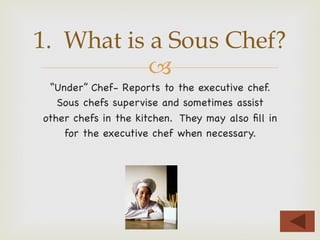
“Under” Chef- Reports to the executive chef.
Sous chefs supervise and sometimes assist
other chefs in the kitchen. They may also fill in
for the executive chef when necessary.
1. What is a Sous Chef?
–
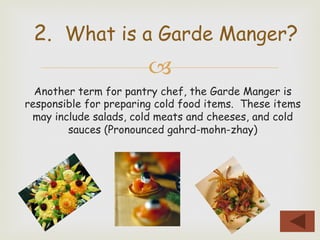
Another term for pantry chef, the Garde Manger is
responsible for preparing cold food items. These items
may include salads, cold meats and cheeses, and cold
sauces (Pronounced gahrd-mohn-zhay)
2. What is a Garde Manger?
–
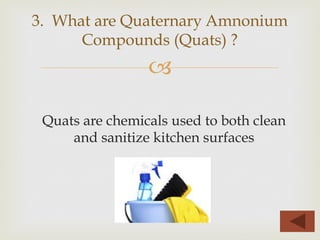
Quats are chemicals used to both clean
and sanitize kitchen surfaces
3. What are Quaternary Amnonium
Compounds (Quats) ?
–
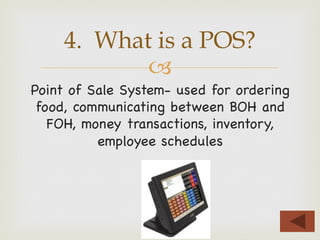
Point of Sale System- used for ordering
food, communicating between BOH and
FOH, money transactions, inventory,
employee schedules
4. What is a POS?
–
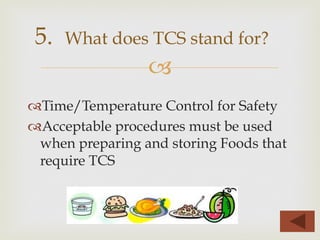
™ Time/Temperature Control for Safety
™ Acceptable procedures must be used
when preparing and storing Foods that
require TCS
5. What does TCS stand for?
–
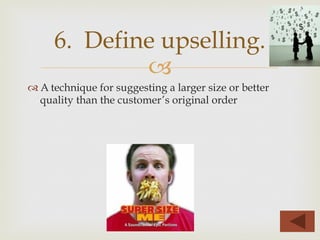
™ A technique for suggesting a larger size or better
quality than the customer’s original order
6. Define upselling.
–
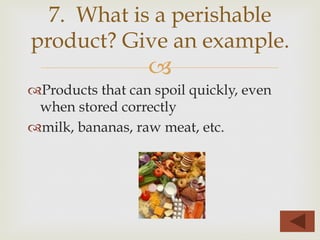
™ Products that can spoil quickly, even
when stored correctly
™ milk, bananas, raw meat, etc.
7. What is a perishable
product? Give an example.
–
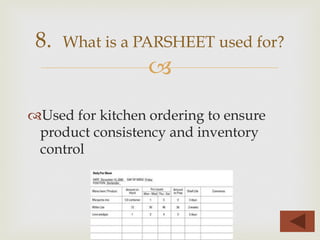
™ Used for kitchen ordering to ensure
product consistency and inventory
control
8. What is a PARSHEET used for?
–
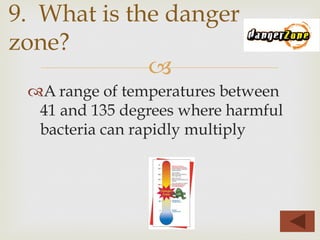
™ A range of temperatures between
41 and 135 degrees where harmful
bacteria can rapidly multiply
9. What is the danger
zone?
–
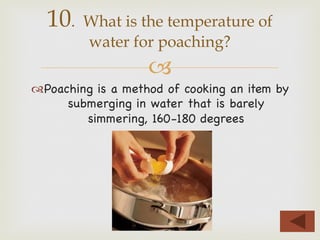
™ Poaching is a method of cooking an item by
submerging in water that is barely
simmering, 160-180 degrees
10. What is the temperature of
water for poaching?
–
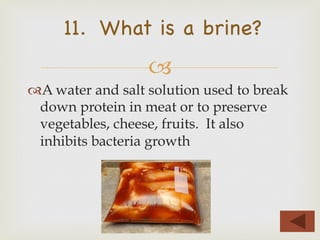
11. What is a brine?
™ A water and salt solution used to break
down protein in meat or to preserve
vegetables, cheese, fruits. It also
inhibits bacteria growth
™ Hazard Analysis Critical Control Point
12. What is a system that identifies specific
hazards and measures of control to ensure the
safety of food ?
–
F.A.T.T.O.M. explains what allows foodborne
pathogens to grow:
Food Acidity Time Temperature Oxygen
Moisture
13. What conditions allow
foodborne pathogens to grow?
–
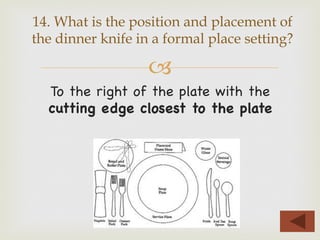
To the right of the plate with the
cutting edge closest to the plate
14. What is the position and placement of
the dinner knife in a formal place setting?
–
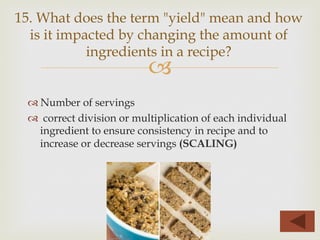
™ Number of servings
™  correct division or multiplication of each individual
ingredient to ensure consistency in recipe and to
increase or decrease servings (SCALING)
15. What does the term "yield" mean and how
is it impacted by changing the amount of
ingredients in a recipe?
–
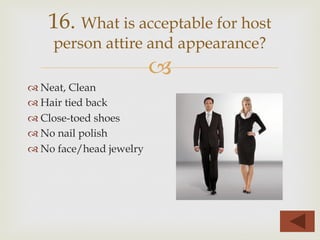
™ Neat, Clean
™ Hair tied back
™ Close-toed shoes
™ No nail polish
™ No face/head jewelry
16. What is acceptable for host
person attire and appearance?
–
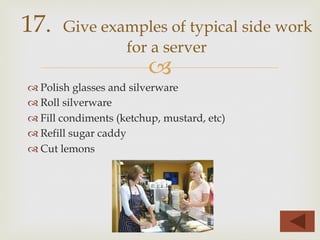
™ Polish glasses and silverware
™ Roll silverware
™ Fill condiments (ketchup, mustard, etc)
™ Refill sugar caddy
™ Cut lemons
17. Give examples of typical side work
for a server
–
™ Kosher Salt
™ Sea Salt
™ Table Salt
18. What are the 3 salts found in a
professional kitchen?
–
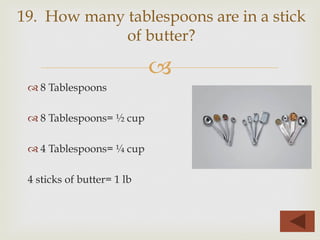
™ 8 Tablespoons
™ 8 Tablespoons= ½ cup
™ 4 Tablespoons= ¼ cup
4 sticks of butter= 1 lb
19. How many tablespoons are in a stick
of butter?
–
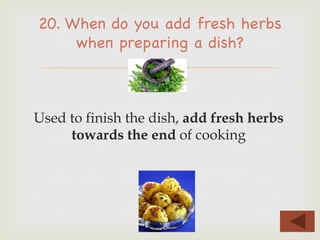
Used to finish the dish, add fresh herbs
towards the end of cooking
20. When do you add fresh herbs
when preparing a dish?
–
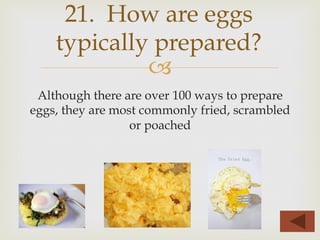
Although there are over 100 ways to prepare
eggs, they are most commonly fried, scrambled
or poached
21. How are eggs
typically prepared?
–
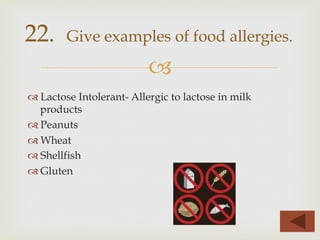
™ Lactose Intolerant- Allergic to lactose in milk
products
™ Peanuts
™ Wheat
™ Shellfish
™ Gluten
22. Give examples of food allergies.
–
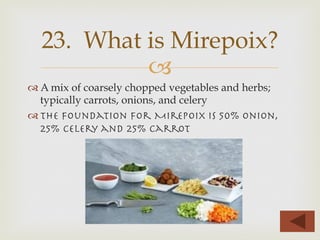
™ A mix of coarsely chopped vegetables and herbs;
typically carrots, onions, and celery
™ the foundation for Mirepoix is 50% Onion,
25% celery and 25% carrot
23. What is Mirepoix?
–
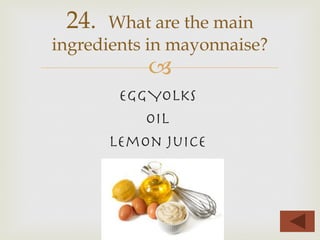
EGGYolks
Oil
Lemon Juice
24. What are the main
ingredients in mayonnaise?
–
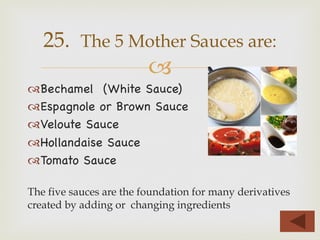
™ Bechamel (White Sauce)
™ Espagnole or Brown Sauce
™ Veloute Sauce
™ Hollandaise Sauce
™ Tomato Sauce
The five sauces are the foundation for many derivatives
created by adding or changing ingredients
25. The 5 Mother Sauces are:
–
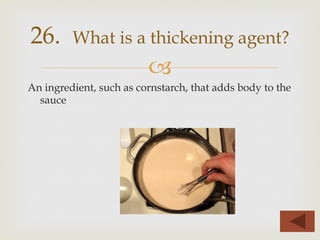
An ingredient, such as cornstarch, that adds body to the
sauce
26. What is a thickening agent?
–
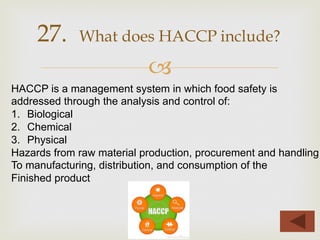
27. What does HACCP include?
HACCP is a management system in which food safety is
addressed through the analysis and control of:
1.  Biological
2.  Chemical
3.  Physical
Hazards from raw material production, procurement and handling
To manufacturing, distribution, and consumption of the
Finished product
–
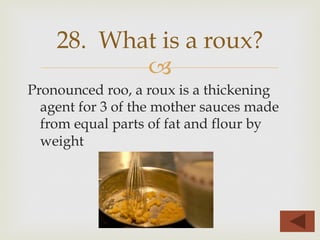
Pronounced roo, a roux is a thickening
agent for 3 of the mother sauces made
from equal parts of fat and flour by
weight
28. What is a roux?
–
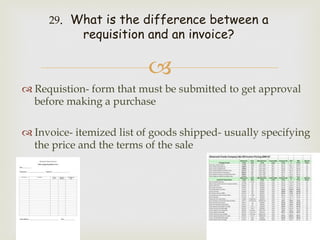
™ Requistion- form that must be submitted to get approval
before making a purchase
™ Invoice- itemized list of goods shipped- usually specifying
the price and the terms of the sale
29. What is the difference between a
requisition and an invoice?
–
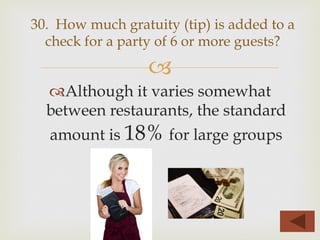
™ Although it varies somewhat
between restaurants, the standard
amount is 18% for large groups
30. How much gratuity (tip) is added to a
check for a party of 6 or more guests?
–
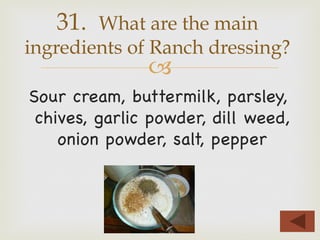
Sour cream, buttermilk, parsley,
chives, garlic powder, dill weed,
onion powder, salt, pepper
31. What are the main
ingredients of Ranch dressing?
–
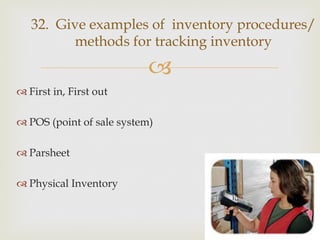
™ First in, First out
™ POS (point of sale system)
™ Parsheet
™ Physical Inventory
32. Give examples of inventory procedures/
methods for tracking inventory
–
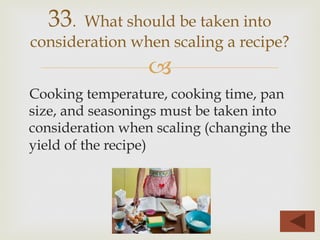
Cooking temperature, cooking time, pan
size, and seasonings must be taken into
consideration when scaling (changing the
yield of the recipe)
33. What should be taken into
consideration when scaling a recipe?
–
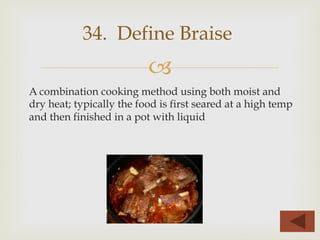
A combination cooking method using both moist and
dry heat; typically the food is first seared at a high temp
and then finished in a pot with liquid
34. Define Braise
–
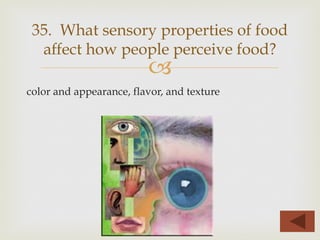
color and appearance, flavor, and texture
35. What sensory properties of food
affect how people perceive food?
–
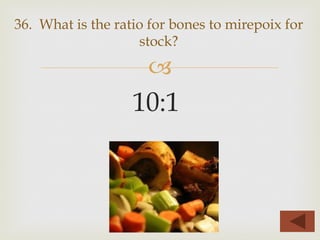
10:1
36. What is the ratio for bones to mirepoix for
stock?
–
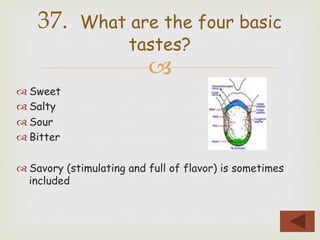
™ Sweet
™ Salty
™ Sour
™ Bitter
™ Savory (stimulating and full of flavor) is sometimes
included
37. What are the four basic
tastes?
–
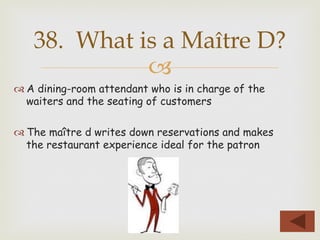
™ A dining-room attendant who is in charge of the
waiters and the seating of customers
™ The maître d writes down reservations and makes
the restaurant experience ideal for the patron
38. What is a Maître D?
–
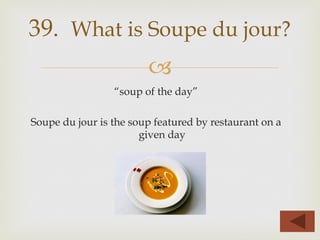
“soup of the day”
Soupe du jour is the soup featured by restaurant on a
given day
39. What is Soupe du jour?
–
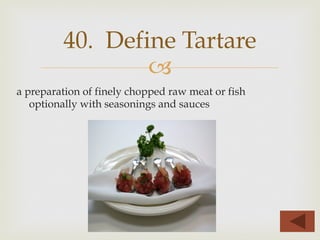
a preparation of finely chopped raw meat or fish
optionally with seasonings and sauces
40. Define Tartare
–
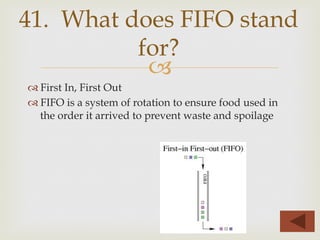
™ First In, First Out
™ FIFO is a system of rotation to ensure food used in
the order it arrived to prevent waste and spoilage
41. What does FIFO stand
for?
–
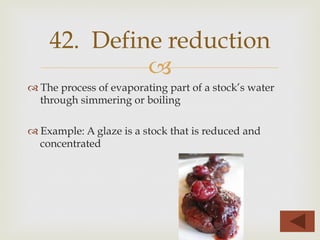
™ The process of evaporating part of a stock’s water
through simmering or boiling
™ Example: A glaze is a stock that is reduced and
concentrated
42. Define reduction
–
™ Salmonella
™ E. Coli
™ Botulism
™ Listeriosis
™ Trichinosis
43. Give an example of a
food-borne illness
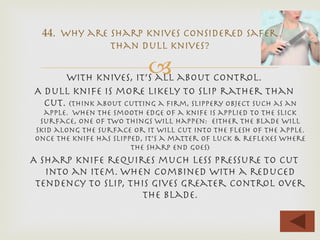
–With knives, it’s all about control.
A dull knife is more likely to slip rather than
cut. (think about cutting a firm, slippery object such as an
apple. When the smooth edge of a knife is applied to the slick
surface, one of two things will happen: either the blade will
skid along the surface or it will cut into the flesh of the apple.
Once the knife has slipped, it’s a matter of luck & reflexes where
the sharp end goes)
A sharp knife requires much less pressure to cut
into an item. When combined with a reduced
tendency to slip, this gives greater control over
the blade.

44. Why are sharp knives considered safer
than dull knives?
–
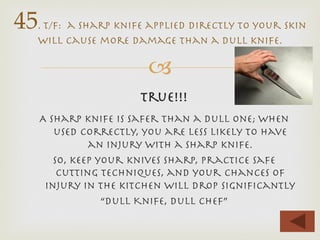
True!!!

A sharp knife is safer than a dull one; when
used correctly, you are less likely to have
an injury with a sharp knife.
So, keep your knives sharp, practice safe
cutting techniques, and your chances of
injury in the kitchen will drop significantly
“Dull Knife, dull chef”
45. t/f: a sharp knife applied directly to your skin
will cause more damage than a dull knife.
–


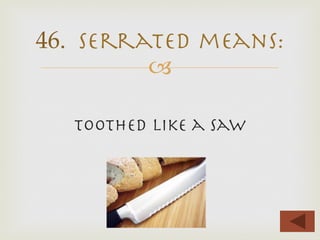
Toothed like a saw
46. Serrated means:
–

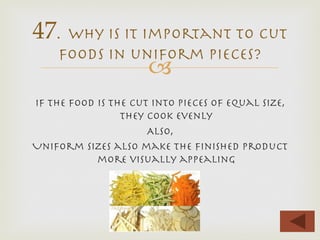
If the food is the cut into pieces of equal size,
they cook evenly
Also,
Uniform sizes also make the finished product
more visually appealing
47. Why is it important to cut
foods in uniform pieces?
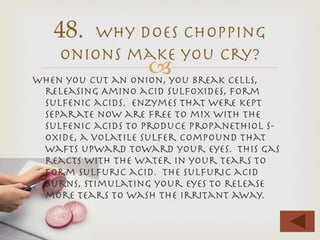
–When you cut an onion, you break cells,
releasing Amino acid sulfoxides, form
sulfenic acids. Enzymes that were kept
separate now are free to mix with the
sulfenic acids to produce propanethiol s-
oxide, a volatile sulfer compound that
wafts upward toward your eyes. This gas
reacts with the water in your tears to
form sulfuric acid. The sulfuric acid
burns, stimulating your eyes to release
more tears to wash the irritant away.
48. Why does chopping
onions make you cry?
–
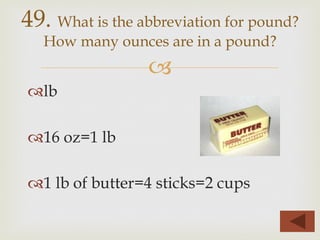
™ lb
™ 16 oz=1 lb
™ 1 lb of butter=4 sticks=2 cups
49. What is the abbreviation for pound?
How many ounces are in a pound?
–
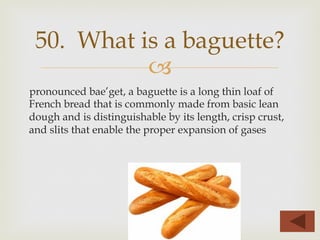
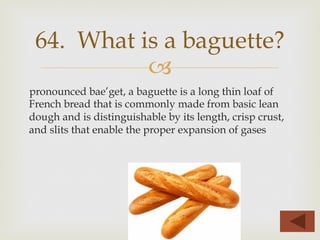
pronounced bae’get, a baguette is a long thin loaf of
French bread that is commonly made from basic lean
dough and is distinguishable by its length, crisp crust,
and slits that enable the proper expansion of gases
50. What is a baguette?
–
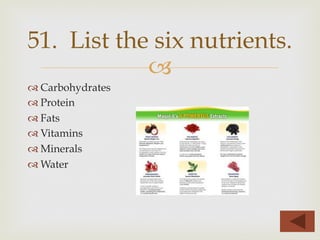
™ Carbohydrates
™ Protein
™ Fats
™ Vitamins
™ Minerals
™ Water
51. List the six nutrients.
–
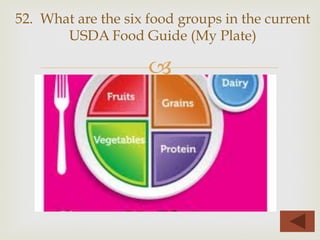
52. What are the six food groups in the current
USDA Food Guide (My Plate)
–
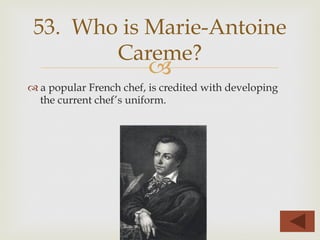
™ a popular French chef, is credited with developing
the current chef’s uniform.
53. Who is Marie-Antoine
Careme?
–
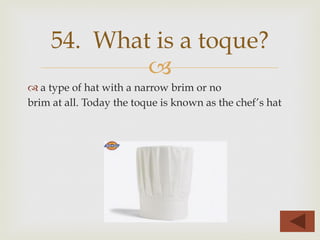
™ a type of hat with a narrow brim or no
brim at all. Today the toque is known as the chef’s hat
54. What is a toque?
–
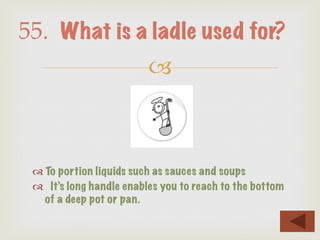
™ To portion liquids such as sauces and soups
™  It’s long handle enables you to reach to the bottom
of a deep pot or pan.
55. What is a ladle used for?
–
3
56. How many teaspoons
are in a tablespoon?
–
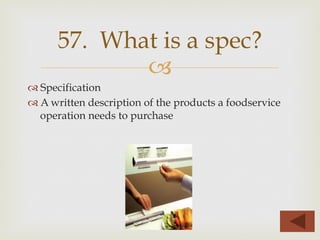
™ Specification
™ A written description of the products a foodservice
operation needs to purchase
57. What is a spec?
–
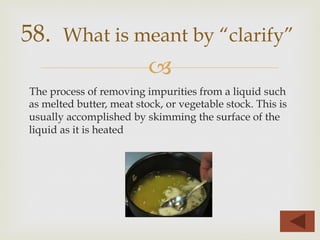
The process of removing impurities from a liquid such
as melted butter, meat stock, or vegetable stock. This is
usually accomplished by skimming the surface of the
liquid as it is heated
58. What is meant by “clarify”
–
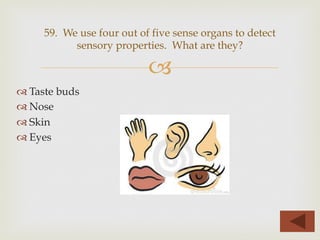
™ Taste buds
™ Nose
™ Skin
™ Eyes
59. We use four out of five sense organs to detect
sensory properties. What are they?
–
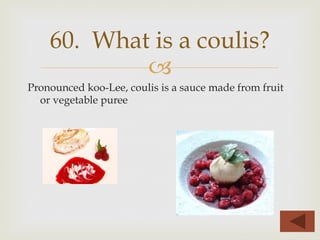
Pronounced koo-Lee, coulis is a sauce made from fruit
or vegetable puree
60. What is a coulis?
–
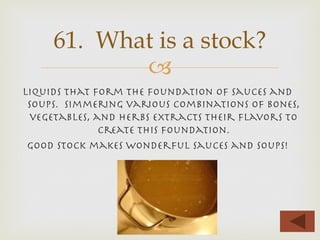
Liquids that form the foundation of sauces and
soups. Simmering various combinations of bones,
vegetables, and herbs extracts their flavors to
create this foundation.
Good stock makes wonderful sauces and soups!
61. What is a stock?
–
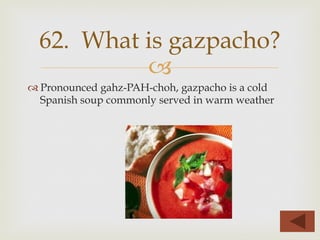
™ Pronounced gahz-PAH-choh, gazpacho is a cold
Spanish soup commonly served in warm weather
62. What is gazpacho?
–
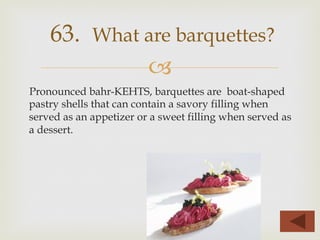
Pronounced bahr-KEHTS, barquettes are boat-shaped
pastry shells that can contain a savory filling when
served as an appetizer or a sweet filling when served as
a dessert.
63. What are barquettes?
–
pronounced bae’get, a baguette is a long thin loaf of
French bread that is commonly made from basic lean
dough and is distinguishable by its length, crisp crust,
and slits that enable the proper expansion of gases
64. What is a baguette?
–
™ Clean is simply free of debris but
sanitized is free of harmful bacteria
65. What is the difference between
clean and sanitized?
–
™ Liquids are measured in a glass or other transparent
material and at eye level. Examples: water, milk, juice
™ Solids are measured in graduated measuring cups as well
and are sometimes packed to take the form of the measure.
Examples: Brown sugar, peanut butter, sour cream, honey
™ Weight- measure amount using an electric or balance scale
™ Volume- measure the amount of space that an ingredient
fills
66. Explain the differences between measuring:
liquid, dry, solid, weight, and volume

Culinary Review

  • 1.
  • 2.
    – “Under” Chef- Reportsto the executive chef. Sous chefs supervise and sometimes assist other chefs in the kitchen. They may also fill in for the executive chef when necessary. 1. What is a Sous Chef?
  • 3.
    – Another term forpantry chef, the Garde Manger is responsible for preparing cold food items. These items may include salads, cold meats and cheeses, and cold sauces (Pronounced gahrd-mohn-zhay) 2. What is a Garde Manger?
  • 4.
    – Quats are chemicalsused to both clean and sanitize kitchen surfaces 3. What are Quaternary Amnonium Compounds (Quats) ?
  • 5.
    – Point of SaleSystem- used for ordering food, communicating between BOH and FOH, money transactions, inventory, employee schedules 4. What is a POS?
  • 6.
    – ™ Time/Temperature Control forSafety ™ Acceptable procedures must be used when preparing and storing Foods that require TCS 5. What does TCS stand for?
  • 7.
    – ™ A technique forsuggesting a larger size or better quality than the customer’s original order 6. Define upselling.
  • 8.
    – ™ Products that canspoil quickly, even when stored correctly ™ milk, bananas, raw meat, etc. 7. What is a perishable product? Give an example.
  • 9.
    – ™ Used for kitchenordering to ensure product consistency and inventory control 8. What is a PARSHEET used for?
  • 10.
    – ™ A range oftemperatures between 41 and 135 degrees where harmful bacteria can rapidly multiply 9. What is the danger zone?
  • 11.
    – ™ Poaching is amethod of cooking an item by submerging in water that is barely simmering, 160-180 degrees 10. What is the temperature of water for poaching?
  • 12.
    – 11. What isa brine? ™ A water and salt solution used to break down protein in meat or to preserve vegetables, cheese, fruits. It also inhibits bacteria growth
  • 13.
    ™ Hazard Analysis CriticalControl Point 12. What is a system that identifies specific hazards and measures of control to ensure the safety of food ?
  • 14.
    – F.A.T.T.O.M. explains whatallows foodborne pathogens to grow: Food Acidity Time Temperature Oxygen Moisture 13. What conditions allow foodborne pathogens to grow?
  • 15.
    – To the rightof the plate with the cutting edge closest to the plate 14. What is the position and placement of the dinner knife in a formal place setting?
  • 16.
    – ™ Number of servings ™ correct division or multiplication of each individual ingredient to ensure consistency in recipe and to increase or decrease servings (SCALING) 15. What does the term "yield" mean and how is it impacted by changing the amount of ingredients in a recipe?
  • 17.
    – ™ Neat, Clean ™ Hair tiedback ™ Close-toed shoes ™ No nail polish ™ No face/head jewelry 16. What is acceptable for host person attire and appearance?
  • 18.
    – ™ Polish glasses andsilverware ™ Roll silverware ™ Fill condiments (ketchup, mustard, etc) ™ Refill sugar caddy ™ Cut lemons 17. Give examples of typical side work for a server
  • 19.
    – ™ Kosher Salt ™ Sea Salt ™ TableSalt 18. What are the 3 salts found in a professional kitchen?
  • 20.
    – ™ 8 Tablespoons ™ 8 Tablespoons=½ cup ™ 4 Tablespoons= ¼ cup 4 sticks of butter= 1 lb 19. How many tablespoons are in a stick of butter?
  • 21.
    – Used to finishthe dish, add fresh herbs towards the end of cooking 20. When do you add fresh herbs when preparing a dish?
  • 22.
    – Although there areover 100 ways to prepare eggs, they are most commonly fried, scrambled or poached 21. How are eggs typically prepared?
  • 23.
    – ™ Lactose Intolerant- Allergicto lactose in milk products ™ Peanuts ™ Wheat ™ Shellfish ™ Gluten 22. Give examples of food allergies.
  • 24.
    – ™ A mix ofcoarsely chopped vegetables and herbs; typically carrots, onions, and celery ™ the foundation for Mirepoix is 50% Onion, 25% celery and 25% carrot 23. What is Mirepoix?
  • 25.
    – EGGYolks Oil Lemon Juice 24. Whatare the main ingredients in mayonnaise?
  • 26.
    – ™ Bechamel (White Sauce) ™ Espagnoleor Brown Sauce ™ Veloute Sauce ™ Hollandaise Sauce ™ Tomato Sauce The five sauces are the foundation for many derivatives created by adding or changing ingredients 25. The 5 Mother Sauces are:
  • 27.
    – An ingredient, suchas cornstarch, that adds body to the sauce 26. What is a thickening agent?
  • 28.
    – 27. What doesHACCP include? HACCP is a management system in which food safety is addressed through the analysis and control of: 1.  Biological 2.  Chemical 3.  Physical Hazards from raw material production, procurement and handling To manufacturing, distribution, and consumption of the Finished product
  • 29.
    – Pronounced roo, aroux is a thickening agent for 3 of the mother sauces made from equal parts of fat and flour by weight 28. What is a roux?
  • 30.
    – ™ Requistion- form thatmust be submitted to get approval before making a purchase ™ Invoice- itemized list of goods shipped- usually specifying the price and the terms of the sale 29. What is the difference between a requisition and an invoice?
  • 31.
    – ™ Although it variessomewhat between restaurants, the standard amount is 18% for large groups 30. How much gratuity (tip) is added to a check for a party of 6 or more guests?
  • 32.
    – Sour cream, buttermilk,parsley, chives, garlic powder, dill weed, onion powder, salt, pepper 31. What are the main ingredients of Ranch dressing?
  • 33.
    – ™ First in, Firstout ™ POS (point of sale system) ™ Parsheet ™ Physical Inventory 32. Give examples of inventory procedures/ methods for tracking inventory
  • 34.
    – Cooking temperature, cookingtime, pan size, and seasonings must be taken into consideration when scaling (changing the yield of the recipe) 33. What should be taken into consideration when scaling a recipe?
  • 35.
    – A combination cookingmethod using both moist and dry heat; typically the food is first seared at a high temp and then finished in a pot with liquid 34. Define Braise
  • 36.
    – color and appearance,flavor, and texture 35. What sensory properties of food affect how people perceive food?
  • 37.
    – 10:1 36. What isthe ratio for bones to mirepoix for stock?
  • 38.
    – ™ Sweet ™ Salty ™ Sour ™ Bitter ™ Savory (stimulating andfull of flavor) is sometimes included 37. What are the four basic tastes?
  • 39.
    – ™ A dining-room attendantwho is in charge of the waiters and the seating of customers ™ The maître d writes down reservations and makes the restaurant experience ideal for the patron 38. What is a Maître D?
  • 40.
    – “soup of theday” Soupe du jour is the soup featured by restaurant on a given day 39. What is Soupe du jour?
  • 41.
    – a preparation offinely chopped raw meat or fish optionally with seasonings and sauces 40. Define Tartare
  • 42.
    – ™ First In, FirstOut ™ FIFO is a system of rotation to ensure food used in the order it arrived to prevent waste and spoilage 41. What does FIFO stand for?
  • 43.
    – ™ The process ofevaporating part of a stock’s water through simmering or boiling ™ Example: A glaze is a stock that is reduced and concentrated 42. Define reduction
  • 44.
  • 45.
    –With knives, it’sall about control. A dull knife is more likely to slip rather than cut. (think about cutting a firm, slippery object such as an apple. When the smooth edge of a knife is applied to the slick surface, one of two things will happen: either the blade will skid along the surface or it will cut into the flesh of the apple. Once the knife has slipped, it’s a matter of luck & reflexes where the sharp end goes) A sharp knife requires much less pressure to cut into an item. When combined with a reduced tendency to slip, this gives greater control over the blade. 44. Why are sharp knives considered safer than dull knives?
  • 46.
    – True!!! A sharp knifeis safer than a dull one; when used correctly, you are less likely to have an injury with a sharp knife. So, keep your knives sharp, practice safe cutting techniques, and your chances of injury in the kitchen will drop significantly “Dull Knife, dull chef” 45. t/f: a sharp knife applied directly to your skin will cause more damage than a dull knife.
  • 47.
    – Toothed like asaw 46. Serrated means:
  • 48.
    – If the foodis the cut into pieces of equal size, they cook evenly Also, Uniform sizes also make the finished product more visually appealing 47. Why is it important to cut foods in uniform pieces?
  • 49.
    –When you cutan onion, you break cells, releasing Amino acid sulfoxides, form sulfenic acids. Enzymes that were kept separate now are free to mix with the sulfenic acids to produce propanethiol s- oxide, a volatile sulfer compound that wafts upward toward your eyes. This gas reacts with the water in your tears to form sulfuric acid. The sulfuric acid burns, stimulating your eyes to release more tears to wash the irritant away. 48. Why does chopping onions make you cry?
  • 50.
    – ™ lb ™ 16 oz=1 lb ™ 1lb of butter=4 sticks=2 cups 49. What is the abbreviation for pound? How many ounces are in a pound?
  • 51.
    – pronounced bae’get, abaguette is a long thin loaf of French bread that is commonly made from basic lean dough and is distinguishable by its length, crisp crust, and slits that enable the proper expansion of gases 50. What is a baguette?
  • 52.
  • 53.
    – 52. What arethe six food groups in the current USDA Food Guide (My Plate)
  • 54.
    – ™ a popular Frenchchef, is credited with developing the current chef’s uniform. 53. Who is Marie-Antoine Careme?
  • 55.
    – ™ a type ofhat with a narrow brim or no brim at all. Today the toque is known as the chef’s hat 54. What is a toque?
  • 56.
    – ™ To portion liquidssuch as sauces and soups ™  It’s long handle enables you to reach to the bottom of a deep pot or pan. 55. What is a ladle used for?
  • 57.
    – 3 56. How manyteaspoons are in a tablespoon?
  • 58.
    – ™ Specification ™ A written descriptionof the products a foodservice operation needs to purchase 57. What is a spec?
  • 59.
    – The process ofremoving impurities from a liquid such as melted butter, meat stock, or vegetable stock. This is usually accomplished by skimming the surface of the liquid as it is heated 58. What is meant by “clarify”
  • 60.
    – ™ Taste buds ™ Nose ™ Skin ™ Eyes 59. Weuse four out of five sense organs to detect sensory properties. What are they?
  • 61.
    – Pronounced koo-Lee, coulisis a sauce made from fruit or vegetable puree 60. What is a coulis?
  • 62.
    – Liquids that formthe foundation of sauces and soups. Simmering various combinations of bones, vegetables, and herbs extracts their flavors to create this foundation. Good stock makes wonderful sauces and soups! 61. What is a stock?
  • 63.
    – ™ Pronounced gahz-PAH-choh, gazpachois a cold Spanish soup commonly served in warm weather 62. What is gazpacho?
  • 64.
    – Pronounced bahr-KEHTS, barquettesare boat-shaped pastry shells that can contain a savory filling when served as an appetizer or a sweet filling when served as a dessert. 63. What are barquettes?
  • 65.
    – pronounced bae’get, abaguette is a long thin loaf of French bread that is commonly made from basic lean dough and is distinguishable by its length, crisp crust, and slits that enable the proper expansion of gases 64. What is a baguette?
  • 66.
    – ™ Clean is simplyfree of debris but sanitized is free of harmful bacteria 65. What is the difference between clean and sanitized?
  • 67.
    – ™ Liquids are measuredin a glass or other transparent material and at eye level. Examples: water, milk, juice ™ Solids are measured in graduated measuring cups as well and are sometimes packed to take the form of the measure. Examples: Brown sugar, peanut butter, sour cream, honey ™ Weight- measure amount using an electric or balance scale ™ Volume- measure the amount of space that an ingredient fills 66. Explain the differences between measuring: liquid, dry, solid, weight, and volume