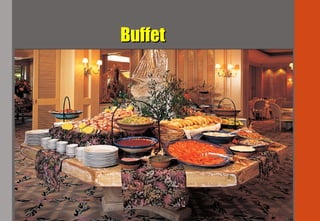
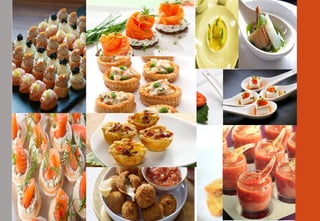
BuffetBuffet
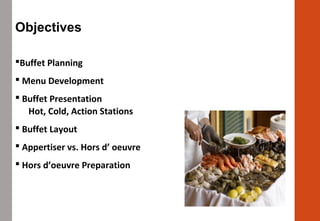
Objectives
Buffet Planning
 Menu Development
 Buffet Presentation
Hot, Cold, Action Stations
 Buffet Layout
 Appertiser vs. Hors d’ oeuvre
 Hors d’oeuvre Preparation
 Buffets must be carefully designed to provide food from a
planned menu in a single attractive setting to a given
number of people within a specified time.
 The theme sets the tone of the event:
Theme defines the menu, decorations, props, linens,
dinnerware, music, lighting, wait staff uniforms, etc…
 Themes can be based on:
season, weather, and the guests’ comfort and
expectations, holidays, etc..
Buffet Planning
Menu Development - crafting a menu that satisfies the guest or
client as well as makes a profit for the operator.
• Review the concept or theme and establish the
appropriate menu selections for the buffet
– remember guest expectations.
• Food is generally the focal point.
• Buffet-style service offers guests variety, the freedom to
choose from different categories, and the option of
unlimited portions.
• Consider the skills necessary to successfully staff the
buffet, as well as the needs of the service staff, and space
and equipment size and availability.
• Safety and Sanitation
• Presentation concerns – buffet vs. plated
• Serve foods that hold temperature well
• Cook and serve small batches of foods
• Sauces in the pans help keep the foods moist and hot
• Keep the chafing dishes closed when not serving
• Watch the use of heat lamps; there is always a fear of someone
getting burned
Buffet Presentation – Hot Food
• Watch temperatures
• Fresh, colorful and welcoming
• Replenish ice often
• Serving platters have to be exchanged often to keep the
food appealing (and safe – remember 4 hours)
• Remember to avoid mixing temperature sensitive foods
with potentially hazardous foods
• Ice carvings and ice beds are often used to keep cold
food cold, as well as for the dramatic appeal. Be certain
that the ice can drain properly and that heavy or large
ice carvings are stable.
Buffet Presentation – Cold Food
Action stations provide:
- custom experience
- highlight the special talents of your staff
- introduce interaction between the guests and staff
Consider:
- skills of the cook to execute the station.
- special equipment needed to produce the item
Action stations can now be adapted to encompass many food
items on a menu.
Ex: To create an appetizer of potato blinis with smoked
salmon and caviar, one person may be sautéing the blinis
while the second person is slicing the salmon and plating
the appetizer.
Buffet Presentation – Action Stations
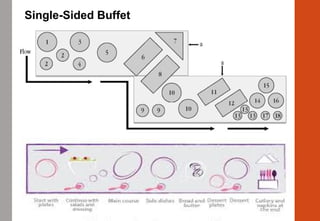
Single-Sided Buffet
Double-Sided Buffet
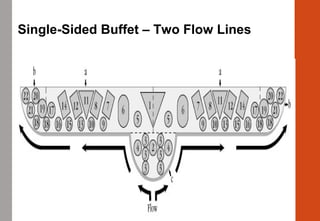
Single-Sided Buffet – Two Flow Lines
• Appetizer, Hors d’oeuvre, Canapé, Amuse Bouche:
appetizer - served before the main courses of a meal
hors d’oeuvre - "apart or outside from the main work"
canapé – “couche” (a piece of furniture similar to a
settee, and is meant to describe an elegant sofa made out of
elaborately carved wood with wooden legs, and upholstered
seats, back an armrests that seats three)
A small, prepared and usually decorative food, held in the
fingers and often eaten in one bite. Usually contains bread as a
base.
amuse bouche - "amusing the mouth“. Gift or treat from
the chef to welcome guests to a restaurant before they decide
what to eat.
Appetizers vs. Hors d’oeuvres
• When selecting hors d’oeuvres, keep in mind the nature and
theme of the event, as well as the menu to follow.
• Hors d’oeuvre served on platters or passed on trays butler
style should be thoughtfully, neatly presented. “All your
soldiers in a row.”
• Use “interesting” plates, platters and props to create a mood
or theme for the event.
• Serve at the proper temperature, and remember to chill or
warm plates/platters.
• Slice, shape and portion properly. There should be just enough
of any given item to make the hors d’oeuvre interesting and
appealing from start to finish.
Hors d’oeuvres Preparation
Buffet: https://www.facebook.com/delhindra/

Buffet: https://www.facebook.com/delhindra/

  • 1.
  • 2.
    Objectives Buffet Planning  MenuDevelopment  Buffet Presentation Hot, Cold, Action Stations  Buffet Layout  Appertiser vs. Hors d’ oeuvre  Hors d’oeuvre Preparation
  • 3.
     Buffets mustbe carefully designed to provide food from a planned menu in a single attractive setting to a given number of people within a specified time.  The theme sets the tone of the event: Theme defines the menu, decorations, props, linens, dinnerware, music, lighting, wait staff uniforms, etc…  Themes can be based on: season, weather, and the guests’ comfort and expectations, holidays, etc.. Buffet Planning
  • 4.
    Menu Development -crafting a menu that satisfies the guest or client as well as makes a profit for the operator. • Review the concept or theme and establish the appropriate menu selections for the buffet – remember guest expectations. • Food is generally the focal point. • Buffet-style service offers guests variety, the freedom to choose from different categories, and the option of unlimited portions. • Consider the skills necessary to successfully staff the buffet, as well as the needs of the service staff, and space and equipment size and availability.
  • 5.
    • Safety andSanitation • Presentation concerns – buffet vs. plated • Serve foods that hold temperature well • Cook and serve small batches of foods • Sauces in the pans help keep the foods moist and hot • Keep the chafing dishes closed when not serving • Watch the use of heat lamps; there is always a fear of someone getting burned Buffet Presentation – Hot Food
  • 6.
    • Watch temperatures •Fresh, colorful and welcoming • Replenish ice often • Serving platters have to be exchanged often to keep the food appealing (and safe – remember 4 hours) • Remember to avoid mixing temperature sensitive foods with potentially hazardous foods • Ice carvings and ice beds are often used to keep cold food cold, as well as for the dramatic appeal. Be certain that the ice can drain properly and that heavy or large ice carvings are stable. Buffet Presentation – Cold Food
  • 7.
    Action stations provide: -custom experience - highlight the special talents of your staff - introduce interaction between the guests and staff Consider: - skills of the cook to execute the station. - special equipment needed to produce the item Action stations can now be adapted to encompass many food items on a menu. Ex: To create an appetizer of potato blinis with smoked salmon and caviar, one person may be sautéing the blinis while the second person is slicing the salmon and plating the appetizer. Buffet Presentation – Action Stations
  • 8.
  • 10.
  • 12.
  • 14.
    • Appetizer, Horsd’oeuvre, Canapé, Amuse Bouche: appetizer - served before the main courses of a meal hors d’oeuvre - "apart or outside from the main work" canapé – “couche” (a piece of furniture similar to a settee, and is meant to describe an elegant sofa made out of elaborately carved wood with wooden legs, and upholstered seats, back an armrests that seats three) A small, prepared and usually decorative food, held in the fingers and often eaten in one bite. Usually contains bread as a base. amuse bouche - "amusing the mouth“. Gift or treat from the chef to welcome guests to a restaurant before they decide what to eat. Appetizers vs. Hors d’oeuvres
  • 16.
    • When selectinghors d’oeuvres, keep in mind the nature and theme of the event, as well as the menu to follow. • Hors d’oeuvre served on platters or passed on trays butler style should be thoughtfully, neatly presented. “All your soldiers in a row.” • Use “interesting” plates, platters and props to create a mood or theme for the event. • Serve at the proper temperature, and remember to chill or warm plates/platters. • Slice, shape and portion properly. There should be just enough of any given item to make the hors d’oeuvre interesting and appealing from start to finish. Hors d’oeuvres Preparation