by: JOE LOVIDICE
1. HRAISC
CHAIRS
2. URODN
ROUND
3. LABET
TABLE
4. TLOAYU
LAY OUT
Banquet is a large
catering activity where
food & beverage are
served for pre-
arranged number of
peoples on pre-fixed
date & time, agreed
menu & price.
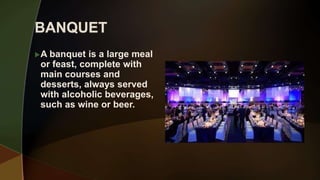
A banquet is a large meal
or feast, complete with
main courses and
desserts, always served
with alcoholic beverages,
such as wine or beer.
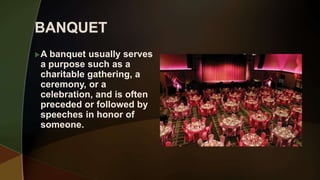
A banquet usually serves
a purpose such as a
charitable gathering, a
ceremony, or a
celebration, and is often
preceded or followed by
speeches in honor of
someone.
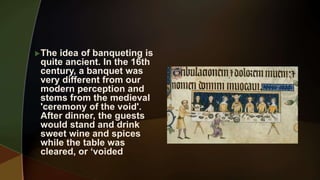
The idea of banqueting is
quite ancient. In the 16th
century, a banquet was
very different from our
modern perception and
stems from the medieval
'ceremony of the void'.
After dinner, the guests
would stand and drink
sweet wine and spices
while the table was
cleared, or ‘voided
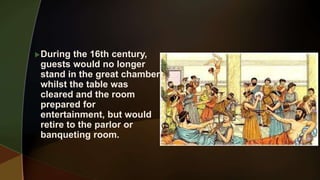
During the 16th century,
guests would no longer
stand in the great chamber
whilst the table was
cleared and the room
prepared for
entertainment, but would
retire to the parlor or
banqueting room.
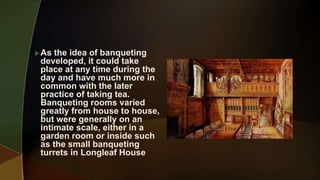
As the idea of banqueting
developed, it could take
place at any time during the
day and have much more in
common with the later
practice of taking tea.
Banqueting rooms varied
greatly from house to house,
but were generally on an
intimate scale, either in a
garden room or inside such
as the small banqueting
turrets in Longleaf House
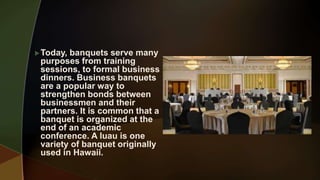
Today, banquets serve many
purposes from training
sessions, to formal business
dinners. Business banquets
are a popular way to
strengthen bonds between
businessmen and their
partners. It is common that a
banquet is organized at the
end of an academic
conference. A luau is one
variety of banquet originally
used in Hawaii.
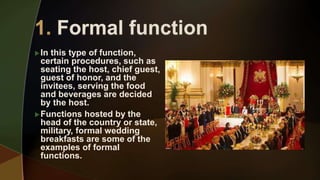
In this type of function,
certain procedures, such as
seating the host, chief guest,
guest of honor, and the
invitees, serving the food
and beverages are decided
by the host.
Functions hosted by the
head of the country or state,
military, formal wedding
breakfasts are some of the
examples of formal
functions.
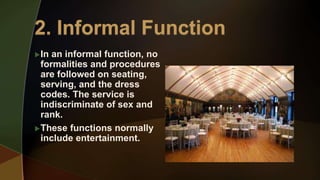
In an informal function, no
formalities and procedures
are followed on seating,
serving, and the dress
codes. The service is
indiscriminate of sex and
rank.
These functions normally
include entertainment.
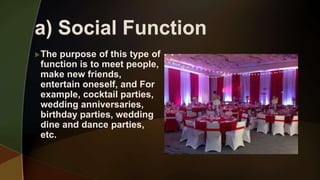
The purpose of this type of
function is to meet people,
make new friends,
entertain oneself, and For
example, cocktail parties,
wedding anniversaries,
birthday parties, wedding
dine and dance parties,
etc.
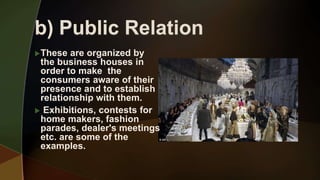
These are organized by
the business houses in
order to make the
consumers aware of their
presence and to establish
relationship with them.
 Exhibitions, contests for
home makers, fashion
parades, dealer's meetings
etc. are some of the
examples.
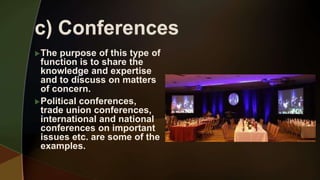
The purpose of this type of
function is to share the
knowledge and expertise
and to discuss on matters
of concern.
Political conferences,
trade union conferences,
international and national
conferences on important
issues etc. are some of the
examples.
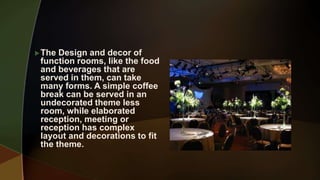
The Design and decor of
function rooms, like the food
and beverages that are
served in them, can take
many forms. A simple coffee
break can be served in an
undecorated theme less
room, while elaborated
reception, meeting or
reception has complex
layout and decorations to fit
the theme.
 Space available inside the
banquet hall.
 Size of the audience ie (minimum
guaranteed pax and maximum).
 Expected level of activity and
interaction required.
 Place required for dinner tables,
meeting tables and head tables.
 Details of equipment's required
eg projectors, screen, lecterns,
Flip chart, board, dance floor,
stage etc.
 The type of service. Eg: Sit down
full service, Buffet etc.
Additionally the guests at
banquets and catered
events must be served
quickly, the layout and
service stations should be
setup to allow for
maximum staff efficiency.
The best way to layout a
room is dependent on a
number of factors
including:
Square
 24” Square: 2 People
 30” Square: 4 People
 32” Square: 4 People
 36” Square: 4 People
 42” Square: 8 People
 60” Square: 8-12 Peole
Round
 30” Round : 2-3 people
 36” Round : 4 People
 42” Round : 5 People
 48” Round : 6 People
 54” Round : 7-8 People
 60” Round : 8 People
 66” Round : 9-10 People
 72” round : 10 People
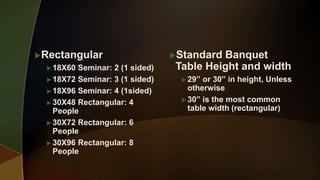
Standard Banquet
Table Height and width
 29” or 30” in height, Unless
otherwise
 30” is the most common
table width (rectangular)
Rectangular
 18X60 Seminar: 2 (1 sided)
 18X72 Seminar: 3 (1 sided)
 18X96 Seminar: 4 (1sided)
 30X48 Rectangular: 4
People
 30X72 Rectangular: 6
People
 30X96 Rectangular: 8
People
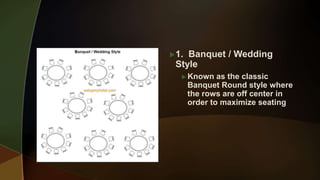
1. Banquet / Wedding
Style
 Known as the classic
Banquet Round style where
the rows are off center in
order to maximize seating
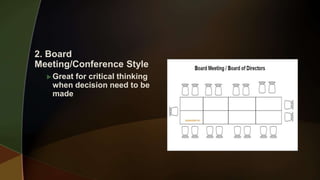
2. Board
Meeting/Conference Style
 Great for critical thinking
when decision need to be
made
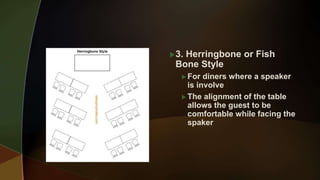
3. Herringbone or Fish
Bone Style
 For diners where a speaker
is involve
 The alignment of the table
allows the guest to be
comfortable while facing the
spaker
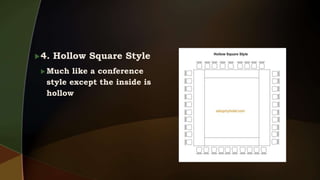
4. Hollow Square Style
 Much like a conference
style except the inside is
hollow
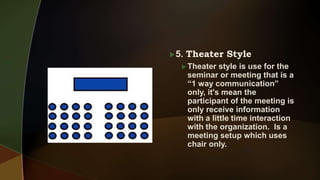
5. Theater Style
 Theater style is use for the
seminar or meeting that is a
“1 way communication”
only, it's mean the
participant of the meeting is
only receive information
with a little time interaction
with the organization. Is a
meeting setup which uses
chair only.
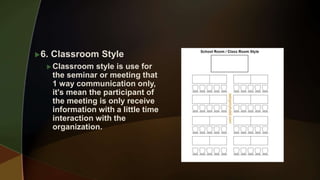
6. Classroom Style
 Classroom style is use for
the seminar or meeting that
1 way communication only,
it's mean the participant of
the meeting is only receive
information with a little time
interaction with the
organization.
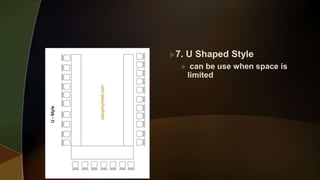
7. U Shaped Style
 can be use when space is
limited
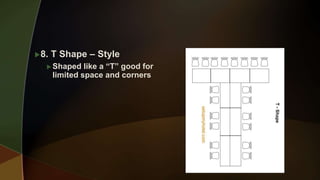
8. T Shape – Style
 Shaped like a “T” good for
limited space and corners
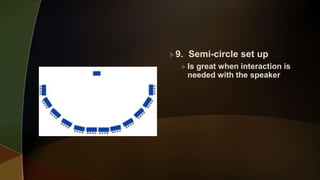
9. Semi-circle set up
 Is great when interaction is
needed with the speaker
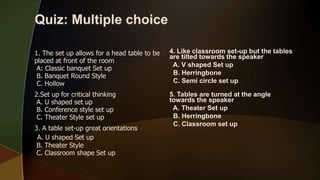
4. Like classroom set-up but the tables
are tilted towards the speaker
A. V shaped Set up
B. Herringbone
C. Semi circle set up
5. Tables are turned at the angle
towards the speaker
A. Theater Set up
B. Herringbone
C. Classroom set up
1. The set up allows for a head table to be
placed at front of the room
A: Classic banquet Set up
B. Banquet Round Style
C. Hollow
2.Set up for critical thinking
A. U shaped set up
B. Conference style set up
C. Theater Style set up
3. A table set-up great orientations
A. U shaped Set up
B. Theater Style
C. Classroom shape Set up
Banquet Setting

Banquet Setting

  • 1.
  • 2.
    1. HRAISC CHAIRS 2. URODN ROUND 3.LABET TABLE 4. TLOAYU LAY OUT
  • 3.
    Banquet is alarge catering activity where food & beverage are served for pre- arranged number of peoples on pre-fixed date & time, agreed menu & price.
  • 4.
    A banquet isa large meal or feast, complete with main courses and desserts, always served with alcoholic beverages, such as wine or beer.
  • 5.
    A banquet usuallyserves a purpose such as a charitable gathering, a ceremony, or a celebration, and is often preceded or followed by speeches in honor of someone.
  • 7.
    The idea ofbanqueting is quite ancient. In the 16th century, a banquet was very different from our modern perception and stems from the medieval 'ceremony of the void'. After dinner, the guests would stand and drink sweet wine and spices while the table was cleared, or ‘voided
  • 8.
    During the 16thcentury, guests would no longer stand in the great chamber whilst the table was cleared and the room prepared for entertainment, but would retire to the parlor or banqueting room.
  • 9.
    As the ideaof banqueting developed, it could take place at any time during the day and have much more in common with the later practice of taking tea. Banqueting rooms varied greatly from house to house, but were generally on an intimate scale, either in a garden room or inside such as the small banqueting turrets in Longleaf House
  • 10.
    Today, banquets servemany purposes from training sessions, to formal business dinners. Business banquets are a popular way to strengthen bonds between businessmen and their partners. It is common that a banquet is organized at the end of an academic conference. A luau is one variety of banquet originally used in Hawaii.
  • 12.
    In this typeof function, certain procedures, such as seating the host, chief guest, guest of honor, and the invitees, serving the food and beverages are decided by the host. Functions hosted by the head of the country or state, military, formal wedding breakfasts are some of the examples of formal functions.
  • 13.
    In an informalfunction, no formalities and procedures are followed on seating, serving, and the dress codes. The service is indiscriminate of sex and rank. These functions normally include entertainment.
  • 14.
    The purpose ofthis type of function is to meet people, make new friends, entertain oneself, and For example, cocktail parties, wedding anniversaries, birthday parties, wedding dine and dance parties, etc.
  • 15.
    These are organizedby the business houses in order to make the consumers aware of their presence and to establish relationship with them.  Exhibitions, contests for home makers, fashion parades, dealer's meetings etc. are some of the examples.
  • 16.
    The purpose ofthis type of function is to share the knowledge and expertise and to discuss on matters of concern. Political conferences, trade union conferences, international and national conferences on important issues etc. are some of the examples.
  • 18.
    The Design anddecor of function rooms, like the food and beverages that are served in them, can take many forms. A simple coffee break can be served in an undecorated theme less room, while elaborated reception, meeting or reception has complex layout and decorations to fit the theme.
  • 19.
     Space availableinside the banquet hall.  Size of the audience ie (minimum guaranteed pax and maximum).  Expected level of activity and interaction required.  Place required for dinner tables, meeting tables and head tables.  Details of equipment's required eg projectors, screen, lecterns, Flip chart, board, dance floor, stage etc.  The type of service. Eg: Sit down full service, Buffet etc. Additionally the guests at banquets and catered events must be served quickly, the layout and service stations should be setup to allow for maximum staff efficiency. The best way to layout a room is dependent on a number of factors including:
  • 21.
    Square  24” Square:2 People  30” Square: 4 People  32” Square: 4 People  36” Square: 4 People  42” Square: 8 People  60” Square: 8-12 Peole Round  30” Round : 2-3 people  36” Round : 4 People  42” Round : 5 People  48” Round : 6 People  54” Round : 7-8 People  60” Round : 8 People  66” Round : 9-10 People  72” round : 10 People
  • 22.
    Standard Banquet Table Heightand width  29” or 30” in height, Unless otherwise  30” is the most common table width (rectangular) Rectangular  18X60 Seminar: 2 (1 sided)  18X72 Seminar: 3 (1 sided)  18X96 Seminar: 4 (1sided)  30X48 Rectangular: 4 People  30X72 Rectangular: 6 People  30X96 Rectangular: 8 People
  • 24.
    1. Banquet /Wedding Style  Known as the classic Banquet Round style where the rows are off center in order to maximize seating
  • 25.
    2. Board Meeting/Conference Style Great for critical thinking when decision need to be made
  • 26.
    3. Herringbone orFish Bone Style  For diners where a speaker is involve  The alignment of the table allows the guest to be comfortable while facing the spaker
  • 27.
    4. Hollow SquareStyle  Much like a conference style except the inside is hollow
  • 28.
    5. Theater Style Theater style is use for the seminar or meeting that is a “1 way communication” only, it's mean the participant of the meeting is only receive information with a little time interaction with the organization. Is a meeting setup which uses chair only.
  • 29.
    6. Classroom Style Classroom style is use for the seminar or meeting that 1 way communication only, it's mean the participant of the meeting is only receive information with a little time interaction with the organization.
  • 30.
    7. U ShapedStyle  can be use when space is limited
  • 31.
    8. T Shape– Style  Shaped like a “T” good for limited space and corners
  • 32.
    9. Semi-circle setup  Is great when interaction is needed with the speaker
  • 34.
    4. Like classroomset-up but the tables are tilted towards the speaker A. V shaped Set up B. Herringbone C. Semi circle set up 5. Tables are turned at the angle towards the speaker A. Theater Set up B. Herringbone C. Classroom set up 1. The set up allows for a head table to be placed at front of the room A: Classic banquet Set up B. Banquet Round Style C. Hollow 2.Set up for critical thinking A. U shaped set up B. Conference style set up C. Theater Style set up 3. A table set-up great orientations A. U shaped Set up B. Theater Style C. Classroom shape Set up