International Journal of Trend in Scientific Research and Development (IJTSRD)
Volume 4 Issue 6, September-October 2020 Available Online: www.ijtsrd.com e-ISSN: 2456 – 6470
@ IJTSRD | Unique Paper ID – IJTSRD33435 | Volume – 4 | Issue – 6 | September-October 2020 Page 676
Review Article on Valsartan
Mr. Sandeep Markad, Dr. Amit Kasabe, Dr. Ashok Bhosale
Department of Pharmaceutical Quality Assurance, Shankarrao Ursal College of
Pharmaceutical Sciences & Research Centre, Kharadi, Pune, Maharashtra, India
ABSTRACT
A simple, sensitive, rapidand reproducible HPLCmethod has been developed
and validated for Calibration determination of Valsartan in bulk and in
pharmaceutical formulation by applying Quality intentionally. For
development of HPLC method for Valsartan various trials are performed by
using Design Expert software by applying 3 level factorial designs.
Quantitative method development by optimization from trials intentionally
Expert software. The Optimized method Desirabilityis0.998 for Mobile Phase
ACN: Phosphate Buffer (65:35) in3.5 pH at maximum Wavelength 274nm at
column oven temperature 40°C. The flow of mobile phase was adjusted 1.0
ml/min. and therefore the injection volume 10 µl. Optimised Standard curve
showed a parametric statistic is 0.998. Retention time wasfoundtobe4.6min.
the half of recovery was found to be within the bounds of the acceptance
criteria with average recovery of 99.4 you take care of Valsartan. The tactic
was validated as per ICH guidelines. The precision and repeatability results
showed % RSD but 2%. The developed method was successfully validated in
consistent with ICH guidelines. Hence, these methods are often conveniently
adopted for the routine analysis in internal control laboratories.
KEYWORDS: Quality intentionally, Valsartan, HPLC, Design Expert Software
How to cite this paper: Mr. Sandeep
Markad | Dr. Amit Kasabe | Dr. Ashok
Bhosale "Review Article on Valsartan"
Published in
International Journal
of Trend in Scientific
Research and
Development (ijtsrd),
ISSN: 2456-6470,
Volume-4 | Issue-6,
October 2020,
pp.676-683, URL:
www.ijtsrd.com/papers/ijtsrd33435.pdf
Copyright © 2020 by author(s) and
International Journal of TrendinScientific
Research and Development Journal. This
is an Open Access article distributed
under the terms of
the Creative
Commons Attribution
License (CC BY 4.0)
(http://creativecommons.org/licenses/by/4.0)
INTRODUCTION
Valsartan may be a non-peptide compound, chemically
describes as“(S)-3-methyl-2-(N-{[2′-(2H-1,2,3,4-tetrazol-5-
yl)biphenyl-4-yl]methyl}-pentanamido)-butanoicacid”,(Val,
Figure 1) used as angiotensin II receptor antagonist having
high specificity for AT1 subtype1. Angiotensin II receptor
antagonists,also referred to as angiotensinreceptorblockers
(ARBs) or sartans, are a gaggle of pharmaceuticals that
modulate the renin-angiotensin-aldosterone system.
Currently, there are seven ARBs (losartan, valsartan,
candesartan, irbesartan, eprosartan, telmisartan and
olmisartan) which are approved by USFDA and utilized in
preventing first occurrence of fibrillation than beta-blocker
(atenolol) or calcium antagonist (amlodipine) therapy2.
Hydrochlorothiazide chemically describes as “6-chloro-3,4-
dihydro-2H-1,2,4-benzothiadiazine-7-sulfonamide” (HCT,
Figure 1b) is employed as diuretic in binary combination
with thecardiovascular agents so as to extend their effects3-
4. Several HPLC methods for the estimation ofARBalongside
HCT4-6 were reported during last 20 years. Simultaneous
determination of Val and HCT using various
spectrophotometric methods7-11, HPLC12-16,HPTLC15,17,
and capillary electrophoresis18 is documented.Additionally,
HPLC-MS–MS was applied for the quantification of both
drugs in human plasma.
Figure 1: Structure of Valsartan
Although a couple of published methods, are stability
indicating developed on random basis by modifying one
parameter (“One parameter ata time”, OPAT). ICH (ICH, Q8-
R1, R2) guideline states “Quality by Design” (QbD) as “a
systematic approach to development that begins with
predefined objectives and emphasizes product and process
understanding and process control, supportedsoundscience
and quality risk management” 22,23. Literature survey
reveals that a non-stability indicating HPLC method16 was
developed utilizing design of experiment protocol (DoE) for
estimation of valsartan. The parameters studied were pH
(2.8 to 3.2), flow-rate (0.8 to 1.2 ml/min) and detection
wavelength (248 to 252 nm). Careful examination indicates
that the pH and wavelength are producing moderate slight
IJTSRD33435
International Journal of Trend in Scientific Research and Development (IJTSRD) @ www.ijtsrd.com eISSN: 2456-6470
@ IJTSRD | Unique Paper ID – IJTSRD33435 | Volume – 4 | Issue – 6 | September-October 2020 Page 677
effect on the height area, tailing factor and theoretical plate
count (perturbation plots and equation)16. Thecomposition
of mobile phase was kept constant. Since the valsartan may
be a BCSclassII drug has low solubility, a correct selectionof
mobile phase is requires, while HCT has different
characteristic. Keeping these parameters in mind this
method was developed. Pharmaceutical industries are
paying more attentions on the event of analytical methods
utilizing “Quality by Design” (QbD). Robust analytical
methods which may deliver the intended performance are
often developed and validated utilizing the concepts of
“Analytical Qualityby Design”(AQbD). AQbD usesascientific
approach to make sure quality by developing a radical
understanding of interaction of various component and
process involved in analysis. The tactic development and
validation utilising different aspects of AQbD are often
improved and optimized for the routine analysis, internal
control and analysis of product under development. Several
analytical methods having deficiencies are still used for the
standard control and analysis is often improved using the
AQbD. The experimental conditionswith different variables
(two or more) are often optimized using “Design of
experiments” (DoE) 23-29. this work was aimed to develop,
optimize and validate a sensitive, specific, precise, accurate
and stability indicatingmethod for the estimation ofValand
HCT (in presence of possible degraded products) in active
pharmaceutical ingredient (API) and tablets utilizing
“Analytical Quality by Design”.
Method:
1. Preliminary Analysis of Drug
A. Description
Colour and texture of Valsartanwascomparedwithreported
characters mentioned in drug bank.
B. Solubility
Solubility of Valsartan decided in various solvents like
methanol, ethanol and Acetonitrile.
C. UV Analysis
UV analysis was administered by scanning the answer of
Valsartan at 200-400 nm.
2. Design of Experiment
2-level factorial designs by Design expert 8 Software.
Two-level factorial design isan experimental matrixthathas
limited application in factorial design when the factor
number is above 2 because the amount of experiments
required for this design (calculated by expression N = 2k,
where N is experiment number and k is factor number) is
extremely large, thereby losing its efficiency within the
modelling of Linear functions.
Selection of Dependant factors
1. Mobile Phase
2. pH of Mobile phase
Selection of Independent factors
1. Retention Time
2. Area
3. Theoretical Plate
4. Asymmetry
Columns used
 C18 Column
Following mobile phases selected
 Water : Methanol
 Water : Acetonitrile
 Phosphate Buffer : Acetonitrile
Miscellaneous Factorial designs facilitate only one
mobile phase at a time:
 Water : Acetonitrile
 Change pH Range: 4-6
 Change Mobile phase proportion Range: 35-65%
(Consider Acetonitrile)
 Change flow rate range: 0.9 to 1mL/min
When all of above ranges put in 2 Level Factorial design. It
gave 08 run at different pH and Mobile phase proportion.
Follow same procedure for every mobilephase.ColumnC-18
has four mobile Phaseswith 24 run eachmobile phase. After
completion of all trails software give one optimizebestvalue
for every column. Optimization means finding an alternate
with the foremost cost effective or highest achievable
performance under the given constraints, by maximizing
desired factorsand minimizing undesiredones.Ascompared,
maximization means trying to achieve the very best or
maximum result or outcome without reference to cost or
expense.
3. Preparation of mobile phase
65 ml of HPLC grade Methanol was added to 35 ml of Water
i.e. in 65: 35 v/v proportions. The pH was adjusted to 4 with
phosphoric acid .the answer was filtered through 0.45μ
membrane filter then sonicated in sonicator bathfor10min.
4. Preparation of stock solutions of Valsartan
Stock solution was prepared by dissolving 10 mg Valsartan
in Acetonitrile then diluted with Acetonitrile in 10 ml of
volumetric flask to urge concentration of 1000 µg/ml. From
the resulting solution 0.4 ml was diluted to 10 ml with
Acetonitrile to get concentration of 40 µg/ml of Valsartan
and labelled as standard stock Valsartan.
5. Selection of detection wavelength
From the quality stock solution further dilutions were done
using Methanol and scanned over the range of 200-400 nm
and therefore the spectra were overlain. It had been
observed that drug showed considerableabsorbance at 274
nm.
A. Optimization Result
Screening design for suitable chromatographic
condition:
Determination of solvent system supported peak
parameters. Methanol: water/ ACN: water and ACN:
Ammonium Format Buffer, these three mobile phases were
selected for screening study on C18 columns at pH 4.0 and
6.0. These mobile phases were screened by varying the
organic phase composition from 40 to hour v/v. flow was
varying form 0.9-1 ml/min.
International Journal of Trend in Scientific Research and Development (IJTSRD) @ www.ijtsrd.com eISSN: 2456-6470
@ IJTSRD | Unique Paper ID – IJTSRD33435 | Volume – 4 | Issue – 6 | September-October 2020 Page 678
Results of various trials, having organic phase composition 65 % v/v are shown in following tables.
Table 1.Trials performed on C18 column at mobile phase (65:35 v/v) with aqueous phase pH 4
Sr. no. Composition Observation Remarks
1 Methanol: water Less peak asymmetry but less theoretical plates Satisfied
2 ACN: buffer
Less peak asymmetry with more theoretical plates and
good retention time with greater peak height
Extremely Satisfactory
3 ACN: water Greater peak Asymmetry and lower theoretical plates Not satisfactory
Optimized chromatographic conditions
Mobile phase: Phosphate buffer: Acetonitrile (35: 65 v/v), pH of buffer: 4, Analytical column: C18columnWatersXBridge(4.6×
250mm id. particle size 5µm), UV detection: 274 nm, Injection volume: 10 µL, Flow rate: 1.00 mL min -1, Temperature:
Ambient, Run time: 10 min
Effect of independent variables on retention time (X):
After applying experimental design, suggested Factorial Model was found to be significantwith model F value of52.03,pvalue
but 0.005 and R2 value of 0.000. There’s only a 0.01% chance that a "Model F-Value" thismassive could occur thanks to noise.
Values of twenty-twoC.V. andadjusted R2 were 28.87 and0.000 respectively. The model for response X (Retention time)isas
follows:
The equation for Factorial model is as follows
Retention Time (X)= +8.24
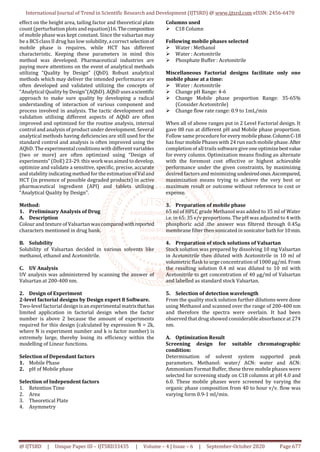
Fig.2 shows a graphical representation of pH of buffer (B) and amount of ACN (A), while flow (C) is maintained constant at its
optimum of 1 mL min-1.
Changein pH of buffer showed slightly change in retention time (X), also increase inamount of Acetonitrile showed decreases
the retention time.
Design-Expert® Software
Factor Coding: Actual
Retention Time
Design points above predicted value
Design points below predicted value
12.54
4.6
X1 = A: Mobile Phase
X2 = B: pH
Actual Factor
C: Flow Rate = 1.00
4.00
4.50
5.00
5.50
6.00
35.00
41.00
47.00
53.00
59.00
65.00
4
6
8
10
12
14
RetentionTime
A: Mobile Phase
B: pH
8.2375
Fig.2Three-dimentional plot for retention time as a function of pH of buffer and amount of buffer. Constant factor
(flow rate- 1mL min-1)
Fit summary: Quadratic model was suggested by the software.
ANOVA: ANOVA of developed 2 level factorial models for retention time (Y1).
Values of "Prob > F" (p- value) but 0.0500 indicate model terms are significant.
During this case all factors are significant model terms. E
Table 2.Significance of p value on model terms of retention time
Source Sum ofSquare Df MeanSquares
Model 0.000 0
Residual 86.66 7 12.38
Cor Total 86.66 7
Effect of independent variables on tailing factor (Y):
After applying experimental design, suggested Response SurfaceLinear Model wasfoundtobesignificantwithmodelFvalueof
1.19, p value but 0.005 and R2 value of 0.0000. There’s only a 0.0001%chance thata "Model F-Value" this massivecouldoccur
thanks to noise. Values of twenty-two C.V. and adjusted R2 were 24.44 and 0.0000 respectively. The model for response
Y (Tailing factor) is as follows:
Y = +1.37
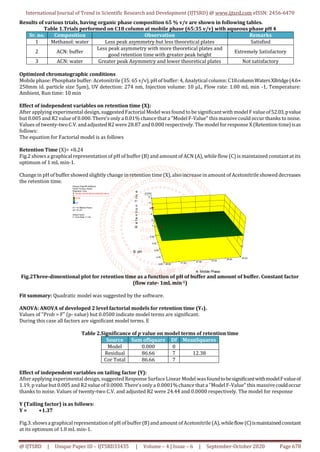
Fig.3. showsa graphical representation of pH of buffer (B)and amount ofAcetonitrile (A),whileflow(C)ismaintainedconstant
at its optimum of 1.0 mL min-1.
International Journal of Trend in Scientific Research and Development (IJTSRD) @ www.ijtsrd.com eISSN: 2456-6470
@ IJTSRD | Unique Paper ID – IJTSRD33435 | Volume – 4 | Issue – 6 | September-October 2020 Page 679
As increasesin pH of buffer hadantagonistic effect on response while increase inamount of Acetonitrile showeddecreasesthe
asymmetric factor.
Design-Expert® Software
Factor Coding: Actual
Asymmetric Factor
Design points above predicted value
Design points below predicted value
1.97
0.9
X1 = A: Mobile Phase
X2 = B: pH
Actual Factor
C: Flow Rate = 1.00
4.00
4.50
5.00
5.50
6.00
35.00
41.00
47.00
53.00
59.00
65.00
0.8
1
1.2
1.4
1.6
1.8
2
AsymmetricFactor
A: Mobile Phase
B: pH
1.37038
Fig.3 Three-dimentional plot for tailing factor as a function of pH of buffer and % v/v of buffer. Constant factor
(flow rate- 1mL min-1)
Fit summary: Response Surface Linear Model was suggested by the software.
ANOVA: ANOVA of developed factorial model for tailing factor (Y).
Values of "Prob>F" (p-value) less than 0.0500 indicate model terms are significant.
In this case A, B are significant model terms.
Table 3.Significance of p value on model terms of tailing factor
Source Sum ofSquare Df MeanSquares
Model 0.000 0
Residual 0.87 7 0.12
Cor Total 0.87 7
Effect of independent variables on theoretical plates (Z):
After applying experimental design, suggested Response Surface Quaratic Model was foundtobesignificantwithmodelFvalue
of two .65, p value but 0.005 and R2 value of 0.000. There’s only a 0.0001% chance that a "Model F-Value" this massive could
occur thanks to noise. Values of twenty-twoC.V. andadjusted R2 were 69.42 and 0.000 respectively. The model for responseZ
(theoretical plates) is as follows:
Z= +7289.13
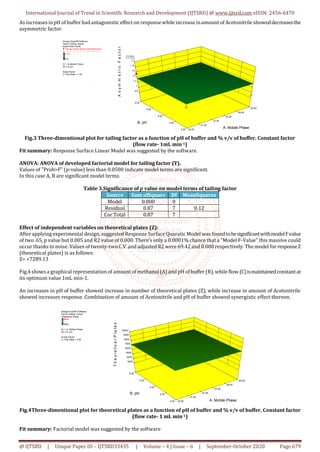
Fig.4 showsa graphical representation of amount ofmethanol (A) and pH ofbuffer (B),while flow (C)ismaintainedconstantat
its optimum value 1mL min-1.
An increases in pH of buffer showed increase in number of theoretical plates (Z), while increase in amount of Acetonitrile
showed increases response. Combination of amount of Acetonitrile and pH of buffer showed synergistic effect thereon.
Design-Expert® Software
Factor Coding: Actual
Theoretical Plates
9865
3980
X1 = A: Mobile Phase
X2 = B: pH
Actual Factor
C: Flow Rate = 0.95
4.00
4.50
5.00
5.50
6.00
35.00
41.00
47.00
53.00
59.00
65.00
3000
4000
5000
6000
7000
8000
9000
10000
TheoreticalPlates
A: Mobile Phase
B: pH
Fig.4Three-dimentional plot for theoretical plates as a function of pH of buffer and % v/v of buffer. Constant factor
(flow rate- 1 mL min-1)
Fit summary: Factorial model was suggested by the software
International Journal of Trend in Scientific Research and Development (IJTSRD) @ www.ijtsrd.com eISSN: 2456-6470
@ IJTSRD | Unique Paper ID – IJTSRD33435 | Volume – 4 | Issue – 6 | September-October 2020 Page 680
ANOVA: ANOVA of developed CCD model for theoretical plates (Z).
Values of "Prob > F" (p- value) less than 0.0500 indicate model terms are significant.
In this case model is significant.
Table 4.Significance of p value on model terms of theoretical plates
Source Sum ofSquare df MeanSquares
Model 0.000 0
Residual 3.074E+007 7 4.392E+006
Cor Total 3.074E+007 7
Validation:
1. Linearity:
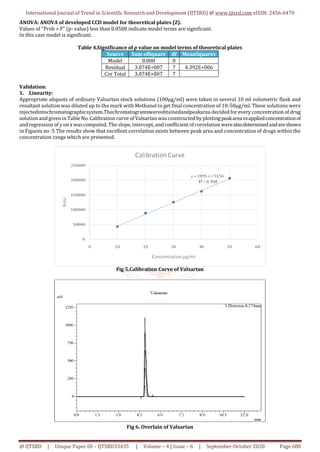
Appropriate aliquots of ordinary Valsartan stock solutions (100µg/ml) were taken in several 10 ml volumetric flask and
resultant solution was diluted up to the mark with Methanol to get final concentration of 10-50µg/ml. These solutions were
injectedintochromatographicsystem.Thechromatogramswereobtainedandpeakarea decided for every concentration of drug
solution and given in Table No. Calibration curve of Valsartan wasconstructed by plottingpeakareavsappliedconcentrationof
and regression of y on x wascomputed. The slope, intercept, andcoefficient ofcorrelation werealsodeterminedandareshown
in Figures no :5 The results show that excellent correlation exists between peak area and concentration of drugs within the
concentration range which are presented.
Fig 5.Calibration Curve of Valsartan
Fig 6. Overlain of Valsartan
International Journal of Trend in Scientific Research and Development (IJTSRD) @ www.ijtsrd.com eISSN: 2456-6470
@ IJTSRD | Unique Paper ID – IJTSRD33435 | Volume – 4 | Issue – 6 | September-October 2020 Page 681
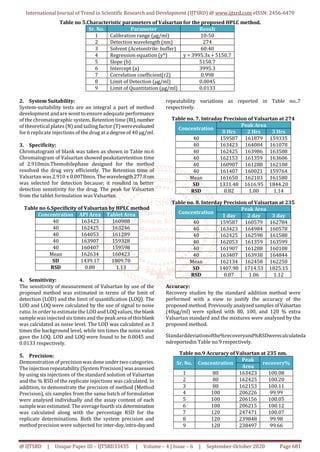
Table no 5.Characteristic parameters of Valsartan for the proposed HPLC method.
Sr. No. Parameter Result
1 Calibration range (µg/ml) 10-50
2 Detection wavelength (nm) 274
3 Solvent (Acetonitrile: buffer) 60:40
4 Regression equation (y*) y = 3995.3x + 5150.7
5 Slope (b) 5150.7
6 Intercept (a) 3995.3
7 Correlation coefficient(r2) 0.998
8 Limit of Detection (µg/ml) 0.0045
9 Limit of Quantitation (µg/ml) 0.0133
2. System Suitability:
System-suitability tests are an integral a part of method
development and are wont to ensure adequate performance
of the chromatographic system. Retention time (Rt),number
of theoretical plates (N) and tailingfactor (T)wereevaluated
for 6 replicate injections of the drug at a degree of 40 µg/ml.
3. Specificity:
Chromatogram of blank was taken as shown in Table no.6
Chromatogram of Valsartan showed peakataretention time
of 2.910min.Themobilephase designed for the method
resolved the drug very efficiently. The Retention time of
Valsartanwas 2.910 ± 0.0078min. The wavelength277.8nm
was selected for detection because; it resulted in better
detection sensitivity for the drug. The peak for Valsartan
from the tablet formulation was Valsartan.
Table no 6.Specificity of Valsartan by HPLC method
Concentration API Area Tablet Area
40 163423 160988
40 162425 163246
40 164053 161289
40 163907 159328
40 160407 159598
Mean 162634 160423
SD 1439.17 1809.70
RSD 0.88 1.13
4. Sensitivity:
The sensitivity of measurement of Valsartan by use of the
proposed method was estimated in terms of the limit of
detection (LOD) and the limit of quantification (LOQ). The
LOD and LOQ were calculated by the use of signal to noise
ratio. In order to estimate the LODand LOQ values, theblank
sample was injected six timesand the peak area of thisblank
was calculated as noise level. The LOD was calculated as 3
times the background level, while ten times the noise value
gave the LOQ. LOD and LOQ were found to be 0.0045 and
0.0133 respectively.
5. Precision:
Demonstration of precision was done under two categories.
The injection repeatability (System Precision)wasassessed
by using six injections of the standard solution of Valsartan
and the % RSD of the replicate injections was calculated. In
addition, to demonstrate the precision of method (Method
Precision), six samples from the same batch of formulation
were analysed individually and the assay content of each
sample was estimated. Theaveragefourth six determination
was calculated along with the percentage RSD for the
replicate determinations. Both the system precision and
method precision were subjected for inter-day,intra-dayand
repeatability variations as reported in Table no..7
respectively.
Table no. 7. Intraday Precision of Valsartan at 274
Concentration
Peak Area
0 Hrs 2 Hrs 3 Hrs
40 159587 161879 159335
40 163423 164084 161078
40 162425 163986 163588
40 162153 161359 163606
40 160907 161288 162108
40 161407 160021 159764
Mean 161650 162103 161580
SD 1331.48 1616.95 1844.20
RSD 0.82 1.00 1.14
Table no. 8. Interday Precision of Valsartan at 235
Concentration
Peak Area
1 day 2 day 3 day
40 159587 160579 162784
40 163423 164984 160578
40 162425 162598 161588
40 162053 161359 163599
40 161907 161288 160108
40 163407 163938 164844
Mean 162134 162458 162250
SD 1407.98 1714.53 1825.15
RSD 0.87 1.06 1.12
Accuracy:
Recovery studies by the standard addition method were
performed with a view to justify the accuracy of the
proposed method. Previously analyzed samples ofValsartan
(40µg/ml) were spiked with 80, 100, and 120 % extra
Valsartan standard and the mixtures were analyzed by the
proposed method.
Standarddeviationofthe%recoveryand%RSDwerecalculateda
ndreportedin Table no.9 respectively.
Table no.9 Accuracy of Valsartan at 235 nm.
Sr. No. Concentration
Peak
recovery%
Area
1 80 163423 100.08
2 80 162425 100.20
3 80 162153 100.11
4 100 206226 99.99
5 100 206156 100.05
6 100 206215 100.12
7 120 247471 100.07
8 120 239848 99.98
9 120 238497 99.66
International Journal of Trend in Scientific Research and Development (IJTSRD) @ www.ijtsrd.com eISSN: 2456-6470
@ IJTSRD | Unique Paper ID – IJTSRD33435 | Volume – 4 | Issue – 6 | September-October 2020 Page 682
Robustness:
Robustness is a measure of capacity of a method to remain
unaffected by small, but deliberate variations in the method
conditions, and is indication so there liability of the method.
a method is robust, if it sun affected by small changes in
operating conditions. To determine the robustness of this
method, the experimental conditions were deliberately
altered at three different levels and retention time and
chromatographic response were evaluated .One factor at a
time was changed to study the effect .Variation of mobile
phase composition (Acetonitrile: Water and Acetonitrile:
buffer) and mobile phase flow rate by 1.0 ml/min had no
significant effect on the retention time and chromatographic
response of the 40 µg/ml solution, indicating that the
method was robust. The results are shown in Table no.10&
11 respectively.
Table no. 10 Robustness of Valsartan at 274. Nm
Conc. (µg/ml)
Area
Acetonitrile:
Buffer
Acetonitrile:
Water
40 161879 12126
40 163084 12568
40 163986 12689
40 161359 12689
40 161288 12878
40 160021 12888
Mean 161936 12640
SD 1410.23 280.12
RSD 0.87 2.22
Table no. 11 Robustness of Valsartan at 274 nm and
265 nm
Conc. (µg/ml)
Area
274 nm 265 nm
40 162587 150815
40 163423 153579
40 163825 154284
40 162153 153968
40 159907 153277
40 161407 150589
Mean 162217 152752
SD 1426.41 1625.78
RSD 0.88 1.06
References:
[1] Khopkar SM. Basic Concept of Analytical Chemistry.
2nd ed. New Delhi: New Age International Ltd.
Publishers; 1998. p. 1, 178-179.
[2] Christen GD. Analytical Chemistry. 5th ed. John Wiley
and Sons; 2003. p. 35-42, 131-132.
[3] Skoog DA, Holler FJ, Crouch SR. Principle of
Instrumental Analysis. 5th ed. Thomson Brooks/Cole.;
2004. p. 1-2, 678-688.
[4] Beckett AH, Stenlake JB. Practical Pharmaceutical
Chemistry. Part-2. 4th ed. New Delhi: CBS Publishers
and Distributors; 2002. p. 275-325.
[5] Chatwal GR, Sharma AK. Instrumental Methods of
qualitative analysis. 5thed. Mumbai: Himalaya
Publishing House; 2002. p. 2.149-2.184.
[6] handbook Pharmaspec, UV 1601 Series, Operation
Guide, Shimadzu Spectrophotometer. Japan:Shimadzu
Corporation Koyoto; 2001. p. 5.16, 8.2.
[7] Swarbrick J, Boylan JC. Encyclopedia ofPharmaceutical
Technology. Vol-1. 3rd ed. New York: Marcel Dekker
Inc.; 1997. p. 538-540.
[8] Skoog DA, Holler FJ, Nieman TA. Principles of
Instrumental Analysis. 6th ed., Thomson Brooks/Cole.;
2007. p. 762-63,816-827.
[9] Dong MW. Modern HPLCfor practicing scientists.New
Jersey: John Wiley & Sons, Inc., Publication, Hoboken;
2006.p. 1-9.
[10] Sethi PD. High Performance Liquid Chromatography,
quantitative chemical analysis of Pharmaceutical
Formulations. 1st ed. New Delhi: CBS Publishers and
Distributors; 2001.p. 3-11, 116-120.
[11] Weston A, Brown PR. High Performance Liquid
Chromatography, and CE – Principles and practice. 1st
ed. California: Academic Press; 1997. p. 1-4, 8-11, 24-
26, 29-32, 71.
[12] Willard HH, Meritt LL, Dean JA, Settle F. Instrumental
Method of study, 7th ed. Delhi: CBS Publishers and
Distributors; 2001.p.14.
[13] Swadesh JK. HPLC Practical and Industrial
Applications. 2nd ed. USA:CRCPress;2000.p.141-143.
[14] ICH, (Q2R1), Harmonized Tripartite Guideline,
Validation of analytical procedures: Text and
Methodology, IFPMA. Geneva; 2005. p. 1- 13.
[15] ICH, (Q2A), Harmonized Tripartite Guideline, Text on
Validation of Analytical Procedures. IFPMA. Geneva;
1994. p. 1-5.
[16] ICH, (Q2B), Harmonized Tripartite Guideline,
Validation of AnalyticalProcedures: Methodology,Text
and Methodology, IFPMA. Geneva; 1996. p. 1-8.
[17] The United state Pharmacopoeia, The National
formulary, Asian ed. USA: published by United state
pharmacopoeial convention; 2003. p. 960.
[18] Nash RA, Wachter AH. Pharmaceutical process
validation. 3rd ed. New York: Marcel DekkerInc.;2003.
p. 1-10.
[19] Gennaro AR. Remington: The Science and Practice of
Pharmacy. 20th ed. vol-1. Philadelphia: Lippincott
Williams and Wilkin; 2000. Page no.587.
[20] Anjeneyulu Y, Chandrasekhar K, Manikam V. A
Textbook of Analytical Chemistry. Pharmamed Press
BSP Books; 2008.p.1-2.
[21] Somenath M. Sample Preparation Techniques in
Analytical Chemistry. 1st ed. New York: Wiley
Interscience; 2003. P.13-16.
[22] Raynord P. Liquid Chromatography for the Analyst.
New York: Marcel Dekker Inc; 1994. p.2.
[23] Scott RW. Principal and Practice of Chromatography.
1st ed. Chrom-Ed Book Series. p. 1-3, 12-14.
International Journal of Trend in Scientific Research and Development (IJTSRD) @ www.ijtsrd.com eISSN: 2456-6470
@ IJTSRD | Unique Paper ID – IJTSRD33435 | Volume – 4 | Issue – 6 | September-October 2020 Page 683
[24] D. M. Brahmankar and Sunil B. Jaiswal,
Biopharmaceutics and Pharmacokinetics, 3rd Edition,
Delhi VallabhPrakashan, Page No-9 to 35.
[25] ICH, Guidance on Analytical Method Validation, In:
Proceeding of the International Convention on Quality
for the Pharmaceutical Industry. Toronto, Canada;
2002.
[26] Alfonso R. Gennaro, Remington: The Science and
Practice of Pharmacy, Volume II, 20th Edition,
Lippincott Williams and Wilkins Publication.
[27] Pharmaceutical Dosage Forms: ParenteralMedications
Volume I, 2nd Edition Edited by Kenneth E. Avis,
Herbert A. Liberman and Leon Lachman.
[28] Theory and Practice of commercial Pharmacy, ByLeon
Lachman, Herbert A. Liberman, Joseph L. Kanig, 3rd
Edition, Indian Edition, Varghese publisher, Dadar,
Bombay.
[29] The Merck Index, An Encyclopedia Of Chemical, Drug’s
and Biologicals. Maryadele J. O. Neil. Eds, 14th ed.
Whitehouse Station, NJ: Published by Merck lab,
Division of Merck and co. Inc; 2006. p. 857, 1422.

Review Article on Valsartan

  • 1.
    International Journal ofTrend in Scientific Research and Development (IJTSRD) Volume 4 Issue 6, September-October 2020 Available Online: www.ijtsrd.com e-ISSN: 2456 – 6470 @ IJTSRD | Unique Paper ID – IJTSRD33435 | Volume – 4 | Issue – 6 | September-October 2020 Page 676 Review Article on Valsartan Mr. Sandeep Markad, Dr. Amit Kasabe, Dr. Ashok Bhosale Department of Pharmaceutical Quality Assurance, Shankarrao Ursal College of Pharmaceutical Sciences & Research Centre, Kharadi, Pune, Maharashtra, India ABSTRACT A simple, sensitive, rapidand reproducible HPLCmethod has been developed and validated for Calibration determination of Valsartan in bulk and in pharmaceutical formulation by applying Quality intentionally. For development of HPLC method for Valsartan various trials are performed by using Design Expert software by applying 3 level factorial designs. Quantitative method development by optimization from trials intentionally Expert software. The Optimized method Desirabilityis0.998 for Mobile Phase ACN: Phosphate Buffer (65:35) in3.5 pH at maximum Wavelength 274nm at column oven temperature 40°C. The flow of mobile phase was adjusted 1.0 ml/min. and therefore the injection volume 10 µl. Optimised Standard curve showed a parametric statistic is 0.998. Retention time wasfoundtobe4.6min. the half of recovery was found to be within the bounds of the acceptance criteria with average recovery of 99.4 you take care of Valsartan. The tactic was validated as per ICH guidelines. The precision and repeatability results showed % RSD but 2%. The developed method was successfully validated in consistent with ICH guidelines. Hence, these methods are often conveniently adopted for the routine analysis in internal control laboratories. KEYWORDS: Quality intentionally, Valsartan, HPLC, Design Expert Software How to cite this paper: Mr. Sandeep Markad | Dr. Amit Kasabe | Dr. Ashok Bhosale "Review Article on Valsartan" Published in International Journal of Trend in Scientific Research and Development (ijtsrd), ISSN: 2456-6470, Volume-4 | Issue-6, October 2020, pp.676-683, URL: www.ijtsrd.com/papers/ijtsrd33435.pdf Copyright © 2020 by author(s) and International Journal of TrendinScientific Research and Development Journal. This is an Open Access article distributed under the terms of the Creative Commons Attribution License (CC BY 4.0) (http://creativecommons.org/licenses/by/4.0) INTRODUCTION Valsartan may be a non-peptide compound, chemically describes as“(S)-3-methyl-2-(N-{[2′-(2H-1,2,3,4-tetrazol-5- yl)biphenyl-4-yl]methyl}-pentanamido)-butanoicacid”,(Val, Figure 1) used as angiotensin II receptor antagonist having high specificity for AT1 subtype1. Angiotensin II receptor antagonists,also referred to as angiotensinreceptorblockers (ARBs) or sartans, are a gaggle of pharmaceuticals that modulate the renin-angiotensin-aldosterone system. Currently, there are seven ARBs (losartan, valsartan, candesartan, irbesartan, eprosartan, telmisartan and olmisartan) which are approved by USFDA and utilized in preventing first occurrence of fibrillation than beta-blocker (atenolol) or calcium antagonist (amlodipine) therapy2. Hydrochlorothiazide chemically describes as “6-chloro-3,4- dihydro-2H-1,2,4-benzothiadiazine-7-sulfonamide” (HCT, Figure 1b) is employed as diuretic in binary combination with thecardiovascular agents so as to extend their effects3- 4. Several HPLC methods for the estimation ofARBalongside HCT4-6 were reported during last 20 years. Simultaneous determination of Val and HCT using various spectrophotometric methods7-11, HPLC12-16,HPTLC15,17, and capillary electrophoresis18 is documented.Additionally, HPLC-MS–MS was applied for the quantification of both drugs in human plasma. Figure 1: Structure of Valsartan Although a couple of published methods, are stability indicating developed on random basis by modifying one parameter (“One parameter ata time”, OPAT). ICH (ICH, Q8- R1, R2) guideline states “Quality by Design” (QbD) as “a systematic approach to development that begins with predefined objectives and emphasizes product and process understanding and process control, supportedsoundscience and quality risk management” 22,23. Literature survey reveals that a non-stability indicating HPLC method16 was developed utilizing design of experiment protocol (DoE) for estimation of valsartan. The parameters studied were pH (2.8 to 3.2), flow-rate (0.8 to 1.2 ml/min) and detection wavelength (248 to 252 nm). Careful examination indicates that the pH and wavelength are producing moderate slight IJTSRD33435
  • 2.
    International Journal ofTrend in Scientific Research and Development (IJTSRD) @ www.ijtsrd.com eISSN: 2456-6470 @ IJTSRD | Unique Paper ID – IJTSRD33435 | Volume – 4 | Issue – 6 | September-October 2020 Page 677 effect on the height area, tailing factor and theoretical plate count (perturbation plots and equation)16. Thecomposition of mobile phase was kept constant. Since the valsartan may be a BCSclassII drug has low solubility, a correct selectionof mobile phase is requires, while HCT has different characteristic. Keeping these parameters in mind this method was developed. Pharmaceutical industries are paying more attentions on the event of analytical methods utilizing “Quality by Design” (QbD). Robust analytical methods which may deliver the intended performance are often developed and validated utilizing the concepts of “Analytical Qualityby Design”(AQbD). AQbD usesascientific approach to make sure quality by developing a radical understanding of interaction of various component and process involved in analysis. The tactic development and validation utilising different aspects of AQbD are often improved and optimized for the routine analysis, internal control and analysis of product under development. Several analytical methods having deficiencies are still used for the standard control and analysis is often improved using the AQbD. The experimental conditionswith different variables (two or more) are often optimized using “Design of experiments” (DoE) 23-29. this work was aimed to develop, optimize and validate a sensitive, specific, precise, accurate and stability indicatingmethod for the estimation ofValand HCT (in presence of possible degraded products) in active pharmaceutical ingredient (API) and tablets utilizing “Analytical Quality by Design”. Method: 1. Preliminary Analysis of Drug A. Description Colour and texture of Valsartanwascomparedwithreported characters mentioned in drug bank. B. Solubility Solubility of Valsartan decided in various solvents like methanol, ethanol and Acetonitrile. C. UV Analysis UV analysis was administered by scanning the answer of Valsartan at 200-400 nm. 2. Design of Experiment 2-level factorial designs by Design expert 8 Software. Two-level factorial design isan experimental matrixthathas limited application in factorial design when the factor number is above 2 because the amount of experiments required for this design (calculated by expression N = 2k, where N is experiment number and k is factor number) is extremely large, thereby losing its efficiency within the modelling of Linear functions. Selection of Dependant factors 1. Mobile Phase 2. pH of Mobile phase Selection of Independent factors 1. Retention Time 2. Area 3. Theoretical Plate 4. Asymmetry Columns used  C18 Column Following mobile phases selected  Water : Methanol  Water : Acetonitrile  Phosphate Buffer : Acetonitrile Miscellaneous Factorial designs facilitate only one mobile phase at a time:  Water : Acetonitrile  Change pH Range: 4-6  Change Mobile phase proportion Range: 35-65% (Consider Acetonitrile)  Change flow rate range: 0.9 to 1mL/min When all of above ranges put in 2 Level Factorial design. It gave 08 run at different pH and Mobile phase proportion. Follow same procedure for every mobilephase.ColumnC-18 has four mobile Phaseswith 24 run eachmobile phase. After completion of all trails software give one optimizebestvalue for every column. Optimization means finding an alternate with the foremost cost effective or highest achievable performance under the given constraints, by maximizing desired factorsand minimizing undesiredones.Ascompared, maximization means trying to achieve the very best or maximum result or outcome without reference to cost or expense. 3. Preparation of mobile phase 65 ml of HPLC grade Methanol was added to 35 ml of Water i.e. in 65: 35 v/v proportions. The pH was adjusted to 4 with phosphoric acid .the answer was filtered through 0.45μ membrane filter then sonicated in sonicator bathfor10min. 4. Preparation of stock solutions of Valsartan Stock solution was prepared by dissolving 10 mg Valsartan in Acetonitrile then diluted with Acetonitrile in 10 ml of volumetric flask to urge concentration of 1000 µg/ml. From the resulting solution 0.4 ml was diluted to 10 ml with Acetonitrile to get concentration of 40 µg/ml of Valsartan and labelled as standard stock Valsartan. 5. Selection of detection wavelength From the quality stock solution further dilutions were done using Methanol and scanned over the range of 200-400 nm and therefore the spectra were overlain. It had been observed that drug showed considerableabsorbance at 274 nm. A. Optimization Result Screening design for suitable chromatographic condition: Determination of solvent system supported peak parameters. Methanol: water/ ACN: water and ACN: Ammonium Format Buffer, these three mobile phases were selected for screening study on C18 columns at pH 4.0 and 6.0. These mobile phases were screened by varying the organic phase composition from 40 to hour v/v. flow was varying form 0.9-1 ml/min.
  • 3.
    International Journal ofTrend in Scientific Research and Development (IJTSRD) @ www.ijtsrd.com eISSN: 2456-6470 @ IJTSRD | Unique Paper ID – IJTSRD33435 | Volume – 4 | Issue – 6 | September-October 2020 Page 678 Results of various trials, having organic phase composition 65 % v/v are shown in following tables. Table 1.Trials performed on C18 column at mobile phase (65:35 v/v) with aqueous phase pH 4 Sr. no. Composition Observation Remarks 1 Methanol: water Less peak asymmetry but less theoretical plates Satisfied 2 ACN: buffer Less peak asymmetry with more theoretical plates and good retention time with greater peak height Extremely Satisfactory 3 ACN: water Greater peak Asymmetry and lower theoretical plates Not satisfactory Optimized chromatographic conditions Mobile phase: Phosphate buffer: Acetonitrile (35: 65 v/v), pH of buffer: 4, Analytical column: C18columnWatersXBridge(4.6× 250mm id. particle size 5µm), UV detection: 274 nm, Injection volume: 10 µL, Flow rate: 1.00 mL min -1, Temperature: Ambient, Run time: 10 min Effect of independent variables on retention time (X): After applying experimental design, suggested Factorial Model was found to be significantwith model F value of52.03,pvalue but 0.005 and R2 value of 0.000. There’s only a 0.01% chance that a "Model F-Value" thismassive could occur thanks to noise. Values of twenty-twoC.V. andadjusted R2 were 28.87 and0.000 respectively. The model for response X (Retention time)isas follows: The equation for Factorial model is as follows Retention Time (X)= +8.24 Fig.2 shows a graphical representation of pH of buffer (B) and amount of ACN (A), while flow (C) is maintained constant at its optimum of 1 mL min-1. Changein pH of buffer showed slightly change in retention time (X), also increase inamount of Acetonitrile showed decreases the retention time. Design-Expert® Software Factor Coding: Actual Retention Time Design points above predicted value Design points below predicted value 12.54 4.6 X1 = A: Mobile Phase X2 = B: pH Actual Factor C: Flow Rate = 1.00 4.00 4.50 5.00 5.50 6.00 35.00 41.00 47.00 53.00 59.00 65.00 4 6 8 10 12 14 RetentionTime A: Mobile Phase B: pH 8.2375 Fig.2Three-dimentional plot for retention time as a function of pH of buffer and amount of buffer. Constant factor (flow rate- 1mL min-1) Fit summary: Quadratic model was suggested by the software. ANOVA: ANOVA of developed 2 level factorial models for retention time (Y1). Values of "Prob > F" (p- value) but 0.0500 indicate model terms are significant. During this case all factors are significant model terms. E Table 2.Significance of p value on model terms of retention time Source Sum ofSquare Df MeanSquares Model 0.000 0 Residual 86.66 7 12.38 Cor Total 86.66 7 Effect of independent variables on tailing factor (Y): After applying experimental design, suggested Response SurfaceLinear Model wasfoundtobesignificantwithmodelFvalueof 1.19, p value but 0.005 and R2 value of 0.0000. There’s only a 0.0001%chance thata "Model F-Value" this massivecouldoccur thanks to noise. Values of twenty-two C.V. and adjusted R2 were 24.44 and 0.0000 respectively. The model for response Y (Tailing factor) is as follows: Y = +1.37 Fig.3. showsa graphical representation of pH of buffer (B)and amount ofAcetonitrile (A),whileflow(C)ismaintainedconstant at its optimum of 1.0 mL min-1.
  • 4.
    International Journal ofTrend in Scientific Research and Development (IJTSRD) @ www.ijtsrd.com eISSN: 2456-6470 @ IJTSRD | Unique Paper ID – IJTSRD33435 | Volume – 4 | Issue – 6 | September-October 2020 Page 679 As increasesin pH of buffer hadantagonistic effect on response while increase inamount of Acetonitrile showeddecreasesthe asymmetric factor. Design-Expert® Software Factor Coding: Actual Asymmetric Factor Design points above predicted value Design points below predicted value 1.97 0.9 X1 = A: Mobile Phase X2 = B: pH Actual Factor C: Flow Rate = 1.00 4.00 4.50 5.00 5.50 6.00 35.00 41.00 47.00 53.00 59.00 65.00 0.8 1 1.2 1.4 1.6 1.8 2 AsymmetricFactor A: Mobile Phase B: pH 1.37038 Fig.3 Three-dimentional plot for tailing factor as a function of pH of buffer and % v/v of buffer. Constant factor (flow rate- 1mL min-1) Fit summary: Response Surface Linear Model was suggested by the software. ANOVA: ANOVA of developed factorial model for tailing factor (Y). Values of "Prob>F" (p-value) less than 0.0500 indicate model terms are significant. In this case A, B are significant model terms. Table 3.Significance of p value on model terms of tailing factor Source Sum ofSquare Df MeanSquares Model 0.000 0 Residual 0.87 7 0.12 Cor Total 0.87 7 Effect of independent variables on theoretical plates (Z): After applying experimental design, suggested Response Surface Quaratic Model was foundtobesignificantwithmodelFvalue of two .65, p value but 0.005 and R2 value of 0.000. There’s only a 0.0001% chance that a "Model F-Value" this massive could occur thanks to noise. Values of twenty-twoC.V. andadjusted R2 were 69.42 and 0.000 respectively. The model for responseZ (theoretical plates) is as follows: Z= +7289.13 Fig.4 showsa graphical representation of amount ofmethanol (A) and pH ofbuffer (B),while flow (C)ismaintainedconstantat its optimum value 1mL min-1. An increases in pH of buffer showed increase in number of theoretical plates (Z), while increase in amount of Acetonitrile showed increases response. Combination of amount of Acetonitrile and pH of buffer showed synergistic effect thereon. Design-Expert® Software Factor Coding: Actual Theoretical Plates 9865 3980 X1 = A: Mobile Phase X2 = B: pH Actual Factor C: Flow Rate = 0.95 4.00 4.50 5.00 5.50 6.00 35.00 41.00 47.00 53.00 59.00 65.00 3000 4000 5000 6000 7000 8000 9000 10000 TheoreticalPlates A: Mobile Phase B: pH Fig.4Three-dimentional plot for theoretical plates as a function of pH of buffer and % v/v of buffer. Constant factor (flow rate- 1 mL min-1) Fit summary: Factorial model was suggested by the software
  • 5.
    International Journal ofTrend in Scientific Research and Development (IJTSRD) @ www.ijtsrd.com eISSN: 2456-6470 @ IJTSRD | Unique Paper ID – IJTSRD33435 | Volume – 4 | Issue – 6 | September-October 2020 Page 680 ANOVA: ANOVA of developed CCD model for theoretical plates (Z). Values of "Prob > F" (p- value) less than 0.0500 indicate model terms are significant. In this case model is significant. Table 4.Significance of p value on model terms of theoretical plates Source Sum ofSquare df MeanSquares Model 0.000 0 Residual 3.074E+007 7 4.392E+006 Cor Total 3.074E+007 7 Validation: 1. Linearity: Appropriate aliquots of ordinary Valsartan stock solutions (100µg/ml) were taken in several 10 ml volumetric flask and resultant solution was diluted up to the mark with Methanol to get final concentration of 10-50µg/ml. These solutions were injectedintochromatographicsystem.Thechromatogramswereobtainedandpeakarea decided for every concentration of drug solution and given in Table No. Calibration curve of Valsartan wasconstructed by plottingpeakareavsappliedconcentrationof and regression of y on x wascomputed. The slope, intercept, andcoefficient ofcorrelation werealsodeterminedandareshown in Figures no :5 The results show that excellent correlation exists between peak area and concentration of drugs within the concentration range which are presented. Fig 5.Calibration Curve of Valsartan Fig 6. Overlain of Valsartan
  • 6.
    International Journal ofTrend in Scientific Research and Development (IJTSRD) @ www.ijtsrd.com eISSN: 2456-6470 @ IJTSRD | Unique Paper ID – IJTSRD33435 | Volume – 4 | Issue – 6 | September-October 2020 Page 681 Table no 5.Characteristic parameters of Valsartan for the proposed HPLC method. Sr. No. Parameter Result 1 Calibration range (µg/ml) 10-50 2 Detection wavelength (nm) 274 3 Solvent (Acetonitrile: buffer) 60:40 4 Regression equation (y*) y = 3995.3x + 5150.7 5 Slope (b) 5150.7 6 Intercept (a) 3995.3 7 Correlation coefficient(r2) 0.998 8 Limit of Detection (µg/ml) 0.0045 9 Limit of Quantitation (µg/ml) 0.0133 2. System Suitability: System-suitability tests are an integral a part of method development and are wont to ensure adequate performance of the chromatographic system. Retention time (Rt),number of theoretical plates (N) and tailingfactor (T)wereevaluated for 6 replicate injections of the drug at a degree of 40 µg/ml. 3. Specificity: Chromatogram of blank was taken as shown in Table no.6 Chromatogram of Valsartan showed peakataretention time of 2.910min.Themobilephase designed for the method resolved the drug very efficiently. The Retention time of Valsartanwas 2.910 ± 0.0078min. The wavelength277.8nm was selected for detection because; it resulted in better detection sensitivity for the drug. The peak for Valsartan from the tablet formulation was Valsartan. Table no 6.Specificity of Valsartan by HPLC method Concentration API Area Tablet Area 40 163423 160988 40 162425 163246 40 164053 161289 40 163907 159328 40 160407 159598 Mean 162634 160423 SD 1439.17 1809.70 RSD 0.88 1.13 4. Sensitivity: The sensitivity of measurement of Valsartan by use of the proposed method was estimated in terms of the limit of detection (LOD) and the limit of quantification (LOQ). The LOD and LOQ were calculated by the use of signal to noise ratio. In order to estimate the LODand LOQ values, theblank sample was injected six timesand the peak area of thisblank was calculated as noise level. The LOD was calculated as 3 times the background level, while ten times the noise value gave the LOQ. LOD and LOQ were found to be 0.0045 and 0.0133 respectively. 5. Precision: Demonstration of precision was done under two categories. The injection repeatability (System Precision)wasassessed by using six injections of the standard solution of Valsartan and the % RSD of the replicate injections was calculated. In addition, to demonstrate the precision of method (Method Precision), six samples from the same batch of formulation were analysed individually and the assay content of each sample was estimated. Theaveragefourth six determination was calculated along with the percentage RSD for the replicate determinations. Both the system precision and method precision were subjected for inter-day,intra-dayand repeatability variations as reported in Table no..7 respectively. Table no. 7. Intraday Precision of Valsartan at 274 Concentration Peak Area 0 Hrs 2 Hrs 3 Hrs 40 159587 161879 159335 40 163423 164084 161078 40 162425 163986 163588 40 162153 161359 163606 40 160907 161288 162108 40 161407 160021 159764 Mean 161650 162103 161580 SD 1331.48 1616.95 1844.20 RSD 0.82 1.00 1.14 Table no. 8. Interday Precision of Valsartan at 235 Concentration Peak Area 1 day 2 day 3 day 40 159587 160579 162784 40 163423 164984 160578 40 162425 162598 161588 40 162053 161359 163599 40 161907 161288 160108 40 163407 163938 164844 Mean 162134 162458 162250 SD 1407.98 1714.53 1825.15 RSD 0.87 1.06 1.12 Accuracy: Recovery studies by the standard addition method were performed with a view to justify the accuracy of the proposed method. Previously analyzed samples ofValsartan (40µg/ml) were spiked with 80, 100, and 120 % extra Valsartan standard and the mixtures were analyzed by the proposed method. Standarddeviationofthe%recoveryand%RSDwerecalculateda ndreportedin Table no.9 respectively. Table no.9 Accuracy of Valsartan at 235 nm. Sr. No. Concentration Peak recovery% Area 1 80 163423 100.08 2 80 162425 100.20 3 80 162153 100.11 4 100 206226 99.99 5 100 206156 100.05 6 100 206215 100.12 7 120 247471 100.07 8 120 239848 99.98 9 120 238497 99.66
  • 7.
    International Journal ofTrend in Scientific Research and Development (IJTSRD) @ www.ijtsrd.com eISSN: 2456-6470 @ IJTSRD | Unique Paper ID – IJTSRD33435 | Volume – 4 | Issue – 6 | September-October 2020 Page 682 Robustness: Robustness is a measure of capacity of a method to remain unaffected by small, but deliberate variations in the method conditions, and is indication so there liability of the method. a method is robust, if it sun affected by small changes in operating conditions. To determine the robustness of this method, the experimental conditions were deliberately altered at three different levels and retention time and chromatographic response were evaluated .One factor at a time was changed to study the effect .Variation of mobile phase composition (Acetonitrile: Water and Acetonitrile: buffer) and mobile phase flow rate by 1.0 ml/min had no significant effect on the retention time and chromatographic response of the 40 µg/ml solution, indicating that the method was robust. The results are shown in Table no.10& 11 respectively. Table no. 10 Robustness of Valsartan at 274. Nm Conc. (µg/ml) Area Acetonitrile: Buffer Acetonitrile: Water 40 161879 12126 40 163084 12568 40 163986 12689 40 161359 12689 40 161288 12878 40 160021 12888 Mean 161936 12640 SD 1410.23 280.12 RSD 0.87 2.22 Table no. 11 Robustness of Valsartan at 274 nm and 265 nm Conc. (µg/ml) Area 274 nm 265 nm 40 162587 150815 40 163423 153579 40 163825 154284 40 162153 153968 40 159907 153277 40 161407 150589 Mean 162217 152752 SD 1426.41 1625.78 RSD 0.88 1.06 References: [1] Khopkar SM. Basic Concept of Analytical Chemistry. 2nd ed. New Delhi: New Age International Ltd. Publishers; 1998. p. 1, 178-179. [2] Christen GD. Analytical Chemistry. 5th ed. John Wiley and Sons; 2003. p. 35-42, 131-132. [3] Skoog DA, Holler FJ, Crouch SR. Principle of Instrumental Analysis. 5th ed. Thomson Brooks/Cole.; 2004. p. 1-2, 678-688. [4] Beckett AH, Stenlake JB. Practical Pharmaceutical Chemistry. Part-2. 4th ed. New Delhi: CBS Publishers and Distributors; 2002. p. 275-325. [5] Chatwal GR, Sharma AK. Instrumental Methods of qualitative analysis. 5thed. Mumbai: Himalaya Publishing House; 2002. p. 2.149-2.184. [6] handbook Pharmaspec, UV 1601 Series, Operation Guide, Shimadzu Spectrophotometer. Japan:Shimadzu Corporation Koyoto; 2001. p. 5.16, 8.2. [7] Swarbrick J, Boylan JC. Encyclopedia ofPharmaceutical Technology. Vol-1. 3rd ed. New York: Marcel Dekker Inc.; 1997. p. 538-540. [8] Skoog DA, Holler FJ, Nieman TA. Principles of Instrumental Analysis. 6th ed., Thomson Brooks/Cole.; 2007. p. 762-63,816-827. [9] Dong MW. Modern HPLCfor practicing scientists.New Jersey: John Wiley & Sons, Inc., Publication, Hoboken; 2006.p. 1-9. [10] Sethi PD. High Performance Liquid Chromatography, quantitative chemical analysis of Pharmaceutical Formulations. 1st ed. New Delhi: CBS Publishers and Distributors; 2001.p. 3-11, 116-120. [11] Weston A, Brown PR. High Performance Liquid Chromatography, and CE – Principles and practice. 1st ed. California: Academic Press; 1997. p. 1-4, 8-11, 24- 26, 29-32, 71. [12] Willard HH, Meritt LL, Dean JA, Settle F. Instrumental Method of study, 7th ed. Delhi: CBS Publishers and Distributors; 2001.p.14. [13] Swadesh JK. HPLC Practical and Industrial Applications. 2nd ed. USA:CRCPress;2000.p.141-143. [14] ICH, (Q2R1), Harmonized Tripartite Guideline, Validation of analytical procedures: Text and Methodology, IFPMA. Geneva; 2005. p. 1- 13. [15] ICH, (Q2A), Harmonized Tripartite Guideline, Text on Validation of Analytical Procedures. IFPMA. Geneva; 1994. p. 1-5. [16] ICH, (Q2B), Harmonized Tripartite Guideline, Validation of AnalyticalProcedures: Methodology,Text and Methodology, IFPMA. Geneva; 1996. p. 1-8. [17] The United state Pharmacopoeia, The National formulary, Asian ed. USA: published by United state pharmacopoeial convention; 2003. p. 960. [18] Nash RA, Wachter AH. Pharmaceutical process validation. 3rd ed. New York: Marcel DekkerInc.;2003. p. 1-10. [19] Gennaro AR. Remington: The Science and Practice of Pharmacy. 20th ed. vol-1. Philadelphia: Lippincott Williams and Wilkin; 2000. Page no.587. [20] Anjeneyulu Y, Chandrasekhar K, Manikam V. A Textbook of Analytical Chemistry. Pharmamed Press BSP Books; 2008.p.1-2. [21] Somenath M. Sample Preparation Techniques in Analytical Chemistry. 1st ed. New York: Wiley Interscience; 2003. P.13-16. [22] Raynord P. Liquid Chromatography for the Analyst. New York: Marcel Dekker Inc; 1994. p.2. [23] Scott RW. Principal and Practice of Chromatography. 1st ed. Chrom-Ed Book Series. p. 1-3, 12-14.
  • 8.
    International Journal ofTrend in Scientific Research and Development (IJTSRD) @ www.ijtsrd.com eISSN: 2456-6470 @ IJTSRD | Unique Paper ID – IJTSRD33435 | Volume – 4 | Issue – 6 | September-October 2020 Page 683 [24] D. M. Brahmankar and Sunil B. Jaiswal, Biopharmaceutics and Pharmacokinetics, 3rd Edition, Delhi VallabhPrakashan, Page No-9 to 35. [25] ICH, Guidance on Analytical Method Validation, In: Proceeding of the International Convention on Quality for the Pharmaceutical Industry. Toronto, Canada; 2002. [26] Alfonso R. Gennaro, Remington: The Science and Practice of Pharmacy, Volume II, 20th Edition, Lippincott Williams and Wilkins Publication. [27] Pharmaceutical Dosage Forms: ParenteralMedications Volume I, 2nd Edition Edited by Kenneth E. Avis, Herbert A. Liberman and Leon Lachman. [28] Theory and Practice of commercial Pharmacy, ByLeon Lachman, Herbert A. Liberman, Joseph L. Kanig, 3rd Edition, Indian Edition, Varghese publisher, Dadar, Bombay. [29] The Merck Index, An Encyclopedia Of Chemical, Drug’s and Biologicals. Maryadele J. O. Neil. Eds, 14th ed. Whitehouse Station, NJ: Published by Merck lab, Division of Merck and co. Inc; 2006. p. 857, 1422.