ISSN: 0973-4945; CODEN ECJHAO
                                                                          E-Journal of Chemistry
http://www.e-journals.net                                                2010, 7(S1), S386-S390


              HPLC Method Development and
          Validation for Simultaneous Analysis of
        Diclofenac Sodium and Rabeprazole Sodium

          A.A HEDA*, D D. GADADE, J M. KATHIRIYA and P K. PURANIK

             Department of Pharmaceutics, Government College of Pharmacy
                  Vedant Road, Osmanpura, Auragabad-431005, India
                                      aaheda@rediffmail.com


                          Received 3 March 2010; Accepted 1 May 2010


          Abstract: A stable, simple, rapid, precise, accurate RP-HPLC method for
          simultaneous analysis of diclofenac sodium and rabeprazole sodium was
          developed and validated as per ICH guidelines without need of any internal
          standard. Separation was carried out using C8 column with triethyl amine
          buffer (pH 5): acetonitrile (50:50 v/v) as mobile phase with flow rate 2 mL min-1.
          The detection was carried out at 284 nm. The parameters studied were
          retention time, linearity and range, accuracy, precision, detection limit,
          quantitation limit and bench top stability. The proposed method can be used
          for simultaneous estimation of diclofenac sodium and rabeprazole sodium in
          bulk drugs and pharmaceutical dosage forms.

Keywords: Diclofenac sodium, Rabeprazole sodium, RP-HPLC, Validation.


Introduction
Diclofenac sodium {2-[(2, 6-Dichlorophenyl) amino] benzene acetic acid sodium salt}
(DICLO) is a phenyl acetic derivative used as non-steroidal anti-inflammatory agent.
Rabeprazole sodium {2-[[[4-(3-methoxypropoxy)-3- methyl-2 pyridinyl] methyl] sulfinyl]-
1H-benzimidazole sodium salt}(RAB), a benzimidazole derivative a proton pump inhibitor
(PPI) used as acid suppressing agent. Several UV spectrophotometric, voltametric or HPLC
methods are reported for DICLO and RAB as individual component or with other drugs1-8.
Reported simultaneous determination method for DICLO and RAB requires indapamide as
an internal standard and using methanol as a solvent9. In present study the simple, rapid,
precise, accurate, sensitive and stable RP-HPLC method has been developed without use of
any internal standard as per ICH guidelines10. Alkaline borate buffer of pH 8 was utilized as
HPLC Method Development and Validation             S387

a solvent which can be used as dissolution medium for dissolution study of the DICLO and
RAB in combined formulation. However 0.5 M sodium hydroxide was used for the
stabilization of RAB. The method was developed for simultaneous estimation of DICLO and
RAB in the pharmaceutical formulations.
Experimental
The chromatographic separation and simultaneous analysis of DICLO and RAB was carried
out using Dionex chromatographic system (Germering, Germany) equipped with Automated
sample injector (P680) plus HPLC pump (ASI 1000) plus UV detector (UVD170U),
Rheodyne injector and Chromeleon® acquision software Ver.6.70. BDS Hypersil C8 column
(250 mm x.4.6 mm, 5 µ) was used for the separation. The 0.22 µm nylon filters (Millipore)
and Vacuum pump (Rocker pump 400 Today’s) were used for filtration while ultra-
sonication was carried out with ultrsonicator (USR 100 Spectralab).
     Diclofenac sodium (Glenmark Ltd., Nasik), rabeprazole sodium (Wockhardts Ltd.,
Aurangabad), triethyl amine (Merck Ltd., Mumbai), acetonitrile (Qualigens), boric acid
(Qualigens), potassium chloride (Loba chem), orthophosphoric acid (Qualigens) and sodium
hydroxide (Merck Ltd., Mumbai), etc. were used in this work.
Genaral procedure
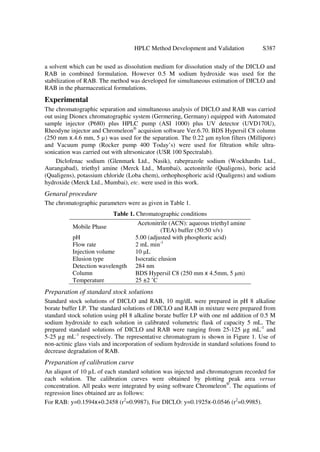
The chromatographic parameters were as given in Table 1.
                           Table 1. Chromatographic conditions
                                     Acetonitrile (ACN): aqueous triethyl amine
           Mobile Phase
                                               (TEA) buffer (50:50 v/v)
           pH                       5.00 (adjusted with phosphoric acid)
           Flow rate                2 mL min-1
           Injection volume         10 µL
           Elusion type             Isocratic elusion
           Detection wavelength     284 nm
           Column                   BDS Hypersil C8 (250 mm x 4.5mm, 5 µm)
           Temperature              25 ±2 ˚C
Preparation of standard stock solutions
Standard stock solutions of DICLO and RAB, 10 mg/dL were prepared in pH 8 alkaline
borate buffer I.P. The standard solutions of DICLO and RAB in mixture were prepared from
standard stock solution using pH 8 alkaline borate buffer I.P with one ml addition of 0.5 M
sodium hydroxide to each solution in calibrated volumetric flask of capacity 5 mL. The
prepared standard solutions of DICLO and RAB were ranging from 25-125 µg mL-1 and
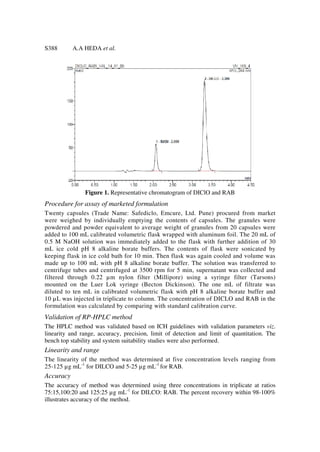
5-25 µg mL-1 respectively. The representative chromatogram is shown in Figure 1. Use of
non-actinic glass vials and incorporation of sodium hydroxide in standard solutions found to
decrease degradation of RAB.
Preparation of calibration curve
An aliquot of 10 µL of each standard solution was injected and chromatogram recorded for
each solution. The calibration curves were obtained by plotting peak area versus
concentration. All peaks were integrated by using software Chromeleon®. The equations of
regression lines obtained are as follows:
For RAB: y=0.1594x+0.2458 (r2=0.9987), For DICLO: y=0.1925x-0.0546 (r2=0.9985).
S388       A.A HEDA et al.


               Figure 1. Representative chromatogram of DIClO and RAB
Procedure for assay of marketed formulation
Twenty capsules (Trade Name: Safediclo, Emcure, Ltd. Pune) procured from market
were weighed by individually emptying the contents of capsules. The granules were
powdered and powder equivalent to average weight of granules from 20 capsules were
added to 100 mL calibrated volumetric flask wrapped with aluminum foil. The 20 mL of
0.5 M NaOH solution was immediately added to the flask with further addition of 30
mL ice cold pH 8 alkaline borate buffers. The contents of flask were sonicated by
keeping flask in ice cold bath for 10 min. Then flask was again cooled and volume was
made up to 100 mL with pH 8 alkaline borate buffer. The solution was transferred to
centrifuge tubes and centrifuged at 3500 rpm for 5 min, supernatant was collected and
filtered through 0.22 µ m nylon filter (Millipore) using a syringe filter (Tarsons)
mounted on the Luer Lok syringe (Becton Dickinson). The one mL of filtrate was
diluted to ten mL in calibrated volumetric flask with pH 8 alkaline borate buffer and
10 µ L was injected in triplicate to column. The concentration of DICLO and RAB in the
formulation was calculated by comparing with standard calibration curve.
Validation of RP-HPLC method
The HPLC method was validated based on ICH guidelines with validation parameters viz.
linearity and range, accuracy, precision, limit of detection and limit of quantitation. The
bench top stability and system suitability studies were also performed.
Linearity and range
The linearity of the method was determined at five concentration levels ranging from
25-125 µg mL-1 for DILCO and 5-25 µg mL-1 for RAB.
Accuracy
The accuracy of method was determined using three concentrations in triplicate at ratios
75:15,100:20 and 125:25 µg mL-1 for DILCO: RAB. The percent recovery within 98-100%
illustrates accuracy of the method.
HPLC Method Development and Validation             S389


Precision
The method is validated using six determinations at 100% of test concentrations for
repeatability and three concentrations at 3 levels for intermediate precision. The RSD not
more than 2 indicates precise method.
Limit of detection (LOD) and limit of quantitation (LOQ)
The limit of detection and limit of quantitation were calculated from the standard deviation
approach.
Bench top stability study
The standard solution containing 100 µg mL-1 and 20 µg mL-1, DICLO and RAB
respectively were kept at room temperature for 24 h and then samples were analyzed.
System suitability
The asymmetry factor not more than 2, relative standard deviation of peak areas of six
replicate injections not more than 2 and resolution of peaks of DILCO and RAB not less
than 2 and theoretical plates not less than 2000 qualifies the system suitability.
Results and Discussion
The RP-HPLC method was developed for DICLO and RAB with sharp and well resolved
peaks. The use of 0.5 M NaOH and non-actinic glassware found to improve stability of RAB
in solution. The different mobile phases at various pH and different flow rates were examined
and mobile phase with ACN: TEA (50:50) pH 5.00 was selected as optimal mobile phase
based on system suitability parameters with well resolved peaks of DICLO and RAB.
     The wavelength for the detection of both compounds was 284 nm with best detector
response. The method was found to be linear at range of 25-125 µg mL-1 for DICLO and
5-25 µg mL-1 for RAB. The developed method was found to be accurate, precise and quite
stable with acceptable values of LOD and LOQ. Validation and other parameters are
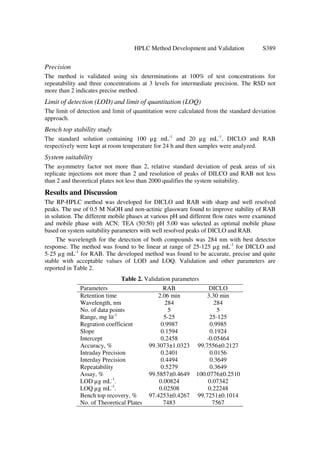
reported in Table 2.
                              Table 2. Validation parameters
              Parameters                        RAB               DICLO
              Retention time                 2.06 min            3.30 min
              Wavelength, nm                    284                 284
              No. of data points                  5                   5
              Range, mg lit-1                   5-25              25-125
              Regration coefficient            0.9987              0.9985
              Slope                           0.1594              0.1924
              Intercept                       0.2458             -0.05464
              Accuracy, %                 99.3073±1.0323     99.7556±0.2127
              Intraday Precision               0.2401              0.0156
              Interday Precision               0.4494              0.3649
              Repeatability                    0.5279              0.3649
              Assay, %                    99.5857±0.4649     100.0776±0.2510
              LOD µg mL-1.                    0.00824             0.07342
              LOQ µg mL-1.                    0.02508             0.22248
              Bench top recovery, %       97.4253±0.4267     99.7251±0.1014
              No. of Theoretical Plates         7483                7567
S390       A.A HEDA et al.


Conclusion
The RP-HPLC method developed for simultaneous analysis of DICLO and RAB can be
used for routine quality control of their bulk drug mixture and their combined dosage form.
Acknowledgments
The authors thanks to M/s. Glenmark Ltd, Nasik and M/s. Wockhardts Ltd., Aurangabad for
providing gift samples of diclofenac sodium and rabeprazole sodium respectively. The
authors are also thankful to Dr. V. K. Mourya, Principal, Government College of Pharmacy,
Aurangabad for providing necessary facilities to carry out the research work.
References
1.     Mitic S, Miletic G, Pavloc A, Tosic S and Pecev E, Chem Pharm Bull., 2007, 55, 1423.
2.     Arcelloni C, Lanzi R, Pedercini S, Molteni G, Fermo I, Pontiroli A and Paroni R, J
       Chromatogr B., 2001, 763(1-2), 195-200.
3.     Garcia C V, Paim C S, Martin S and Elfrides El-S S, J Pharm Biomed Anal., 2006,
       41, 833–837.
4.     El-Gindy A, El-Yazby F and Maher M M, J Pharm Biomed Anal., 2003, 31, 229-242.
5.     Radi A, El-Ghany N A and Wahdan T, IL Farmaco. 2004, 59, 515-518.
6.     Sabnis S S, Dhavale N D, Jadhav V Y and Gandhi S V, Spectrochimica Acta A, 2008,
       69, 849–852.
7.     Rao R N, Narasa Raju A and Nagaraju D, Talanta, 2006, 70(4), 805–810.
8.     Shrinivas K S V, Buchireddy R, Mukkanti K and Srinivasulu P, Chromatographia,
       2009, 69, 381–384.
9.     Vora A, Damle M, Bhat L and Godge R, Chromatographia, 2007, 66, 941–943.
10.    ICH Harmonised Tripartite Guideline: Validation of analytical procedures text and
       methodology 2005, Q2 (R1).

Diclofenac rabeprazole hplc

  • 1.
    ISSN: 0973-4945; CODENECJHAO E-Journal of Chemistry http://www.e-journals.net 2010, 7(S1), S386-S390 HPLC Method Development and Validation for Simultaneous Analysis of Diclofenac Sodium and Rabeprazole Sodium A.A HEDA*, D D. GADADE, J M. KATHIRIYA and P K. PURANIK Department of Pharmaceutics, Government College of Pharmacy Vedant Road, Osmanpura, Auragabad-431005, India aaheda@rediffmail.com Received 3 March 2010; Accepted 1 May 2010 Abstract: A stable, simple, rapid, precise, accurate RP-HPLC method for simultaneous analysis of diclofenac sodium and rabeprazole sodium was developed and validated as per ICH guidelines without need of any internal standard. Separation was carried out using C8 column with triethyl amine buffer (pH 5): acetonitrile (50:50 v/v) as mobile phase with flow rate 2 mL min-1. The detection was carried out at 284 nm. The parameters studied were retention time, linearity and range, accuracy, precision, detection limit, quantitation limit and bench top stability. The proposed method can be used for simultaneous estimation of diclofenac sodium and rabeprazole sodium in bulk drugs and pharmaceutical dosage forms. Keywords: Diclofenac sodium, Rabeprazole sodium, RP-HPLC, Validation. Introduction Diclofenac sodium {2-[(2, 6-Dichlorophenyl) amino] benzene acetic acid sodium salt} (DICLO) is a phenyl acetic derivative used as non-steroidal anti-inflammatory agent. Rabeprazole sodium {2-[[[4-(3-methoxypropoxy)-3- methyl-2 pyridinyl] methyl] sulfinyl]- 1H-benzimidazole sodium salt}(RAB), a benzimidazole derivative a proton pump inhibitor (PPI) used as acid suppressing agent. Several UV spectrophotometric, voltametric or HPLC methods are reported for DICLO and RAB as individual component or with other drugs1-8. Reported simultaneous determination method for DICLO and RAB requires indapamide as an internal standard and using methanol as a solvent9. In present study the simple, rapid, precise, accurate, sensitive and stable RP-HPLC method has been developed without use of any internal standard as per ICH guidelines10. Alkaline borate buffer of pH 8 was utilized as
  • 2.
    HPLC Method Developmentand Validation S387 a solvent which can be used as dissolution medium for dissolution study of the DICLO and RAB in combined formulation. However 0.5 M sodium hydroxide was used for the stabilization of RAB. The method was developed for simultaneous estimation of DICLO and RAB in the pharmaceutical formulations. Experimental The chromatographic separation and simultaneous analysis of DICLO and RAB was carried out using Dionex chromatographic system (Germering, Germany) equipped with Automated sample injector (P680) plus HPLC pump (ASI 1000) plus UV detector (UVD170U), Rheodyne injector and Chromeleon® acquision software Ver.6.70. BDS Hypersil C8 column (250 mm x.4.6 mm, 5 µ) was used for the separation. The 0.22 µm nylon filters (Millipore) and Vacuum pump (Rocker pump 400 Today’s) were used for filtration while ultra- sonication was carried out with ultrsonicator (USR 100 Spectralab). Diclofenac sodium (Glenmark Ltd., Nasik), rabeprazole sodium (Wockhardts Ltd., Aurangabad), triethyl amine (Merck Ltd., Mumbai), acetonitrile (Qualigens), boric acid (Qualigens), potassium chloride (Loba chem), orthophosphoric acid (Qualigens) and sodium hydroxide (Merck Ltd., Mumbai), etc. were used in this work. Genaral procedure The chromatographic parameters were as given in Table 1. Table 1. Chromatographic conditions Acetonitrile (ACN): aqueous triethyl amine Mobile Phase (TEA) buffer (50:50 v/v) pH 5.00 (adjusted with phosphoric acid) Flow rate 2 mL min-1 Injection volume 10 µL Elusion type Isocratic elusion Detection wavelength 284 nm Column BDS Hypersil C8 (250 mm x 4.5mm, 5 µm) Temperature 25 ±2 ˚C Preparation of standard stock solutions Standard stock solutions of DICLO and RAB, 10 mg/dL were prepared in pH 8 alkaline borate buffer I.P. The standard solutions of DICLO and RAB in mixture were prepared from standard stock solution using pH 8 alkaline borate buffer I.P with one ml addition of 0.5 M sodium hydroxide to each solution in calibrated volumetric flask of capacity 5 mL. The prepared standard solutions of DICLO and RAB were ranging from 25-125 µg mL-1 and 5-25 µg mL-1 respectively. The representative chromatogram is shown in Figure 1. Use of non-actinic glass vials and incorporation of sodium hydroxide in standard solutions found to decrease degradation of RAB. Preparation of calibration curve An aliquot of 10 µL of each standard solution was injected and chromatogram recorded for each solution. The calibration curves were obtained by plotting peak area versus concentration. All peaks were integrated by using software Chromeleon®. The equations of regression lines obtained are as follows: For RAB: y=0.1594x+0.2458 (r2=0.9987), For DICLO: y=0.1925x-0.0546 (r2=0.9985).
  • 3.
    S388 A.A HEDA et al. Figure 1. Representative chromatogram of DIClO and RAB Procedure for assay of marketed formulation Twenty capsules (Trade Name: Safediclo, Emcure, Ltd. Pune) procured from market were weighed by individually emptying the contents of capsules. The granules were powdered and powder equivalent to average weight of granules from 20 capsules were added to 100 mL calibrated volumetric flask wrapped with aluminum foil. The 20 mL of 0.5 M NaOH solution was immediately added to the flask with further addition of 30 mL ice cold pH 8 alkaline borate buffers. The contents of flask were sonicated by keeping flask in ice cold bath for 10 min. Then flask was again cooled and volume was made up to 100 mL with pH 8 alkaline borate buffer. The solution was transferred to centrifuge tubes and centrifuged at 3500 rpm for 5 min, supernatant was collected and filtered through 0.22 µ m nylon filter (Millipore) using a syringe filter (Tarsons) mounted on the Luer Lok syringe (Becton Dickinson). The one mL of filtrate was diluted to ten mL in calibrated volumetric flask with pH 8 alkaline borate buffer and 10 µ L was injected in triplicate to column. The concentration of DICLO and RAB in the formulation was calculated by comparing with standard calibration curve. Validation of RP-HPLC method The HPLC method was validated based on ICH guidelines with validation parameters viz. linearity and range, accuracy, precision, limit of detection and limit of quantitation. The bench top stability and system suitability studies were also performed. Linearity and range The linearity of the method was determined at five concentration levels ranging from 25-125 µg mL-1 for DILCO and 5-25 µg mL-1 for RAB. Accuracy The accuracy of method was determined using three concentrations in triplicate at ratios 75:15,100:20 and 125:25 µg mL-1 for DILCO: RAB. The percent recovery within 98-100% illustrates accuracy of the method.
  • 4.
    HPLC Method Developmentand Validation S389 Precision The method is validated using six determinations at 100% of test concentrations for repeatability and three concentrations at 3 levels for intermediate precision. The RSD not more than 2 indicates precise method. Limit of detection (LOD) and limit of quantitation (LOQ) The limit of detection and limit of quantitation were calculated from the standard deviation approach. Bench top stability study The standard solution containing 100 µg mL-1 and 20 µg mL-1, DICLO and RAB respectively were kept at room temperature for 24 h and then samples were analyzed. System suitability The asymmetry factor not more than 2, relative standard deviation of peak areas of six replicate injections not more than 2 and resolution of peaks of DILCO and RAB not less than 2 and theoretical plates not less than 2000 qualifies the system suitability. Results and Discussion The RP-HPLC method was developed for DICLO and RAB with sharp and well resolved peaks. The use of 0.5 M NaOH and non-actinic glassware found to improve stability of RAB in solution. The different mobile phases at various pH and different flow rates were examined and mobile phase with ACN: TEA (50:50) pH 5.00 was selected as optimal mobile phase based on system suitability parameters with well resolved peaks of DICLO and RAB. The wavelength for the detection of both compounds was 284 nm with best detector response. The method was found to be linear at range of 25-125 µg mL-1 for DICLO and 5-25 µg mL-1 for RAB. The developed method was found to be accurate, precise and quite stable with acceptable values of LOD and LOQ. Validation and other parameters are reported in Table 2. Table 2. Validation parameters Parameters RAB DICLO Retention time 2.06 min 3.30 min Wavelength, nm 284 284 No. of data points 5 5 Range, mg lit-1 5-25 25-125 Regration coefficient 0.9987 0.9985 Slope 0.1594 0.1924 Intercept 0.2458 -0.05464 Accuracy, % 99.3073±1.0323 99.7556±0.2127 Intraday Precision 0.2401 0.0156 Interday Precision 0.4494 0.3649 Repeatability 0.5279 0.3649 Assay, % 99.5857±0.4649 100.0776±0.2510 LOD µg mL-1. 0.00824 0.07342 LOQ µg mL-1. 0.02508 0.22248 Bench top recovery, % 97.4253±0.4267 99.7251±0.1014 No. of Theoretical Plates 7483 7567
  • 5.
    S390 A.A HEDA et al. Conclusion The RP-HPLC method developed for simultaneous analysis of DICLO and RAB can be used for routine quality control of their bulk drug mixture and their combined dosage form. Acknowledgments The authors thanks to M/s. Glenmark Ltd, Nasik and M/s. Wockhardts Ltd., Aurangabad for providing gift samples of diclofenac sodium and rabeprazole sodium respectively. The authors are also thankful to Dr. V. K. Mourya, Principal, Government College of Pharmacy, Aurangabad for providing necessary facilities to carry out the research work. References 1. Mitic S, Miletic G, Pavloc A, Tosic S and Pecev E, Chem Pharm Bull., 2007, 55, 1423. 2. Arcelloni C, Lanzi R, Pedercini S, Molteni G, Fermo I, Pontiroli A and Paroni R, J Chromatogr B., 2001, 763(1-2), 195-200. 3. Garcia C V, Paim C S, Martin S and Elfrides El-S S, J Pharm Biomed Anal., 2006, 41, 833–837. 4. El-Gindy A, El-Yazby F and Maher M M, J Pharm Biomed Anal., 2003, 31, 229-242. 5. Radi A, El-Ghany N A and Wahdan T, IL Farmaco. 2004, 59, 515-518. 6. Sabnis S S, Dhavale N D, Jadhav V Y and Gandhi S V, Spectrochimica Acta A, 2008, 69, 849–852. 7. Rao R N, Narasa Raju A and Nagaraju D, Talanta, 2006, 70(4), 805–810. 8. Shrinivas K S V, Buchireddy R, Mukkanti K and Srinivasulu P, Chromatographia, 2009, 69, 381–384. 9. Vora A, Damle M, Bhat L and Godge R, Chromatographia, 2007, 66, 941–943. 10. ICH Harmonised Tripartite Guideline: Validation of analytical procedures text and methodology 2005, Q2 (R1).