Enzyme Immobilization
Shubham A. Chinchulkar (Regulatory Affairs)
M.Tech (Pharm.)
National Institute of Pharmaceutical education and
Research (NIPER), Mohali
shubhamchinchulkar007@gmail.com
Introduction & Background
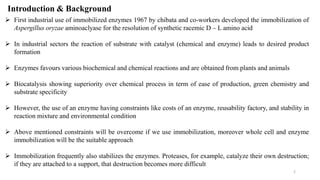
 First industrial use of immobilized enzymes 1967 by chibata and co-workers developed the immobilization of
Aspergillus oryzae aminoaclyase for the resolution of synthetic racemic D – L amino acid
 In industrial sectors the reaction of substrate with catalyst (chemical and enzyme) leads to desired product
formation
 Enzymes favours various biochemical and chemical reactions and are obtained from plants and animals
 Biocatalysis showing superiority over chemical process in term of ease of production, green chemistry and
substrate specificity
 However, the use of an enzyme having constraints like costs of an enzyme, reusability factory, and stability in
reaction mixture and environmental condition
 Above mentioned constraints will be overcome if we use immobilization, moreover whole cell and enzyme
immobilization will be the suitable approach
 Immobilization frequently also stabilizes the enzymes. Proteases, for example, catalyze their own destruction;
if they are attached to a support, that destruction becomes more difficult
2
3
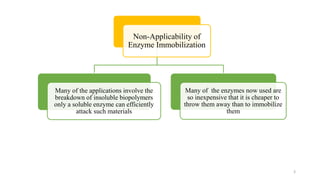
Non-Applicability of
Enzyme Immobilization
Many of the applications involve the
breakdown of insoluble biopolymers
only a soluble enzyme can efficiently
attack such materials
Many of the enzymes now used are
so inexpensive that it is cheaper to
throw them away than to immobilize
them
Advantages and
Disadvantages Techniques of
Immobilization
Applications
Concept of co-
Immobilization
4
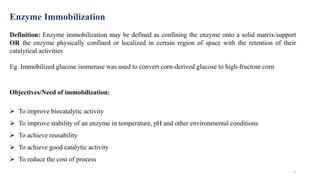
 To improve biocatalytic activity
 To improve stability of an enzyme in temperature, pH and other environmental conditions
 To achieve reusability
 To achieve good catalytic activity
 To reduce the cost of process
Objectives/Need of immobilization:
5
Enzyme Immobilization
Definition: Enzyme immobilization may be defined as confining the enzyme onto a solid matrix/support
OR the enzyme physically confined or localized in certain region of space with the retention of their
catalytical activities
Eg. Immobilized glucose isomerase was used to convert corn-derived glucose to high-fructose corn
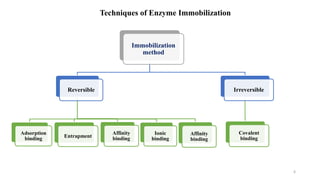
Immobilization
method
Reversible
Adsorption
binding
Ionic
binding
Affinity
binding
Affinity
binding
Entrapment
Irreversible
Covalent
binding
Techniques of Enzyme Immobilization
6
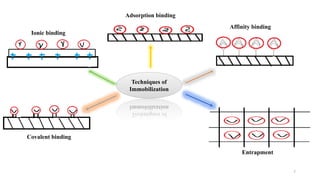
Techniques of
Immobilization
Adsorption binding
Ionic binding
Affinity binding
Entrapment
Covalent binding
7
Techniques of Immobilization
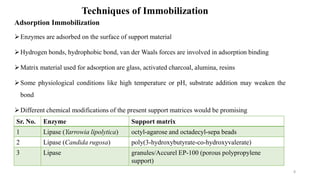
Adsorption Immobilization
Enzymes are adsorbed on the surface of support material
Hydrogen bonds, hydrophobic bond, van der Waals forces are involved in adsorption binding
Matrix material used for adsorption are glass, activated charcoal, alumina, resins
Some physiological conditions like high temperature or pH, substrate addition may weaken the
bond
Different chemical modifications of the present support matrices would be promising
Sr. No. Enzyme Support matrix
1 Lipase (Yarrowia lipolytica) octyl-agarose and octadecyl-sepa beads
2 Lipase (Candida rugosa) poly(3-hydroxybutyrate-co-hydroxyvalerate)
3 Lipase granules/Accurel EP-100 (porous polypropylene
support)
8
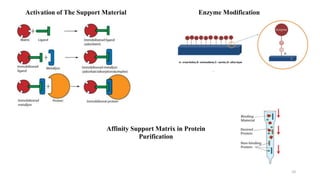
Affinity Immobilization
Immobilization of enzyme to the support matrix by specific interactions
Two methods
The first one is activation of the support material which contains the coupled affinity ligand so that
enzyme will be added OR first method is precoupling of the matrix to an affinity ligand for target
enzyme
The second method, enzyme modified to another molecule which has ability to bind towards a matrix
OR enzyme modified or conjugated to another molecule which develops affinity toward the matrix
Affinity adsorbents have also been used for enzyme purification
Enzymes immobilized on complex affinity support matrix such as alkali stable chitosan-coated porous
silica beads possess higher amounts of enzyme and promoted increased efficiency and stability
9
10
Activation of The Support Material Enzyme Modification
Affinity Support Matrix in Protein
Purification
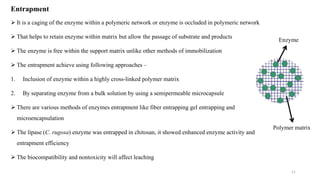
Entrapment
 It is a caging of the enzyme within a polymeric network or enzyme is occluded in polymeric network
 That helps to retain enzyme within matrix but allow the passage of substrate and products
 The enzyme is free within the support matrix unlike other methods of immobilization
 The entrapment achieve using following approaches –
1. Inclusion of enzyme within a highly cross-linked polymer matrix
2. By separating enzyme from a bulk solution by using a semipermeable microcapsule
 There are various methods of enzymes entrapment like fiber entrapping gel entrapping and
microencapsulation
 The lipase (C. rugosa) enzyme was entrapped in chitosan, it showed enhanced enzyme activity and
entrapment efficiency
 The biocompatibility and nontoxicity will affect leaching
11
Polymer matrix
Enzyme
12
 Lipases when entrapped with ĸ-carrageenan showed high tolerance to organic solvents
 Drawback of mass transfer limitations and low enzyme loading
 By adjusting the polymerisation conditions - the polymer porosity, network structure, surface functionalities, and particle
size can all be modified
 Modulation of porosity - Method of drying
Solvent surface tension
Polymer composition of the sol–gel
 Eg. Polysiloxane (POS)–polyvinyl alcohol (PVA) hybrid matrices for Candida antarctica lipase B (CaL-B) - PVA can
significantly influence physical properties of the particle, such as hardness and surface area
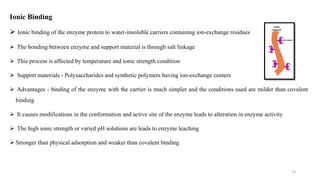
Ionic Binding
 Ionic binding of the enzyme protein to water-insoluble carriers containing ion-exchange residues
 The bonding between enzyme and support material is through salt linkage
 This process is affected by temperature and ionic strength condition
 Support materials - Polysaccharides and synthetic polymers having ion-exchange centers
 Advantages - binding of the enzyme with the carrier is much simpler and the conditions used are milder than covalent
binding
 It causes modifications in the conformation and active site of the enzyme leads to alteration in enzyme activity
 The high ionic strength or varied pH solutions are leads to enzyme leaching
 Stronger than physical adsorption and weaker than covalent binding
13
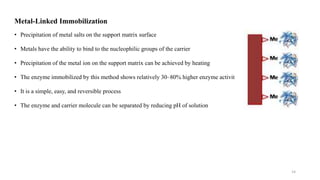
Metal-Linked Immobilization
• Precipitation of metal salts on the support matrix surface
• Metals have the ability to bind to the nucleophilic groups of the carrier
• Precipitation of the metal ion on the support matrix can be achieved by heating
• The enzyme immobilized by this method shows relatively 30–80% higher enzyme activity
• It is a simple, easy, and reversible process
• The enzyme and carrier molecule can be separated by reducing pH of solution
14
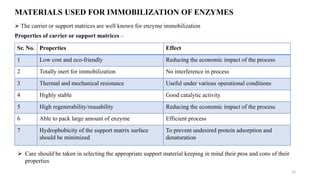
MATERIALS USED FOR IMMOBILIZATION OF ENZYMES
 The carrier or support matrices are well known for enzyme immobilization
Properties of carrier or support matrices –
Sr. No. Properties Effect
1 Low cost and eco-friendly Reducing the economic impact of the process
2 Totally inert for immobilization No interference in process
3 Thermal and mechanical resistance Useful under various operational conditions
4 Highly stable Good catalytic activity
5 High regenerability/reusability Reducing the economic impact of the process
6 Able to pack large amount of enzyme Efficient process
7 Hydrophobicity of the support matrix surface
should be minimized
To prevent undesired protein adsorption and
denaturation
 Care should be taken in selecting the appropriate support material keeping in mind their pros and cons of their
properties
15
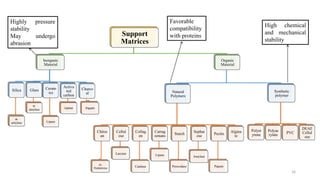
Support
Matrices
Inorganic
Material
Silica
α-
amylase
Ceram
ics
Lipase
Glass
α-
amylase
Activa
ted
carbon
Lipase
Charco
al
Papain
Organic
Material
Natural
Polymers
Chitos
an
D-
Hydantoise
Cellul
ose
Laccase
Collag
en
Catalase
Carrag
eenans
Lipase
Starch
Perocidase
Sephar
ose
Amylase
Pectin
Papain
Algina
te
Synthetic
polymer
Polyst
yrene
Polyac
rylate
PVC
DEAE
Cellul
ose
16
Highly pressure
stability
May undergo
abrasion
Favorable
compatibility
with proteins
High chemical
and mechanical
stability
Advantages
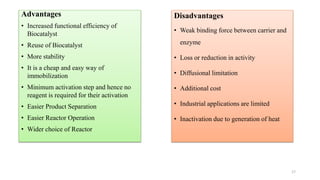
• Increased functional efficiency of
Biocatalyst
• Reuse of Biocatalyst
• More stability
• It is a cheap and easy way of
immobilization
• Minimum activation step and hence no
reagent is required for their activation
• Easier Product Separation
• Easier Reactor Operation
• Wider choice of Reactor
Disadvantages
• Weak binding force between carrier and
enzyme
• Loss or reduction in activity
• Diffusional limitation
• Additional cost
• Industrial applications are limited
• Inactivation due to generation of heat
17
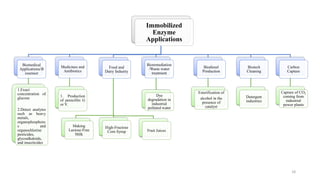
Immobilized
Enzyme
Applications
Biomedical
Applications/B
iosensor
1.Exact
concentration of
glucose
2.Detect analytes
such as heavy
metals,
organophosphoru
s and
organochlorine
pesticides,
glycoalkaloids,
and insecticides
Medicines and
Antibiotics
1. Production
of penicillin G
or V.
Food and
Dairy Industry
Making
Lactose-Free
Milk
High-Fructose
Corn Syrup Fruit Juices
Bioremediation
/Waste water
treatment
Dye
degradation in
industrial
polluted water
Biodiesel
Production
Esterification of
alcohol in the
presence of
catalyst
Biotech
Cleaning
Detergent
industries
Carbon
Capture
Capture of CO2
coming from
industrial
power plants
18
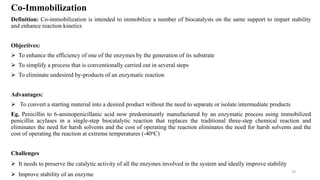
Co-Immobilization
Definition: Co-immobilization is intended to immobilize a number of biocatalysts on the same support to impart stability
and enhance reaction kinetics
Objectives:
 To enhance the efficiency of one of the enzymes by the generation of its substrate
 To simplify a process that is conventionally carried out in several steps
 To eliminate undesired by-products of an enzymatic reaction
Advantages:
 To convert a starting material into a desired product without the need to separate or isolate intermediate products
Eg. Penicillin to 6-aminopenicillanic acid now predominantly manufactured by an enzymatic process using immobilized
penicillin acylases in a single-step biocatalytic reaction that replaces the traditional three-step chemical reaction and
eliminates the need for harsh solvents and the cost of operating the reaction eliminates the need for harsh solvents and the
cost of operating the reaction at extreme temperatures (-40oC)
Challenges
 It needs to preserve the catalytic activity of all the enzymes involved in the system and ideally improve stability
 Improve stability of an enzyme
19
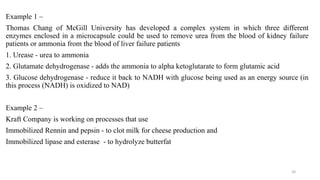
Example 1 –
Thomas Chang of McGill University has developed a complex system in which three different
enzymes enclosed in a microcapsule could be used to remove urea from the blood of kidney failure
patients or ammonia from the blood of liver failure patients
1. Urease - urea to ammonia
2. Glutamate dehydrogenase - adds the ammonia to alpha ketoglutarate to form glutamic acid
3. Glucose dehydrogenase - reduce it back to NADH with glucose being used as an energy source (in
this process (NADH) is oxidized to NAD)
Example 2 –
Kraft Company is working on processes that use
Immobilized Rennin and pepsin - to clot milk for cheese production and
Immobilized lipase and esterase - to hydrolyze butterfat
20
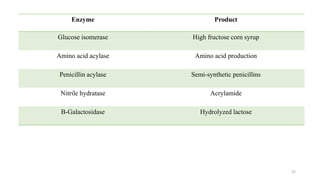
Enzyme Product
Glucose isomerase High fructose corn syrup
Amino acid acylase Amino acid production
Penicillin acylase Semi-synthetic penicillins
Nitrile hydratase Acrylamide
Β-Galactosidase Hydrolyzed lactose
21
22

Enzyme immobilization

  • 1.
    Enzyme Immobilization Shubham A.Chinchulkar (Regulatory Affairs) M.Tech (Pharm.) National Institute of Pharmaceutical education and Research (NIPER), Mohali shubhamchinchulkar007@gmail.com
  • 2.
    Introduction & Background First industrial use of immobilized enzymes 1967 by chibata and co-workers developed the immobilization of Aspergillus oryzae aminoaclyase for the resolution of synthetic racemic D – L amino acid  In industrial sectors the reaction of substrate with catalyst (chemical and enzyme) leads to desired product formation  Enzymes favours various biochemical and chemical reactions and are obtained from plants and animals  Biocatalysis showing superiority over chemical process in term of ease of production, green chemistry and substrate specificity  However, the use of an enzyme having constraints like costs of an enzyme, reusability factory, and stability in reaction mixture and environmental condition  Above mentioned constraints will be overcome if we use immobilization, moreover whole cell and enzyme immobilization will be the suitable approach  Immobilization frequently also stabilizes the enzymes. Proteases, for example, catalyze their own destruction; if they are attached to a support, that destruction becomes more difficult 2
  • 3.
    3 Non-Applicability of Enzyme Immobilization Manyof the applications involve the breakdown of insoluble biopolymers only a soluble enzyme can efficiently attack such materials Many of the enzymes now used are so inexpensive that it is cheaper to throw them away than to immobilize them
  • 4.
    Advantages and Disadvantages Techniquesof Immobilization Applications Concept of co- Immobilization 4
  • 5.
     To improvebiocatalytic activity  To improve stability of an enzyme in temperature, pH and other environmental conditions  To achieve reusability  To achieve good catalytic activity  To reduce the cost of process Objectives/Need of immobilization: 5 Enzyme Immobilization Definition: Enzyme immobilization may be defined as confining the enzyme onto a solid matrix/support OR the enzyme physically confined or localized in certain region of space with the retention of their catalytical activities Eg. Immobilized glucose isomerase was used to convert corn-derived glucose to high-fructose corn
  • 6.
  • 7.
    Techniques of Immobilization Adsorption binding Ionicbinding Affinity binding Entrapment Covalent binding 7
  • 8.
    Techniques of Immobilization AdsorptionImmobilization Enzymes are adsorbed on the surface of support material Hydrogen bonds, hydrophobic bond, van der Waals forces are involved in adsorption binding Matrix material used for adsorption are glass, activated charcoal, alumina, resins Some physiological conditions like high temperature or pH, substrate addition may weaken the bond Different chemical modifications of the present support matrices would be promising Sr. No. Enzyme Support matrix 1 Lipase (Yarrowia lipolytica) octyl-agarose and octadecyl-sepa beads 2 Lipase (Candida rugosa) poly(3-hydroxybutyrate-co-hydroxyvalerate) 3 Lipase granules/Accurel EP-100 (porous polypropylene support) 8
  • 9.
    Affinity Immobilization Immobilization ofenzyme to the support matrix by specific interactions Two methods The first one is activation of the support material which contains the coupled affinity ligand so that enzyme will be added OR first method is precoupling of the matrix to an affinity ligand for target enzyme The second method, enzyme modified to another molecule which has ability to bind towards a matrix OR enzyme modified or conjugated to another molecule which develops affinity toward the matrix Affinity adsorbents have also been used for enzyme purification Enzymes immobilized on complex affinity support matrix such as alkali stable chitosan-coated porous silica beads possess higher amounts of enzyme and promoted increased efficiency and stability 9
  • 10.
    10 Activation of TheSupport Material Enzyme Modification Affinity Support Matrix in Protein Purification
  • 11.
    Entrapment  It isa caging of the enzyme within a polymeric network or enzyme is occluded in polymeric network  That helps to retain enzyme within matrix but allow the passage of substrate and products  The enzyme is free within the support matrix unlike other methods of immobilization  The entrapment achieve using following approaches – 1. Inclusion of enzyme within a highly cross-linked polymer matrix 2. By separating enzyme from a bulk solution by using a semipermeable microcapsule  There are various methods of enzymes entrapment like fiber entrapping gel entrapping and microencapsulation  The lipase (C. rugosa) enzyme was entrapped in chitosan, it showed enhanced enzyme activity and entrapment efficiency  The biocompatibility and nontoxicity will affect leaching 11 Polymer matrix Enzyme
  • 12.
    12  Lipases whenentrapped with ĸ-carrageenan showed high tolerance to organic solvents  Drawback of mass transfer limitations and low enzyme loading  By adjusting the polymerisation conditions - the polymer porosity, network structure, surface functionalities, and particle size can all be modified  Modulation of porosity - Method of drying Solvent surface tension Polymer composition of the sol–gel  Eg. Polysiloxane (POS)–polyvinyl alcohol (PVA) hybrid matrices for Candida antarctica lipase B (CaL-B) - PVA can significantly influence physical properties of the particle, such as hardness and surface area
  • 13.
    Ionic Binding  Ionicbinding of the enzyme protein to water-insoluble carriers containing ion-exchange residues  The bonding between enzyme and support material is through salt linkage  This process is affected by temperature and ionic strength condition  Support materials - Polysaccharides and synthetic polymers having ion-exchange centers  Advantages - binding of the enzyme with the carrier is much simpler and the conditions used are milder than covalent binding  It causes modifications in the conformation and active site of the enzyme leads to alteration in enzyme activity  The high ionic strength or varied pH solutions are leads to enzyme leaching  Stronger than physical adsorption and weaker than covalent binding 13
  • 14.
    Metal-Linked Immobilization • Precipitationof metal salts on the support matrix surface • Metals have the ability to bind to the nucleophilic groups of the carrier • Precipitation of the metal ion on the support matrix can be achieved by heating • The enzyme immobilized by this method shows relatively 30–80% higher enzyme activity • It is a simple, easy, and reversible process • The enzyme and carrier molecule can be separated by reducing pH of solution 14
  • 15.
    MATERIALS USED FORIMMOBILIZATION OF ENZYMES  The carrier or support matrices are well known for enzyme immobilization Properties of carrier or support matrices – Sr. No. Properties Effect 1 Low cost and eco-friendly Reducing the economic impact of the process 2 Totally inert for immobilization No interference in process 3 Thermal and mechanical resistance Useful under various operational conditions 4 Highly stable Good catalytic activity 5 High regenerability/reusability Reducing the economic impact of the process 6 Able to pack large amount of enzyme Efficient process 7 Hydrophobicity of the support matrix surface should be minimized To prevent undesired protein adsorption and denaturation  Care should be taken in selecting the appropriate support material keeping in mind their pros and cons of their properties 15
  • 16.
  • 17.
    Advantages • Increased functionalefficiency of Biocatalyst • Reuse of Biocatalyst • More stability • It is a cheap and easy way of immobilization • Minimum activation step and hence no reagent is required for their activation • Easier Product Separation • Easier Reactor Operation • Wider choice of Reactor Disadvantages • Weak binding force between carrier and enzyme • Loss or reduction in activity • Diffusional limitation • Additional cost • Industrial applications are limited • Inactivation due to generation of heat 17
  • 18.
    Immobilized Enzyme Applications Biomedical Applications/B iosensor 1.Exact concentration of glucose 2.Detect analytes suchas heavy metals, organophosphoru s and organochlorine pesticides, glycoalkaloids, and insecticides Medicines and Antibiotics 1. Production of penicillin G or V. Food and Dairy Industry Making Lactose-Free Milk High-Fructose Corn Syrup Fruit Juices Bioremediation /Waste water treatment Dye degradation in industrial polluted water Biodiesel Production Esterification of alcohol in the presence of catalyst Biotech Cleaning Detergent industries Carbon Capture Capture of CO2 coming from industrial power plants 18
  • 19.
    Co-Immobilization Definition: Co-immobilization isintended to immobilize a number of biocatalysts on the same support to impart stability and enhance reaction kinetics Objectives:  To enhance the efficiency of one of the enzymes by the generation of its substrate  To simplify a process that is conventionally carried out in several steps  To eliminate undesired by-products of an enzymatic reaction Advantages:  To convert a starting material into a desired product without the need to separate or isolate intermediate products Eg. Penicillin to 6-aminopenicillanic acid now predominantly manufactured by an enzymatic process using immobilized penicillin acylases in a single-step biocatalytic reaction that replaces the traditional three-step chemical reaction and eliminates the need for harsh solvents and the cost of operating the reaction eliminates the need for harsh solvents and the cost of operating the reaction at extreme temperatures (-40oC) Challenges  It needs to preserve the catalytic activity of all the enzymes involved in the system and ideally improve stability  Improve stability of an enzyme 19
  • 20.
    Example 1 – ThomasChang of McGill University has developed a complex system in which three different enzymes enclosed in a microcapsule could be used to remove urea from the blood of kidney failure patients or ammonia from the blood of liver failure patients 1. Urease - urea to ammonia 2. Glutamate dehydrogenase - adds the ammonia to alpha ketoglutarate to form glutamic acid 3. Glucose dehydrogenase - reduce it back to NADH with glucose being used as an energy source (in this process (NADH) is oxidized to NAD) Example 2 – Kraft Company is working on processes that use Immobilized Rennin and pepsin - to clot milk for cheese production and Immobilized lipase and esterase - to hydrolyze butterfat 20
  • 21.
    Enzyme Product Glucose isomeraseHigh fructose corn syrup Amino acid acylase Amino acid production Penicillin acylase Semi-synthetic penicillins Nitrile hydratase Acrylamide Β-Galactosidase Hydrolyzed lactose 21
  • 22.