Use Of Data Mining
in Marketing…
Outline
• What is Data Mining?
• Why is Data Mining important?
• The Purpose of Data Mining
• Data Mining in Marketing
• Benefits using Data Mining in Marketing
• Barriers using Data Mining in Marketing
• Data Mining Techniques for Marketing
• Data Mining Tools for Marketing
• Case Study
• Conclusion
What is data mining?
– Methods for finding interesting structure in large
databases
• E.g. patterns, prediction rules, unusual cases
– Focus on efficient, scalable algorithms
• Contrasts with emphasis on correct inference
in statistics
– Related to data warehousing, machine learning
Why is data mining
important?
– Data Mining can be used in many different sectors of
business to both predict and discover trends. In the
past, we were only able to analyse what a
company’s customers or clients HAD DONE, but
now, with the help of Data Mining, we can predict
what clientele WILL DO.
– Can make data analysis more accessible to end
users
• Results can be easier to interpret than e.g.
regression models
• Strong focus on decisions and their
implementation
The Purpose of Data Mining
– Data Mining helps marketing professionals
improve their understanding of customer
behaviour.
– In turn, this better understanding allows them to
target marketing campaigns more accurately and
to align campaigns more closely with the needs,
wants and attitudes of customers and prospects.
– Handles large databases directly
Data Mining in Marketing..
• Data mining technology allows to learn more about their
customers and make smart marketing decisions.
• The data mining business, grows 10 percent a year as
the amount of data produced is booming.
• DM Information can help to
– increase return on investment (ROI),
– improve CRM and market analysis,
– reduce marketing campaign costs,
– facilitate fraud detection and customer retention.
Data Mining in Marketing..
• The 4Ps is one way of the best way of defining
the marketing:
–Product (or Service)
–Price
–Place
–Promotion
Benefits Using Data Mining in
Marketing..
• Predict future trends
• customer purchase habits
• Help with decision making
• Improve company revenue and lower costs
• Market basket analysis
• Quick Fraud detection
Barriers Using Data Mining in
Marketing..
• User privacy/security
• Amount of data is overwhelming
• Great cost at implementation stage
• Possible misuse of information
• Possible in accuracy of data
Data Mining Techniques for
Marketing
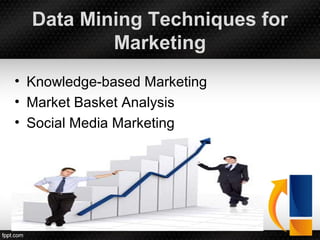
• Knowledge-based Marketing
• Market Basket Analysis
• Social Media Marketing
Knowledge-based Marketing
• It is marketing which makes use of the macro-
and micro-environmental knowledge that is
available to the marketing functional unit in an
organization.
• There are three major areas of application of data
mining for knowledge-based marketing are
customers profiling, deviation analysis, and trend
analysis.
Knowledge-based Marketing
• The Customers profiling systems can analyse the
frequency of purchases, companies can know how
many times the customers can buy this product or visit
the store.
• The Deviation analysis gives the marketer a good
capability to query changes that occurred as a result of
recent price changes or promotions.
• The Trend analysis can determine trends in sales,
costs and profits by products or markets in order to
achieve the highest amount of sales.
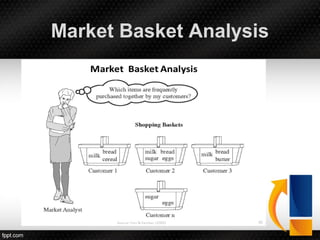
Market Basket Analysis
• Most common and useful types of data analysis
for marketing and retailing.
• Determine what products customers purchase
together.
• Improve the effectiveness of marketing and sales
tactics using customer data already available to
the company.
Market Basket Analysis
Social Media Marketing
• SMM is a form of internet marketing that
implements various social media networks in
order to achieve marketing communication and
branding goals.
• SMM primarily covers activities involving social
sharing of content, videos, and images for
marketing purposes, as well as paid social
media advertising.
Data Mining Tools for
Marketing
• WEKA
• Rapid Miner
• R-Programming Tool
• Python Based Orange and NTLK
• KNIME
• RapidMiner, formerly known as YALE (Yet Another
Learning Environment),
• RapidMiner is a software platform developed by the
company of the same name that provides an
integrated environment for machine learning, data
mining, text mining, predictive analytics and
business analytics.
• RapidMiner uses a client/server model with the server
offered as Software as a Service or on cloud
infrastructures.
• Used for business and commercial applications
and supports all steps of the data mining
process including data preparation, results
visualization, validation and optimization.
• RapidMiner is written in the Java programming
language.
• RapidMiner provides a GUI to design and
execute analytical workflows.
• Video RapidMiner
Case Study
• A company wants to launch an advertising campaign for a
product. Among its present customers the company wants to
post product information to those with a high probability of
purchasing the product. The company has data describing
the past customer behaviour and personal data about each of
its customers.
• There are also customers who have already bought the
product, e.g. in a trial period. The customers of the trial
period are divided into two classes: those who have bought
the product and those who have not. With this data a
prediction model is created to predict the probability of
purchasing the product.
Case Study
• After that the probability of purchasing the product is
predicted for all other customers. Only those with a higher
probability are addressed. As a side effect the company
learns with this data mining analysis which are the relevant
driver attributes of its customers buying a specific product.
• The example shows how DM can help in marketing to
predict the purchase probability of customers for a specific
product. This reduces cost, because sales activity can be
focused much better. The customers benefit at the same time
because the average relevance of the company’s offers
increases.
Conclusion
• In sum, data mining in marketing is very helpful
because business owners can able to summarize
and analyse to discover useful information.
• They have capability to increase the profits and
reduce the cost of products.
• They have the capability to analyse the frequency
of customers purchase.
Conclusion
• Collecting data gives business firms a lot of good
things, such as increased profits, keeping
company in competition with other companies,
and streamlining outreach between consumers
and companies.

Data mining in marketing

  • 1.
    Use Of DataMining in Marketing…
  • 2.
    Outline • What isData Mining? • Why is Data Mining important? • The Purpose of Data Mining • Data Mining in Marketing • Benefits using Data Mining in Marketing • Barriers using Data Mining in Marketing • Data Mining Techniques for Marketing • Data Mining Tools for Marketing • Case Study • Conclusion
  • 3.
    What is datamining? – Methods for finding interesting structure in large databases • E.g. patterns, prediction rules, unusual cases – Focus on efficient, scalable algorithms • Contrasts with emphasis on correct inference in statistics – Related to data warehousing, machine learning
  • 4.
    Why is datamining important? – Data Mining can be used in many different sectors of business to both predict and discover trends. In the past, we were only able to analyse what a company’s customers or clients HAD DONE, but now, with the help of Data Mining, we can predict what clientele WILL DO. – Can make data analysis more accessible to end users • Results can be easier to interpret than e.g. regression models • Strong focus on decisions and their implementation
  • 5.
    The Purpose ofData Mining – Data Mining helps marketing professionals improve their understanding of customer behaviour. – In turn, this better understanding allows them to target marketing campaigns more accurately and to align campaigns more closely with the needs, wants and attitudes of customers and prospects. – Handles large databases directly
  • 6.
    Data Mining inMarketing.. • Data mining technology allows to learn more about their customers and make smart marketing decisions. • The data mining business, grows 10 percent a year as the amount of data produced is booming. • DM Information can help to – increase return on investment (ROI), – improve CRM and market analysis, – reduce marketing campaign costs, – facilitate fraud detection and customer retention.
  • 7.
    Data Mining inMarketing.. • The 4Ps is one way of the best way of defining the marketing: –Product (or Service) –Price –Place –Promotion
  • 8.
    Benefits Using DataMining in Marketing.. • Predict future trends • customer purchase habits • Help with decision making • Improve company revenue and lower costs • Market basket analysis • Quick Fraud detection
  • 9.
    Barriers Using DataMining in Marketing.. • User privacy/security • Amount of data is overwhelming • Great cost at implementation stage • Possible misuse of information • Possible in accuracy of data
  • 10.
    Data Mining Techniquesfor Marketing • Knowledge-based Marketing • Market Basket Analysis • Social Media Marketing
  • 11.
    Knowledge-based Marketing • Itis marketing which makes use of the macro- and micro-environmental knowledge that is available to the marketing functional unit in an organization. • There are three major areas of application of data mining for knowledge-based marketing are customers profiling, deviation analysis, and trend analysis.
  • 12.
    Knowledge-based Marketing • TheCustomers profiling systems can analyse the frequency of purchases, companies can know how many times the customers can buy this product or visit the store. • The Deviation analysis gives the marketer a good capability to query changes that occurred as a result of recent price changes or promotions. • The Trend analysis can determine trends in sales, costs and profits by products or markets in order to achieve the highest amount of sales.
  • 13.
    Market Basket Analysis •Most common and useful types of data analysis for marketing and retailing. • Determine what products customers purchase together. • Improve the effectiveness of marketing and sales tactics using customer data already available to the company.
  • 14.
  • 15.
    Social Media Marketing •SMM is a form of internet marketing that implements various social media networks in order to achieve marketing communication and branding goals. • SMM primarily covers activities involving social sharing of content, videos, and images for marketing purposes, as well as paid social media advertising.
  • 16.
    Data Mining Toolsfor Marketing • WEKA • Rapid Miner • R-Programming Tool • Python Based Orange and NTLK • KNIME
  • 17.
    • RapidMiner, formerlyknown as YALE (Yet Another Learning Environment), • RapidMiner is a software platform developed by the company of the same name that provides an integrated environment for machine learning, data mining, text mining, predictive analytics and business analytics. • RapidMiner uses a client/server model with the server offered as Software as a Service or on cloud infrastructures.
  • 18.
    • Used forbusiness and commercial applications and supports all steps of the data mining process including data preparation, results visualization, validation and optimization. • RapidMiner is written in the Java programming language. • RapidMiner provides a GUI to design and execute analytical workflows.
  • 19.
  • 20.
    Case Study • Acompany wants to launch an advertising campaign for a product. Among its present customers the company wants to post product information to those with a high probability of purchasing the product. The company has data describing the past customer behaviour and personal data about each of its customers. • There are also customers who have already bought the product, e.g. in a trial period. The customers of the trial period are divided into two classes: those who have bought the product and those who have not. With this data a prediction model is created to predict the probability of purchasing the product.
  • 21.
    Case Study • Afterthat the probability of purchasing the product is predicted for all other customers. Only those with a higher probability are addressed. As a side effect the company learns with this data mining analysis which are the relevant driver attributes of its customers buying a specific product. • The example shows how DM can help in marketing to predict the purchase probability of customers for a specific product. This reduces cost, because sales activity can be focused much better. The customers benefit at the same time because the average relevance of the company’s offers increases.
  • 22.
    Conclusion • In sum,data mining in marketing is very helpful because business owners can able to summarize and analyse to discover useful information. • They have capability to increase the profits and reduce the cost of products. • They have the capability to analyse the frequency of customers purchase.
  • 23.
    Conclusion • Collecting datagives business firms a lot of good things, such as increased profits, keeping company in competition with other companies, and streamlining outreach between consumers and companies.