Immune System Defense
Patrick Clements
Jeremy Pesner
Introduction
• Dr. Zheng drew parallels between OO
programming and biological systems in a
published paper
• Also wanted an educational game to have
interested students play. Should be fun,
but also educational and factually accurate
• We were called upon to merge all these
ideas together
Educational Games
• Have been in existence about as long as
computer games
• Educators tried to capitalize on the “magic
of Pac Man”
• In 1981, Thomas Malone set out five main
characteristics that he believed
educational games should possess
Malone’s Five Points
• Clear goals that students find meaningful
• Multiple goal structures and scoring to
give students feedback on their progress
• Multiple difficulty levels to adjust the game
difficulty to learner skill
• Random elements of surprise
• An emotionally appealing fantasy and
metaphor that is related to game skills
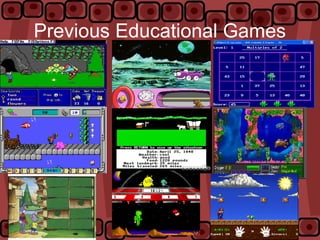
Previous Educational Games
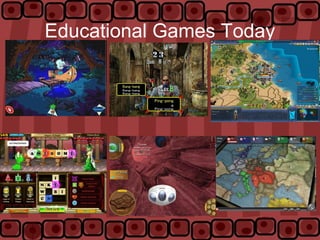
Educational Games Today
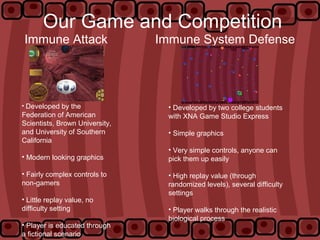
Our Game and Competition
Immune Attack Immune System Defense
• Developed by the
Federation of American
Scientists, Brown University,
and University of Southern
California
• Modern looking graphics
• Fairly complex controls to
non-gamers
• Little replay value, no
difficulty setting
• Player is educated through
a fictional scenario
• Developed by two college students
with XNA Game Studio Express
• Simple graphics
• Very simple controls, anyone can
pick them up easily
• High replay value (through
randomized levels), several difficulty
settings
• Player walks through the realistic
biological process
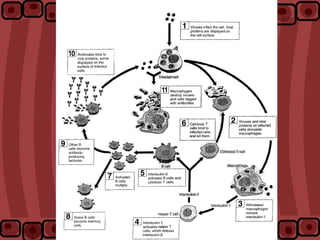
The Immune System
Software Process
• Early Ideas:
– Real-Time Strategy Game (Turn-based
combat)
– Shooter game (Shoot pathogens down)
– Tower Defense Game
Software Process
• How a Tower Defense game operates
• Relation to our game
– “Towers” = immune system cells
– “Attackers” = pathogens
– “Citizens” = generic body cells
– Extra controls for user
Software Process- Gameplay
• Points
– Used to “buy” more cells after a stage
– Cumulative
– Earn points based on the number of “citizen”
cells remaining after each stage
• Scoring
– Number of cells remaining each round
– Total number of pathogens destroyed
Software Process
• Implementation
– Cells derived from Base class with multiple
interfaces
– Updating and Hit Testing
– “Vicinity” targeting
Future Works
• Randomly Generated Levels
– A vein network created from branching nodes
• Various Types of Pathogens
– More biologically accurate and entertaining
• Different Degrees of Difficulty
– Allow the game to suit more users
• Framework?
– Scripting for use with several different body
systems
Conclusion
• Without formal testing available, evaluate
with regards to Malone’s elements of
good educational games
1. Clear, meaningful goals
• Defend cells from infection
• Compete for high scores with other
players
2. Multiple Goal Structures
w/ immediate feedback
• Point feedback at the end of each level
that depends on the performance in each
stage
3. Multiple Difficulty Levels
• Clear lack of adjustability
• Rigid gameplay (all users play the same
exact game)
4. Random Elements of Surprise
• Movement and placement along with
targeting allow the game to be different
every time through
• Though random, this does not provide a
surprise and thus lacks some ability to
keep users coming back
5. Emotionally appealing fantasy
related to game skills
• Game based strongly in reality
• Emotional appeal rests in the students
dislike of being sick and desire to be
healthy again as quickly as possible
Conclusion
• Game loosely adheres to Malone’s
elements
• Some games are successful without many
of the concepts (Simulation games for
example)
• Real value comes from actual testing
– How entertaining is it?
– Does the entertainment lend itself to the
learning process?

Immune System Defense

  • 1.
    Immune System Defense PatrickClements Jeremy Pesner
  • 2.
    Introduction • Dr. Zhengdrew parallels between OO programming and biological systems in a published paper • Also wanted an educational game to have interested students play. Should be fun, but also educational and factually accurate • We were called upon to merge all these ideas together
  • 3.
    Educational Games • Havebeen in existence about as long as computer games • Educators tried to capitalize on the “magic of Pac Man” • In 1981, Thomas Malone set out five main characteristics that he believed educational games should possess
  • 4.
    Malone’s Five Points •Clear goals that students find meaningful • Multiple goal structures and scoring to give students feedback on their progress • Multiple difficulty levels to adjust the game difficulty to learner skill • Random elements of surprise • An emotionally appealing fantasy and metaphor that is related to game skills
  • 5.
  • 6.
  • 7.
    Our Game andCompetition Immune Attack Immune System Defense • Developed by the Federation of American Scientists, Brown University, and University of Southern California • Modern looking graphics • Fairly complex controls to non-gamers • Little replay value, no difficulty setting • Player is educated through a fictional scenario • Developed by two college students with XNA Game Studio Express • Simple graphics • Very simple controls, anyone can pick them up easily • High replay value (through randomized levels), several difficulty settings • Player walks through the realistic biological process
  • 8.
  • 9.
    Software Process • EarlyIdeas: – Real-Time Strategy Game (Turn-based combat) – Shooter game (Shoot pathogens down) – Tower Defense Game
  • 10.
    Software Process • Howa Tower Defense game operates • Relation to our game – “Towers” = immune system cells – “Attackers” = pathogens – “Citizens” = generic body cells – Extra controls for user
  • 11.
    Software Process- Gameplay •Points – Used to “buy” more cells after a stage – Cumulative – Earn points based on the number of “citizen” cells remaining after each stage • Scoring – Number of cells remaining each round – Total number of pathogens destroyed
  • 12.
    Software Process • Implementation –Cells derived from Base class with multiple interfaces – Updating and Hit Testing – “Vicinity” targeting
  • 13.
    Future Works • RandomlyGenerated Levels – A vein network created from branching nodes • Various Types of Pathogens – More biologically accurate and entertaining • Different Degrees of Difficulty – Allow the game to suit more users • Framework? – Scripting for use with several different body systems
  • 14.
    Conclusion • Without formaltesting available, evaluate with regards to Malone’s elements of good educational games
  • 15.
    1. Clear, meaningfulgoals • Defend cells from infection • Compete for high scores with other players
  • 16.
    2. Multiple GoalStructures w/ immediate feedback • Point feedback at the end of each level that depends on the performance in each stage
  • 17.
    3. Multiple DifficultyLevels • Clear lack of adjustability • Rigid gameplay (all users play the same exact game)
  • 18.
    4. Random Elementsof Surprise • Movement and placement along with targeting allow the game to be different every time through • Though random, this does not provide a surprise and thus lacks some ability to keep users coming back
  • 19.
    5. Emotionally appealingfantasy related to game skills • Game based strongly in reality • Emotional appeal rests in the students dislike of being sick and desire to be healthy again as quickly as possible
  • 20.
    Conclusion • Game looselyadheres to Malone’s elements • Some games are successful without many of the concepts (Simulation games for example) • Real value comes from actual testing – How entertaining is it? – Does the entertainment lend itself to the learning process?

Editor's Notes

  • #3 1st bullet examples: Multifunctionality is represented by polymorphism on OO, and enzymes catalyzing different substrates in biological systems. Hierarchical relations are shown through inheritance in OO, and whether an enzyme is a given type of protein
  • #6 Generally platform-oriented, with mathematical or lexical knowledge being required to advance through the stages. Touch typing began to grow popular at this point.
  • #7 There is a much larger diversity here. The touch typing game is significantly more mature. Immune Attack (bottom center) is the educational biology game we compared ourselves to. Civilization IV educates incidentally: it wasn’t marketed as an educational game but is recognized as having educational value