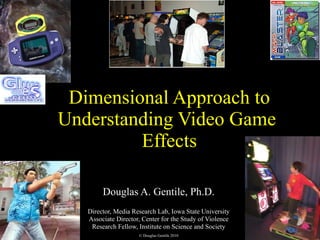
Dimensional Approach to Understanding Video Game  Effects Douglas A. Gentile, Ph.D. Director, Media Research Lab, Iowa State University Associate Director, Center for the Study of Violence Research Fellow, Institute on Science and Society © Douglas Gentile 2010
My approach today As mentioned yesterday, individual differences matter in how games may have effects on players  Furthermore, gamers’ motivations matter And of course, many other moderating influences matter (e.g., parents) My focus today, however, is on the features of interactions with games that can be influenced by game design, and how these features can change the effects games have
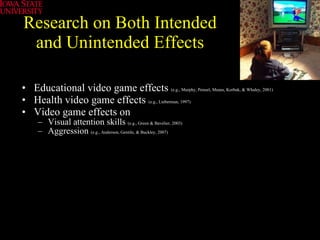
Research on Both Intended and Unintended Effects Health video game effects   (e.g., Lieberman, 1997)   Educational video game effects  (e.g., Murphy, Penuel, Means, Korbak, & Whaley, 2001)
What Makes a Great Teacher? (Gentile & Gentile, 2008) Have clear objectives, often set at multiple difficulty levels to adapt to the prior knowledge and skills of each learner The pace of the activities can be adjusted for faster or slower learners, novices or experts, to deliver differentiated instruction.
Halo 2: Controller Adaptation
What Makes a Great Teacher? (Gentile & Gentile, 2008) Have clear objectives, often set at multiple difficulty levels to adapt to the prior knowledge and skills of each learner The pace of the activities can be adjusted for faster or slower learners, novices or experts, to deliver differentiated instruction.  Well-sequenced in levels of increasing difficulty, pace, or complexity, with success at later levels contingent on competencies at prior levels
Learning is active with practice, feedback, and more practice to the point of mastery Once mastered, the knowledge and skills are practiced further to the point of automaticity Mastery of an objective is reinforced both extrinsically (e.g., with points, weapons, levels, etc.) and intrinsically (higher levels of competence and resulting self-esteem) What Makes a Great Teacher? (Gentile & Gentile, 2008)
Encourage a close-to-optimal combination of massed and distributed practice Knowledge/skills learned and practiced in multiple ways in a variety of contexts Important if transfer is desired Great teachers get students excited and “hooked” on topics What Makes a Great Teacher? (Gentile & Gentile, 2008)
Research on Both Intended and Unintended Effects Educational video game effects  (e.g., Murphy, Penuel, Means, Korbak, & Whaley, 2001) Health video game effects   (e.g., Lieberman, 1997)   Video game effects on  Visual attention skills  (e.g., Green & Bavelier, 2003) Aggression  (e.g., Anderson, Gentile, & Buckley, 2007)
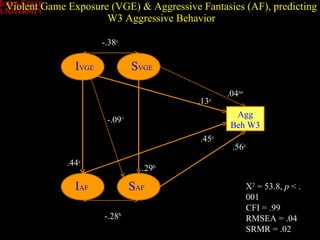
Violent Game Exposure (VGE) & Aggressive Fantasies (AF), predicting W3 Aggressive Behavior I VGE S VGE I AF S AF .44 c -.09 + .13 c .04 ns .56 c .45 c Agg Beh W3 -.28 b -.38 c X 2  = 53.8,  p  < .001 CFI = .99 RMSEA = .04 SRMR = .02 .29 b
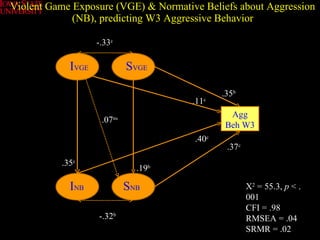
Violent Game Exposure (VGE) & Normative Beliefs about Aggression (NB), predicting W3 Aggressive Behavior I VGE S VGE I NB S NB .35 c .07 ns .11 c .35 b .37 c .40 c Agg Beh W3 -.32 b -.33 c X 2  = 55.3,  p  < .001 CFI = .98 RMSEA = .04 SRMR = .02 .19 b
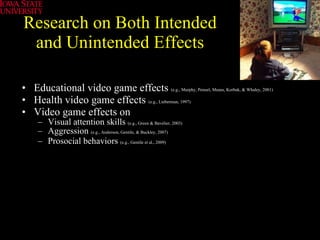
Research on Both Intended and Unintended Effects Educational video game effects  (e.g., Murphy, Penuel, Means, Korbak, & Whaley, 2001) Health video game effects   (e.g., Lieberman, 1997)   Video game effects on  Visual attention skills  (e.g., Green & Bavelier, 2003) Aggression  (e.g., Anderson, Gentile, & Buckley, 2007) Prosocial behaviors  (e.g., Gentile et al., 2009)
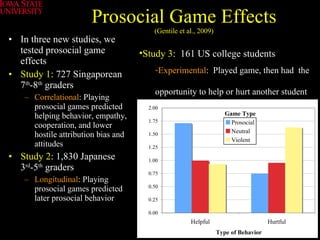
Prosocial Game Effects (Gentile et al., 2009) In three new studies, we tested prosocial game effects Study 1 : 727 Singaporean 7 th -8 th  graders Correlational : Playing prosocial games predicted helping behavior, empathy, cooperation, and lower hostile attribution bias and attitudes Study 2 : 1,830 Japanese 3 rd -5 th  graders Longitudinal : Playing prosocial games predicted later prosocial behavior Study 3 :  161 US college students Experimental :  Played game, then had  the  opportunity to help or hurt another student
Research on Both Intended and Unintended Effects Educational video game effects  (e.g., Murphy, Penuel, Means, Korbak, & Whaley, 2001) Health video game effects   (e.g., Lieberman, 1997)   Video game effects on  Visual attention skills  (e.g., Green & Bavelier, 2003) Aggression  (e.g., Anderson, Gentile, & Buckley, 2007) Prosocial behaviors  (e.g., Gentile et al., 2009)   Obesity  (e.g., Vandewater, Shim, & Caplovitz, 2004)   School performance  (e.g., Gentile, Lynch, Linder, & Walsh, 2004) Attention problems  (e.g., Swing, Gentile, & Anderson, 2010) Physical health:  e.g., Seizures & repetitive stress disorders  (e.g., Ricci & Vigevano, 1999) Advanced laparoscopic surgical skills  (e.g., Rosser, Lynch, Haskamp, Yalif, Gentile, & Giammaria, 2004)
Research on Both Intended and Unintended Effects Educational video game effects  (e.g., Murphy, Penuel, Means, Korbak, & Whaley, 2001) Health video game effects   (e.g., Lieberman, 1997)   Video game effects on  Visual attention skills  (e.g., Green & Bavelier, 2003) Aggression  (e.g., Anderson, Gentile, & Buckley, 2007) Prosocial behaviors  (e.g., Gentile et al., 2009)   Obesity  (e.g., Vandewater, Shim, & Caplovitz, 2004)   School performance  (e.g., Gentile, Lynch, Linder, & Walsh, 2004) Attention problems  (e.g., Swing, Gentile, & Anderson, 2010) Physical health:  e.g., Seizures & repetitive stress disorders  (e.g., Ricci & Vigevano, 1999) Advanced laparoscopic surgical skills  (e.g., Rosser, Lynch, Haskamp, Yalif, Gentile, & Giammaria, 2004) Video game “addiction”  (e.g., Gentile, 2009)
Research on Both Intended and Unintended Effects Educational video game effects  (e.g., Murphy, Penuel, Means, Korbak, & Whaley, 2001) Health video game effects   (e.g., Lieberman, 1997)   Video game effects on  Visual attention skills  (e.g., Green & Bavelier, 2003) Aggression  (e.g., Anderson, Gentile, & Buckley, 2007) Prosocial behaviors  (e.g., Gentile et al., 2009)   Obesity  (e.g., Vandewater, Shim, & Caplovitz, 2004)   School performance  (e.g., Gentile, Lynch, Linder, & Walsh, 2004) Attention problems  (e.g., Swing, Gentile, & Anderson, 2010) Physical health:  e.g., Seizures & repetitive stress disorders  (e.g., Ricci & Vigevano, 1999) Advanced laparoscopic surgical skills  (e.g., Rosser, Lynch, Haskamp, Yalif, Gentile, & Giammaria, 2004) Video game “addiction”  (e.g., Gentile, 2009)   And these are just  some  of the empirically identified effects!
How can we make  sense of it all?
There are  Multiple Dimensions  on Which Video Games can have an Effect Amount Content Structure Context Mechanics
Effects of Amount Overall amount seems to be most related to school performance Greater amount of entertainment games -> Poorer performance Greater amount -> Increased attention problems Overall amount may be related to health outcomes e.g., Obesity, repetitive-stress disorders Overall amount isn’t the whole story, however Distributed vs. Massed practice
Effects of Content Specific to the content of the game (i.e., the “script” elements or themes) Reading games -> Increased reading skills Math games -> Increased math skills Health games -> Increased health knowledge and health compliance behaviors Violent games -> Increased aggressive thoughts, feelings, and behaviors
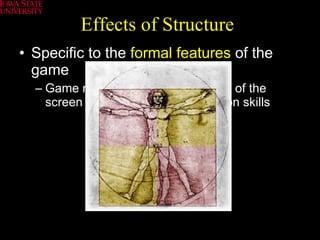
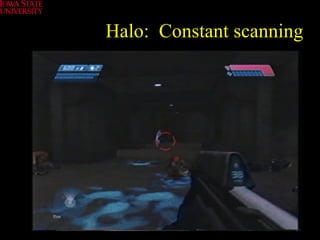
Effects of Structure Specific to the  formal features  of the game Game requires constant scanning of the screen -> Improved visual attention skills
Halo:  Constant scanning
Unreal Tournament: Constant Scanning
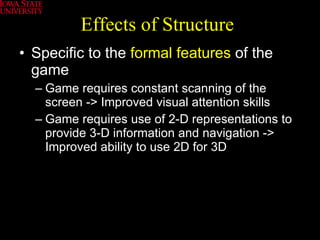
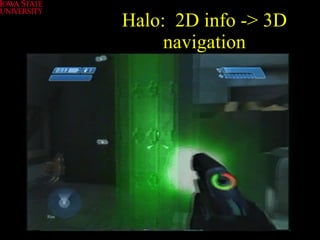
Effects of Structure Specific to the  formal features  of the game Game requires constant scanning of the screen -> Improved visual attention skills Game requires use of 2-D representations to provide 3-D information and navigation -> Improved ability to use 2D for 3D
Halo:  2D info -> 3D navigation
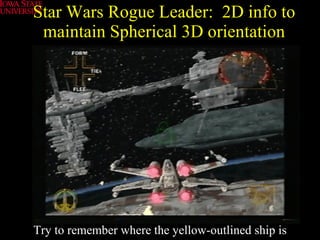
Effects of Structure Specific to the  formal features  of the game Game requires constant scanning of the screen -> Improved visual attention skills Game requires use of 2-D representations to provide 3-D information and navigation -> Improved ability to use 2D for 3D Game requires constant scanning and maintaining orientation in spherical 3D space with only 2D information
Star Wars Rogue Leader:  2D info to maintain Spherical 3D orientation Try to remember where the yellow-outlined ship is
Effects of Structure Specific to the  formal features  of the game Game requires constant scanning of the screen -> Improved visual attention skills Game requires use of 2-D representations to provide 3-D information and navigation -> Improved ability to use 2D for 3D Game requires constant scanning and maintaining orientation in spherical 3D space with only 2D information To the extent the representation is more  realistic  (perceptual fidelity), learning and transfer should be faster
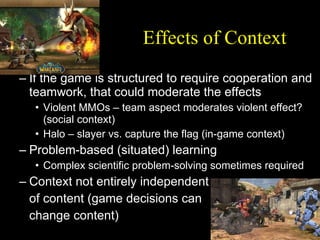
Effects of Context If the game is structured to require cooperation and teamwork, that could moderate the effects Violent MMOs – team aspect moderates violent effect? (social context) Halo – slayer vs. capture the flag (in-game context) Problem-based (situated) learning  Complex scientific problem-solving sometimes required Context not entirely independent of content (game decisions can change content)
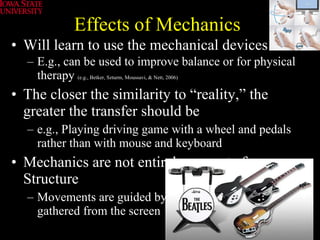
Effects of Mechanics Will learn to use the mechanical devices E.g., can be used to improve balance or for physical therapy  (e.g., Betker, Szturm, Moussavi, & Nett, 2006) The closer the similarity to “reality,” the greater the transfer should be e.g., Playing driving game with a wheel and pedals rather than with mouse and keyboard Mechanics are not entirely separate from Structure Movements are guided by visual information gathered from the screen
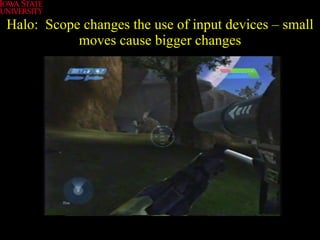
Halo:  Scope changes the use of input devices – small moves cause bigger changes
Four Benefits of This Approach Gets beyond dichotomous thinking of games as “good” or “bad” Allows us to understand multiple levels of effects
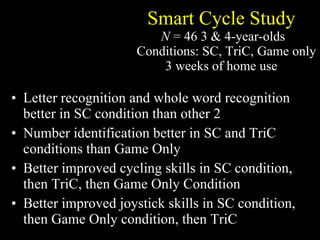
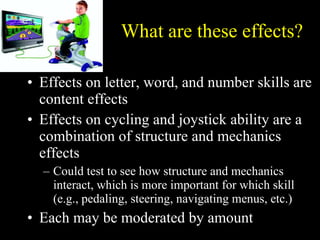
Smart Cycle Study   N  = 46 3 & 4-year-olds 3 Conditions: SC, TriC, Game only 3 weeks of home use Letter recognition and whole word recognition better in SC condition than other 2 Number identification better in SC and TriC conditions than Game Only Better improved cycling skills in SC condition, then TriC, then Game Only Condition Better improved joystick skills in SC condition, then Game Only condition, then TriC
What are these effects? Effects on letter, word, and number skills are content effects Effects on cycling and joystick ability are a combination of structure and mechanics effects Could test to see how structure and mechanics interact, which is more important for which skill (e.g., pedaling, steering, navigating menus, etc.) Each may be moderated by amount
Four Benefits of This Approach Gets beyond dichotomous thinking of games as “good” or “bad” Allows us to understand multiple levels of effects Provides testable hypotheses Allows for greater impact when attempting to have intended effects
To have the greatest impact, video game designers should consider all five dimensions of effect Example: Laparoscopic surgical simulators Amount: Require certain amount, distributed practice Content: Variations, complications, errors, etc. Structure: As realistic as possible, as many variations as possible, 3D-2D Context: Sense of urgency similar to surgical context Mechanics: Input devices similar to surgical tools, formal reactivity as similar as possible Goal: Under pressure, you see something wrong and instinctively react quickly, proportionally, and correctly
Media Research Lab www.DouglasGentile.com www.psychology.iastate.edu/~dgentile

Dimensional Approach to Understanding Video Game

  • 1.
    Dimensional Approach toUnderstanding Video Game Effects Douglas A. Gentile, Ph.D. Director, Media Research Lab, Iowa State University Associate Director, Center for the Study of Violence Research Fellow, Institute on Science and Society © Douglas Gentile 2010
  • 2.
    My approach todayAs mentioned yesterday, individual differences matter in how games may have effects on players Furthermore, gamers’ motivations matter And of course, many other moderating influences matter (e.g., parents) My focus today, however, is on the features of interactions with games that can be influenced by game design, and how these features can change the effects games have
  • 3.
    Research on BothIntended and Unintended Effects Health video game effects (e.g., Lieberman, 1997) Educational video game effects (e.g., Murphy, Penuel, Means, Korbak, & Whaley, 2001)
  • 4.
    What Makes aGreat Teacher? (Gentile & Gentile, 2008) Have clear objectives, often set at multiple difficulty levels to adapt to the prior knowledge and skills of each learner The pace of the activities can be adjusted for faster or slower learners, novices or experts, to deliver differentiated instruction.
  • 5.
  • 6.
    What Makes aGreat Teacher? (Gentile & Gentile, 2008) Have clear objectives, often set at multiple difficulty levels to adapt to the prior knowledge and skills of each learner The pace of the activities can be adjusted for faster or slower learners, novices or experts, to deliver differentiated instruction. Well-sequenced in levels of increasing difficulty, pace, or complexity, with success at later levels contingent on competencies at prior levels
  • 7.
    Learning is activewith practice, feedback, and more practice to the point of mastery Once mastered, the knowledge and skills are practiced further to the point of automaticity Mastery of an objective is reinforced both extrinsically (e.g., with points, weapons, levels, etc.) and intrinsically (higher levels of competence and resulting self-esteem) What Makes a Great Teacher? (Gentile & Gentile, 2008)
  • 8.
    Encourage a close-to-optimalcombination of massed and distributed practice Knowledge/skills learned and practiced in multiple ways in a variety of contexts Important if transfer is desired Great teachers get students excited and “hooked” on topics What Makes a Great Teacher? (Gentile & Gentile, 2008)
  • 9.
    Research on BothIntended and Unintended Effects Educational video game effects (e.g., Murphy, Penuel, Means, Korbak, & Whaley, 2001) Health video game effects (e.g., Lieberman, 1997) Video game effects on Visual attention skills (e.g., Green & Bavelier, 2003) Aggression (e.g., Anderson, Gentile, & Buckley, 2007)
  • 10.
    Violent Game Exposure(VGE) & Aggressive Fantasies (AF), predicting W3 Aggressive Behavior I VGE S VGE I AF S AF .44 c -.09 + .13 c .04 ns .56 c .45 c Agg Beh W3 -.28 b -.38 c X 2 = 53.8, p < .001 CFI = .99 RMSEA = .04 SRMR = .02 .29 b
  • 11.
    Violent Game Exposure(VGE) & Normative Beliefs about Aggression (NB), predicting W3 Aggressive Behavior I VGE S VGE I NB S NB .35 c .07 ns .11 c .35 b .37 c .40 c Agg Beh W3 -.32 b -.33 c X 2 = 55.3, p < .001 CFI = .98 RMSEA = .04 SRMR = .02 .19 b
  • 12.
    Research on BothIntended and Unintended Effects Educational video game effects (e.g., Murphy, Penuel, Means, Korbak, & Whaley, 2001) Health video game effects (e.g., Lieberman, 1997) Video game effects on Visual attention skills (e.g., Green & Bavelier, 2003) Aggression (e.g., Anderson, Gentile, & Buckley, 2007) Prosocial behaviors (e.g., Gentile et al., 2009)
  • 13.
    Prosocial Game Effects(Gentile et al., 2009) In three new studies, we tested prosocial game effects Study 1 : 727 Singaporean 7 th -8 th graders Correlational : Playing prosocial games predicted helping behavior, empathy, cooperation, and lower hostile attribution bias and attitudes Study 2 : 1,830 Japanese 3 rd -5 th graders Longitudinal : Playing prosocial games predicted later prosocial behavior Study 3 : 161 US college students Experimental : Played game, then had the opportunity to help or hurt another student
  • 14.
    Research on BothIntended and Unintended Effects Educational video game effects (e.g., Murphy, Penuel, Means, Korbak, & Whaley, 2001) Health video game effects (e.g., Lieberman, 1997) Video game effects on Visual attention skills (e.g., Green & Bavelier, 2003) Aggression (e.g., Anderson, Gentile, & Buckley, 2007) Prosocial behaviors (e.g., Gentile et al., 2009) Obesity (e.g., Vandewater, Shim, & Caplovitz, 2004) School performance (e.g., Gentile, Lynch, Linder, & Walsh, 2004) Attention problems (e.g., Swing, Gentile, & Anderson, 2010) Physical health: e.g., Seizures & repetitive stress disorders (e.g., Ricci & Vigevano, 1999) Advanced laparoscopic surgical skills (e.g., Rosser, Lynch, Haskamp, Yalif, Gentile, & Giammaria, 2004)
  • 15.
    Research on BothIntended and Unintended Effects Educational video game effects (e.g., Murphy, Penuel, Means, Korbak, & Whaley, 2001) Health video game effects (e.g., Lieberman, 1997) Video game effects on Visual attention skills (e.g., Green & Bavelier, 2003) Aggression (e.g., Anderson, Gentile, & Buckley, 2007) Prosocial behaviors (e.g., Gentile et al., 2009) Obesity (e.g., Vandewater, Shim, & Caplovitz, 2004) School performance (e.g., Gentile, Lynch, Linder, & Walsh, 2004) Attention problems (e.g., Swing, Gentile, & Anderson, 2010) Physical health: e.g., Seizures & repetitive stress disorders (e.g., Ricci & Vigevano, 1999) Advanced laparoscopic surgical skills (e.g., Rosser, Lynch, Haskamp, Yalif, Gentile, & Giammaria, 2004) Video game “addiction” (e.g., Gentile, 2009)
  • 16.
    Research on BothIntended and Unintended Effects Educational video game effects (e.g., Murphy, Penuel, Means, Korbak, & Whaley, 2001) Health video game effects (e.g., Lieberman, 1997) Video game effects on Visual attention skills (e.g., Green & Bavelier, 2003) Aggression (e.g., Anderson, Gentile, & Buckley, 2007) Prosocial behaviors (e.g., Gentile et al., 2009) Obesity (e.g., Vandewater, Shim, & Caplovitz, 2004) School performance (e.g., Gentile, Lynch, Linder, & Walsh, 2004) Attention problems (e.g., Swing, Gentile, & Anderson, 2010) Physical health: e.g., Seizures & repetitive stress disorders (e.g., Ricci & Vigevano, 1999) Advanced laparoscopic surgical skills (e.g., Rosser, Lynch, Haskamp, Yalif, Gentile, & Giammaria, 2004) Video game “addiction” (e.g., Gentile, 2009) And these are just some of the empirically identified effects!
  • 17.
    How can wemake sense of it all?
  • 18.
    There are Multiple Dimensions on Which Video Games can have an Effect Amount Content Structure Context Mechanics
  • 19.
    Effects of AmountOverall amount seems to be most related to school performance Greater amount of entertainment games -> Poorer performance Greater amount -> Increased attention problems Overall amount may be related to health outcomes e.g., Obesity, repetitive-stress disorders Overall amount isn’t the whole story, however Distributed vs. Massed practice
  • 20.
    Effects of ContentSpecific to the content of the game (i.e., the “script” elements or themes) Reading games -> Increased reading skills Math games -> Increased math skills Health games -> Increased health knowledge and health compliance behaviors Violent games -> Increased aggressive thoughts, feelings, and behaviors
  • 21.
    Effects of StructureSpecific to the formal features of the game Game requires constant scanning of the screen -> Improved visual attention skills
  • 22.
  • 23.
  • 24.
    Effects of StructureSpecific to the formal features of the game Game requires constant scanning of the screen -> Improved visual attention skills Game requires use of 2-D representations to provide 3-D information and navigation -> Improved ability to use 2D for 3D
  • 25.
    Halo: 2Dinfo -> 3D navigation
  • 26.
    Effects of StructureSpecific to the formal features of the game Game requires constant scanning of the screen -> Improved visual attention skills Game requires use of 2-D representations to provide 3-D information and navigation -> Improved ability to use 2D for 3D Game requires constant scanning and maintaining orientation in spherical 3D space with only 2D information
  • 27.
    Star Wars RogueLeader: 2D info to maintain Spherical 3D orientation Try to remember where the yellow-outlined ship is
  • 28.
    Effects of StructureSpecific to the formal features of the game Game requires constant scanning of the screen -> Improved visual attention skills Game requires use of 2-D representations to provide 3-D information and navigation -> Improved ability to use 2D for 3D Game requires constant scanning and maintaining orientation in spherical 3D space with only 2D information To the extent the representation is more realistic (perceptual fidelity), learning and transfer should be faster
  • 29.
    Effects of ContextIf the game is structured to require cooperation and teamwork, that could moderate the effects Violent MMOs – team aspect moderates violent effect? (social context) Halo – slayer vs. capture the flag (in-game context) Problem-based (situated) learning Complex scientific problem-solving sometimes required Context not entirely independent of content (game decisions can change content)
  • 30.
    Effects of MechanicsWill learn to use the mechanical devices E.g., can be used to improve balance or for physical therapy (e.g., Betker, Szturm, Moussavi, & Nett, 2006) The closer the similarity to “reality,” the greater the transfer should be e.g., Playing driving game with a wheel and pedals rather than with mouse and keyboard Mechanics are not entirely separate from Structure Movements are guided by visual information gathered from the screen
  • 31.
    Halo: Scopechanges the use of input devices – small moves cause bigger changes
  • 32.
    Four Benefits ofThis Approach Gets beyond dichotomous thinking of games as “good” or “bad” Allows us to understand multiple levels of effects
  • 33.
    Smart Cycle Study N = 46 3 & 4-year-olds 3 Conditions: SC, TriC, Game only 3 weeks of home use Letter recognition and whole word recognition better in SC condition than other 2 Number identification better in SC and TriC conditions than Game Only Better improved cycling skills in SC condition, then TriC, then Game Only Condition Better improved joystick skills in SC condition, then Game Only condition, then TriC
  • 34.
    What are theseeffects? Effects on letter, word, and number skills are content effects Effects on cycling and joystick ability are a combination of structure and mechanics effects Could test to see how structure and mechanics interact, which is more important for which skill (e.g., pedaling, steering, navigating menus, etc.) Each may be moderated by amount
  • 35.
    Four Benefits ofThis Approach Gets beyond dichotomous thinking of games as “good” or “bad” Allows us to understand multiple levels of effects Provides testable hypotheses Allows for greater impact when attempting to have intended effects
  • 36.
    To have thegreatest impact, video game designers should consider all five dimensions of effect Example: Laparoscopic surgical simulators Amount: Require certain amount, distributed practice Content: Variations, complications, errors, etc. Structure: As realistic as possible, as many variations as possible, 3D-2D Context: Sense of urgency similar to surgical context Mechanics: Input devices similar to surgical tools, formal reactivity as similar as possible Goal: Under pressure, you see something wrong and instinctively react quickly, proportionally, and correctly
  • 37.
    Media Research Labwww.DouglasGentile.com www.psychology.iastate.edu/~dgentile