MINISTRY OF EDUCATION
TECHNOLOGICAL UNIVERSITY
(TOUNGOO)
DEPARTMENT OF CIVIL ENGINEERING
RETROFITTING OF MULTI-STORY RC BUILDING
USING CFRPAGAINST EARTHQUAKE EFFECT
Title Defence
(21.2.2020)
Supervised by
Daw Zin Mar Thet
Presented by
Ma May Thansin Nway
VI.C-2
OUTLINE OF PRESENTATION
• Introduction
• Objective
• Scope
• Flow Chart
INTRODUCTION
• Among the nature hazards, earthquakes have the potential for causing the greatest
damages to structures.
• Beams and columns, being the lateral load and vertical load resisting members in
RC structure are particularly vulnerable to failures during earthquakes.
• Seismic retrofitting is an effective method of reducing the risks for existing
seismically deficient structure.
• The retrofit process consist of a variety of treatments, including; preservation,
rehabilitation, restoration and reconstruction.
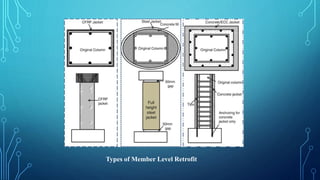
Types of Member Level Retrofit
CONTINUED;
• Fiber reinforced polymer (FRP) materials increase the confinement of
column and flexural and shear strengthening of beams.
• FRP materials are lightweight, non-corrosive, non-magnetic and exhibit
high tensile strength.
• A fiber reinforced polymer system consists of fibers typically made of
carbon, glass, or aramid and a polymer adhesive that can be an epoxy,
polyester, or vinyl-ester.
CONTINUED;
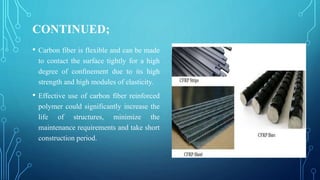
• Carbon fiber is flexible and can be made
to contact the surface tightly for a high
degree of confinement due to its high
strength and high modules of elasticity.
• Effective use of carbon fiber reinforced
polymer could significantly increase the
life of structures, minimize the
maintenance requirements and take short
construction period.
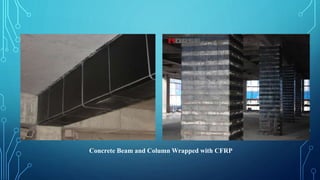
Concrete Beam and Column Wrapped with CFRP
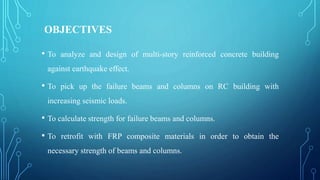
OBJECTIVES
• To analyze and design of multi-story reinforced concrete building
against earthquake effect.
• To pick up the failure beams and columns on RC building with
increasing seismic loads.
• To calculate strength for failure beams and columns.
• To retrofit with FRP composite materials in order to obtain the
necessary strength of beams and columns.
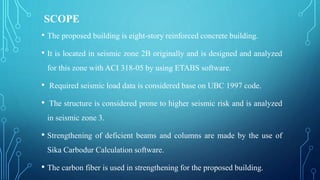
SCOPE
• The proposed building is eight-story reinforced concrete building.
• It is located in seismic zone 2B originally and is designed and analyzed
for this zone with ACI 318-05 by using ETABS software.
• Required seismic load data is considered base on UBC 1997 code.
• The structure is considered prone to higher seismic risk and is analyzed
in seismic zone 3.
• Strengthening of deficient beams and columns are made by the use of
Sika Carbodur Calculation software.
• The carbon fiber is used in strengthening for the proposed building.
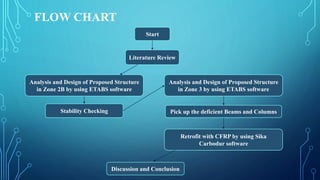
FLOW CHART
Start
Literature Review
Analysis and Design of Proposed Structure
in Zone 2B by using ETABS software
Analysis and Design of Proposed Structure
in Zone 3 by using ETABS software
Pick up the deficient Beams and Columns
Retrofit with CFRP by using Sika
Carbodur software
Discussion and Conclusion
Stability Checking
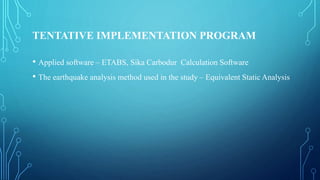
TENTATIVE IMPLEMENTATION PROGRAM
• Applied software – ETABS, Sika Carbodur Calculation Software
• The earthquake analysis method used in the study – Equivalent Static Analysis
THANK YOU
FOR YOUR ATTENTION!

title defense.pptx

  • 1.
    MINISTRY OF EDUCATION TECHNOLOGICALUNIVERSITY (TOUNGOO) DEPARTMENT OF CIVIL ENGINEERING RETROFITTING OF MULTI-STORY RC BUILDING USING CFRPAGAINST EARTHQUAKE EFFECT Title Defence (21.2.2020) Supervised by Daw Zin Mar Thet Presented by Ma May Thansin Nway VI.C-2
  • 2.
    OUTLINE OF PRESENTATION •Introduction • Objective • Scope • Flow Chart
  • 3.
    INTRODUCTION • Among thenature hazards, earthquakes have the potential for causing the greatest damages to structures. • Beams and columns, being the lateral load and vertical load resisting members in RC structure are particularly vulnerable to failures during earthquakes. • Seismic retrofitting is an effective method of reducing the risks for existing seismically deficient structure. • The retrofit process consist of a variety of treatments, including; preservation, rehabilitation, restoration and reconstruction.
  • 4.
    Types of MemberLevel Retrofit
  • 5.
    CONTINUED; • Fiber reinforcedpolymer (FRP) materials increase the confinement of column and flexural and shear strengthening of beams. • FRP materials are lightweight, non-corrosive, non-magnetic and exhibit high tensile strength. • A fiber reinforced polymer system consists of fibers typically made of carbon, glass, or aramid and a polymer adhesive that can be an epoxy, polyester, or vinyl-ester.
  • 6.
    CONTINUED; • Carbon fiberis flexible and can be made to contact the surface tightly for a high degree of confinement due to its high strength and high modules of elasticity. • Effective use of carbon fiber reinforced polymer could significantly increase the life of structures, minimize the maintenance requirements and take short construction period.
  • 7.
    Concrete Beam andColumn Wrapped with CFRP
  • 8.
    OBJECTIVES • To analyzeand design of multi-story reinforced concrete building against earthquake effect. • To pick up the failure beams and columns on RC building with increasing seismic loads. • To calculate strength for failure beams and columns. • To retrofit with FRP composite materials in order to obtain the necessary strength of beams and columns.
  • 9.
    SCOPE • The proposedbuilding is eight-story reinforced concrete building. • It is located in seismic zone 2B originally and is designed and analyzed for this zone with ACI 318-05 by using ETABS software. • Required seismic load data is considered base on UBC 1997 code. • The structure is considered prone to higher seismic risk and is analyzed in seismic zone 3. • Strengthening of deficient beams and columns are made by the use of Sika Carbodur Calculation software. • The carbon fiber is used in strengthening for the proposed building.
  • 10.
    FLOW CHART Start Literature Review Analysisand Design of Proposed Structure in Zone 2B by using ETABS software Analysis and Design of Proposed Structure in Zone 3 by using ETABS software Pick up the deficient Beams and Columns Retrofit with CFRP by using Sika Carbodur software Discussion and Conclusion Stability Checking
  • 11.
    TENTATIVE IMPLEMENTATION PROGRAM •Applied software – ETABS, Sika Carbodur Calculation Software • The earthquake analysis method used in the study – Equivalent Static Analysis
  • 12.