Image Bank: Foot FracturesImage and Answer
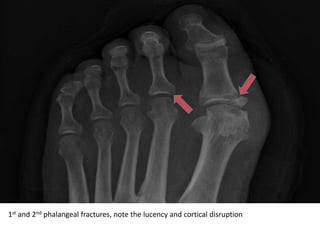
1st and 2nd phalangeal fractures, note the lucency and cortical disruption
No fracture, this is a growth plate in a child, note the lack of cortication of the fragment and the multiple ossification centers, indicating this is a young foot.
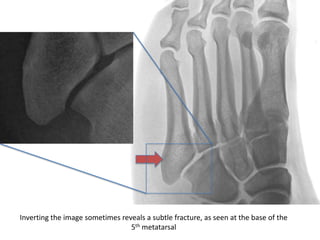
Inverting the image sometimes reveals a subtle fracture, as seen at the base of the 5th metatarsal
+Calcaneal fracture, always track your cortical lines for disruptions
Dedicated calcaneus film, consider this in pt’s w/ falls or significant heel injuries concerning for a fracture.  Mild hyperlucency noted (red arrow, likely calcific Achille’s tendon insertion) and hypolucency (blue arrow) concerning for a subtle fracture.
Cuboid fracture, very subtle, easily overlooked
Subtle cuboid fracture vsosnaviculare, consider possibility of an avulsion injury 2/2 rupture calcaneocuboid part of the bifurcated ligament should mechanism exist
Cuboid fracture, longitudinal plantar ligament avulsion fxTx: NWB splint w/ ortho f/u 2wks for wt-bearing XRays
Cuboid fracture, note the hypolucent irregularity (green arrows) with cortical distortion (red arrow)Tx: NWB short leg cast x4-6wks
Navicularpseudofracture…this is actually a normal Xray, the hypolucency is actually just as a result of prominent trabeculae, note the smooth cortical rim
Cuboid Fracture:  Use the lateral films to interrogate the plantar aspect of the cuboid, you can easily miss obvious fractures!
Stress Fx/Jones Fx (distal to the insertion of the peroneus brevis and 4th MT groove) Tx: Strict NWB ortho shoe 4-6wks vs possible ORIF (high risk of non-union, usually only indicated for displaced fx)
Jones Fx (Zone II), no displacement, so likely no surgery
Subtle Stress Fx (Jones Zone iII):  Use the lateral films to also interrogate the 5th MT to scan for subtle cortical disruptions (red arrow)
Disrupted Jones III Fx:  This will need pinning, not today, but soon…call ortho but send home
Avulsion PseudoJones (Zone II) fracture of the 5th MTUnstable fracture, will require pinning, strict NWB status until f/u
LisFranc Fracture: Mechanism is twisting on a planted foot, falls, severe plantar flexion.  Fracture through the proximal MTs or midfoot disruption causes classic “Terry Thomas” sign highlighted here.  Isolated fracture type.
(left) Lis Franc w/ marked MT disruption and homolateral (all 5 MTs) shiftHomolateral fracture type highly associated with cuboid fractures(below) Isolated LisFranc w/ subtle cortical disruptions noted
Multiple new (blue arrows) and a healing (red arrow) distal MT fractures in a child…should consider DCFS call if the story is in question
Proximal phalangeal fracturesTx: Ice, elevation, NWB, f/u ortho for possible pinning given loose fragment
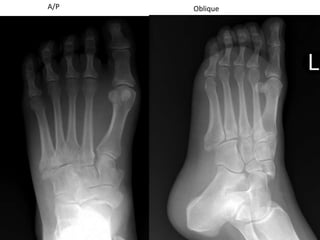
A/POblique
Navicular fracture (blue arrows) with cuneiform fracture (red arrows).  Navicularfxs have high incidence of avascular necrosis!  Need ORIF!!!
Foot fractures
Foot fractures

Foot fractures

  • 1.
    Image Bank: FootFracturesImage and Answer
  • 3.
    1st and 2ndphalangeal fractures, note the lucency and cortical disruption
  • 5.
    No fracture, thisis a growth plate in a child, note the lack of cortication of the fragment and the multiple ossification centers, indicating this is a young foot.
  • 7.
    Inverting the imagesometimes reveals a subtle fracture, as seen at the base of the 5th metatarsal
  • 10.
    +Calcaneal fracture, alwaystrack your cortical lines for disruptions
  • 11.
    Dedicated calcaneus film,consider this in pt’s w/ falls or significant heel injuries concerning for a fracture. Mild hyperlucency noted (red arrow, likely calcific Achille’s tendon insertion) and hypolucency (blue arrow) concerning for a subtle fracture.
  • 13.
    Cuboid fracture, verysubtle, easily overlooked
  • 15.
    Subtle cuboid fracturevsosnaviculare, consider possibility of an avulsion injury 2/2 rupture calcaneocuboid part of the bifurcated ligament should mechanism exist
  • 17.
    Cuboid fracture, longitudinalplantar ligament avulsion fxTx: NWB splint w/ ortho f/u 2wks for wt-bearing XRays
  • 18.
    Cuboid fracture, notethe hypolucent irregularity (green arrows) with cortical distortion (red arrow)Tx: NWB short leg cast x4-6wks
  • 19.
    Navicularpseudofracture…this is actuallya normal Xray, the hypolucency is actually just as a result of prominent trabeculae, note the smooth cortical rim
  • 21.
    Cuboid Fracture: Use the lateral films to interrogate the plantar aspect of the cuboid, you can easily miss obvious fractures!
  • 23.
    Stress Fx/Jones Fx(distal to the insertion of the peroneus brevis and 4th MT groove) Tx: Strict NWB ortho shoe 4-6wks vs possible ORIF (high risk of non-union, usually only indicated for displaced fx)
  • 25.
    Jones Fx (ZoneII), no displacement, so likely no surgery
  • 27.
    Subtle Stress Fx(Jones Zone iII): Use the lateral films to also interrogate the 5th MT to scan for subtle cortical disruptions (red arrow)
  • 29.
    Disrupted Jones IIIFx: This will need pinning, not today, but soon…call ortho but send home
  • 31.
    Avulsion PseudoJones (ZoneII) fracture of the 5th MTUnstable fracture, will require pinning, strict NWB status until f/u
  • 33.
    LisFranc Fracture: Mechanismis twisting on a planted foot, falls, severe plantar flexion. Fracture through the proximal MTs or midfoot disruption causes classic “Terry Thomas” sign highlighted here. Isolated fracture type.
  • 34.
    (left) Lis Francw/ marked MT disruption and homolateral (all 5 MTs) shiftHomolateral fracture type highly associated with cuboid fractures(below) Isolated LisFranc w/ subtle cortical disruptions noted
  • 36.
    Multiple new (bluearrows) and a healing (red arrow) distal MT fractures in a child…should consider DCFS call if the story is in question
  • 38.
    Proximal phalangeal fracturesTx:Ice, elevation, NWB, f/u ortho for possible pinning given loose fragment
  • 39.
  • 40.
    Navicular fracture (bluearrows) with cuneiform fracture (red arrows). Navicularfxs have high incidence of avascular necrosis! Need ORIF!!!