Results - based
Performance
Management
System (RPMS) for
DepEd
Lead, Engage, Align & Do! (LEAD)
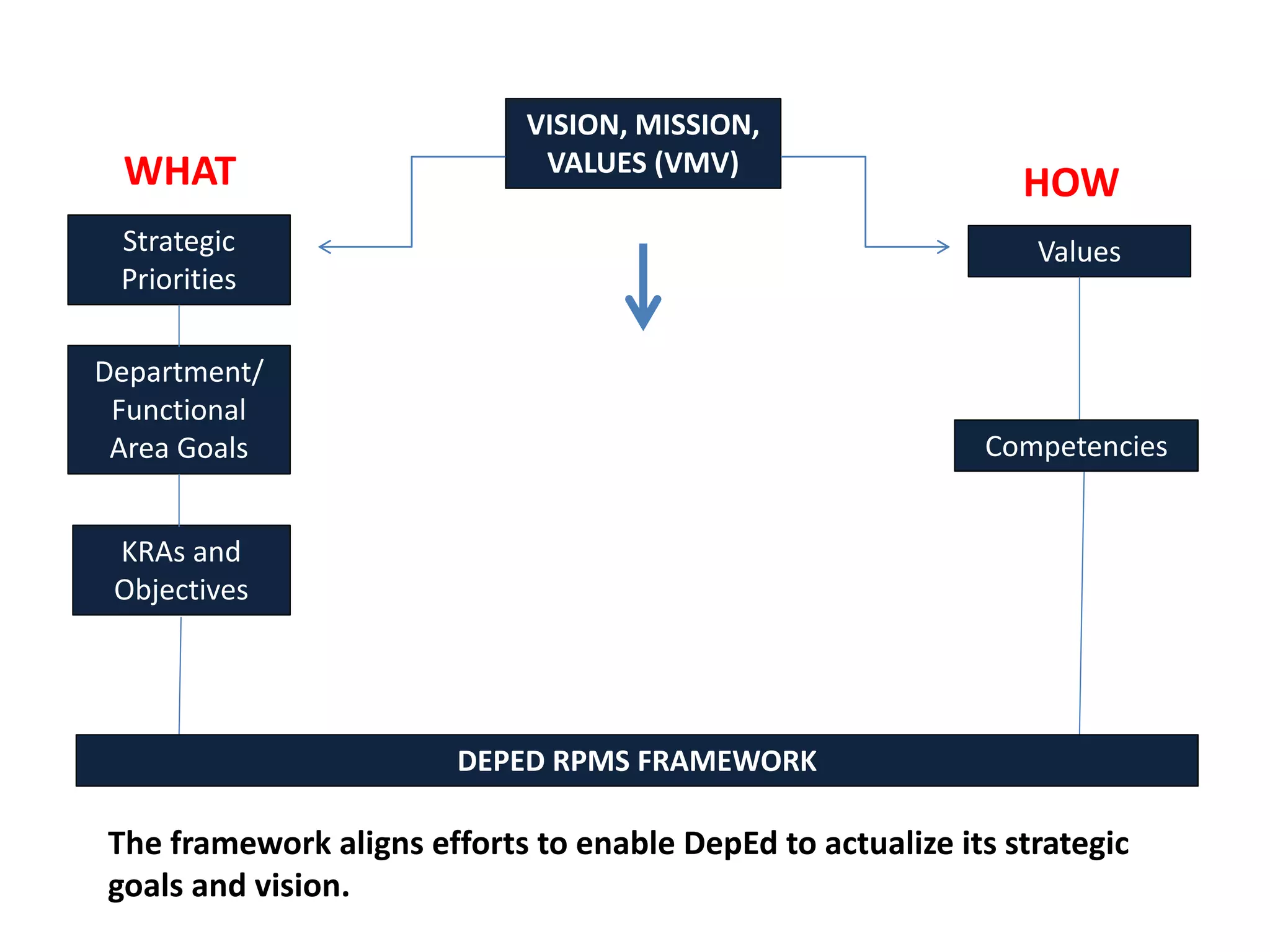
The framework aligns efforts to enable DepEd to actualize its strategic
goals and vision.
VISION, MISSION,
VALUES (VMV)
Strategic
Priorities
Department/
Functional
Area Goals
KRAs and
Objectives
Values
DEPED RPMS FRAMEWORK
Competencies
WHAT HOW
The DepEd RPMS is aligned with the
SPMS of CSC which has 4 Phases:
1. Performance
Planning and
Commitment
3. Performance
Review and
Evaluation
2. Performance
Monitoring and
Coaching
4. Performance
Rewarding and
Development
Planning
A systematic approach for continuous and
consistent work improvement and
individual growth.
What is Performance Management?
An organization-wide process to ensure
that employees focus work efforts
towards achieving DepEd’s Vision, Mission
and Values (VMV).
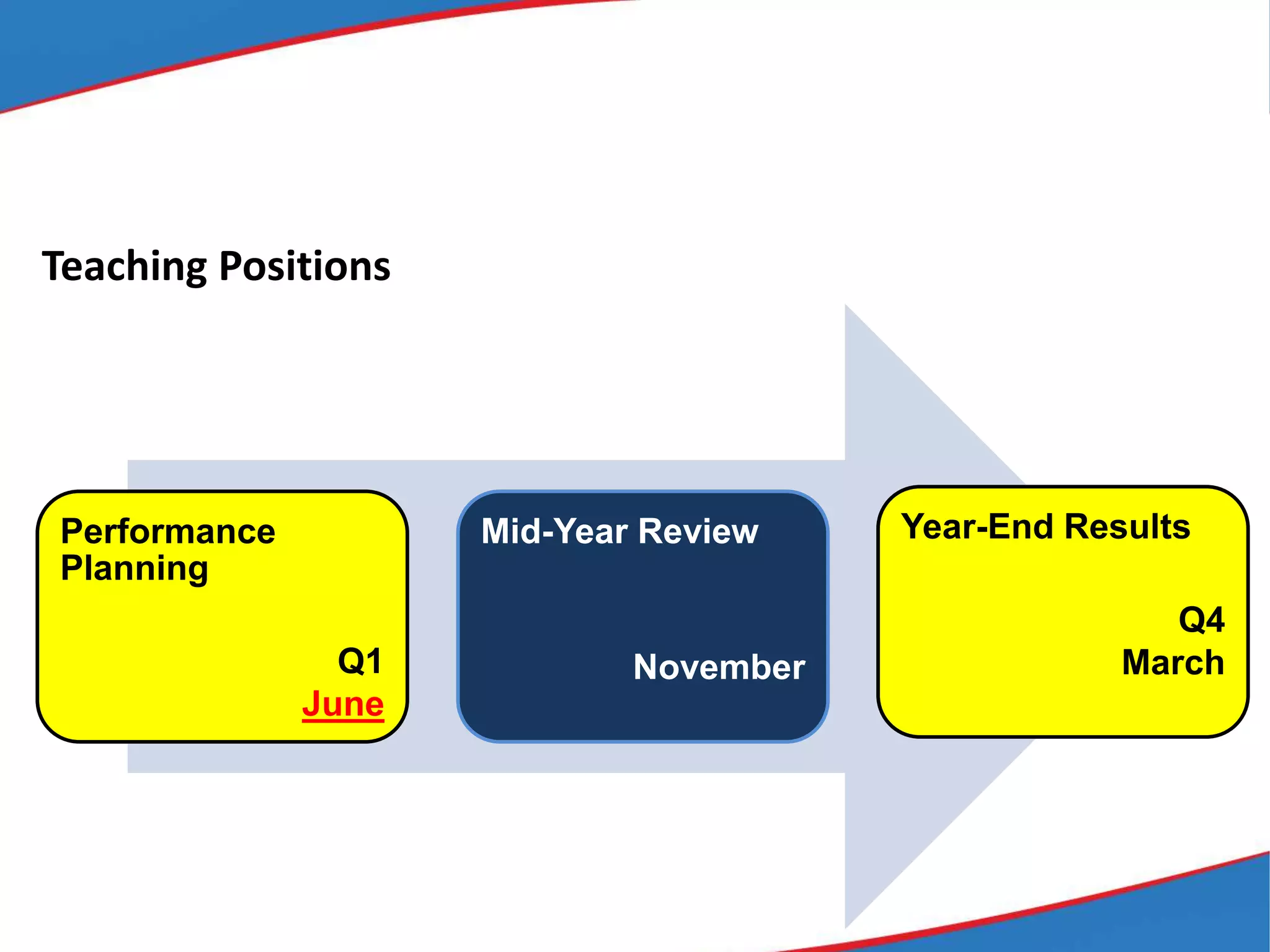
Performance
Planning
Q1
June
Mid-Year Review
November
Year-End Results
Q4
March
Teaching Positions
What =
Results
How =
Competencies+(Results & Objectives
of a position)
(Skills, Knowledge &
Behaviors used to
accomplish results)
Components of Performance
Management
Phase 1
Performance Planning
and Commitment
1. Discuss Unit’s Objectives
2. Identify Individual KRAs, Objectives
and Performance Indicators
3. Discuss Competencies Required and
Additional Competencies Needed
4. Reaching Agreement
What is the definition of KRAs?
KRAs define the areas in which an employee is
expected to focus his/her efforts.
What is the definition of Objectives?
Objectives are the specific things you need to do,
to achieve the results you want.
SMART Criteria for Objectives
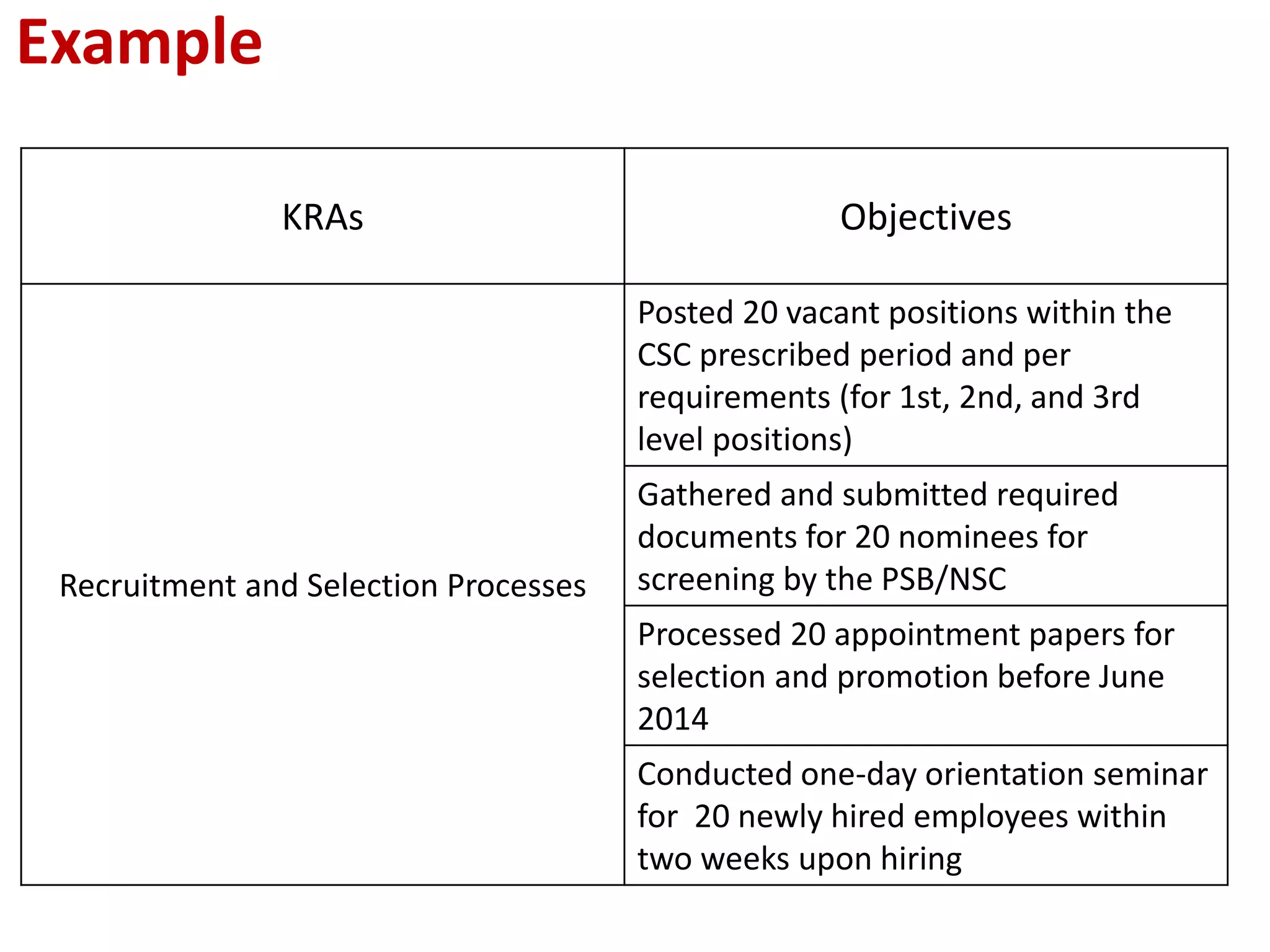
Example
KRAs Objectives
Recruitment and Selection Processes
Posted 20 vacant positions within the
CSC prescribed period and per
requirements (for 1st, 2nd, and 3rd
level positions)
Gathered and submitted required
documents for 20 nominees for
screening by the PSB/NSC
Processed 20 appointment papers for
selection and promotion before June
2014
Conducted one-day orientation seminar
for 20 newly hired employees within
two weeks upon hiring
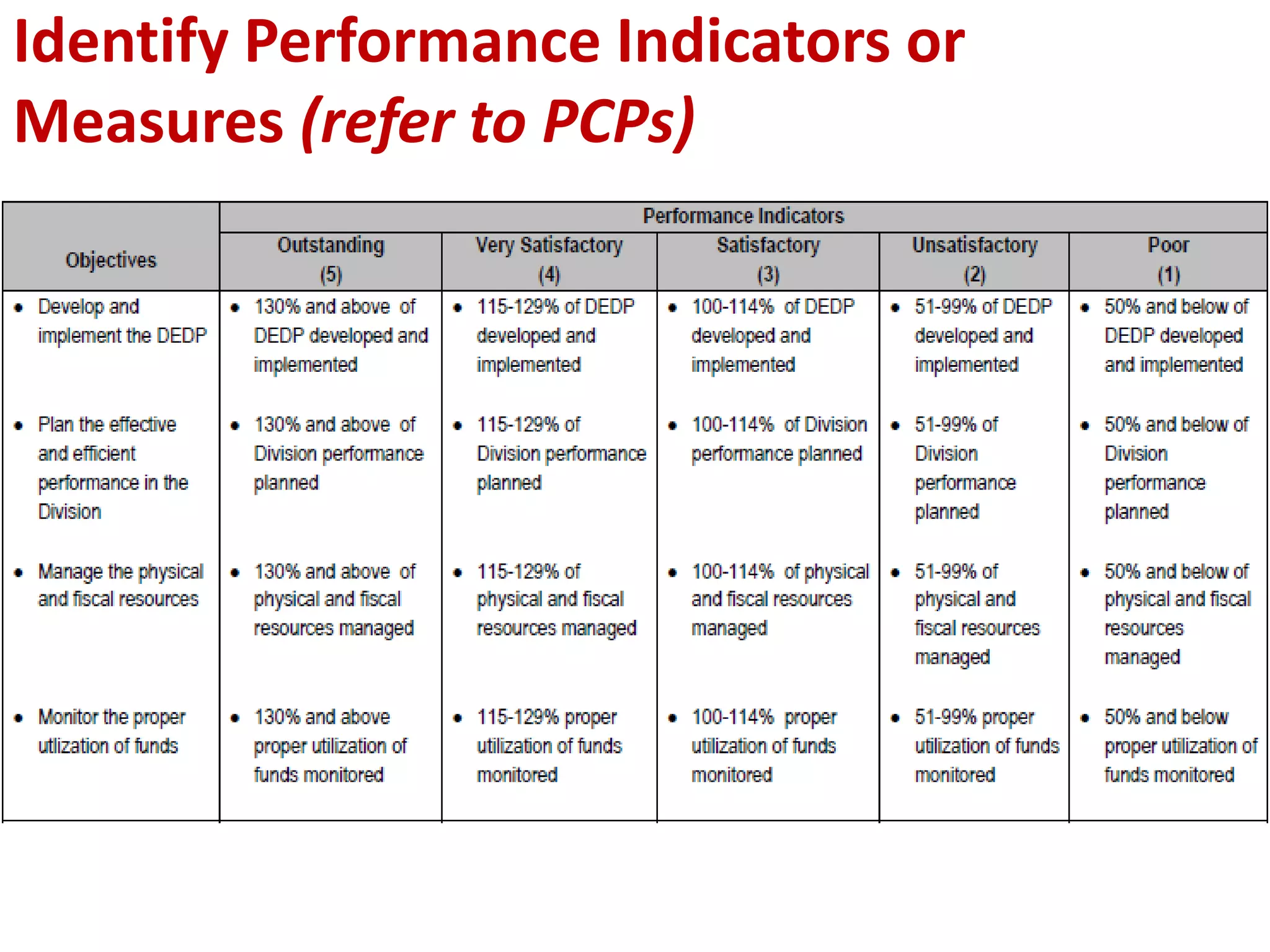
Identify Performance Indicators or
Measures (refer to PCPs)
Performance Indicators
• They are EXACT QUANTIFICATION OF OBJECTIVES.
• It is an assessment tool that gauges whether a performance
is good or bad.
• Agree on acceptable tracking sources
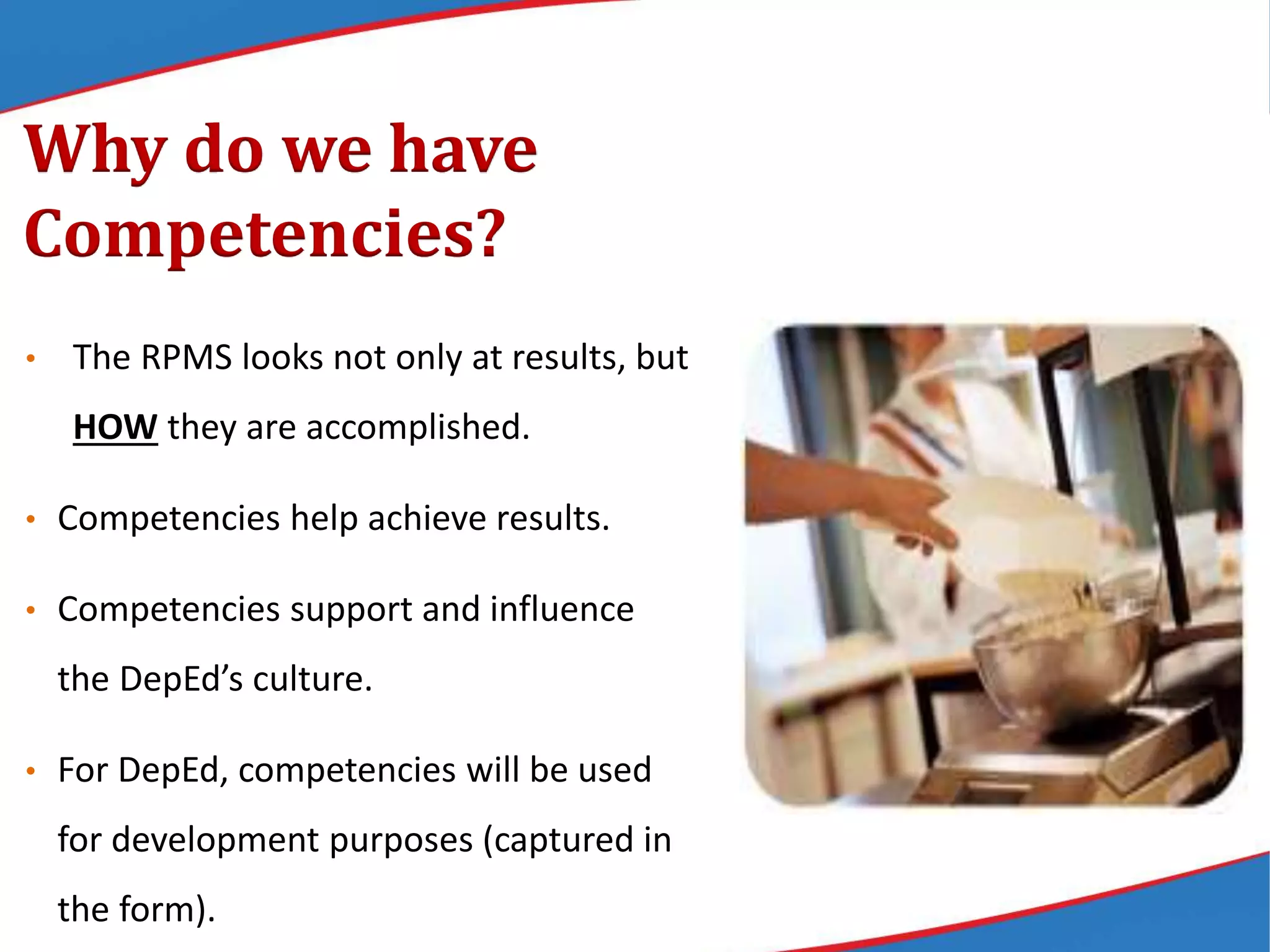
• The RPMS looks not only at results, but
HOW they are accomplished.
• Competencies help achieve results.
• Competencies support and influence
the DepEd’s culture.
• For DepEd, competencies will be used
for development purposes (captured in
the form).
Why do we have
Competencies?
4. Reaching Agreement
Once the form is completed :
KRAs + Objectives + Performance Indicators +
Competencies
1. Rater schedules a meeting with Ratee.
2. Agree on the listed KRAs, Objectives,
Performance Indicators and assigned Weight
per KRA.
3. Where to focus on the Competencies
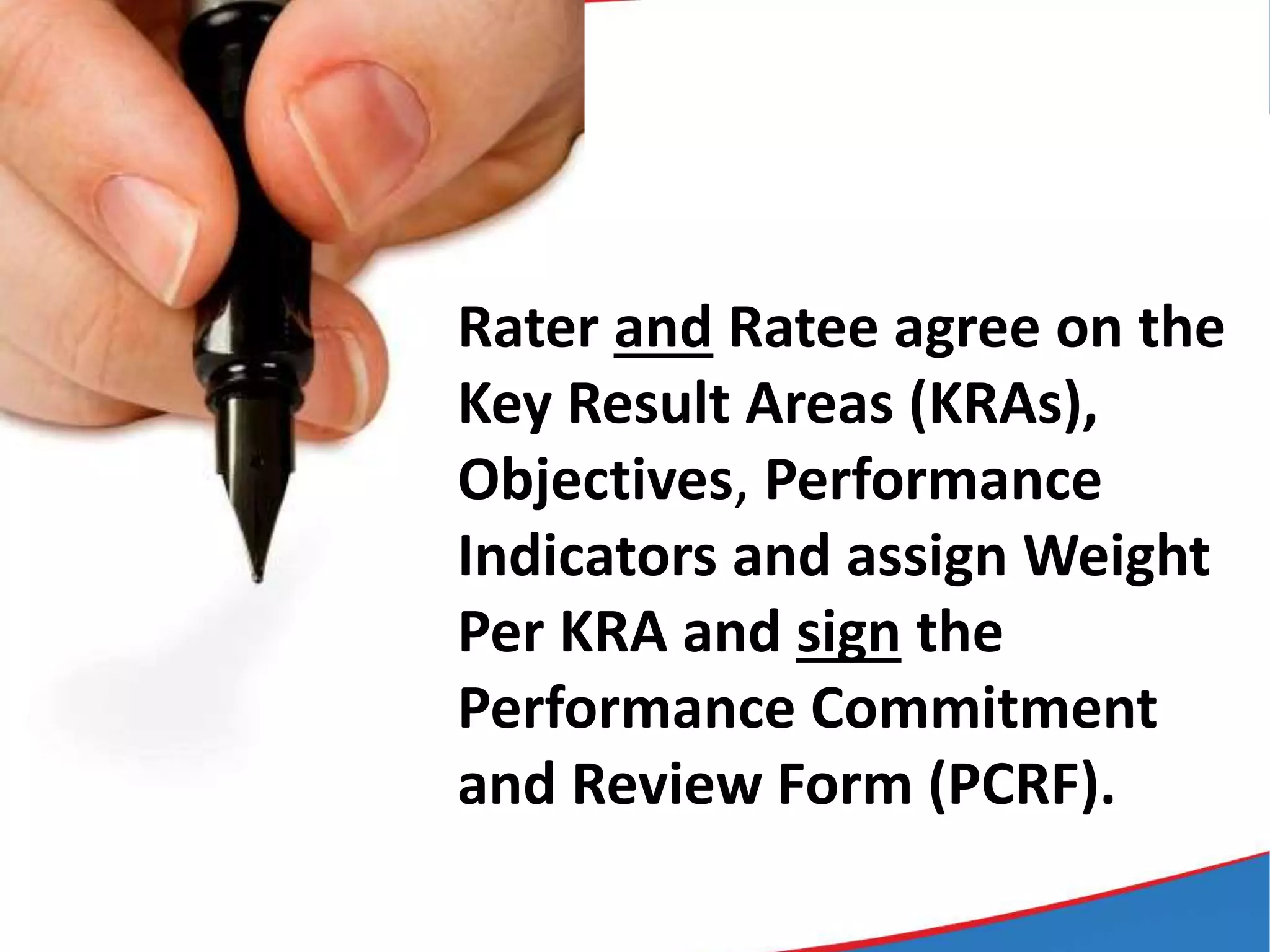
Rater and Ratee agree on the
Key Result Areas (KRAs),
Objectives, Performance
Indicators and assign Weight
Per KRA and sign the
Performance Commitment
and Review Form (PCRF).
Phase 2
Performance Monitoring
and Coaching
1. Performance Tracking
2. Coaching/Feedback
Heart of the RPMS
“If you want it,
measure it. If you
can’t measure it,
forget it.”
– Peter Drucker
WHAT GETS MEASURED GETS DONE!
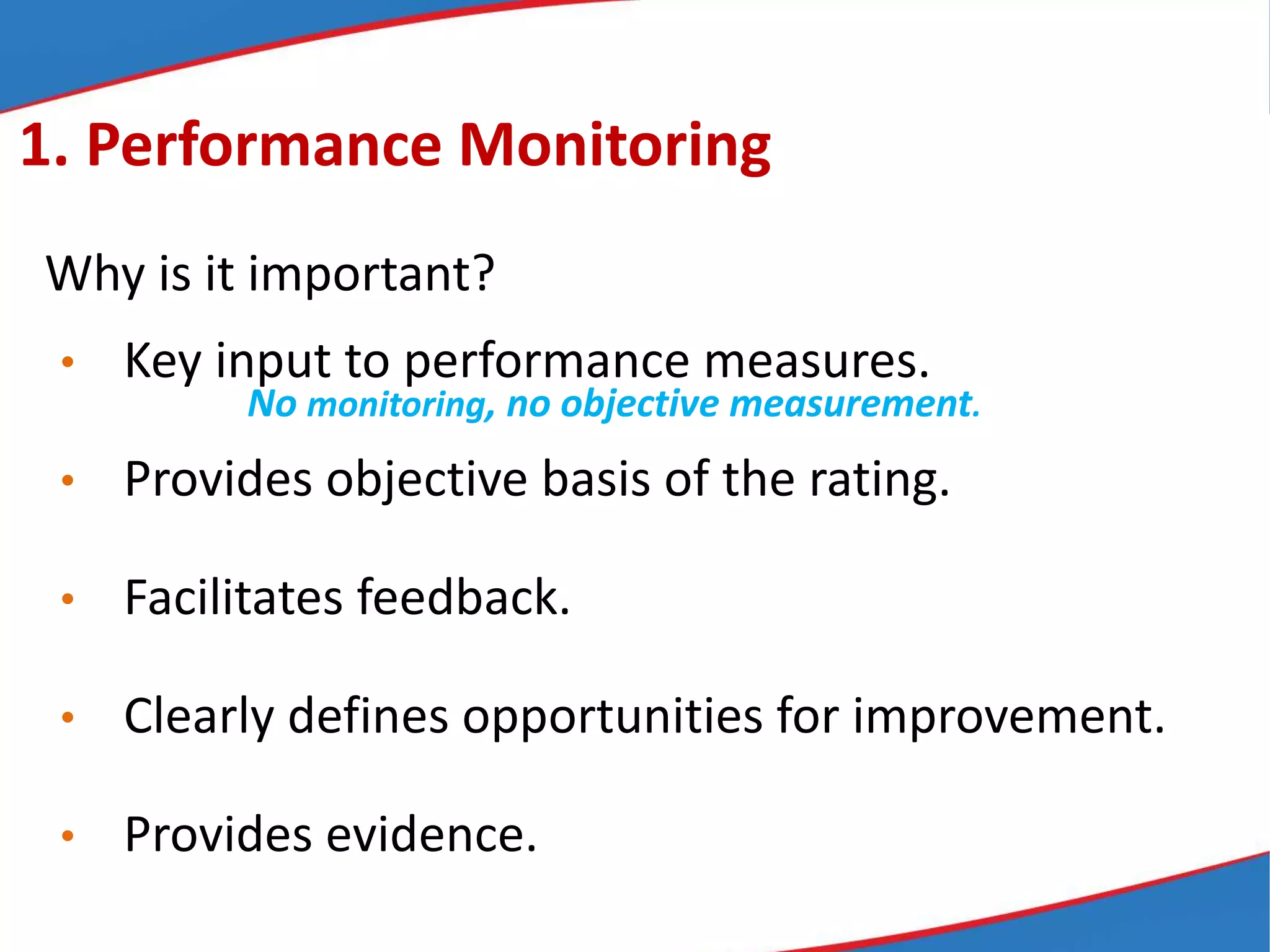
Why is it important?
• Key input to performance measures.
• Provides objective basis of the rating.
• Facilitates feedback.
• Clearly defines opportunities for improvement.
• Provides evidence.
No monitoring, no objective measurement.
1. Performance Monitoring
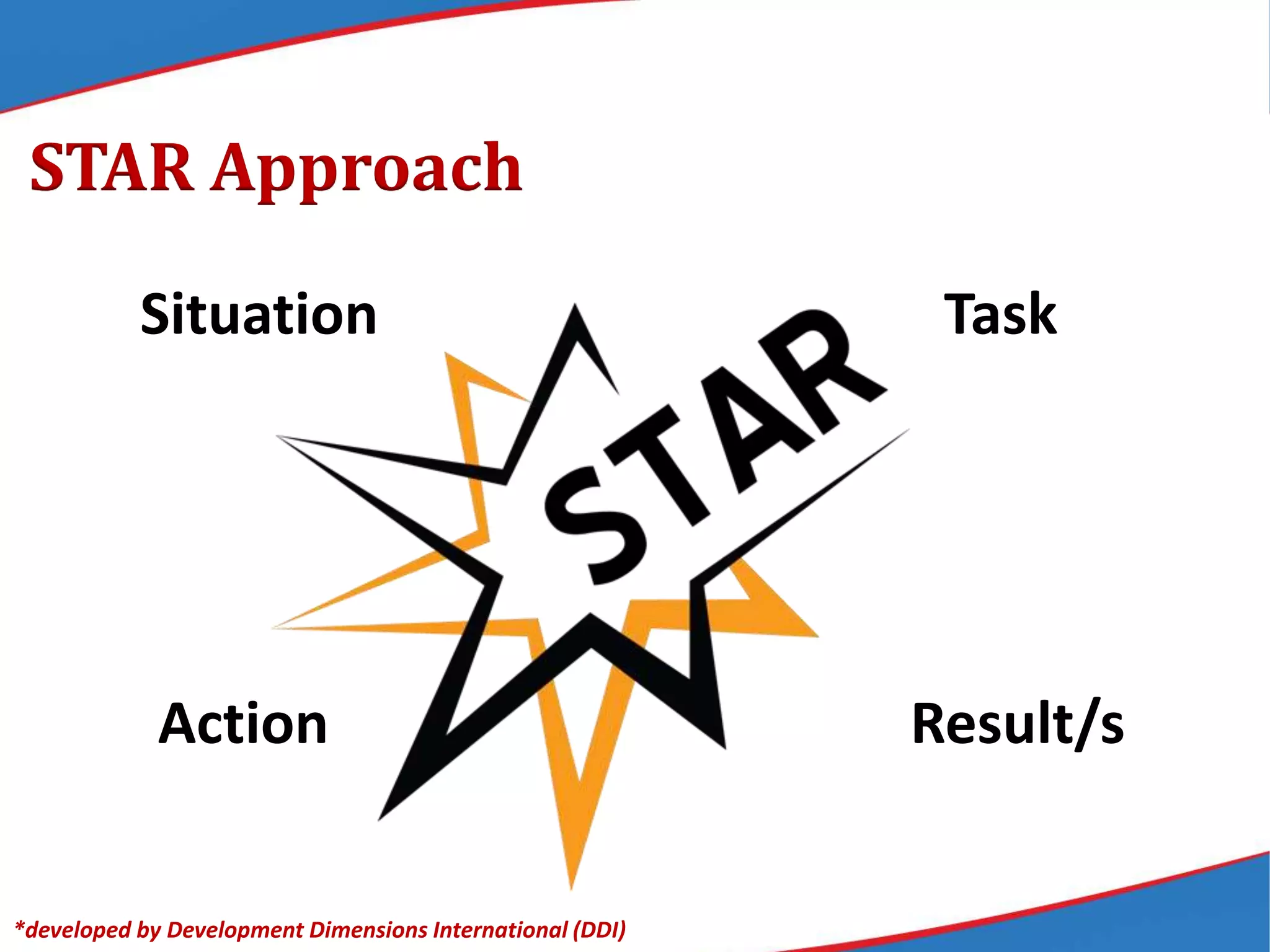
STAR Approach
Situation Task
Action Result/s
*developed by Development Dimensions International (DDI)
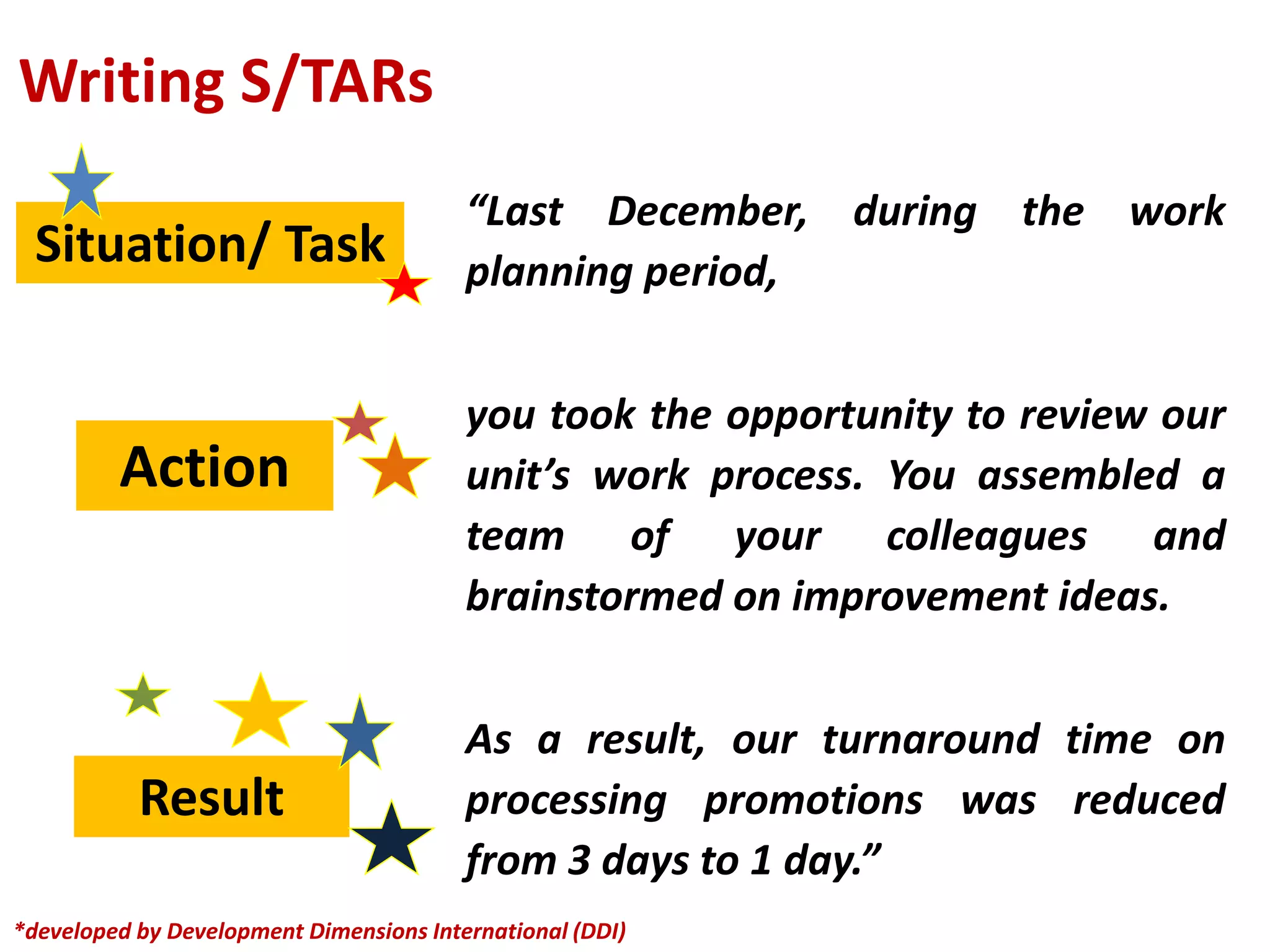
Writing S/TARs
“Last December, during the work
planning period,
you took the opportunity to review our
unit’s work process. You assembled a
team of your colleagues and
brainstormed on improvement ideas.
As a result, our turnaround time on
processing promotions was reduced
from 3 days to 1 day.”
Situation/ Task
Action
Result
*developed by Development Dimensions International (DDI)
To be effective in this phase you
should:
•Track your
performance against
your plan.
•Use JOURNALS!
*developed by the Civil Service Commission (CSC)
• Manage the system as a
process, NOT a one-time
event!
• It is NOT a year-end paper
exercise.
• It is important to teach
performance on certain
frequencies and provide
feedback and coaching.
Remember:
For the Raters:
During Performance Phase
always:
•Provide COACHING to your
subordinates to improve work
performance and behavior.
•Provide FEEDBACK on the
progress of work performance
and behavior change.
2. Coaching/Feedback
For the Ratees:
•During Performance Phase, always seek the coaching of your
leader specially when you realize that you need improvements
in your results.
•FEEDBACK: Know where and how to get helpful feedback for
important aspects of your job
Phase 3
Performance Review and
Evaluation
1. Reviewing Performance1. Review Performance
2. Discuss Strengths and
Improvement Needs
A successful review session should:
• Be a positive experience
• Have no surprises
• Be a two-way discussion
• Well prepared (both sides)
1. Review Performance
Results and Competencies
Note: The Rater should set a meeting with the Ratee.
Request the Ratee to do self-assessment.
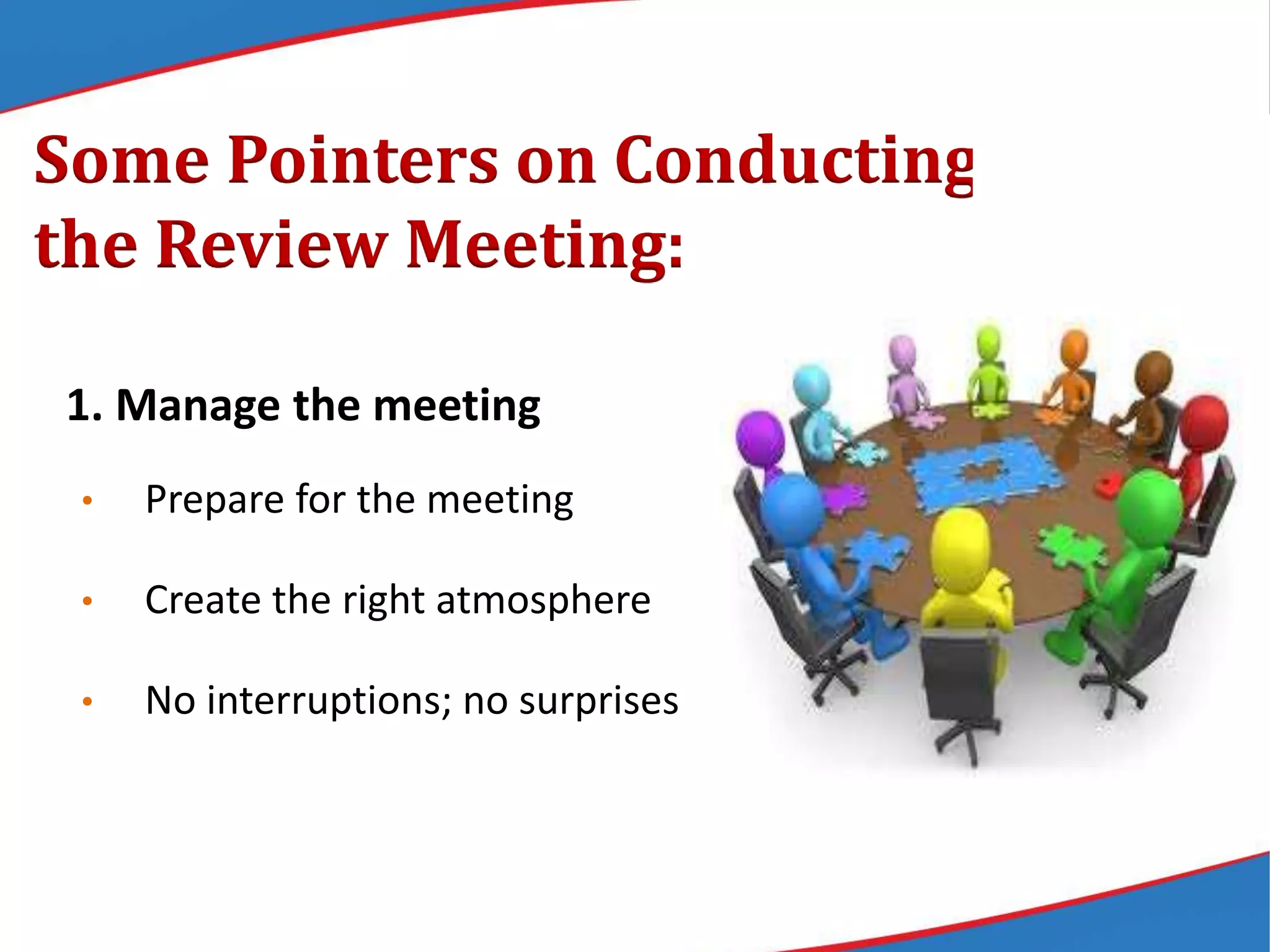
Some Pointers on Conducting
the Review Meeting:
1. Manage the meeting
• Prepare for the meeting
• Create the right atmosphere
• No interruptions; no surprises
2. Enhance or maintain self-esteem
• Express appreciation
• Encourage self-appraisal
• Focus on the performance issue, not on the person
3. Be fair and objective
• Base assessments on evidence
• Change the behavior, not the person
• Focus on solving problems or correcting a behavior
4. Empower the employee
• Ask him for ideas on how to resolve a problem or improve
performance
• Adopt a joint problem-solving approach
• Be supportive
Performance Evaluation is not:
Attack on employee’s
personality
Monologue
A chance to wield power
and authority
Paper activity (compliance)
An opportunity to gain
“pogi points” with staff
Evaluate the
manifestations
of each
competency.
Evaluate each
objective
whether it has
been achieved
or not.
Determine
overall
rating.
Steps for Evaluating Objectives
and Competencies
Rating Performance
Compute final rating
Rate each objective using the rating scale
Reflect actual results / accomplishments
Fill up the Performance Evaluation worksheet
*DepEd’s Competencies Scale
Scale Definition
5 Role model
4 Consistently demonstrates
3
Most of the time
demonstrates
2 Sometimes demonstrates
1 Rarely demonstrates
5 (role model) - all competency indicators
4 (consistently demonstrates) – four competency indicators
3 (most of the time demonstrates) – three competency indicators
2 (sometimes demonstrates) – two competency indicators
1 (rarely demonstrates) – one competence indicator
*will be used for developmental purposes
2. Discuss Strengths and Improvement
Needs
Phase 4
Performance Rewarding
and Development
Planning
1. Rewards
2. Development Planning
1. Rewards
Link to PBIS (EO 80 s. 2012)
•Performance Based Bonus (PBB)
•Step Increment
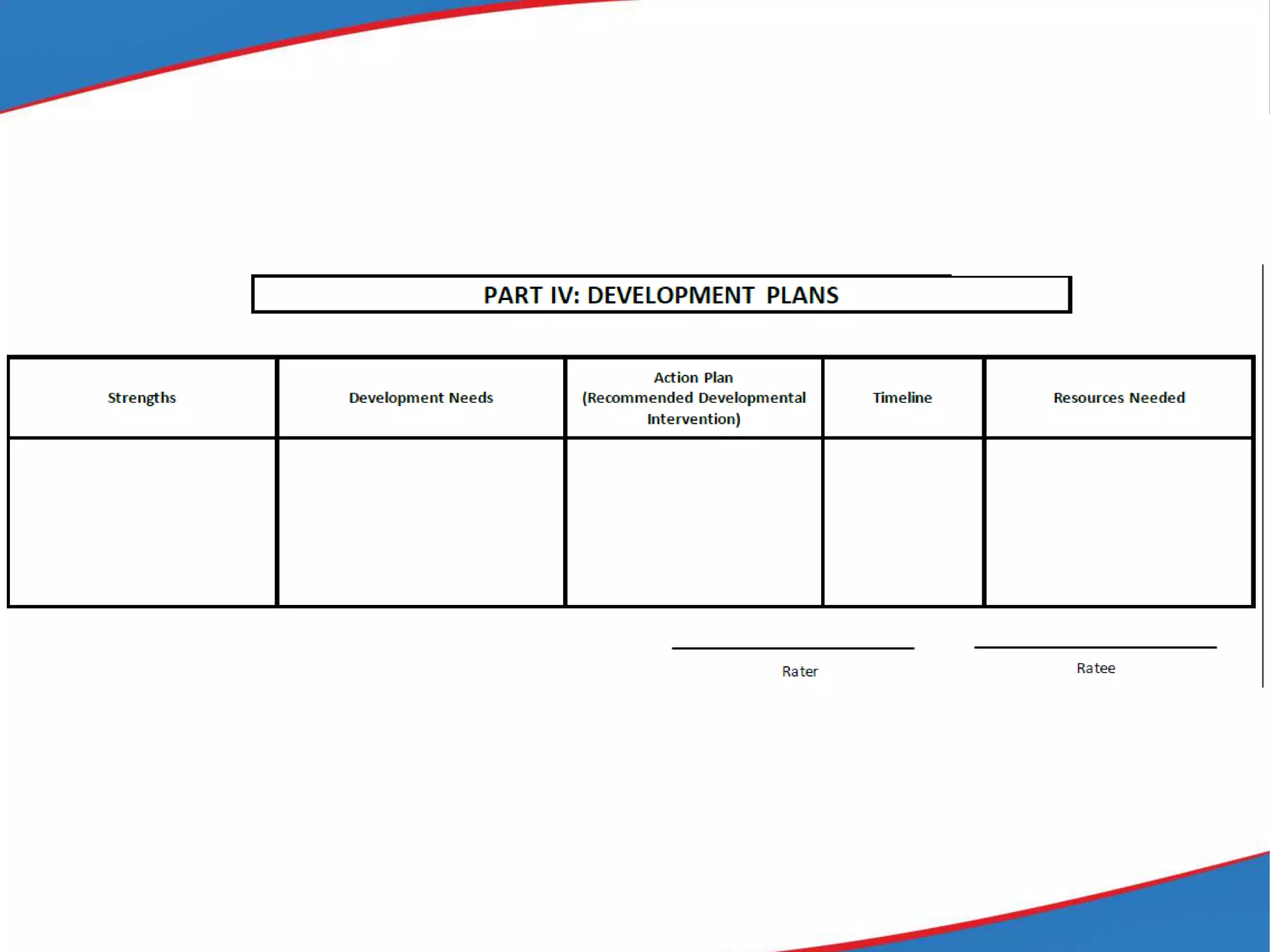
2. Development Planning
• Employee development is a continuous learning
process that enables an individual to achieve his
personal objectives within the context of the business
goals.
• Employee development is a shared responsibility
among the Individual, Manager, HR and the
Organization.
Steps in Development
Planning
1. Identify development needs
2. Set goals for meeting these needs
3. Prepare actions plans for meeting the development
need
• sanction learning activities
• resources / support
• measures of success
4. Implement Plans
5. Evaluate
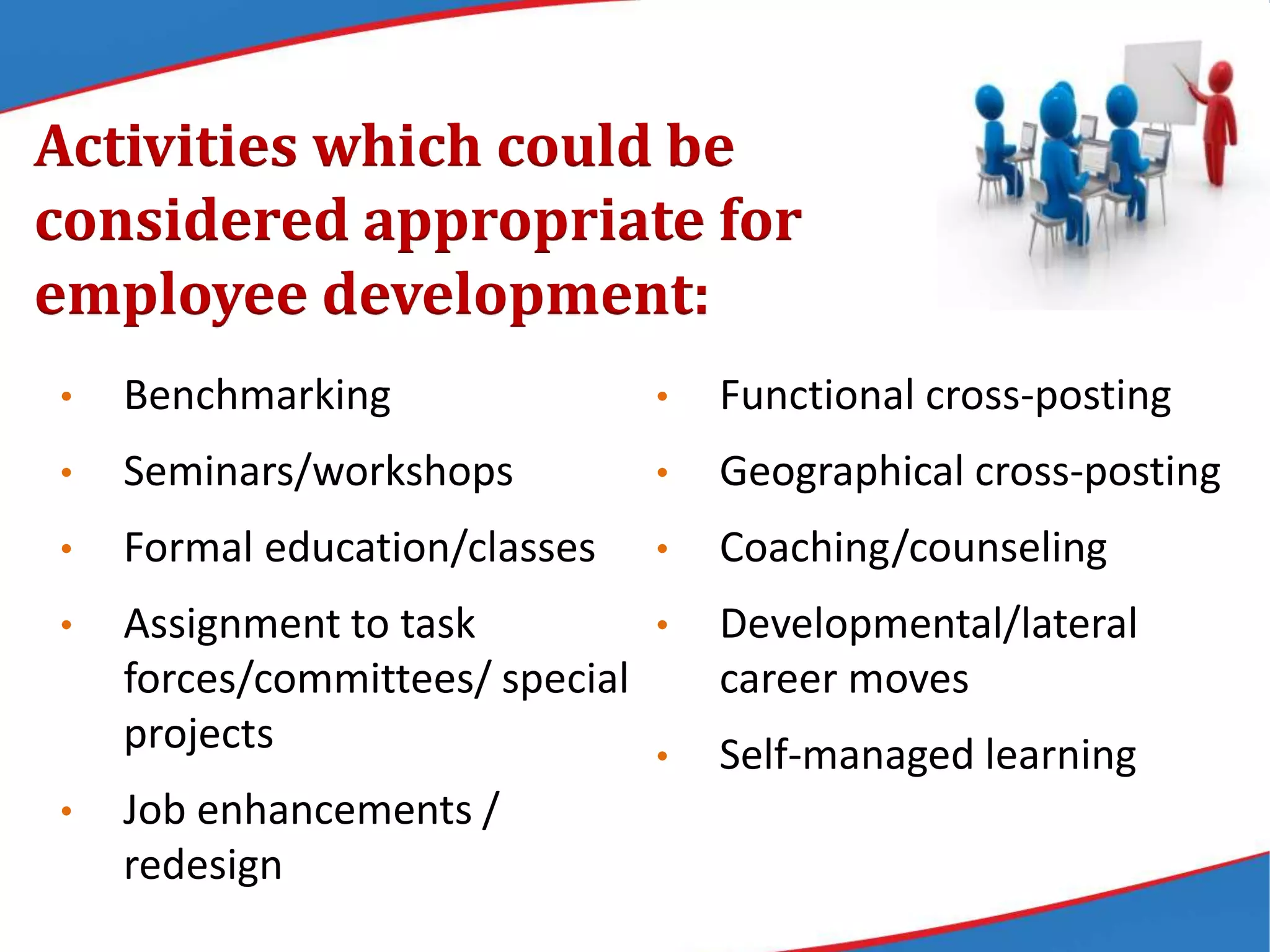
Activities which could be
considered appropriate for
employee development:
• Benchmarking
• Seminars/workshops
• Formal education/classes
• Assignment to task
forces/committees/ special
projects
• Job enhancements /
redesign
• Functional cross-posting
• Geographical cross-posting
• Coaching/counseling
• Developmental/lateral
career moves
• Self-managed learning
“Behind every
successful person,
there is one
elementary truth.
Somewhere,
someway,
someone cared about
their growth and
development.”
- Donald Miller, UK Mentoring
Programme
Results   based performance management system (rpms) for dep ed

Results based performance management system (rpms) for dep ed

  • 1.
    Results - based Performance Management System(RPMS) for DepEd Lead, Engage, Align & Do! (LEAD)
  • 2.
    The framework alignsefforts to enable DepEd to actualize its strategic goals and vision. VISION, MISSION, VALUES (VMV) Strategic Priorities Department/ Functional Area Goals KRAs and Objectives Values DEPED RPMS FRAMEWORK Competencies WHAT HOW
  • 3.
    The DepEd RPMSis aligned with the SPMS of CSC which has 4 Phases: 1. Performance Planning and Commitment 3. Performance Review and Evaluation 2. Performance Monitoring and Coaching 4. Performance Rewarding and Development Planning
  • 4.
    A systematic approachfor continuous and consistent work improvement and individual growth. What is Performance Management? An organization-wide process to ensure that employees focus work efforts towards achieving DepEd’s Vision, Mission and Values (VMV).
  • 5.
  • 6.
    What = Results How = Competencies+(Results& Objectives of a position) (Skills, Knowledge & Behaviors used to accomplish results) Components of Performance Management
  • 7.
  • 8.
    1. Discuss Unit’sObjectives 2. Identify Individual KRAs, Objectives and Performance Indicators 3. Discuss Competencies Required and Additional Competencies Needed 4. Reaching Agreement
  • 9.
    What is thedefinition of KRAs? KRAs define the areas in which an employee is expected to focus his/her efforts.
  • 10.
    What is thedefinition of Objectives? Objectives are the specific things you need to do, to achieve the results you want.
  • 11.
  • 12.
    Example KRAs Objectives Recruitment andSelection Processes Posted 20 vacant positions within the CSC prescribed period and per requirements (for 1st, 2nd, and 3rd level positions) Gathered and submitted required documents for 20 nominees for screening by the PSB/NSC Processed 20 appointment papers for selection and promotion before June 2014 Conducted one-day orientation seminar for 20 newly hired employees within two weeks upon hiring
  • 13.
    Identify Performance Indicatorsor Measures (refer to PCPs)
  • 14.
    Performance Indicators • Theyare EXACT QUANTIFICATION OF OBJECTIVES. • It is an assessment tool that gauges whether a performance is good or bad. • Agree on acceptable tracking sources
  • 15.
    • The RPMSlooks not only at results, but HOW they are accomplished. • Competencies help achieve results. • Competencies support and influence the DepEd’s culture. • For DepEd, competencies will be used for development purposes (captured in the form). Why do we have Competencies?
  • 16.
    4. Reaching Agreement Oncethe form is completed : KRAs + Objectives + Performance Indicators + Competencies 1. Rater schedules a meeting with Ratee. 2. Agree on the listed KRAs, Objectives, Performance Indicators and assigned Weight per KRA. 3. Where to focus on the Competencies
  • 17.
    Rater and Rateeagree on the Key Result Areas (KRAs), Objectives, Performance Indicators and assign Weight Per KRA and sign the Performance Commitment and Review Form (PCRF).
  • 19.
  • 20.
    1. Performance Tracking 2.Coaching/Feedback Heart of the RPMS
  • 21.
    “If you wantit, measure it. If you can’t measure it, forget it.” – Peter Drucker WHAT GETS MEASURED GETS DONE!
  • 22.
    Why is itimportant? • Key input to performance measures. • Provides objective basis of the rating. • Facilitates feedback. • Clearly defines opportunities for improvement. • Provides evidence. No monitoring, no objective measurement. 1. Performance Monitoring
  • 23.
    STAR Approach Situation Task ActionResult/s *developed by Development Dimensions International (DDI)
  • 24.
    Writing S/TARs “Last December,during the work planning period, you took the opportunity to review our unit’s work process. You assembled a team of your colleagues and brainstormed on improvement ideas. As a result, our turnaround time on processing promotions was reduced from 3 days to 1 day.” Situation/ Task Action Result *developed by Development Dimensions International (DDI)
  • 25.
    To be effectivein this phase you should: •Track your performance against your plan. •Use JOURNALS!
  • 26.
    *developed by theCivil Service Commission (CSC)
  • 27.
    • Manage thesystem as a process, NOT a one-time event! • It is NOT a year-end paper exercise. • It is important to teach performance on certain frequencies and provide feedback and coaching. Remember:
  • 28.
    For the Raters: DuringPerformance Phase always: •Provide COACHING to your subordinates to improve work performance and behavior. •Provide FEEDBACK on the progress of work performance and behavior change. 2. Coaching/Feedback
  • 29.
    For the Ratees: •DuringPerformance Phase, always seek the coaching of your leader specially when you realize that you need improvements in your results. •FEEDBACK: Know where and how to get helpful feedback for important aspects of your job
  • 30.
  • 31.
    1. Reviewing Performance1.Review Performance 2. Discuss Strengths and Improvement Needs
  • 32.
    A successful reviewsession should: • Be a positive experience • Have no surprises • Be a two-way discussion • Well prepared (both sides) 1. Review Performance Results and Competencies Note: The Rater should set a meeting with the Ratee. Request the Ratee to do self-assessment.
  • 33.
    Some Pointers onConducting the Review Meeting: 1. Manage the meeting • Prepare for the meeting • Create the right atmosphere • No interruptions; no surprises
  • 34.
    2. Enhance ormaintain self-esteem • Express appreciation • Encourage self-appraisal • Focus on the performance issue, not on the person
  • 35.
    3. Be fairand objective • Base assessments on evidence • Change the behavior, not the person • Focus on solving problems or correcting a behavior
  • 36.
    4. Empower theemployee • Ask him for ideas on how to resolve a problem or improve performance • Adopt a joint problem-solving approach • Be supportive
  • 37.
    Performance Evaluation isnot: Attack on employee’s personality Monologue A chance to wield power and authority Paper activity (compliance) An opportunity to gain “pogi points” with staff
  • 38.
    Evaluate the manifestations of each competency. Evaluateeach objective whether it has been achieved or not. Determine overall rating. Steps for Evaluating Objectives and Competencies
  • 39.
    Rating Performance Compute finalrating Rate each objective using the rating scale Reflect actual results / accomplishments Fill up the Performance Evaluation worksheet
  • 40.
    *DepEd’s Competencies Scale ScaleDefinition 5 Role model 4 Consistently demonstrates 3 Most of the time demonstrates 2 Sometimes demonstrates 1 Rarely demonstrates 5 (role model) - all competency indicators 4 (consistently demonstrates) – four competency indicators 3 (most of the time demonstrates) – three competency indicators 2 (sometimes demonstrates) – two competency indicators 1 (rarely demonstrates) – one competence indicator *will be used for developmental purposes
  • 41.
    2. Discuss Strengthsand Improvement Needs
  • 42.
  • 43.
  • 44.
    1. Rewards Link toPBIS (EO 80 s. 2012) •Performance Based Bonus (PBB) •Step Increment
  • 45.
    2. Development Planning •Employee development is a continuous learning process that enables an individual to achieve his personal objectives within the context of the business goals. • Employee development is a shared responsibility among the Individual, Manager, HR and the Organization.
  • 46.
    Steps in Development Planning 1.Identify development needs 2. Set goals for meeting these needs 3. Prepare actions plans for meeting the development need • sanction learning activities • resources / support • measures of success 4. Implement Plans 5. Evaluate
  • 47.
    Activities which couldbe considered appropriate for employee development: • Benchmarking • Seminars/workshops • Formal education/classes • Assignment to task forces/committees/ special projects • Job enhancements / redesign • Functional cross-posting • Geographical cross-posting • Coaching/counseling • Developmental/lateral career moves • Self-managed learning
  • 49.
    “Behind every successful person, thereis one elementary truth. Somewhere, someway, someone cared about their growth and development.” - Donald Miller, UK Mentoring Programme