TERMINOLOGIES USED IN CONSERVATION
Importance of developing an understanding for standard
terminology includes;
 Developing a co-relation on an international level
 Meaning and understanding the same things
Able to interpret international documents correctly


The terms used to describe cultural values worth preserving
have expanded to include a wide variety and scale of
properties. In the beginning only to monumental buildings were
considered within the scope. By passage of time it was realized
that more moderate buildings are also part of cultural heritage.
          ‘cultural heritage’ , ‘cultural
Thus the terms
property’ and ‘architectural heritage’
became popular. (‘75 onward after the Amsterdam conference)


             TERMINOLOGIES IN ARCHITECTURAL CONSERVATION
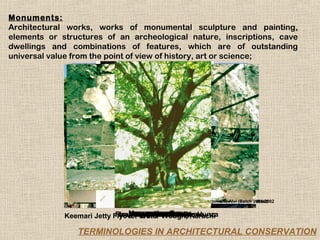
Monuments:
Architectural works, works of monumental sculpture and painting,
elements or structures of an archeological nature, inscriptions, cave
dwellings and combinations of features, which are of outstanding
universal value from the point of view of history, art or science;


                                      Courtesy:Rahat Saboor,Courtesy:Heritage Cell, DAP-NED
                                                            Arjumand Alvi (Batch 2001-2002
                                                         Courtesy:Heritage Cell, DAP-NED


                                Merewether Market
                                  Anitkabir, Tower
                                 Anitkabir, Fort
                                      Lahore
             Keemari Jetty FlyoverEmpressAnkaraKarachi
                            Flour Koza Old Tree, Bursa
                            Hangingyr HunzaBridge, Hunza
                                SuspensionAnkara
                                800WaterMahal
                                  Mill, Han, Bursa
                                     Mosque, Hunza
                                      Taj Trough,

                TERMINOLOGIES IN ARCHITECTURAL CONSERVATION
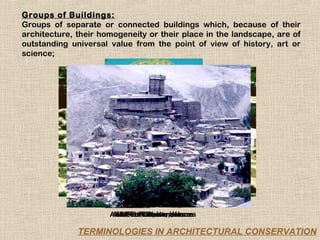
Groups of Buildings:
Groups of separate or connected buildings which, because of their
architecture, their homogeneity or their place in the landscape, are of
outstanding universal value from the point of view of history, art or
science;


                      AltitAltit Fort, Hunza
                       AltitFort Cluster, Hunza
                        AltitFort Cluster, Hunza
                              Fort Cluster, Hunza

              TERMINOLOGIES IN ARCHITECTURAL CONSERVATION
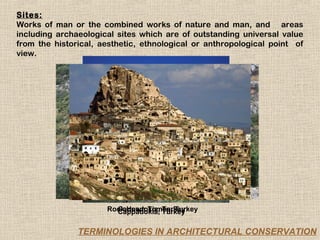
Sites:
Works of man or the combined works of nature and man, and areas
including archaeological sites which are of outstanding universal value
from the historical, aesthetic, ethnological or anthropological point of
view.


                      Rock Hewn Tombs, Turkey
                        Cappadokia, Turkey
                        Cappadokia, Turkey

               TERMINOLOGIES IN ARCHITECTURAL CONSERVATION
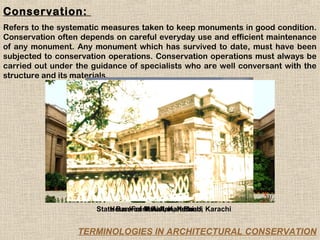
Conservation:
Refers to the systematic measures taken to keep monuments in good condition.
Conservation often depends on careful everyday use and efficient maintenance
of any monument. Any monument which has survived to date, must have been
subjected to conservation operations. Conservation operations must always be
carried out under the guidance of specialists who are well conversant with the
structure and its materials.


                       State Bank on Pakistan, Karachi Karachi
                           HouseFrere Hall, Karachi
                                  of M.A.Jinnah Road,


                  TERMINOLOGIES IN ARCHITECTURAL CONSERVATION
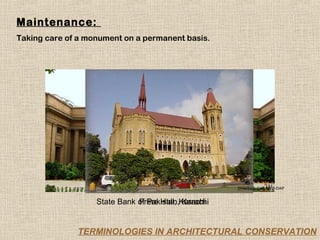
Maintenance:
Taking care of a monument on a permanent basis.


                                                    ©Heritage Cell, NED-DAP


                   State Bank of Pakistan,Karachi
                              Frere Hall, Karachi


              TERMINOLOGIES IN ARCHITECTURAL CONSERVATION
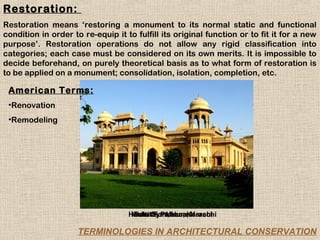
Restoration:
Restoration means ‘restoring a monument to its normal static and functional
condition in order to re-equip it to fulfill its original function or to fit it for a new
purpose’. Restoration operations do not allow any rigid classification into
categories; each case must be considered on its own merits. It is impossible to
decide beforehand, on purely theoretical basis as to what form of restoration is
to be applied on a monument; consolidation, isolation, completion, etc.

 American Terms:
 •Renovation
 •Remodeling


                                   Hindu Gymkhana, Karachi
                                    Mohatta Palace, Karachi
                                    Baltit Fort, Hunza

                     TERMINOLOGIES IN ARCHITECTURAL CONSERVATION
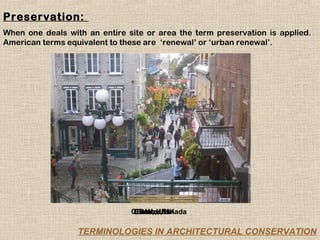
Preservation:
When one deals with an entire site or area the term preservation is applied.
American terms equivalent to these are ‘renewal’ or ‘urban renewal’.


                               Quebec,UK
                               Chester,Canada
                                Bath, UK
                                 Bath, UK

                  TERMINOLOGIES IN ARCHITECTURAL CONSERVATION
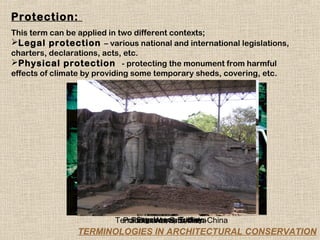
Protection:
This term can be applied in two different contexts;
Legal protection – various national and international legislations,
charters, declarations, acts, etc.
Physical protection - protecting the monument from harmful
effects of climate by providing some temporary sheds, covering, etc.


                               Sagalassos, Turkey
                         Terracotta Warriors, Xian-China
                           Polonarowa, Srilanka
                             Polonarowa, Srilanka
                TERMINOLOGIES IN ARCHITECTURAL CONSERVATION
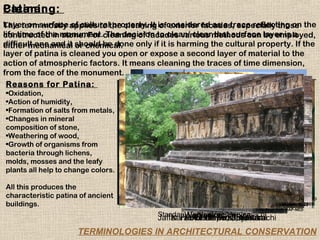
Patina:
Cleaning:
Layer on mostly of cultural property. It of exterior facades, especially those
This termsurface applies to the cleaning is considered as a trace reflecting on the
life time of the monument.cleaning of facades various methods can layer is a
constructed in stone. For The decision to clean/ clear that surface be employed,
difficult one and it should be done only if it is harming the cultural property. If the
either mechanical or chemical.
layer of patina is cleaned you open or expose a second layer of material to the
action of atmospheric factors. It means cleaning the traces of time dimension,
from the face of the monument.
 Reasons for Patina:                                                                   `
•Oxidation,
•Action of humidity,
•Formation of salts from metals,
•Changes in mineral
composition of stone,
•Weathering of wood,
•Growth of organisms from
bacteria through lichens,
molds, mosses and the leafy
plants all help to change colors.

All this produces the
characteristic patina of ancient                                      ©Heritage Cell, DAP-NED
                                                                              ©Heritage Cell, DAP-NED
buildings.                                                                        ©ANaeem, 2005
                                                                                ©ANaeem, 2005
                                                                       ©Heritage Cell, DAP-NED
                                           Standard VeniceVenice Karachi
                                                    Chartered Bank,
                                                  Worksite at Venice
                                                      Venice
                                           Jaffar Faddo Dispensary, Karachi
                                               Karachi Port Trust, Karachi
                                                   Polonarowa, Srilanka
                                                    Polonarowa, Srilanka
                     TERMINOLOGIES IN ARCHITECTURAL CONSERVATION
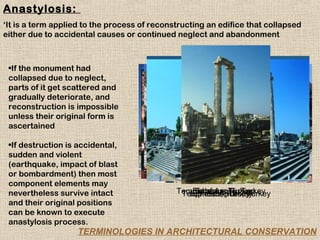
Anastylosis:
‘It is a term applied to the process of reconstructing an edifice that collapsed
either due to accidental causes or continued neglect and abandonment


 •If the monument had
 collapsed due to neglect,
 parts of it get scattered and
 gradually deteriorate, and
 reconstruction is impossible
 unless their original form is
 ascertained

 •If destruction is accidental,
 sudden and violent
 (earthquake, impact of blast
 or bombardment) then most
 component elements may
 nevertheless survive intact                  Temple ofof Apollo, Turkey
                                               Temple Apollo, Turkey
                                                  Ephesus, Turkey
                                                   Ephesus, Turkey
                                                 Ephesus, Turkey
                                                  Ephesus, Turkey
 and their original positions
 can be known to execute
 anastylosis process.
                    TERMINOLOGIES IN ARCHITECTURAL CONSERVATION
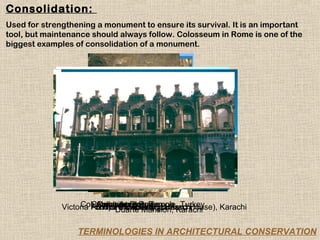
Consolidation:
Used for strengthening a monument to ensure its survival. It is an important
tool, but maintenance should always follow. Colosseum in Rome is one of the
biggest examples of consolidation of a monument.


              Victoria Furniture MarketVerona Karachi
                   Column of OldDemre Karachi
                       ColumnYerebatan
                       Arch at Apollo's Temple, Turkey
                        Amphitheatre, (Old Illaco House), Karachi
                        Colloseum, Rome
                                at Building,
                        Stupa at Mohenjodaro
                              Duarte Mansion,

                  TERMINOLOGIES IN ARCHITECTURAL CONSERVATION
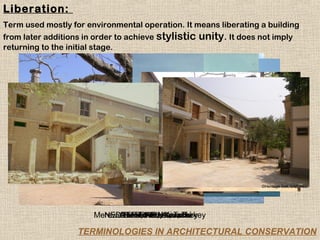
Liberation:
Term used mostly for environmental operation. It means liberating a building
from later additions in order to achieve stylistic   unity. It does not imply
returning to the initial stage.


                                                                   ©Heritage Cell, DAP-NED

                                                                     ©Heritage Cell, DAP-NED


                       Merewether Tower,Karachi
                         NED-DAP, Karachi Turkey
                             NED-DAP,Hisar, Turkey
                             Denso Hall, Karachi
                              Rumeli Hisar,
                                Rumeli

                   TERMINOLOGIES IN ARCHITECTURAL CONSERVATION
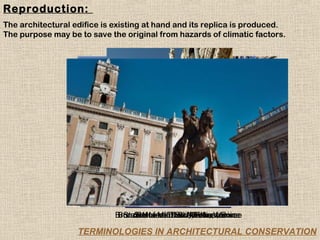
Reproduction:
The architectural edifice is existing at hand and its replica is produced.
The purpose may be to save the original from hazards of climatic factors.


                             Bronze Horse of St. Aurellius, Rome
                              Bronze Horse David,Marks,Venice
                               Statue of Marcus Marks, Venice
                                  Statue of of St. Florence
                                   Statue of David, Florence

                   TERMINOLOGIES IN ARCHITECTURAL CONSERVATION
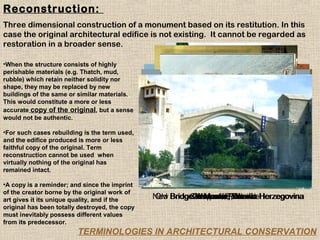
Reconstruction:
Three dimensional construction of a monument based on its restitution. In this
case the original architectural edifice is not existing. It cannot be regarded as
restoration in a broader sense.

•When the structure consists of highly
perishable materials (e.g. Thatch, mud,
rubble) which retain neither solidity nor
shape, they may be replaced by new
buildings of the same or similar materials.
This would constitute a more or less
accurate copy of the original, but a sense
would not be authentic.

•For such cases rebuilding is the term used,
and the edifice produced is more or less
faithful copy of the original. Term
reconstruction cannot be used when
virtually nothing of the original has
remained intact.

•A copy is a reminder; and since the imprint
of the creator borne by the original work of
art gives it its unique quality, and if the     New BridgeCampanile,Bosnia Herzegovina
                                                Old      Campanile, Poland
                                                          Warsaw, Poland
                                                          in Mostar, Venice
                                                          Warsaw, Poland
                                                           Warsaw, Venice
original has been totally destroyed, the copy
must inevitably possess different values
from its predecessor.
                         TERMINOLOGIES IN ARCHITECTURAL CONSERVATION
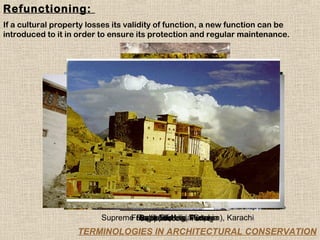
Refunctioning:
If a cultural property losses its validity of function, a new function can be
introduced to it in order to ensure its protection and regular maintenance.


                                                               ©Heritage Cell, DAP-NED

                          Supreme Court (Victoria Turkey
                                FrescosFort
                                  Hagia Sophia, Museum), Karachi
                                   Baltit of HagiaTurkey
                                   Cappadoccia, Sophia
                    TERMINOLOGIES IN ARCHITECTURAL CONSERVATION
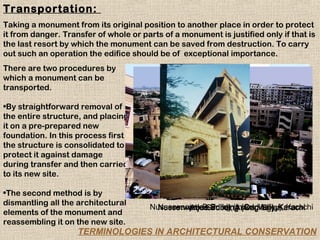
Transportation:
Taking a monument from its original position to another place in order to protect
it from danger. Transfer of whole or parts of a monument is justified only if that is
the last resort by which the monument can be saved from destruction. To carry
out such an operation the edifice should be of exceptional importance.
There are two procedures by
which a monument can be
transported.

•By straightforward removal of
the entire structure, and placing
it on a pre-prepared new
foundation. In this process first
the structure is consolidated to
protect it against damage
during transfer and then carried
to its new site.

•The second method is by
dismantling all the architectural
                                       Nusserwanjee Building (Indus Valley), Karachi
                                         Nusserwanjee Building (Original), Karachi
                                                Abu Simbel, Aswan-Egypt
elements of the monument and
reassembling it on the new site.
                    TERMINOLOGIES IN ARCHITECTURAL CONSERVATION
Authenticity:
The authenticity of the work of art is a measure of truthfulness of the internal
unity of the creative process and the physical realization of the work and the
effects of its passage through historic times.


 In the light of of Nara on Authenticity, 1994, endorsed by international
  The Document internationally accepted
 principles and guidelines of conservation, etc. also identifies aspects
  organizations like UNESCO, ICCROM and ICOMOS,
 any monument is judged for its worth in
  of authenticity as
 terms of authenticity on basis of following
 four things (Management Guidelines for
 World Cultural Heritage Sites, ICCROM
           “form and design, material and substance, use and function,
 1993);       traditions and techniques, location and setting, spirit and
             feeling and internal and external aspects of information
                           •Authenticity of Material
                                     sources”.
                           •Authenticity of Workmanship
                           •Authenticity of Design
                           •Authenticity in Setting
                         Authenticity is not reproducible.


                    TERMINOLOGIES IN ARCHITECTURAL CONSERVATION
Authenticity:
The authenticity of the work of art is a measure of truthfulness of the internal
unity of the creative process and the physical realization of the work and the
effects of its passage through historic times.


 In the light of of Nara on Authenticity, 1994, endorsed by international
  The Document internationally accepted
 principles and guidelines of conservation, etc. also identifies aspects
  organizations like UNESCO, ICCROM and ICOMOS,
 any monument is judged for its worth in
  of authenticity as
 terms of authenticity on basis of following
 four things (Management Guidelines for
 World Cultural Heritage Sites, ICCROM
           “form and design, material and substance, use and function,
 1993);       traditions and techniques, location and setting, spirit and
             feeling and internal and external aspects of information
                           •Authenticity of Material
                                     sources”.
                           •Authenticity of Workmanship
                           •Authenticity of Design
                           •Authenticity in Setting
                         Authenticity is not reproducible.


                    TERMINOLOGIES IN ARCHITECTURAL CONSERVATION
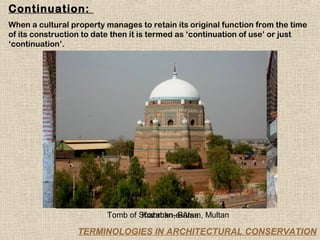
Continuation:
When a cultural property manages to retain its original function from the time
of its construction to date then it is termed as ‘continuation of use’ or just
‘continuation’.


                         Tomb of Shahrukn-e-Alam, Multan
                                  Kozahan, Bursa

                  TERMINOLOGIES IN ARCHITECTURAL CONSERVATION
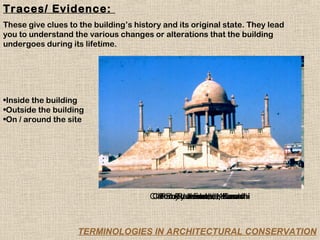
Traces/ Evidence:
These give clues to the building’s history and its original state. They lead
you to understand the various changes or alterations that the building
undergoes during its lifetime.


•Inside the building
•Outside the building
•On / around the site


                                       Clifton Promenade,Karachi
                                       Clifton Promenade,Karachi
                                           Ruby Jewelers, Karachi
                                             Rohtas Fort, Jhelum
                                             Ruby Jewelers,
                                                  Karachi


                    TERMINOLOGIES IN ARCHITECTURAL CONSERVATION

Conservation terminologies for site and monuments

  • 1.
    TERMINOLOGIES USED INCONSERVATION Importance of developing an understanding for standard terminology includes;  Developing a co-relation on an international level  Meaning and understanding the same things Able to interpret international documents correctly The terms used to describe cultural values worth preserving have expanded to include a wide variety and scale of properties. In the beginning only to monumental buildings were considered within the scope. By passage of time it was realized that more moderate buildings are also part of cultural heritage. ‘cultural heritage’ , ‘cultural Thus the terms property’ and ‘architectural heritage’ became popular. (‘75 onward after the Amsterdam conference) TERMINOLOGIES IN ARCHITECTURAL CONSERVATION
  • 2.
    Monuments: Architectural works, worksof monumental sculpture and painting, elements or structures of an archeological nature, inscriptions, cave dwellings and combinations of features, which are of outstanding universal value from the point of view of history, art or science; Courtesy:Rahat Saboor,Courtesy:Heritage Cell, DAP-NED Arjumand Alvi (Batch 2001-2002 Courtesy:Heritage Cell, DAP-NED Merewether Market Anitkabir, Tower Anitkabir, Fort Lahore Keemari Jetty FlyoverEmpressAnkaraKarachi Flour Koza Old Tree, Bursa Hangingyr HunzaBridge, Hunza SuspensionAnkara 800WaterMahal Mill, Han, Bursa Mosque, Hunza Taj Trough, TERMINOLOGIES IN ARCHITECTURAL CONSERVATION
  • 3.
    Groups of Buildings: Groupsof separate or connected buildings which, because of their architecture, their homogeneity or their place in the landscape, are of outstanding universal value from the point of view of history, art or science; AltitAltit Fort, Hunza AltitFort Cluster, Hunza AltitFort Cluster, Hunza Fort Cluster, Hunza TERMINOLOGIES IN ARCHITECTURAL CONSERVATION
  • 4.
    Sites: Works of manor the combined works of nature and man, and areas including archaeological sites which are of outstanding universal value from the historical, aesthetic, ethnological or anthropological point of view. Rock Hewn Tombs, Turkey Cappadokia, Turkey Cappadokia, Turkey TERMINOLOGIES IN ARCHITECTURAL CONSERVATION
  • 5.
    Conservation: Refers to thesystematic measures taken to keep monuments in good condition. Conservation often depends on careful everyday use and efficient maintenance of any monument. Any monument which has survived to date, must have been subjected to conservation operations. Conservation operations must always be carried out under the guidance of specialists who are well conversant with the structure and its materials. State Bank on Pakistan, Karachi Karachi HouseFrere Hall, Karachi of M.A.Jinnah Road, TERMINOLOGIES IN ARCHITECTURAL CONSERVATION
  • 6.
    Maintenance: Taking care ofa monument on a permanent basis. ©Heritage Cell, NED-DAP State Bank of Pakistan,Karachi Frere Hall, Karachi TERMINOLOGIES IN ARCHITECTURAL CONSERVATION
  • 7.
    Restoration: Restoration means ‘restoringa monument to its normal static and functional condition in order to re-equip it to fulfill its original function or to fit it for a new purpose’. Restoration operations do not allow any rigid classification into categories; each case must be considered on its own merits. It is impossible to decide beforehand, on purely theoretical basis as to what form of restoration is to be applied on a monument; consolidation, isolation, completion, etc. American Terms: •Renovation •Remodeling Hindu Gymkhana, Karachi Mohatta Palace, Karachi Baltit Fort, Hunza TERMINOLOGIES IN ARCHITECTURAL CONSERVATION
  • 8.
    Preservation: When one dealswith an entire site or area the term preservation is applied. American terms equivalent to these are ‘renewal’ or ‘urban renewal’. Quebec,UK Chester,Canada Bath, UK Bath, UK TERMINOLOGIES IN ARCHITECTURAL CONSERVATION
  • 9.
    Protection: This term canbe applied in two different contexts; Legal protection – various national and international legislations, charters, declarations, acts, etc. Physical protection - protecting the monument from harmful effects of climate by providing some temporary sheds, covering, etc. Sagalassos, Turkey Terracotta Warriors, Xian-China Polonarowa, Srilanka Polonarowa, Srilanka TERMINOLOGIES IN ARCHITECTURAL CONSERVATION
  • 10.
    Patina: Cleaning: Layer on mostlyof cultural property. It of exterior facades, especially those This termsurface applies to the cleaning is considered as a trace reflecting on the life time of the monument.cleaning of facades various methods can layer is a constructed in stone. For The decision to clean/ clear that surface be employed, difficult one and it should be done only if it is harming the cultural property. If the either mechanical or chemical. layer of patina is cleaned you open or expose a second layer of material to the action of atmospheric factors. It means cleaning the traces of time dimension, from the face of the monument. Reasons for Patina: ` •Oxidation, •Action of humidity, •Formation of salts from metals, •Changes in mineral composition of stone, •Weathering of wood, •Growth of organisms from bacteria through lichens, molds, mosses and the leafy plants all help to change colors. All this produces the characteristic patina of ancient ©Heritage Cell, DAP-NED ©Heritage Cell, DAP-NED buildings. ©ANaeem, 2005 ©ANaeem, 2005 ©Heritage Cell, DAP-NED Standard VeniceVenice Karachi Chartered Bank, Worksite at Venice Venice Jaffar Faddo Dispensary, Karachi Karachi Port Trust, Karachi Polonarowa, Srilanka Polonarowa, Srilanka TERMINOLOGIES IN ARCHITECTURAL CONSERVATION
  • 11.
    Anastylosis: ‘It is aterm applied to the process of reconstructing an edifice that collapsed either due to accidental causes or continued neglect and abandonment •If the monument had collapsed due to neglect, parts of it get scattered and gradually deteriorate, and reconstruction is impossible unless their original form is ascertained •If destruction is accidental, sudden and violent (earthquake, impact of blast or bombardment) then most component elements may nevertheless survive intact Temple ofof Apollo, Turkey Temple Apollo, Turkey Ephesus, Turkey Ephesus, Turkey Ephesus, Turkey Ephesus, Turkey and their original positions can be known to execute anastylosis process. TERMINOLOGIES IN ARCHITECTURAL CONSERVATION
  • 12.
    Consolidation: Used for strengtheninga monument to ensure its survival. It is an important tool, but maintenance should always follow. Colosseum in Rome is one of the biggest examples of consolidation of a monument. Victoria Furniture MarketVerona Karachi Column of OldDemre Karachi ColumnYerebatan Arch at Apollo's Temple, Turkey Amphitheatre, (Old Illaco House), Karachi Colloseum, Rome at Building, Stupa at Mohenjodaro Duarte Mansion, TERMINOLOGIES IN ARCHITECTURAL CONSERVATION
  • 13.
    Liberation: Term used mostlyfor environmental operation. It means liberating a building from later additions in order to achieve stylistic unity. It does not imply returning to the initial stage. ©Heritage Cell, DAP-NED ©Heritage Cell, DAP-NED Merewether Tower,Karachi NED-DAP, Karachi Turkey NED-DAP,Hisar, Turkey Denso Hall, Karachi Rumeli Hisar, Rumeli TERMINOLOGIES IN ARCHITECTURAL CONSERVATION
  • 14.
    Reproduction: The architectural edificeis existing at hand and its replica is produced. The purpose may be to save the original from hazards of climatic factors. Bronze Horse of St. Aurellius, Rome Bronze Horse David,Marks,Venice Statue of Marcus Marks, Venice Statue of of St. Florence Statue of David, Florence TERMINOLOGIES IN ARCHITECTURAL CONSERVATION
  • 15.
    Reconstruction: Three dimensional constructionof a monument based on its restitution. In this case the original architectural edifice is not existing. It cannot be regarded as restoration in a broader sense. •When the structure consists of highly perishable materials (e.g. Thatch, mud, rubble) which retain neither solidity nor shape, they may be replaced by new buildings of the same or similar materials. This would constitute a more or less accurate copy of the original, but a sense would not be authentic. •For such cases rebuilding is the term used, and the edifice produced is more or less faithful copy of the original. Term reconstruction cannot be used when virtually nothing of the original has remained intact. •A copy is a reminder; and since the imprint of the creator borne by the original work of art gives it its unique quality, and if the New BridgeCampanile,Bosnia Herzegovina Old Campanile, Poland Warsaw, Poland in Mostar, Venice Warsaw, Poland Warsaw, Venice original has been totally destroyed, the copy must inevitably possess different values from its predecessor. TERMINOLOGIES IN ARCHITECTURAL CONSERVATION
  • 16.
    Refunctioning: If a culturalproperty losses its validity of function, a new function can be introduced to it in order to ensure its protection and regular maintenance. ©Heritage Cell, DAP-NED Supreme Court (Victoria Turkey FrescosFort Hagia Sophia, Museum), Karachi Baltit of HagiaTurkey Cappadoccia, Sophia TERMINOLOGIES IN ARCHITECTURAL CONSERVATION
  • 17.
    Transportation: Taking a monumentfrom its original position to another place in order to protect it from danger. Transfer of whole or parts of a monument is justified only if that is the last resort by which the monument can be saved from destruction. To carry out such an operation the edifice should be of exceptional importance. There are two procedures by which a monument can be transported. •By straightforward removal of the entire structure, and placing it on a pre-prepared new foundation. In this process first the structure is consolidated to protect it against damage during transfer and then carried to its new site. •The second method is by dismantling all the architectural Nusserwanjee Building (Indus Valley), Karachi Nusserwanjee Building (Original), Karachi Abu Simbel, Aswan-Egypt elements of the monument and reassembling it on the new site. TERMINOLOGIES IN ARCHITECTURAL CONSERVATION
  • 18.
    Authenticity: The authenticity ofthe work of art is a measure of truthfulness of the internal unity of the creative process and the physical realization of the work and the effects of its passage through historic times. In the light of of Nara on Authenticity, 1994, endorsed by international The Document internationally accepted principles and guidelines of conservation, etc. also identifies aspects organizations like UNESCO, ICCROM and ICOMOS, any monument is judged for its worth in of authenticity as terms of authenticity on basis of following four things (Management Guidelines for World Cultural Heritage Sites, ICCROM “form and design, material and substance, use and function, 1993); traditions and techniques, location and setting, spirit and feeling and internal and external aspects of information •Authenticity of Material sources”. •Authenticity of Workmanship •Authenticity of Design •Authenticity in Setting Authenticity is not reproducible. TERMINOLOGIES IN ARCHITECTURAL CONSERVATION
  • 19.
    Authenticity: The authenticity ofthe work of art is a measure of truthfulness of the internal unity of the creative process and the physical realization of the work and the effects of its passage through historic times. In the light of of Nara on Authenticity, 1994, endorsed by international The Document internationally accepted principles and guidelines of conservation, etc. also identifies aspects organizations like UNESCO, ICCROM and ICOMOS, any monument is judged for its worth in of authenticity as terms of authenticity on basis of following four things (Management Guidelines for World Cultural Heritage Sites, ICCROM “form and design, material and substance, use and function, 1993); traditions and techniques, location and setting, spirit and feeling and internal and external aspects of information •Authenticity of Material sources”. •Authenticity of Workmanship •Authenticity of Design •Authenticity in Setting Authenticity is not reproducible. TERMINOLOGIES IN ARCHITECTURAL CONSERVATION
  • 20.
    Continuation: When a culturalproperty manages to retain its original function from the time of its construction to date then it is termed as ‘continuation of use’ or just ‘continuation’. Tomb of Shahrukn-e-Alam, Multan Kozahan, Bursa TERMINOLOGIES IN ARCHITECTURAL CONSERVATION
  • 21.
    Traces/ Evidence: These giveclues to the building’s history and its original state. They lead you to understand the various changes or alterations that the building undergoes during its lifetime. •Inside the building •Outside the building •On / around the site Clifton Promenade,Karachi Clifton Promenade,Karachi Ruby Jewelers, Karachi Rohtas Fort, Jhelum Ruby Jewelers, Karachi TERMINOLOGIES IN ARCHITECTURAL CONSERVATION