Chapter Four
Restaurant Operations
This Chapter Should Help You...
• Identify the three main divisions of
activity found in restaurant operations,
and summarize their respective roles.
• Explain the best way to become
familiar with operations in a restaurant
or other food service organizations.
Three Main Areas of Food
Service Operations:
• Front of the House
• Back of the House
• Office
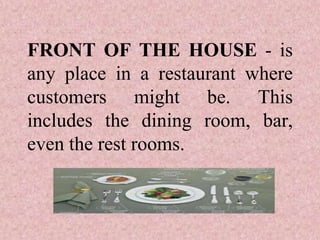
FRONT OF THE HOUSE - is
any place in a restaurant where
customers might be. This
includes the dining room, bar,
even the rest rooms.
DINING AREA AND THE BAR
RESTROOM AND THE
RECEPTION
Front of the House:
The key responsibility of the front of the
house is GUEST SATISFACTION!
• It is extremely important to
remember that as a front of the
house employee, the key to providing
excellent guest satisfaction is
fulfilling the guest’s wants and
expectations.
Front of the House Tasks
Include:
• Some tasks include:
– Greeting the guest
– Taking the order
– Serving the food
– Removing used tableware
– Accepting payment and accounting for cash and
charge sales
– Thanking the guest and inviting them for future
business
F O H EMPLOYEES
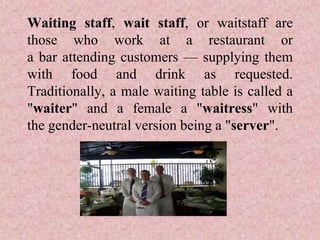
Waiting staff, wait staff, or waitstaff are
those who work at a restaurant or
a bar attending customers — supplying them
with food and drink as requested.
Traditionally, a male waiting table is called a
"waiter" and a female a "waitress" with
the gender-neutral version being a "server".
Runners
Runners work under the servers,
bringing customers the food they
ordered directly from the kitchen.
Bussers
Bussers are the folks who clear
tables and re-set them. They
bring the dirty dishes to the
kitchen to be washed.
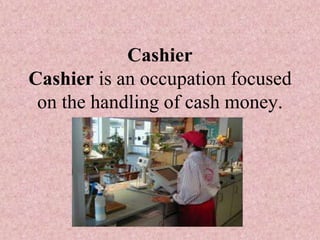
Cashier
Cashier is an occupation focused
on the handling of cash money.
ORGANIZATIONAL CHART
FOH
BACK OF THE HOUSE - The
areas of the restaurant where
guests are not permitted including
the kitchen. All kitchen staff are
back of the house employees.
Back of the House
• The principal responsibility of the back of
the house is the quality of the food the guest
is served
• Sanitation is an extremely important
responsibility of employees in the back of
the house
• Finally, cost control - food, labor, and
supplies - is a “make or break”
responsibility of the back of the house
Sanitation is the hygienic means
of promoting
health through prevention of human
contact with the hazards of wastes.
Back of the House Tasks
• Some Tasks Performed include:
–Food production
–Food quality and cost control
–Dish washing and pot washing
–Back-of-the-house cleaning
–Pest control
B O H EMPLOYEES
The Executive Chef is in charge of a kitchen,
responsible for recipe and menu creation, staff
training, and overseeing all cooking. The chef
also “manages” the staff of cooks, bakers,
butchers, and everyone else involved in the
preparation of food. The chef writes the menu,
determines food cost and is in charge
of purchasing for the restaurant.
This person must be a confident
leader, with the proven mastery skill
and understanding of all stations in
the kitchen. The chef must know
how to manage the bottom line, as
well as have top cooking skills.
CRISTETA COMERFORD
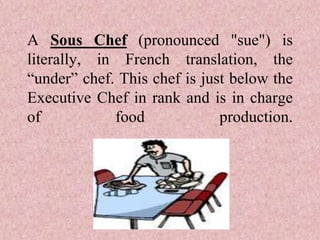
A Sous Chef (pronounced "sue") is
literally, in French translation, the
“under” chef. This chef is just below the
Executive Chef in rank and is in charge
of food production.
He/she spends more time cooking than
the executive chef and overseeing the
daily happenings in the kitchen. The line
cooks usually report to the sous chef.
Some larger restaurants have more than
one sous chef, each in charge of his/her
own area.
A line cook works on the hot line of
the kitchen (where the food is
cooked). He/she is below the sous
chef in rank. Often, a line cook will
be assigned to a station such as sauté
or fryer or grill.
A prep cook spends their time at work
prepping for all of the dishes that will be
served during meal service, whether it is
breakfast, lunch or dinner. Prepping includes
washing, slicing, trimming and weighing. This
person needs to be organized and quick, as
they support the rest of the cooks. Line cooks
may do all their own prep in smaller
restaurants.
The pastry chef specializes in pastry and
baking and is in charge of all pastry
production in the restaurant. Smaller
restaurants may not have a pastry chef,
and may just buy desserts from an
outside bakery.
A dishwasher washes dishes and pots and
empties the trash. This is one of the most
demanding jobs in the kitchen and the least
glamorous. Many chefs would attest to the
fact that the dishwasher is the most important
employee in a restaurant, since the place will
come to a standstill if there are no clean plates
or pots.
A reliable dishwasher will work
fast and hard and be able to keep
up with the piles of dirty dishes
and keep the trash cans emptied.
This person needs to be reliable
and strong!
ORGANIZATIONAL CHART
BOH
Office
• The first responsibility of employees in the
office is providing administrative assistance
to the general manager and his or her staff
• The office staff is responsible for all of the
daily correspondence, phone calls, and
office procedures to help free the managers
from these time-consuming duties
• Lastly, the office staff is responsible for
keeping the books
CORRESPONDENCE is non-
concurrent,remote communication
between people,
including letters, email, newsgroups,
Internet forums, blogs
Office Staff Tasks
• Correspondence
• Phone calls
• Bookkeeping, (i.e., preliminary processing
of cashier deposits, payroll preparation, and
bill approval)
• Cost control report preparation
Division of a Restaurant’s Day
• Opening
• Before and after the rush
• Meal periods
• Closing
Controllable Expenses
• Payroll costs
• Employee benefits
• Utilities
• Advertising and promotion
• Administrative costs
• Repairs and maintenance

4-Restaurant Operations.pptx

  • 1.
  • 2.
    This Chapter ShouldHelp You... • Identify the three main divisions of activity found in restaurant operations, and summarize their respective roles. • Explain the best way to become familiar with operations in a restaurant or other food service organizations.
  • 3.
    Three Main Areasof Food Service Operations: • Front of the House • Back of the House • Office
  • 4.
    FRONT OF THEHOUSE - is any place in a restaurant where customers might be. This includes the dining room, bar, even the rest rooms.
  • 5.
  • 6.
  • 7.
    Front of theHouse: The key responsibility of the front of the house is GUEST SATISFACTION! • It is extremely important to remember that as a front of the house employee, the key to providing excellent guest satisfaction is fulfilling the guest’s wants and expectations.
  • 8.
    Front of theHouse Tasks Include: • Some tasks include: – Greeting the guest – Taking the order – Serving the food – Removing used tableware – Accepting payment and accounting for cash and charge sales – Thanking the guest and inviting them for future business
  • 9.
    F O HEMPLOYEES
  • 10.
    Waiting staff, waitstaff, or waitstaff are those who work at a restaurant or a bar attending customers — supplying them with food and drink as requested. Traditionally, a male waiting table is called a "waiter" and a female a "waitress" with the gender-neutral version being a "server".
  • 11.
    Runners Runners work underthe servers, bringing customers the food they ordered directly from the kitchen.
  • 12.
    Bussers Bussers are thefolks who clear tables and re-set them. They bring the dirty dishes to the kitchen to be washed.
  • 13.
    Cashier Cashier is anoccupation focused on the handling of cash money.
  • 14.
  • 15.
    BACK OF THEHOUSE - The areas of the restaurant where guests are not permitted including the kitchen. All kitchen staff are back of the house employees.
  • 16.
    Back of theHouse • The principal responsibility of the back of the house is the quality of the food the guest is served • Sanitation is an extremely important responsibility of employees in the back of the house • Finally, cost control - food, labor, and supplies - is a “make or break” responsibility of the back of the house
  • 17.
    Sanitation is thehygienic means of promoting health through prevention of human contact with the hazards of wastes.
  • 18.
    Back of theHouse Tasks • Some Tasks Performed include: –Food production –Food quality and cost control –Dish washing and pot washing –Back-of-the-house cleaning –Pest control
  • 19.
    B O HEMPLOYEES
  • 20.
    The Executive Chefis in charge of a kitchen, responsible for recipe and menu creation, staff training, and overseeing all cooking. The chef also “manages” the staff of cooks, bakers, butchers, and everyone else involved in the preparation of food. The chef writes the menu, determines food cost and is in charge of purchasing for the restaurant.
  • 21.
    This person mustbe a confident leader, with the proven mastery skill and understanding of all stations in the kitchen. The chef must know how to manage the bottom line, as well as have top cooking skills.
  • 22.
  • 23.
    A Sous Chef(pronounced "sue") is literally, in French translation, the “under” chef. This chef is just below the Executive Chef in rank and is in charge of food production.
  • 24.
    He/she spends moretime cooking than the executive chef and overseeing the daily happenings in the kitchen. The line cooks usually report to the sous chef. Some larger restaurants have more than one sous chef, each in charge of his/her own area.
  • 25.
    A line cookworks on the hot line of the kitchen (where the food is cooked). He/she is below the sous chef in rank. Often, a line cook will be assigned to a station such as sauté or fryer or grill.
  • 26.
    A prep cookspends their time at work prepping for all of the dishes that will be served during meal service, whether it is breakfast, lunch or dinner. Prepping includes washing, slicing, trimming and weighing. This person needs to be organized and quick, as they support the rest of the cooks. Line cooks may do all their own prep in smaller restaurants.
  • 27.
    The pastry chefspecializes in pastry and baking and is in charge of all pastry production in the restaurant. Smaller restaurants may not have a pastry chef, and may just buy desserts from an outside bakery.
  • 28.
    A dishwasher washesdishes and pots and empties the trash. This is one of the most demanding jobs in the kitchen and the least glamorous. Many chefs would attest to the fact that the dishwasher is the most important employee in a restaurant, since the place will come to a standstill if there are no clean plates or pots.
  • 29.
    A reliable dishwasherwill work fast and hard and be able to keep up with the piles of dirty dishes and keep the trash cans emptied. This person needs to be reliable and strong!
  • 30.
  • 31.
    Office • The firstresponsibility of employees in the office is providing administrative assistance to the general manager and his or her staff • The office staff is responsible for all of the daily correspondence, phone calls, and office procedures to help free the managers from these time-consuming duties • Lastly, the office staff is responsible for keeping the books
  • 32.
    CORRESPONDENCE is non- concurrent,remotecommunication between people, including letters, email, newsgroups, Internet forums, blogs
  • 33.
    Office Staff Tasks •Correspondence • Phone calls • Bookkeeping, (i.e., preliminary processing of cashier deposits, payroll preparation, and bill approval) • Cost control report preparation
  • 34.
    Division of aRestaurant’s Day • Opening • Before and after the rush • Meal periods • Closing
  • 35.
    Controllable Expenses • Payrollcosts • Employee benefits • Utilities • Advertising and promotion • Administrative costs • Repairs and maintenance