CATERING INDUSTRY
SASIKUMAR NATARAJAN
WHAT IS CATERING
The term catering refers to providing food and beverage. It is to provide
food for pleasure. It has two aspects preparation, presentation and
service in an unique style.
SASIKUMAR NATARAJAN - EDUCATIONALIST & HOSPITALITY TRAINER
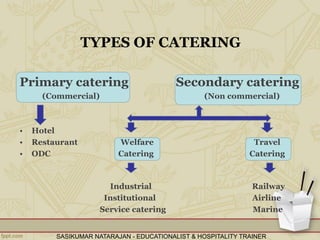
TYPES OF CATERING
Primary catering Secondary catering
(Commercial) (Non commercial)
• Hotel
• Restaurant Welfare Travel
• ODC Catering Catering
Industrial Railway
Institutional Airline
Service catering Marine
SASIKUMAR NATARAJAN - EDUCATIONALIST & HOSPITALITY TRAINER
HOTELS
Five Star Hotels
These usually have several restaurants, grill rooms, ethnic (Indian,
Chinese, Italian, etc. among the most popular), European and coffee
shops are included. Service in these hotels is usually attentive and
entertainment is nearly always available. Prices in these
establishments tend to be high.
Medium Class Hotels
Similar to the five-star hotels, though surroundings are less
luxurious and prices are reflected in this.
SASIKUMAR NATARAJAN - EDUCATIONALIST & HOSPITALITY TRAINER
RESTAURANT
Free Standing Restaurants
Often quite high class, offering good Ala Carte menus- service is
usually of a high standard.
Snacks Bar
It is popular with the working public offering everyday fare, at very
reasonable prices.
Fast Food Centre:
The “eating out” of 80’s growing in popularity in India especially
with the young, these restaurants offer fast, clean service at popular
prices. Service is minimal and turnover is high.
SASIKUMAR NATARAJAN - EDUCATIONALIST & HOSPITALITY TRAINER
OUTDOOR / RETAIL STORE CATERING
This catering includes the provision of food and drink away from home base
and suppliers. The venue is left to the peoples’ choice. Hotels, restaurants and
catering contractors meet this growing demand. The type of food and set up
depends entirely on the price agreed upon. Outdoor catering includes catering
for functions such as marriages, parties and conventions.
Retail Store Catering
Some retail stores, apart from carrying on their primary activity of retailing
their own wares, provide catering as an additional facility. This type of
catering evolved when large departmental stores wished to provide food and
beverages to their customers as a part of their retailing concept. It is
inconvenient and time consuming for customers to take a break from
shopping, to have some refreshments at a different location. Thus arouse the
need for some sort of a dining facility in the retail store itself. This style of
catering is becoming more popular and varied nowadays.
SASIKUMAR NATARAJAN - EDUCATIONALIST & HOSPITALITY TRAINER
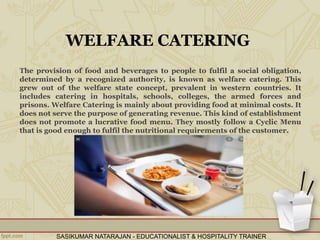
WELFARE CATERING
The provision of food and beverages to people to fulfil a social obligation,
determined by a recognized authority, is known as welfare catering. This
grew out of the welfare state concept, prevalent in western countries. It
includes catering in hospitals, schools, colleges, the armed forces and
prisons. Welfare Catering is mainly about providing food at minimal costs. It
does not serve the purpose of generating revenue. This kind of establishment
does not promote a lucrative food menu. They mostly follow a Cyclic Menu
that is good enough to fulfil the nutritional requirements of the customer.
SASIKUMAR NATARAJAN - EDUCATIONALIST & HOSPITALITY TRAINER
INDUSTRIAL CATERING
The provision of food and beverages to ‘people at work,’ in industries and
factories at highly subsidized rates is called industrial catering. It is based on
the assumption that better fed employees at concessional rates are happy
and more productive. Catering for a large workforce may be undertaken by
the management itself, or may be contracted out to professional caterers.
Depending on the choice of the menu suggested by the management, catering
contractors undertake to feed the workforce for a fixed period of time at a
predetermined price.
SASIKUMAR NATARAJAN - EDUCATIONALIST & HOSPITALITY TRAINER
INSTITUTIONAL CATERING
The provision of food and beverages to ‘students in schools or colleges’ at
highly subsidized rates is called institutional catering. It is the responsibility
of the institutes to provide the students with a complete balanced diet. This
kind of catering establishment may be under taken by the management itself
or may be contracted out to professional caterers. The food menu in this type
of establishment is Cyclic and is mostly based on the seasonal availability of
ingredients. The concept is not to earn revenue but to serve their own social
responsibility.
SASIKUMAR NATARAJAN - EDUCATIONALIST & HOSPITALITY TRAINER
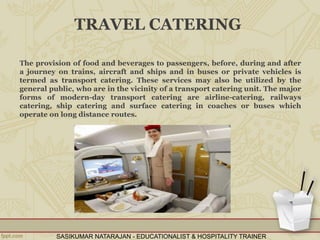
TRAVEL CATERING
The provision of food and beverages to passengers, before, during and after
a journey on trains, aircraft and ships and in buses or private vehicles is
termed as transport catering. These services may also be utilized by the
general public, who are in the vicinity of a transport catering unit. The major
forms of modern-day transport catering are airline-catering, railways
catering, ship catering and surface catering in coaches or buses which
operate on long distance routes.
SASIKUMAR NATARAJAN - EDUCATIONALIST & HOSPITALITY TRAINER
AIRLINE CATERING
Since no cooking facility is available in the aircraft all prepared food has to be
carried before the flight takes off. Because of limitations of space and storage
facility the pantries are specifically designed and equipped for holding and
reheating the food. Today airline catering has become much more sophisticated
and airlines are taking more care to plan more appetizing and varied menu. Civil
aviation progressed very rapidly after the second world war when large war supply
air craft were available for disposal. From 1946 onwards commercial airlines
started food service. Initially in-flight services were limited and only light meals
and dry snacks were being served. This system continued till airlines started to
make international journeys. This made it necessary to serve more substantial
meals which resulted in the development of flight Kitchens which met the demand.
SASIKUMAR NATARAJAN - EDUCATIONALIST & HOSPITALITY TRAINER
RAILWAY CATERING
Catering to railway passengers both during the journey as well as during
halts at different railway stations is called railway catering.
Travelling by train for long distances can be very tiring; hence a constant
supply of a variety of refreshment choices helps to make the journey less
tedious. On-board meal services are also provided on long distance trains.
SASIKUMAR NATARAJAN - EDUCATIONALIST & HOSPITALITY TRAINER
MARINE CATERING
Marine catering includes catering for passengers as well as the crew on
board. The modern day luxury cruise liners have very high standard and
equipped with facilities like, restaurants, ball room, discotheque, casino,
swimming pool, golf course, laundry etc. all on board. On luxury liners
service reaches the highest standard. Apart from the different meals served
in the most professional way social activities like parties, dance etc. are also
organized. Events like birthday parties, anniversaries etc. are also celebrated
to provide entertainment and create goodwill. The menus served are
exclusive and quite elaborate to provide ample amount of choice.
SASIKUMAR NATARAJAN - EDUCATIONALIST & HOSPITALITY TRAINER
PROCESS OF CATERING INDUSTRY
SASIKUMAR NATARAJAN - EDUCATIONALIST & HOSPITALITY TRAINER
A STEP BY STEP GUIDE TO START A
CATERING BUSINESS
(i) Make a proper business plan and finalize your niche.
ii) Get your kitchen location and rent.
iii) Sort out the sources of your capital.
iv) Get the most important equipment first.
v) Find out your source vendors for your catering
supplies.
vi) Get your licenses and permits.
vii) Decide on food costing and menu engineering.
viii) Hire adequate and proper staff.
ix) Market your brand well.
SASIKUMAR NATARAJAN - EDUCATIONALIST & HOSPITALITY TRAINER
A STEP BY STEP GUIDE TO START A
CATERING BUSINESS
i) Make A Proper Business Plan And Finalize Your Niche
Your business model must revolve around your availability, the space rented and storage
requirements. It should cover all your investment costs and expenses for the initial few months. Only
after identifying your potential customers and researching the marketplace should you start to think
about the same.
In case you’re planning for a full-time catering business, you need a permanent storage and cooking
facility. Along with that, there must be enough plumbing so that it’s easier to set up your kitchen. You
could also get a place near a storefront to put in some tables and chairs for customers to taste your
food right away. If you are only looking to start a part-time catering business, you must look for a
model that includes renting the kitchen space on a day-to-day basis. This would allow you to save
money and work on the weekends or a few times a month.
After setting up your kitchen, you need to finalize your cuisine. Get authentic feedback from the
consumers and work on the negative ones. This helps you to gain more customers and pre-orders even
before the business is completely set up. Some of the niches that you can stick on are banquet lunch
boxes, contract catering service, and private chef service.
SASIKUMAR NATARAJAN - EDUCATIONALIST & HOSPITALITY TRAINER
A STEP BY STEP GUIDE TO START A
CATERING BUSINESS
ii) Get To Know About Your Kitchen Area And Rent!
The minimum required kitchen area one would require even in case of a small
scale catering business involving 20-25 people is around 70-80 sq. feet. Any
order serving more than 25 people will need 100 square feet of kitchen space at
the least.
Setting up your own kitchen would bring you more clients due to efficient and
hygienic food making. The rent for such places would differ for each place,
whereas an average rent for 100 square feet kitchen area would be somewhere
between Rs. 8000 to Rs 10,000, location being a prime factor.
SASIKUMAR NATARAJAN - EDUCATIONALIST & HOSPITALITY TRAINER
A STEP BY STEP GUIDE TO START A
CATERING BUSINESS
iii) Sort Out The Sources Of Your Capital
The next step has to be penning down the sources of your capital, and how to use them
efficiently for on-site equipment, rental costings, licenses, and other expenses. Use your
research skills to know about the right sources for your capital. It could be coming from
other investors, from your own funds or a bank loan.
An average budget to start a catering business in India is ideally around Rs. 20 lakh, which
includes an initial few months of expenses, kitchen rent, transport, licenses, and other
permits. This budget may vary according to your preferences. You must also take note of
the smaller costs involved like that of table decoration, napkins, workers, etc. You can
seek help from a bank in case of a loan. All you need to do is convince them with your
business plan and revenue generation model. There are many such schemes in various
banks that help you get a loan without any hassle.
SASIKUMAR NATARAJAN - EDUCATIONALIST & HOSPITALITY TRAINER
A STEP BY STEP GUIDE TO START A
CATERING BUSINESS
iv) Get The Most Important Equipment First!
Once you have enough capital, you need to invest in this on-site equipment for your
kitchen. Fryers and refrigerators, storage cabinets, a few burner stoves, 2-3 compartment
sinks, and stainless steel prep tables are the major requirements for a base kitchen. Apart
from these, here is a list of other equipment that you would require.
Cooking Oven
Serving Equipment
Coffee/Beverage Station
Cambro
Tin Foil
Plastic Wrap
Garbage Bins
Disposable Containers For Storage
SASIKUMAR NATARAJAN - EDUCATIONALIST & HOSPITALITY TRAINER
A STEP BY STEP GUIDE TO START A
CATERING BUSINESS
v) Find Out Your Source Vendors For Your Catering Supplies
The raw materials or products for your business could come locally from farmers or
a supply distribution agency. In the initial phases, you can use a wholesale club to
buy your raw materials, as it saves up on a lot of your money plus they are fresh! It is
always easier to do business with a larger supply company.
Once you take up a few orders, start growing your network of supply vendors and
agencies. You can then use to do business with the best ones in the market.
SASIKUMAR NATARAJAN - EDUCATIONALIST & HOSPITALITY TRAINER
A STEP BY STEP GUIDE TO START A
CATERING BUSINESS
vi) Get Your Licenses And Permits
It’s time to get moving with your business plan now. We have listed down the criteria
for registration of a catering business in India. Once you have these in place, you can
apply for a basic vendor registration from FSSAI, which would cost you only a
hundred bucks annually. This registration is valid either for a year or five years
depending on what term you choose.
Once you expand your business and start increasing your turnover to more than 12
lakhs a year, only then you need a few other licenses and permits. But before all of
that, make sure that you get your FSSAI license by ensuring that the following
parameters are taken care of.
SASIKUMAR NATARAJAN - EDUCATIONALIST & HOSPITALITY TRAINER
A STEP BY STEP GUIDE TO START A
CATERING BUSINESS
• The location of your business must be free from external pollutants.
• There must be proper and adequate storage in the most hygienic condition possible.
• The stalls or counters should be clean and proper.
• The food that you’re using must be free from any contamination.
• Only freshly prepared food should go out for delivery to consumers.
• The staff that you hire to help in your business must also maintain the proper conduct
of personal hygiene.
• The containers that you use for cooking and delivery must be free from dust or any
other contamination.
• The licenses that need to be in place are mentioned here. These licenses are for
different kinds of businesses, so see which all do you need for your kind of business.
Check for Health Trade, eating the house, shop, and establishment, GST registration,
NOC from the fire department, etc.
SASIKUMAR NATARAJAN - EDUCATIONALIST & HOSPITALITY TRAINER
A STEP BY STEP GUIDE TO START A
CATERING BUSINESS
Food Establishment License – This one is a necessity to have for all kinds of catering
businesses. To obtain one, you will be inspected by state compliance. Your kitchen
space and the staff should all be prepared well enough for the inspection.
Liquor License – In case you are serving in any events or parties that include alcohol,
you must make sure that you have obtained an alcohol license.
Other Licenses Or Permits – Other state agencies and jurisdictions might impose
some additional licenses and permits on the food and beverage sector. You might
come across Quality Assurance and Health Insurance. Other important licenses are
Fire and water licenses, sewage licenses and permits to ensure that your labor is
above 18 years of age.
SASIKUMAR NATARAJAN - EDUCATIONALIST & HOSPITALITY TRAINER
A STEP BY STEP GUIDE TO START A
CATERING BUSINESS
vii) Decide The Menu
Menu engineering has been unanimously said to be one of the toughest tasks of
handling a food-related business. You need to consider the raw material cost, the
quantity, the change in rates and so on. Competitors are one of the last, but
important factors to be considered. It is important to know what your competitors
are charging to sustain in the market.
Standardizing your recipe helps in reducing food costs to a higher margin by
defining the exact quantity of raw materials required for each dish. A proper POS
system will help you achieve that. It maintains a standardized recipe for you,
ensuring constant taste and quality. Your per-plate costing may vary according to
demand and services added. Initially, try to have a moderate rate and consistency in
your food quality to get more orders flowing in. Apart from that, the magnitude of
the event will also decide the prices.
SASIKUMAR NATARAJAN - EDUCATIONALIST & HOSPITALITY TRAINER
A STEP BY STEP GUIDE TO START A
CATERING BUSINESS
viii) Hire Adequate And Proper Manpower
Any new business needs a spoonful of dedication and hard work to come out as
successful. In order for that to happen, adequate and dedicated staff is required for
your business. In the initial stages, you could try out an agency to hire your cooks
and servers, and then hire permanent staff when you have enough funds.
Maintain a uniform for all the staff members and make sure they are well trained.
The minimum number of people that you can start your catering business with is
around 10-12 people including a head chef, junior chef, other cooks, menu designer,
and delivery people.
SASIKUMAR NATARAJAN - EDUCATIONALIST & HOSPITALITY TRAINER
A STEP BY STEP GUIDE TO START A
CATERING BUSINESS
ix) Market Your Brand Well
You can’t deny the importance of marketing in a newly established catering business. You need
your leads, and you need to convert them into potential customers.
Word of mouth could work wonders! – Unlike other businesses, a catering business prospers
way too fast solely on the basis of word of mouth of their existing customers. Target cold
calling and give it a personal touch.
Use powerful social media platforms like Instagram, Whatsapp, and Facebook .
Create your own website and work on your blogs – Creating your own website is highly
required in a catering business, especially in the present times. This is to showcase your work
through a catalog to people so that they are attracted to your business. This also brings about
a trust factor within customers. Along with that, your website could play a major role in getting
your prospects for potential customers.
Networking – B2B advertisements to grow your network with event planners, DJs, cake
makers, etc.
Target your consumers – Make sure that there are repeat buyers, especially banquet halls and
businesses. Put out different offers, campaigns and other upgrades that help you attract
referrals. Email-marketing could also help in your case as it helps in retaining customers by
making them realize that you care about them.
SASIKUMAR NATARAJAN - EDUCATIONALIST & HOSPITALITY TRAINER
A STEP BY STEP GUIDE TO START A
CATERING BUSINESS
x) Use Technology For Getting Orders And Managing Stock
Automation of your catering business becomes an absolute necessity in today’s generation as
it prevents human errors in taking orders, and saves from you situations of overlapping of a
particular order. While taking care of a particular order, you need to note down each of the
specifications to avoid any discrepancies in the future.
Along with that, it helps you to take care of your inventory and analyze your per day
consumption. Having a detailed analysis of your consumption and wastage helps you manage
your inventory better. A smart catering software would help you streamline your operations
and reduce the manual labor up to a great extent.
All in all, as we have already established that it takes more than just cooking to start even a
small scale catering business. You need to be extra careful and follow this detailed checklist.
Once you do that, we ensure you that you will be absolutely ready to start your own catering
business and a flourishing one at that!
SASIKUMAR NATARAJAN - EDUCATIONALIST & HOSPITALITY TRAINER
CHALLENGES IN CATERING BUSINESS
Competition:
As more and more people are getting attracted to the business world, every person
dreams to utilize their cooking skills by establishing a catering business. At present,
the catering industry is completely saturated with numerous companies. It is
challenging to prove yourself in the market and stand ahead of your competitors.
You have to face tough competition to do well in this business. If you are a person
who is passionate to establish a catering company, you have to know your unique
specialty and promote to attract clients.
SASIKUMAR NATARAJAN - EDUCATIONALIST & HOSPITALITY TRAINER
CHALLENGES IN CATERING BUSINESS
Finances:
Another major challenge faced by most startup catering companies is finance.
During the starting stage, you have to take care of various things for establishing
your business. You need to have sufficient funds to purchase and maintain your
equipment. Moreover, you should also hire staffs to assist you in various projects.
There are several expenses to manage like choosing and buying the right appliances,
training staff members and creating the company. It is best to draft the plan and
expenses involved in a paper before starting the company. Arrange the cash and
then think about getting into the business to manage things smoothly.
SASIKUMAR NATARAJAN - EDUCATIONALIST & HOSPITALITY TRAINER
CHALLENGES IN CATERING BUSINESS
The scarcity of orders
It is common in the catering business to remain without orders at certain times.
During wedding months, the demand will be more but in other months, you would
get a mix of party and function orders. At times of offseason, you would not have
many orders. The business keeps growing until there are celebrations and parties
going on. One of the best ways to develop your catering business is to develop your
catering portfolio in the best way. This way, you can take up various kinds of
catering foods and for different events. It is also recommended to choose auxiliary
selling in the same catering industry like selling catering associated equipment.
SASIKUMAR NATARAJAN - EDUCATIONALIST & HOSPITALITY TRAINER
CHALLENGES IN CATERING BUSINESS
Management:
One of the most important features of any business is management. The success of
your business mostly depends on how you handle. It may be challenging to handle
several things at once. A good manager should be talented to handle cooks,
dishwashers, servers and also make sure they maintain hygiene throughout. The
best caterers were able to accomplish a top position because of excellent
management skills. Nobody would wish to compromise when it is food. Everyone
would expect value for money. You can grow faster only when you offer valuable
services to clients.
SASIKUMAR NATARAJAN - EDUCATIONALIST & HOSPITALITY TRAINER
CHALLENGES IN CATERING BUSINESS
Food waste:
It is another major issue that remains highly challenging to handle in a catering
business. When you are trying to meet your client requirements, there are chances
for you to cook and serve extra food. A lot of food would get waste in the majority of
functions. You need to know how to manage this issue in a smart manner. It is best
to tie up with NGOs so that you can serve the food that is not used at the party.
SASIKUMAR NATARAJAN - EDUCATIONALIST & HOSPITALITY TRAINER
CHALLENGES IN CATERING BUSINESS
Planning and contingencies — One challenge is determining how much food to
prepare for a given number of people, how many staff you need to do this, and what to do
if something goes amiss. For outdoor venues, there’s always the risk of getting rained out;
in this case, you need a contingency plan.
Staff — To run a successful catering business, you need a lot of employees to perform a
number of different tasks. Even though labor costs are high, many owners have a hard
time retaining employees who leave in search of higher-paying jobs.
Leave no trace — In general, you have to arrive at the site with all the necessary
equipment in perfect condition, set it up, and then once you’re finished, you must take it
all away so it looks as though you were never there. In addition to serving many people
and making a lot of food, you have to move a small restaurant twice in a day.
SASIKUMAR NATARAJAN - EDUCATIONALIST & HOSPITALITY TRAINER
CATERING INDUSTRY
SOURCE :
• Enotes
• Websites
• Expert knowledge
• Books
THANK YOU
SASIKUMAR NATARAJAN - EDUCATIONALIST & HOSPITALITY TRAINER

Catering Industry

  • 1.
  • 2.
    WHAT IS CATERING Theterm catering refers to providing food and beverage. It is to provide food for pleasure. It has two aspects preparation, presentation and service in an unique style. SASIKUMAR NATARAJAN - EDUCATIONALIST & HOSPITALITY TRAINER
  • 3.
    TYPES OF CATERING Primarycatering Secondary catering (Commercial) (Non commercial) • Hotel • Restaurant Welfare Travel • ODC Catering Catering Industrial Railway Institutional Airline Service catering Marine SASIKUMAR NATARAJAN - EDUCATIONALIST & HOSPITALITY TRAINER
  • 4.
    HOTELS Five Star Hotels Theseusually have several restaurants, grill rooms, ethnic (Indian, Chinese, Italian, etc. among the most popular), European and coffee shops are included. Service in these hotels is usually attentive and entertainment is nearly always available. Prices in these establishments tend to be high. Medium Class Hotels Similar to the five-star hotels, though surroundings are less luxurious and prices are reflected in this. SASIKUMAR NATARAJAN - EDUCATIONALIST & HOSPITALITY TRAINER
  • 5.
    RESTAURANT Free Standing Restaurants Oftenquite high class, offering good Ala Carte menus- service is usually of a high standard. Snacks Bar It is popular with the working public offering everyday fare, at very reasonable prices. Fast Food Centre: The “eating out” of 80’s growing in popularity in India especially with the young, these restaurants offer fast, clean service at popular prices. Service is minimal and turnover is high. SASIKUMAR NATARAJAN - EDUCATIONALIST & HOSPITALITY TRAINER
  • 6.
    OUTDOOR / RETAILSTORE CATERING This catering includes the provision of food and drink away from home base and suppliers. The venue is left to the peoples’ choice. Hotels, restaurants and catering contractors meet this growing demand. The type of food and set up depends entirely on the price agreed upon. Outdoor catering includes catering for functions such as marriages, parties and conventions. Retail Store Catering Some retail stores, apart from carrying on their primary activity of retailing their own wares, provide catering as an additional facility. This type of catering evolved when large departmental stores wished to provide food and beverages to their customers as a part of their retailing concept. It is inconvenient and time consuming for customers to take a break from shopping, to have some refreshments at a different location. Thus arouse the need for some sort of a dining facility in the retail store itself. This style of catering is becoming more popular and varied nowadays. SASIKUMAR NATARAJAN - EDUCATIONALIST & HOSPITALITY TRAINER
  • 7.
    WELFARE CATERING The provisionof food and beverages to people to fulfil a social obligation, determined by a recognized authority, is known as welfare catering. This grew out of the welfare state concept, prevalent in western countries. It includes catering in hospitals, schools, colleges, the armed forces and prisons. Welfare Catering is mainly about providing food at minimal costs. It does not serve the purpose of generating revenue. This kind of establishment does not promote a lucrative food menu. They mostly follow a Cyclic Menu that is good enough to fulfil the nutritional requirements of the customer. SASIKUMAR NATARAJAN - EDUCATIONALIST & HOSPITALITY TRAINER
  • 8.
    INDUSTRIAL CATERING The provisionof food and beverages to ‘people at work,’ in industries and factories at highly subsidized rates is called industrial catering. It is based on the assumption that better fed employees at concessional rates are happy and more productive. Catering for a large workforce may be undertaken by the management itself, or may be contracted out to professional caterers. Depending on the choice of the menu suggested by the management, catering contractors undertake to feed the workforce for a fixed period of time at a predetermined price. SASIKUMAR NATARAJAN - EDUCATIONALIST & HOSPITALITY TRAINER
  • 9.
    INSTITUTIONAL CATERING The provisionof food and beverages to ‘students in schools or colleges’ at highly subsidized rates is called institutional catering. It is the responsibility of the institutes to provide the students with a complete balanced diet. This kind of catering establishment may be under taken by the management itself or may be contracted out to professional caterers. The food menu in this type of establishment is Cyclic and is mostly based on the seasonal availability of ingredients. The concept is not to earn revenue but to serve their own social responsibility. SASIKUMAR NATARAJAN - EDUCATIONALIST & HOSPITALITY TRAINER
  • 10.
    TRAVEL CATERING The provisionof food and beverages to passengers, before, during and after a journey on trains, aircraft and ships and in buses or private vehicles is termed as transport catering. These services may also be utilized by the general public, who are in the vicinity of a transport catering unit. The major forms of modern-day transport catering are airline-catering, railways catering, ship catering and surface catering in coaches or buses which operate on long distance routes. SASIKUMAR NATARAJAN - EDUCATIONALIST & HOSPITALITY TRAINER
  • 11.
    AIRLINE CATERING Since nocooking facility is available in the aircraft all prepared food has to be carried before the flight takes off. Because of limitations of space and storage facility the pantries are specifically designed and equipped for holding and reheating the food. Today airline catering has become much more sophisticated and airlines are taking more care to plan more appetizing and varied menu. Civil aviation progressed very rapidly after the second world war when large war supply air craft were available for disposal. From 1946 onwards commercial airlines started food service. Initially in-flight services were limited and only light meals and dry snacks were being served. This system continued till airlines started to make international journeys. This made it necessary to serve more substantial meals which resulted in the development of flight Kitchens which met the demand. SASIKUMAR NATARAJAN - EDUCATIONALIST & HOSPITALITY TRAINER
  • 12.
    RAILWAY CATERING Catering torailway passengers both during the journey as well as during halts at different railway stations is called railway catering. Travelling by train for long distances can be very tiring; hence a constant supply of a variety of refreshment choices helps to make the journey less tedious. On-board meal services are also provided on long distance trains. SASIKUMAR NATARAJAN - EDUCATIONALIST & HOSPITALITY TRAINER
  • 13.
    MARINE CATERING Marine cateringincludes catering for passengers as well as the crew on board. The modern day luxury cruise liners have very high standard and equipped with facilities like, restaurants, ball room, discotheque, casino, swimming pool, golf course, laundry etc. all on board. On luxury liners service reaches the highest standard. Apart from the different meals served in the most professional way social activities like parties, dance etc. are also organized. Events like birthday parties, anniversaries etc. are also celebrated to provide entertainment and create goodwill. The menus served are exclusive and quite elaborate to provide ample amount of choice. SASIKUMAR NATARAJAN - EDUCATIONALIST & HOSPITALITY TRAINER
  • 14.
    PROCESS OF CATERINGINDUSTRY SASIKUMAR NATARAJAN - EDUCATIONALIST & HOSPITALITY TRAINER
  • 15.
    A STEP BYSTEP GUIDE TO START A CATERING BUSINESS (i) Make a proper business plan and finalize your niche. ii) Get your kitchen location and rent. iii) Sort out the sources of your capital. iv) Get the most important equipment first. v) Find out your source vendors for your catering supplies. vi) Get your licenses and permits. vii) Decide on food costing and menu engineering. viii) Hire adequate and proper staff. ix) Market your brand well. SASIKUMAR NATARAJAN - EDUCATIONALIST & HOSPITALITY TRAINER
  • 16.
    A STEP BYSTEP GUIDE TO START A CATERING BUSINESS i) Make A Proper Business Plan And Finalize Your Niche Your business model must revolve around your availability, the space rented and storage requirements. It should cover all your investment costs and expenses for the initial few months. Only after identifying your potential customers and researching the marketplace should you start to think about the same. In case you’re planning for a full-time catering business, you need a permanent storage and cooking facility. Along with that, there must be enough plumbing so that it’s easier to set up your kitchen. You could also get a place near a storefront to put in some tables and chairs for customers to taste your food right away. If you are only looking to start a part-time catering business, you must look for a model that includes renting the kitchen space on a day-to-day basis. This would allow you to save money and work on the weekends or a few times a month. After setting up your kitchen, you need to finalize your cuisine. Get authentic feedback from the consumers and work on the negative ones. This helps you to gain more customers and pre-orders even before the business is completely set up. Some of the niches that you can stick on are banquet lunch boxes, contract catering service, and private chef service. SASIKUMAR NATARAJAN - EDUCATIONALIST & HOSPITALITY TRAINER
  • 17.
    A STEP BYSTEP GUIDE TO START A CATERING BUSINESS ii) Get To Know About Your Kitchen Area And Rent! The minimum required kitchen area one would require even in case of a small scale catering business involving 20-25 people is around 70-80 sq. feet. Any order serving more than 25 people will need 100 square feet of kitchen space at the least. Setting up your own kitchen would bring you more clients due to efficient and hygienic food making. The rent for such places would differ for each place, whereas an average rent for 100 square feet kitchen area would be somewhere between Rs. 8000 to Rs 10,000, location being a prime factor. SASIKUMAR NATARAJAN - EDUCATIONALIST & HOSPITALITY TRAINER
  • 18.
    A STEP BYSTEP GUIDE TO START A CATERING BUSINESS iii) Sort Out The Sources Of Your Capital The next step has to be penning down the sources of your capital, and how to use them efficiently for on-site equipment, rental costings, licenses, and other expenses. Use your research skills to know about the right sources for your capital. It could be coming from other investors, from your own funds or a bank loan. An average budget to start a catering business in India is ideally around Rs. 20 lakh, which includes an initial few months of expenses, kitchen rent, transport, licenses, and other permits. This budget may vary according to your preferences. You must also take note of the smaller costs involved like that of table decoration, napkins, workers, etc. You can seek help from a bank in case of a loan. All you need to do is convince them with your business plan and revenue generation model. There are many such schemes in various banks that help you get a loan without any hassle. SASIKUMAR NATARAJAN - EDUCATIONALIST & HOSPITALITY TRAINER
  • 19.
    A STEP BYSTEP GUIDE TO START A CATERING BUSINESS iv) Get The Most Important Equipment First! Once you have enough capital, you need to invest in this on-site equipment for your kitchen. Fryers and refrigerators, storage cabinets, a few burner stoves, 2-3 compartment sinks, and stainless steel prep tables are the major requirements for a base kitchen. Apart from these, here is a list of other equipment that you would require. Cooking Oven Serving Equipment Coffee/Beverage Station Cambro Tin Foil Plastic Wrap Garbage Bins Disposable Containers For Storage SASIKUMAR NATARAJAN - EDUCATIONALIST & HOSPITALITY TRAINER
  • 20.
    A STEP BYSTEP GUIDE TO START A CATERING BUSINESS v) Find Out Your Source Vendors For Your Catering Supplies The raw materials or products for your business could come locally from farmers or a supply distribution agency. In the initial phases, you can use a wholesale club to buy your raw materials, as it saves up on a lot of your money plus they are fresh! It is always easier to do business with a larger supply company. Once you take up a few orders, start growing your network of supply vendors and agencies. You can then use to do business with the best ones in the market. SASIKUMAR NATARAJAN - EDUCATIONALIST & HOSPITALITY TRAINER
  • 21.
    A STEP BYSTEP GUIDE TO START A CATERING BUSINESS vi) Get Your Licenses And Permits It’s time to get moving with your business plan now. We have listed down the criteria for registration of a catering business in India. Once you have these in place, you can apply for a basic vendor registration from FSSAI, which would cost you only a hundred bucks annually. This registration is valid either for a year or five years depending on what term you choose. Once you expand your business and start increasing your turnover to more than 12 lakhs a year, only then you need a few other licenses and permits. But before all of that, make sure that you get your FSSAI license by ensuring that the following parameters are taken care of. SASIKUMAR NATARAJAN - EDUCATIONALIST & HOSPITALITY TRAINER
  • 22.
    A STEP BYSTEP GUIDE TO START A CATERING BUSINESS • The location of your business must be free from external pollutants. • There must be proper and adequate storage in the most hygienic condition possible. • The stalls or counters should be clean and proper. • The food that you’re using must be free from any contamination. • Only freshly prepared food should go out for delivery to consumers. • The staff that you hire to help in your business must also maintain the proper conduct of personal hygiene. • The containers that you use for cooking and delivery must be free from dust or any other contamination. • The licenses that need to be in place are mentioned here. These licenses are for different kinds of businesses, so see which all do you need for your kind of business. Check for Health Trade, eating the house, shop, and establishment, GST registration, NOC from the fire department, etc. SASIKUMAR NATARAJAN - EDUCATIONALIST & HOSPITALITY TRAINER
  • 23.
    A STEP BYSTEP GUIDE TO START A CATERING BUSINESS Food Establishment License – This one is a necessity to have for all kinds of catering businesses. To obtain one, you will be inspected by state compliance. Your kitchen space and the staff should all be prepared well enough for the inspection. Liquor License – In case you are serving in any events or parties that include alcohol, you must make sure that you have obtained an alcohol license. Other Licenses Or Permits – Other state agencies and jurisdictions might impose some additional licenses and permits on the food and beverage sector. You might come across Quality Assurance and Health Insurance. Other important licenses are Fire and water licenses, sewage licenses and permits to ensure that your labor is above 18 years of age. SASIKUMAR NATARAJAN - EDUCATIONALIST & HOSPITALITY TRAINER
  • 24.
    A STEP BYSTEP GUIDE TO START A CATERING BUSINESS vii) Decide The Menu Menu engineering has been unanimously said to be one of the toughest tasks of handling a food-related business. You need to consider the raw material cost, the quantity, the change in rates and so on. Competitors are one of the last, but important factors to be considered. It is important to know what your competitors are charging to sustain in the market. Standardizing your recipe helps in reducing food costs to a higher margin by defining the exact quantity of raw materials required for each dish. A proper POS system will help you achieve that. It maintains a standardized recipe for you, ensuring constant taste and quality. Your per-plate costing may vary according to demand and services added. Initially, try to have a moderate rate and consistency in your food quality to get more orders flowing in. Apart from that, the magnitude of the event will also decide the prices. SASIKUMAR NATARAJAN - EDUCATIONALIST & HOSPITALITY TRAINER
  • 25.
    A STEP BYSTEP GUIDE TO START A CATERING BUSINESS viii) Hire Adequate And Proper Manpower Any new business needs a spoonful of dedication and hard work to come out as successful. In order for that to happen, adequate and dedicated staff is required for your business. In the initial stages, you could try out an agency to hire your cooks and servers, and then hire permanent staff when you have enough funds. Maintain a uniform for all the staff members and make sure they are well trained. The minimum number of people that you can start your catering business with is around 10-12 people including a head chef, junior chef, other cooks, menu designer, and delivery people. SASIKUMAR NATARAJAN - EDUCATIONALIST & HOSPITALITY TRAINER
  • 26.
    A STEP BYSTEP GUIDE TO START A CATERING BUSINESS ix) Market Your Brand Well You can’t deny the importance of marketing in a newly established catering business. You need your leads, and you need to convert them into potential customers. Word of mouth could work wonders! – Unlike other businesses, a catering business prospers way too fast solely on the basis of word of mouth of their existing customers. Target cold calling and give it a personal touch. Use powerful social media platforms like Instagram, Whatsapp, and Facebook . Create your own website and work on your blogs – Creating your own website is highly required in a catering business, especially in the present times. This is to showcase your work through a catalog to people so that they are attracted to your business. This also brings about a trust factor within customers. Along with that, your website could play a major role in getting your prospects for potential customers. Networking – B2B advertisements to grow your network with event planners, DJs, cake makers, etc. Target your consumers – Make sure that there are repeat buyers, especially banquet halls and businesses. Put out different offers, campaigns and other upgrades that help you attract referrals. Email-marketing could also help in your case as it helps in retaining customers by making them realize that you care about them. SASIKUMAR NATARAJAN - EDUCATIONALIST & HOSPITALITY TRAINER
  • 27.
    A STEP BYSTEP GUIDE TO START A CATERING BUSINESS x) Use Technology For Getting Orders And Managing Stock Automation of your catering business becomes an absolute necessity in today’s generation as it prevents human errors in taking orders, and saves from you situations of overlapping of a particular order. While taking care of a particular order, you need to note down each of the specifications to avoid any discrepancies in the future. Along with that, it helps you to take care of your inventory and analyze your per day consumption. Having a detailed analysis of your consumption and wastage helps you manage your inventory better. A smart catering software would help you streamline your operations and reduce the manual labor up to a great extent. All in all, as we have already established that it takes more than just cooking to start even a small scale catering business. You need to be extra careful and follow this detailed checklist. Once you do that, we ensure you that you will be absolutely ready to start your own catering business and a flourishing one at that! SASIKUMAR NATARAJAN - EDUCATIONALIST & HOSPITALITY TRAINER
  • 28.
    CHALLENGES IN CATERINGBUSINESS Competition: As more and more people are getting attracted to the business world, every person dreams to utilize their cooking skills by establishing a catering business. At present, the catering industry is completely saturated with numerous companies. It is challenging to prove yourself in the market and stand ahead of your competitors. You have to face tough competition to do well in this business. If you are a person who is passionate to establish a catering company, you have to know your unique specialty and promote to attract clients. SASIKUMAR NATARAJAN - EDUCATIONALIST & HOSPITALITY TRAINER
  • 29.
    CHALLENGES IN CATERINGBUSINESS Finances: Another major challenge faced by most startup catering companies is finance. During the starting stage, you have to take care of various things for establishing your business. You need to have sufficient funds to purchase and maintain your equipment. Moreover, you should also hire staffs to assist you in various projects. There are several expenses to manage like choosing and buying the right appliances, training staff members and creating the company. It is best to draft the plan and expenses involved in a paper before starting the company. Arrange the cash and then think about getting into the business to manage things smoothly. SASIKUMAR NATARAJAN - EDUCATIONALIST & HOSPITALITY TRAINER
  • 30.
    CHALLENGES IN CATERINGBUSINESS The scarcity of orders It is common in the catering business to remain without orders at certain times. During wedding months, the demand will be more but in other months, you would get a mix of party and function orders. At times of offseason, you would not have many orders. The business keeps growing until there are celebrations and parties going on. One of the best ways to develop your catering business is to develop your catering portfolio in the best way. This way, you can take up various kinds of catering foods and for different events. It is also recommended to choose auxiliary selling in the same catering industry like selling catering associated equipment. SASIKUMAR NATARAJAN - EDUCATIONALIST & HOSPITALITY TRAINER
  • 31.
    CHALLENGES IN CATERINGBUSINESS Management: One of the most important features of any business is management. The success of your business mostly depends on how you handle. It may be challenging to handle several things at once. A good manager should be talented to handle cooks, dishwashers, servers and also make sure they maintain hygiene throughout. The best caterers were able to accomplish a top position because of excellent management skills. Nobody would wish to compromise when it is food. Everyone would expect value for money. You can grow faster only when you offer valuable services to clients. SASIKUMAR NATARAJAN - EDUCATIONALIST & HOSPITALITY TRAINER
  • 32.
    CHALLENGES IN CATERINGBUSINESS Food waste: It is another major issue that remains highly challenging to handle in a catering business. When you are trying to meet your client requirements, there are chances for you to cook and serve extra food. A lot of food would get waste in the majority of functions. You need to know how to manage this issue in a smart manner. It is best to tie up with NGOs so that you can serve the food that is not used at the party. SASIKUMAR NATARAJAN - EDUCATIONALIST & HOSPITALITY TRAINER
  • 33.
    CHALLENGES IN CATERINGBUSINESS Planning and contingencies — One challenge is determining how much food to prepare for a given number of people, how many staff you need to do this, and what to do if something goes amiss. For outdoor venues, there’s always the risk of getting rained out; in this case, you need a contingency plan. Staff — To run a successful catering business, you need a lot of employees to perform a number of different tasks. Even though labor costs are high, many owners have a hard time retaining employees who leave in search of higher-paying jobs. Leave no trace — In general, you have to arrive at the site with all the necessary equipment in perfect condition, set it up, and then once you’re finished, you must take it all away so it looks as though you were never there. In addition to serving many people and making a lot of food, you have to move a small restaurant twice in a day. SASIKUMAR NATARAJAN - EDUCATIONALIST & HOSPITALITY TRAINER
  • 34.
    CATERING INDUSTRY SOURCE : •Enotes • Websites • Expert knowledge • Books THANK YOU SASIKUMAR NATARAJAN - EDUCATIONALIST & HOSPITALITY TRAINER