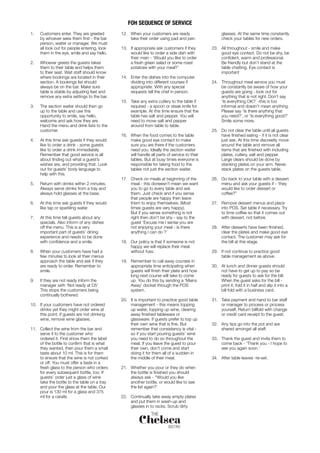
1. Customers enter. They are greeted
by whoever sees them first - the bar
person, waiter or manager. We must
all look out for people entering, look
them in the eye, smile and say hello.
2. Whoever greets the guests takes
them to their table and helps them
to their seat. Wait staff should know
where bookings are located in their
section. A bookings list should
always be on the bar. Make sure
table is stable by adjusting feet and
remove any extra settings to the bar.
3. The section waiter should then go
up to the table and use this
opportunity to smile, say hello,
welcome and ask how they are.
Hand the menu and drink lists to the
customer.
4. At this time ask guests if they would
like to order a drink - some guests
like to order a drink immediately.
Remember that good service is all
about finding out what a guest’s
wishes are, and providing that. Look
out for guests’ body language to
help with this.
5. Return with drinks within 2 minutes.
Always serve drinks from a tray and
always hold glasses at the base.
6. At this time ask guests if they would
like tap or sparkling water.
7. At this time tell guests about any
specials. Also inform of any dishes
off the menu. This is a very
important part of guests’ dining
experience and needs to be done
with confidence and a smile.
8. When your customers have had a
few minutes to look at their menus
approach the table and ask if they
are ready to order. Remember to
smile.
9. If they are not ready inform the
manager with ‘Not ready at D5’
This stops the customers being
continually bothered.
10. If your customers have not ordered
drinks yet they might order wine at
this point. If guests are not drinking
wine, remove wine glasses.
11. Collect the wine from the bar and
serve it to the customer who
ordered it. First show them the label
of the bottle to confirm that is what
they wanted, then pour them a small
taste about 10 ml. This is for them
to ensure that the wine is not corked
or off. You must offer a taste in a
fresh glass to the person who orders
for every subsequent bottle, too. If
guests’ order just a glass of wine
take the bottle to the table on a tray
and pour the glass at the table. Our
pour is 130 ml for a glass and 375
ml for a carafe.
12. When your customers are ready
take their order using pad and pen.
13. If appropriate ask customers if they
would like to order a side dish with
their main - ‘Would you like to order
a fresh green salad or some roast
potatoes with your meal?’
14. Enter the dishes into the computer
dividing into different courses if
appropriate. With any special
requests tell the chef in person.
15. Take any extra cutlery to the table if
required - a spoon or steak knife for
example. At this time ensure that the
table has salt and pepper. You will
need to move salt and pepper
around from table to table.
16. When the food comes to the table
make good eye contact to make
sure you are there if the customers
need you. Ideally the section waiter
will handle all parts of service to their
tables. But at busy times everyone is
responsible for taking food to the
tables not just the section waiter.
17. Check on meals at beginning of the
meal - this doneesn’t mean we want
you to go to every table and ask
them. Just check and if you sense
that people are happy then leave
them to enjoy themselves. (Most
times guests are very happy).
But if you sense something is not
right then don’t be shy - say to the
guest ‘Excuse me I sense you are
not enjoying your meal - is there
anything I can do ?’
18. Our policy is that if someone is not
happy we will replace their meal
without fuss.
19. Remember to call away courses in
appropriate time anticipating when
guests will finish their plate and how
long next course will take to come
up. You do this by sending a ‘Mains
Away’ docket through the POS
system.
20. It is important to practice good table
management - this means topping
up water, topping up wine, clearing
away finished tableware or
glassware. If guests prefer to top up
their own wine that is fine. But
remember that consistency is vital -
so if you start pouring guests’ wine
you need to do so throughout the
meal. If you leave the guest to pour
their own, don’t come and start
doing it for them all of a sudden in
the middle of their meal.
21. Whether you pour or they do when
the bottle is finished you should
always ask - ‘‘Would you like
another bottle, or would like to see
the list again?’
22. Continually take away empty plates
and put them in wash-up and
glasses in to racks. Scrub dirty
glasses. At the same time constantly
check your tables for new orders.
23. All throughout - smile and make
good eye contact. Do not be shy, be
confident, warm and professional.
Be friendly but don’t stand at the
table chatting. Eye contact is
important
24. Throughout meal service you must
be constantly be aware of how your
guests are going - look out for
anything that is not right. Don’t say
‘Is everything OK?’ -this is too
informal and doesn’t mean anything.
Please say ‘Is there anything that
you need?’, or ‘Is everything good?’
Smile some more.
25. Do not clear the table until all guests
have finished eating - if it is not clear
just ask. At this time discreetly move
around the table and remove all
items that are finished with including
plates, cutlery, salt and pepper.
Large clears should be done by
stacking plates on your arm. Never,
stack plates on the guests table.
26. Go back to your table with a dessert
menu and ask your guests if - ‘they
would like to order dessert or
coffee?”
27. Remove dessert menus and place
into POS. Set table if necessary. Try
to time coffee so that it comes out
with dessert, not before.
28. After desserts have been finished,
clear the plates and make good eye
contact. The customer may ask for
the bill at this stage.
29. If not continue to practice good
table management as above.
30. At lunch and dinner guests should
not have to get up to pay so be
ready for guests to ask for the bill.
When the guest asks for the bill -
print it, fold it in half and slip it into a
bill fold with a business card.
31. Take payment and hand to bar staff
or manager to process or process
yourself. Return billfold with change
or credit card receipt to the guest.
32. Any tips go into the pot and are
shared amongst all staff.
33. Thank the guest and invite them to
come back - ‘Thank you - I hope to
see you again soon.’
34. After table leaves -re-set.
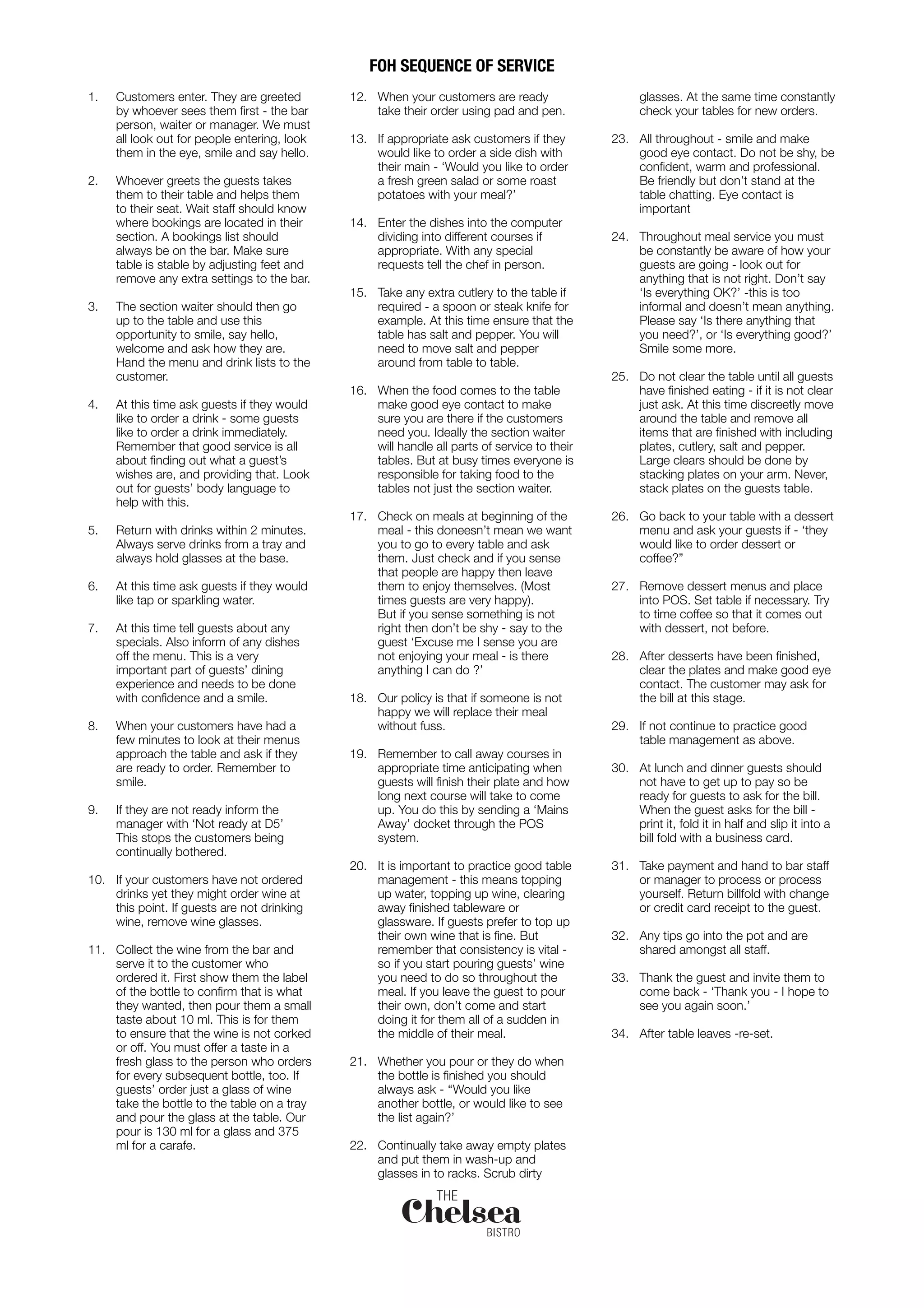
FOH SEQUENCE OF SERVICE

SEQUENCE OF SERVICE PDF

  • 1.
    1. Customers enter.They are greeted by whoever sees them first - the bar person, waiter or manager. We must all look out for people entering, look them in the eye, smile and say hello. 2. Whoever greets the guests takes them to their table and helps them to their seat. Wait staff should know where bookings are located in their section. A bookings list should always be on the bar. Make sure table is stable by adjusting feet and remove any extra settings to the bar. 3. The section waiter should then go up to the table and use this opportunity to smile, say hello, welcome and ask how they are. Hand the menu and drink lists to the customer. 4. At this time ask guests if they would like to order a drink - some guests like to order a drink immediately. Remember that good service is all about finding out what a guest’s wishes are, and providing that. Look out for guests’ body language to help with this. 5. Return with drinks within 2 minutes. Always serve drinks from a tray and always hold glasses at the base. 6. At this time ask guests if they would like tap or sparkling water. 7. At this time tell guests about any specials. Also inform of any dishes off the menu. This is a very important part of guests’ dining experience and needs to be done with confidence and a smile. 8. When your customers have had a few minutes to look at their menus approach the table and ask if they are ready to order. Remember to smile. 9. If they are not ready inform the manager with ‘Not ready at D5’ This stops the customers being continually bothered. 10. If your customers have not ordered drinks yet they might order wine at this point. If guests are not drinking wine, remove wine glasses. 11. Collect the wine from the bar and serve it to the customer who ordered it. First show them the label of the bottle to confirm that is what they wanted, then pour them a small taste about 10 ml. This is for them to ensure that the wine is not corked or off. You must offer a taste in a fresh glass to the person who orders for every subsequent bottle, too. If guests’ order just a glass of wine take the bottle to the table on a tray and pour the glass at the table. Our pour is 130 ml for a glass and 375 ml for a carafe. 12. When your customers are ready take their order using pad and pen. 13. If appropriate ask customers if they would like to order a side dish with their main - ‘Would you like to order a fresh green salad or some roast potatoes with your meal?’ 14. Enter the dishes into the computer dividing into different courses if appropriate. With any special requests tell the chef in person. 15. Take any extra cutlery to the table if required - a spoon or steak knife for example. At this time ensure that the table has salt and pepper. You will need to move salt and pepper around from table to table. 16. When the food comes to the table make good eye contact to make sure you are there if the customers need you. Ideally the section waiter will handle all parts of service to their tables. But at busy times everyone is responsible for taking food to the tables not just the section waiter. 17. Check on meals at beginning of the meal - this doneesn’t mean we want you to go to every table and ask them. Just check and if you sense that people are happy then leave them to enjoy themselves. (Most times guests are very happy). But if you sense something is not right then don’t be shy - say to the guest ‘Excuse me I sense you are not enjoying your meal - is there anything I can do ?’ 18. Our policy is that if someone is not happy we will replace their meal without fuss. 19. Remember to call away courses in appropriate time anticipating when guests will finish their plate and how long next course will take to come up. You do this by sending a ‘Mains Away’ docket through the POS system. 20. It is important to practice good table management - this means topping up water, topping up wine, clearing away finished tableware or glassware. If guests prefer to top up their own wine that is fine. But remember that consistency is vital - so if you start pouring guests’ wine you need to do so throughout the meal. If you leave the guest to pour their own, don’t come and start doing it for them all of a sudden in the middle of their meal. 21. Whether you pour or they do when the bottle is finished you should always ask - ‘‘Would you like another bottle, or would like to see the list again?’ 22. Continually take away empty plates and put them in wash-up and glasses in to racks. Scrub dirty glasses. At the same time constantly check your tables for new orders. 23. All throughout - smile and make good eye contact. Do not be shy, be confident, warm and professional. Be friendly but don’t stand at the table chatting. Eye contact is important 24. Throughout meal service you must be constantly be aware of how your guests are going - look out for anything that is not right. Don’t say ‘Is everything OK?’ -this is too informal and doesn’t mean anything. Please say ‘Is there anything that you need?’, or ‘Is everything good?’ Smile some more. 25. Do not clear the table until all guests have finished eating - if it is not clear just ask. At this time discreetly move around the table and remove all items that are finished with including plates, cutlery, salt and pepper. Large clears should be done by stacking plates on your arm. Never, stack plates on the guests table. 26. Go back to your table with a dessert menu and ask your guests if - ‘they would like to order dessert or coffee?” 27. Remove dessert menus and place into POS. Set table if necessary. Try to time coffee so that it comes out with dessert, not before. 28. After desserts have been finished, clear the plates and make good eye contact. The customer may ask for the bill at this stage. 29. If not continue to practice good table management as above. 30. At lunch and dinner guests should not have to get up to pay so be ready for guests to ask for the bill. When the guest asks for the bill - print it, fold it in half and slip it into a bill fold with a business card. 31. Take payment and hand to bar staff or manager to process or process yourself. Return billfold with change or credit card receipt to the guest. 32. Any tips go into the pot and are shared amongst all staff. 33. Thank the guest and invite them to come back - ‘Thank you - I hope to see you again soon.’ 34. After table leaves -re-set. FOH SEQUENCE OF SERVICE