WHO WE ARE
C O N S T A N C E
C A L A N D R I N O
Director of Academic
Foundations
Mathematics
E L I Z A B E T H
N E S I U S
Director of
Academic
Foundations
English
WORK-PLACE LEARNING DESIGN
Created learning community of basic algebra,
reading, and writing
 The same group of students for all 3
 Collaboration on assignments
 Shared supplemental resources
Designed curriculum and assignments around
work-place learning methodology
 LC for pre-nursing students
 Expanded to multiple majors in pilot semester
KNOWLES’S THEORY OF
ANDRAGOGY
makes the following assumptions about
the design of learning:
adults need to know why they need to learn
something,
adults need to learn experientially,
adults approach learning as problem-solving, and
adults learn best when the topic is of immediate
value.
Knowles, M., & Associates. (1984). Andragogy in Action. Applying
modern principles of adult education. San Francisco: Jossey Bass.
NCTM AND AMATYC
STATE…
The Learning Principle:
…students who memorize facts or procedures
without understanding often are not sure when or
how to use what they know. … conceptual
understanding enables students to deal with novel
problems and settings. ….Learning with
understanding also helps students become
autonomous
learners…
NCTE AND CCCC STATE…
To restrict students’ engagement with writing to only
academic contexts and forms is to risk narrowing what we
as a nation can remember, understand, and create. [T]he
Conference on College Composition and Communication
affirms that many genres and uses of writing must be
taught well in the nation’s schools, colleges, and
universities:
 forms of workplace discourse that observe established conventions,
though never at the expense of failing to convey ideas that enlighten
and compel, including memos, proposals, evaluations, oral
presentations, lab and progress reports, letters, reviews,
instructions, and user manuals;
Learning is a function not only of the
activity itself but also of the context
and culture in which it takes place.
Think about a situation where you had a
chance to learn through the active
application of knowledge and skills. What
difference did it make to what and how you
learned?
To encourage transfer to other contexts,
effective learning requires the
acquisition of a complex knowledge
base including content knowledge,
skills, and cognitive and metacognitive
strategies.
Think of a situation where you have transferred
knowledge or a skill learned in one context to a
new context. What helped you to do so?
 How do you infuse contextualized
content?
 Which instructional strategies work
best?
 How do we engage students as
active learners?
 What are the implications of
contextualization on curriculum
design?
HOW DO YOU INFUSE CONTEXTUALIZED CONTENT?
Examine the desired course outcomes.
Identify the Big Ideas.
Collaborate to identify workplace skills.
Select readings and develop assignments
that reflect the workplace skills and
correlate to the Big Ideas and course
outcomes for math and English.
WHICH INSTRUCTIONAL STRATEGIES WORK
BEST?
Learner-centered
Teamwork
How do we engage students as active
learners?
Use of technology
Authentic Problem Solving
WHAT ARE THE IMPLICATIONS OF
CONTEXTUALIZATION ON CURRICULUM
DESIGN?
Accelerates the career pathway by offering
career content early on.
Improves motivation to persist.
Teaches students how to apply skills to
real world problems.
ADMINISTRATIVE
Administrative challenges centered
around scheduling
 Linking the courses “both ways”
 Limiting which students could
register
 Making sure all stakeholders are in
the loop (e.g. Registrar,
Advisement, Deans)
PEDAGOGICAL
• Requires time for collaboration
between instructors for creating
assignments.
• Professional development to
support use of technology and
learner-centered strategies.
• Efficient and effective use of
Supplemental Instruction Leader.
STUDENT
 Scheduling the classes.
 Advertising the classes.
 Correlation of the Student Success
course.
STUDENT SATISFACTION SURVEY RESULTS
 100% strongly agreed or agreed that what was
learned in the course would be helpful to them
in the rest of their college careers
 100% strongly agreed or agreed that what was
learned would be helpful to them in their
majors
 93.33% strongly agreed or agreed that the
course content was interesting and engaging
 73.33% found the addition of an SI Leader in
the class to be very helpful or helpful
STUDENTS IN BASIC ALGEBRA REPORTED
Having the SI Leader in the class was
beneficial.
75% of the students in Basic Algebra class
participated in the SI Sessions 10 or
more times, noting that holding the
sessions before class was convenient.
STUDENT COMMENT
“I feel this class should help me in my
future . It was very challenging and I
hope I did well in the class ,so I can
move on to more challenging
academics.”
STUDENT COMMENT
“This class really helped me to prepare for
College Algebra. I feel ready for the exit
exam. It was a challenge, but I learned a
lot as a result of the work.”
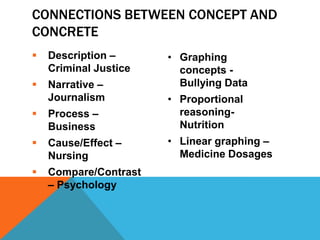
 Description –
Criminal Justice
 Narrative –
Journalism
 Process –
Business
 Cause/Effect –
Nursing
 Compare/Contrast
– Psychology
• Graphing
concepts -
Bullying Data
• Proportional
reasoning-
Nutrition
• Linear graphing –
Medicine Dosages
CONNECTIONS BETWEEN CONCEPT AND
CONCRETE
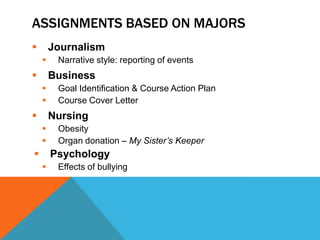
ASSIGNMENTS BASED ON MAJORS
 Journalism
 Narrative style: reporting of events
 Business
 Goal Identification & Course Action Plan
 Course Cover Letter
 Nursing
 Obesity
 Organ donation – My Sister’s Keeper
 Psychology
 Effects of bullying
MATH ASSIGNMENTS
Create math problem solving to correlate
to the readings in English.
Examples: problem solving , graphing
data, and proportional reasoning.
COLLABORATION
• Correlate reading to problem solving
• Student Surveys
• Analyze data collected via student
surveys and grades
• Evaluate the Process and Revise Future
lessons
Connie
Calandrino
AF Mathematics
ccalandrino@hccc.e
du
Elizabeth Nesius
AF English
enesius@hccc.edu
CONTACT US

Njall

  • 2.
    WHO WE ARE CO N S T A N C E C A L A N D R I N O Director of Academic Foundations Mathematics E L I Z A B E T H N E S I U S Director of Academic Foundations English
  • 4.
    WORK-PLACE LEARNING DESIGN Createdlearning community of basic algebra, reading, and writing  The same group of students for all 3  Collaboration on assignments  Shared supplemental resources Designed curriculum and assignments around work-place learning methodology  LC for pre-nursing students  Expanded to multiple majors in pilot semester
  • 6.
    KNOWLES’S THEORY OF ANDRAGOGY makesthe following assumptions about the design of learning: adults need to know why they need to learn something, adults need to learn experientially, adults approach learning as problem-solving, and adults learn best when the topic is of immediate value. Knowles, M., & Associates. (1984). Andragogy in Action. Applying modern principles of adult education. San Francisco: Jossey Bass.
  • 7.
    NCTM AND AMATYC STATE… TheLearning Principle: …students who memorize facts or procedures without understanding often are not sure when or how to use what they know. … conceptual understanding enables students to deal with novel problems and settings. ….Learning with understanding also helps students become autonomous learners…
  • 8.
    NCTE AND CCCCSTATE… To restrict students’ engagement with writing to only academic contexts and forms is to risk narrowing what we as a nation can remember, understand, and create. [T]he Conference on College Composition and Communication affirms that many genres and uses of writing must be taught well in the nation’s schools, colleges, and universities:  forms of workplace discourse that observe established conventions, though never at the expense of failing to convey ideas that enlighten and compel, including memos, proposals, evaluations, oral presentations, lab and progress reports, letters, reviews, instructions, and user manuals;
  • 9.
    Learning is afunction not only of the activity itself but also of the context and culture in which it takes place. Think about a situation where you had a chance to learn through the active application of knowledge and skills. What difference did it make to what and how you learned?
  • 10.
    To encourage transferto other contexts, effective learning requires the acquisition of a complex knowledge base including content knowledge, skills, and cognitive and metacognitive strategies. Think of a situation where you have transferred knowledge or a skill learned in one context to a new context. What helped you to do so?
  • 12.
     How doyou infuse contextualized content?  Which instructional strategies work best?  How do we engage students as active learners?  What are the implications of contextualization on curriculum design?
  • 13.
    HOW DO YOUINFUSE CONTEXTUALIZED CONTENT? Examine the desired course outcomes. Identify the Big Ideas. Collaborate to identify workplace skills. Select readings and develop assignments that reflect the workplace skills and correlate to the Big Ideas and course outcomes for math and English.
  • 14.
    WHICH INSTRUCTIONAL STRATEGIESWORK BEST? Learner-centered Teamwork How do we engage students as active learners? Use of technology Authentic Problem Solving
  • 15.
    WHAT ARE THEIMPLICATIONS OF CONTEXTUALIZATION ON CURRICULUM DESIGN? Accelerates the career pathway by offering career content early on. Improves motivation to persist. Teaches students how to apply skills to real world problems.
  • 17.
    ADMINISTRATIVE Administrative challenges centered aroundscheduling  Linking the courses “both ways”  Limiting which students could register  Making sure all stakeholders are in the loop (e.g. Registrar, Advisement, Deans)
  • 18.
    PEDAGOGICAL • Requires timefor collaboration between instructors for creating assignments. • Professional development to support use of technology and learner-centered strategies. • Efficient and effective use of Supplemental Instruction Leader.
  • 19.
    STUDENT  Scheduling theclasses.  Advertising the classes.  Correlation of the Student Success course.
  • 21.
    STUDENT SATISFACTION SURVEYRESULTS  100% strongly agreed or agreed that what was learned in the course would be helpful to them in the rest of their college careers  100% strongly agreed or agreed that what was learned would be helpful to them in their majors  93.33% strongly agreed or agreed that the course content was interesting and engaging  73.33% found the addition of an SI Leader in the class to be very helpful or helpful
  • 22.
    STUDENTS IN BASICALGEBRA REPORTED Having the SI Leader in the class was beneficial. 75% of the students in Basic Algebra class participated in the SI Sessions 10 or more times, noting that holding the sessions before class was convenient.
  • 23.
    STUDENT COMMENT “I feelthis class should help me in my future . It was very challenging and I hope I did well in the class ,so I can move on to more challenging academics.”
  • 24.
    STUDENT COMMENT “This classreally helped me to prepare for College Algebra. I feel ready for the exit exam. It was a challenge, but I learned a lot as a result of the work.”
  • 26.
     Description – CriminalJustice  Narrative – Journalism  Process – Business  Cause/Effect – Nursing  Compare/Contrast – Psychology • Graphing concepts - Bullying Data • Proportional reasoning- Nutrition • Linear graphing – Medicine Dosages CONNECTIONS BETWEEN CONCEPT AND CONCRETE
  • 27.
    ASSIGNMENTS BASED ONMAJORS  Journalism  Narrative style: reporting of events  Business  Goal Identification & Course Action Plan  Course Cover Letter  Nursing  Obesity  Organ donation – My Sister’s Keeper  Psychology  Effects of bullying
  • 28.
    MATH ASSIGNMENTS Create mathproblem solving to correlate to the readings in English. Examples: problem solving , graphing data, and proportional reasoning.
  • 29.
    COLLABORATION • Correlate readingto problem solving • Student Surveys • Analyze data collected via student surveys and grades • Evaluate the Process and Revise Future lessons
  • 31.