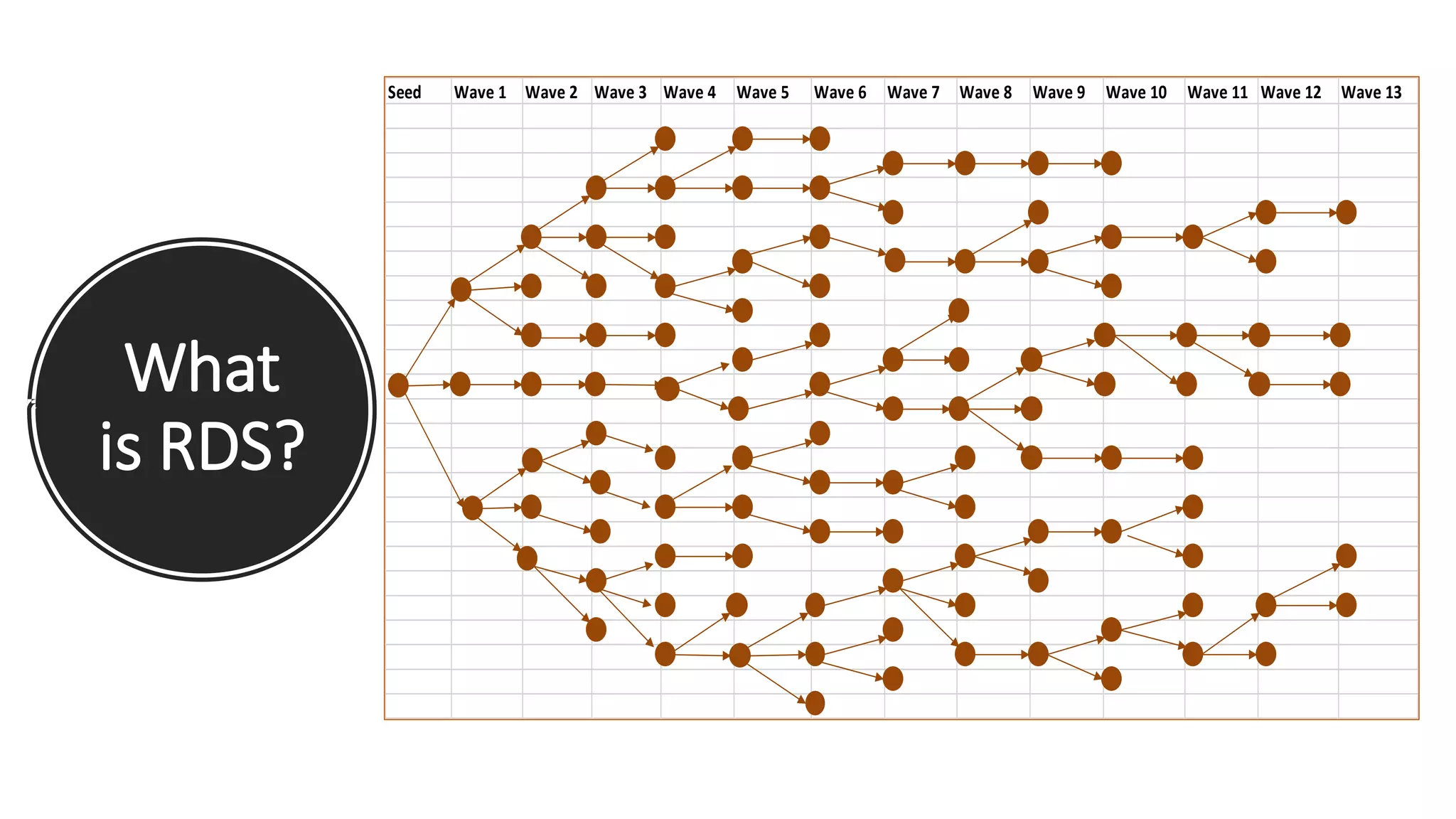
Respondent Driven Sampling (RDS) is a technique for sampling hard-to-reach populations. It works by having initial participants (seeds) recruit a small number of people from their social networks, who are then eligible to recruit others from their networks. This process continues in successive waves. RDS relies on assumptions about network structure and recruitment behaviors. Analysis adjusts for network size and recruitment patterns. The technique was used to sample migrants in Morocco to estimate HIV, syphilis, and tuberculosis prevalence and understand their demographics, risks, and access to services. Results provided insights to guide health programs for this population.
Respondent Driven Sampling
LisaG Johnston, MA, Mph, PhD
Affiliations: University of California, San Francisco; Tulane University of Public
Health and Tropical Medicine
www.lisagjohnston.com; www.respondentdrivensampling.com
lsjohnston@gmail.com
Respondent-
Driven
Sampling
Background
First described in1997*
Adopted by US CDC in early 2000s for
use in HIV biological behavioral
surveillance surveys†
Endorsed by Global Fund, WHO and
UNAIDS^ for sampling hard to reach
populations
Started to be noticed in late 2000s by
other disciplines
It is a sampling and analysis technique
*Heckathorn DD. Respondent-driven sampling: a new approach to the study of hidden populations. Soc Probl. 1997;44(2):174–99.
†Johnston LG. Conducting respondent driven sampling (RDS) studies in diverse settings: a training manual for planning RDS studies. Centers for Disease
Control and Prevention, Atlanta. 2007.
^UNAIDS. Guidelines on surveillance among populations most at risk for HIV. 2012; WHO. Bio-behavioural survey guidelines for populations at risk for HIV.
2017.; Johnston LG. WHO Module 4: Introduction to respondent driven sampling. Introduction to HIV/AIDS and sexually transmitted infection surveillance.
2013.
4.
Hidden and hardto
reach populations
•No sampling frame
•Often want to remain
hidden due to practices
and behaviors that are
illegal or stigmatized
5.
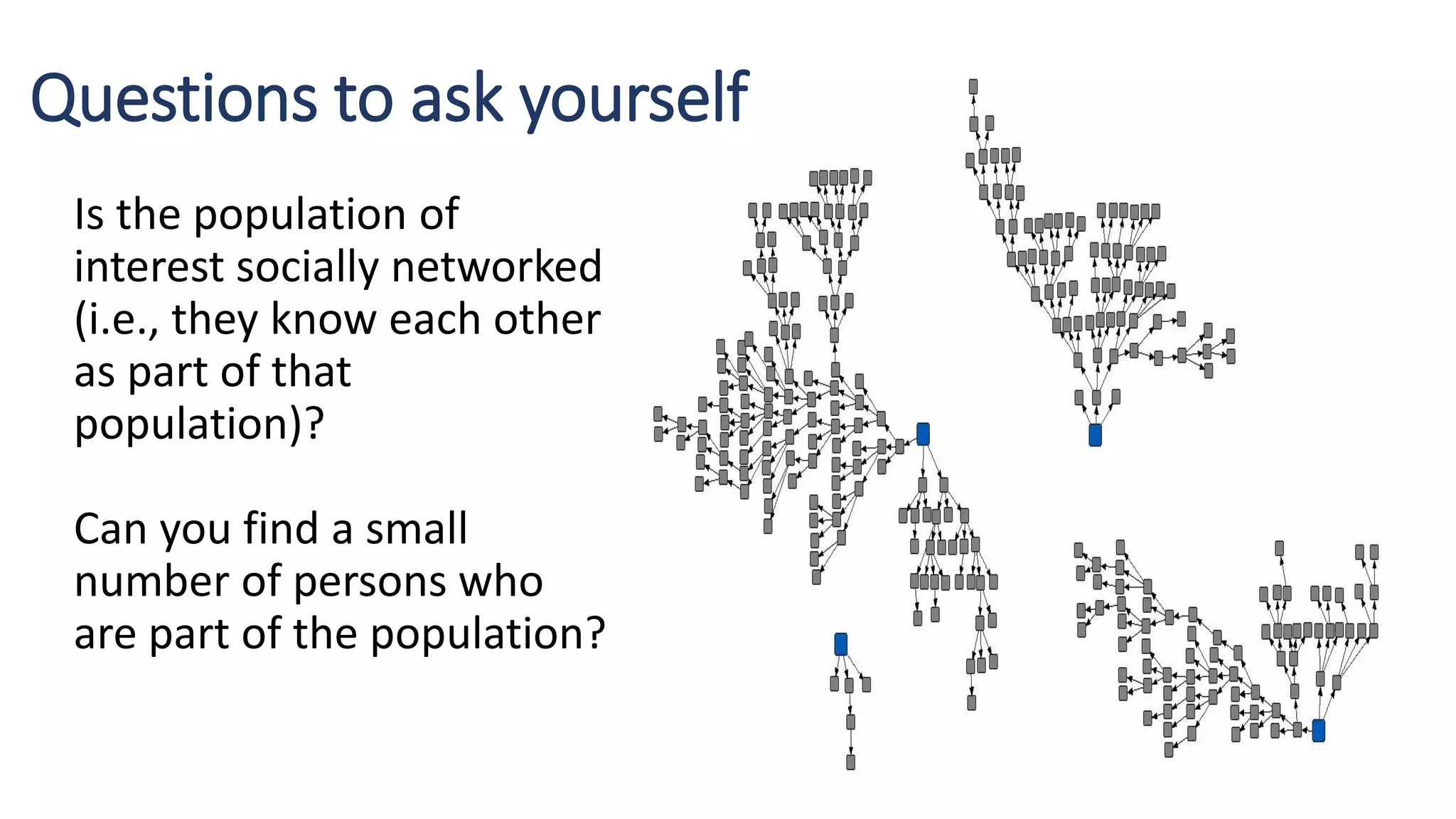
Is the populationof
interest socially networked
(i.e., they know each other
as part of that
population)?
Can you find a small
number of persons who
are part of the population?
Questions to ask yourself
Assumptions in RDS
•Respondents know each other as members of the target population (and
these are reciprocal)
• Respondents are linked by a network composed of a single component
• Sampling occurs with replacement (population from which a sample is
gathered is infinitely large)
• Respondents can accurately report their personal network size (and this
needs to be measured)
• Peer recruitment is a random selection from the recruiter’s network
• Each respondent recruits a single peer
Heckathorn DD. Extensions of respondent-driven sampling: analyzing continuous variables and controlling for differential recruitment.
Sociol Methodol. 2007;37(1):151–207;
Johnston LG. Introduction to Respondent Driven Sampling. Introduction to HIV/AIDS and sexually transmitted infection surveillance.
WHO, Geneva Switzerland; 2013. Available from: http://applications.emro.who.int/dsaf/EMRPUB_2014_EN_1686.pdf
8.
Anatomy of aSurvey
Conducted using RDS
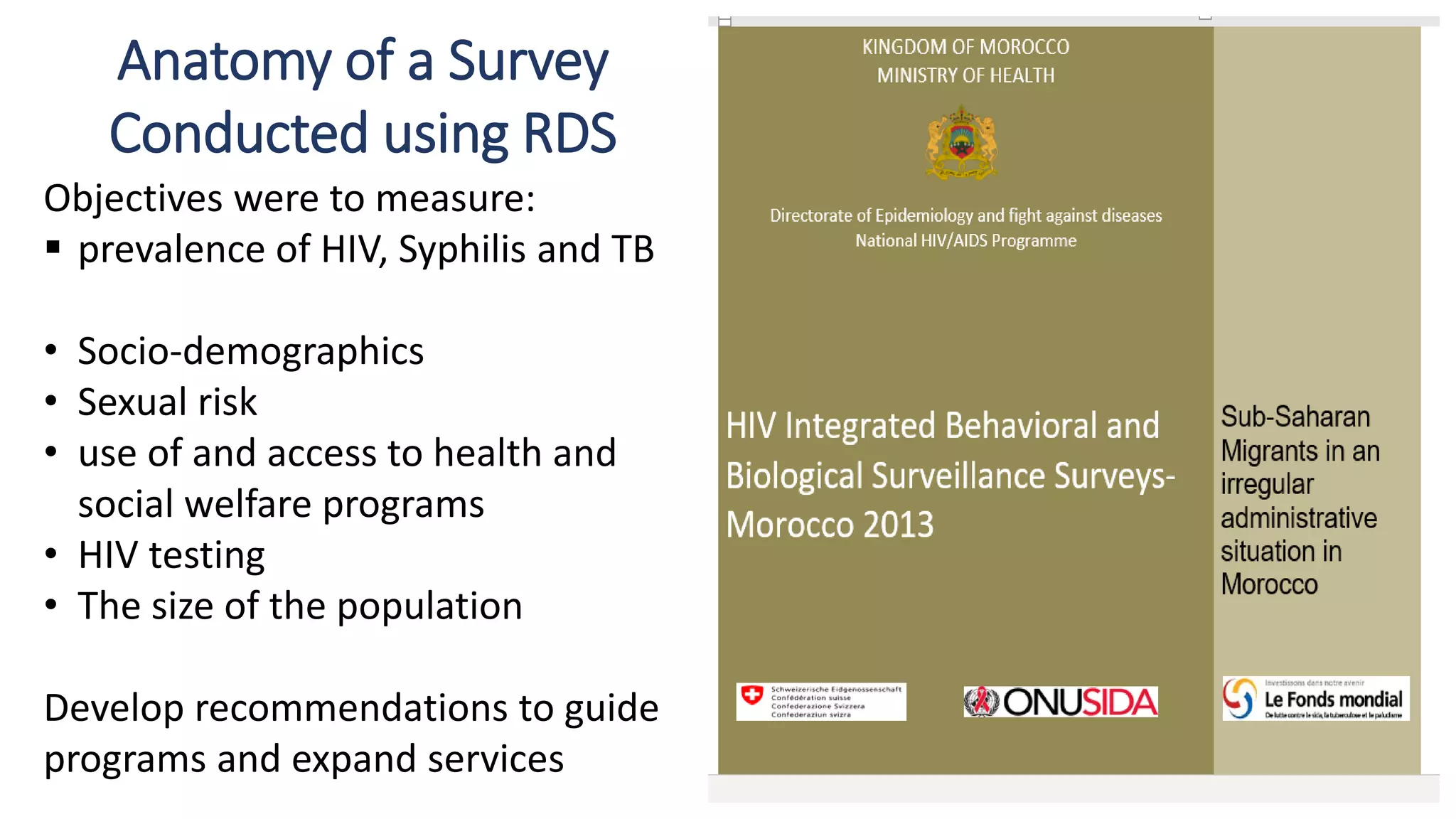
Objectives were to measure:
prevalence of HIV, Syphilis and TB
• Socio-demographics
• Sexual risk
• use of and access to health and
social welfare programs
• HIV testing
• The size of the population
Develop recommendations to guide
programs and expand services
9.
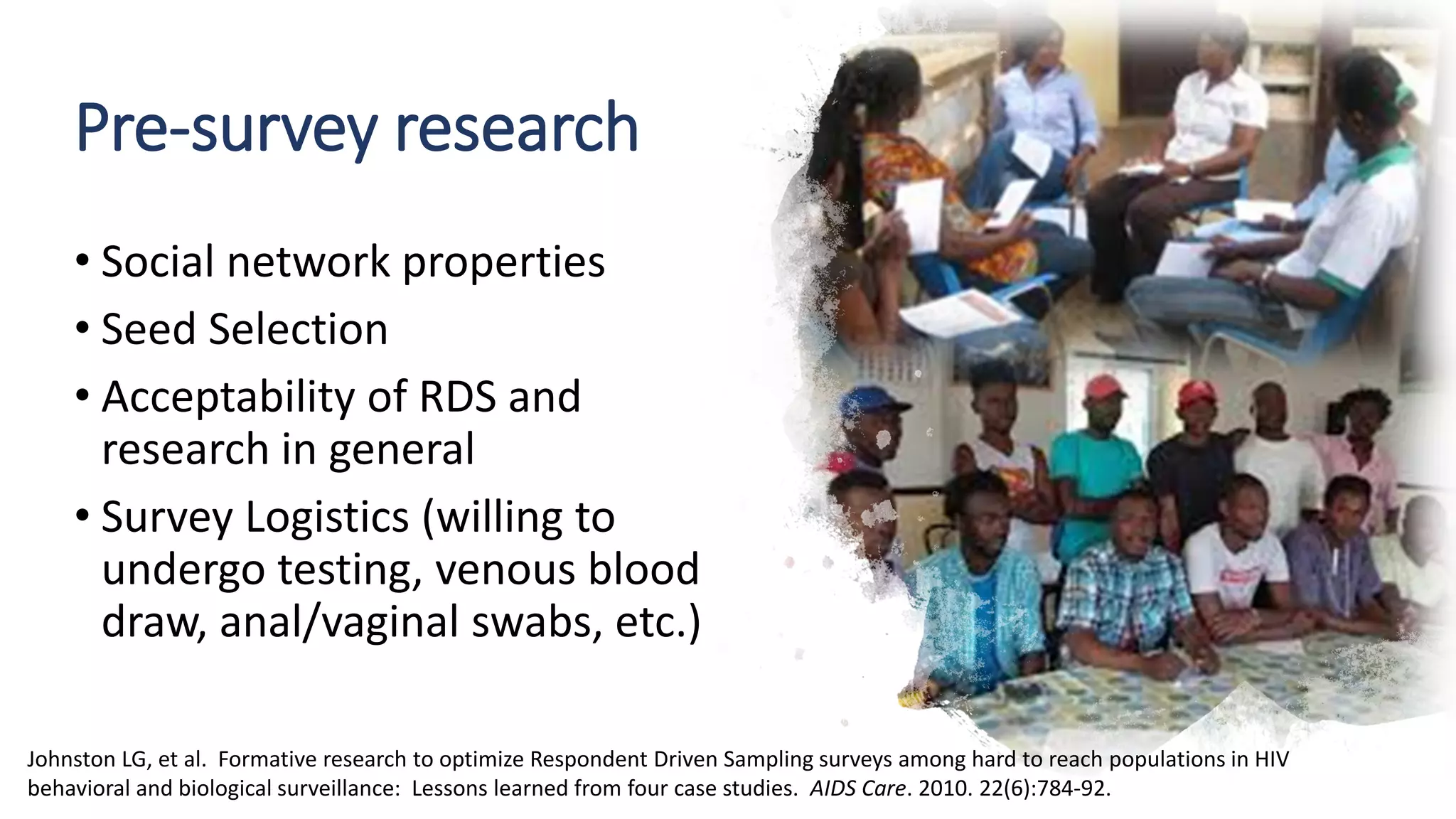
Pre-survey research
• Socialnetwork properties
• Seed Selection
• Acceptability of RDS and
research in general
• Survey Logistics (willing to
undergo testing, venous blood
draw, anal/vaginal swabs, etc.)
Johnston LG, et al. Formative research to optimize Respondent Driven Sampling surveys among hard to reach populations in HIV
behavioral and biological surveillance: Lessons learned from four case studies. AIDS Care. 2010. 22(6):784-92.
10.
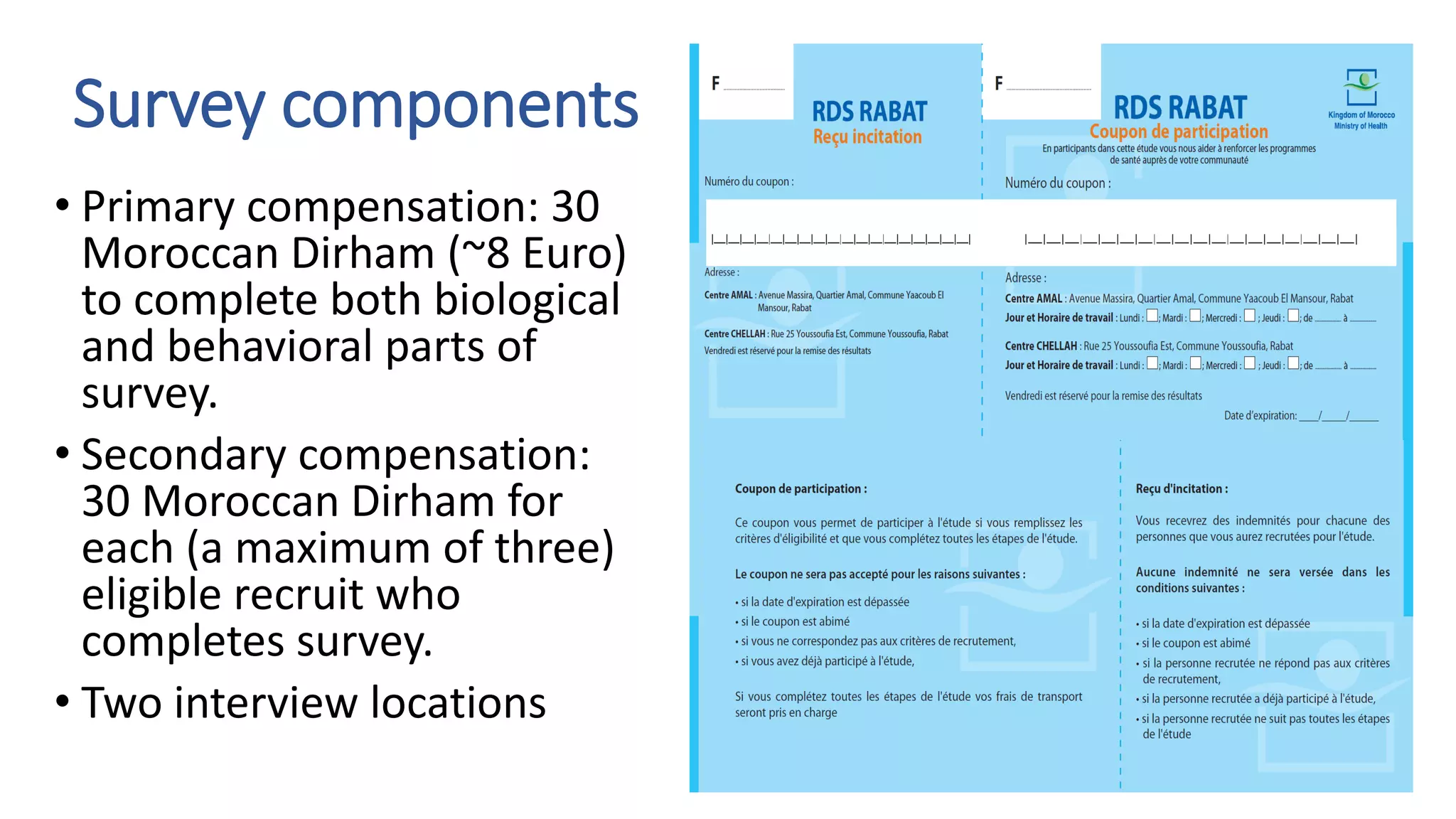
Survey components
• Primarycompensation: 30
Moroccan Dirham (~8 Euro)
to complete both biological
and behavioral parts of
survey.
• Secondary compensation:
30 Moroccan Dirham for
each (a maximum of three)
eligible recruit who
completes survey.
• Two interview locations
11.
Eligibility
• Eligibility forboth surveys
• 18 years or older
• Living and/or working in Rabat
• Residing three months or more in Morocco.
• in an irregular administrative situation in Morocco
(undocumented, asylum seeker, refugee)
• Anglophone:
• Originating from anglophone Sub-Saharan countries: Nigeria,
Gambia, Ghana, Liberia, or Sierra Leone, etc.
• Francophone:
• Originating from francophone Sub-Saharan countries: Senegal,
Cameroun, Mali, Cote d’Ivoire, DRC, Guinea, etc.
12.
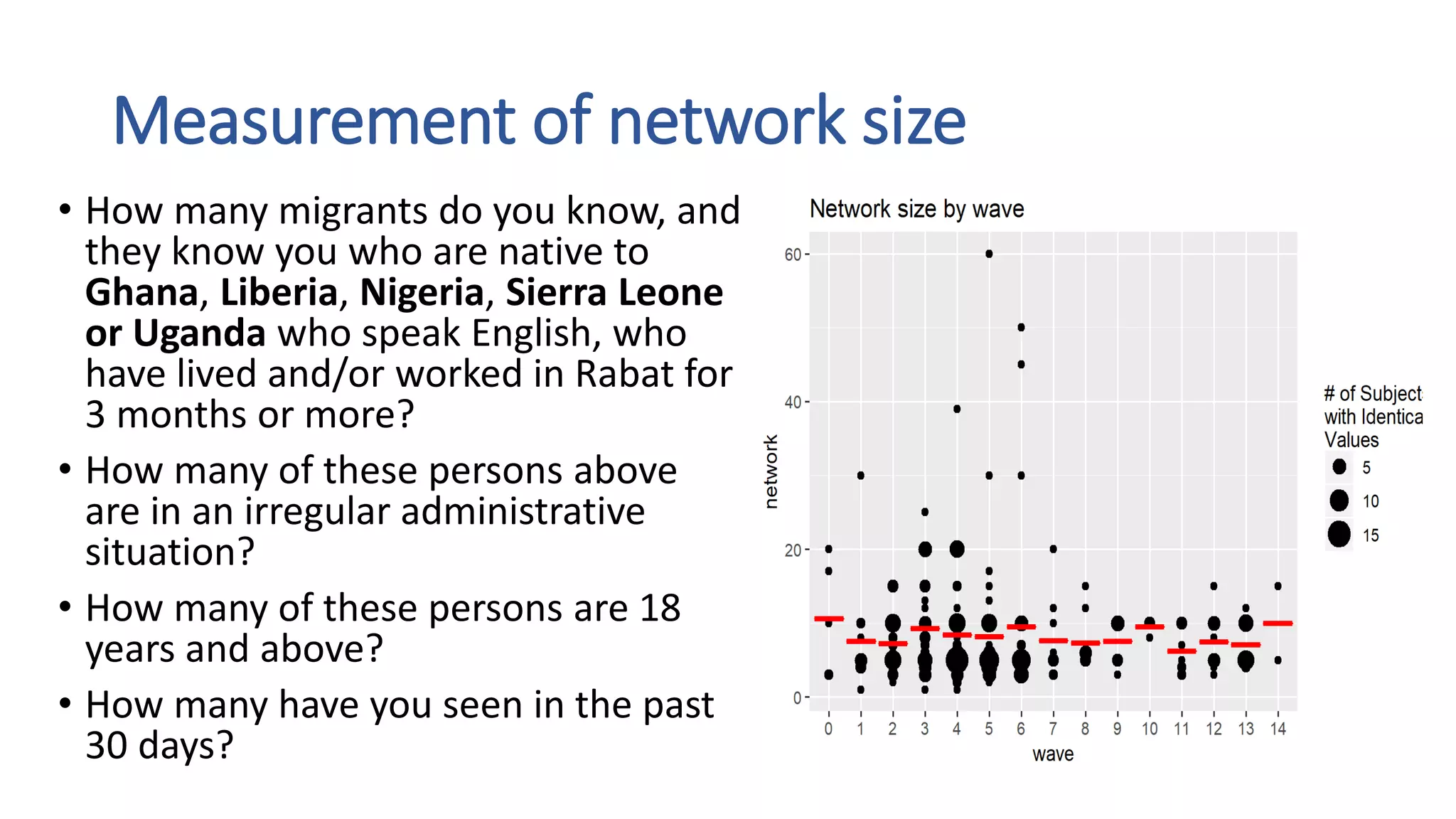
Measurement of networksize
• How many migrants do you know, and
they know you who are native to
Ghana, Liberia, Nigeria, Sierra Leone
or Uganda who speak English, who
have lived and/or worked in Rabat for
3 months or more?
• How many of these persons above
are in an irregular administrative
situation?
• How many of these persons are 18
years and above?
• How many have you seen in the past
30 days?
13.
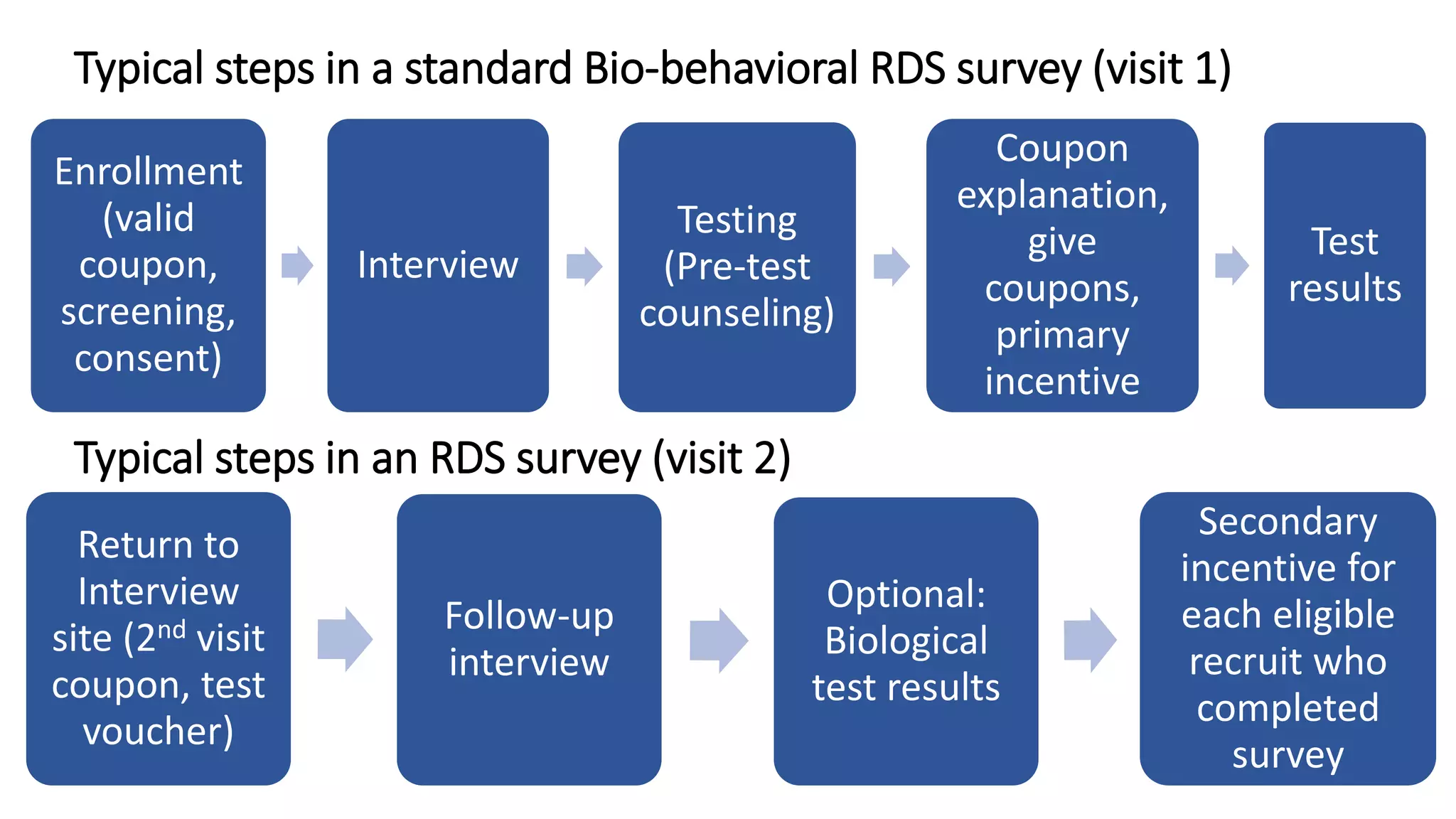
Typical steps ina standard Bio-behavioral RDS survey (visit 1)
Enrollment
(valid
coupon,
screening,
consent)
Interview
Testing
(Pre-test
counseling)
Coupon
explanation,
give
coupons,
primary
incentive
Test
results
Lsjohnston.global@gmail.com,
www.lisagjohnston.com
Typical steps in an RDS survey (visit 2)
Return to
Interview
site (2nd visit
coupon, test
voucher)
Follow-up
interview
Optional:
Biological
test results
Secondary
incentive for
each eligible
recruit who
completed
survey
14.
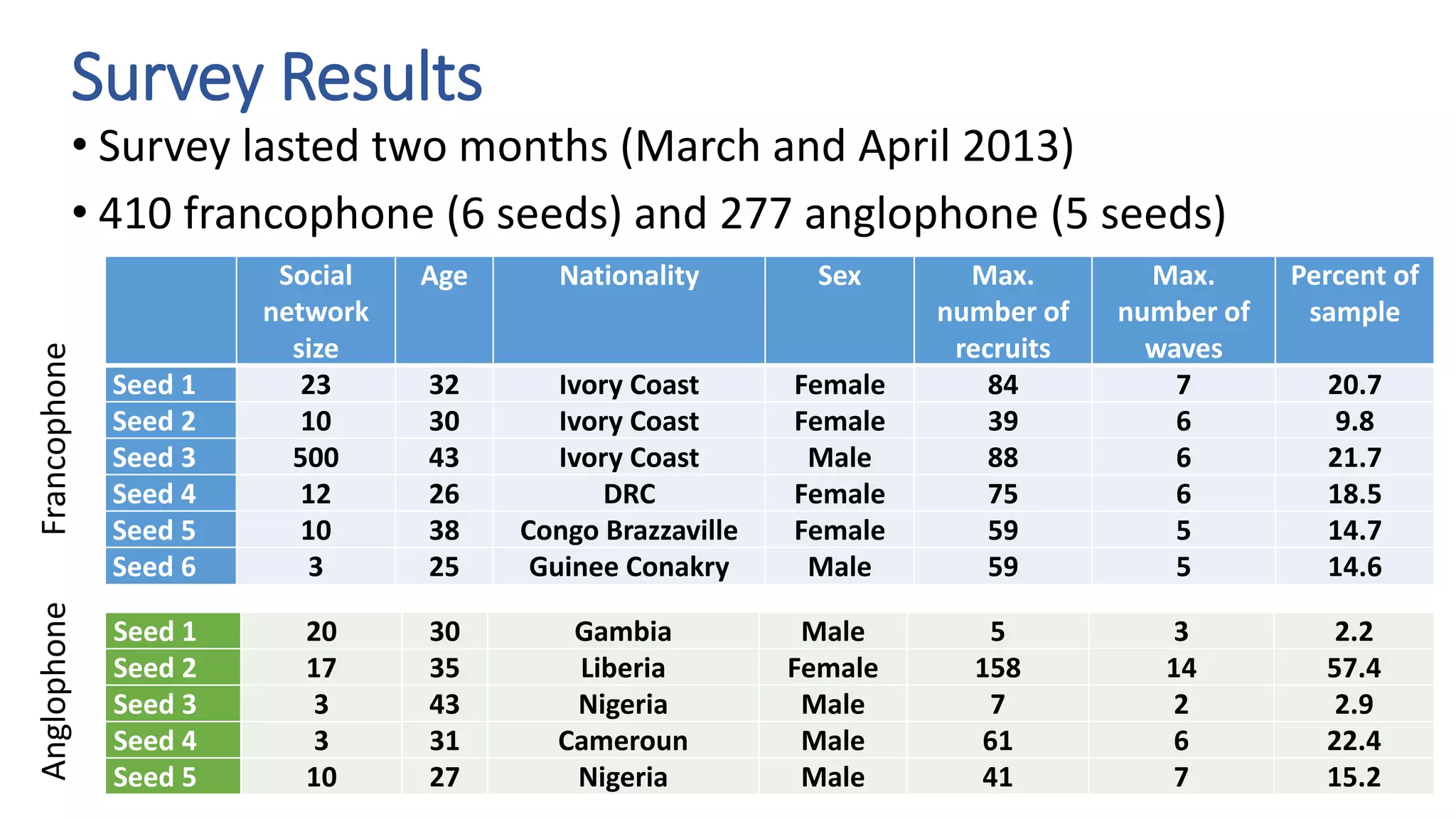
Survey Results
• Surveylasted two months (March and April 2013)
• 410 francophone (6 seeds) and 277 anglophone (5 seeds)
Social
network
size
Age Nationality Sex Max.
number of
recruits
Max.
number of
waves
Percent of
sample
Seed 1 23 32 Ivory Coast Female 84 7 20.7
Seed 2 10 30 Ivory Coast Female 39 6 9.8
Seed 3 500 43 Ivory Coast Male 88 6 21.7
Seed 4 12 26 DRC Female 75 6 18.5
Seed 5 10 38 Congo Brazzaville Female 59 5 14.7
Seed 6 3 25 Guinee Conakry Male 59 5 14.6
Seed 1 20 30 Gambia Male 5 3 2.2
Seed 2 17 35 Liberia Female 158 14 57.4
Seed 3 3 43 Nigeria Male 7 2 2.9
Seed 4 3 31 Cameroun Male 61 6 22.4
Seed 5 10 27 Nigeria Male 41 7 15.2
AnglophoneFrancophone
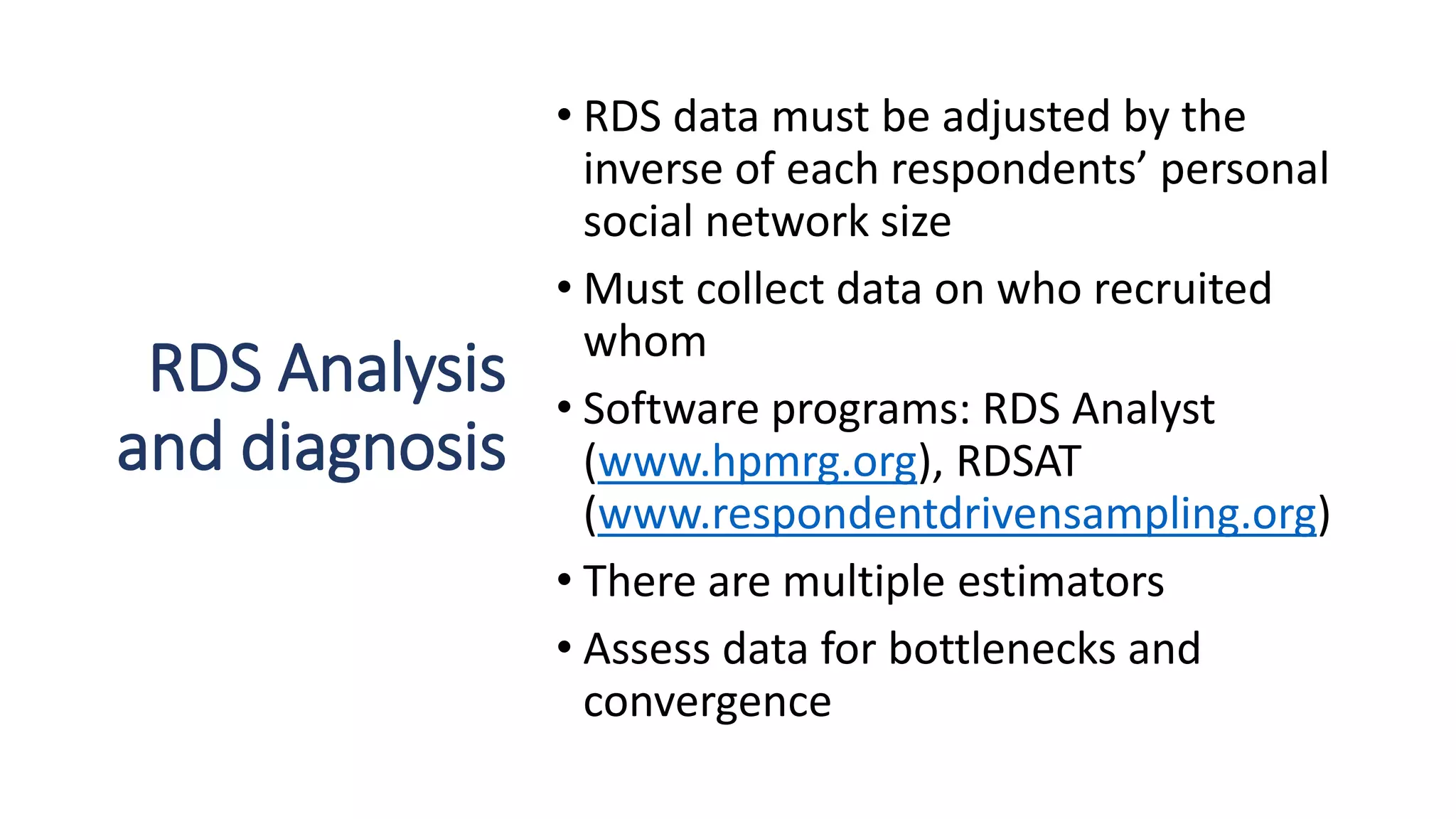
RDS Analysis
and diagnosis
•RDS data must be adjusted by the
inverse of each respondents’ personal
social network size
• Must collect data on who recruited
whom
• Software programs: RDS Analyst
(www.hpmrg.org), RDSAT
(www.respondentdrivensampling.org)
• There are multiple estimators
• Assess data for bottlenecks and
convergence
17.
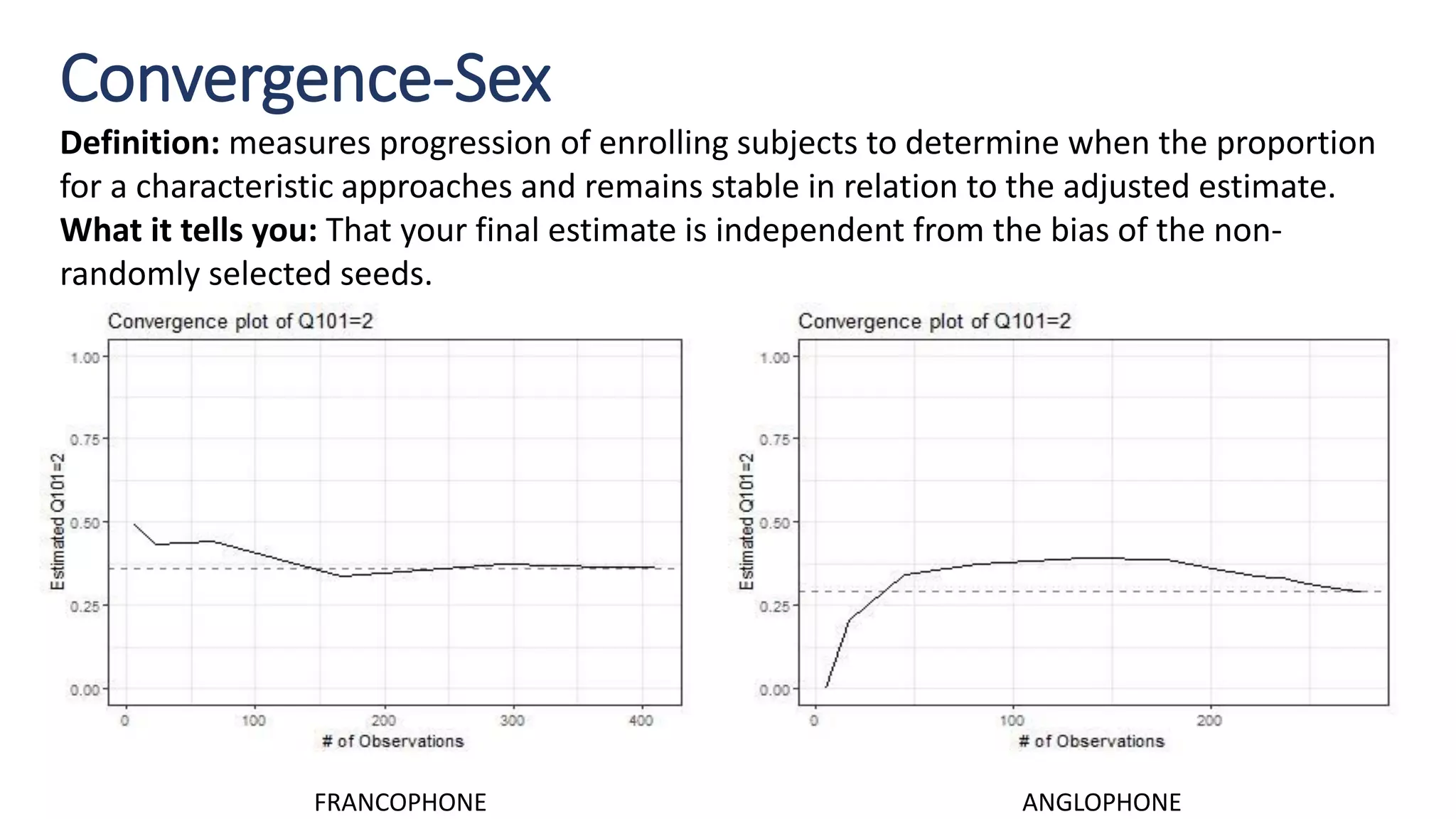
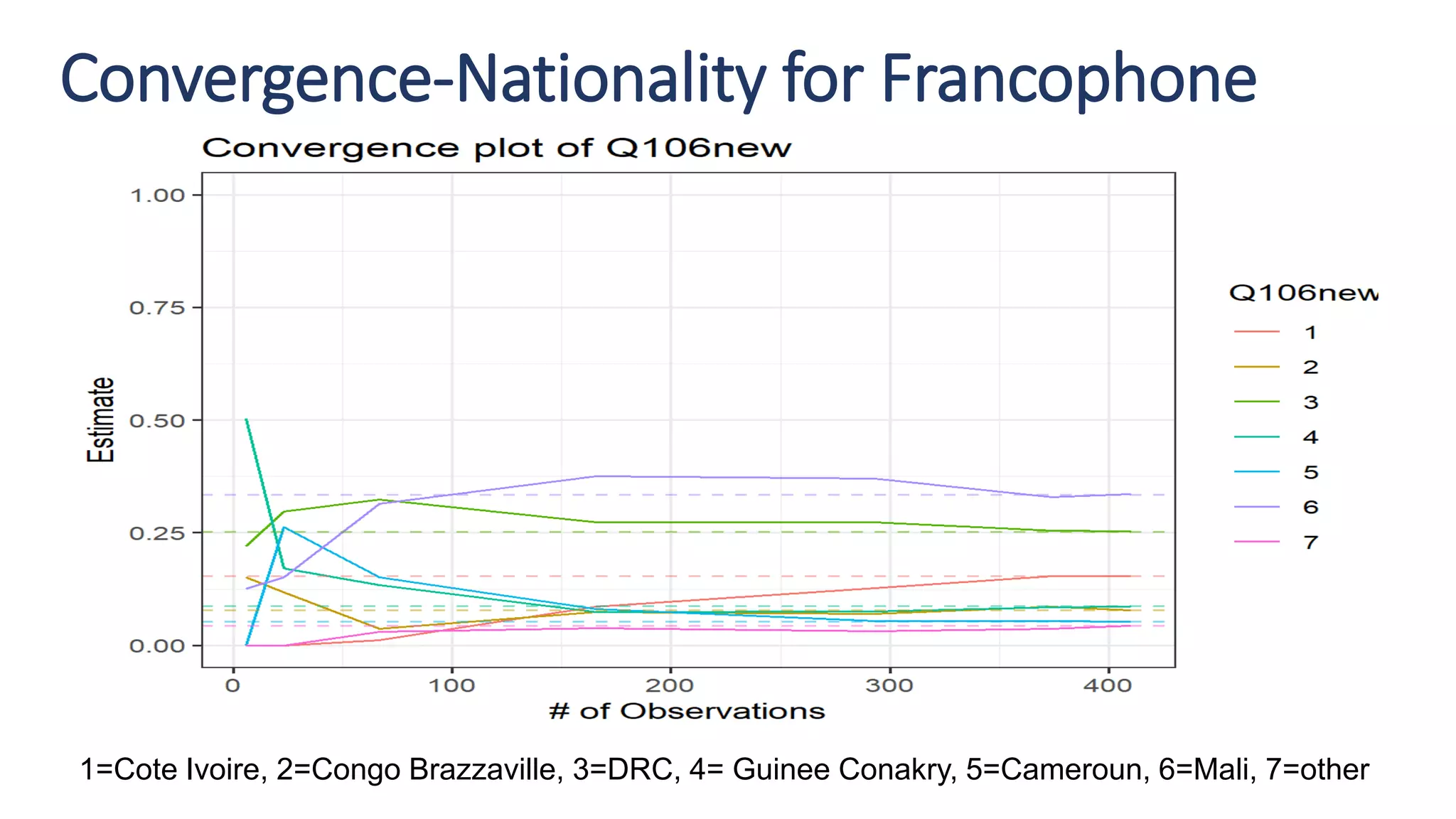
Convergence-Sex
Definition: measures progressionof enrolling subjects to determine when the proportion
for a characteristic approaches and remains stable in relation to the adjusted estimate.
What it tells you: That your final estimate is independent from the bias of the non-
randomly selected seeds.
ANGLOPHONEFRANCOPHONE
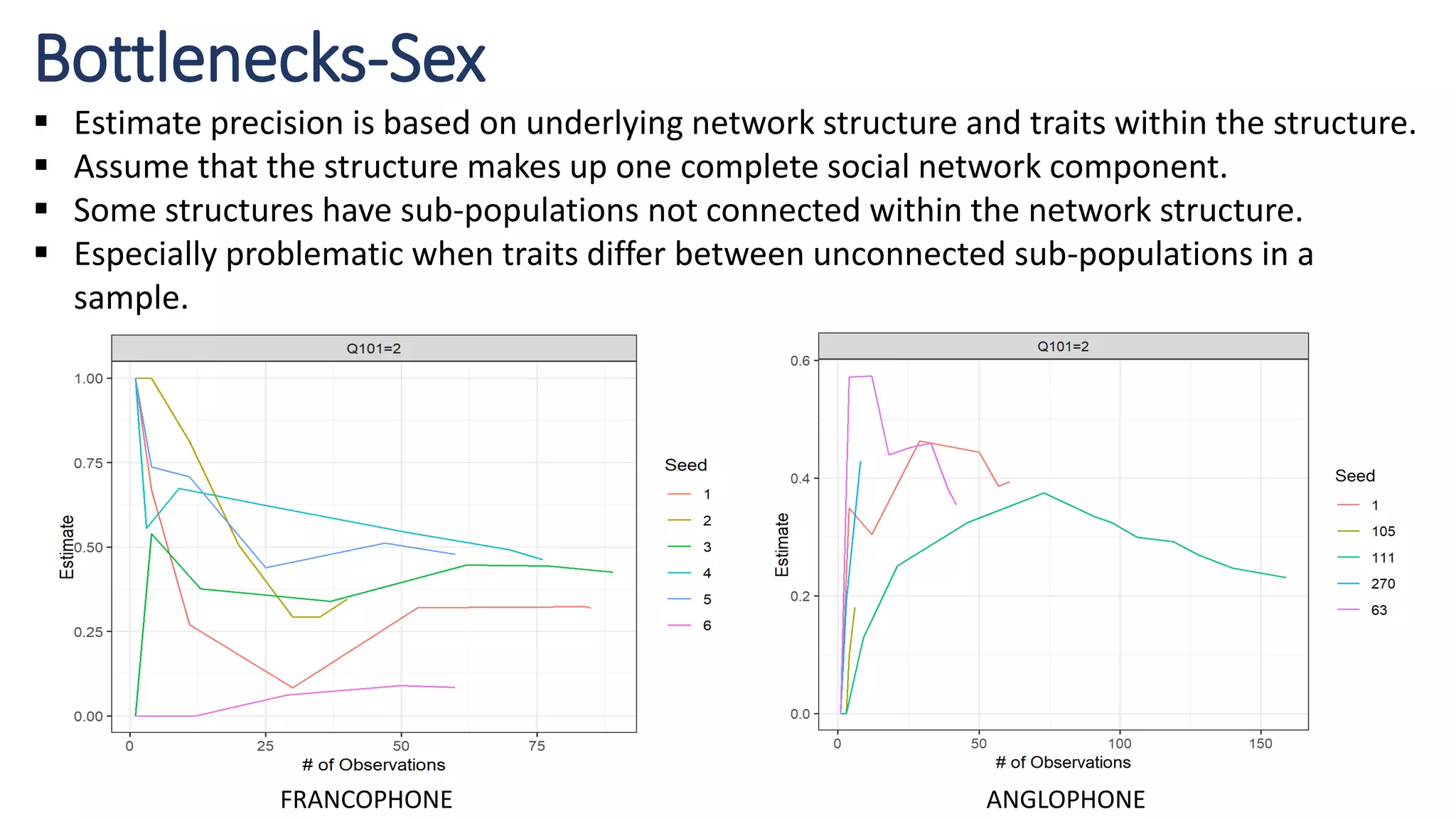
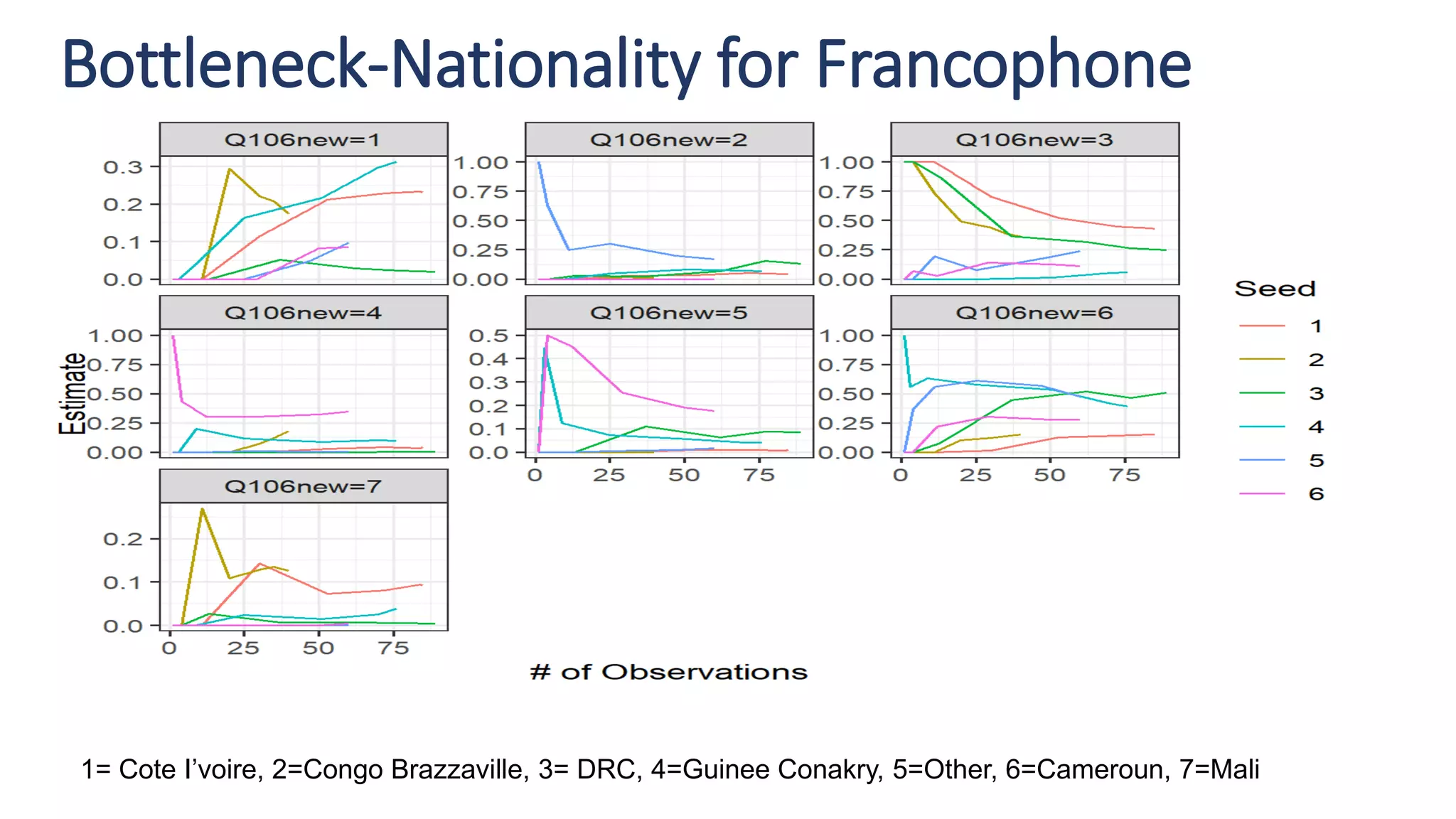
Bottlenecks-Sex
Estimate precisionis based on underlying network structure and traits within the structure.
Assume that the structure makes up one complete social network component.
Some structures have sub-populations not connected within the network structure.
Especially problematic when traits differ between unconnected sub-populations in a
sample.
FRANCOPHONE ANGLOPHONE
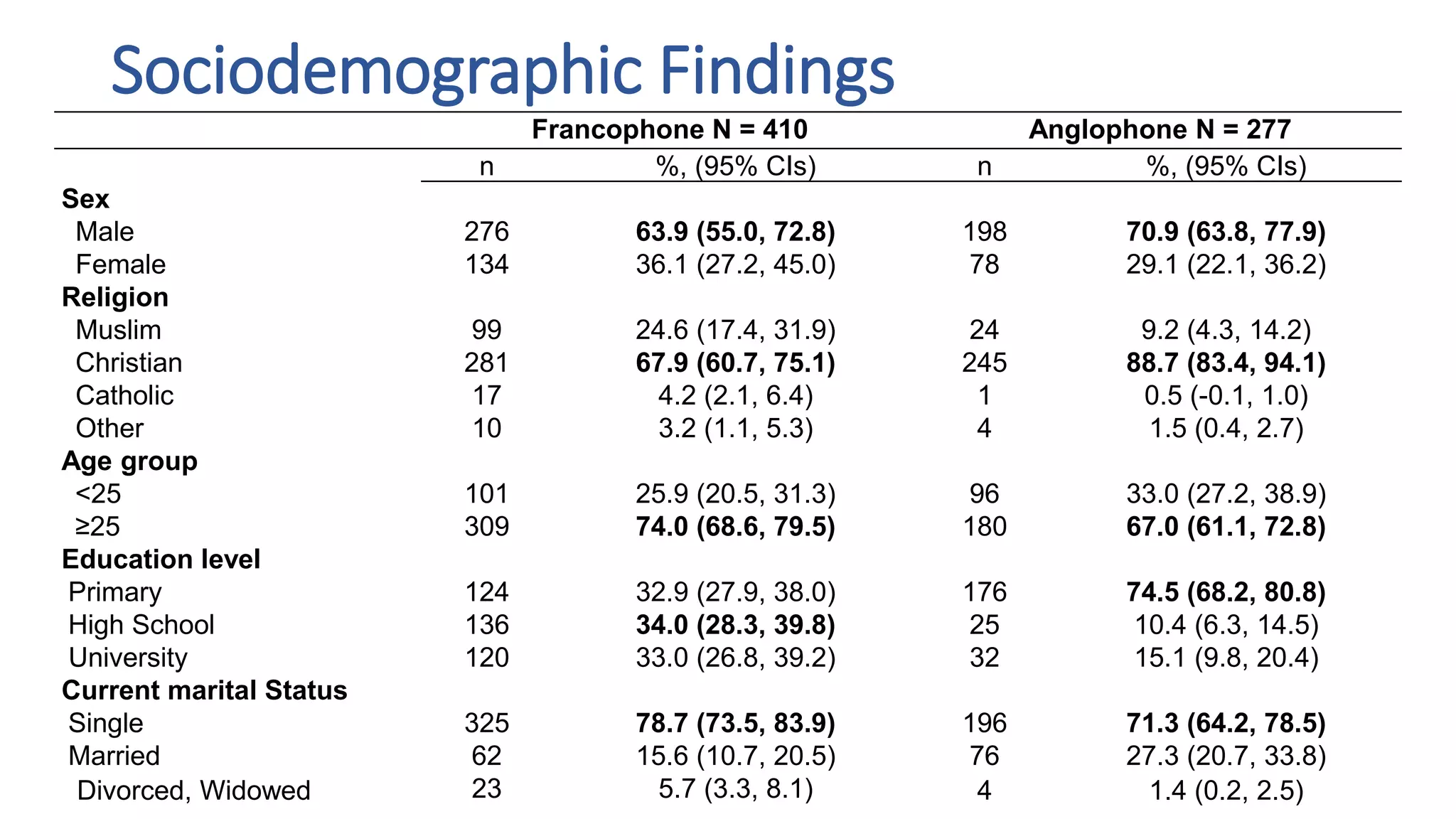
Sociodemographic Findings
Francophone N= 410 Anglophone N = 277
n %, (95% CIs) n %, (95% CIs)
Sex
Male 276 63.9 (55.0, 72.8) 198 70.9 (63.8, 77.9)
Female 134 36.1 (27.2, 45.0) 78 29.1 (22.1, 36.2)
Religion
Muslim 99 24.6 (17.4, 31.9) 24 9.2 (4.3, 14.2)
Christian 281 67.9 (60.7, 75.1) 245 88.7 (83.4, 94.1)
Catholic 17 4.2 (2.1, 6.4) 1 0.5 (-0.1, 1.0)
Other 10 3.2 (1.1, 5.3) 4 1.5 (0.4, 2.7)
Age group
<25 101 25.9 (20.5, 31.3) 96 33.0 (27.2, 38.9)
≥25 309 74.0 (68.6, 79.5) 180 67.0 (61.1, 72.8)
Education level
Primary 124 32.9 (27.9, 38.0) 176 74.5 (68.2, 80.8)
High School 136 34.0 (28.3, 39.8) 25 10.4 (6.3, 14.5)
University 120 33.0 (26.8, 39.2) 32 15.1 (9.8, 20.4)
Current marital Status
Single 325 78.7 (73.5, 83.9) 196 71.3 (64.2, 78.5)
Married 62 15.6 (10.7, 20.5) 76 27.3 (20.7, 33.8)
Divorced, Widowed 23 5.7 (3.3, 8.1) 4 1.4 (0.2, 2.5)
22.
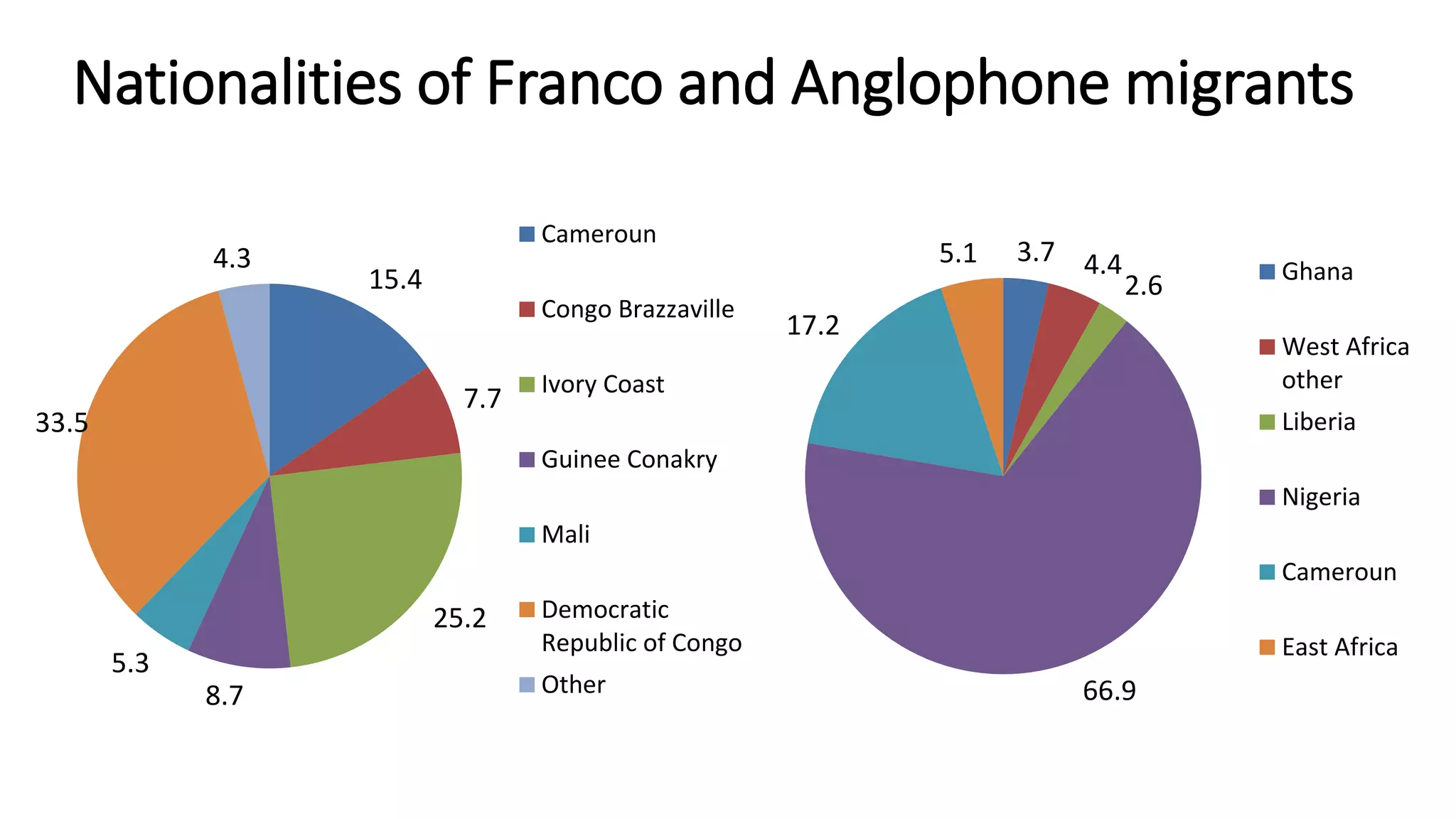
Nationalities of Francoand Anglophone migrants
15.4
7.7
25.2
8.7
5.3
33.5
4.3
Cameroun
Congo Brazzaville
Ivory Coast
Guinee Conakry
Mali
Democratic
Republic of Congo
Other
3.7 4.4
2.6
66.9
17.2
5.1
Ghana
West Africa
other
Liberia
Nigeria
Cameroun
East Africa
23.
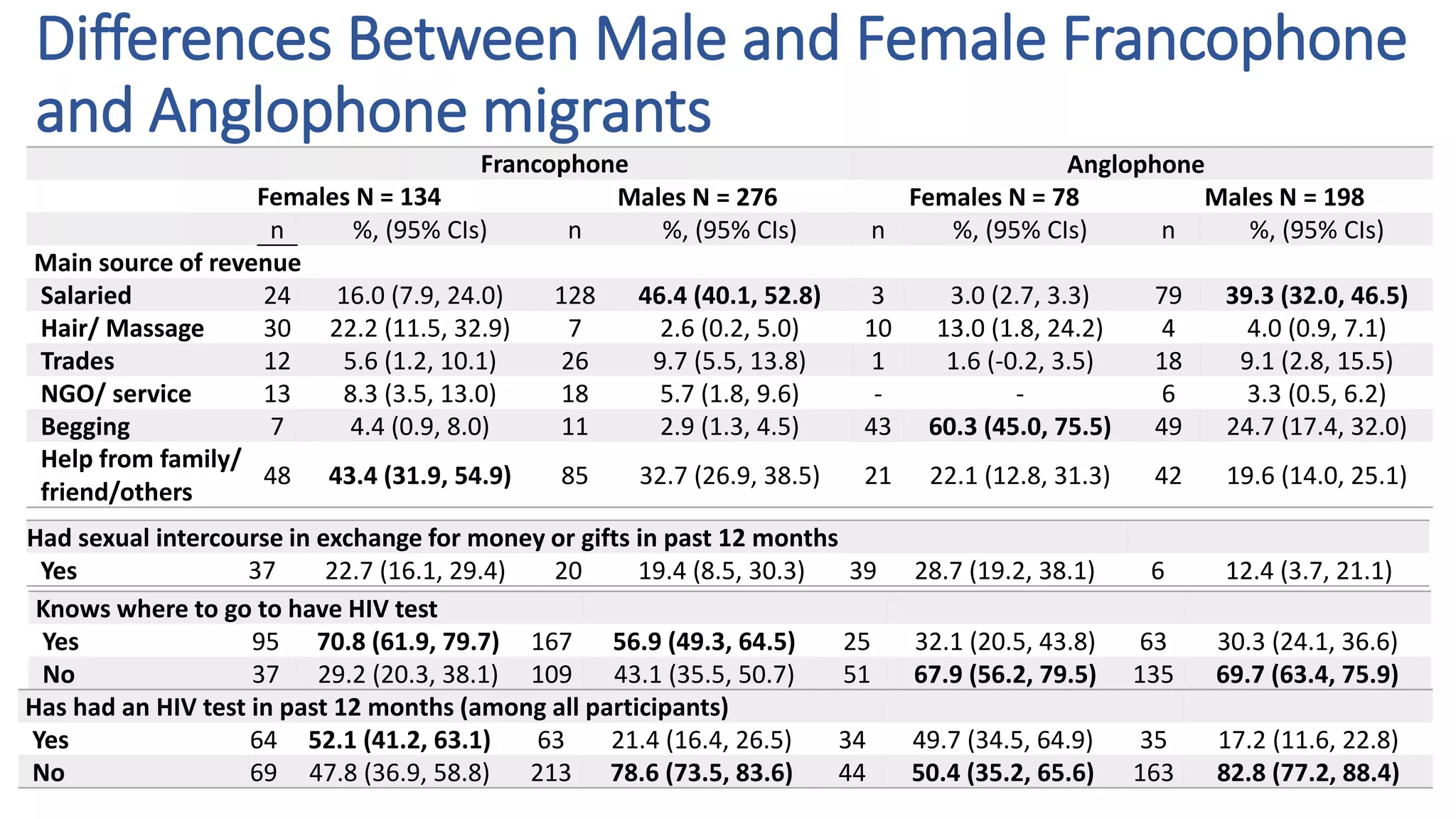
Differences Between Maleand Female Francophone
and Anglophone migrants
Francophone Anglophone
Females N = 134 Males N = 276 Females N = 78 Males N = 198
n %, (95% CIs) n %, (95% CIs) n %, (95% CIs) n %, (95% CIs)
Main source of revenue
Salaried 24 16.0 (7.9, 24.0) 128 46.4 (40.1, 52.8) 3 3.0 (2.7, 3.3) 79 39.3 (32.0, 46.5)
Hair/ Massage 30 22.2 (11.5, 32.9) 7 2.6 (0.2, 5.0) 10 13.0 (1.8, 24.2) 4 4.0 (0.9, 7.1)
Trades 12 5.6 (1.2, 10.1) 26 9.7 (5.5, 13.8) 1 1.6 (-0.2, 3.5) 18 9.1 (2.8, 15.5)
NGO/ service 13 8.3 (3.5, 13.0) 18 5.7 (1.8, 9.6) - - 6 3.3 (0.5, 6.2)
Begging 7 4.4 (0.9, 8.0) 11 2.9 (1.3, 4.5) 43 60.3 (45.0, 75.5) 49 24.7 (17.4, 32.0)
Help from family/
friend/others
48 43.4 (31.9, 54.9) 85 32.7 (26.9, 38.5) 21 22.1 (12.8, 31.3) 42 19.6 (14.0, 25.1)
Had sexual intercourse in exchange for money or gifts in past 12 months
Yes 37 22.7 (16.1, 29.4) 20 19.4 (8.5, 30.3) 39 28.7 (19.2, 38.1) 6 12.4 (3.7, 21.1)
Knows where to go to have HIV test
Yes 95 70.8 (61.9, 79.7) 167 56.9 (49.3, 64.5) 25 32.1 (20.5, 43.8) 63 30.3 (24.1, 36.6)
No 37 29.2 (20.3, 38.1) 109 43.1 (35.5, 50.7) 51 67.9 (56.2, 79.5) 135 69.7 (63.4, 75.9)
Has had an HIV test in past 12 months (among all participants)
Yes 64 52.1 (41.2, 63.1) 63 21.4 (16.4, 26.5) 34 49.7 (34.5, 64.9) 35 17.2 (11.6, 22.8)
No 69 47.8 (36.9, 58.8) 213 78.6 (73.5, 83.6) 44 50.4 (35.2, 65.6) 163 82.8 (77.2, 88.4)
24.
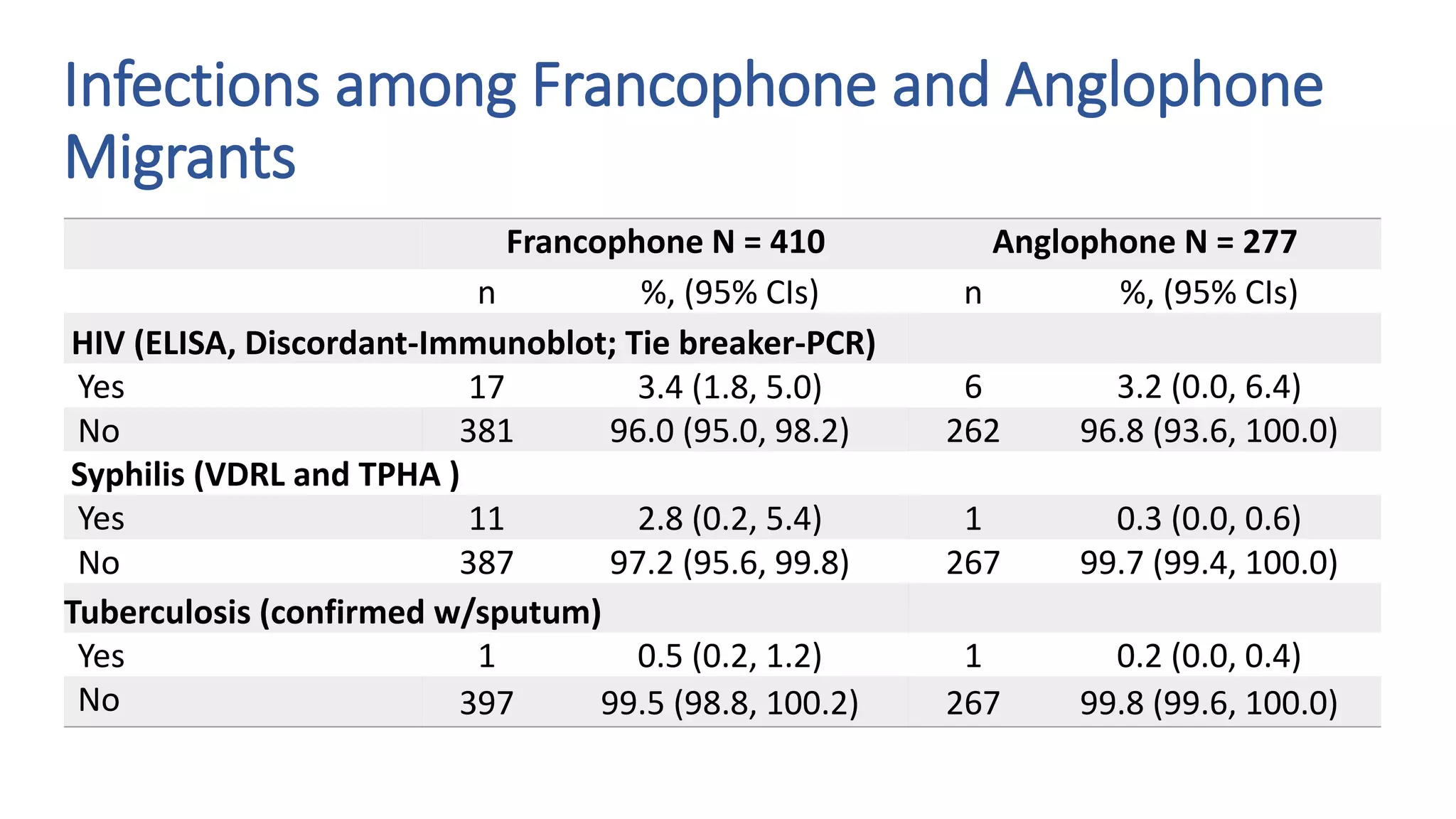
Infections among Francophoneand Anglophone
Migrants
Francophone N = 410 Anglophone N = 277
n %, (95% CIs) n %, (95% CIs)
HIV (ELISA, Discordant-Immunoblot; Tie breaker-PCR)
Yes 17 3.4 (1.8, 5.0) 6 3.2 (0.0, 6.4)
No 381 96.0 (95.0, 98.2) 262 96.8 (93.6, 100.0)
Syphilis (VDRL and TPHA )
Yes 11 2.8 (0.2, 5.4) 1 0.3 (0.0, 0.6)
No 387 97.2 (95.6, 99.8) 267 99.7 (99.4, 100.0)
Tuberculosis (confirmed w/sputum)
Yes 1 0.5 (0.2, 1.2) 1 0.2 (0.0, 0.4)
No 397 99.5 (98.8, 100.2) 267 99.8 (99.6, 100.0)
25.
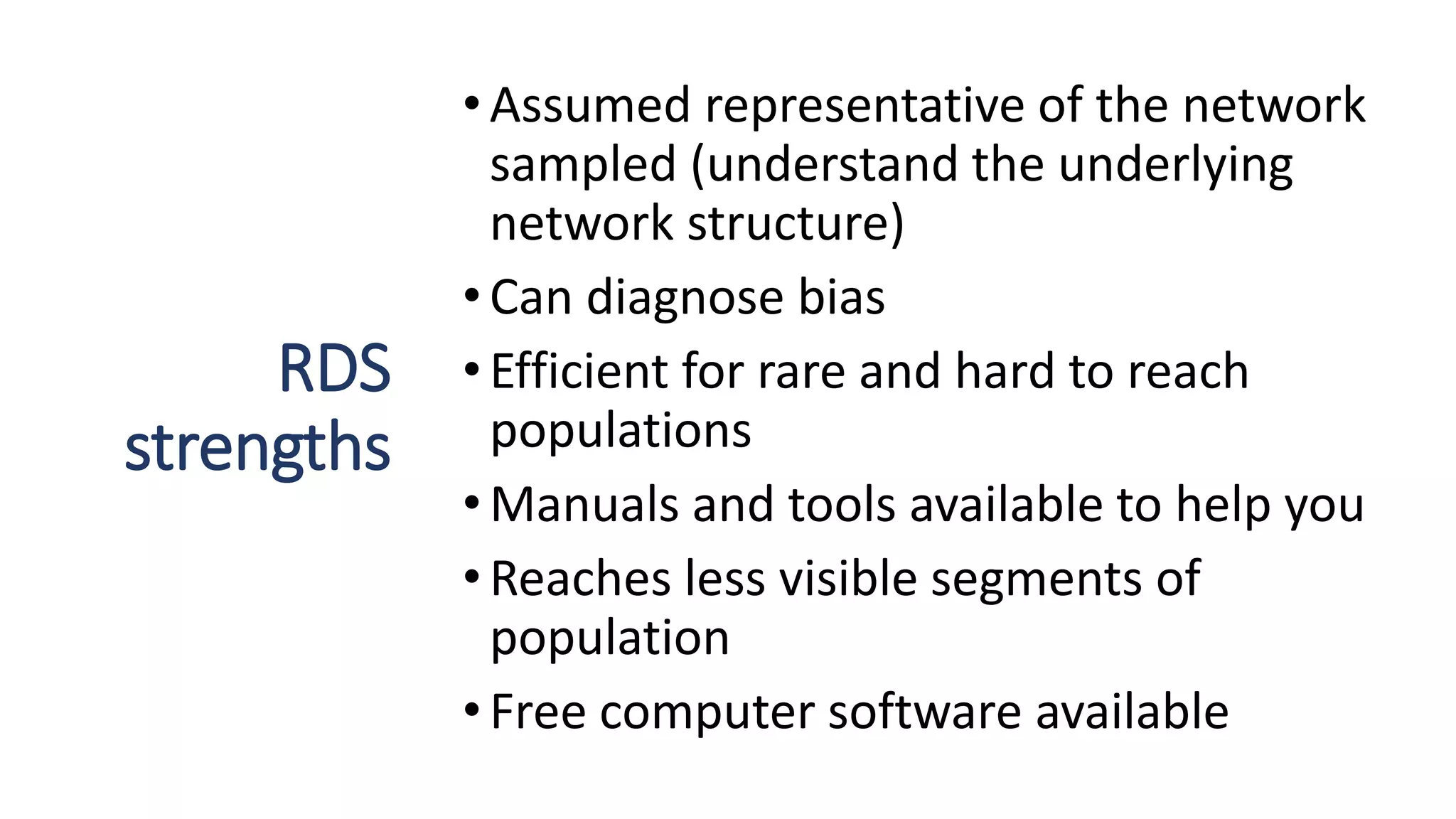
RDS
strengths
•Assumed representative ofthe network
sampled (understand the underlying
network structure)
•Can diagnose bias
•Efficient for rare and hard to reach
populations
•Manuals and tools available to help you
•Reaches less visible segments of
population
•Free computer software available
26.
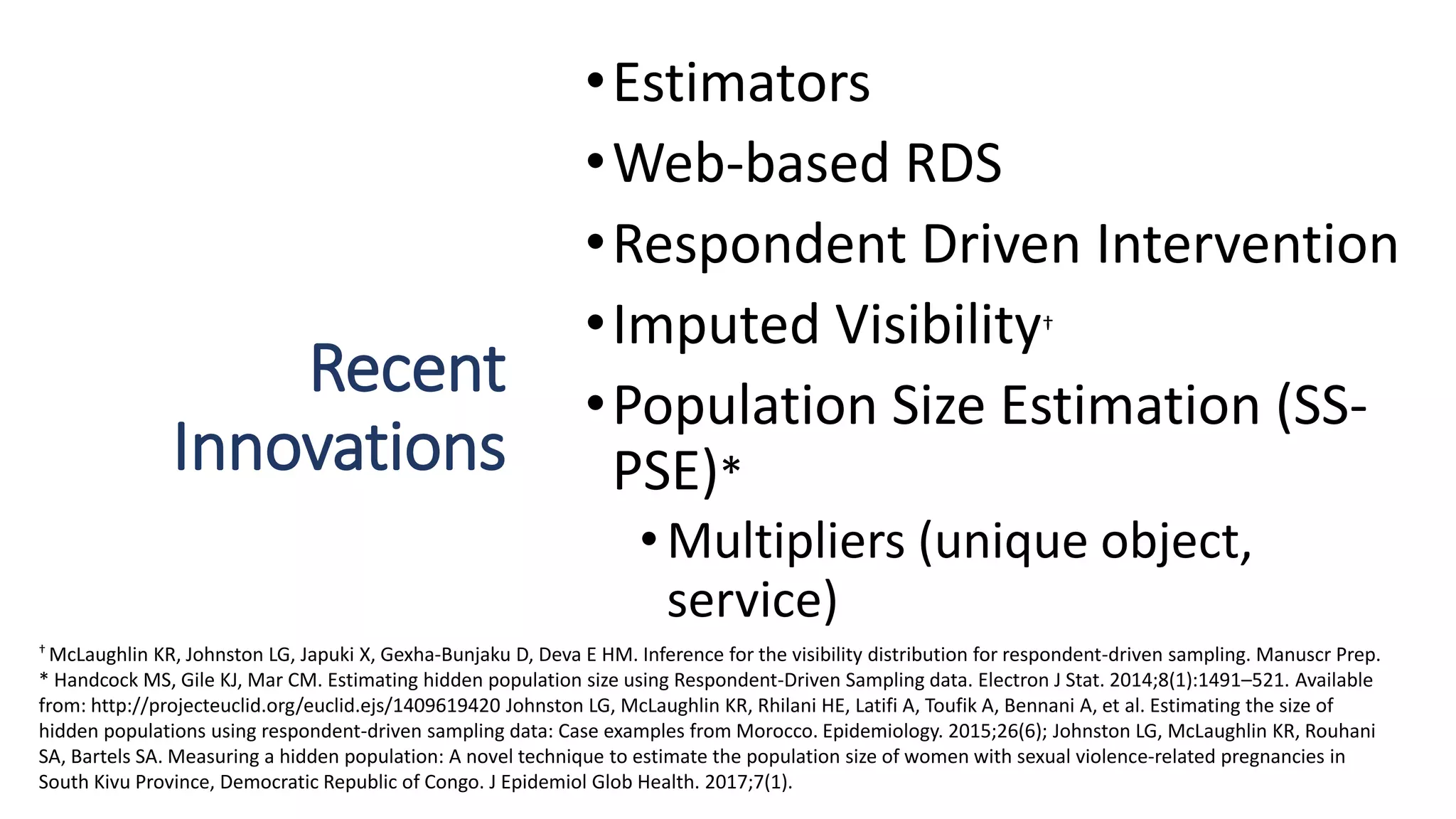
Recent
Innovations
•Estimators
•Web-based RDS
•Respondent DrivenIntervention
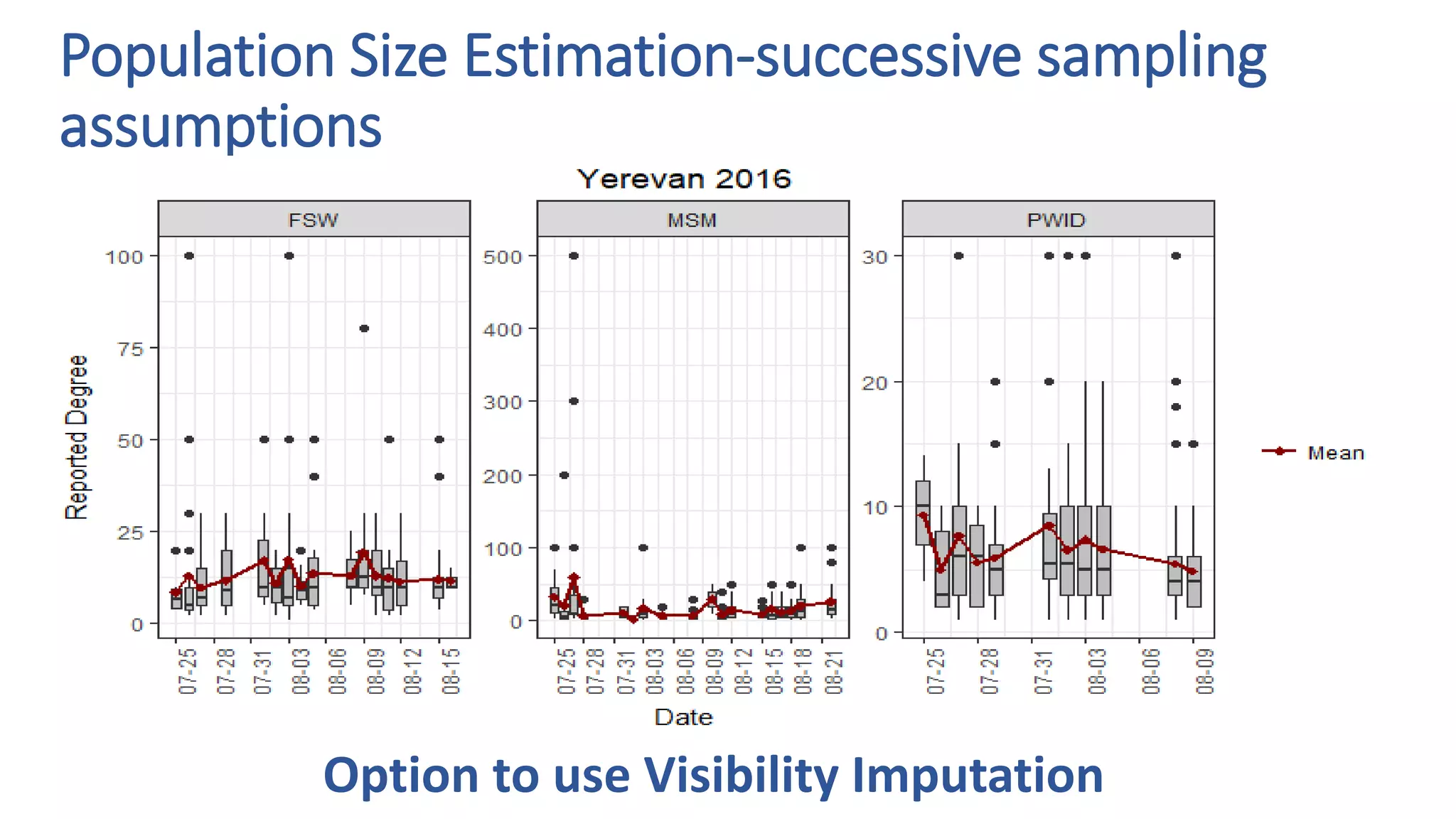
•Imputed Visibility†
•Population Size Estimation (SS-
PSE)*
• Multipliers (unique object,
service)
† McLaughlin KR, Johnston LG, Japuki X, Gexha-Bunjaku D, Deva E HM. Inference for the visibility distribution for respondent-driven sampling. Manuscr Prep.
* Handcock MS, Gile KJ, Mar CM. Estimating hidden population size using Respondent-Driven Sampling data. Electron J Stat. 2014;8(1):1491–521. Available
from: http://projecteuclid.org/euclid.ejs/1409619420 Johnston LG, McLaughlin KR, Rhilani HE, Latifi A, Toufik A, Bennani A, et al. Estimating the size of
hidden populations using respondent-driven sampling data: Case examples from Morocco. Epidemiology. 2015;26(6); Johnston LG, McLaughlin KR, Rouhani
SA, Bartels SA. Measuring a hidden population: A novel technique to estimate the population size of women with sexual violence-related pregnancies in
South Kivu Province, Democratic Republic of Congo. J Epidemiol Glob Health. 2017;7(1).
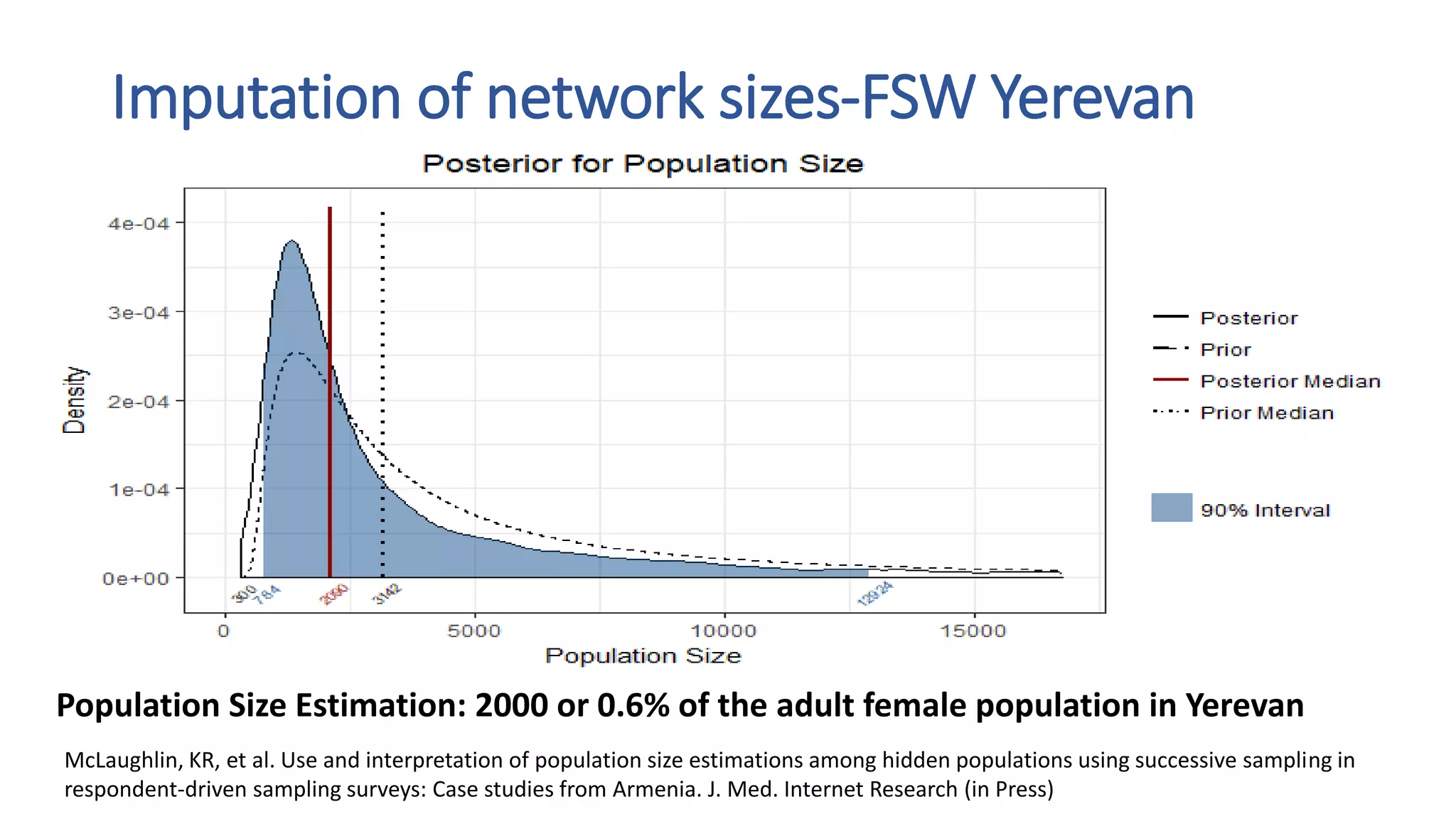
Imputation of networksizes-FSW Yerevan
Population Size Estimation: 2000 or 0.6% of the adult female population in Yerevan
McLaughlin, KR, et al. Use and interpretation of population size estimations among hidden populations using successive sampling in
respondent-driven sampling surveys: Case studies from Armenia. J. Med. Internet Research (in Press)
29.
Resources
and
courses
Resources
• Johnston, L.G. Introduction to Respondent Driven Sampling. 2013.
Geneva, Switzerland.
http://applications.emro.who.int/dsaf/EMRPUB_2013_EN_1539.pdf
• www.hpmrg.org (RDS Analyst Software)
• www.respondentdrivensampling.org (RDSAT, references, RDS
materials)
• www.lisagjohnston.com; www.respondentdrivensampling.com
(resource materials, journal articles, etc.)
Upcoming courses
• Tulane University of Public Health and Tropical Medicine, New
Orleans, Louisiana, USA. January 7 to 11, 2019. For more
information contact: lsjohnston.global@gmail.com
• ECPR Methods Winter School, University of Bamberg, Germany. 25
February– 1 March
2019. Contact: https://ecpr.eu/Events/EventTypeDetails.aspx?Event
TypeID=5