Netaji Subhas Chandra Bose Instit
ute Of Pharmacy
NAME - Saikat Changdar
COURSE - B.pharm
SUBJECT - HUMAN ANATOMY&PHYSIOLOGY 2
TOPIC - RESPIRATORY SYSTEM
YEAR - 1st year, 2nd sem.
‱ What is Breathing ?
It is a simply intake of fresh air & removal of f
oul air from the body.
‱ What is respiration ?
it is defined as exchange of cases betwee
n body tissue & external environment suppli
ed of oxygen to the tissue & exchange of ca
rbon dioxide.
‱ Function of Respiration -
1. Transport of oxygen to the tissue & excreti
on of carbon dioxide.
2. Excretion of volatile substance.
3.Regulation of body temp. Through the loss of h
eat.
4.Maintain the PH of blood.
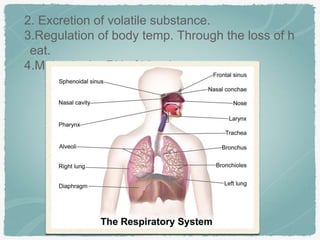
‱ The respiratory system consist of different parts -
a. Nasal cavity - we have a pair of external nostrils openin
g out above the upper lips.
b.Pharynx - It is a portion of which is the common passage
of food & air.
c.Larynx - larynx is a cartilaginous box which helps to prod
uction of sounds & also known as sound box.
d.Trachea - it is commonly known as wind pipe.extends fro
m the larynx.
e.Bronchi - trachea is straight tube which divided at the 5th
thoracic vertebrae & form right & left primary bronchi.
f.Alveoli - each terminal bronchiole gives rise to a number
of very thin irregular walled & bag like structure called alv
eoli.
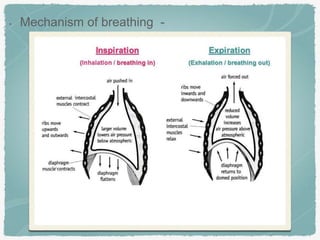
‱ Mechanism of breathing -
Respiratory volume & capacity -
1. Tidal volume(TV) - volume of air inspired or expi
red during a normal respiration. It approx 500ml
2.Inspiratory Reserve Volume(IRV) - additional a
mount of air a person can inspire by a forcible ins
piration . It approx 2500 - 3000ml.
3.Expiratory Reserve volume(ERV) - additional am
ount of air a person can expire by a forcible expira
tion. It approx 1000 - 1100ml.
4.Residual volume(RV) - volume of air remaining in
the lungs even after a forcible expiration. This ave
rage 1100 - 1200ml.
5. Inspiratory capacity(IC) - Total volume of air a p
erson can inspire after a normal expiration. It total
(TV+IRV) i.e; 3500ml.
6.Expiratory capacity(EC) - total volume of air a pe
rson can expire after a normal inspiration. It is (TV
+ERV).
7.Functional residual capacity(FRC) - vol. of air tha
t will remain in the lungs after a normal expiration.
It is ERV+TV+IRV.
8.Vital capacity(VC) - the max. Vol. of air a person
can breathier after a forced expiration.
9.Total lung capacity - total vol. of air accommoda
ted in the lungs at the end of forced inspiration.
Disorder of Respiratory System -
‱ Asthma - it is difficulty in breathing causing whe
ezing due to inflammation of bronchi & bronchiol
es.
‱ Emphysema - it is a chronic disorder in which th
e alveolar walls are damaged due to which respir
atory surface is decreased .one of major cause f
or cigarette smoking.
THANK YOU

Respiratory System

  • 1.
    Netaji Subhas ChandraBose Instit ute Of Pharmacy NAME - Saikat Changdar COURSE - B.pharm SUBJECT - HUMAN ANATOMY&PHYSIOLOGY 2 TOPIC - RESPIRATORY SYSTEM YEAR - 1st year, 2nd sem.
  • 2.
    ‱ What isBreathing ? It is a simply intake of fresh air & removal of f oul air from the body. ‱ What is respiration ? it is defined as exchange of cases betwee n body tissue & external environment suppli ed of oxygen to the tissue & exchange of ca rbon dioxide. ‱ Function of Respiration - 1. Transport of oxygen to the tissue & excreti on of carbon dioxide.
  • 3.
    2. Excretion ofvolatile substance. 3.Regulation of body temp. Through the loss of h eat. 4.Maintain the PH of blood.
  • 4.
    ‱ The respiratorysystem consist of different parts - a. Nasal cavity - we have a pair of external nostrils openin g out above the upper lips. b.Pharynx - It is a portion of which is the common passage of food & air. c.Larynx - larynx is a cartilaginous box which helps to prod uction of sounds & also known as sound box. d.Trachea - it is commonly known as wind pipe.extends fro m the larynx. e.Bronchi - trachea is straight tube which divided at the 5th thoracic vertebrae & form right & left primary bronchi. f.Alveoli - each terminal bronchiole gives rise to a number of very thin irregular walled & bag like structure called alv eoli.
  • 5.
  • 6.
    Respiratory volume &capacity - 1. Tidal volume(TV) - volume of air inspired or expi red during a normal respiration. It approx 500ml 2.Inspiratory Reserve Volume(IRV) - additional a mount of air a person can inspire by a forcible ins piration . It approx 2500 - 3000ml. 3.Expiratory Reserve volume(ERV) - additional am ount of air a person can expire by a forcible expira tion. It approx 1000 - 1100ml. 4.Residual volume(RV) - volume of air remaining in the lungs even after a forcible expiration. This ave rage 1100 - 1200ml.
  • 7.
    5. Inspiratory capacity(IC)- Total volume of air a p erson can inspire after a normal expiration. It total (TV+IRV) i.e; 3500ml. 6.Expiratory capacity(EC) - total volume of air a pe rson can expire after a normal inspiration. It is (TV +ERV). 7.Functional residual capacity(FRC) - vol. of air tha t will remain in the lungs after a normal expiration. It is ERV+TV+IRV. 8.Vital capacity(VC) - the max. Vol. of air a person can breathier after a forced expiration. 9.Total lung capacity - total vol. of air accommoda ted in the lungs at the end of forced inspiration.
  • 8.
    Disorder of RespiratorySystem - ‱ Asthma - it is difficulty in breathing causing whe ezing due to inflammation of bronchi & bronchiol es. ‱ Emphysema - it is a chronic disorder in which th e alveolar walls are damaged due to which respir atory surface is decreased .one of major cause f or cigarette smoking.
  • 9.