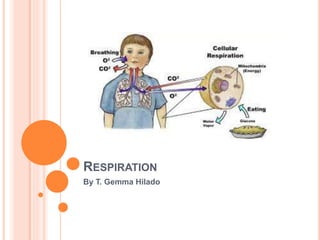
RESPIRATION
By T. Gemma Hilado
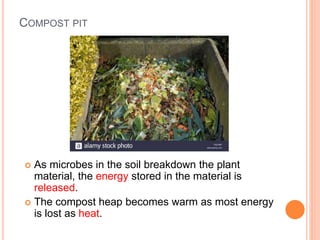
COMPOST PIT
 As microbes in the soil breakdown the plant
material, the energy stored in the material is
released.
 The compost heap becomes warm as most energy
is lost as heat.
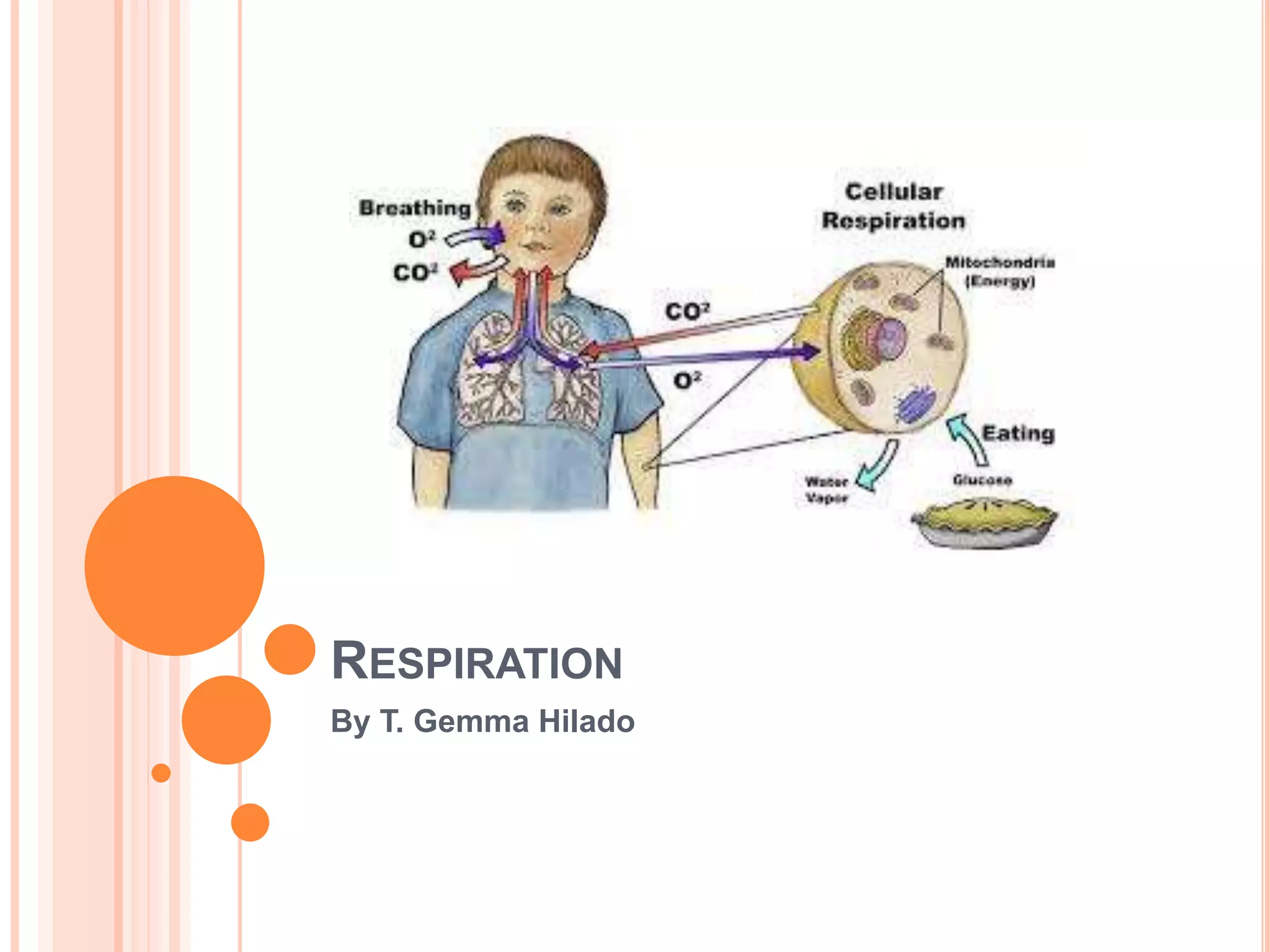
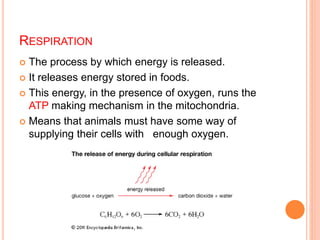
RESPIRATION
 The process by which energy is released.
 It releases energy stored in foods.
 This energy, in the presence of oxygen, runs the
ATP making mechanism in the mitochondria.
 Means that animals must have some way of
supplying their cells with enough oxygen.
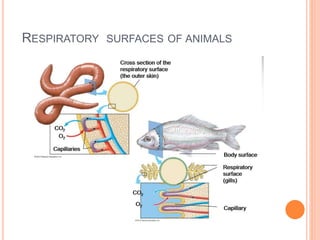
RESPIRATORY SURFACES OF ANIMALS
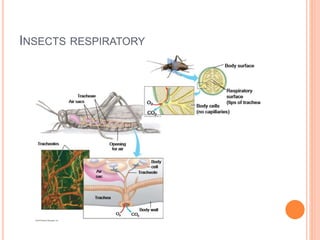
INSECTS RESPIRATORY
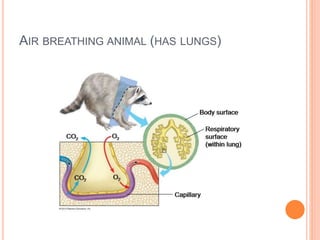
AIR BREATHING ANIMAL (HAS LUNGS)
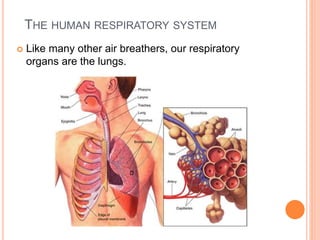
THE HUMAN RESPIRATORY SYSTEM
 Like many other air breathers, our respiratory
organs are the lungs.
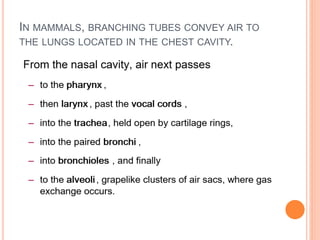
IN MAMMALS, BRANCHING TUBES CONVEY AIR TO
THE LUNGS LOCATED IN THE CHEST CAVITY.
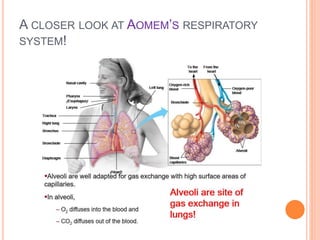
A CLOSER LOOK AT AOMEM’S RESPIRATORY
SYSTEM!
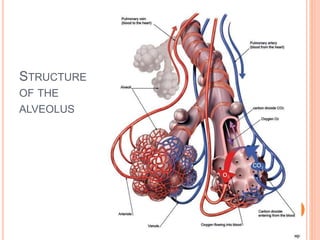
STRUCTURE
OF THE
ALVEOLUS
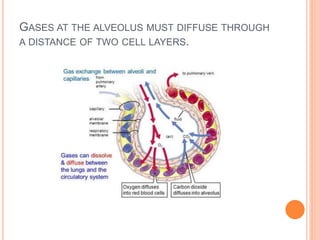
GASES AT THE ALVEOLUS MUST DIFFUSE THROUGH
A DISTANCE OF TWO CELL LAYERS.
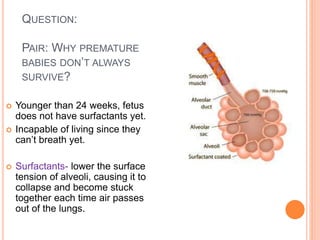
QUESTION:
PAIR: WHY PREMATURE
BABIES DON’T ALWAYS
SURVIVE?
 Younger than 24 weeks, fetus
does not have surfactants yet.
 Incapable of living since they
can’t breath yet.
 Surfactants- lower the surface
tension of alveoli, causing it to
collapse and become stuck
together each time air passes
out of the lungs.
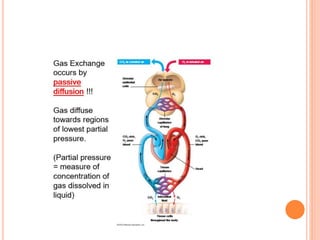
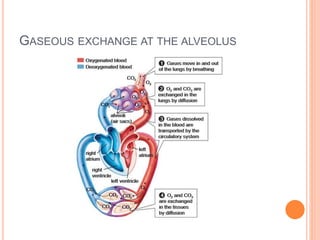
GASEOUS EXCHANGE AT THE ALVEOLUS
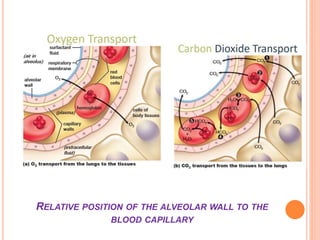
RELATIVE POSITION OF THE ALVEOLAR WALL TO THE
BLOOD CAPILLARY
DIFFUSION ACROSS THE ALVEOLI IS
ENHANCED BY THE FOLLOWING:
 Large surface area of the alveoli
 Short distance between the air and the blood
 Steep concentration gradient maintained by
constant movement of blood through the tissues
and ventilation of the lungs
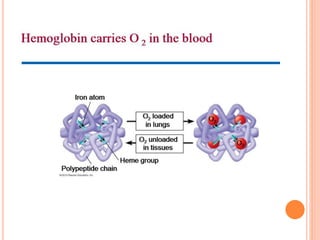
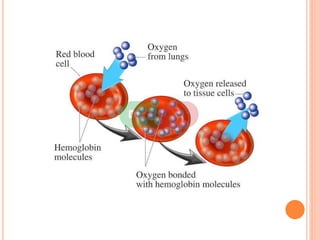
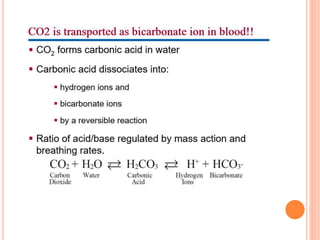
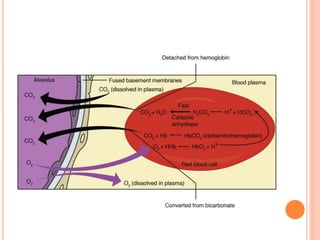
 Ability of blood to carry oxygen and carbon dioxide
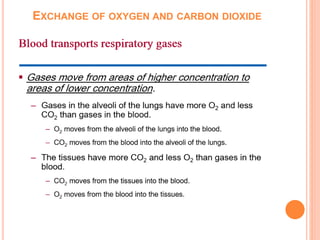
EXCHANGE OF OXYGEN AND CARBON DIOXIDE
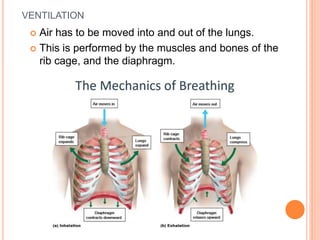
VENTILATION
 Air has to be moved into and out of the lungs.
 This is performed by the muscles and bones of the
rib cage, and the diaphragm.
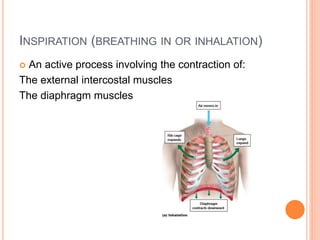
INSPIRATION (BREATHING IN OR INHALATION)
 An active process involving the contraction of:
The external intercostal muscles
The diaphragm muscles
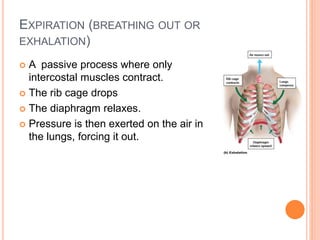
EXPIRATION (BREATHING OUT OR
EXHALATION)
 A passive process where only
intercostal muscles contract.
 The rib cage drops
 The diaphragm relaxes.
 Pressure is then exerted on the air in
the lungs, forcing it out.
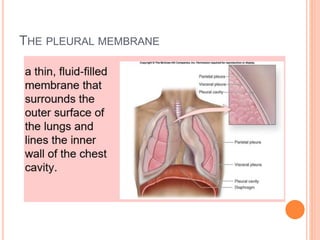
THE PLEURAL MEMBRANE
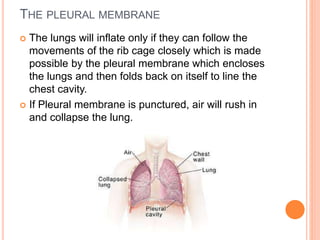
 The lungs will inflate only if they can follow the
movements of the rib cage closely which is made
possible by the pleural membrane which encloses
the lungs and then folds back on itself to line the
chest cavity.
 If Pleural membrane is punctured, air will rush in
and collapse the lung.
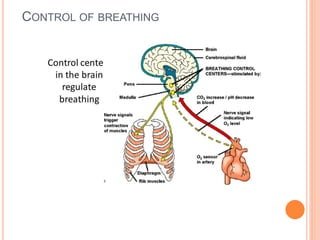
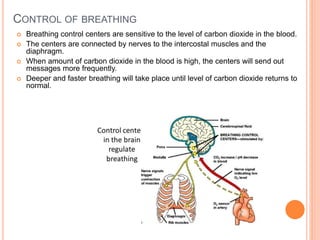
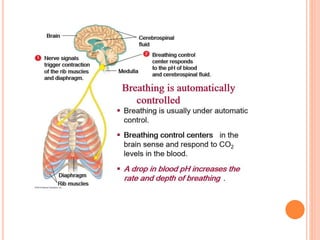
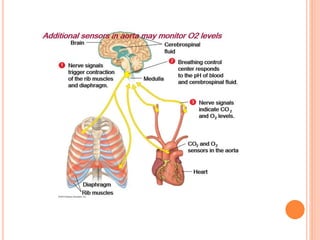
CONTROL OF BREATHING
 Breathing control centers are sensitive to the level of carbon dioxide in the blood.
 The centers are connected by nerves to the intercostal muscles and the
diaphragm.
 When amount of carbon dioxide in the blood is high, the centers will send out
messages more frequently.
 Deeper and faster breathing will take place until level of carbon dioxide returns to
normal.
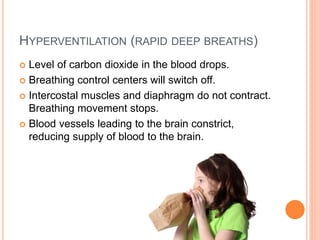
HYPERVENTILATION (RAPID DEEP BREATHS)
 Level of carbon dioxide in the blood drops.
 Breathing control centers will switch off.
 Intercostal muscles and diaphragm do not contract.
Breathing movement stops.
 Blood vessels leading to the brain constrict,
reducing supply of blood to the brain.
QUESTIONS:
1. Why can drinking excessive alcohol result in
death? (FILM…. Take note…..)  
2. Why will breathing into a paper bag help someone
who is hyperventilating (having panic attack) to
quickly breath normally again? (especially for
those who always have DRAMA in life like Aom
Em and Pum )  
ANSWERS:
1. So much alcohol in the bloodstream affect the
areas of the brain controlling basic life-support
functions—such as breathing, heart rate, and
temperature control— these controls begin to shut
down.
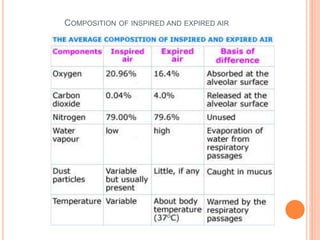
COMPOSITION OF INSPIRED AND EXPIRED AIR
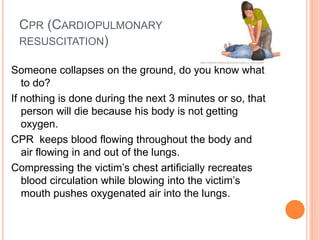
CPR (CARDIOPULMONARY
RESUSCITATION)
Someone collapses on the ground, do you know what
to do?
If nothing is done during the next 3 minutes or so, that
person will die because his body is not getting
oxygen.
CPR keeps blood flowing throughout the body and
air flowing in and out of the lungs.
Compressing the victim’s chest artificially recreates
blood circulation while blowing into the victim’s
mouth pushes oxygenated air into the lungs.
INTERNAL RESPIRATION (CELLULAR )
 For humans, the process by which external air is
drawn into the body in order to supply the lungs
with oxygen and carbon dioxide expelled from the
lungs in order to be removed from the body..
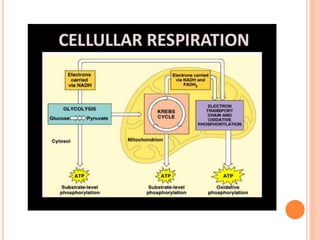
1. Aerobic Respiration
2. Anaerobic Respiration
AEROBIC RESPIRATION
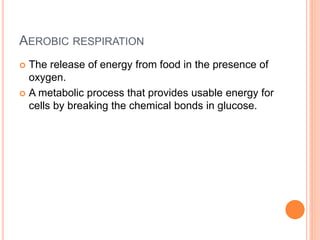
 The release of energy from food in the presence of
oxygen.
 A metabolic process that provides usable energy for
cells by breaking the chemical bonds in glucose.
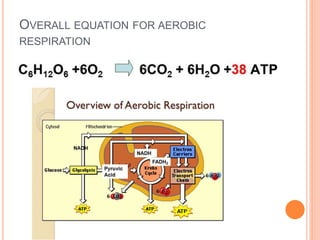
OVERALL EQUATION FOR AEROBIC
RESPIRATION
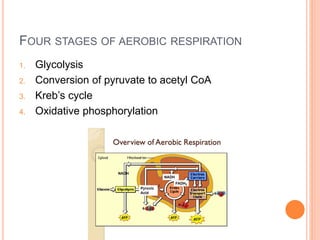
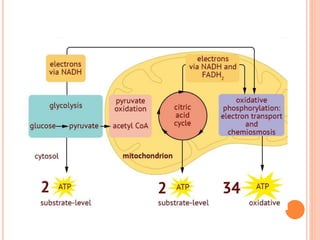
FOUR STAGES OF AEROBIC RESPIRATION
1. Glycolysis
2. Conversion of pyruvate to acetyl CoA
3. Kreb’s cycle
4. Oxidative phosphorylation
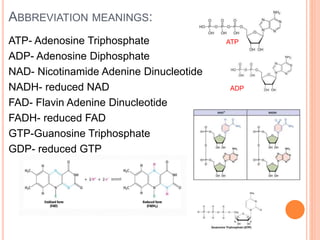
ABBREVIATION MEANINGS:
ATP- Adenosine Triphosphate ATP
ADP- Adenosine Diphosphate
NAD- Nicotinamide Adenine Dinucleotide
NADH- reduced NAD ADP
FAD- Flavin Adenine Dinucleotide
FADH- reduced FAD
GTP-Guanosine Triphosphate
GDP- reduced GTP
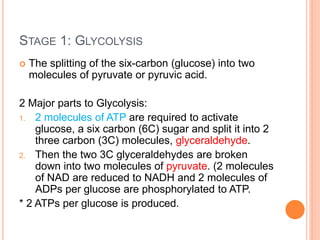
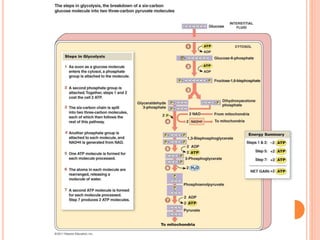
STAGE 1: GLYCOLYSIS
 The splitting of the six-carbon (glucose) into two
molecules of pyruvate or pyruvic acid.
2 Major parts to Glycolysis:
1. 2 molecules of ATP are required to activate
glucose, a six carbon (6C) sugar and split it into 2
three carbon (3C) molecules, glyceraldehyde.
2. Then the two 3C glyceraldehydes are broken
down into two molecules of pyruvate. (2 molecules
of NAD are reduced to NADH and 2 molecules of
ADPs per glucose are phosphorylated to ATP.
* 2 ATPs per glucose is produced.
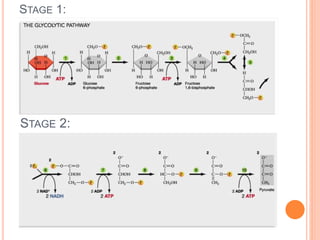
STAGE 1:
STAGE 2:
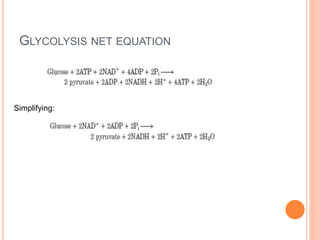
GLYCOLYSIS NET EQUATION
Simplifying:
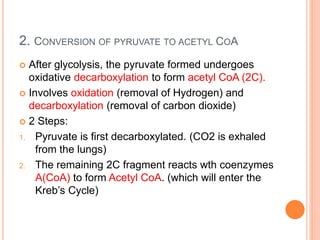
2. CONVERSION OF PYRUVATE TO ACETYL COA
 After glycolysis, the pyruvate formed undergoes
oxidative decarboxylation to form acetyl CoA (2C).
 Involves oxidation (removal of Hydrogen) and
decarboxylation (removal of carbon dioxide)
 2 Steps:
1. Pyruvate is first decarboxylated. (CO2 is exhaled
from the lungs)
2. The remaining 2C fragment reacts wth coenzymes
A(CoA) to form Acetyl CoA. (which will enter the
Kreb’s Cycle)
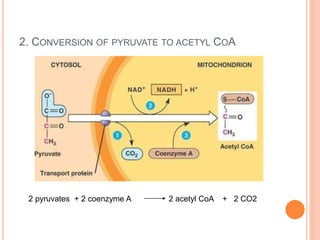
2. CONVERSION OF PYRUVATE TO ACETYL COA
2 pyruvates + 2 coenzyme A 2 acetyl CoA + 2 CO2
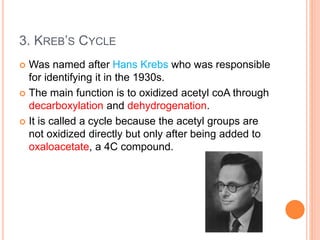
3. KREB’S CYCLE
 Was named after Hans Krebs who was responsible
for identifying it in the 1930s.
 The main function is to oxidized acetyl coA through
decarboxylation and dehydrogenation.
 It is called a cycle because the acetyl groups are
not oxidized directly but only after being added to
oxaloacetate, a 4C compound.
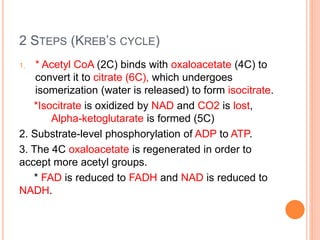
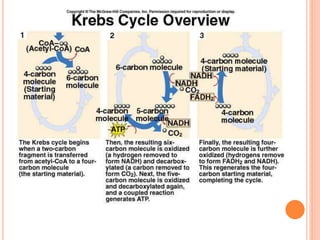
2 STEPS (KREB’S CYCLE)
1. * Acetyl CoA (2C) binds with oxaloacetate (4C) to
convert it to citrate (6C), which undergoes
isomerization (water is released) to form isocitrate.
*Isocitrate is oxidized by NAD and CO2 is lost,
Alpha-ketoglutarate is formed (5C)
2. Substrate-level phosphorylation of ADP to ATP.
3. The 4C oxaloacetate is regenerated in order to
accept more acetyl groups.
* FAD is reduced to FADH and NAD is reduced to
NADH.
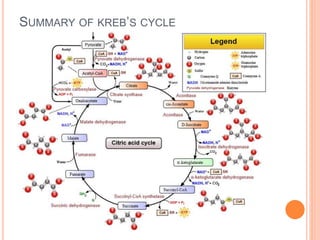
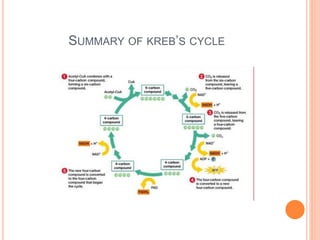
SUMMARY OF KREB’S CYCLE
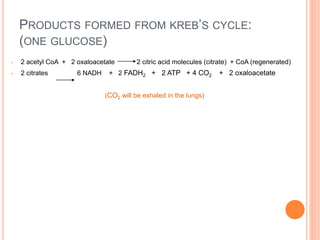
PRODUCTS FORMED FROM KREB’S CYCLE:
(ONE GLUCOSE)
• 2 acetyl CoA + 2 oxaloacetate 2 citric acid molecules (citrate) + CoA (regenerated)
• 2 citrates 6 NADH + 2 FADH2 + 2 ATP + 4 CO2 + 2 oxaloacetate
(CO2 will be exhaled in the lungs)
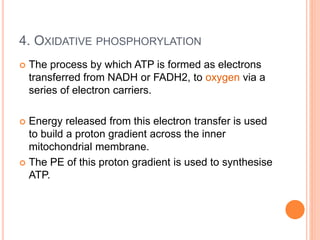
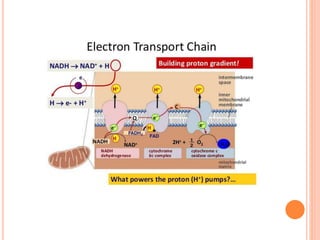
4. OXIDATIVE PHOSPHORYLATION
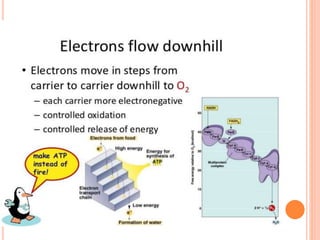
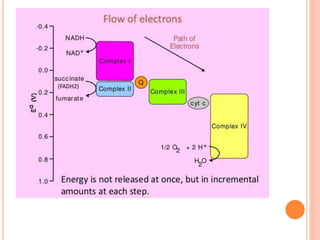
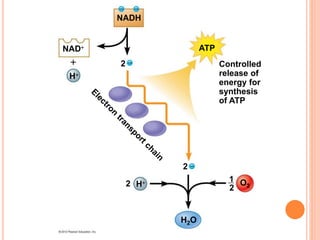
 The process by which ATP is formed as electrons
transferred from NADH or FADH2, to oxygen via a
series of electron carriers.
 Energy released from this electron transfer is used
to build a proton gradient across the inner
mitochondrial membrane.
 The PE of this proton gradient is used to synthesise
ATP.
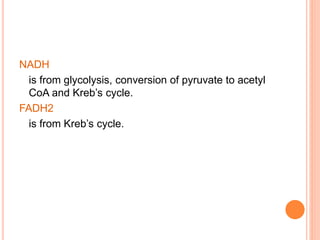
NADH
is from glycolysis, conversion of pyruvate to acetyl
CoA and Kreb’s cycle.
FADH2
is from Kreb’s cycle.
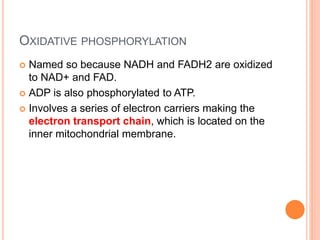
OXIDATIVE PHOSPHORYLATION
 Named so because NADH and FADH2 are oxidized
to NAD+ and FAD.
 ADP is also phosphorylated to ATP.
 Involves a series of electron carriers making the
electron transport chain, which is located on the
inner mitochondrial membrane.
Controlled
release of
energy for
synthesis
of ATP
NADH
NAD
H
H O2
H2O
2
2
2
ATP
2
1
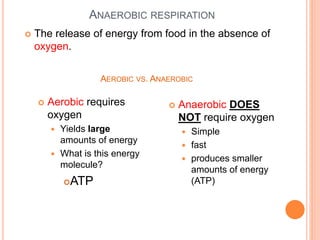
ANAEROBIC RESPIRATION
 The release of energy from food in the absence of
oxygen.
AEROBIC VS. ANAEROBIC
 Anaerobic DOES
NOT require oxygen
 Simple
 fast
 produces smaller
amounts of energy
(ATP)
 Aerobic requires
oxygen
 Yields large
amounts of energy
 What is this energy
molecule?
ATP
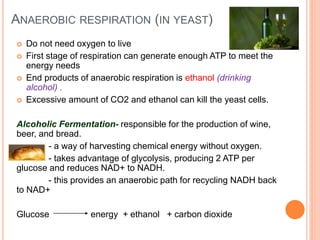
ANAEROBIC RESPIRATION (IN YEAST)
 Do not need oxygen to live
 First stage of respiration can generate enough ATP to meet the
energy needs
 End products of anaerobic respiration is ethanol (drinking
alcohol) .
 Excessive amount of CO2 and ethanol can kill the yeast cells.
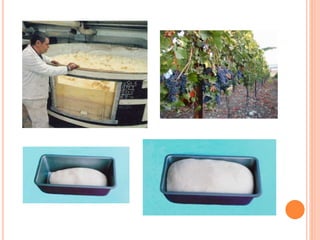
Alcoholic Fermentation- responsible for the production of wine,
beer, and bread.
- a way of harvesting chemical energy without oxygen.
- takes advantage of glycolysis, producing 2 ATP per
glucose and reduces NAD+ to NADH.
- this provides an anaerobic path for recycling NADH back
to NAD+
Glucose energy + ethanol + carbon dioxide
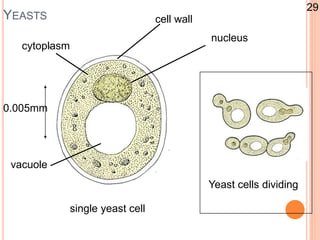
YEASTS
0.005mm
single yeast cell
Yeast cells dividing
cell wall
nucleus
cytoplasm
vacuole
29
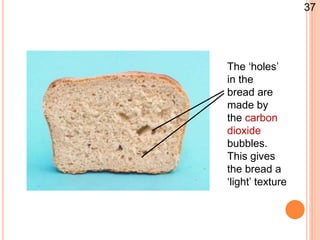
The ‘holes’
in the
bread are
made by
the carbon
dioxide
bubbles.
This gives
the bread a
‘light’ texture
37
LACTIC ACID FERMENTATION
In Humans (like Film) (Lactic Acid Fermentation)
- our cells get enough oxygen to enable aerobic
respiration to happen.
- but when the demand for energy increases (Film
is dancing PANAMA), our muscle cells are forced to work
under anaerobic conditions.
- certain bacteria can oxidize NADH through lactic
acid fermentation.
* NADH is oxidized to NAD+
* pyruvate is reduced to lactic acid
* Lactic acid is carried by the blood to the
liver where it is converted back to glucose in the presence
of oxygen.
BETA-OXIDATION OF FATTY ACIDS
 After fats are digested to glycerol and fatty acids, the
glycerol is converted to glyceraldehyde-3-phosphate
(an intermediate of glycolysis)
 Most of the energy of fats is stored in the fatty acids.
 β-oxidation – is used to process fatty acids into a
form which can be used by the Kreb’s cycle.
DEAMINATION OF PROTEINS
 Removal of an amine group from amino acids
(proteins), before it goes to glycolysis or Kreb’s
cycle.
 Nitrogenous waste is excreted in the form of
ammonia or urea.
 In humans, deamination occurs mostly in the liver
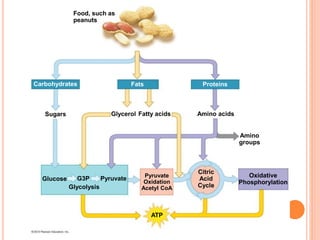
Food, such as
peanuts
Sugars Glycerol Fatty acids Amino acids
Amino
groups
Oxidative
Phosphorylation
Citric
Acid
Cycle
Pyruvate
Oxidation
Acetyl CoA
ATP
Glucose G3P Pyruvate
Glycolysis
Carbohydrates Fats Proteins
That’s all for this term!!!

Respiration

  • 1.
  • 2.
    COMPOST PIT  Asmicrobes in the soil breakdown the plant material, the energy stored in the material is released.  The compost heap becomes warm as most energy is lost as heat.
  • 3.
    RESPIRATION  The processby which energy is released.  It releases energy stored in foods.  This energy, in the presence of oxygen, runs the ATP making mechanism in the mitochondria.  Means that animals must have some way of supplying their cells with enough oxygen.
  • 4.
  • 5.
  • 6.
  • 7.
    THE HUMAN RESPIRATORYSYSTEM  Like many other air breathers, our respiratory organs are the lungs.
  • 8.
    IN MAMMALS, BRANCHINGTUBES CONVEY AIR TO THE LUNGS LOCATED IN THE CHEST CAVITY.
  • 9.
    A CLOSER LOOKAT AOMEM’S RESPIRATORY SYSTEM!
  • 10.
  • 12.
    GASES AT THEALVEOLUS MUST DIFFUSE THROUGH A DISTANCE OF TWO CELL LAYERS.
  • 13.
    QUESTION: PAIR: WHY PREMATURE BABIESDON’T ALWAYS SURVIVE?  Younger than 24 weeks, fetus does not have surfactants yet.  Incapable of living since they can’t breath yet.  Surfactants- lower the surface tension of alveoli, causing it to collapse and become stuck together each time air passes out of the lungs.
  • 14.
    GASEOUS EXCHANGE ATTHE ALVEOLUS
  • 15.
    RELATIVE POSITION OFTHE ALVEOLAR WALL TO THE BLOOD CAPILLARY
  • 16.
    DIFFUSION ACROSS THEALVEOLI IS ENHANCED BY THE FOLLOWING:  Large surface area of the alveoli  Short distance between the air and the blood  Steep concentration gradient maintained by constant movement of blood through the tissues and ventilation of the lungs  Ability of blood to carry oxygen and carbon dioxide
  • 17.
    EXCHANGE OF OXYGENAND CARBON DIOXIDE
  • 22.
    VENTILATION  Air hasto be moved into and out of the lungs.  This is performed by the muscles and bones of the rib cage, and the diaphragm.
  • 23.
    INSPIRATION (BREATHING INOR INHALATION)  An active process involving the contraction of: The external intercostal muscles The diaphragm muscles
  • 24.
    EXPIRATION (BREATHING OUTOR EXHALATION)  A passive process where only intercostal muscles contract.  The rib cage drops  The diaphragm relaxes.  Pressure is then exerted on the air in the lungs, forcing it out.
  • 25.
  • 26.
    THE PLEURAL MEMBRANE The lungs will inflate only if they can follow the movements of the rib cage closely which is made possible by the pleural membrane which encloses the lungs and then folds back on itself to line the chest cavity.  If Pleural membrane is punctured, air will rush in and collapse the lung.
  • 27.
  • 28.
    CONTROL OF BREATHING Breathing control centers are sensitive to the level of carbon dioxide in the blood.  The centers are connected by nerves to the intercostal muscles and the diaphragm.  When amount of carbon dioxide in the blood is high, the centers will send out messages more frequently.  Deeper and faster breathing will take place until level of carbon dioxide returns to normal.
  • 31.
    HYPERVENTILATION (RAPID DEEPBREATHS)  Level of carbon dioxide in the blood drops.  Breathing control centers will switch off.  Intercostal muscles and diaphragm do not contract. Breathing movement stops.  Blood vessels leading to the brain constrict, reducing supply of blood to the brain.
  • 32.
    QUESTIONS: 1. Why candrinking excessive alcohol result in death? (FILM…. Take note…..)   2. Why will breathing into a paper bag help someone who is hyperventilating (having panic attack) to quickly breath normally again? (especially for those who always have DRAMA in life like Aom Em and Pum )  
  • 33.
    ANSWERS: 1. So muchalcohol in the bloodstream affect the areas of the brain controlling basic life-support functions—such as breathing, heart rate, and temperature control— these controls begin to shut down.
  • 34.
    COMPOSITION OF INSPIREDAND EXPIRED AIR
  • 35.
    CPR (CARDIOPULMONARY RESUSCITATION) Someone collapseson the ground, do you know what to do? If nothing is done during the next 3 minutes or so, that person will die because his body is not getting oxygen. CPR keeps blood flowing throughout the body and air flowing in and out of the lungs. Compressing the victim’s chest artificially recreates blood circulation while blowing into the victim’s mouth pushes oxygenated air into the lungs.
  • 36.
    INTERNAL RESPIRATION (CELLULAR)  For humans, the process by which external air is drawn into the body in order to supply the lungs with oxygen and carbon dioxide expelled from the lungs in order to be removed from the body.. 1. Aerobic Respiration 2. Anaerobic Respiration
  • 37.
    AEROBIC RESPIRATION  Therelease of energy from food in the presence of oxygen.  A metabolic process that provides usable energy for cells by breaking the chemical bonds in glucose.
  • 38.
    OVERALL EQUATION FORAEROBIC RESPIRATION
  • 39.
    FOUR STAGES OFAEROBIC RESPIRATION 1. Glycolysis 2. Conversion of pyruvate to acetyl CoA 3. Kreb’s cycle 4. Oxidative phosphorylation
  • 40.
    ABBREVIATION MEANINGS: ATP- AdenosineTriphosphate ATP ADP- Adenosine Diphosphate NAD- Nicotinamide Adenine Dinucleotide NADH- reduced NAD ADP FAD- Flavin Adenine Dinucleotide FADH- reduced FAD GTP-Guanosine Triphosphate GDP- reduced GTP
  • 41.
    STAGE 1: GLYCOLYSIS The splitting of the six-carbon (glucose) into two molecules of pyruvate or pyruvic acid. 2 Major parts to Glycolysis: 1. 2 molecules of ATP are required to activate glucose, a six carbon (6C) sugar and split it into 2 three carbon (3C) molecules, glyceraldehyde. 2. Then the two 3C glyceraldehydes are broken down into two molecules of pyruvate. (2 molecules of NAD are reduced to NADH and 2 molecules of ADPs per glucose are phosphorylated to ATP. * 2 ATPs per glucose is produced.
  • 43.
  • 44.
  • 45.
    2. CONVERSION OFPYRUVATE TO ACETYL COA  After glycolysis, the pyruvate formed undergoes oxidative decarboxylation to form acetyl CoA (2C).  Involves oxidation (removal of Hydrogen) and decarboxylation (removal of carbon dioxide)  2 Steps: 1. Pyruvate is first decarboxylated. (CO2 is exhaled from the lungs) 2. The remaining 2C fragment reacts wth coenzymes A(CoA) to form Acetyl CoA. (which will enter the Kreb’s Cycle)
  • 46.
    2. CONVERSION OFPYRUVATE TO ACETYL COA 2 pyruvates + 2 coenzyme A 2 acetyl CoA + 2 CO2
  • 47.
    3. KREB’S CYCLE Was named after Hans Krebs who was responsible for identifying it in the 1930s.  The main function is to oxidized acetyl coA through decarboxylation and dehydrogenation.  It is called a cycle because the acetyl groups are not oxidized directly but only after being added to oxaloacetate, a 4C compound.
  • 48.
    2 STEPS (KREB’SCYCLE) 1. * Acetyl CoA (2C) binds with oxaloacetate (4C) to convert it to citrate (6C), which undergoes isomerization (water is released) to form isocitrate. *Isocitrate is oxidized by NAD and CO2 is lost, Alpha-ketoglutarate is formed (5C) 2. Substrate-level phosphorylation of ADP to ATP. 3. The 4C oxaloacetate is regenerated in order to accept more acetyl groups. * FAD is reduced to FADH and NAD is reduced to NADH.
  • 50.
  • 51.
  • 52.
    PRODUCTS FORMED FROMKREB’S CYCLE: (ONE GLUCOSE) • 2 acetyl CoA + 2 oxaloacetate 2 citric acid molecules (citrate) + CoA (regenerated) • 2 citrates 6 NADH + 2 FADH2 + 2 ATP + 4 CO2 + 2 oxaloacetate (CO2 will be exhaled in the lungs)
  • 53.
    4. OXIDATIVE PHOSPHORYLATION The process by which ATP is formed as electrons transferred from NADH or FADH2, to oxygen via a series of electron carriers.  Energy released from this electron transfer is used to build a proton gradient across the inner mitochondrial membrane.  The PE of this proton gradient is used to synthesise ATP.
  • 54.
    NADH is from glycolysis,conversion of pyruvate to acetyl CoA and Kreb’s cycle. FADH2 is from Kreb’s cycle.
  • 55.
    OXIDATIVE PHOSPHORYLATION  Namedso because NADH and FADH2 are oxidized to NAD+ and FAD.  ADP is also phosphorylated to ATP.  Involves a series of electron carriers making the electron transport chain, which is located on the inner mitochondrial membrane.
  • 59.
    Controlled release of energy for synthesis ofATP NADH NAD H H O2 H2O 2 2 2 ATP 2 1
  • 62.
    ANAEROBIC RESPIRATION  Therelease of energy from food in the absence of oxygen. AEROBIC VS. ANAEROBIC  Anaerobic DOES NOT require oxygen  Simple  fast  produces smaller amounts of energy (ATP)  Aerobic requires oxygen  Yields large amounts of energy  What is this energy molecule? ATP
  • 63.
    ANAEROBIC RESPIRATION (INYEAST)  Do not need oxygen to live  First stage of respiration can generate enough ATP to meet the energy needs  End products of anaerobic respiration is ethanol (drinking alcohol) .  Excessive amount of CO2 and ethanol can kill the yeast cells. Alcoholic Fermentation- responsible for the production of wine, beer, and bread. - a way of harvesting chemical energy without oxygen. - takes advantage of glycolysis, producing 2 ATP per glucose and reduces NAD+ to NADH. - this provides an anaerobic path for recycling NADH back to NAD+ Glucose energy + ethanol + carbon dioxide
  • 64.
    YEASTS 0.005mm single yeast cell Yeastcells dividing cell wall nucleus cytoplasm vacuole 29
  • 66.
    The ‘holes’ in the breadare made by the carbon dioxide bubbles. This gives the bread a ‘light’ texture 37
  • 67.
    LACTIC ACID FERMENTATION InHumans (like Film) (Lactic Acid Fermentation) - our cells get enough oxygen to enable aerobic respiration to happen. - but when the demand for energy increases (Film is dancing PANAMA), our muscle cells are forced to work under anaerobic conditions. - certain bacteria can oxidize NADH through lactic acid fermentation. * NADH is oxidized to NAD+ * pyruvate is reduced to lactic acid * Lactic acid is carried by the blood to the liver where it is converted back to glucose in the presence of oxygen.
  • 68.
    BETA-OXIDATION OF FATTYACIDS  After fats are digested to glycerol and fatty acids, the glycerol is converted to glyceraldehyde-3-phosphate (an intermediate of glycolysis)  Most of the energy of fats is stored in the fatty acids.  β-oxidation – is used to process fatty acids into a form which can be used by the Kreb’s cycle.
  • 69.
    DEAMINATION OF PROTEINS Removal of an amine group from amino acids (proteins), before it goes to glycolysis or Kreb’s cycle.  Nitrogenous waste is excreted in the form of ammonia or urea.  In humans, deamination occurs mostly in the liver
  • 70.
    Food, such as peanuts SugarsGlycerol Fatty acids Amino acids Amino groups Oxidative Phosphorylation Citric Acid Cycle Pyruvate Oxidation Acetyl CoA ATP Glucose G3P Pyruvate Glycolysis Carbohydrates Fats Proteins
  • 72.
    That’s all forthis term!!!