Developing Sustainable Supply
Chains
Mary Margaret Rogers
Anderson School of Management
University of New Mexico
Sustainability in Supply Chain Management
Definitions:	
	Supply	chain	management	encompasses	all	activities	associated	
with	the	flow	and	transformation	of	goods	from		the	raw	materials	
stage	through		the	end	user,	as	well	as	the	associated	information	
flows.	(CSCPM)	
	Sustainable	supply	chain	management	requires	that	sustainability	
criteria	be	met	while	maintaining	competitiveness	through	meeting	
customer	needs.	(Seuring	and	MĂźller,	2008)
Why Should Supply Chains Try to Be
Sustainable?
•  Supply	chains	are	boundary	spanning	
– Coordination	across	normal	boundaries	means	that	
many	aspects	of	sustainability	may	be	affected	
– From	initial	processing	of	RM	to	consumption	by	final	
customer
Why Should Supply Chains Try to Be
Sustainable?
•  Outsourcing		
•  Watchdog	groups	
•  Government	requirements
Why Should Supply Chains Try to Be
Sustainable?
•  Reduce	cost	and	wastes	
•  Manage	risks	
•  Create	distinguishing	(sellable)	reputation	
•  Reinforce	shareholder	value
Issues	affecting	sustainability	
•  Product	design	
•  Product	returns	
•  Length	of	product	life	
cycle	
•  Extension	of	product	life	
cycle	
•  End	of	life	disposal	
•  Packaging	
	
•  Source	reduction	
•  Recycling	
•  Material	substitution	
•  Waste	disposal	
•  Refurbishing	
•  Repair	
•  Remanufacturing
Puma’s Clever Little Bag
Sustainability in Supply Chain Management
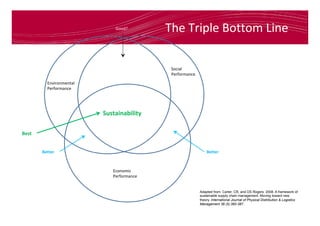
•  Use	of	the	triple	bottom	line	
–  Social	
•  Manage	risks	to	organizational	reputation	
•  Create	competitive	advantage	
–  Environmental	
•  Regulatory	issues	
•  Risk	of	harm	from	usage,	disposal,	packaging,	shipping	
–  Economic	
•  Sustainability	can	be	cost	efficient	
•  Sustainability	can	enhance	shareholder	value
Adapted from: Carter, CR, and DS Rogers. 2008. A framework of
sustainable supply chain management: Moving toward new
theory. International Journal of Physical Distribution & Logistics
Management 38 (5):360-387.
Environmental	
Performance	
Social	
Performance	
Economic	
Performance	
Sustainability	
Good?	
Better	
Best	
Better	
The	Triple	Bottom	Line
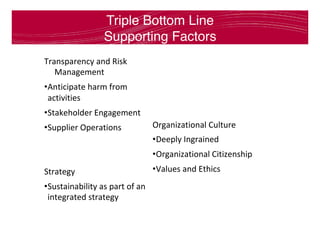
Triple Bottom Line

Supporting Factors
Transparency	and	Risk	
Management	
• Anticipate	harm	from	
activities	
• Stakeholder	Engagement	
• Supplier	Operations	
	
	
Strategy	
• Sustainability	as	part	of	an	
integrated	strategy	


Organizational	Culture	
• Deeply	Ingrained	
• Organizational	Citizenship	
• Values	and	Ethics
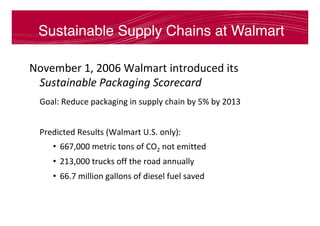
Sustainable Supply Chains at Walmart
November	1,	2006	Walmart	introduced	its	
Sustainable	Packaging	Scorecard		
	Goal:	Reduce	packaging	in	supply	chain	by	5%	by	2013	
	
Predicted	Results	(Walmart	U.S.	only):	
•  667,000	metric	tons	of	CO2	not	emitted		
•  213,000	trucks	off	the	road	annually	
•  66.7	million	gallons	of	diesel	fuel	saved
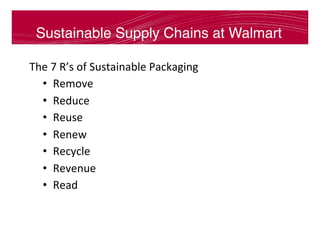
Sustainable Supply Chains at Walmart
The	7	R’s	of	Sustainable	Packaging	
•  Remove	
•  Reduce	
•  Reuse	
•  Renew	
•  Recycle	
•  Revenue	
•  Read
Sustainable Supply Chains at Walmart
“When	Wal-Mart	tells	a	supplier	that	it	wants	a	
change	in	packaging,	that	supplier	will	change	all	its	
packaging…Wal-Mart	has	the	potential	to	have	a	
tremendous	impact	on	America’s	environmental	
footprint.”		
	David	Willett,	spokesman	for	The	Sierra	Club
Sustainable Supply Chains at Walmart
July	16,	2009:	Walmart	announced	it	would	develop	
a	Sustainability	Index.	
Step	1:	Supplier	Assessment	
Step	2:	Life	cycle	Analysis	Database	
Step	3:	Tool	for	Consumer
Sustainable Supply Chains at Walmart
February	25,	2010:	Walmart	announced	plans	to	
eliminate	20	million	metric	tons	of	greenhouse	gas	
emissions	from	the	global	supply	chain	by	the	end	
of	2015.	
Goal:	Reduce	energy	use	and	cost	for	suppliers,	
Walmart,	and	customers.
Sustainable Supply Chains at Walmart
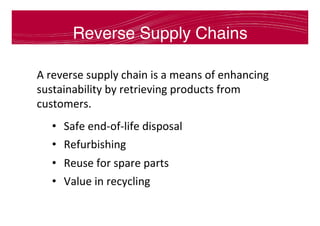
Reverse Supply Chains
A	reverse	supply	chain	is	a	means	of	enhancing	
sustainability	by	retrieving	products	from	
customers.	
•  Safe	end-of-life	disposal	
•  Refurbishing	
•  Reuse	for	spare	parts	
•  Value	in	recycling
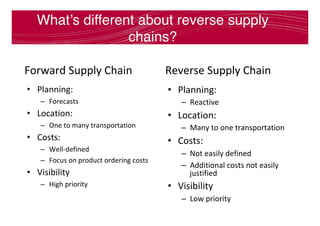
What’s different about reverse supply
chains?
Forward	Supply	Chain	 Reverse	Supply	Chain	
•  Planning:	
–  Forecasts	
•  Location:	
–  One	to	many	transportation	
•  Costs:	
–  Well-defined	
–  Focus	on	product	ordering	costs	
•  Visibility	
–  High	priority	
•  Planning:	
–  Reactive	
•  Location:	
–  Many	to	one	transportation	
•  Costs:	
–  Not	easily	defined	
–  Additional	costs	not	easily	
justified	
•  Visibility	
–  Low	priority
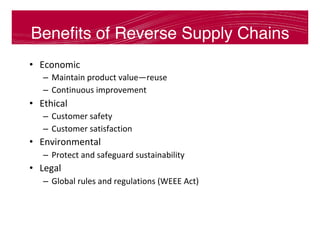
Benets of Reverse Supply Chains
•  Economic	
–  Maintain	product	value—reuse	
–  Continuous	improvement	
•  Ethical	
–  Customer	safety	
–  Customer	satisfaction	
•  Environmental 		
–  Protect	and	safeguard	sustainability	
•  Legal	
–  Global	rules	and	regulations	(WEEE	Act)
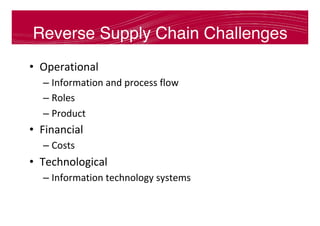
Reverse Supply Chain Challenges
•  Operational	
– Information	and	process	flow	
– Roles	
– Product	
•  Financial	
– Costs	
•  Technological	
– Information	technology	systems
The
Circular Economy
in the
Asia Pacific Region
www.circularecconomyasia.org

Developing Sustainability in Supply Chains

  • 1.
    Developing Sustainable Supply Chains MaryMargaret Rogers Anderson School of Management University of New Mexico
  • 2.
    Sustainability in SupplyChain Management Definitions: Supply chain management encompasses all activities associated with the flow and transformation of goods from the raw materials stage through the end user, as well as the associated information flows. (CSCPM) Sustainable supply chain management requires that sustainability criteria be met while maintaining competitiveness through meeting customer needs. (Seuring and MĂźller, 2008)
  • 3.
    Why Should SupplyChains Try to Be Sustainable? •  Supply chains are boundary spanning – Coordination across normal boundaries means that many aspects of sustainability may be affected – From initial processing of RM to consumption by final customer
  • 4.
    Why Should SupplyChains Try to Be Sustainable? •  Outsourcing •  Watchdog groups •  Government requirements
  • 5.
    Why Should SupplyChains Try to Be Sustainable? •  Reduce cost and wastes •  Manage risks •  Create distinguishing (sellable) reputation •  Reinforce shareholder value
  • 6.
    Issues affecting sustainability •  Product design •  Product returns • Length of product life cycle •  Extension of product life cycle •  End of life disposal •  Packaging •  Source reduction •  Recycling •  Material substitution •  Waste disposal •  Refurbishing •  Repair •  Remanufacturing
  • 7.
  • 8.
    Sustainability in SupplyChain Management •  Use of the triple bottom line –  Social •  Manage risks to organizational reputation •  Create competitive advantage –  Environmental •  Regulatory issues •  Risk of harm from usage, disposal, packaging, shipping –  Economic •  Sustainability can be cost efficient •  Sustainability can enhance shareholder value
  • 9.
    Adapted from: Carter,CR, and DS Rogers. 2008. A framework of sustainable supply chain management: Moving toward new theory. International Journal of Physical Distribution & Logistics Management 38 (5):360-387. Environmental Performance Social Performance Economic Performance Sustainability Good? Better Best Better The Triple Bottom Line
  • 10.
    Triple Bottom Line
 SupportingFactors Transparency and Risk Management • Anticipate harm from activities • Stakeholder Engagement • Supplier Operations Strategy • Sustainability as part of an integrated strategy Organizational Culture • Deeply Ingrained • Organizational Citizenship • Values and Ethics
  • 11.
    Sustainable Supply Chainsat Walmart November 1, 2006 Walmart introduced its Sustainable Packaging Scorecard Goal: Reduce packaging in supply chain by 5% by 2013 Predicted Results (Walmart U.S. only): •  667,000 metric tons of CO2 not emitted •  213,000 trucks off the road annually •  66.7 million gallons of diesel fuel saved
  • 12.
    Sustainable Supply Chainsat Walmart The 7 R’s of Sustainable Packaging •  Remove •  Reduce •  Reuse •  Renew •  Recycle •  Revenue •  Read
  • 13.
    Sustainable Supply Chainsat Walmart “When Wal-Mart tells a supplier that it wants a change in packaging, that supplier will change all its packaging…Wal-Mart has the potential to have a tremendous impact on America’s environmental footprint.” David Willett, spokesman for The Sierra Club
  • 14.
    Sustainable Supply Chainsat Walmart July 16, 2009: Walmart announced it would develop a Sustainability Index. Step 1: Supplier Assessment Step 2: Life cycle Analysis Database Step 3: Tool for Consumer
  • 15.
    Sustainable Supply Chainsat Walmart February 25, 2010: Walmart announced plans to eliminate 20 million metric tons of greenhouse gas emissions from the global supply chain by the end of 2015. Goal: Reduce energy use and cost for suppliers, Walmart, and customers.
  • 16.
  • 17.
    Reverse Supply Chains A reverse supply chain is a means of enhancing sustainability by retrieving products from customers. • Safe end-of-life disposal •  Refurbishing •  Reuse for spare parts •  Value in recycling
  • 18.
    What’s different aboutreverse supply chains? Forward Supply Chain Reverse Supply Chain •  Planning: –  Forecasts •  Location: –  One to many transportation •  Costs: –  Well-defined –  Focus on product ordering costs •  Visibility –  High priority •  Planning: –  Reactive •  Location: –  Many to one transportation •  Costs: –  Not easily defined –  Additional costs not easily justified •  Visibility –  Low priority
  • 19.
    Benefits of ReverseSupply Chains •  Economic –  Maintain product value—reuse –  Continuous improvement •  Ethical –  Customer safety –  Customer satisfaction •  Environmental –  Protect and safeguard sustainability •  Legal –  Global rules and regulations (WEEE Act)
  • 20.
    Reverse Supply ChainChallenges •  Operational – Information and process flow – Roles – Product •  Financial – Costs •  Technological – Information technology systems
  • 21.
    The Circular Economy in the AsiaPacific Region www.circularecconomyasia.org