23.07.2018
The future moves circular – a bio based life cycle in mobility
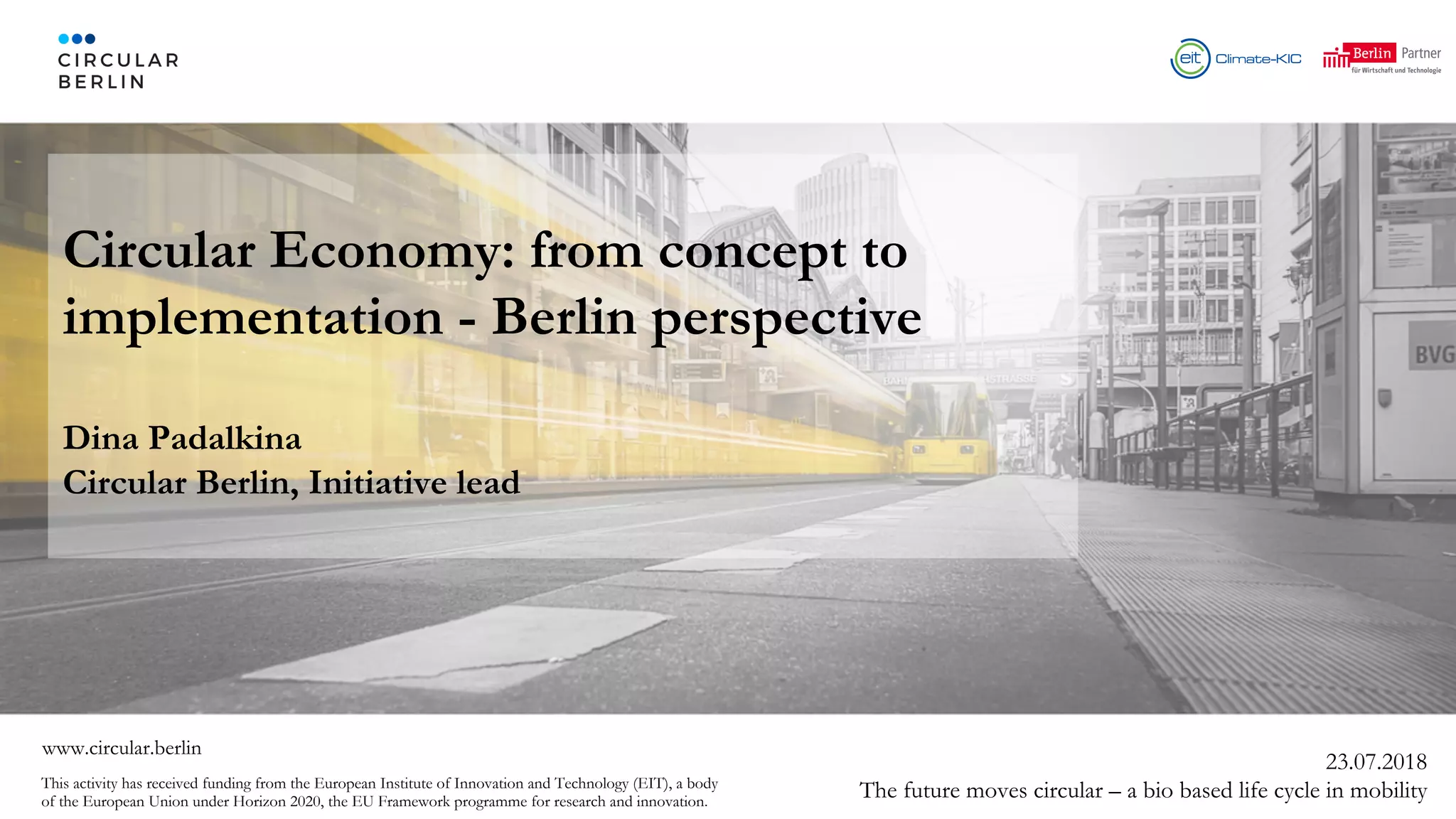
Circular Economy: from concept to
implementation - Berlin perspective
Dina Padalkina
Circular Berlin, Initiative lead
www.circular.berlin
This activity has received funding from the European Institute of Innovation and Technology (EIT), a body
of the European Union under Horizon 2020, the EU Framework programme for research and innovation.
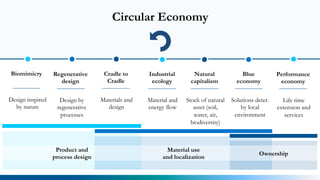
Circular Economy
Cradle to
Cradle
Materials and
design
Performance
economy
Life time
extension and
services
Biomimicry
Design inspired
by nature
Industrial
ecology
Material and
energy flow
Natural
capitalism
Stock of natural
asset (soil,
water, air,
biodiversity)
Blue
economy
Solutions deter.
by local
environment
Regenerative
design
Design by
regenerative
processes
Product and
process design
Material use
and localization
Ownership
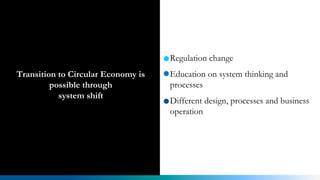
Regulation change
Education on system thinking and
processes
Different design, processes and business
operation
Transition to Circular Economy is
possible through
system shift
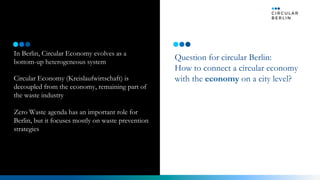
In Berlin, Circular Economy evolves as a
bottom-up heterogeneous system
Circular Economy (Kreislaufwirtschaft) is
decoupled from the economy, remaining part of
the waste industry
Zero Waste agenda has an important role for
Berlin, but it focuses mostly on waste prevention
strategies
Question for circular Berlin:
How to connect a circular economy
with the economy on a city level?
Vision Now
A building is a product
with the very long lifespan
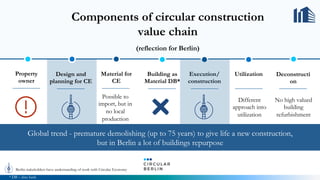
Components of circular construction
value chain
(reflection for Berlin)
Material for
CE
Deconstructi
on
Property
owner
Building as
Material DB*
Execution/
construction
UtilizationDesign and
planning for CE
* DB – data bank
No high valued
building
refurbishment
Different
approach into
utilization
Possible to
import, but in
no local
production
Global trend - premature demolishing (up to 75 years) to give life a new construction,
but in Berlin a lot of buildings repurpose
Berlin stakeholders have understanding of work with Circular Economy
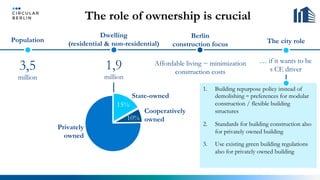
Population
3,5
million
Dwelling
(residential & non-residential)
1,9
million
State-owned
Cooperatively
owned
Privately
owned
15%
10%
Berlin
construction focus
Affordable living ~ minimization
construction costs
1.  Building repurpose policy instead of
demolishing – preferences for modular
construction / flexible building
structures
2.  Standards for building construction also
for privately owned building
3.  Use existing green building regulations
also for privately owned building
… if it wants to be
s CE driver
The city role
The role of ownership is crucial
Textile product is
dominated by fast fashion
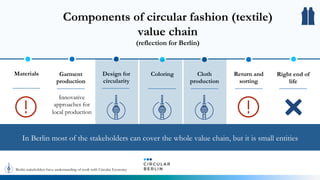
Components of circular fashion (textile)
value chain
(reflection for Berlin)
Design for
circularity
Right end of
life
Materials Coloring Cloth
production
Return and
sorting
Garment
production
Innovative
approaches for
local production
In Berlin most of the stakeholders can cover the whole value chain, but it is small entities
Berlin stakeholders have understanding of work with Circular Economy
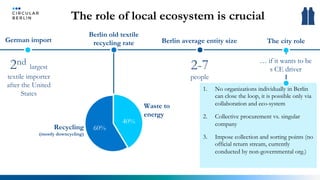
German import Berlin average entity size
2-7
people
The role of local ecosystem is crucial
1.  No organizations individually in Berlin
can close the loop, it is possible only via
collaboration and eco-system
2.  Collective procurement vs. singular
company
3.  Impose collection and sorting points (no
official return stream, currently
conducted by non-governmental org.)
… if it wants to be
s CE driver
The city role
2nd largest
textile importer
after the United
States
Berlin old textile
recycling rate
Waste to
energy
Recycling
(mostly downcycling)
40%
60%
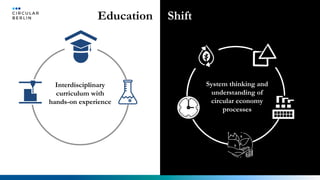
Interdisciplinary
curriculum with
hands-on experience
System thinking and
understanding of
circular economy
processes
Education Shift
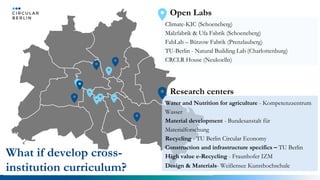
Climate-KIC (Schoeneberg)
Malzfabrik & Ufa Fabrik (Schoeneberg)
FabLab – Bützow Fabrik (Prenzlauberg)
TU-Berlin - Natural Building Lab (Charlottenburg)
CRCLR House (Neukoelln)
Open Labs
Water and Nutrition for agriculture - Kompetenzzentrum
Wasser
Material development - Bundesanstalt für
Materialforschung
Recycling - TU Berlin Circular Economy
Construction and infrastructure specifics – TU Berlin
High value e-Recycling - Fraunhofer IZM
Design & Materials- Weißensee Kunsthochschule
Research centers
What if develop cross-
institution curriculum?
Circular Berlin aims to provide an engagement platform
for diverse stakeholders with the mission to accelerate the
transition to circularity through the joint development of
practical and scalable solutions on the local level
JOIN THE PROJECT
SHARE YOUR CIRCULR WORK
SHAPE BERLIN CIRCULAR AGENDA www.circular.berlin

Circular Economy: from concept to implementation - Berlin perspective.

  • 1.
    23.07.2018 The future movescircular – a bio based life cycle in mobility Circular Economy: from concept to implementation - Berlin perspective Dina Padalkina Circular Berlin, Initiative lead www.circular.berlin This activity has received funding from the European Institute of Innovation and Technology (EIT), a body of the European Union under Horizon 2020, the EU Framework programme for research and innovation.
  • 2.
    Circular Economy Cradle to Cradle Materialsand design Performance economy Life time extension and services Biomimicry Design inspired by nature Industrial ecology Material and energy flow Natural capitalism Stock of natural asset (soil, water, air, biodiversity) Blue economy Solutions deter. by local environment Regenerative design Design by regenerative processes Product and process design Material use and localization Ownership
  • 3.
    Regulation change Education onsystem thinking and processes Different design, processes and business operation Transition to Circular Economy is possible through system shift
  • 4.
    In Berlin, CircularEconomy evolves as a bottom-up heterogeneous system Circular Economy (Kreislaufwirtschaft) is decoupled from the economy, remaining part of the waste industry Zero Waste agenda has an important role for Berlin, but it focuses mostly on waste prevention strategies Question for circular Berlin: How to connect a circular economy with the economy on a city level? Vision Now
  • 5.
    A building isa product with the very long lifespan
  • 6.
    Components of circularconstruction value chain (reflection for Berlin) Material for CE Deconstructi on Property owner Building as Material DB* Execution/ construction UtilizationDesign and planning for CE * DB – data bank No high valued building refurbishment Different approach into utilization Possible to import, but in no local production Global trend - premature demolishing (up to 75 years) to give life a new construction, but in Berlin a lot of buildings repurpose Berlin stakeholders have understanding of work with Circular Economy
  • 7.
    Population 3,5 million Dwelling (residential & non-residential) 1,9 million State-owned Cooperatively owned Privately owned 15% 10% Berlin constructionfocus Affordable living ~ minimization construction costs 1.  Building repurpose policy instead of demolishing – preferences for modular construction / flexible building structures 2.  Standards for building construction also for privately owned building 3.  Use existing green building regulations also for privately owned building … if it wants to be s CE driver The city role The role of ownership is crucial
  • 8.
  • 9.
    Components of circularfashion (textile) value chain (reflection for Berlin) Design for circularity Right end of life Materials Coloring Cloth production Return and sorting Garment production Innovative approaches for local production In Berlin most of the stakeholders can cover the whole value chain, but it is small entities Berlin stakeholders have understanding of work with Circular Economy
  • 10.
    German import Berlinaverage entity size 2-7 people The role of local ecosystem is crucial 1.  No organizations individually in Berlin can close the loop, it is possible only via collaboration and eco-system 2.  Collective procurement vs. singular company 3.  Impose collection and sorting points (no official return stream, currently conducted by non-governmental org.) … if it wants to be s CE driver The city role 2nd largest textile importer after the United States Berlin old textile recycling rate Waste to energy Recycling (mostly downcycling) 40% 60%
  • 11.
    Interdisciplinary curriculum with hands-on experience Systemthinking and understanding of circular economy processes Education Shift
  • 12.
    Climate-KIC (Schoeneberg) Malzfabrik &Ufa Fabrik (Schoeneberg) FabLab – Bützow Fabrik (Prenzlauberg) TU-Berlin - Natural Building Lab (Charlottenburg) CRCLR House (Neukoelln) Open Labs Water and Nutrition for agriculture - Kompetenzzentrum Wasser Material development - Bundesanstalt für Materialforschung Recycling - TU Berlin Circular Economy Construction and infrastructure specifics – TU Berlin High value e-Recycling - Fraunhofer IZM Design & Materials- Weißensee Kunsthochschule Research centers What if develop cross- institution curriculum?
  • 13.
    Circular Berlin aimsto provide an engagement platform for diverse stakeholders with the mission to accelerate the transition to circularity through the joint development of practical and scalable solutions on the local level JOIN THE PROJECT SHARE YOUR CIRCULR WORK SHAPE BERLIN CIRCULAR AGENDA www.circular.berlin