SAVING AND INVESTMENT IN INDIA
&
RESOURCE MOBILISATION FOR
PLANNING

DR. LAXMI NARAYAN

ASSISTANT PROFESSOR OF ECONOMICS

GOVT. COLLEGE FOR WOMEN, BHODIA KHERA
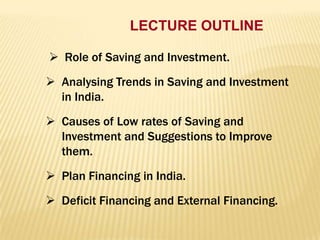
LECTURE OUTLINE
 Role of Saving and Investment.
 Analysing Trends in Saving and Investment
in India.
 Causes of Low rates of Saving and
Investment and Suggestions to Improve
them.
 Plan Financing in India.

 Deficit Financing and External Financing.
SAVING
AND
INVESTMENT
IN INDIA
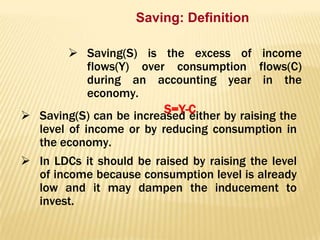
Saving: Definition
 Saving(S) is the excess of income
flows(Y) over consumption flows(C)
during an accounting year in the
economy.
S=Y-C
 Saving(S) can be increased either by raising the
level of income or by reducing consumption in
the economy.
 In LDCs it should be raised by raising the level
of income because consumption level is already
low and it may dampen the inducement to
invest.
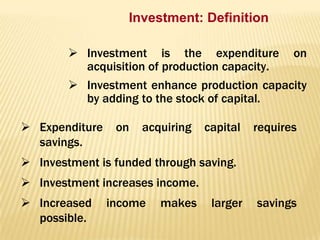
Investment: Definition
 Investment is the expenditure
acquisition of production capacity.

on

 Investment enhance production capacity
by adding to the stock of capital.
 Expenditure
savings.

on

acquiring

capital

requires

 Investment is funded through saving.
 Investment increases income.
 Increased
possible.

income

makes

larger

savings
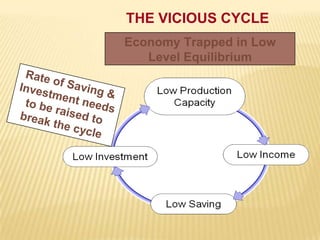
THE VICIOUS CYCLE
Economy Trapped in Low
Level Equilibrium
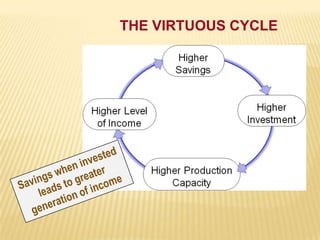
THE VIRTUOUS CYCLE
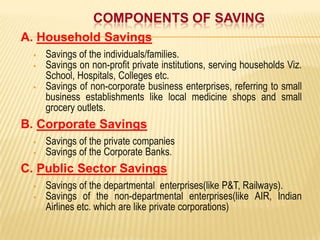
COMPONENTS OF SAVING
A. Household Savings




Savings of the individuals/families.
Savings on non-profit private institutions, serving households Viz.
School, Hospitals, Colleges etc.
Savings of non-corporate business enterprises, referring to small
business establishments like local medicine shops and small
grocery outlets.

B. Corporate Savings



Savings of the private companies
Savings of the Corporate Banks.

C. Public Sector Savings



Savings of the departmental enterprises(like P&T, Railways).
Savings of the non-departmental enterprises(like AIR, Indian
Airlines etc. which are like private corporations)
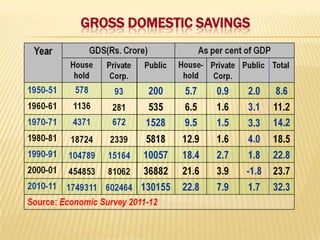
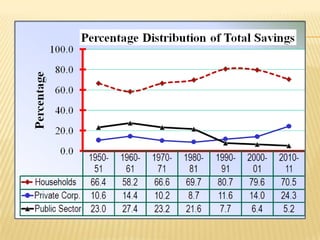
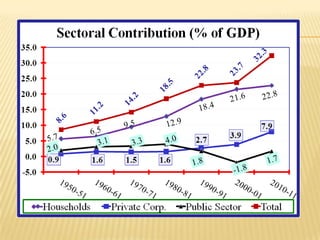
GROSS DOMESTIC SAVINGS
INVESTMENT IN INDIA
A. Investment(Capital Formation)





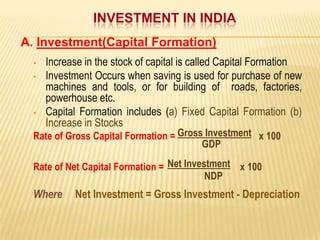
Increase in the stock of capital is called Capital Formation
Investment Occurs when saving is used for purchase of new
machines and tools, or for building of roads, factories,
powerhouse etc.
Capital Formation includes (a) Fixed Capital Formation (b)
Increase in Stocks

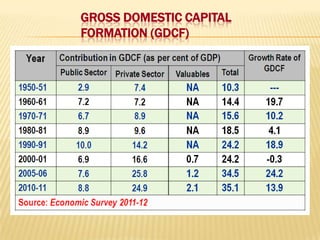
Rate of Gross Capital Formation = Gross Investment x 100
GDP
Rate of Net Capital Formation = Net Investment x 100
NDP

Where

Net Investment = Gross Investment - Depreciation
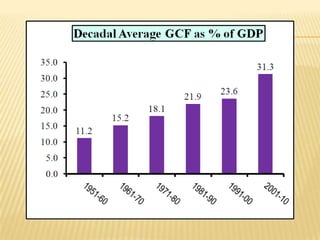
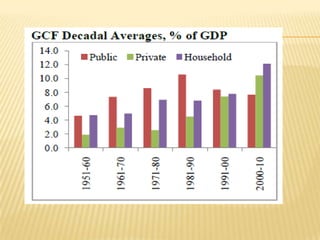
GROSS DOMESTIC CAPITAL
FORMATION (GDCF)
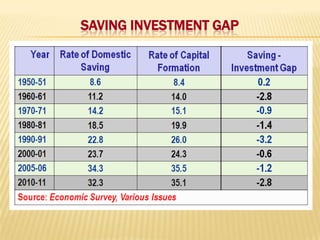
SAVING INVESTMENT GAP
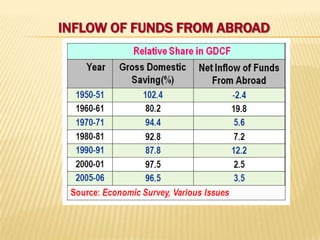
INFLOW OF FUNDS FROM ABROAD
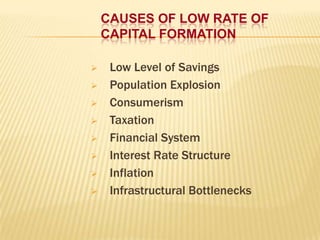
CAUSES OF LOW RATE OF
CAPITAL FORMATION









Low Level of Savings
Population Explosion
Consumerism
Taxation
Financial System
Interest Rate Structure
Inflation
Infrastructural Bottlenecks
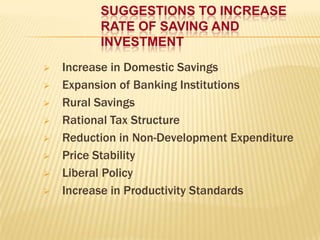
SUGGESTIONS TO INCREASE
RATE OF SAVING AND
INVESTMENT









Increase in Domestic Savings
Expansion of Banking Institutions
Rural Savings
Rational Tax Structure
Reduction in Non-Development Expenditure
Price Stability
Liberal Policy
Increase in Productivity Standards
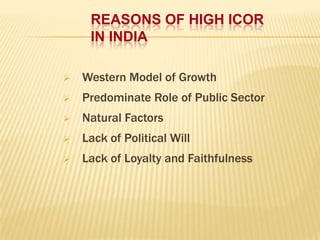
REASONS OF HIGH ICOR
IN INDIA


Western Model of Growth



Predominate Role of Public Sector



Natural Factors



Lack of Political Will



Lack of Loyalty and Faithfulness
RESOURCE
MOBILISATION
FOR
PLANNING
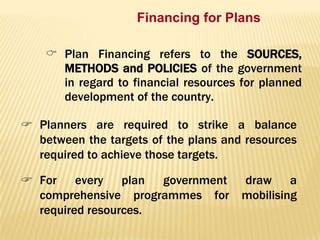
Financing for Plans
 Plan Financing refers to the SOURCES,
METHODS and POLICIES of the government
in regard to financial resources for planned
development of the country.

 Planners are required to strike a balance
between the targets of the plans and resources
required to achieve those targets.
 For every plan government
comprehensive programmes for
required resources.

draw a
mobilising
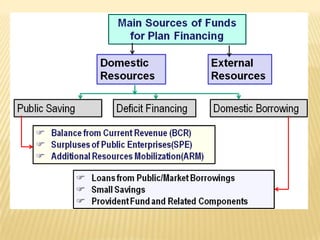
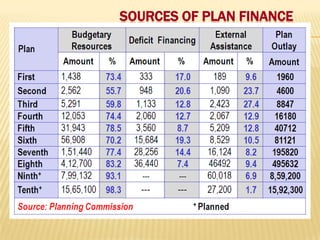
SOURCES OF PLAN FINANCE
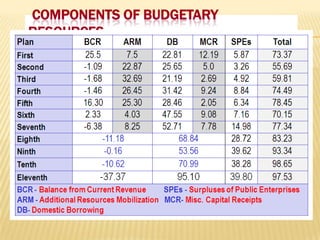
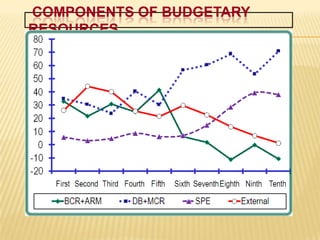
COMPONENTS OF BUDGETARY
RESOURCES
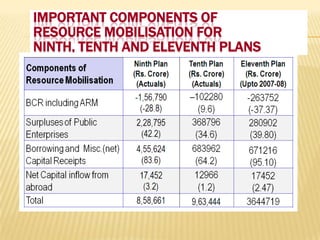
IMPORTANT COMPONENTS OF
RESOURCE MOBILISATION FOR
NINTH, TENTH AND ELEVENTH PLANS
COMPONENTS OF BUDGETARY
RESOURCES
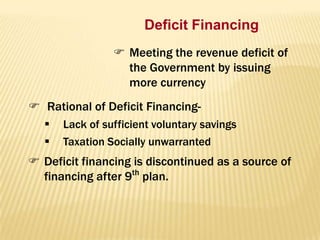
Deficit Financing
 Meeting the revenue deficit of
the Government by issuing
more currency
 Rational of Deficit Financing


Lack of sufficient voluntary savings
Taxation Socially unwarranted

 Deficit financing is discontinued as a source of
financing after 9th plan.
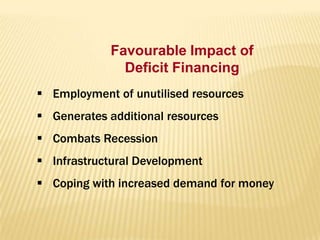
Favourable Impact of
Deficit Financing
 Employment of unutilised resources

 Generates additional resources
 Combats Recession

 Infrastructural Development
 Coping with increased demand for money
Unfavourable Impact of
Deficit Financing







Changes in the pattern of Investment
Increase in money supply and Price Level
Increase in Consumerism
BOP Deficit
Price Rise and Inequality
Increase in the Cost of Planning
NEW/KEY TERMS







 Rate of Domestic Saving
 Saving-Invetsment Gap
 BCR
 ARM
Gross domestic Capital Formation
Incremental Capital Output Ratio
Deficit Financing
External Resource Mobilisation
Domestic Resource Mobilisation
REFERENCES
 Jain & Majhi, “Economic
Development and Policy in India”
V.K. Global Publications.

 R.K. Misra & V.K.Puri, “Indian
Economy” Himalaya
Publications.
Ruddar Dutt and K.P.M. Sundaram, “Indian
Economy” Sultan Chand.
Uma Kapila, “Understanding the Problems Of
Indian Economy” Academic Foundation.
FAQs
 Discuss the main source of
financing India’s Five Year Plans?
 Explain the role of foreign capital
in financing India’s Five Year
Plans?
 Critically examine the role of deficit financing in
Indian economic planning.
 Do you think present rates of savings and capital
formation are adequate in India? How these can be
improved?
 Critically examine the recent trends in Savings and
investment in India?
Resource mobilisation in india

Resource mobilisation in india

  • 1.
    SAVING AND INVESTMENTIN INDIA & RESOURCE MOBILISATION FOR PLANNING DR. LAXMI NARAYAN ASSISTANT PROFESSOR OF ECONOMICS GOVT. COLLEGE FOR WOMEN, BHODIA KHERA
  • 2.
    LECTURE OUTLINE  Roleof Saving and Investment.  Analysing Trends in Saving and Investment in India.  Causes of Low rates of Saving and Investment and Suggestions to Improve them.  Plan Financing in India.  Deficit Financing and External Financing.
  • 3.
  • 4.
    Saving: Definition  Saving(S)is the excess of income flows(Y) over consumption flows(C) during an accounting year in the economy. S=Y-C  Saving(S) can be increased either by raising the level of income or by reducing consumption in the economy.  In LDCs it should be raised by raising the level of income because consumption level is already low and it may dampen the inducement to invest.
  • 5.
    Investment: Definition  Investmentis the expenditure acquisition of production capacity. on  Investment enhance production capacity by adding to the stock of capital.  Expenditure savings. on acquiring capital requires  Investment is funded through saving.  Investment increases income.  Increased possible. income makes larger savings
  • 6.
    THE VICIOUS CYCLE EconomyTrapped in Low Level Equilibrium
  • 7.
  • 8.
    COMPONENTS OF SAVING A.Household Savings    Savings of the individuals/families. Savings on non-profit private institutions, serving households Viz. School, Hospitals, Colleges etc. Savings of non-corporate business enterprises, referring to small business establishments like local medicine shops and small grocery outlets. B. Corporate Savings   Savings of the private companies Savings of the Corporate Banks. C. Public Sector Savings   Savings of the departmental enterprises(like P&T, Railways). Savings of the non-departmental enterprises(like AIR, Indian Airlines etc. which are like private corporations)
  • 9.
  • 12.
    INVESTMENT IN INDIA A.Investment(Capital Formation)    Increase in the stock of capital is called Capital Formation Investment Occurs when saving is used for purchase of new machines and tools, or for building of roads, factories, powerhouse etc. Capital Formation includes (a) Fixed Capital Formation (b) Increase in Stocks Rate of Gross Capital Formation = Gross Investment x 100 GDP Rate of Net Capital Formation = Net Investment x 100 NDP Where Net Investment = Gross Investment - Depreciation
  • 13.
  • 16.
  • 17.
    INFLOW OF FUNDSFROM ABROAD
  • 18.
    CAUSES OF LOWRATE OF CAPITAL FORMATION         Low Level of Savings Population Explosion Consumerism Taxation Financial System Interest Rate Structure Inflation Infrastructural Bottlenecks
  • 19.
    SUGGESTIONS TO INCREASE RATEOF SAVING AND INVESTMENT         Increase in Domestic Savings Expansion of Banking Institutions Rural Savings Rational Tax Structure Reduction in Non-Development Expenditure Price Stability Liberal Policy Increase in Productivity Standards
  • 20.
    REASONS OF HIGHICOR IN INDIA  Western Model of Growth  Predominate Role of Public Sector  Natural Factors  Lack of Political Will  Lack of Loyalty and Faithfulness
  • 21.
  • 22.
    Financing for Plans Plan Financing refers to the SOURCES, METHODS and POLICIES of the government in regard to financial resources for planned development of the country.  Planners are required to strike a balance between the targets of the plans and resources required to achieve those targets.  For every plan government comprehensive programmes for required resources. draw a mobilising
  • 24.
  • 25.
  • 26.
    IMPORTANT COMPONENTS OF RESOURCEMOBILISATION FOR NINTH, TENTH AND ELEVENTH PLANS
  • 27.
  • 28.
    Deficit Financing  Meetingthe revenue deficit of the Government by issuing more currency  Rational of Deficit Financing  Lack of sufficient voluntary savings Taxation Socially unwarranted  Deficit financing is discontinued as a source of financing after 9th plan.
  • 29.
    Favourable Impact of DeficitFinancing  Employment of unutilised resources  Generates additional resources  Combats Recession  Infrastructural Development  Coping with increased demand for money
  • 30.
    Unfavourable Impact of DeficitFinancing       Changes in the pattern of Investment Increase in money supply and Price Level Increase in Consumerism BOP Deficit Price Rise and Inequality Increase in the Cost of Planning
  • 31.
    NEW/KEY TERMS       Rateof Domestic Saving  Saving-Invetsment Gap  BCR  ARM Gross domestic Capital Formation Incremental Capital Output Ratio Deficit Financing External Resource Mobilisation Domestic Resource Mobilisation
  • 32.
    REFERENCES  Jain &Majhi, “Economic Development and Policy in India” V.K. Global Publications.  R.K. Misra & V.K.Puri, “Indian Economy” Himalaya Publications. Ruddar Dutt and K.P.M. Sundaram, “Indian Economy” Sultan Chand. Uma Kapila, “Understanding the Problems Of Indian Economy” Academic Foundation.
  • 33.
    FAQs  Discuss themain source of financing India’s Five Year Plans?  Explain the role of foreign capital in financing India’s Five Year Plans?  Critically examine the role of deficit financing in Indian economic planning.  Do you think present rates of savings and capital formation are adequate in India? How these can be improved?  Critically examine the recent trends in Savings and investment in India?