Financial plannig
 It refers to the process of streamlining the income,
expense, assets and liabilities of the household to take
care of both current and future need for funds
Need for Financial planning
 Financial planning aims at ensuring that a household
has adequate income or resources to meet current and
future expense and needs
 Current income of the household must also provide for
a time when there will be no or low income being
generated(eg. retirement period)
 To fulfill unexpected expenses which are not budgeted,
such as a large medical expense
 Education of children or buying a home.
Key points of financial planning
 It enables better management of personal financial
situation
 It works primararily through identification of key
goals.
 It puts in place an action plan to realign the finances to
meet financial goals.
 It is the exercise of ensuring that a household has
adequate income or resources to meet current and
future expenses or needs
Financial goals
 Financial goal is the term used to describe the future
needs of an individual that require funding. It specifies
the sum of money required in order to meet the need
and when it is required.
 Goals described in terms of the money required to
meet it at a point of time in a future, is called as
FINANCIAL GOAL
Exampels of financial goals
 Rs. 30 lakhs are required in five years for child’s college
admission.
 RS. 20 lakhs are reuired after 3 years as a downpayment
for a new house
 Rs 3 lakhs required each month after 10 years to meet
household expenses in retirement.
Each financial goal contains two
components
 Goal value
 Time to goal or investment horizon
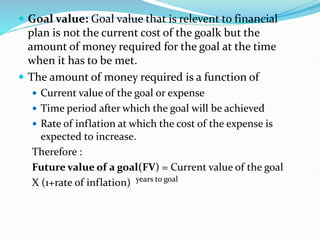
 Goal value: Goal value that is relevent to financial
plan is not the current cost of the goalk but the
amount of money required for the goal at the time
when it has to be met.
 The amount of money required is a function of
 Current value of the goal or expense
 Time period after which the goal will be achieved
 Rate of inflation at which the cost of the expense is
expected to increase.
Therefore :
Future value of a goal(FV) = Current value of the goal
X (1+rate of inflation) years to goal
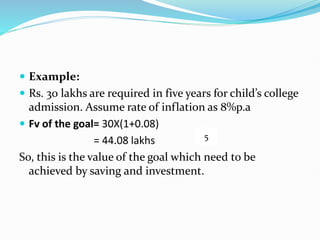
 Example:
 Rs. 30 lakhs are required in five years for child’s college
admission. Assume rate of inflation as 8%p.a
 Fv of the goal= 30X(1+0.08)
= 44.08 lakhs
So, this is the value of the goal which need to be
achieved by saving and investment.
5
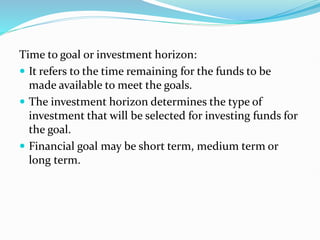
Time to goal or investment horizon:
 It refers to the time remaining for the funds to be
made available to meet the goals.
 The investment horizon determines the type of
investment that will be selected for investing funds for
the goal.
 Financial goal may be short term, medium term or
long term.
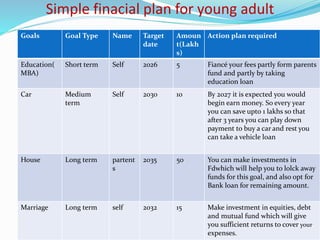
Simple finacial plan for young adult
Goals Goal Type Name Target
date
Amoun
t(Lakh
s)
Action plan required
Education(
MBA)
Short term Self 2026 5 Fiancé your fees partly form parents
fund and partly by taking
education loan
Car Medium
term
Self 2030 10 By 2027 it is expected you would
begin earn money. So every year
you can save upto 1 lakhs so that
after 3 years you can play down
payment to buy a car and rest you
can take a vehicle loan
House Long term partent
s
2035 50 You can make investments in
Fdwhich will help you to lolck away
funds for this goal, and also opt for
Bank loan for remaining amount.
Marriage Long term self 2032 15 Make investment in equities, debt
and mutual fund which will give
you sufficient returns to cover your
expenses.
Economics
 British economist Alfred Marshall defined economics
as “ The study of man in the ordinary business life”
Key concept terms
Income
 It refers to the money that a person or entity receives in
exchange for their labour or products.
 Broadly income can be classified as business income,
personal income and income from investments
 Some types of incomes are:
 Wages
 Salaries
 Commission
 Revenue
 Interest
 Investment return
 Llowance/Pocket money
 Government pensions, Gratuity payments
Expenditure
 It refers to the act of spending time, energy or money
on something.
 In economics its mmoney spend on purchasing goods
or services
 Exampels of business expenses include:
 Payment of wages or salaries
 Factory/ office lease/rent payments
 Payment made to vendors for services
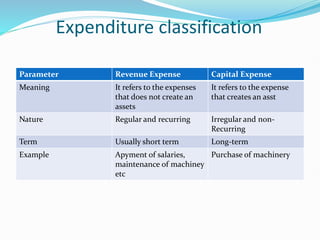
Expenditure classification
Parameter Revenue Expense Capital Expense
Meaning It refers to the expenses
that does not create an
assets
It refers to the expense
that creates an asst
Nature Regular and recurring Irregular and non-
Recurring
Term Usually short term Long-term
Example Apyment of salaries,
maintenance of machiney
etc
Purchase of machinery
Savings
 It refers to the individuals unspent earnings. It is the
amount that remains after meeting the household
expenses and other personal expenses over a given
period.
 Savings= income- expense
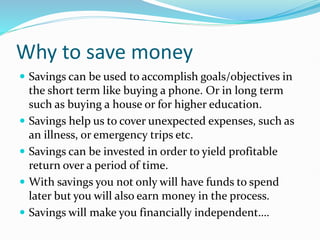
Why to save money
 Savings can be used to accomplish goals/objectives in
the short term like buying a phone. Or in long term
such as buying a house or for higher education.
 Savings help us to cover unexpected expenses, such as
an illness, or emergency trips etc.
 Savings can be invested in order to yield profitable
return over a period of time.
 With savings you not only will have funds to spend
later but you will also earn money in the process.
 Savings will make you financially independent….
Asset
 Assets are the items your company/person owns that
can provide future economic benefit.
Liability
 Liabilities are what Company/person owe other
parties.
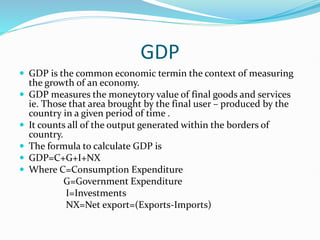
GDP
 GDP is the common economic termin the context of measuring
the growth of an economy.
 GDP measures the moneytory value of final goods and services
ie. Those that area brought by the final user – produced by the
country in a given period of time .
 It counts all of the output generated within the borders of
country.
 The formula to calculate GDP is
 GDP=C+G+I+NX
 Where C=Consumption Expenditure
G=Government Expenditure
I=Investments
NX=Net export=(Exports-Imports)
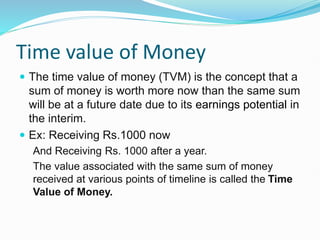
Time value of Money
 The time value of money (TVM) is the concept that a
sum of money is worth more now than the same sum
will be at a future date due to its earnings potential in
the interim.
 Ex: Receiving Rs.1000 now
And Receiving Rs. 1000 after a year.
The value associated with the same sum of money
received at various points of timeline is called the Time
Value of Money.
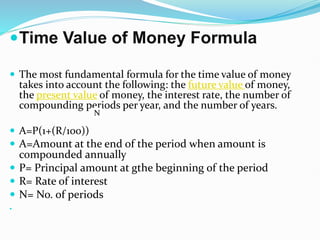
Time Value of Money Formula
 The most fundamental formula for the time value of money
takes into account the following: the future value of money,
the present value of money, the interest rate, the number of
compounding periods per year, and the number of years.
 A=P(1+(R/100))
 A=Amount at the end of the period when amount is
compounded annually
 P= Principal amount at gthe beginning of the period
 R= Rate of interest
 N= No. of periods

N
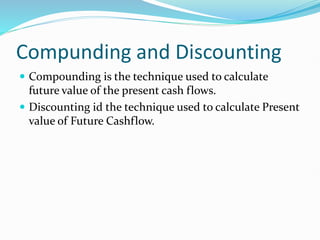
Compunding and Discounting
 Compounding is the technique used to calculate
future value of the present cash flows.
 Discounting id the technique used to calculate Present
value of Future Cashflow.
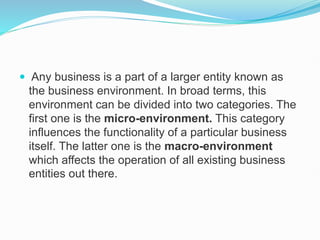
 Any business is a part of a larger entity known as
the business environment. In broad terms, this
environment can be divided into two categories. The
first one is the micro-environment. This category
influences the functionality of a particular business
itself. The latter one is the macro-environment
which affects the operation of all existing business
entities out there.
Factors influencing Decision making
(Macro/Micro environment)
 The two categories may be different, but both are
essential to understand in order to truly see your
business in its full context.
Micro-environment factors
 The micro-environment is basically the environment
that has a direct impact on your business. It is
related to the particular area where your company
operates and can directly affect all of your business
processes. In other words, it consists of all the
factors that affect particularly your business. They
have the ability to influence your daily proceedings
and general performance of the company. Still, the
effect that they have is not a long-lasting one.
 The micro-environment includes customers,
suppliers, resellers, competitors, and the general
public.
What is the macro-
environment?
 What is the macro-environment?
 The macro-environment is more general - it is
the environment in the economy itself. It has an
effect on how all business groups operate,
perform, make decisions, and form
strategies simultaneously. It is quite dynamic,
which means that a business has to constantly
track its changes. It consists of external factors
that the company itself doesn’t control but is
certainly affected by.
The factors that make up the
macro-environment are
 Economic factors(taxes, interest rates, inflation,
recession)
 Demographic forces (like age, language, cultural
differences, lifestyle )
 technological factors(innovations, Automations,
Internet facilities)
 Natural and physical forces(availability of natural
resources, climate change, pollutuion),
 Political and legal forces(rules and regulations,
laws),
 Social and cultural forces(educaction, population
growth rate, social status, buying habits, religion)
What is a Bank
 As per the Banking Companies Act of 1949, a bank
is a financial institution that dispenses banking and
other financial operations to their customers. A bank
is generally considered as an institution which
provides fundamental banking services such as
providing loans and accepting deposits.
Banking in India
 Banking in India forms the base for the
economic development of the country.
 The History of Banking in India dates
back to before India got independence
in 1947.
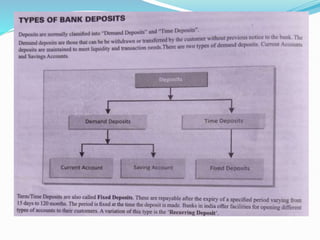
Types of deposits
 Traditionally in India, we have four
major types of Bank Deposits, namely
Current Accounts, Savings Accounts,
Recurring Deposits, and Fixed Deposits,
each with varying advantages.
 However these days, some banks have
also introduced many new products,
which combine the features of two or
more types of bank deposits like 2-in-1
Deposits, Power Saving Deposits, Smart
Deposits, etc.
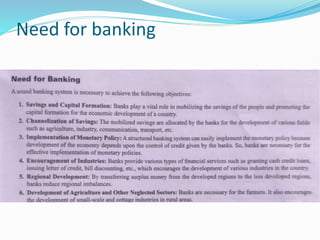
Need for banking
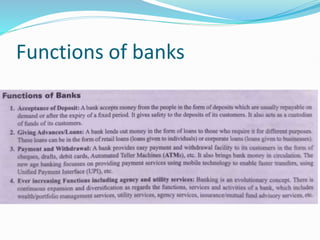
Functions of banks
Foundation for Finance.pptx

Foundation for Finance.pptx

  • 2.
    Financial plannig  Itrefers to the process of streamlining the income, expense, assets and liabilities of the household to take care of both current and future need for funds
  • 3.
    Need for Financialplanning  Financial planning aims at ensuring that a household has adequate income or resources to meet current and future expense and needs  Current income of the household must also provide for a time when there will be no or low income being generated(eg. retirement period)  To fulfill unexpected expenses which are not budgeted, such as a large medical expense  Education of children or buying a home.
  • 4.
    Key points offinancial planning  It enables better management of personal financial situation  It works primararily through identification of key goals.  It puts in place an action plan to realign the finances to meet financial goals.  It is the exercise of ensuring that a household has adequate income or resources to meet current and future expenses or needs
  • 5.
    Financial goals  Financialgoal is the term used to describe the future needs of an individual that require funding. It specifies the sum of money required in order to meet the need and when it is required.  Goals described in terms of the money required to meet it at a point of time in a future, is called as FINANCIAL GOAL
  • 6.
    Exampels of financialgoals  Rs. 30 lakhs are required in five years for child’s college admission.  RS. 20 lakhs are reuired after 3 years as a downpayment for a new house  Rs 3 lakhs required each month after 10 years to meet household expenses in retirement.
  • 7.
    Each financial goalcontains two components  Goal value  Time to goal or investment horizon
  • 8.
     Goal value:Goal value that is relevent to financial plan is not the current cost of the goalk but the amount of money required for the goal at the time when it has to be met.  The amount of money required is a function of  Current value of the goal or expense  Time period after which the goal will be achieved  Rate of inflation at which the cost of the expense is expected to increase. Therefore : Future value of a goal(FV) = Current value of the goal X (1+rate of inflation) years to goal
  • 9.
     Example:  Rs.30 lakhs are required in five years for child’s college admission. Assume rate of inflation as 8%p.a  Fv of the goal= 30X(1+0.08) = 44.08 lakhs So, this is the value of the goal which need to be achieved by saving and investment. 5
  • 10.
    Time to goalor investment horizon:  It refers to the time remaining for the funds to be made available to meet the goals.  The investment horizon determines the type of investment that will be selected for investing funds for the goal.  Financial goal may be short term, medium term or long term.
  • 11.
    Simple finacial planfor young adult Goals Goal Type Name Target date Amoun t(Lakh s) Action plan required Education( MBA) Short term Self 2026 5 Fiancé your fees partly form parents fund and partly by taking education loan Car Medium term Self 2030 10 By 2027 it is expected you would begin earn money. So every year you can save upto 1 lakhs so that after 3 years you can play down payment to buy a car and rest you can take a vehicle loan House Long term partent s 2035 50 You can make investments in Fdwhich will help you to lolck away funds for this goal, and also opt for Bank loan for remaining amount. Marriage Long term self 2032 15 Make investment in equities, debt and mutual fund which will give you sufficient returns to cover your expenses.
  • 12.
    Economics  British economistAlfred Marshall defined economics as “ The study of man in the ordinary business life”
  • 13.
    Key concept terms Income It refers to the money that a person or entity receives in exchange for their labour or products.  Broadly income can be classified as business income, personal income and income from investments  Some types of incomes are:  Wages  Salaries  Commission  Revenue  Interest  Investment return  Llowance/Pocket money  Government pensions, Gratuity payments
  • 14.
    Expenditure  It refersto the act of spending time, energy or money on something.  In economics its mmoney spend on purchasing goods or services  Exampels of business expenses include:  Payment of wages or salaries  Factory/ office lease/rent payments  Payment made to vendors for services
  • 15.
    Expenditure classification Parameter RevenueExpense Capital Expense Meaning It refers to the expenses that does not create an assets It refers to the expense that creates an asst Nature Regular and recurring Irregular and non- Recurring Term Usually short term Long-term Example Apyment of salaries, maintenance of machiney etc Purchase of machinery
  • 16.
    Savings  It refersto the individuals unspent earnings. It is the amount that remains after meeting the household expenses and other personal expenses over a given period.  Savings= income- expense
  • 17.
    Why to savemoney  Savings can be used to accomplish goals/objectives in the short term like buying a phone. Or in long term such as buying a house or for higher education.  Savings help us to cover unexpected expenses, such as an illness, or emergency trips etc.  Savings can be invested in order to yield profitable return over a period of time.  With savings you not only will have funds to spend later but you will also earn money in the process.  Savings will make you financially independent….
  • 18.
    Asset  Assets arethe items your company/person owns that can provide future economic benefit.
  • 19.
    Liability  Liabilities arewhat Company/person owe other parties.
  • 20.
    GDP  GDP isthe common economic termin the context of measuring the growth of an economy.  GDP measures the moneytory value of final goods and services ie. Those that area brought by the final user – produced by the country in a given period of time .  It counts all of the output generated within the borders of country.  The formula to calculate GDP is  GDP=C+G+I+NX  Where C=Consumption Expenditure G=Government Expenditure I=Investments NX=Net export=(Exports-Imports)
  • 21.
    Time value ofMoney  The time value of money (TVM) is the concept that a sum of money is worth more now than the same sum will be at a future date due to its earnings potential in the interim.  Ex: Receiving Rs.1000 now And Receiving Rs. 1000 after a year. The value associated with the same sum of money received at various points of timeline is called the Time Value of Money.
  • 22.
    Time Value ofMoney Formula  The most fundamental formula for the time value of money takes into account the following: the future value of money, the present value of money, the interest rate, the number of compounding periods per year, and the number of years.  A=P(1+(R/100))  A=Amount at the end of the period when amount is compounded annually  P= Principal amount at gthe beginning of the period  R= Rate of interest  N= No. of periods  N
  • 23.
    Compunding and Discounting Compounding is the technique used to calculate future value of the present cash flows.  Discounting id the technique used to calculate Present value of Future Cashflow.
  • 24.
     Any businessis a part of a larger entity known as the business environment. In broad terms, this environment can be divided into two categories. The first one is the micro-environment. This category influences the functionality of a particular business itself. The latter one is the macro-environment which affects the operation of all existing business entities out there.
  • 25.
    Factors influencing Decisionmaking (Macro/Micro environment)  The two categories may be different, but both are essential to understand in order to truly see your business in its full context.
  • 26.
    Micro-environment factors  Themicro-environment is basically the environment that has a direct impact on your business. It is related to the particular area where your company operates and can directly affect all of your business processes. In other words, it consists of all the factors that affect particularly your business. They have the ability to influence your daily proceedings and general performance of the company. Still, the effect that they have is not a long-lasting one.  The micro-environment includes customers, suppliers, resellers, competitors, and the general public.
  • 27.
    What is themacro- environment?  What is the macro-environment?  The macro-environment is more general - it is the environment in the economy itself. It has an effect on how all business groups operate, perform, make decisions, and form strategies simultaneously. It is quite dynamic, which means that a business has to constantly track its changes. It consists of external factors that the company itself doesn’t control but is certainly affected by.
  • 28.
    The factors thatmake up the macro-environment are  Economic factors(taxes, interest rates, inflation, recession)  Demographic forces (like age, language, cultural differences, lifestyle )  technological factors(innovations, Automations, Internet facilities)  Natural and physical forces(availability of natural resources, climate change, pollutuion),  Political and legal forces(rules and regulations, laws),  Social and cultural forces(educaction, population growth rate, social status, buying habits, religion)
  • 29.
    What is aBank  As per the Banking Companies Act of 1949, a bank is a financial institution that dispenses banking and other financial operations to their customers. A bank is generally considered as an institution which provides fundamental banking services such as providing loans and accepting deposits.
  • 30.
    Banking in India Banking in India forms the base for the economic development of the country.  The History of Banking in India dates back to before India got independence in 1947.
  • 31.
    Types of deposits Traditionally in India, we have four major types of Bank Deposits, namely Current Accounts, Savings Accounts, Recurring Deposits, and Fixed Deposits, each with varying advantages.  However these days, some banks have also introduced many new products, which combine the features of two or more types of bank deposits like 2-in-1 Deposits, Power Saving Deposits, Smart Deposits, etc.
  • 32.
  • 33.