FORCE
Dr. Susanta Sarkar
Department of Physical Education
University of Kalyani
Introduction
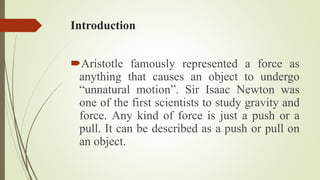
Aristotle famously represented a force as
anything that causes an object to undergo
“unnatural motion”. Sir Isaac Newton was
one of the first scientists to study gravity and
force. Any kind of force is just a push or a
pull. It can be described as a push or pull on
an object.
Definition of Force
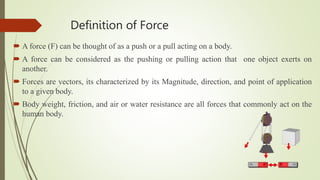
 A force (F) can be thought of as a push or a pull acting on a body.
 A force can be considered as the pushing or pulling action that one object exerts on
another.
 Forces are vectors, its characterized by its Magnitude, direction, and point of application
to a given body.
 Body weight, friction, and air or water resistance are all forces that commonly act on the
human body.
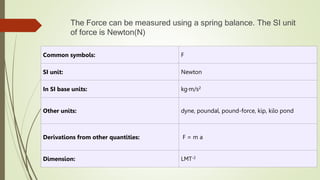
The Force can be measured using a spring balance. The SI unit
of force is Newton(N)
Common symbols: F
SI unit: Newton
In SI base units: kg·m/s2
Other units: dyne, poundal, pound-force, kip, kilo pond
Derivations from other quantities: F = m a
Dimension: LMT-2
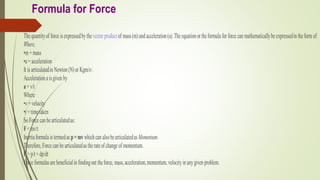
Formula for Force
Types of force
Internal force:
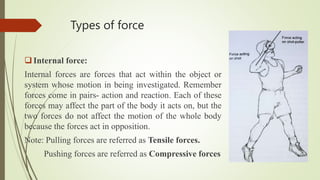
Internal forces are forces that act within the object or
system whose motion in being investigated. Remember
forces come in pairs- action and reaction. Each of these
forces may affect the part of the body it acts on, but the
two forces do not affect the motion of the whole body
because the forces act in opposition.
Note: Pulling forces are referred as Tensile forces.
Pushing forces are referred as Compressive forces
 External force:
External for are those forces that act on an object as a result of its
interaction with the environment surrounding it.
Gravitational force
Action and Reaction force
Friction force
Buoyant force
Fluid dynamic force
Drag force
Lift force
Impact force
Gravitational Force
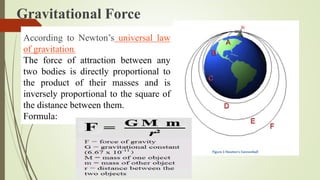
According to Newton’s universal law
of gravitation,
The force of attraction between any
two bodies is directly proportional to
the product of their masses and is
inversely proportional to the square of
the distance between them.
Formula:
Action and Reaction force
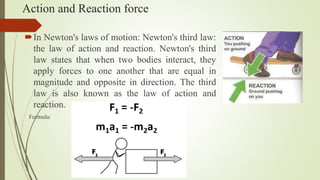
In Newton's laws of motion: Newton's third law:
the law of action and reaction. Newton's third
law states that when two bodies interact, they
apply forces to one another that are equal in
magnitude and opposite in direction. The third
law is also known as the law of action and
reaction.
Formula:
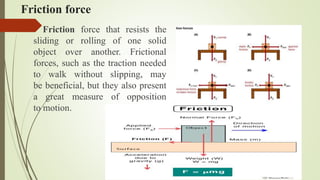
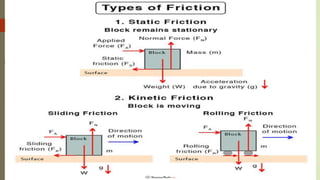
Friction force
 Friction force that resists the
sliding or rolling of one solid
object over another. Frictional
forces, such as the traction needed
to walk without slipping, may
be beneficial, but they also present
a great measure of opposition
to motion.
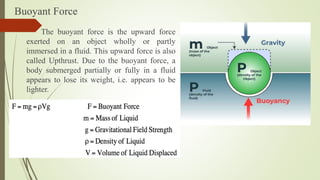
Buoyant Force
The buoyant force is the upward force
exerted on an object wholly or partly
immersed in a fluid. This upward force is also
called Upthrust. Due to the buoyant force, a
body submerged partially or fully in a fluid
appears to lose its weight, i.e. appears to be
lighter.
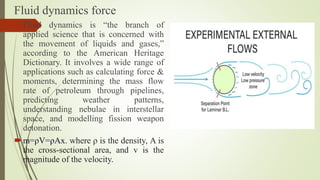
Fluid dynamics force
Fluid dynamics is “the branch of
applied science that is concerned with
the movement of liquids and gases,”
according to the American Heritage
Dictionary. It involves a wide range of
applications such as calculating force &
moments, determining the mass flow
rate of petroleum through pipelines,
predicting weather patterns,
understanding nebulae in interstellar
space, and modelling fission weapon
detonation.
m=ρV=ρAx. where ρ is the density, A is
the cross-sectional area, and v is the
magnitude of the velocity.
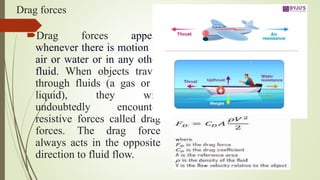
Drag forces
Drag forces appear
whenever there is motion in
air or water or in any other
fluid. When objects travel
through fluids (a gas or a
liquid), they will
undoubtedly encounter
resistive forces called drag
forces. The drag force
always acts in the opposite
direction to fluid flow.
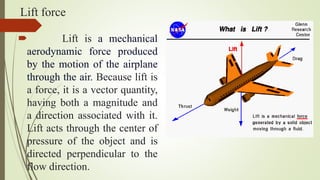
Lift force
 Lift is a mechanical
aerodynamic force produced
by the motion of the airplane
through the air. Because lift is
a force, it is a vector quantity,
having both a magnitude and
a direction associated with it.
Lift acts through the center of
pressure of the object and is
directed perpendicular to the
flow direction.
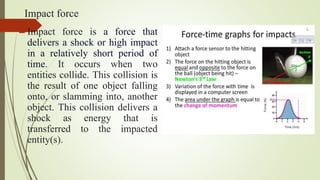
Impact force
Impact force is a force that
delivers a shock or high impact
in a relatively short period of
time. It occurs when two
entities collide. This collision is
the result of one object falling
onto, or slamming into, another
object. This collision delivers a
shock as energy that is
transferred to the impacted
entity(s).
Home work
Applications of Force to Sports
Activities

FORCE.pptx

  • 1.
    FORCE Dr. Susanta Sarkar Departmentof Physical Education University of Kalyani
  • 2.
    Introduction Aristotle famously representeda force as anything that causes an object to undergo “unnatural motion”. Sir Isaac Newton was one of the first scientists to study gravity and force. Any kind of force is just a push or a pull. It can be described as a push or pull on an object.
  • 3.
    Definition of Force A force (F) can be thought of as a push or a pull acting on a body.  A force can be considered as the pushing or pulling action that one object exerts on another.  Forces are vectors, its characterized by its Magnitude, direction, and point of application to a given body.  Body weight, friction, and air or water resistance are all forces that commonly act on the human body.
  • 4.
    The Force canbe measured using a spring balance. The SI unit of force is Newton(N) Common symbols: F SI unit: Newton In SI base units: kg·m/s2 Other units: dyne, poundal, pound-force, kip, kilo pond Derivations from other quantities: F = m a Dimension: LMT-2
  • 5.
  • 6.
    Types of force Internalforce: Internal forces are forces that act within the object or system whose motion in being investigated. Remember forces come in pairs- action and reaction. Each of these forces may affect the part of the body it acts on, but the two forces do not affect the motion of the whole body because the forces act in opposition. Note: Pulling forces are referred as Tensile forces. Pushing forces are referred as Compressive forces
  • 7.
     External force: Externalfor are those forces that act on an object as a result of its interaction with the environment surrounding it. Gravitational force Action and Reaction force Friction force Buoyant force Fluid dynamic force Drag force Lift force Impact force
  • 8.
    Gravitational Force According toNewton’s universal law of gravitation, The force of attraction between any two bodies is directly proportional to the product of their masses and is inversely proportional to the square of the distance between them. Formula:
  • 9.
    Action and Reactionforce In Newton's laws of motion: Newton's third law: the law of action and reaction. Newton's third law states that when two bodies interact, they apply forces to one another that are equal in magnitude and opposite in direction. The third law is also known as the law of action and reaction. Formula:
  • 10.
    Friction force  Frictionforce that resists the sliding or rolling of one solid object over another. Frictional forces, such as the traction needed to walk without slipping, may be beneficial, but they also present a great measure of opposition to motion.
  • 12.
    Buoyant Force The buoyantforce is the upward force exerted on an object wholly or partly immersed in a fluid. This upward force is also called Upthrust. Due to the buoyant force, a body submerged partially or fully in a fluid appears to lose its weight, i.e. appears to be lighter.
  • 13.
    Fluid dynamics force Fluiddynamics is “the branch of applied science that is concerned with the movement of liquids and gases,” according to the American Heritage Dictionary. It involves a wide range of applications such as calculating force & moments, determining the mass flow rate of petroleum through pipelines, predicting weather patterns, understanding nebulae in interstellar space, and modelling fission weapon detonation. m=ρV=ρAx. where ρ is the density, A is the cross-sectional area, and v is the magnitude of the velocity.
  • 14.
    Drag forces Drag forcesappear whenever there is motion in air or water or in any other fluid. When objects travel through fluids (a gas or a liquid), they will undoubtedly encounter resistive forces called drag forces. The drag force always acts in the opposite direction to fluid flow.
  • 15.
    Lift force  Liftis a mechanical aerodynamic force produced by the motion of the airplane through the air. Because lift is a force, it is a vector quantity, having both a magnitude and a direction associated with it. Lift acts through the center of pressure of the object and is directed perpendicular to the flow direction.
  • 16.
    Impact force Impact forceis a force that delivers a shock or high impact in a relatively short period of time. It occurs when two entities collide. This collision is the result of one object falling onto, or slamming into, another object. This collision delivers a shock as energy that is transferred to the impacted entity(s).
  • 17.
    Home work Applications ofForce to Sports Activities