Reskill or let
them go
Keynote delivered at the Future of
Talent Conference 2021
Angela de Longchamps
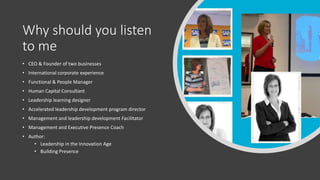
Why should you listen
to me
• CEO & Founder of two businesses
• International corporate experience
• Functional & People Manager
• Human Capital Consultant
• Leadership learning designer
• Accelerated leadership development program director
• Management and leadership development Facilitator
• Management and Executive Presence Coach
• Author:
• Leadership in the Innovation Age
• Building Presence
The BIG wave
• 58% of the workforce will need to
upskill
• 10% increase in skills requirement
for all jobs every year
• 33% of IT skills are obsolete after 3
years
Source:Gartner & TalentNeuron
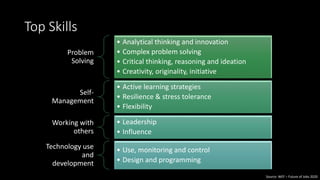
Top Skills
Problem
Solving
• Analytical thinking and innovation
• Complex problem solving
• Critical thinking, reasoning and ideation
• Creativity, originality, initiative
Self-
Management
• Active learning strategies
• Resilience & stress tolerance
• Flexibility
Working with
others
• Leadership
• Influence
Technology use
and
development
• Use, monitoring and control
• Design and programming
Source: WEF – Future of Jobs 2020
Who is the “them”?
Reskill or let them go…
Responsibility for
reskilling?
• The employer (HR)
• The employee
• The manager
The Employer (HR)
Rethink
• Career progression
• Skills stacking
• Employment models
• Loyalty, belonging
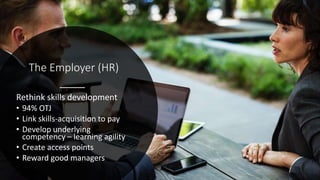
The Employer (HR)
Rethink skills development
• 94% OTJ
• Link skills-acquisition to pay
• Develop underlying
competency – learning agility
• Create access points
• Reward good managers
The Employee
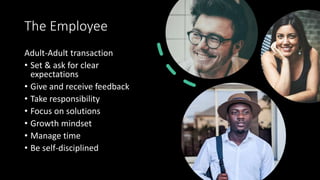
The Employee
Adult-Adult transaction
• Set & ask for clear
expectations
• Give and receive feedback
• Take responsibility
• Focus on solutions
• Growth mindset
• Manage time
• Be self-disciplined
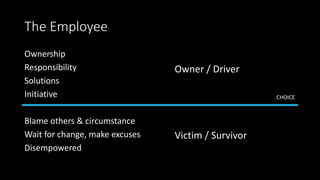
The Employee
Ownership
Responsibility
Solutions
Initiative
Blame others & circumstance
Wait for change, make excuses
Disempowered
Owner / Driver
Victim / Survivor
CHOICE
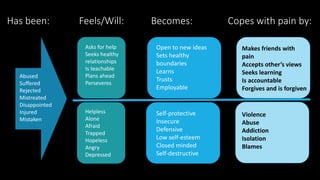
Has been: Feels/Will: Becomes: Copes with pain by:
Abused
Suffered
Rejected
Mistreated
Disappointed
Injured
Mistaken
Asks for help
Seeks healthy
relationships
Is teachable
Plans ahead
Perseveres
Helpless
Alone
Afraid
Trapped
Hopeless
Angry
Depressed
Open to new ideas
Sets healthy
boundaries
Learns
Trusts
Employable
Self-protective
Insecure
Defensive
Low self-esteem
Closed minded
Self-destructive
Violence
Abuse
Addiction
Isolation
Blames
Makes friends with
pain
Accepts other’s views
Seeks learning
Is accountable
Forgives and is forgiven
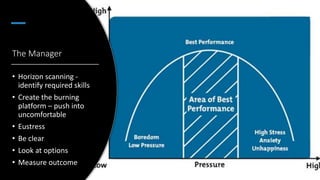
The Manager
• Horizon scanning -
identify required skills
• Create the burning
platform – push into
uncomfortable
• Eustress
• Be clear
• Look at options
• Measure outcome
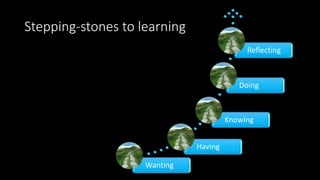
Stepping-stones to learning
Wanting
Having
Knowing
Doing
Reflecting
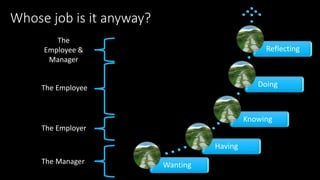
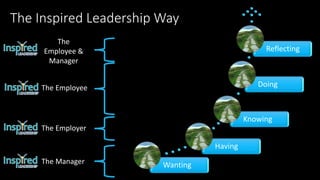
Whose job is it anyway?
Wanting
Having
Knowing
Doing
Reflecting
The Manager
The Employer
The Employee
The
Employee &
Manager
The Inspired Leadership Way
Wanting
Having
Knowing
Doing
Reflecting
The Manager
The Employer
The Employee
The
Employee &
Manager
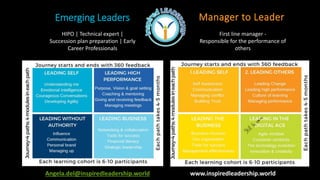
Emerging Leaders Manager to Leader
HIPO | Technical expert |
Succession plan preparation | Early
Career Professionals
First line manager -
Responsible for the performance of
others
Angela.del@inspiredleadership.world www.inspiredleadership.world

Reskill or let them go slide share

  • 1.
    Reskill or let themgo Keynote delivered at the Future of Talent Conference 2021 Angela de Longchamps
  • 2.
    Why should youlisten to me • CEO & Founder of two businesses • International corporate experience • Functional & People Manager • Human Capital Consultant • Leadership learning designer • Accelerated leadership development program director • Management and leadership development Facilitator • Management and Executive Presence Coach • Author: • Leadership in the Innovation Age • Building Presence
  • 3.
    The BIG wave •58% of the workforce will need to upskill • 10% increase in skills requirement for all jobs every year • 33% of IT skills are obsolete after 3 years Source:Gartner & TalentNeuron
  • 4.
    Top Skills Problem Solving • Analyticalthinking and innovation • Complex problem solving • Critical thinking, reasoning and ideation • Creativity, originality, initiative Self- Management • Active learning strategies • Resilience & stress tolerance • Flexibility Working with others • Leadership • Influence Technology use and development • Use, monitoring and control • Design and programming Source: WEF – Future of Jobs 2020
  • 5.
    Who is the“them”? Reskill or let them go…
  • 6.
    Responsibility for reskilling? • Theemployer (HR) • The employee • The manager
  • 7.
    The Employer (HR) Rethink •Career progression • Skills stacking • Employment models • Loyalty, belonging
  • 8.
    The Employer (HR) Rethinkskills development • 94% OTJ • Link skills-acquisition to pay • Develop underlying competency – learning agility • Create access points • Reward good managers
  • 9.
  • 10.
    The Employee Adult-Adult transaction •Set & ask for clear expectations • Give and receive feedback • Take responsibility • Focus on solutions • Growth mindset • Manage time • Be self-disciplined
  • 11.
    The Employee Ownership Responsibility Solutions Initiative Blame others& circumstance Wait for change, make excuses Disempowered Owner / Driver Victim / Survivor CHOICE
  • 12.
    Has been: Feels/Will:Becomes: Copes with pain by: Abused Suffered Rejected Mistreated Disappointed Injured Mistaken Asks for help Seeks healthy relationships Is teachable Plans ahead Perseveres Helpless Alone Afraid Trapped Hopeless Angry Depressed Open to new ideas Sets healthy boundaries Learns Trusts Employable Self-protective Insecure Defensive Low self-esteem Closed minded Self-destructive Violence Abuse Addiction Isolation Blames Makes friends with pain Accepts other’s views Seeks learning Is accountable Forgives and is forgiven
  • 13.
    The Manager • Horizonscanning - identify required skills • Create the burning platform – push into uncomfortable • Eustress • Be clear • Look at options • Measure outcome
  • 14.
  • 15.
    Whose job isit anyway? Wanting Having Knowing Doing Reflecting The Manager The Employer The Employee The Employee & Manager
  • 16.
    The Inspired LeadershipWay Wanting Having Knowing Doing Reflecting The Manager The Employer The Employee The Employee & Manager
  • 17.
    Emerging Leaders Managerto Leader HIPO | Technical expert | Succession plan preparation | Early Career Professionals First line manager - Responsible for the performance of others Angela.del@inspiredleadership.world www.inspiredleadership.world

Editor's Notes

  • #3 Working with & inspiring people to give of their best has been my life’s work. I have done this sitting in various chairs across various organisations, as an employee, consultant, designer and as a business owners. My quest has been and continues to be: how can we close the gap between those who have and those who don’t. You might be wondering “have what”? It isn’t about global inequality & poverty, but the gap between those who have natural leadership skills and those who need to learn them in order to increase their personal influence and effectiveness and the performance of the team they lead. I fell into leadership naturally at a very early age, nursery school reports give evidence to that. But my quest is to help others learn how to lead, when it doesn’t come naturally. And I have done this for 20+ years. Creating the environment for people to learn to lead. I am bringing you this session to alert you to 3 common mistakes that get made over and over again, and instead of setting people up to succeed, is a set-up for failure.
  • #5 Critical thinking and problem-solving top the list of skills employers believe will grow in prominence in the next five years. Newly emerging this year are skills in self-management such as active learning, resilience, stress tolerance and flexibility.
  • #7 Shifting relationship between ER & EE Impact of COVID, world changes, democratisation of access to learning & opportunity Fundamental shift in the balance of power: Company was focused on doing the minimum legally to required Now, able to source talent from a growing global talent pool. WFH – provision of office, comfy chair & table tennis table was seemingly important, but now, not so much.
  • #8 Rethink career progression consider promotion less of an upward movement only, but a stacking of skills & learning agility is seen as just as important as seniority. Employment models to make use of flexible or hot skills for a time. Conservative or patriarchal approaches to employment e.g. highly restructure labour laws found in some European countries and parts of Africa make this extremely challenging and make it very difficult for employers to shift with the times. Companies with strong unions struggle to create a work environment which fosters individual employee learning and growth. Rethink loyalty – Good to feel a sense of belonging but is it realistic. Change approach to orientation and departure – see departure /exit as a temporary – advocate out there, who will return. Make it easy to work with you. Highly skilled workers have choice, make on-boarding easy.
  • #9 The vast majority of business leaders (94%) now expect employees to pick up new skills on the job – a sharp rise from 65% in 2018. Consider linking pay directly to skills acquisition and resultant business value added. High learning agility – high value – higher pay Employers to work on creating environments that foster learning mindsets and learning agility, and whilst it is tempting, it is not needed for HR or L&D to bottleneck the provision or curating of learning through them. L&D needs to focus on creating access points for quality learning & recognize the rapid shift that are impossible to keep up with, so why bother and release people to find their own learning. Incentivise, reward & retain good managers. Managers who are great at identifying skill gaps and facilitating on-the-job skills acquisition. Managers who equip their team to leave them, but stay in the org. These managers are critical!
  • #10 Increasing sense of personal ownership for skills and career.
  • #11 Moving away from the Patriarchy/Parental EMPLOYER mindset and more of an adult-adult transaction. Realising that as a worker, talent is now without borders, the competition field became a lot bigger. Remote work means self-discipline and time management skills added to the list above As an employee you need to take ownership for your attitude to learning, so suggest you download this short assessment & complete it. https://inspiredleadership.world/wp-content/uploads/2020/11/Attitute-to-learn.pdf
  • #12 Move from victim to driver. Drive the skills conversation, ask for fb Power of choice
  • #13 Download the Learning Attitude Checklist: https://inspiredleadership.world/wp-content/uploads/2020/11/Attitute-to-learn.pdf https://bit.ly/2NBN7OZ
  • #14  Hold meaningful skills conversations; be transparent with reality; give specific fb (clear is kind, kind is clear). Talk Skills – gaps – options for development – agree on actions and when they will be done by.
  • #15 The process for skills development isn’t a “them and us” conversation, it is questionable as to who we would “let go” because of the shared responsibility and ownership across the stakeholders in this process. Wanting – create the desire to learn, be aware of gaps Having – Access to learning to fill those gaps Knowing – reading, watching, listening Doing – testing, applying, failing, playing Reflecting – Becoming a life long learner through active reflection of performance & skills application
  • #16 Who’s job is it anyway… Creating that burning platform for skills dev & lighting the fire under employees is arguably the manager who creates the wanting Is the employer who makes it possible for employees to have access to learning, either through digital academies, open source learning, OTJ training, unblocking YOUTUBE. Then it s the employee who is in charge of their learning, so they both KNOW more and put it into practice The final stage can be done by both the employee and manager. Why? Through active questioning, an employee can reflect very effectively. A well placed question can unlock the next round of wanting – having….
  • #17 This is really what we do at Inspired Leadership. We support the manager, employer and employee to walk on the stepping stones to learning. And our focus in developing the critical skills mentioned earlier: Active learning strategies Flexibility Leadership Influence Resilience
  • #18 We do this through deploying 2 leadership skills development journeys. One for EL and one for M2L Our unique design and deployment approach serves all the role-players who are responsible for skills development (ee, er and HR) and has measurable results. On the Attitude to Learn assessment are various ways you can get in touch with us and become part of developing your skills as an EL, as a manager and work with us to create a learning culture in your organisation. https://inspiredleadership.world/wp-content/uploads/2020/11/Attitute-to-learn.pdf