RESERVOIR PETROPHYSICS
PETE 311
PETROPHYSICS
Petrophysics is the study of rock properties and
rock interactions with fluids (gases, liquid
hydrocarbons, and aqueous solutions).
Modified from Tiab and Donaldson, 1996, p. 1
RESERVOIR PETROPHYSICS
PETE 311
COURSE DESCRIPTION
Systematic theoretical and laboratory study of
physical properties of petroleum reservoir rocks
• Lithology
• Porosity
• Compressibility
• Permeability
• Fluid saturations
• Capillary characteristics
• Rock stress
• Fluid-rock interaction
RESERVOIR PETROPHYSICS
Course Objectives
By the last day of class, the student should be able to:
1. Define porosity; discuss the factors which effect porosity and
describe the methods of determining values of porosity;
2. Define the coefficient of isothermal compressibility of reservoir
rock and describe methods for determining values of formation
compressibility;
3. Reproduce the Darcy equation in differential form, explain its
meaning, integrate the equation for typical reservoir systems,
discuss and calculate the effect of fractures and channels, and
describe methods for determining values of absolute
permeability;
RESERVOIR PETROPHYSICS
Course Objectives
4. Explain boundary tension and wettability and their effect on capillary
pressure, describe methods of determining values of capillary
pressure, and convert laboratory capillary pressure values to reservoir
conditions;
5. Describe methods of determining fluid saturations in reservoir rock
and show relationship between fluid saturation and capillary pressure;
6. Define resistivity, electrical formation resistivity factor, resistivity
index, saturation exponent, and cementation factor and show their
relationship and uses; discuss laboratory measurement of electrical
properties of reservoir rocks; and demonstrate the calculations
necessary in analyzing laboratory measurements;
RESERVOIR PETROPHYSICS
Course Objectives
7. Define effective permeability, relative permeability, permeability
ratio; reproduce typical relative permeability curves and show effect of
saturation history on relative permeability; illustrate the measurement
of relative permeability; and demonstrate some uses of relative
permeability data.
8. Describe three-phase flow in reservoir rock and explain methods of
displaying three-phase effective permeabilities.
9. Demonstrate the techniques of averaging porosity, permeability, and
reservoir pressure data.
10. Demonstrate capability to perform calculations relating to all
concepts above.
(These are minimum skills to be achieved/demonstrated)
PETROPHYSICS
• Why do we study petrophysics?
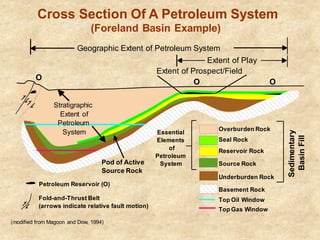
Cross Section Of A Petroleum System
(Foreland Basin Example)
Overburden Rock
Seal Rock
Reservoir Rock
Source Rock
Underburden Rock
Basement Rock
Top Oil Window
Top Gas Window
Geographic Extent of Petroleum System
Petroleum Reservoir (O)
Fold-and-Thrust Belt
(arrows indicate relative fault motion)
Essential
Elements
of
Petroleum
System
(modified from Magoon and Dow, 1994)
O O
Sedimentary
Basin
Fill
O
Stratigraphic
Extent of
Petroleum
System
Pod of Active
Source Rock
Extent of Prospect/Field
Extent of Play
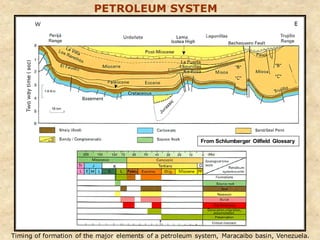
Timing of formation of the major elements of a petroleum system, Maracaibo basin, Venezuela.
PETROLEUM SYSTEM
From Schlumberger Oilfield Glossary
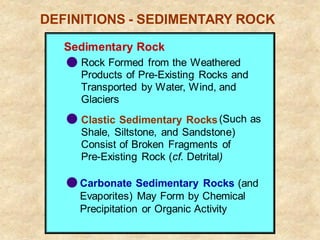
DEFINITIONS - SEDIMENTARY ROCK
Sedimentary Rock
Clastic Sedimentary Rocks(Such as
Shale, Siltstone, and Sandstone)
Consist of Broken Fragments of
Pre-Existing Rock (cf. Detrital)
Carbonate Sedimentary Rocks (and
Evaporites) May Form by Chemical
Precipitation or Organic Activity
Rock Formed from the Weathered
Products of Pre-Existing Rocks and
Transported by Water, Wind, and
Glaciers
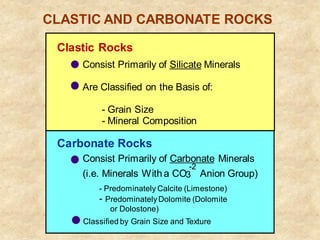
CLASTIC AND CARBONATE ROCKS
Clastic Rocks
Consist Primarily of Silicate Minerals
Are Classified on the Basis of:
- Grain Size
- Mineral Composition
Carbonate Rocks
Consist Primarily of Carbonate Minerals
(i.e. Minerals With a CO Anion Group)
- Predominately Calcite (Limestone)
- PredominatelyDolomite (Dolomite
or Dolostone)
3
-2
Classified by Grain Size and Texture
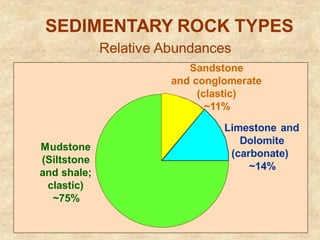
Relative Abundances
Mudstone
(Siltstone
and shale;
clastic)
~75%
Sandstone
and conglomerate
(clastic)
~11%
Limestone and
Dolomite
(carbonate)
~14%
SEDIMENTARY ROCK TYPES
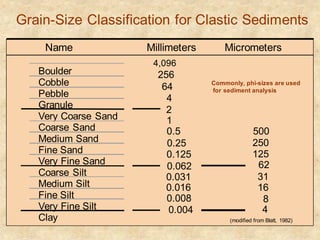
Grain-Size Classification for Clastic Sediments
Name Millimeters Micrometers
Boulder
Cobble
Pebble
Granule
Very Coarse Sand
Coarse Sand
Medium Sand
Fine Sand
Very Fine Sand
Coarse Silt
Medium Silt
Fine Silt
Very Fine Silt
Clay
4,096
256
64
4
2
1
0.5
0.25
0.125
0.062
0.031
0.016
0.008
0.004
500
250
125
62
31
16
8
4
(modified from Blatt, 1982)
Commonly, phi-sizes are used
for sediment analysis
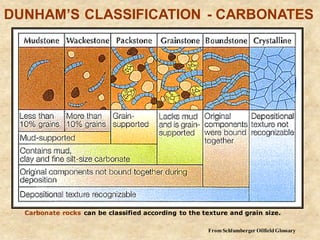
Carbonate rocks can be classified according to the texture and grain size.
DUNHAM’S CLASSIFICATION - CARBONATES
From Schlumberger OilfieldGlossary
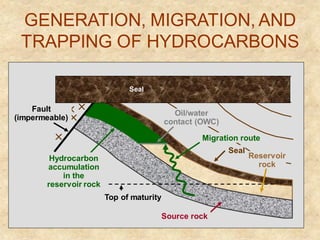
Seal
Reservoir
rock
Seal
Migration route
Oil/water
contact (OWC)
Hydrocarbon
accumulation
in the
reservoir rock
Top of maturity
Source rock
Fault
(impermeable)
GENERATION, MIGRATION, AND
TRAPPING OF HYDROCARBONS
Seal
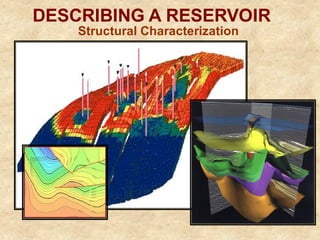
DESCRIBING A RESERVOIR
Structural Characterization
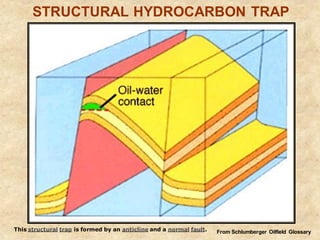
This structural trap is formed by an anticline and a normal fault. From Schlumberger Oilfield Glossary
STRUCTURAL HYDROCARBON TRAP
Closure. In map view (top),
closure is the area within the
deepest structural contour
that forms a trapping
geometry, in this case 1300
ft [390 m]. In cross section
A-A', closure is the vertical
distance from the top of the
structure to the lowest
closing contour, in this case
about 350 ft [105 m]. The
point beyond which
hydrocarbons could leak
from or migrate beyond the
trap is the spill point.
DOMAL TRAP
From Schlumberger Oilfield Glossary
• Are hydrocarbons in this field oil or gas?
• What is the volume of hydrocarbons
In this trap?
• What are the reserves?
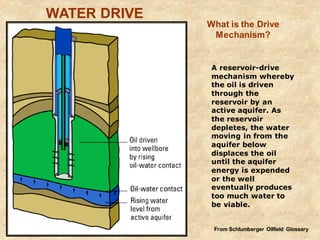
A reservoir-drive
mechanism whereby
the oil is driven
through the
reservoir by an
active aquifer. As
the reservoir
depletes, the water
moving in from the
aquifer below
displaces the oil
until the aquifer
energy is expended
or the well
eventually produces
too much water to
be viable.
WATER DRIVE
From Schlumberger Oilfield Glossary
What is the Drive
Mechanism?
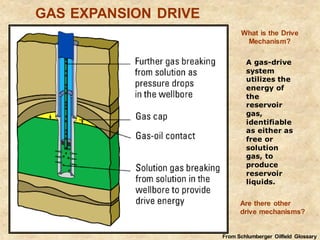
A gas-drive
system
utilizes the
energy of
the
reservoir
gas,
identifiable
as either as
free or
solution
gas, to
produce
reservoir
liquids.
GAS EXPANSION DRIVE
From Schlumberger Oilfield Glossary
What is the Drive
Mechanism?
Are there other
drive mechanisms?
TYPES OF HYDROCARBONS
• Composition
• Molecular structure
• Physical properties
PHYSICAL PROPERTIES OF
HYDROCARBONS
• Color
• Refractive Index
• Odor
• Density (Specific Gravity)
• Boiling Point
• Freezing Point
• Flash Point
• Viscosity
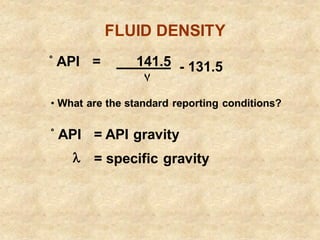
FLUID DENSITY
˚ API = 141.5
٧
= specific gravity
- 131.5
˚ API = API gravity
• What are the standard reporting conditions?

FLUID VISCOSITY
• Importance
• Units – centipoises (μ, cp)
• Strongly temperature dependent
• Standard reporting conditions
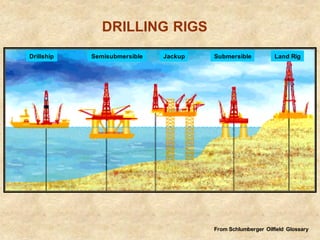
Drillship Jackup Submersible Land Rig
Semisubmersible
DRILLING RIGS
From Schlumberger Oilfield Glossary
ROTARY DRILL BIT, WORN
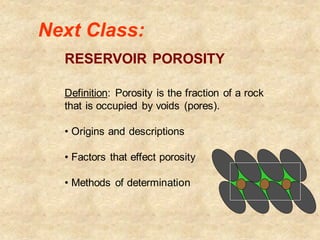
RESERVOIR POROSITY
Definition: Porosity is the fraction of a rock
that is occupied by voids (pores).
• Origins and descriptions
• Factors that effect porosity
• Methods of determination
Next Class:

RESERVOIR PETROPHYSICS.pdf

  • 1.
  • 2.
    PETROPHYSICS Petrophysics is thestudy of rock properties and rock interactions with fluids (gases, liquid hydrocarbons, and aqueous solutions). Modified from Tiab and Donaldson, 1996, p. 1
  • 3.
    RESERVOIR PETROPHYSICS PETE 311 COURSEDESCRIPTION Systematic theoretical and laboratory study of physical properties of petroleum reservoir rocks • Lithology • Porosity • Compressibility • Permeability • Fluid saturations • Capillary characteristics • Rock stress • Fluid-rock interaction
  • 4.
    RESERVOIR PETROPHYSICS Course Objectives Bythe last day of class, the student should be able to: 1. Define porosity; discuss the factors which effect porosity and describe the methods of determining values of porosity; 2. Define the coefficient of isothermal compressibility of reservoir rock and describe methods for determining values of formation compressibility; 3. Reproduce the Darcy equation in differential form, explain its meaning, integrate the equation for typical reservoir systems, discuss and calculate the effect of fractures and channels, and describe methods for determining values of absolute permeability;
  • 5.
    RESERVOIR PETROPHYSICS Course Objectives 4.Explain boundary tension and wettability and their effect on capillary pressure, describe methods of determining values of capillary pressure, and convert laboratory capillary pressure values to reservoir conditions; 5. Describe methods of determining fluid saturations in reservoir rock and show relationship between fluid saturation and capillary pressure; 6. Define resistivity, electrical formation resistivity factor, resistivity index, saturation exponent, and cementation factor and show their relationship and uses; discuss laboratory measurement of electrical properties of reservoir rocks; and demonstrate the calculations necessary in analyzing laboratory measurements;
  • 6.
    RESERVOIR PETROPHYSICS Course Objectives 7.Define effective permeability, relative permeability, permeability ratio; reproduce typical relative permeability curves and show effect of saturation history on relative permeability; illustrate the measurement of relative permeability; and demonstrate some uses of relative permeability data. 8. Describe three-phase flow in reservoir rock and explain methods of displaying three-phase effective permeabilities. 9. Demonstrate the techniques of averaging porosity, permeability, and reservoir pressure data. 10. Demonstrate capability to perform calculations relating to all concepts above. (These are minimum skills to be achieved/demonstrated)
  • 7.
    PETROPHYSICS • Why dowe study petrophysics?
  • 8.
    Cross Section OfA Petroleum System (Foreland Basin Example) Overburden Rock Seal Rock Reservoir Rock Source Rock Underburden Rock Basement Rock Top Oil Window Top Gas Window Geographic Extent of Petroleum System Petroleum Reservoir (O) Fold-and-Thrust Belt (arrows indicate relative fault motion) Essential Elements of Petroleum System (modified from Magoon and Dow, 1994) O O Sedimentary Basin Fill O Stratigraphic Extent of Petroleum System Pod of Active Source Rock Extent of Prospect/Field Extent of Play
  • 9.
    Timing of formationof the major elements of a petroleum system, Maracaibo basin, Venezuela. PETROLEUM SYSTEM From Schlumberger Oilfield Glossary
  • 10.
    DEFINITIONS - SEDIMENTARYROCK Sedimentary Rock Clastic Sedimentary Rocks(Such as Shale, Siltstone, and Sandstone) Consist of Broken Fragments of Pre-Existing Rock (cf. Detrital) Carbonate Sedimentary Rocks (and Evaporites) May Form by Chemical Precipitation or Organic Activity Rock Formed from the Weathered Products of Pre-Existing Rocks and Transported by Water, Wind, and Glaciers
  • 11.
    CLASTIC AND CARBONATEROCKS Clastic Rocks Consist Primarily of Silicate Minerals Are Classified on the Basis of: - Grain Size - Mineral Composition Carbonate Rocks Consist Primarily of Carbonate Minerals (i.e. Minerals With a CO Anion Group) - Predominately Calcite (Limestone) - PredominatelyDolomite (Dolomite or Dolostone) 3 -2 Classified by Grain Size and Texture
  • 12.
    Relative Abundances Mudstone (Siltstone and shale; clastic) ~75% Sandstone andconglomerate (clastic) ~11% Limestone and Dolomite (carbonate) ~14% SEDIMENTARY ROCK TYPES
  • 13.
    Grain-Size Classification forClastic Sediments Name Millimeters Micrometers Boulder Cobble Pebble Granule Very Coarse Sand Coarse Sand Medium Sand Fine Sand Very Fine Sand Coarse Silt Medium Silt Fine Silt Very Fine Silt Clay 4,096 256 64 4 2 1 0.5 0.25 0.125 0.062 0.031 0.016 0.008 0.004 500 250 125 62 31 16 8 4 (modified from Blatt, 1982) Commonly, phi-sizes are used for sediment analysis
  • 14.
    Carbonate rocks canbe classified according to the texture and grain size. DUNHAM’S CLASSIFICATION - CARBONATES From Schlumberger OilfieldGlossary
  • 15.
    Seal Reservoir rock Seal Migration route Oil/water contact (OWC) Hydrocarbon accumulation inthe reservoir rock Top of maturity Source rock Fault (impermeable) GENERATION, MIGRATION, AND TRAPPING OF HYDROCARBONS Seal
  • 16.
  • 17.
    This structural trapis formed by an anticline and a normal fault. From Schlumberger Oilfield Glossary STRUCTURAL HYDROCARBON TRAP
  • 18.
    Closure. In mapview (top), closure is the area within the deepest structural contour that forms a trapping geometry, in this case 1300 ft [390 m]. In cross section A-A', closure is the vertical distance from the top of the structure to the lowest closing contour, in this case about 350 ft [105 m]. The point beyond which hydrocarbons could leak from or migrate beyond the trap is the spill point. DOMAL TRAP From Schlumberger Oilfield Glossary • Are hydrocarbons in this field oil or gas? • What is the volume of hydrocarbons In this trap? • What are the reserves?
  • 19.
    A reservoir-drive mechanism whereby theoil is driven through the reservoir by an active aquifer. As the reservoir depletes, the water moving in from the aquifer below displaces the oil until the aquifer energy is expended or the well eventually produces too much water to be viable. WATER DRIVE From Schlumberger Oilfield Glossary What is the Drive Mechanism?
  • 20.
    A gas-drive system utilizes the energyof the reservoir gas, identifiable as either as free or solution gas, to produce reservoir liquids. GAS EXPANSION DRIVE From Schlumberger Oilfield Glossary What is the Drive Mechanism? Are there other drive mechanisms?
  • 21.
    TYPES OF HYDROCARBONS •Composition • Molecular structure • Physical properties
  • 22.
    PHYSICAL PROPERTIES OF HYDROCARBONS •Color • Refractive Index • Odor • Density (Specific Gravity) • Boiling Point • Freezing Point • Flash Point • Viscosity
  • 23.
    FLUID DENSITY ˚ API= 141.5 ٧ = specific gravity - 131.5 ˚ API = API gravity • What are the standard reporting conditions? 
  • 24.
    FLUID VISCOSITY • Importance •Units – centipoises (μ, cp) • Strongly temperature dependent • Standard reporting conditions
  • 25.
    Drillship Jackup SubmersibleLand Rig Semisubmersible DRILLING RIGS From Schlumberger Oilfield Glossary
  • 26.
    From Schlumberger OilfieldGlossary ROTARY DRILL BIT, WORN
  • 27.
    RESERVOIR POROSITY Definition: Porosityis the fraction of a rock that is occupied by voids (pores). • Origins and descriptions • Factors that effect porosity • Methods of determination Next Class: