Chapter 2

        Menus, Recipes and
        Recipe Calculations

. 2248 email: tpavit@wu.ac.th           1
Menus and Recipe
• Menus are used in the dining room to give
  both wait staff and guests important
  information about what the establishment
  offers.
• Recipes give detailed instructions to aid
  kitchen staff to produce menu items.
• Carefully designed menus and recipes can
  help chef in kitchen operation and control
  costs

                                               2
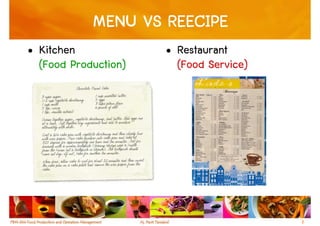
MENU VS REECIPE
• Kitchen             • Restaurant
  (Food Production)     (Food Service)


                                         3
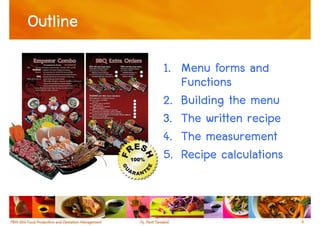
Outline
          1. Menu forms and
             Functions
          2. Building the menu
          3. The written recipe
          4. The measurement
          5. Recipe calculations


                                   4
MENU FORMS AND
  FUNCTIONS

                 5
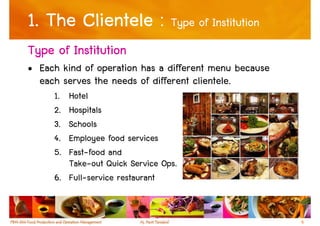
1. The Clientele : Type of Institution
Type of Institution
• Each kind of operation has a different menu because
  each serves the needs of different clientele.
     1. Hotel
     2. Hospitals
     3. Schools
     4. Employee food services
     5. Fast-food and
        Take-out Quick Service Ops.
     6. Full-service restaurant


                                                        6
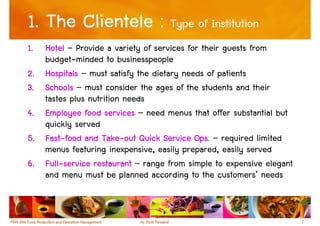
1. The Clientele : Type of Institution
1.   Hotel – Provide a variety of services for their guests from
     budget-minded to businesspeople
2.   Hospitals – must satisfy the dietary needs of patients
3.   Schools – must consider the ages of the students and their
     tastes plus nutrition needs
4.   Employee food services – need menus that offer substantial but
     quickly served
5.   Fast-
     Fast-food and Take-out Quick Service Ops. – required limited
                     Take-
     menus featuring inexpensive, easily prepared, easily served
6.   Full-
     Full-service restaurant – range from simple to expensive elegant
     and menu must be planned according to the customers’ needs


                                                                        7
1. The Clientele : Customer Preferences
• Most of the foodservice must produce food that is
  appealing to their customers and in sufficient
  variety to keep them form getting bored.
• People are becoming more and more interested in
  trying unfamiliar foods, especially ethnic foods.
• Nevertheless, tastes vary by region,
  neighborhood, age group, and social and ethnic
  background.
• Price must be kept in line with the customers’
  ability and willingness to pay


                                                      8
2. Kind of Meal
1. Breakfast
     • Breakfast menu are fairly standard within one country, a
       restaurant has to offer the usual selection of fruits, juices,
       eggs, cereal, breads, pancakes, waffles, meats, and
       regional specialties.
     • Breakfast menus must feature foods that can be prepared
       quickly and can be eaten in a hurry.
2. Lunch
     • Speed + Simplicity + Variety
3. Dinner
     • Main meal and is eaten in a more leisurely fashion


                                                                        9
3. Type of : Menus Static and Cycle Menus
Static and Cycle Menus
    Static Menu is one that offers the same dishes
    everyday. These menus are used in restaurant
    where the clientele changes daily or the menu
    offer sufficient variety.
    Cycle Menu is one that changes everyday for a
    certain period; after this period the daily menus
    repeat in the same order. This kind of menu is
    used in such operations as schools and hospitals


                                                        10
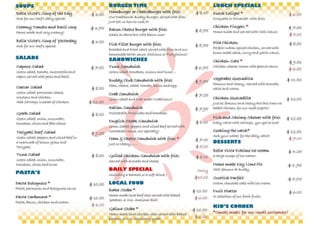
3. Type of : À la carte & Table d'hôte
À la carte & Table d'hôte
   À la carte  is one which each individual items is
   listed separately, with its own price The
                                   price.
   customer makes selections from the various
   courses and side dish make up a meal.
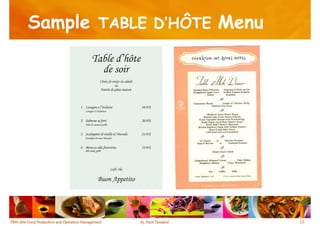
   Table d'hôte meant a fixed menu with no
   choices. The menu that offers a selection of
   complete meals at SET PRICE


                                                       11
12
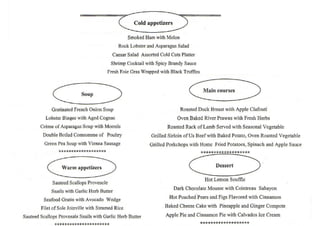
Sample TABLE D’HÔTE Menu


                           13
BUILDING THE MENU

                    14
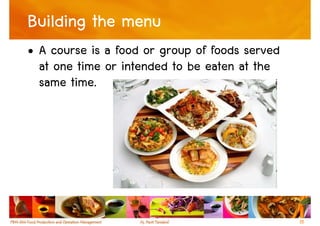
Building the menu
• A course is a food or group of foods served
  at one time or intended to be eaten at the
  same time.


                                                15
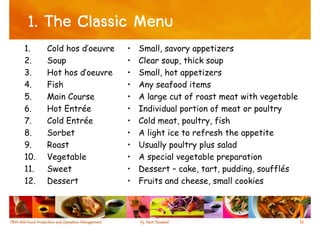
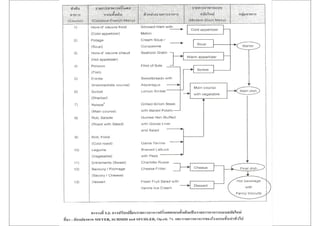
1. The Classic Menu
1.    Cold hos d’oeuvre   •   Small, savory appetizers
2.    Soup                •   Clear soup, thick soup
3.    Hot hos d’oeuvre    •   Small, hot appetizers
4.    Fish                •   Any seafood items
5.    Main Course         •   A large cut of roast meat with vegetable
6.    Hot Entrée          •   Individual portion of meat or poultry
7.    Cold Entrée         •   Cold meat, poultry, fish
8.    Sorbet              •   A light ice to refresh the appetite
9.    Roast               •   Usually poultry plus salad
10.   Vegetable           •   A special vegetable preparation
11.   Sweet               •   Dessert – cake, tart, pudding, soufflés
12.   Dessert             •   Fruits and cheese, small cookies


                                                                         16
17
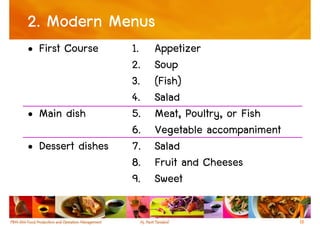
2. Modern Menus
• First Course     1.   Appetizer
                   2.   Soup
                   3.   (Fish)
                   4.   Salad
• Main dish        5.   Meat, Poultry, or Fish
                   6.   Vegetable accompaniment
• Dessert dishes   7.   Salad
                   8.   Fruit and Cheeses
                   9.   Sweet

                                                  18
19
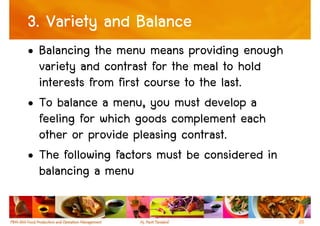
3. Variety and Balance
• Balancing the menu means providing enough
  variety and contrast for the meal to hold
  interests from first course to the last.
• To balance a menu, you must develop a
  feeling for which goods complement each
  other or provide pleasing contrast.
• The following factors must be considered in
  balancing a menu

                                                20
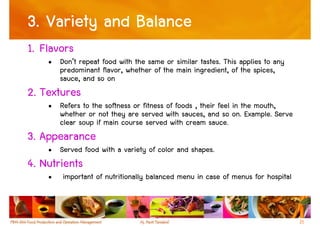
3. Variety and Balance
1. Flavors
    • Don’t repeat food with the same or similar tastes. This applies to any
      predominant flavor, whether of the main ingredient, of the spices,
      sauce, and so on
2. Textures
    • Refers to the softness or fitness of foods , their feel in the mouth,
      whether or not they are served with sauces, and so on. Example. Serve
      clear soup if main course served with cream sauce.
3. Appearance
    • Served food with a variety of color and shapes.
4. Nutrients
    •   important of nutritionally balanced menu in case of menus for hospital


                                                                                 21
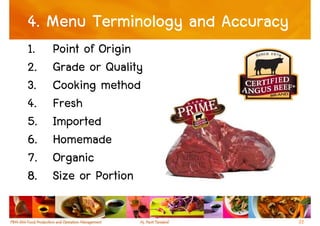
4. Menu Terminology and Accuracy
1.   Point of Origin
2.   Grade or Quality
3.   Cooking method
4.   Fresh
5.   Imported
6.   Homemade
7.   Organic
8.   Size or Portion

                                   22
THE WRITTEN RECIPE

                     23
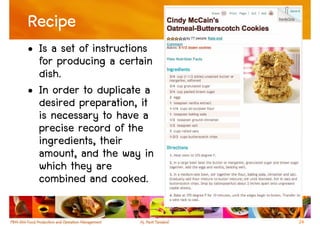
Recipe
• Is a set of instructions
  for producing a certain
  dish.
• In order to duplicate a
  desired preparation, it
  is necessary to have a
  precise record of the
  ingredients, their
  amount, and the way in
  which they are
  combined and cooked.

                             24
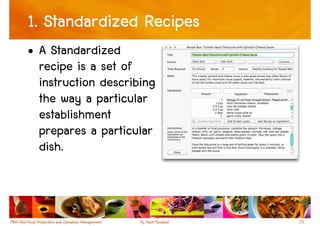
1. Standardized Recipes
• A Standardized
  recipe is a set of
  instruction describing
  the way a particular
  establishment
  prepares a particular
  dish.


                           25
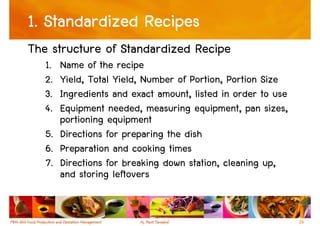
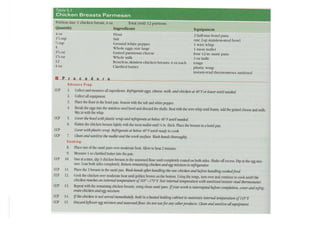
1. Standardized Recipes
The structure of Standardized Recipe
   1. Name of the recipe
   2. Yield, Total Yield, Number of Portion, Portion Size
   3. Ingredients and exact amount, listed in order to use
   4. Equipment needed, measuring equipment, pan sizes,
      portioning equipment
   5. Directions for preparing the dish
   6. Preparation and cooking times
   7. Directions for breaking down station, cleaning up,
      and storing leftovers


                                                             26
27
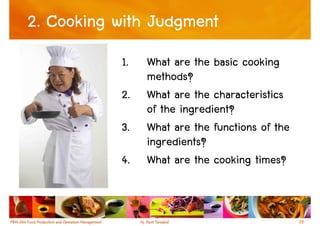
2. Cooking with Judgment
           1.   What are the basic cooking
                methods?
           2.   What are the characteristics
                of the ingredient?
           3.   What are the functions of the
                ingredients?
           4.   What are the cooking times?


                                                28
THE MEASUREMENT

                  29
Measurement
• Careful measurement is one of the most important
  parts of food production.
• It is important for consistent quality each time a
  recipe is prepared and served
• There are two important kinds of measurement in
  the kitchen
     1. Ingredient measurement
     2. Portion measurement


                                                       30
1. Ingredient Measument
1. Weight (Scale)
    • AP weight – As Purchased Weight
    • EP weight – Edible Portion Weight
2. Volume
    • Use to measure for liquids
3. Count
    • Measuring ingredients by count when units
      are fairly standard sizes eg. Eggs

                                                  31
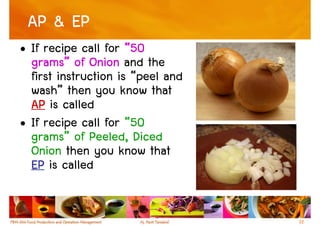
AP & EP
• If recipe call for “50
  grams”
  grams” of Onion and the
  first instruction is “peel and
  wash” then you know that
  AP is called
• If recipe call for “50
  grams” of Peeled, Diced
  Onion then you know that
  EP is called


                                   32
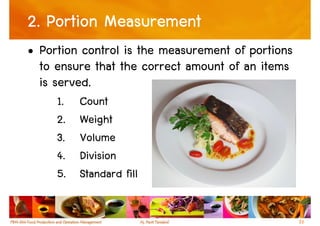
2. Portion Measurement
• Portion control is the measurement of portions
  to ensure that the correct amount of an items
  is served.
     1.   Count
     2.   Weight
     3.   Volume
     4.   Division
     5.   Standard fill


                                                   33
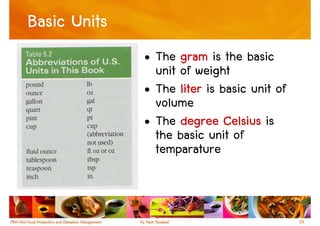
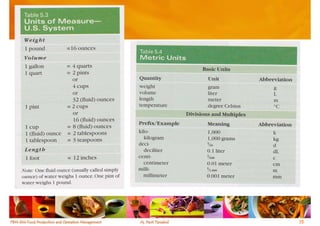
Basic Units
              • The gram is the basic
                unit of weight
              • The liter is basic unit of
                volume
              • The degree Celsius is
                the basic unit of
                temparature


                                             34
35
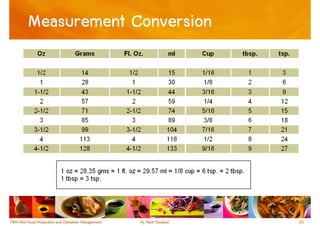
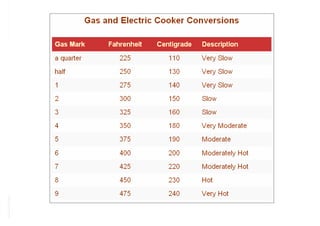
Measurement Conversion


                         36
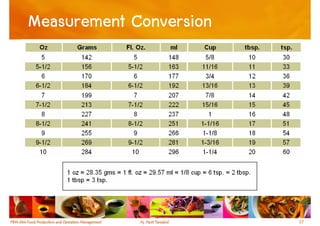
Measurement Conversion


                         37
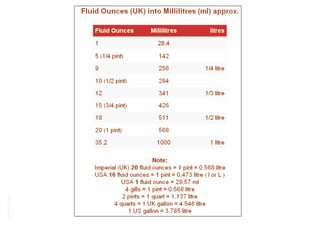
38
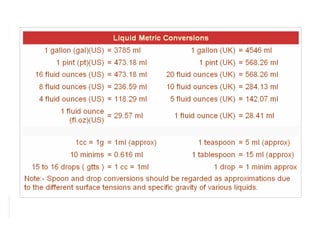
39
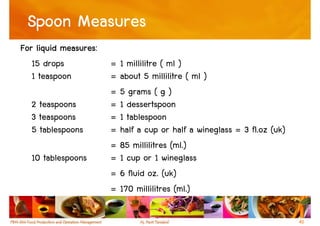
Spoon Measures
           measures:
For liquid measures:
   15 drops            = 1 millilitre ( ml )
   1 teaspoon          = about 5 millilitre ( ml )
                       = 5 grams ( g )
  2 teaspoons          = 1 dessertspoon
  3 teaspoons          = 1 tablespoon
  5 tablespoons        = half a cup or half a wineglass = 3 fl.oz (uk)
                       = 85 millilitres (ml.)
  10 tablespoons       = 1 cup or 1 wineglass
                       = 6 fluid oz. (uk)
                       = 170 millilitres (ml.)

                                                                         40
41
Recipe Calculations

                      42
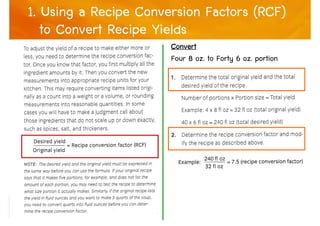
1. Using a Recipe Conversion Factors (RCF)
   to Convert Recipe Yields
                       Convert
                       Four 8 oz. to Forty 6 oz. portion


             1.


                                                           43
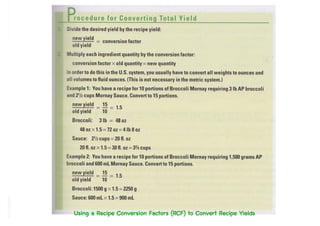
Using a Recipe Conversion Factors (RCF) to Convert Recipe Yields
                                                                   44
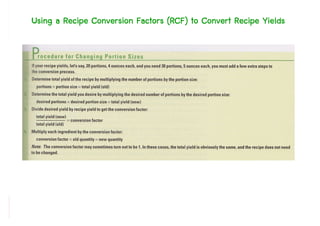
Using a Recipe Conversion Factors (RCF) to Convert Recipe Yields


                                                                   45
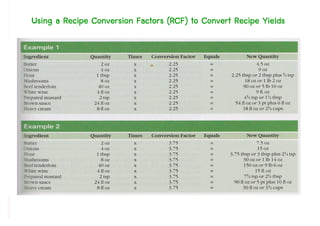
Using a Recipe Conversion Factors (RCF) to Convert Recipe Yields


                                                                   46
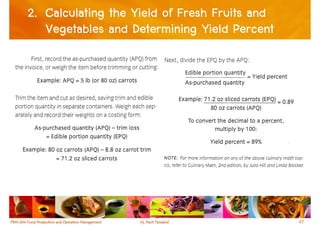
2. Calculating the Yield of Fresh Fruits and
   Vegetables and Determining Yield Percent


                                               47
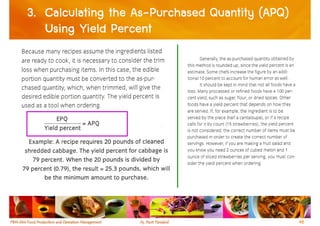
3. Calculating the As-Purchased Quantity (APQ)
                   As-
   Using Yield Percent


                                                 48
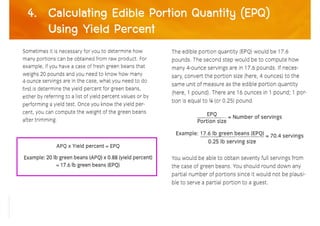
4. Calculating Edible Portion Quantity (EPQ)
   Using Yield Percent


                                               49
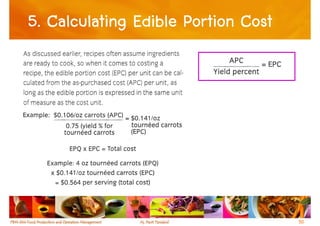
5. Calculating Edible Portion Cost


                                     50
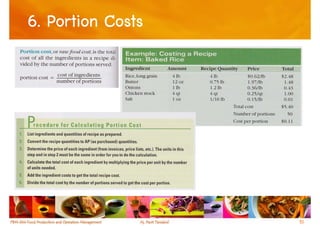
6. Portion Costs


                   51
Q&A

      52

Chapter 2 Menus, Recipes and Calculation

  • 1.
    Chapter 2 Menus, Recipes and Recipe Calculations . 2248 email: tpavit@wu.ac.th 1
  • 2.
    Menus and Recipe •Menus are used in the dining room to give both wait staff and guests important information about what the establishment offers. • Recipes give detailed instructions to aid kitchen staff to produce menu items. • Carefully designed menus and recipes can help chef in kitchen operation and control costs 2
  • 3.
    MENU VS REECIPE •Kitchen • Restaurant (Food Production) (Food Service) 3
  • 4.
    Outline 1. Menu forms and Functions 2. Building the menu 3. The written recipe 4. The measurement 5. Recipe calculations 4
  • 5.
    MENU FORMS AND FUNCTIONS 5
  • 6.
    1. The Clientele: Type of Institution Type of Institution • Each kind of operation has a different menu because each serves the needs of different clientele. 1. Hotel 2. Hospitals 3. Schools 4. Employee food services 5. Fast-food and Take-out Quick Service Ops. 6. Full-service restaurant 6
  • 7.
    1. The Clientele: Type of Institution 1. Hotel – Provide a variety of services for their guests from budget-minded to businesspeople 2. Hospitals – must satisfy the dietary needs of patients 3. Schools – must consider the ages of the students and their tastes plus nutrition needs 4. Employee food services – need menus that offer substantial but quickly served 5. Fast- Fast-food and Take-out Quick Service Ops. – required limited Take- menus featuring inexpensive, easily prepared, easily served 6. Full- Full-service restaurant – range from simple to expensive elegant and menu must be planned according to the customers’ needs 7
  • 8.
    1. The Clientele: Customer Preferences • Most of the foodservice must produce food that is appealing to their customers and in sufficient variety to keep them form getting bored. • People are becoming more and more interested in trying unfamiliar foods, especially ethnic foods. • Nevertheless, tastes vary by region, neighborhood, age group, and social and ethnic background. • Price must be kept in line with the customers’ ability and willingness to pay 8
  • 9.
    2. Kind ofMeal 1. Breakfast • Breakfast menu are fairly standard within one country, a restaurant has to offer the usual selection of fruits, juices, eggs, cereal, breads, pancakes, waffles, meats, and regional specialties. • Breakfast menus must feature foods that can be prepared quickly and can be eaten in a hurry. 2. Lunch • Speed + Simplicity + Variety 3. Dinner • Main meal and is eaten in a more leisurely fashion 9
  • 10.
    3. Type of: Menus Static and Cycle Menus Static and Cycle Menus Static Menu is one that offers the same dishes everyday. These menus are used in restaurant where the clientele changes daily or the menu offer sufficient variety. Cycle Menu is one that changes everyday for a certain period; after this period the daily menus repeat in the same order. This kind of menu is used in such operations as schools and hospitals 10
  • 11.
    3. Type of: À la carte & Table d'hôte À la carte & Table d'hôte À la carte is one which each individual items is listed separately, with its own price The price. customer makes selections from the various courses and side dish make up a meal. Table d'hôte meant a fixed menu with no choices. The menu that offers a selection of complete meals at SET PRICE 11
  • 12.
  • 13.
  • 14.
  • 15.
    Building the menu •A course is a food or group of foods served at one time or intended to be eaten at the same time. 15
  • 16.
    1. The ClassicMenu 1. Cold hos d’oeuvre • Small, savory appetizers 2. Soup • Clear soup, thick soup 3. Hot hos d’oeuvre • Small, hot appetizers 4. Fish • Any seafood items 5. Main Course • A large cut of roast meat with vegetable 6. Hot Entrée • Individual portion of meat or poultry 7. Cold Entrée • Cold meat, poultry, fish 8. Sorbet • A light ice to refresh the appetite 9. Roast • Usually poultry plus salad 10. Vegetable • A special vegetable preparation 11. Sweet • Dessert – cake, tart, pudding, soufflés 12. Dessert • Fruits and cheese, small cookies 16
  • 17.
  • 18.
    2. Modern Menus •First Course 1. Appetizer 2. Soup 3. (Fish) 4. Salad • Main dish 5. Meat, Poultry, or Fish 6. Vegetable accompaniment • Dessert dishes 7. Salad 8. Fruit and Cheeses 9. Sweet 18
  • 19.
  • 20.
    3. Variety andBalance • Balancing the menu means providing enough variety and contrast for the meal to hold interests from first course to the last. • To balance a menu, you must develop a feeling for which goods complement each other or provide pleasing contrast. • The following factors must be considered in balancing a menu 20
  • 21.
    3. Variety andBalance 1. Flavors • Don’t repeat food with the same or similar tastes. This applies to any predominant flavor, whether of the main ingredient, of the spices, sauce, and so on 2. Textures • Refers to the softness or fitness of foods , their feel in the mouth, whether or not they are served with sauces, and so on. Example. Serve clear soup if main course served with cream sauce. 3. Appearance • Served food with a variety of color and shapes. 4. Nutrients • important of nutritionally balanced menu in case of menus for hospital 21
  • 22.
    4. Menu Terminologyand Accuracy 1. Point of Origin 2. Grade or Quality 3. Cooking method 4. Fresh 5. Imported 6. Homemade 7. Organic 8. Size or Portion 22
  • 23.
  • 24.
    Recipe • Is aset of instructions for producing a certain dish. • In order to duplicate a desired preparation, it is necessary to have a precise record of the ingredients, their amount, and the way in which they are combined and cooked. 24
  • 25.
    1. Standardized Recipes •A Standardized recipe is a set of instruction describing the way a particular establishment prepares a particular dish. 25
  • 26.
    1. Standardized Recipes Thestructure of Standardized Recipe 1. Name of the recipe 2. Yield, Total Yield, Number of Portion, Portion Size 3. Ingredients and exact amount, listed in order to use 4. Equipment needed, measuring equipment, pan sizes, portioning equipment 5. Directions for preparing the dish 6. Preparation and cooking times 7. Directions for breaking down station, cleaning up, and storing leftovers 26
  • 27.
  • 28.
    2. Cooking withJudgment 1. What are the basic cooking methods? 2. What are the characteristics of the ingredient? 3. What are the functions of the ingredients? 4. What are the cooking times? 28
  • 29.
  • 30.
    Measurement • Careful measurementis one of the most important parts of food production. • It is important for consistent quality each time a recipe is prepared and served • There are two important kinds of measurement in the kitchen 1. Ingredient measurement 2. Portion measurement 30
  • 31.
    1. Ingredient Measument 1.Weight (Scale) • AP weight – As Purchased Weight • EP weight – Edible Portion Weight 2. Volume • Use to measure for liquids 3. Count • Measuring ingredients by count when units are fairly standard sizes eg. Eggs 31
  • 32.
    AP & EP •If recipe call for “50 grams” grams” of Onion and the first instruction is “peel and wash” then you know that AP is called • If recipe call for “50 grams” of Peeled, Diced Onion then you know that EP is called 32
  • 33.
    2. Portion Measurement •Portion control is the measurement of portions to ensure that the correct amount of an items is served. 1. Count 2. Weight 3. Volume 4. Division 5. Standard fill 33
  • 34.
    Basic Units • The gram is the basic unit of weight • The liter is basic unit of volume • The degree Celsius is the basic unit of temparature 34
  • 35.
  • 36.
  • 37.
  • 38.
  • 39.
  • 40.
    Spoon Measures measures: For liquid measures: 15 drops = 1 millilitre ( ml ) 1 teaspoon = about 5 millilitre ( ml ) = 5 grams ( g ) 2 teaspoons = 1 dessertspoon 3 teaspoons = 1 tablespoon 5 tablespoons = half a cup or half a wineglass = 3 fl.oz (uk) = 85 millilitres (ml.) 10 tablespoons = 1 cup or 1 wineglass = 6 fluid oz. (uk) = 170 millilitres (ml.) 40
  • 41.
  • 42.
  • 43.
    1. Using aRecipe Conversion Factors (RCF) to Convert Recipe Yields Convert Four 8 oz. to Forty 6 oz. portion 1. 43
  • 44.
    Using a RecipeConversion Factors (RCF) to Convert Recipe Yields 44
  • 45.
    Using a RecipeConversion Factors (RCF) to Convert Recipe Yields 45
  • 46.
    Using a RecipeConversion Factors (RCF) to Convert Recipe Yields 46
  • 47.
    2. Calculating theYield of Fresh Fruits and Vegetables and Determining Yield Percent 47
  • 48.
    3. Calculating theAs-Purchased Quantity (APQ) As- Using Yield Percent 48
  • 49.
    4. Calculating EdiblePortion Quantity (EPQ) Using Yield Percent 49
  • 50.
    5. Calculating EdiblePortion Cost 50
  • 51.
  • 52.
    Q&A 52