t
                lifa
           d Kh
    he e
Ras


      © 2012 Rasheed Khlifat ®
What is a reservation?
It is a booking in advance for a space for a specified
 period of time.

E.g. Hotel ballroom, restaurant booking, airline seat, a
 theatre seat, a hotel guestroom, a doctor’s
 appointment.
Introduction
From a guest’s point of view, the most important
 outcome of the reservations process is having a
 guestroom ready and waiting when the guest arrives.
To achieve these outcomes, the hotel must have
 efficient reservation procedures in place.

Here are the reservation process activities:-
Reservation Activities

• Conduct reservation inquiry.

· Determine room and rate availability.

· Create reservation record.

· Confirm reservation record.

· Maintain reservation record.

· Produce reservation reports.

· Research, plan, and monitor reservations.
Types of Reservations

  • 1. Guaranteed Reservation: Insures that the hotel will
    hold a room for the guest until a specific time of guest’s
    scheduled arrival date .
  • The guest must provide us a method of payment.
  • If the guest does not show up or cancel properly,
    the guest will be charged for one night
    accommodation.

     In order to guarantee a reservation, guests can choose
     one of the following methods:
Guaranteed Reservations
The reservation can be guaranteed by

• Prepayment

· Credit card

· Advance deposit

• Travel agent voucher/miscellaneous charge
  order (MCO)

· Corporate (direct billing account)
Non-guaranteed Reservation


     2. Non-guaranteed Reservation: Insures that the
     hotel agrees to hold a room for the guest until a
     stated reservation cancellation hour (Usually 6 p.m.)
     on the day of arrival.
    It is common for hotels planning on full occupancy or
     nearing full occupancy to accept only guaranteed
     reservation once a specified number of expected
     arrivals is achieved.
Reservation Inquiry

  • Guests can communicate their reservation inquiries in
      person, over the telephone, via mail, through facsimile, telex,
      e-mail…

  • While getting a reservation inquiry, the reservation staff shall
      obtain the following guest-related information:

  •   Guest’s name, address and telephone number
  •   Company or travel agency name
  •   Date of arrival and departure
  •   Type and number of rooms requested
cont.

 Desired room rate
 Number of people in the group, if applicable
 Method of payment and/or guarantee
 Any other special requests
 • Most of the above mentioned information is used to create
   a reservation record.
The seven steps reservation sales process
   • 1. Greet the caller. ( thank you for calling Holiday
       inn. This is Mary speaking How can I help you
       today?)
   •   2. Identify caller’s need ( arrival date, departure
       date, preference ....)
   •   3. Provide an overview of the hotel’s feature
       ( number of restaurant, swimming pool )
   •   4. Make a room recommendation and room rate.
   •   5. Ask for the sales ( Would you like me to book the
       reservation for you?
cont.
• 6. Create a reservation record according to the hotel
  procedures.
• 7. Thank the caller. Closing a call as warmly as opening
  a call, leaves the caller with a sense of confidence that
  they have made the correct decision.
Sources of Reservations

 • Central Reservation System

 · Global Distribution System

 · Intersell Agencies (for example flight
 centre)

 · Property Direct

 · Internet
Central Reservation System (CRS)
A central (or computerised) reservation system that
  controls and maintains the reservations for several
  hotels in one location, and automatically redirects the
  reservation to the required hotel.
Central reservation systems


   • The majority of hotel groups belong to one or more Central
     Reservation Systems
   • • A central reservation system is composed of a central
     reservation office, member hotels connected together via
     communication devices, and potential guests.
   • It exchanges room availability information with members
     hotel.
   • • Central Reservation Office [CRO] offers its services via a
     24-hours toll free telephone number(s) [Green Numbers].
continued
On return, central reservation offices charges a fee for the
   utilization of its services which might take the form of a flat
   fee and a variable fee, or a flat percentage of potential room
   revenue, actual room revenue, and/or Rooms Division
   gross profit…
Global Distribution Systems
•Computerized system by which reservation-related
information is stored and retrieved for multiple
organizations.

• Global Distribution Systems [GDS]⇒ System including
several Central Reservation Offices connected to each
other.
• Selling hotel rooms is accomplished by connecting the
hotel reservation system with the GDS system.
• GDSs have become a powerful force in hotel reservation.
Property Direct Reservation System:
  Even though many of the five-star hotels rely heavily on
    central reservation offices and intersell agencies, some
    potential guests still find it convenient, and personal to call
    directly the hotel to communicate a reservation inquiry.
Property Direct Reservations
Property direct reservations are made in a several ways

· Telephone

· Mail

· Property-to-property

· FAX

· E-mail
Group Bookings
Types of groups
 Tour groups
 Conference/convention
 Charity groups (fund raising)
 Flight crews
 School groups
 Sporting groups
Reasons for Travel
Business
Pleasure
Education
Family
Religious
Special events (e.g.Olympic Games)
Types of Market Sources
F.I.T. – free/fully independent traveller
Group
Corporate
Government
Package
Room Rate Factors
$ Location (CBD, Country)
$ Hotel Rating (Star/Flag/Crown)
Room attributes/aspects
Hotel facilities
$ Competition
$ Time of year
$ Intended client
Room Rate Types

Rack
Corporate
Government
Airline (delayed flights, crew, package)
Travel Agents (package, familiarisation, group,
 F.I.T.)
Groups/conference
Packages (honeymoon, weekend, midweek)
Five steps to selling
• Know your product
• Know your guest
• Match the guest to the best alternative
• Be aware you are part of the sales team
• Always sell the product before the price
Guest History
Assist with marketing strategies
Ensure future reservations are more efficient
Ensure a quicker check-in
Ensure guest’s needs are met
Assist with check-out
History data

Reservation forms
Registration cards
Guest folios on check-out


History can be stored and maintained:
Manually
Computerised
Cancellation
Retrieve original reservation
Note date and time cancellation received
Record contact name of person cancelling
Update manual and computer records
File cancelled reservation
Apply cancellation fee as per hotel policy
Thank caller
Amendments
 Retrieve original reservation
 Note date and time amendment received
 Record contact name of person amending
 Update manual and computer records
 File amended reservation
 Thank caller
Departments concerned with reservations
report
Housekeeping
To enable accurate staff rostering
Budgeting, planning for refurbishment, ordering of
 supplies
Food and Beverage
As above
Departments concerned with reservations
report

Maintenance
To enable accurate staff rostering
Budgeting, planning for refurbishment, ordering of
 supplies
Concierge/Porters/Front Desk
As above
Types of Reports
Occupancy
Arrivals
Cancellations
Special requests
V.I.P.S
Black lists
Market Segments
Guest history
Black List

 “Bad” debts (previous accounts remain unsettled)
 Malicious damage to hotel property
 Theft of hotel property
 Verbal/physical assault of staff members
Potential Reservation Problems
• 3 main common problems that might be encountered:
• 1) Errors in a reservation record:
a. Record a wrong arrival or departure date
b. Misspell the guest’s name or reverse it
c. Reserve for the caller instead of the guest
Potential Reservation Problems

2) Misunderstandings due to industry jargon:
Confirmed versus guaranteed reservation
Double room versus 2 beds
Connecting rooms versus adjacent rooms
Potential Reservation Problems
3) Miscommunications with external reservation systems:
Book a guest in the wrong hotel
Book a guest in the wrong city [ex: Novotel, Melbourne versus
  Novotel, Sydney]
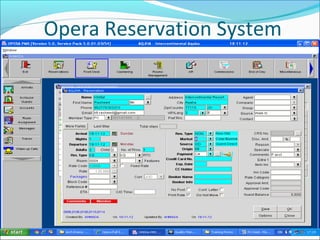
Opera Reservation System
Rasheed Khlifat
Risk Management & Insurance

Reservation

  • 1.
    t lifa d Kh he e Ras © 2012 Rasheed Khlifat ®
  • 2.
    What is areservation? It is a booking in advance for a space for a specified period of time. E.g. Hotel ballroom, restaurant booking, airline seat, a theatre seat, a hotel guestroom, a doctor’s appointment.
  • 3.
    Introduction From a guest’spoint of view, the most important outcome of the reservations process is having a guestroom ready and waiting when the guest arrives. To achieve these outcomes, the hotel must have efficient reservation procedures in place. Here are the reservation process activities:-
  • 4.
    Reservation Activities • Conductreservation inquiry. · Determine room and rate availability. · Create reservation record. · Confirm reservation record. · Maintain reservation record. · Produce reservation reports. · Research, plan, and monitor reservations.
  • 5.
    Types of Reservations • 1. Guaranteed Reservation: Insures that the hotel will hold a room for the guest until a specific time of guest’s scheduled arrival date . • The guest must provide us a method of payment. • If the guest does not show up or cancel properly, the guest will be charged for one night accommodation. In order to guarantee a reservation, guests can choose one of the following methods:
  • 6.
    Guaranteed Reservations The reservationcan be guaranteed by • Prepayment · Credit card · Advance deposit • Travel agent voucher/miscellaneous charge order (MCO) · Corporate (direct billing account)
  • 7.
    Non-guaranteed Reservation  2. Non-guaranteed Reservation: Insures that the hotel agrees to hold a room for the guest until a stated reservation cancellation hour (Usually 6 p.m.) on the day of arrival. It is common for hotels planning on full occupancy or nearing full occupancy to accept only guaranteed reservation once a specified number of expected arrivals is achieved.
  • 8.
    Reservation Inquiry • Guests can communicate their reservation inquiries in person, over the telephone, via mail, through facsimile, telex, e-mail… • While getting a reservation inquiry, the reservation staff shall obtain the following guest-related information: • Guest’s name, address and telephone number • Company or travel agency name • Date of arrival and departure • Type and number of rooms requested
  • 9.
    cont. Desired roomrate Number of people in the group, if applicable Method of payment and/or guarantee Any other special requests • Most of the above mentioned information is used to create a reservation record.
  • 10.
    The seven stepsreservation sales process • 1. Greet the caller. ( thank you for calling Holiday inn. This is Mary speaking How can I help you today?) • 2. Identify caller’s need ( arrival date, departure date, preference ....) • 3. Provide an overview of the hotel’s feature ( number of restaurant, swimming pool ) • 4. Make a room recommendation and room rate. • 5. Ask for the sales ( Would you like me to book the reservation for you?
  • 11.
    cont. • 6. Createa reservation record according to the hotel procedures. • 7. Thank the caller. Closing a call as warmly as opening a call, leaves the caller with a sense of confidence that they have made the correct decision.
  • 12.
    Sources of Reservations • Central Reservation System · Global Distribution System · Intersell Agencies (for example flight centre) · Property Direct · Internet
  • 13.
    Central Reservation System(CRS) A central (or computerised) reservation system that controls and maintains the reservations for several hotels in one location, and automatically redirects the reservation to the required hotel.
  • 14.
    Central reservation systems • The majority of hotel groups belong to one or more Central Reservation Systems • • A central reservation system is composed of a central reservation office, member hotels connected together via communication devices, and potential guests. • It exchanges room availability information with members hotel. • • Central Reservation Office [CRO] offers its services via a 24-hours toll free telephone number(s) [Green Numbers].
  • 15.
    continued On return, centralreservation offices charges a fee for the utilization of its services which might take the form of a flat fee and a variable fee, or a flat percentage of potential room revenue, actual room revenue, and/or Rooms Division gross profit…
  • 16.
    Global Distribution Systems •Computerizedsystem by which reservation-related information is stored and retrieved for multiple organizations. • Global Distribution Systems [GDS]⇒ System including several Central Reservation Offices connected to each other. • Selling hotel rooms is accomplished by connecting the hotel reservation system with the GDS system. • GDSs have become a powerful force in hotel reservation.
  • 17.
    Property Direct ReservationSystem: Even though many of the five-star hotels rely heavily on central reservation offices and intersell agencies, some potential guests still find it convenient, and personal to call directly the hotel to communicate a reservation inquiry.
  • 18.
    Property Direct Reservations Propertydirect reservations are made in a several ways · Telephone · Mail · Property-to-property · FAX · E-mail
  • 19.
    Group Bookings Types ofgroups Tour groups Conference/convention Charity groups (fund raising) Flight crews School groups Sporting groups
  • 20.
  • 21.
    Types of MarketSources F.I.T. – free/fully independent traveller Group Corporate Government Package
  • 22.
    Room Rate Factors $Location (CBD, Country) $ Hotel Rating (Star/Flag/Crown) Room attributes/aspects Hotel facilities $ Competition $ Time of year $ Intended client
  • 23.
    Room Rate Types Rack Corporate Government Airline(delayed flights, crew, package) Travel Agents (package, familiarisation, group, F.I.T.) Groups/conference Packages (honeymoon, weekend, midweek)
  • 24.
    Five steps toselling • Know your product • Know your guest • Match the guest to the best alternative • Be aware you are part of the sales team • Always sell the product before the price
  • 25.
    Guest History Assist withmarketing strategies Ensure future reservations are more efficient Ensure a quicker check-in Ensure guest’s needs are met Assist with check-out
  • 26.
    History data Reservation forms Registrationcards Guest folios on check-out History can be stored and maintained: Manually Computerised
  • 27.
    Cancellation Retrieve original reservation Notedate and time cancellation received Record contact name of person cancelling Update manual and computer records File cancelled reservation Apply cancellation fee as per hotel policy Thank caller
  • 28.
    Amendments Retrieve originalreservation Note date and time amendment received Record contact name of person amending Update manual and computer records File amended reservation Thank caller
  • 29.
    Departments concerned withreservations report Housekeeping To enable accurate staff rostering Budgeting, planning for refurbishment, ordering of supplies Food and Beverage As above
  • 30.
    Departments concerned withreservations report Maintenance To enable accurate staff rostering Budgeting, planning for refurbishment, ordering of supplies Concierge/Porters/Front Desk As above
  • 31.
    Types of Reports Occupancy Arrivals Cancellations Specialrequests V.I.P.S Black lists Market Segments Guest history
  • 32.
    Black List “Bad”debts (previous accounts remain unsettled) Malicious damage to hotel property Theft of hotel property Verbal/physical assault of staff members
  • 33.
    Potential Reservation Problems •3 main common problems that might be encountered: • 1) Errors in a reservation record: a. Record a wrong arrival or departure date b. Misspell the guest’s name or reverse it c. Reserve for the caller instead of the guest
  • 34.
    Potential Reservation Problems 2)Misunderstandings due to industry jargon: Confirmed versus guaranteed reservation Double room versus 2 beds Connecting rooms versus adjacent rooms
  • 35.
    Potential Reservation Problems 3)Miscommunications with external reservation systems: Book a guest in the wrong hotel Book a guest in the wrong city [ex: Novotel, Melbourne versus Novotel, Sydney]
  • 36.
  • 37.

Editor's Notes

  • #6 [i.e. Check-out time or start of the hotel’s day Shift or any time the lodging property chooses
  • #35 © 2012 Rasheed Khlifat ®