www.cthresources.com 
Page 1 
www.cthawards.com 
1 
Front Office Operations 
June 2010
www.cthresources.com 
Page 2 
www.cthawards.com 
Essential Reading 
Confederation of Tourism and Hospitality (CTH) – Front Office Operations: Study Text (Paperback) 
by BPP Learning Media (Author) 
Publisher: BPP Learning Media (July 2009) ISBN: 9780 7517 7795 6 
http://www.bpp.com/learning-materials/our-products/tourism--hospitality/cth-dip-in-hotel-management.aspx
www.cthresources.com 
Page 3 
www.cthawards.com 
Content 
I. Description 
II. Learning Outcomes 
III. Syllabus 
IV. Assessment 
V. Chapters 1 - 9
www.cthresources.com 
Page 4 
www.cthawards.com 
Description 
Description 
This module introduces students to the systems and procedures required for Front Office Operations. It 
provides an overview of the functions and supervisory aspects of the front office department. Students 
will develop knowledge and skills in departmental procedures as well as understanding the key 
legislation.
www.cthresources.com 
Page 5 
www.cthawards.com 
Content 
I. Description 
II. Learning Outcomes 
III. Syllabus 
IV. Assessment 
V. Chapters 1 - 9
www.cthresources.com 
www.cthawards.com 
Summary of Learning Outcomes 
Page 6 
Learning Outcomes 
On completion of this module, students will be able to: 
z Demonstrate knowledge of the key functional areas of front office 
z Describe the function and activities of the reservations, reception and cashiers departments 
z Analyse guest accounting processes 
z Review the use yield management, statistics and reports within the front office operation 
z Explain the importance of security and safety within rooms division including key legislation for 
reception operations 
z Describe the key features of the communication services available to guests 
z Explain the role front office plays in in selling hotel services and facilities
www.cthresources.com 
Page 7 
www.cthawards.com 
Content 
I. Description 
II. Learning Outcomes 
III. Syllabus 
IV. Assessment 
V. Chapters 1 - 9
www.cthresources.com 
Page 8 
www.cthawards.com 
Syllabus – Part 1 of 6 
Syllabus 
Introduction to front 
office operations 
● The organisation structure of rooms division. 
● Front of house departments; reception, advance reservations, cashiering, 
guest relations, switchboard, concierge, portering. 
● Roles and responsibilities of front of house staff. 
● The guest cycle 
● Property management systems 
● Liaison with other departments
www.cthresources.com 
Page 9 
www.cthawards.com 
Syllabus – Part 2 of 6 
Syllabus 
Reservation procedures 
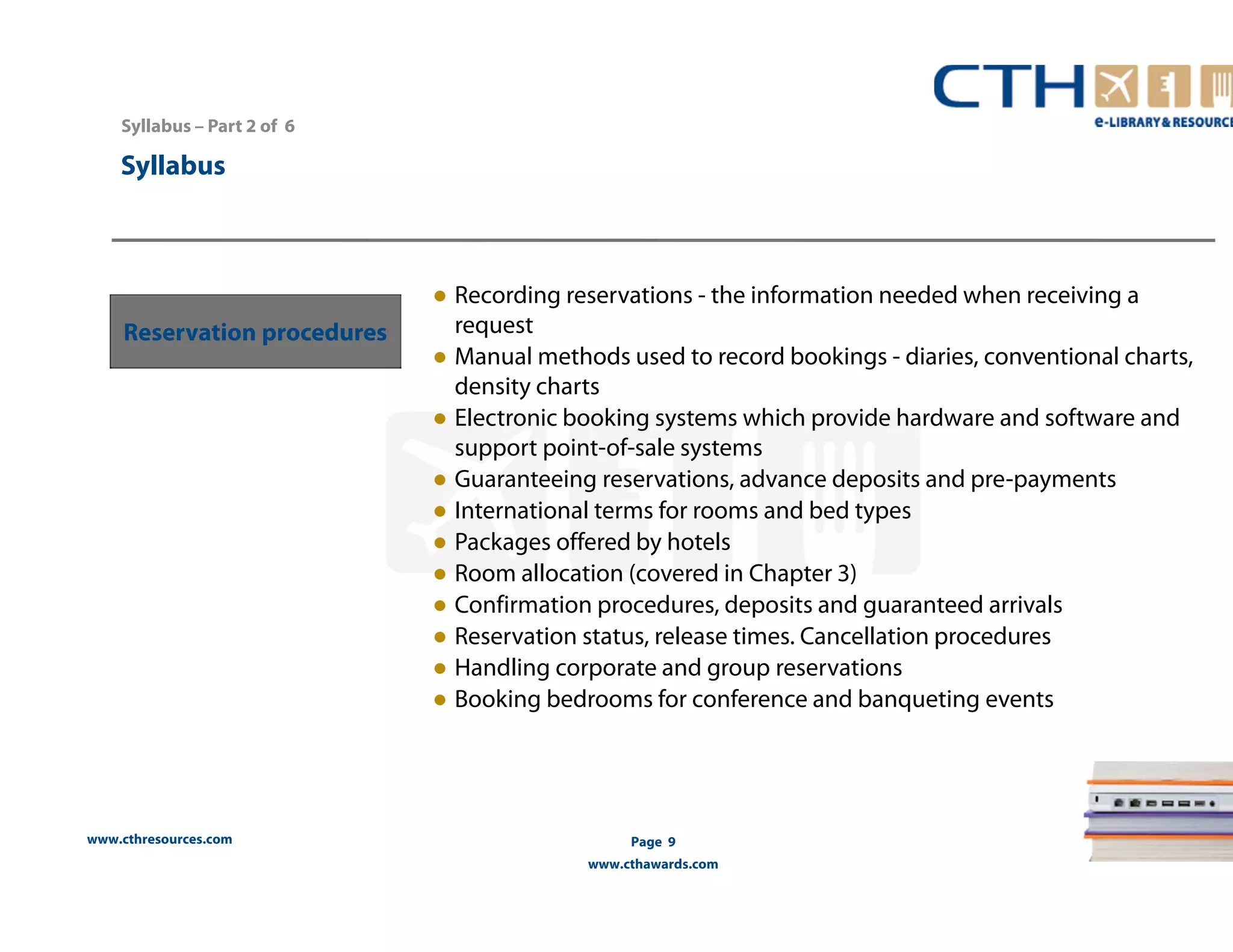
● Recording reservations - the information needed when receiving a 
request 
● Manual methods used to record bookings - diaries, conventional charts, 
density charts 
● Electronic booking systems which provide hardware and software and 
support point-of-sale systems 
● Guaranteeing reservations, advance deposits and pre-payments 
● International terms for rooms and bed types 
● Packages offered by hotels 
● Room allocation (covered in Chapter 3) 
● Confirmation procedures, deposits and guaranteed arrivals 
● Reservation status, release times. Cancellation procedures 
● Handling corporate and group reservations 
● Booking bedrooms for conference and banqueting events
www.cthresources.com 
Page 10 
www.cthawards.com 
Syllabus – Part 3 of 6 
Syllabus 
Check-in procedures 
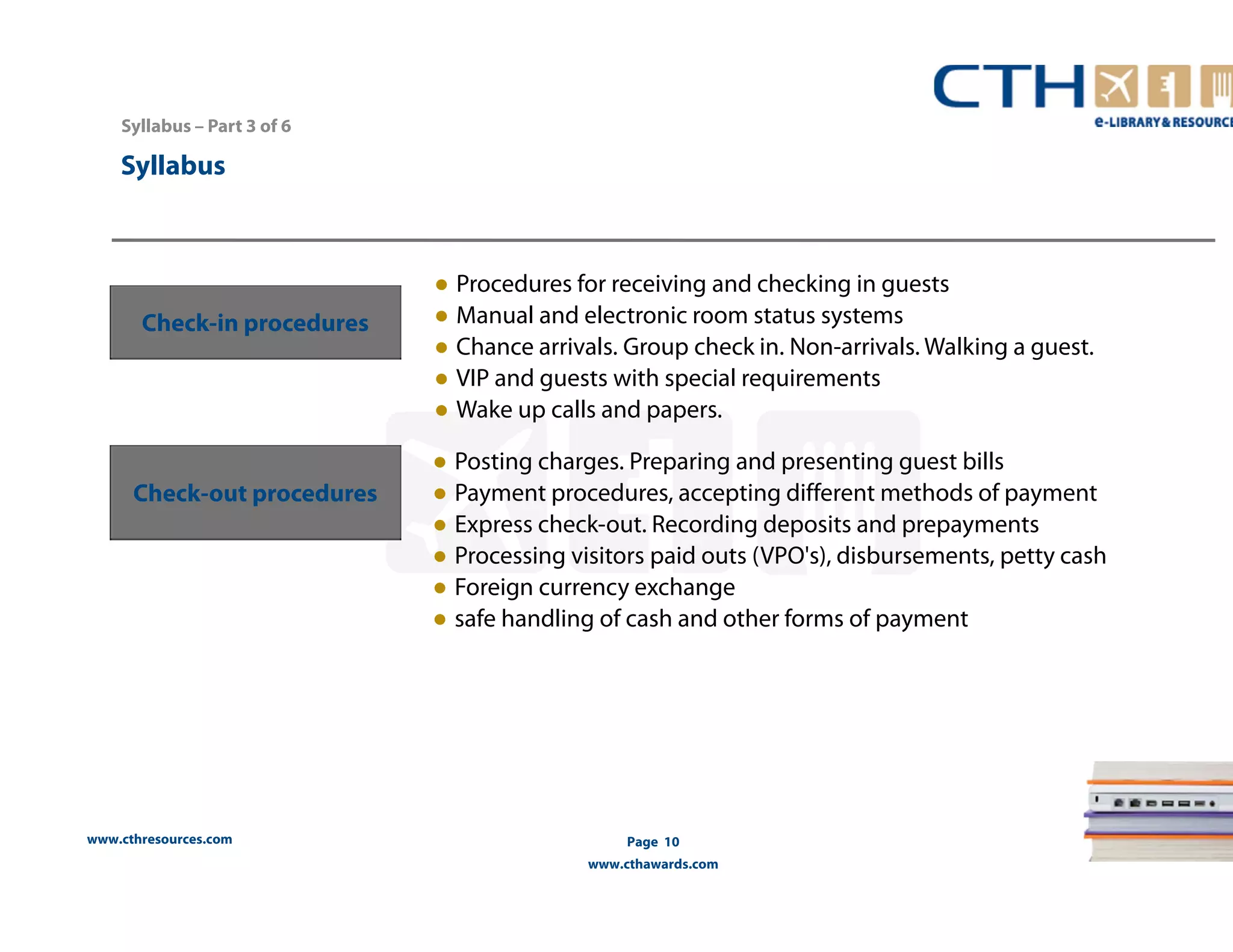
● Procedures for receiving and checking in guests 
● Manual and electronic room status systems 
● Chance arrivals. Group check in. Non-arrivals. Walking a guest. 
● VIP and guests with special requirements 
● Wake up calls and papers. 
Check-out procedures 
● Posting charges. Preparing and presenting guest bills 
● Payment procedures, accepting different methods of payment 
● Express check-out. Recording deposits and prepayments 
● Processing visitors paid outs (VPO's), disbursements, petty cash 
● Foreign currency exchange 
● safe handling of cash and other forms of payment
www.cthresources.com 
Page 11 
www.cthawards.com 
Syllabus – Part 4 of 6 
Syllabus 
Guest accounting 
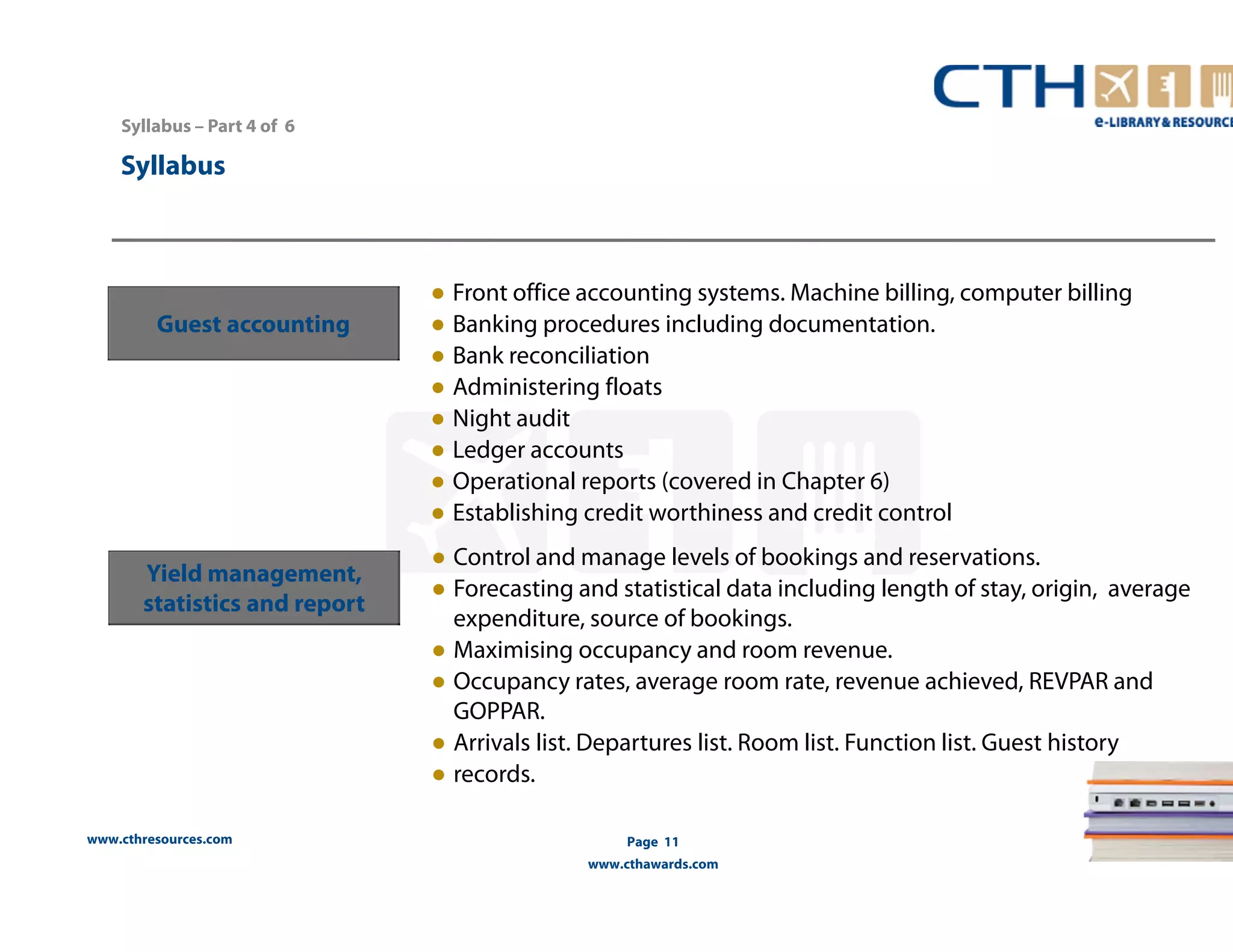
● Front office accounting systems. Machine billing, computer billing 
● Banking procedures including documentation. 
● Bank reconciliation 
● Administering floats 
● Night audit 
● Ledger accounts 
● Operational reports (covered in Chapter 6) 
● Establishing credit worthiness and credit control 
Yield management, 
statistics and report 
● Control and manage levels of bookings and reservations. 
● Forecasting and statistical data including length of stay, origin, average 
expenditure, source of bookings. 
● Maximising occupancy and room revenue. 
● Occupancy rates, average room rate, revenue achieved, REVPAR and 
GOPPAR. 
● Arrivals list. Departures list. Room list. Function list. Guest history 
● records.
www.cthresources.com 
Page 12 
www.cthawards.com 
Syllabus – Part 5 of 6 
Syllabus 
Security and safety 
responsibilities 
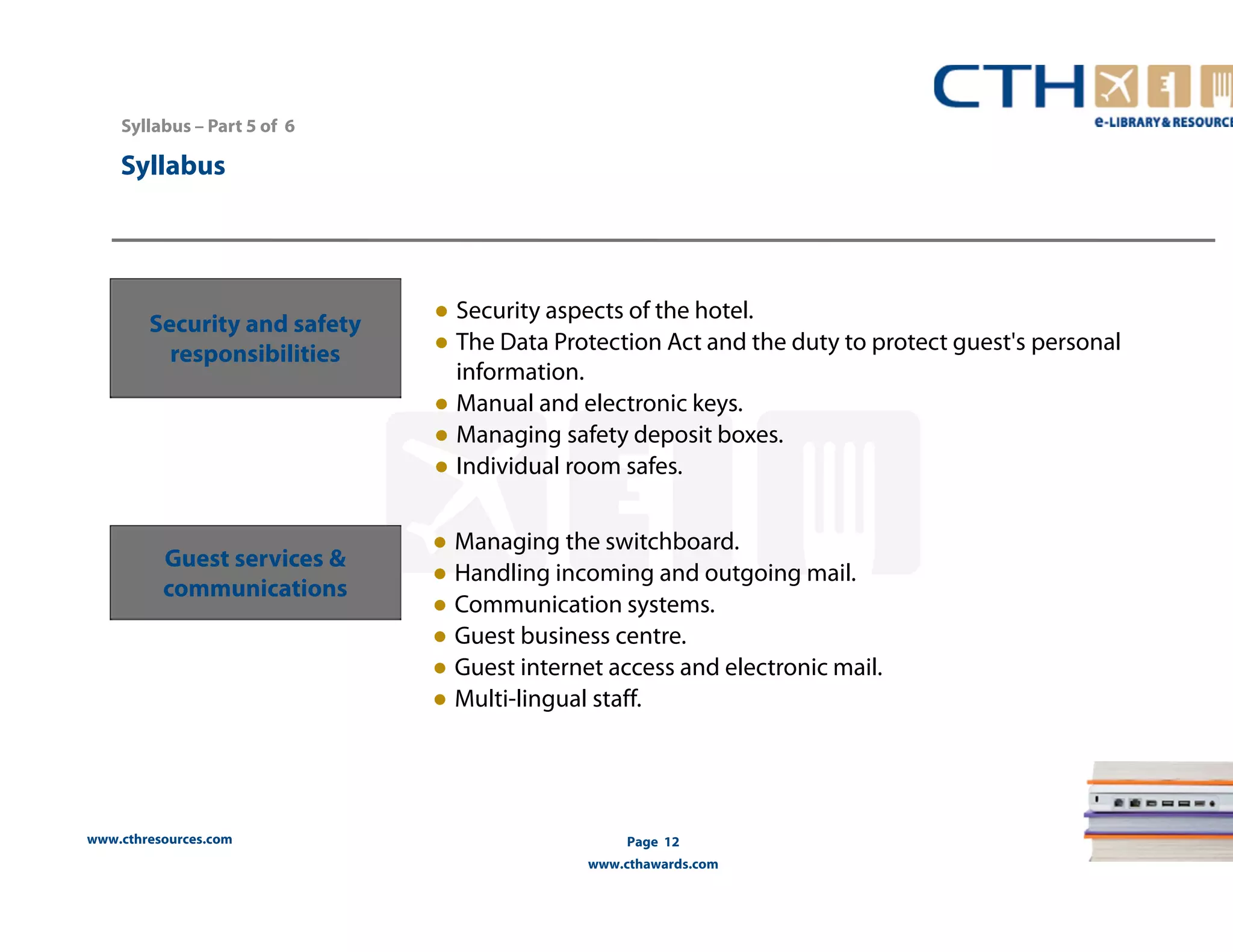
● Security aspects of the hotel. 
● The Data Protection Act and the duty to protect guest's personal 
information. 
● Manual and electronic keys. 
● Managing safety deposit boxes. 
● Individual room safes. 
Guest services & 
communications 
● Managing the switchboard. 
● Handling incoming and outgoing mail. 
● Communication systems. 
● Guest business centre. 
● Guest internet access and electronic mail. 
● Multi-lingual staff.
www.cthresources.com 
Page 13 
www.cthawards.com 
Syllabus – Part 6 of 6 
Syllabus 
Selling methods used 
by front office staff 
● Skills and techniques required when selling the facilities and services 
within the hotel. 
● Benefits to organisation, increased occupancy, customer loyalty, new 
business 
● Staff training 
● Selling techniques, product knowledge, up-selling, selling other services, 
using sales leads, repeat sales, referred sales 
● Paying commission
www.cthresources.com 
Page 14 
www.cthawards.com 
Content 
I. Description 
II. Learning Outcomes 
III. Syllabus 
IV. Assessment 
V. Chapters 1 - 9
www.cthresources.com 
Page 15 
www.cthawards.com 
Assessment 
Assessment 
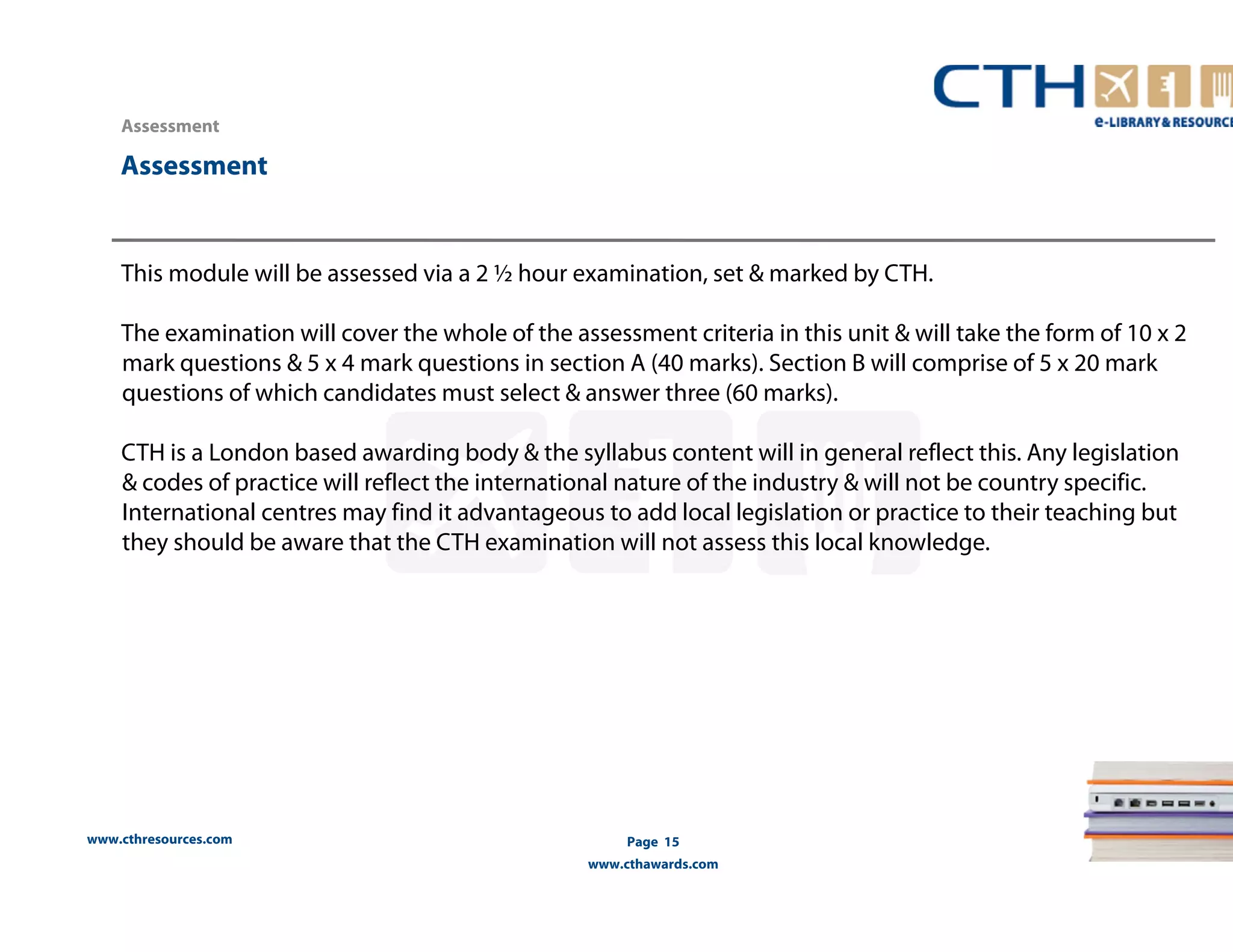
This module will be assessed via a 2 ½ hour examination, set & marked by CTH. 
The examination will cover the whole of the assessment criteria in this unit & will take the form of 10 x 2 
mark questions & 5 x 4 mark questions in section A (40 marks). Section B will comprise of 5 x 20 mark 
questions of which candidates must select & answer three (60 marks). 
CTH is a London based awarding body & the syllabus content will in general reflect this. Any legislation 
& codes of practice will reflect the international nature of the industry & will not be country specific. 
International centres may find it advantageous to add local legislation or practice to their teaching but 
they should be aware that the CTH examination will not assess this local knowledge.
www.cthresources.com 
Page 16 
www.cthawards.com 
Content 
I. Description 
II. Learning Outcomes 
III. Syllabus 
IV. Assessment 
V. Chapters 1 - 9
www.cthresources.com 
Page 17 
www.cthawards.com 
Chapters 
1. Introduction to front office operations 
2. Reservation procedures 
3. Check-in procedures 
4. Check-out procedures 
5. Guest accounting 
6. Yield management, statistics and reports 
7. Security and safety responsibilities 
8. Guest services and communications 
9. Interpersonal and selling skills
www.cthresources.com 
Page 18 
www.cthawards.com 
Chapter 1 – Introduction to front office operations 
Objectives 
In this chapter you will learn to :- 
● The importance of effective front office operations 
● The organization structure of front office operations 
● The role and responsibilities of front-of-house departments and staff 
● An overview of the guest cycle: pre-arrival, arrival, occupancy and 
departure 
● The role of property management system 
● How front-of-house departments liaise and communicate with other 
departments in the hotel 
● How hotels and other accommodation providers differ, in such a way as to 
require different procedures and systems
Chapter 1 – Introduction to front office operations 
Front office operations 
www.cthresources.com 
Page 19 
www.cthawards.com 
1. Front office operations 
1.1 What is the ‘front office’ ? 
1.2 Why are front house activities important
Chapter 1 – Introduction to front office operations 
www.cthresources.com 
Page 20 
www.cthawards.com 
Front office operations 
1.1 What is the ‘front office’ ? 
When people decide that they want or might want, to stay in a hotel, they may. 
● Check out the hotels, and e-mail the reservation department to ask about room rates and availability 
● Telephone the hotel or switchboard and ask to speak to someone(perhaps in the reservation 
department) about room rates and availability, the facilities and location of the hotel and other 
information that will help them make the decision to book. 
● Walk in off the street and approach the front desk to ask about room rates and availability (perhaps 
test out the friendliness and general ‘look’ of the hotel). 
When the guest make the decision on the exact room to book with the given number of nights, there 
may be some follow up correspondence to confirm the booking, give extra information (such as maps 
on how to get to the hotel) or make adjustments to the booking as the guest’s plans change. 
When the guest arrives, (s)he will go to a reception desk to register, be allocated a room & receive a 
room key (with information about the facilities and service of the hotel). There may be a porter to help 
the guest with luggage or to show the room to the guest.
Chapter 1 – Introduction to front office operations 
www.cthresources.com 
Page 21 
www.cthawards.com 
Front office operations 
1.1 What is the ‘front office’ ? Continued... 
During the stay, the guest will come to the reception for many reasons; to collect messages, to leave and 
pick keys, to know some information, to make a complaint or to get a problem solved, etc. 
The hotel may offer additional service such as currency exchange facilities, or use of an in-house office 
facility, restaurant or spa, or an information and reservation/ticketing service for local attraction and 
activities. The guest will receive theses by ringing the hotel switchboard or approaching the front desk. 
At the end of stay, guest will handover the key to the reception and will settle the bill.: help may be 
required with luggage or onward transport. Even after the departure the hotel office will keep the 
guest’s registration details on file for a specific period. (any other queries or special offers) , so that the 
guest will arrive back next time. 
“First impression will be the last impression” so it’s the job of the front office/reception to make the 
guest satisfied.
Chapter 1 – Introduction to front office operations 
www.cthresources.com 
Page 22 
www.cthawards.com 
Front office operations 
1.1 What is the ‘front office’ ? Continued... 
In a small hotel, front office functions may be carried out by a single person at a reception area or front 
desk: answering the switchboard, taking bookings, welcoming and registration guests, billing and 
processing payment and so on. In a large hotel, there may be separate departments dividing these 
responsibilities, including: 
● Switchboard: taking and routing telephone calls 
● Reservation: taking bookings 
● Reception (or front office): welcoming and registering guests at the main reception desk 
● Concierge / enquiries: answering guests’ and visitors’ questions; handling mail and guest keys; 
perhaps also handling car hire, tour booking and entertainment tickets for guests 
● Billing office: preparing guests’ accounts and bills 
● Cashier: receiving guests’ payments and processing other financial transactions (currency exchange) 
● Uniform staff: luggage porters, lift attendants, doormen, cloakroom attendants, garage attendants 
or valet parking etc.
Chapter 1 – Introduction to front office operations 
www.cthresources.com 
Page 23 
www.cthawards.com 
Front office operations 
1.2 Why are front of house activities important? 
Front of house activities are important for several reasons such as, 
● Front office may be the first contact a guest or prospective guest has with the hotel (in written, by 
telephone or in person) 
– Help people decide to whether to choose the hotel (or not!) - winning or losing a prospective 
customer; 
– Influence everything else they think about the hotel. Due to what psychologists call the 'halo 
effect', a good first impression may predispose guests to think well of their rooms, the service they 
are given during their stay and so on. A bad first impression may put them on the alert for other 
bad 'signals', and incline them to find fault with everything else. 
● Front office is the 'service hub' of the hotel: the area where most guest contacts and transactions take 
place throughout their stay. Guests' experience of 'hotel service' is, therefore, mainly shaped by front 
office personnel and procedures. This is important because the quality and style of service is a major 
factor in;
Chapter 1 – Introduction to front office operations 
www.cthresources.com 
Page 24 
www.cthawards.com 
Front office operations 
1.2 Why are front of house activities important? Continued... 
– Providing an enjoyable, relaxing, satisfying experience for guests - which is, after all, the hotel's 
raison d'être; 
– Helping the hotel 'stand out' from its competitors, which may have similar rooms and facilities; 
– Ensuring that guests will want to return again - and meanwhile, will give a positive report of the 
hotel (recommend), to other people. Hotels rely on this positive word of mouth promotion, and 
definitely don't want guests spreading negative reports, especially since the Internet allows them 
to tell thousands of other travellers (in online hotel review sites or travel 'blogs') when they've had 
a good - or bad - experience. 
● Front office has a special responsibility for dealing with guests' problems and complaints; the 
'critical incidents' which can make all the difference between satisfaction and dissatisfaction.
Chapter 1 – Introduction to front office operations 
www.cthresources.com 
Page 25 
www.cthawards.com 
Front office operations 
1.2 Why are front of house activities important? Continued... 
● Front office is the communications hub of the hotel (information is exchanged by and with all other 
departments). If reception fails to tell housekeeping to make a room ready for arriving guests; or fails 
to relay a guest complaint about faulty air conditioning to the maintenance department; or fails to 
make a booking in the hotel restaurant for the guest the system breaks down, and the guest is not 
served. Likewise, if reception fails to heed housekeeping's warning that a room needs repair or 
redecoration; or fails to add a dinner charge, sent through from the restaurant, to the guest's bill - the 
system fails. 
● Front office is the administrative hub of the hotel, where reservations are logged, room allocations are 
planned, room status is monitored, guest bills are prepared, payments are processed, records are 
kept, information displays are maintained; etc. If all these tasks aren't carried out efficiently, the hotel 
would simply cease to function.
Chapter 1 – Introduction to front office operations 
www.cthresources.com 
Page 26 
www.cthawards.com 
Front of house organisation 
2. Front of house organisation 
2.1Organisational structure 
2.2 The room division
Chapter 1 – Introduction to front office operations 
www.cthresources.com 
Page 27 
www.cthawards.com 
Front of house organisation 
2.1 Organisation structure 
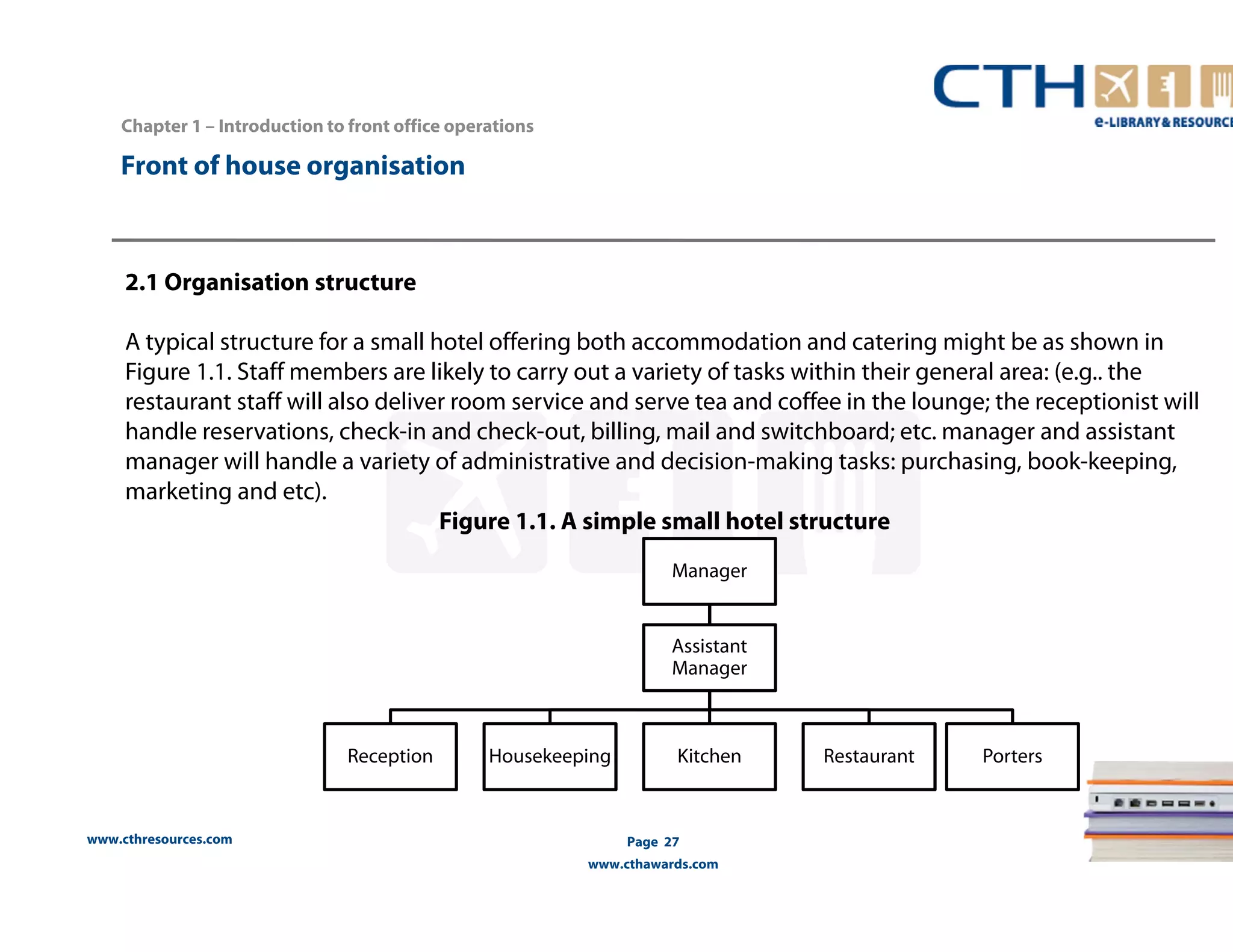
A typical structure for a small hotel offering both accommodation and catering might be as shown in 
Figure 1.1. Staff members are likely to carry out a variety of tasks within their general area: (e.g.. the 
restaurant staff will also deliver room service and serve tea and coffee in the lounge; the receptionist will 
handle reservations, check-in and check-out, billing, mail and switchboard; etc. manager and assistant 
manager will handle a variety of administrative and decision-making tasks: purchasing, book-keeping, 
marketing and etc). 
Figure 1.1. A simple small hotel structure 
Manager 
Assistant 
Manager 
Reception Housekeeping Kitchen Restaurant Porters
Front of house organisation 
www.cthresources.com 
Page 28 
www.cthawards.com 
Chapter 1 – Introduction to front office operations 
2.1 Organisation structure 
In a larger hotel, it is possible to organise staff into more clearly defined departments, each with a 
supervisor or department head (in a medium-sized hotel) or a manager (in a large hotel). There will also 
be more specialised staff, because the hotel can afford to employ more people - and there will be more 
work for each person to do. 
The main revenue-earning functions of the hotel are generally split into a Rooms Division (responsible 
for accommodation) and a Food and Beverages Division (responsible for catering). 
In a medium-sized hotel, there might be a manager and one or more assistant managers, who 
supervise operations (probably on a shift basis, so that there is some managerial supervision seven days 
per week).
Front of house organisation 
www.cthresources.com 
Page 29 
www.cthawards.com 
Chapter 1 – Introduction to front office operations 
2.1 Organisation structure continued… 
In a large hotel, there will be a general management team, responsible for planning and coordinating 
the business and operations of the hotel. Unlike the 'hands on' manager of a small hotel, the manager 
here is essentially a business manager, responsible for policy, planning and control: (s)he may only rarely 
encounter guests or intervene in day-to-day hotel decisions. The 'duty manager' – as assistant managers 
at this level are often called - is the one with hands-on responsibility for dealing with guests, and 
resolving problems and queries referred by front office staff. A number of duty managers may be 
employed to cover a 24-hour roster, so there is always someone available to deal with guest issues.
Front of house organisation 
www.cthresources.com 
Page 30 
www.cthawards.com 
Chapter 1 – Introduction to front office operations 
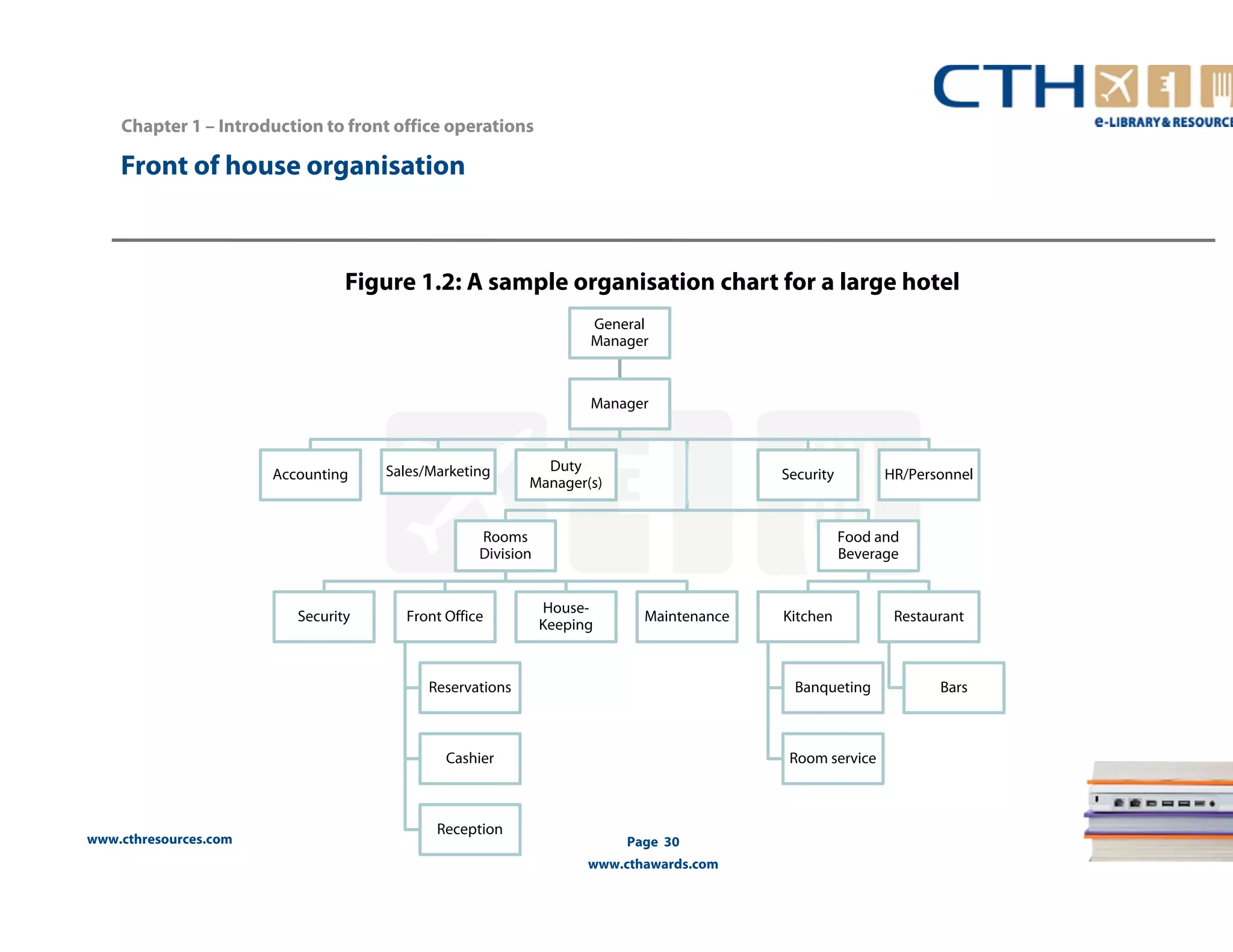
Figure 1.2: A sample organisation chart for a large hotel 
General 
Manager 
Manager 
Accounting Sales/Marketing Duty 
Manager(s) 
Rooms 
Division 
Security Front Office 
Reservations 
Cashier 
Reception 
House- 
Keeping Maintenance 
Security HR/Personnel 
Food and 
Beverage 
Kitchen 
Banqueting 
Room service 
Restaurant 
Bars
Front of house organization 
www.cthresources.com 
Page 31 
www.cthawards.com 
Chapter 1 – Introduction to front office operations 
2.1 Organisation structure continued… 
The things to notice about an organisation chart: 
● The ‘branches’ of the chart show how roles and responsibilities are divided up into sections or departments. 
(e.g.. the management of the hotel shown above is divided into two basic divisions: the Rooms Division and 
Food & Beverage. The Rooms Division is, in turn, divided into four basic functions: Front Office, 
Housekeeping, Maintenance and security). 
● The vertical connecting lines of the chart are also lines of authority and reporting. So, for example, 
reservations staff report to the Front Office Manager, who reports to the Rooms Division Manager – or, to 
look at it another way, policies and instructions flow down from the Rooms Division Manager to front office 
staff. 
● The connecting lines of the chart are also lines of communication and liaison. So, for example, it is clear from 
our chart that staff in the reservations, reception and cashier sections need to communicate with each other: 
each contributes something to the overall work of the Front Office. At the same time, there is a line 
connecting reception and maintenance, say: if a guest comes to reception and says that her TV isn’t working, 
or her window doesn't open, reception will have to liaise with maintenance to make sure it gets 
fixed. We will look at how Front Office liaises with the other departments of the hotel in more 
detail later.
Chapter 1 – Introduction to front office operations 
Front of house organization 
www.cthresources.com 
Mail 
Page 32 
www.cthawards.com 
2.2 The Rooms Division 
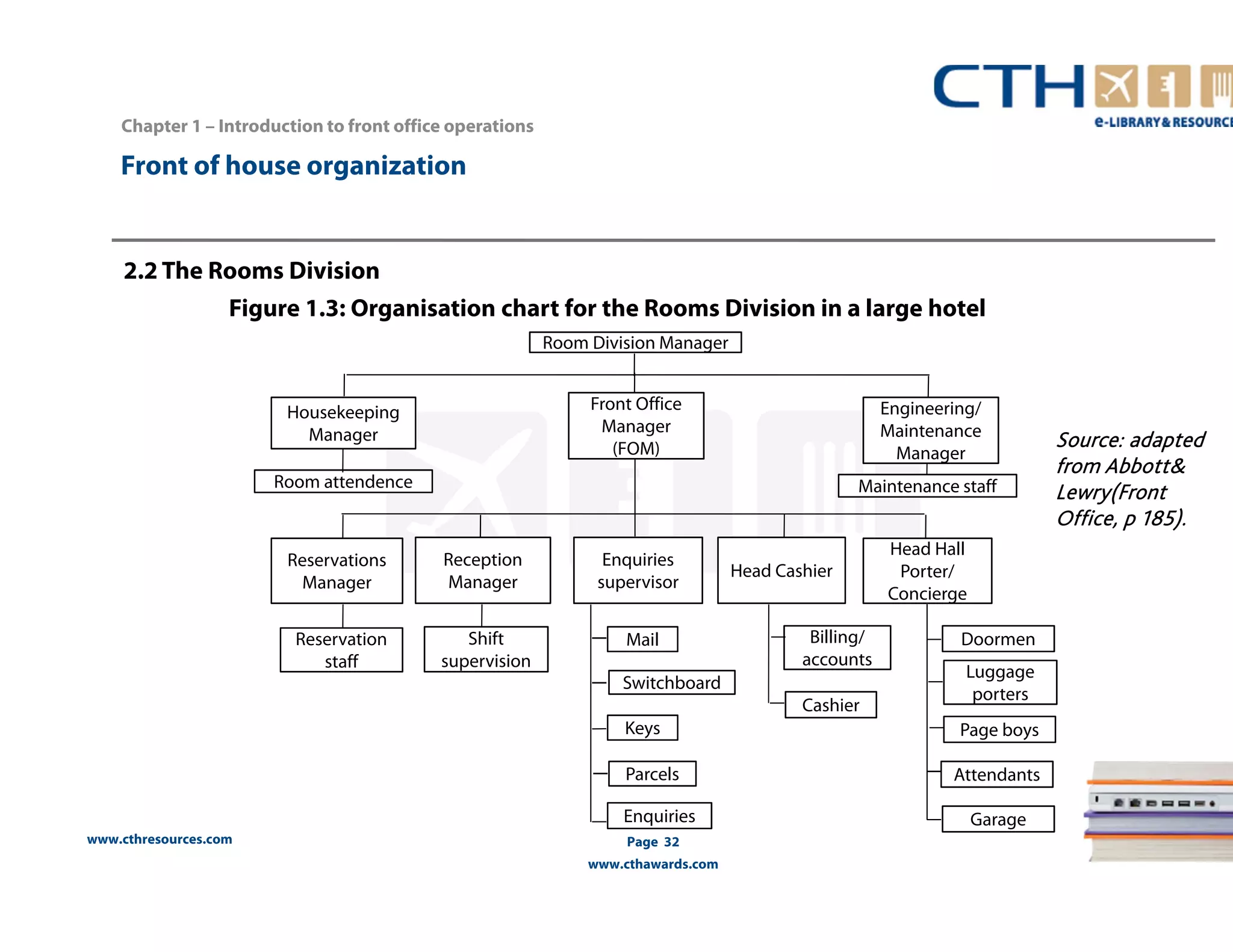
Figure 1.3: Organisation chart for the Rooms Division in a large hotel 
Housekeeping 
Manager 
Room attendence 
Reservations 
Manager 
Head Hall 
Porter/ 
Concierge 
Reception 
Manager Enquiries Head Cashier 
supervisor 
Engineering/ 
Maintenance 
Manager 
Front Office 
Manager 
(FOM) 
Maintenance staff 
Room Division Manager 
Reservation 
staff 
Shift 
supervision 
Switchboard 
Keys 
Parcels 
Enquiries 
Doormen 
Luggage 
porters 
Page boys 
Attendants 
Garage 
Billing/ 
accounts 
Cashier 
Source: adapted 
from Abbott& 
Lewry(Front 
Office, p 185).
Role and responsibilities of front of house staff 
www.cthresources.com 
Page 33 
www.cthawards.com 
Chapter 1 – Introduction to front office operations 
3. Role and responsibilities of front of house staff 
3.1Reservations 
3.2Reception (front desk) 
3.3 Guest accounting/billing 
3.4 Cashiering and night audit 
3.5 Switchboard 
3.6 Concierge and uniformed staff 
3.7 Guest relations 
3.8 Job descriptions for front office roles 
3.9 Working in shifts
Chapter 1 – Introduction to front office operations 
Role and responsibilities of front of house staff 
3.1 Reservations 
Reservations clerks are responsible for taking enquiries from prospective guests, travel agents, group 
or conference organisers and other parties who may wish to reserve accommodation. 
Their role is to obtain the information required to make a booking; record that information in manual or 
computerised reservation records; monitor the levels of reservations; issue any documentation to 
guests to confirm the booking (e.g.. confirmation letters, requests for deposit); and ensure that 
reception is Informed of the confirmed reservation details and expected arrivals for each day. 
A reservations manager or supervisor will be in control of the section, organise staff duty rosters, and 
make decisions on whether and which bookings should be accepted (if the hotel is fully booked, or 
bookings have to be 'juggled' to maximise occupancy). 
Advance reservations may be handled by the receptionist in a small hotel, but many hotels will have a 
separate reservations desk or department - perhaps in a back office near reception, since most 
reservation requests come in by telephone, mail, e-mail or online, rather than via 'walk ins'. 
www.cthresources.com 
Page 34 
www.cthawards.com
Chapter 1 – Introduction to front office operations 
Role and responsibilities of front of house staff 
3.2 Reception (front desk) 
'Reception' may be an umbrella term for all front-office functions, but in larger hotels, there is likely to be 
a special reception desk. 
The main roles of receptionists (or front desk agents) are: taking enquiries and reservation requests 
from 'walk in' Visitors; preparing for the arrival of guests; greeting guests on their arrival; checking guests 
in (registering them, allocating suitable rooms and checking methods of payment); selling the facilities 
and services of the hotel; responding to guest problems and queries, or referring them to other 
departments that can do so; providing information about guests to other front office units and 
departments of the hotel; and maintaining guest records. 
There may be a senior receptionist in charge of each team or shift: of reception staff, who will take 
responsibility for staff rosters, and the handling of more challenging tasks such as group arrivals and 
guest problems, requests and complaints. There will also be a reception or front desk manager, with 
responsibility for the training, supervision and motivation of reception staff; the maximisation of 
occupancy and revenue (yield management) from the sale of hotel facilities and services; and higher-profile 
guest duties (e.g.. greeting VIP guests). 
www.cthresources.com 
Page 35 
www.cthawards.com
Chapter 1 – Introduction to front office operations 
Role and responsibilities of front of house staff 
3.2 Reception (front desk) continued… 
The reception desk in a very small hotel may only operate extended business hours (say, 7.30 am to 
8.30 pm) to cover the main peaks of activity. The hotel will often post an 'after hours' contact number 
(or operate an intercom system) to allow late-arriving guests, or guests with problems during the night, 
to contact a designated 'on-call' person (often a resident caretaker or manager). A larger hotel will seek 
to cover the reception desk on a 24/7 basis, with a permanent night staff or night shift:. 
www.cthresources.com 
Page 36 
www.cthawards.com
Chapter 1 – Introduction to front office operations 
Role and responsibilities of front of house staff 
3.3 Guest accounting/billing 
The accounting/billing office is generally a 'back office' role, both because it does not require direct 
guest contact - and because it requires detailed, methodical (un-distracted) working with numbers, 
calculations and records! Its main roles are: 
● The posting of charges (expenses incurred by the guest for accommodation, meals and other extras) 
and payments (e.g.. deposits, pre-payments, staged payments and/or the final settling of the bill) to 
each guest's bill 
● The recording of charges/sales and payments in relevant accounting records, and the 'balancing of 
those records (so that amounts owing always equal amounts paid or due to be paid) 
● The preparation of relevant accounting records and management reports (e.g.. summaries of sales 
figures) 
www.cthresources.com 
Page 37 
www.cthawards.com
Chapter 1 – Introduction to front office operations 
Role and responsibilities of front of house staff 
3.4 Cashiering and night audit 
The cashier's department is like the 'bank' of the hotel, with responsibly for handling payments, monies 
and valuables. Cashiers may report either to the front office manager or to the accounts manager or 
both, according to the nature of their work. 
● Depending on the facilities offered by the hotel, the role of front office cashiers may include: 
● The opening and preparation of guest accounts (if not handled by a separate accounting/billing 
department) 
● Accepting and processing payment from guests in settlement of their bills 
● Handling foreign currency exchanges for guests (if the hotel is registered to provide this service) 
● Accepting and processing takings from other departments of the hotel (e.g.. the restaurant and bar), 
for account-keeping, reporting, safe storage and banking procedures 
www.cthresources.com 
Page 38 
www.cthawards.com
Chapter 1 – Introduction to front office operations 
Role and responsibilities of front of house staff 
3.4 Cashiering and night audit continued… 
● Providing the cash requirements of other departments (e.g.. the cash 'float’ held by the restaurant or 
bar, in order to be able to give change to customers, or the 'petty cash' held at reception for small cash 
expenses) 
● Administering the safe custody system, whereby guests can deposit their valuables for safekeeping 
by the hotel 
The responsibility of a night auditor, is to post the latest batch of charges/expenses to client accounts, 
balance guest and hotel accounts, prepare revenue reports, and produce statistics and summaries for 
management. 
www.cthresources.com 
Page 39 
www.cthawards.com
Chapter 1 – Introduction to front office operations 
Role and responsibilities of front of house staff 
3.5 Switchboard 
In 'the old days’ basic telephone functions had to be handled by a central switchboard operator. 
However, more sophisticated networks now allow guests to dial out direct from their rooms (to external 
numbers, other room extensions and selected departments of the hotel), and to receive calls direct from 
other rooms and departments of the hotel. Such systems may also have added facilities for automatic 
logging of guest call charges to the billing office; automated wake-up calls; and hotel and guest 'answer 
machine' or 'voice mail' (message taking) systems. Where such systems are in place, switchboard 
operators have much less to do: mainly, directing in-coming calls to the appropriate guest rooms 
(consulting a guest directory) or to appropriate departments of the hotel; and dealing with answer 
machine messages. 
In smaller or more old-fashioned hotels, however, the switchboard may be a general communications 
'hub': putting internal and external calls through for guests; taking messages for guests; making 
personal wake-up calls; and perhaps also handling incoming and outgoing mail. 
www.cthresources.com 
Page 40 
www.cthawards.com
Chapter 1 – Introduction to front office operations 
Role and responsibilities of front of house staff 
3.6 Concierge and uniformed staff 
‘Concierge is the French term for 'porter', but the concierge department in a large hotel (which may also be 
called 'lobby services') may cover a variety of roles, often divided into: 
● An enquiries desk, which may be responsible for general guest or visitor enquiries and directions; 
handing out and accepting guest keys; handling incoming and outgoing mail for guests; and 
organising taxis or valet parking. 
● A bookings desk, which may handle car hire, flight confirmations, tour bookings and entertainment 
tickets for guests. (This desk may also be operated by specialist car hire companies and/or booking 
agencies, who pay for the right to operate on a 'concession' basis within the hotel) 
● A baggage handling and storage desk, or 'porterage' desk (although this may also be handled from 
reception). 
● Security in the lobby/reception area, if this is not handled by a separate security officer or team. 
www.cthresources.com 
Page 41 
www.cthawards.com
Chapter 1 – Introduction to front office operations 
Role and responsibilities of front of house staff 
3.6 Concierge and uniformed staff continued… 
Traditionally, 'concierge' is the title given to the Head Porter, who manages all these services and 
supervises a range of uniformed staff. 
Uniformed staff include: 
● Doorpersons (or greeters): who open doors; bring luggage from guests' transport to the hotel (and 
vice versa on departure); and hail or call taxis on request 
● Porters, 'bell staff and/or pages, who carry luggage to and from guests' rooms; keep the lobby area 
clean and tidy; run errands and relay messages 
● Lift attendants, parking attendants, cloakroom attendants etc 
www.cthresources.com 
Page 42 
www.cthawards.com
Chapter 1 – Introduction to front office operations 
Role and responsibilities of front of house staff 
3.7 Guest relations 
In large hotels, Guest Relations Officers (GROs) are sometimes employed to create a more 'personal‘ 
relationship with guests - who might otherwise have very little human contact with hotel staff. 
Their main role is to make guests feel welcome and provide personalised service, by greeting guests; 
attending social gatherings held by the hotel (as social 'facilitators'); and perhaps talking to those who 
are travelling alone. 
Guests with special needs, problems or complaints may be referred to GROs by reception. GROs may also 
be given the task of greeting and liaising with Very Important Persons (VIPs), Commercially Important 
Guests (CIGs) and Special Attention guests (SPATTs). 
GROs may support sales staff (e.g.. by escorting potential clients around the hotel, or providing guests 
with information about the hotel's services and facilities), and provide non-routine guest services when 
required (e.g.. sending a fax for a guest after the hotel's business centre has closed). 
www.cthresources.com 
Page 43 
www.cthawards.com
Chapter 1 – Introduction to front office operations 
Role and responsibilities of front of house staff 
3.8 Job descriptions for front office roles 
Job descriptions are often used in the recruitment of staff, both to prepare job advertisements, and to 
measure the skills, characteristics and experience of candidates against the requirements of the job. 
They are also used as a guide to the induction and training of new staff, as the list of duties can be used 
as a 'checklist' for what recruits need to be able to do to work competently in the job. The key is to keep a 
job description brief and simple. It should generally contain: 
● The job title, department and place of work 
● A 'job or role summary': a short paragraph describing the major function of the job (perhaps with an 
organisation chart to show where it 'fits' in the rooms division or front-office structure) 
● The person/or position to whom the job-holder is responsible (i.e. a manager or supervisor) 
● Any persons/positions for whom the job-holder is responsible, or who report to the job-holder: that is 
any staff (s)he will have to manage or supervise 
● A list of the main duties, tasks or responsibilities entailed by the job 
● Where relevant, a note of other departments or roles with which the job-holder must regularly 
liaise, communicate or co-operate. 
www.cthresources.com 
Page 44 
www.cthawards.com
Chapter 1 – Introduction to front office operations 
Role and responsibilities of front of house staff 
3.9 Working in shifts 
A small hotel or guest house may shut down its front office over night, leaving an 'Out of Hours' or 
'Emergency' contact number (and/or front entrance intercom) for late arrivals or guests with problems 
during the night. 
A large hotel, front office staff will be available to meet guest needs 24 hours per day. Most back office 
departments will operate normal or extended office hours: reservations will tend to be concentrated 
within business hours, and billing and cashiering activity in the early morning (posting of last-minute 
charges), middle of the day (lunchtime postings and banking of takings) and evening (opening bills for 
new arrivals). 
However, certain significant front office roles (reception, night audit, porter and switchboard) will 
have to be covered overnight. 
www.cthresources.com 
Page 45 
www.cthawards.com
Chapter 1 – Introduction to front office operations 
Role and responsibilities of front of house staff 
3.9 Working in shifts continued… 
Work is therefore usually organised on a shift basis. 
Day staff may work an early shift (say, 7.00 am to 3.00 pm) or a late shift (3.00 pm to 11.00 pm), on a 
rotating roster system, five days per week (with varying days off ). The main peaks of activity at front 
desk will be check-out time (7.30 - 10.30 am) and arrival time (say, 3.00 -7.00 pm). 
A separate (generally smaller) night staff will usually be employed to cover the night or 'graveyard' shift 
(11.00pm to 7.00 am), to enable them to establish a routine of night working rather than rotating 
between day and night shifts. 
Shift hours usually also allow 15-30 minutes for 'hand-over' between shifts, so that unresolved issues 
can be notified to the incoming shift, responsibilities for the cash drawer signed over and so on. 
Drawing-up and maintaining shift rosters, to ensure that all shifts are adequately covered - while being 
flexible to the needs of staff members - is a significant challenge for the front office manager! 
www.cthresources.com 
Page 46 
www.cthawards.com
www.cthresources.com 
Page 47 
www.cthawards.com 
Chapter 1 – Introduction to front office operations 
The guest cycle 
4. The guest cycle
www.cthresources.com 
Page 48 
www.cthawards.com 
Chapter 1 – Introduction to front office operations 
The guest cycle 
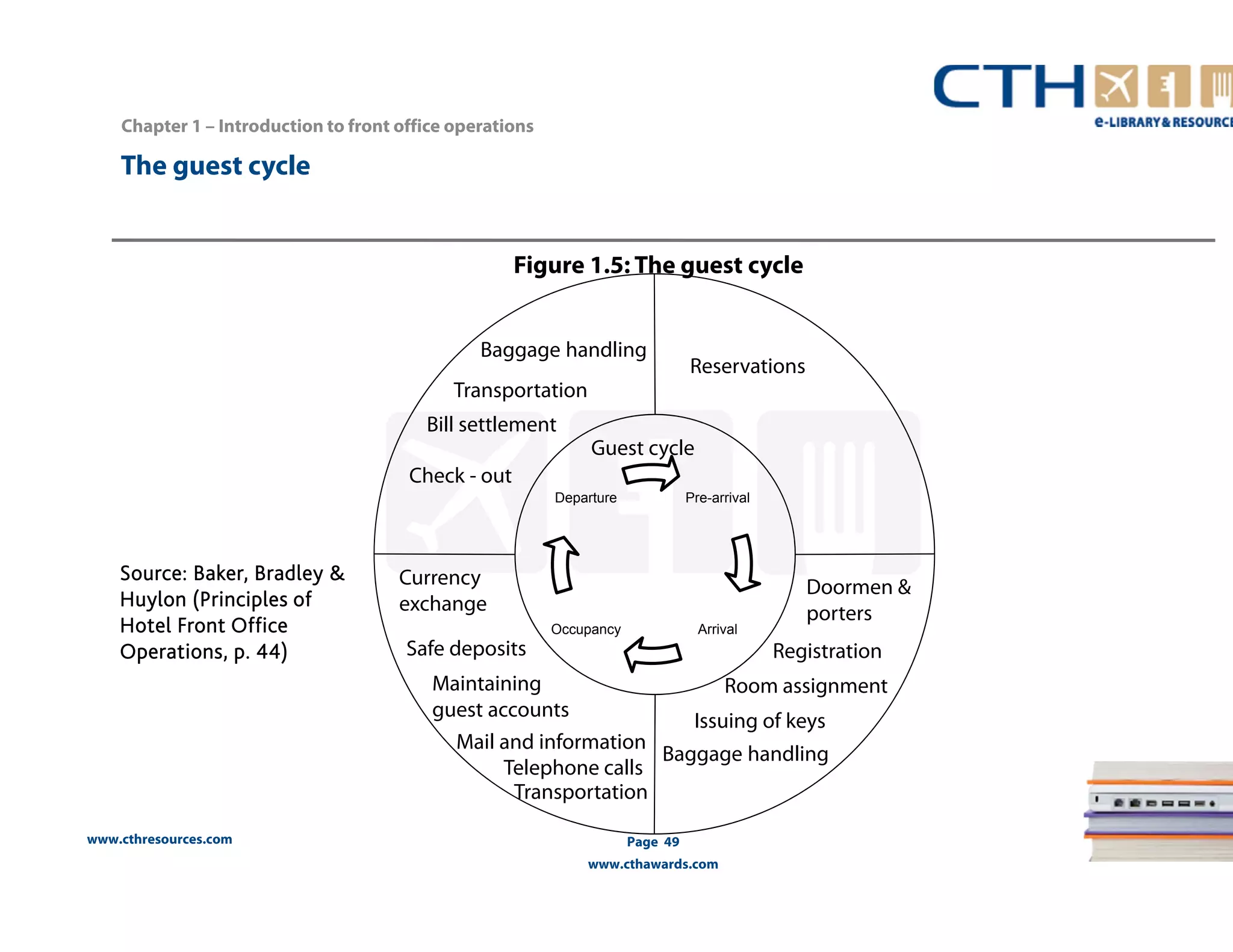
As the organisation charts, the grouping of tasks onto divisions and departments sets up a series of 
'vertical' chains or structures, reflecting the separation of specialised activities. 
But look at from the point of view of a guest coming into a hotel, the 'flow' of activity doesn't look like 
this at all. A guest experiences the hotel less as a vertical structure than as a horizontal process. (S)he 
makes a booking, has it confirmed, arrives at the hotel on the due day, checks-in, requests various 
services as the stay unfolds, then turns up to check-out, receives the bill, pays it - and departs. For the 
guest, the experience is chronological: unfolding as a series of events, activities and services received 
over time. 
The guest doesn't need to know - and ideally, shouldn't feel - that (s)he is having to cross over from one 
separate department to another at each stage: (s)he should be able to progress more or less seamlessly 
from booking (reservations) to check-in (reception) to occupancy (housekeeping, food and beverage 
and various other departments as required) to check-out (billing, cashier). In order to create this 
seamless service, it is useful to think of the role of front office, not in terms of departmental roles and 
responsibilities, but in terms of the guest cycle.
www.cthresources.com 
Guest cycle 
Page 49 
Departure 
www.cthawards.com 
Chapter 1 – Introduction to front office operations 
The guest cycle 
Pre-arrival 
Occupancy Arrival 
Source: Baker, Bradley & 
Huylon (Principles of 
Hotel Front Office 
Operations, p. 44) 
Figure 1.5: The guest cycle 
Reservations 
Doormen & 
porters 
Registration 
Room assignment 
Issuing of keys 
Baggage handling 
Baggage handling 
Transportation 
Bill settlement 
Check - out 
Currency 
exchange 
Safe deposits 
Maintaining 
guest accounts 
Mail and information 
Telephone calls 
Transportation
www.cthresources.com 
Page 50 
www.cthawards.com 
Chapter 1 – Introduction to front office operations 
Liaising with other departments 
5. Liaising with other departments 
5.1 Other departments in the hotel 
5.2 The flow of information within a hotel
www.cthresources.com 
Page 51 
www.cthawards.com 
Chapter 1 – Introduction to front office operations 
Liaising with other departments 
5.1 Other departments in the hotel 
There are a number of departments in a large hotel. 
Some of them will be concerned with raising revenue, or earning money for the hotel: the rooms 
division and food and beverage divisions are the main ones - but the hotel may also earn revenue 
through recreational facilities, guest laundry/dry cleaning, a business centre and etc. 
Other departments may fulfill the management and support functions of the hotel (sales and marketing, 
accounting/finance, security, engineering/maintenance, premises management, information 
technology (IT) and HR/personnel). 
Since front office will have to liaise with various other departments in the hotel, Following is a brief at 
what the main ones do, and why liaison is required.
www.cthresources.com 
Page 52 
www.cthawards.com 
Chapter 1 – Introduction to front office operations 
Liaising with other departments 
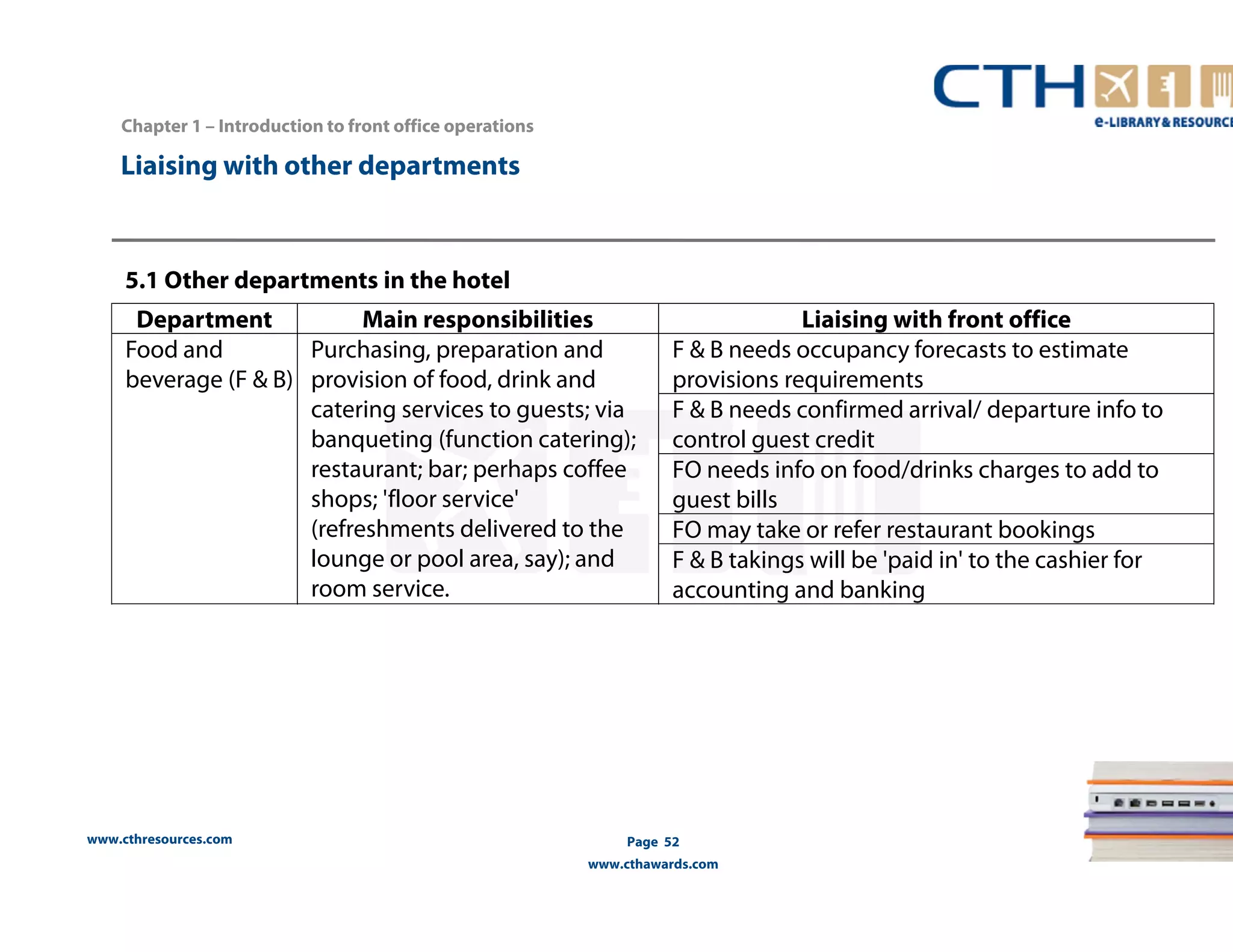
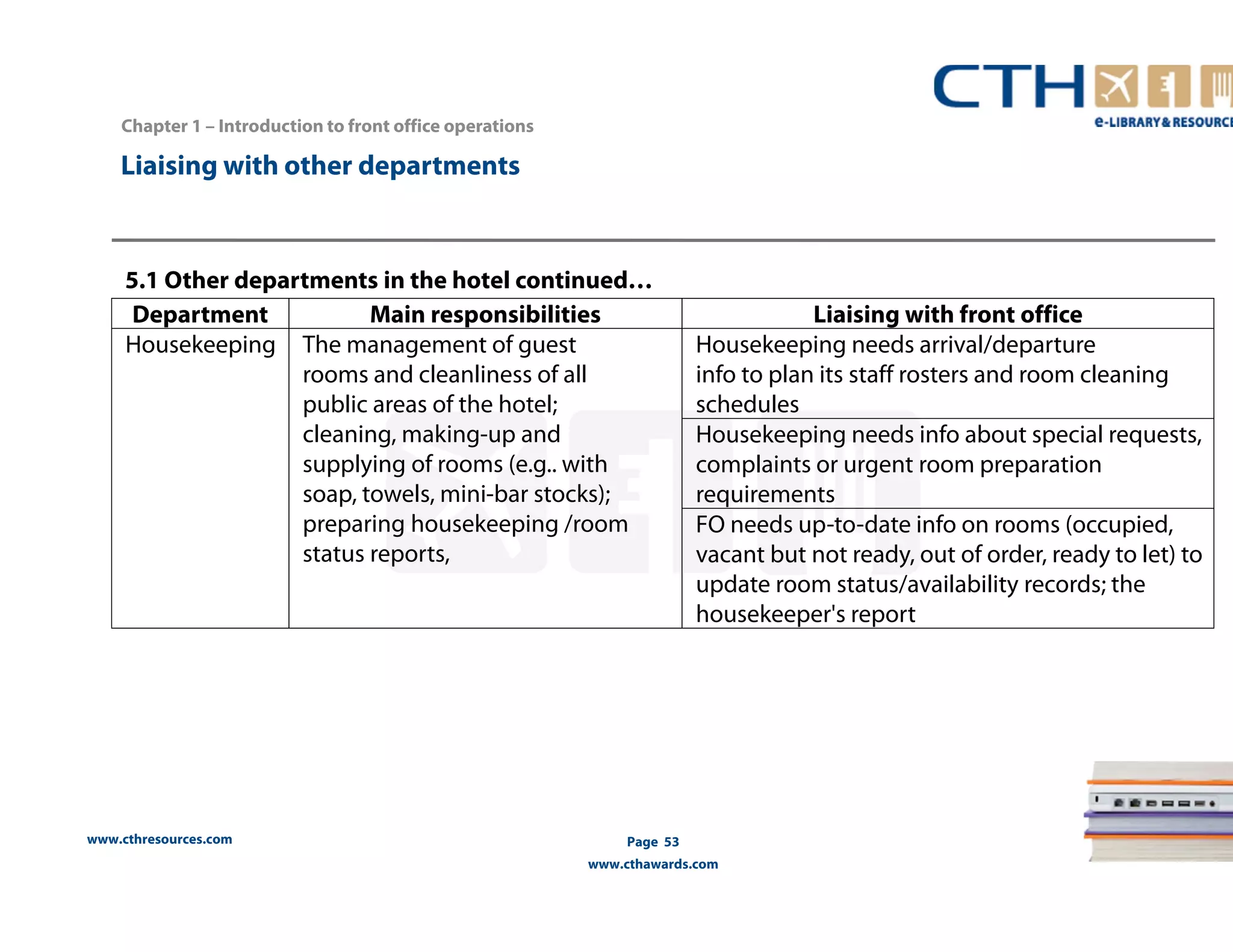
5.1 Other departments in the hotel 
Department Main responsibilities Liaising with front office 
Food and 
beverage (F & B) 
Purchasing, preparation and 
provision of food, drink and 
catering services to guests; via 
banqueting (function catering); 
restaurant; bar; perhaps coffee 
shops; 'floor service' 
(refreshments delivered to the 
lounge or pool area, say); and 
room service. 
F & B needs occupancy forecasts to estimate 
provisions requirements 
F & B needs confirmed arrival/ departure info to 
control guest credit 
FO needs info on food/drinks charges to add to 
guest bills 
FO may take or refer restaurant bookings 
F & B takings will be 'paid in' to the cashier for 
accounting and banking
www.cthresources.com 
Page 53 
www.cthawards.com 
Chapter 1 – Introduction to front office operations 
Liaising with other departments 
Department Main responsibilities Liaising with front office 
Housekeeping The management of guest 
rooms and cleanliness of all 
public areas of the hotel; 
cleaning, making-up and 
supplying of rooms (e.g.. with 
soap, towels, mini-bar stocks); 
preparing housekeeping /room 
status reports, 
Housekeeping needs arrival/departure 
info to plan its staff rosters and room cleaning 
schedules 
Housekeeping needs info about special requests, 
complaints or urgent room preparation 
requirements 
FO needs up-to-date info on rooms (occupied, 
vacant but not ready, out of order, ready to let) to 
update room status/availability records; the 
housekeeper's report 
5.1 Other departments in the hotel continued…
www.cthresources.com 
Page 54 
www.cthawards.com 
Chapter 1 – Introduction to front office operations 
Liaising with other departments 
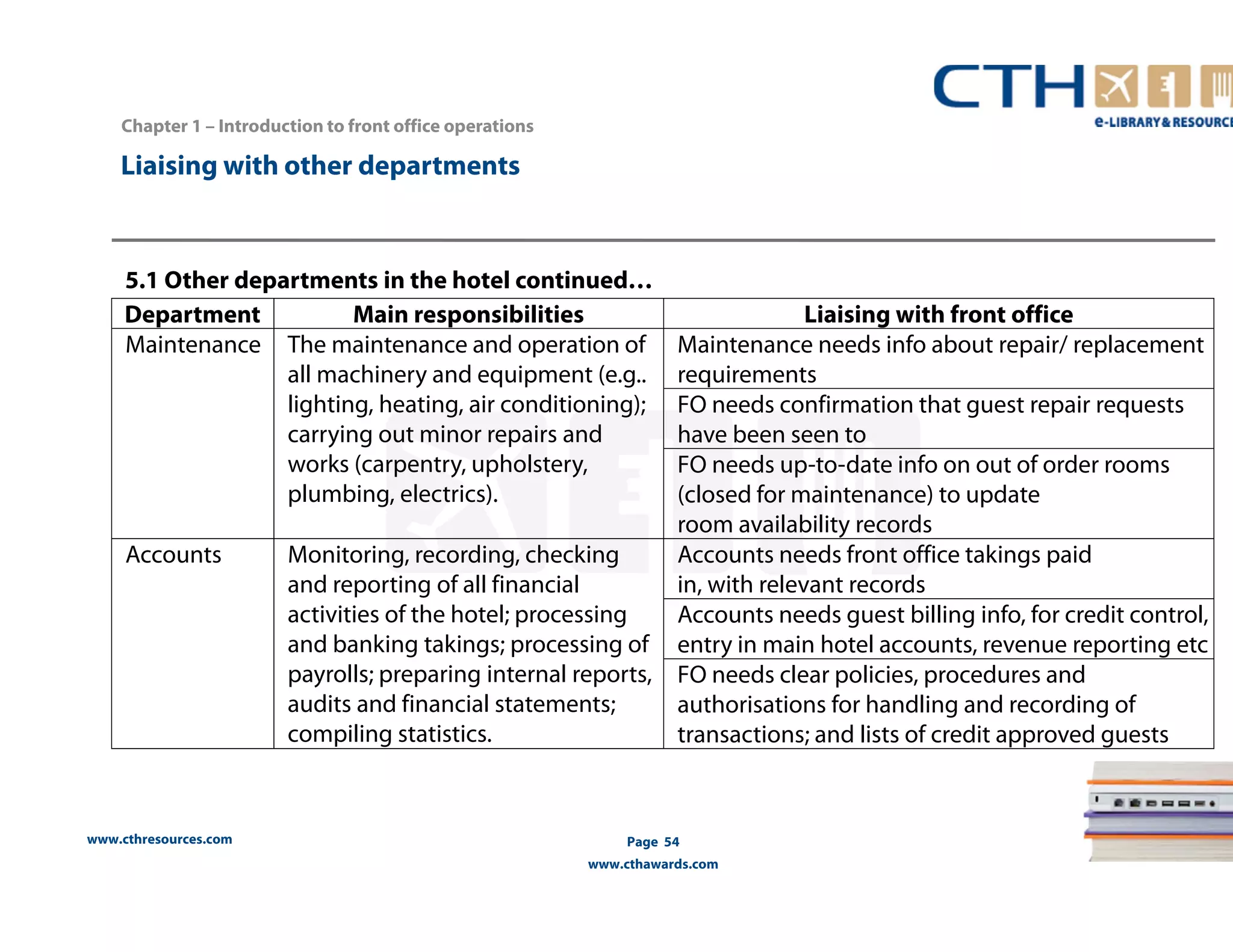
Department Main responsibilities Liaising with front office 
Maintenance The maintenance and operation of 
all machinery and equipment (e.g.. 
lighting, heating, air conditioning); 
carrying out minor repairs and 
works (carpentry, upholstery, 
plumbing, electrics). 
Maintenance needs info about repair/ replacement 
requirements 
FO needs confirmation that guest repair requests 
have been seen to 
FO needs up-to-date info on out of order rooms 
(closed for maintenance) to update 
room availability records 
Accounts Monitoring, recording, checking 
and reporting of all financial 
activities of the hotel; processing 
and banking takings; processing of 
payrolls; preparing internal reports, 
audits and financial statements; 
compiling statistics. 
Accounts needs front office takings paid 
in, with relevant records 
Accounts needs guest billing info, for credit control, 
entry in main hotel accounts, revenue reporting etc 
FO needs clear policies, procedures and 
authorisations for handling and recording of 
transactions; and lists of credit approved guests 
5.1 Other departments in the hotel continued…
5.1 Other departments in the hotel continued… 
www.cthresources.com 
Page 55 
www.cthawards.com 
Chapter 1 – Introduction to front office operations 
Liaising with other departments 
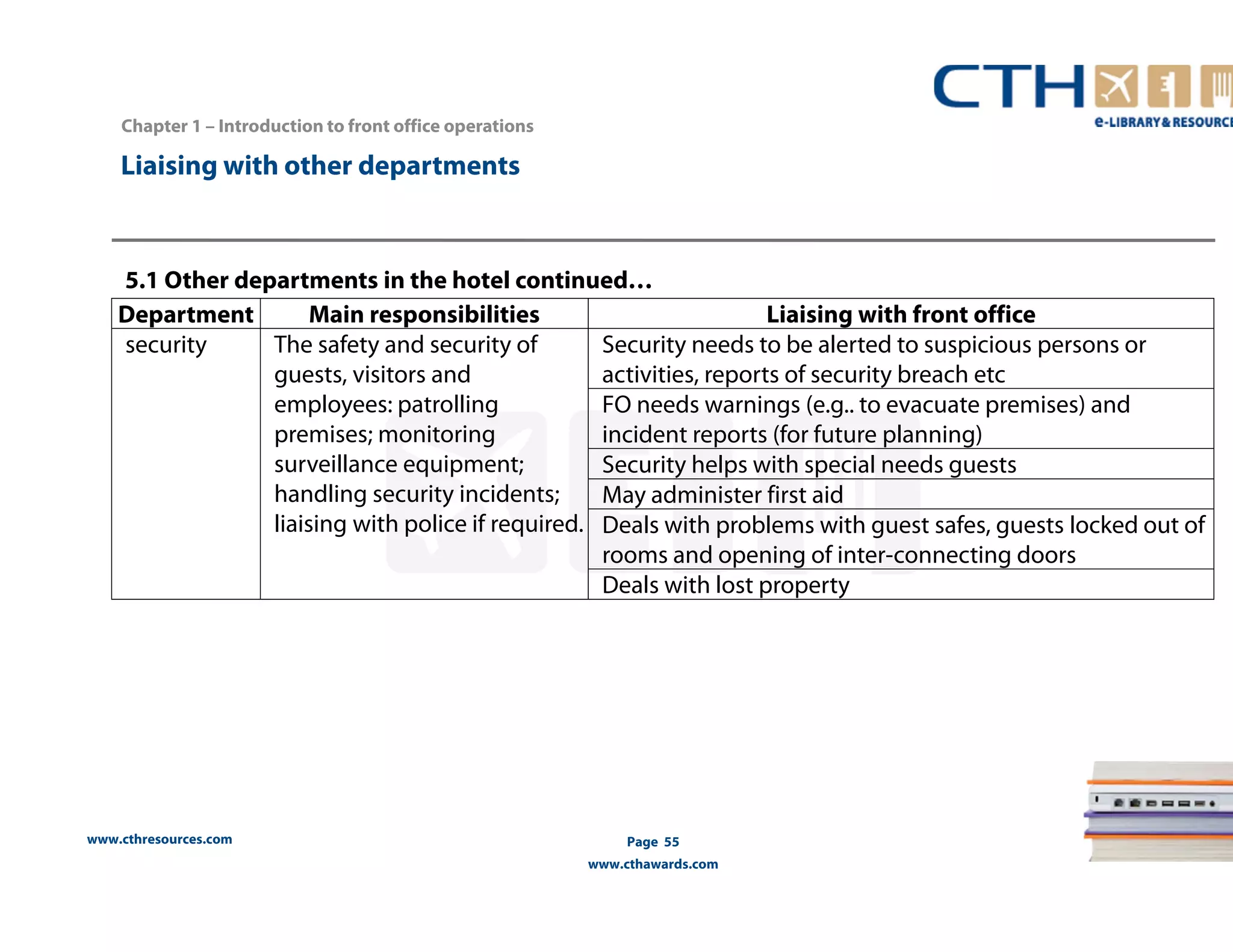
Department Main responsibilities Liaising with front office 
security The safety and security of 
guests, visitors and 
employees: patrolling 
premises; monitoring 
surveillance equipment; 
handling security incidents; 
liaising with police if required. 
Security needs to be alerted to suspicious persons or 
activities, reports of security breach etc 
FO needs warnings (e.g.. to evacuate premises) and 
incident reports (for future planning) 
Security helps with special needs guests 
May administer first aid 
Deals with problems with guest safes, guests locked out of 
rooms and opening of inter-connecting doors 
Deals with lost property
5.1 Other departments in the hotel continued… 
www.cthresources.com 
Page 56 
www.cthawards.com 
Chapter 1 – Introduction to front office operations 
Liaising with other departments 
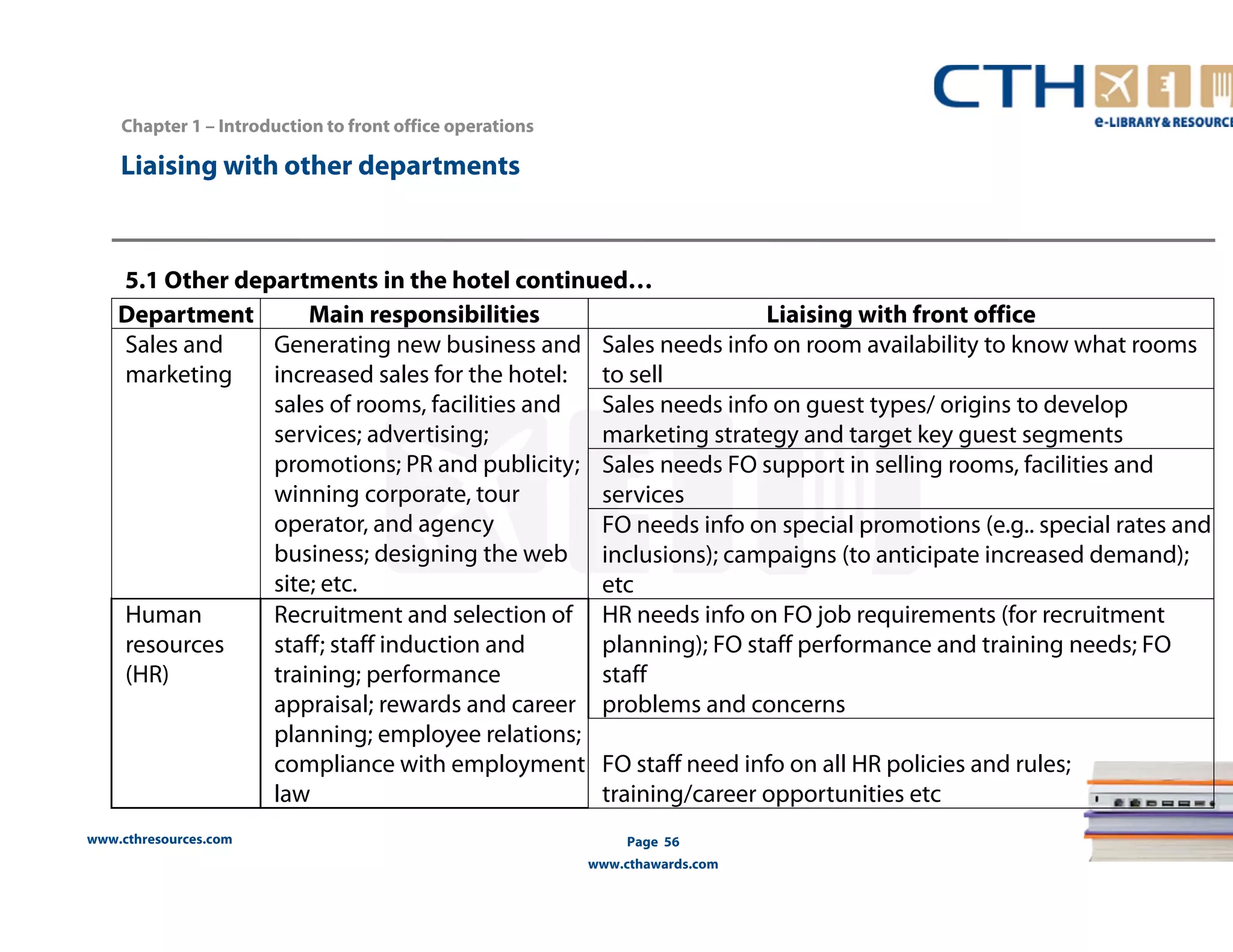
Department Main responsibilities Liaising with front office 
Sales and 
marketing 
Generating new business and 
increased sales for the hotel: 
sales of rooms, facilities and 
services; advertising; 
promotions; PR and publicity; 
winning corporate, tour 
operator, and agency 
business; designing the web 
site; etc. 
Sales needs info on room availability to know what rooms 
to sell 
Sales needs info on guest types/ origins to develop 
marketing strategy and target key guest segments 
Sales needs FO support in selling rooms, facilities and 
services 
FO needs info on special promotions (e.g.. special rates and 
inclusions); campaigns (to anticipate increased demand); 
etc 
Human 
resources 
(HR) 
Recruitment and selection of 
staff; staff induction and 
training; performance 
appraisal; rewards and career 
planning; employee relations; 
compliance with employment 
law 
HR needs info on FO job requirements (for recruitment 
planning); FO staff performance and training needs; FO 
staff 
problems and concerns 
FO staff need info on all HR policies and rules; 
training/career opportunities etc
www.cthresources.com 
Page 57 
www.cthawards.com 
Chapter 1 – Introduction to front office operations 
Liaising with other departments 
5.2 The flow of information within a hotel 
Number of routine reports and notifications that will need to flow from front office to other 
departments. Examples include: 
● A list of guests currently in residence - or guest index - in alphabetical order, so that any member of 
staff can look up a guest or locate their room number when necessary 
● A list of anticipated arrivals (based on reservations), group arrivals and VIP/special needs arrivals, so 
that departments can prepare for them 
● A list of amendments to the arrivals list (e.g.. last-minute bookings and chance walk-in guests) 
● A list of guest amendments: changes of room number, number of guests, terms and so on, so that 
departments can adjust accordingly 
● A list of anticipated departures (based on booked departure dates) so that departments can plan 
to prepare rooms for re-Ietting, prepare bills for departing guests and so 
● A list of amendments to the departures list (e.g.. guests extending their stay) 
● A list of guests who have left the hotel, so that telephone calls and messages can handled 
accordingly, and rooms prepared for re-Ietting.
www.cthresources.com 
Page 58 
www.cthawards.com 
Chapter 1 – Introduction to front office operations 
Liaising with other departments 
Flow of information within front office sections: 
Concierge/enquiries will need arrivals, departures and current guest lists, in order to sort incoming 
guest mail, take messages, give the right keys to the right guests, and take the right baggage to the right 
rooms. 
Switchboard will need the current guest list and checked-out guest list, in order to handle incoming 
phone calls and charge guests calls to the right rooms. 
Reception will need all the information collected by the reservation section, in order to prepare for and 
verify the bookings of arriving guests, maintain room availability records and so on. 
Reservations will need information on returning guests, compiled by reception, in order to offer a 
personalised service. 
Cashier will need guests' reservation and check-in information In order to open a guest bill, charge the 
correct rate agreed with the guest, confirm the guests payment details, check corporate accounts and so 
on. They may also need access to guest history records, in order to check that guests have 
paid their bills in the past, or to identify guests who are entitled to special discounts.
www.cthresources.com 
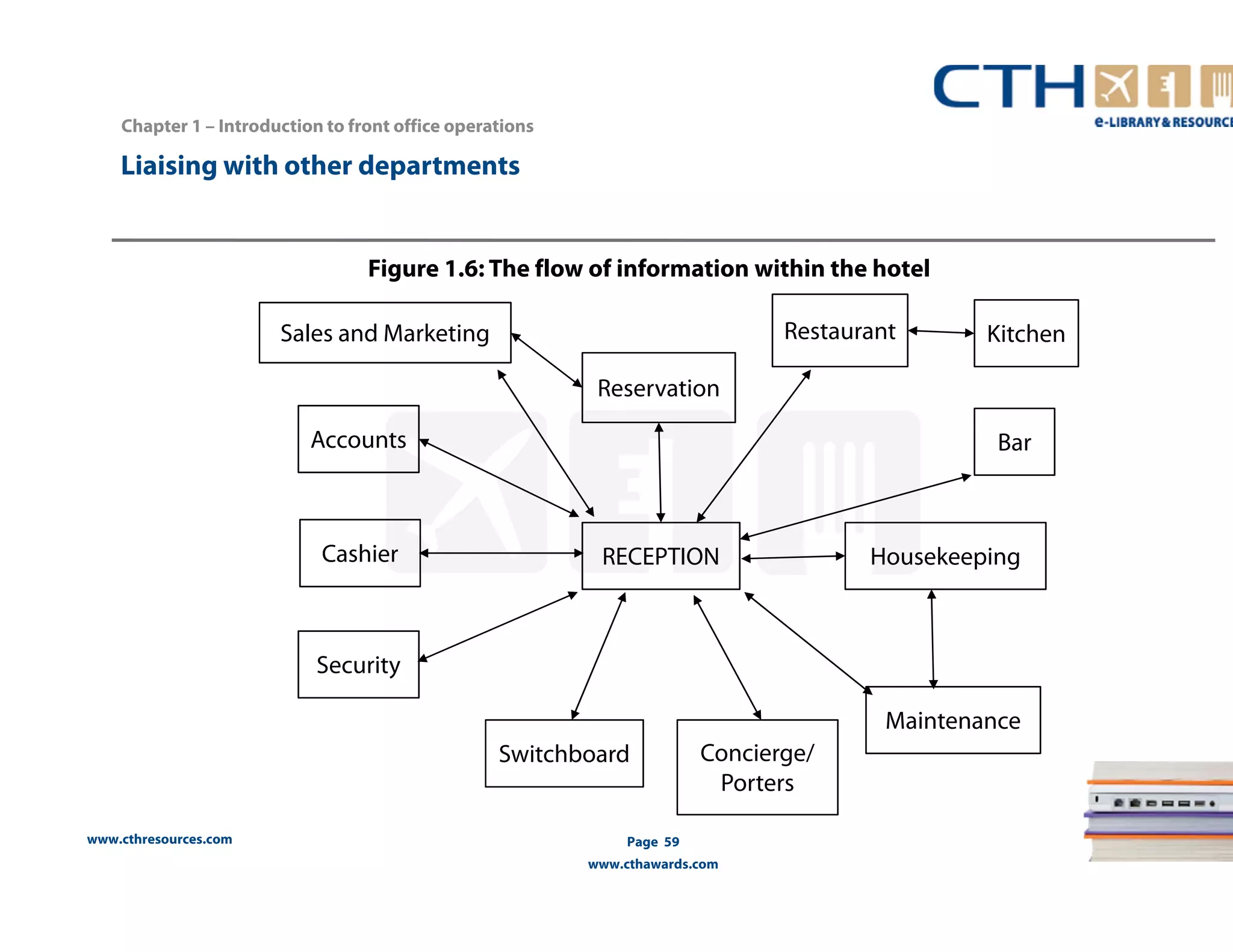
Sales and Marketing Restaurant 
Reservation 
Kitchen 
RECEPTION Housekeeping 
Page 59 
www.cthawards.com 
Accounts 
Cashier 
Security 
Switchboard 
Maintenance 
Concierge/ 
Porters 
Bar 
Chapter 1 – Introduction to front office operations 
Liaising with other departments 
Figure 1.6: The flow of information within the hotel
www.cthresources.com 
Page 60 
www.cthawards.com 
Chapter 1 – Introduction to front office operations 
Property managements systems 
6. Property management systems 
6.1 Hotel, property or premises management systems 
6.2 General advantages and disadvantages of ‘computerising’ the hotel
www.cthresources.com 
Page 61 
www.cthawards.com 
Chapter 1 – Introduction to front office operations 
Property managements systems 
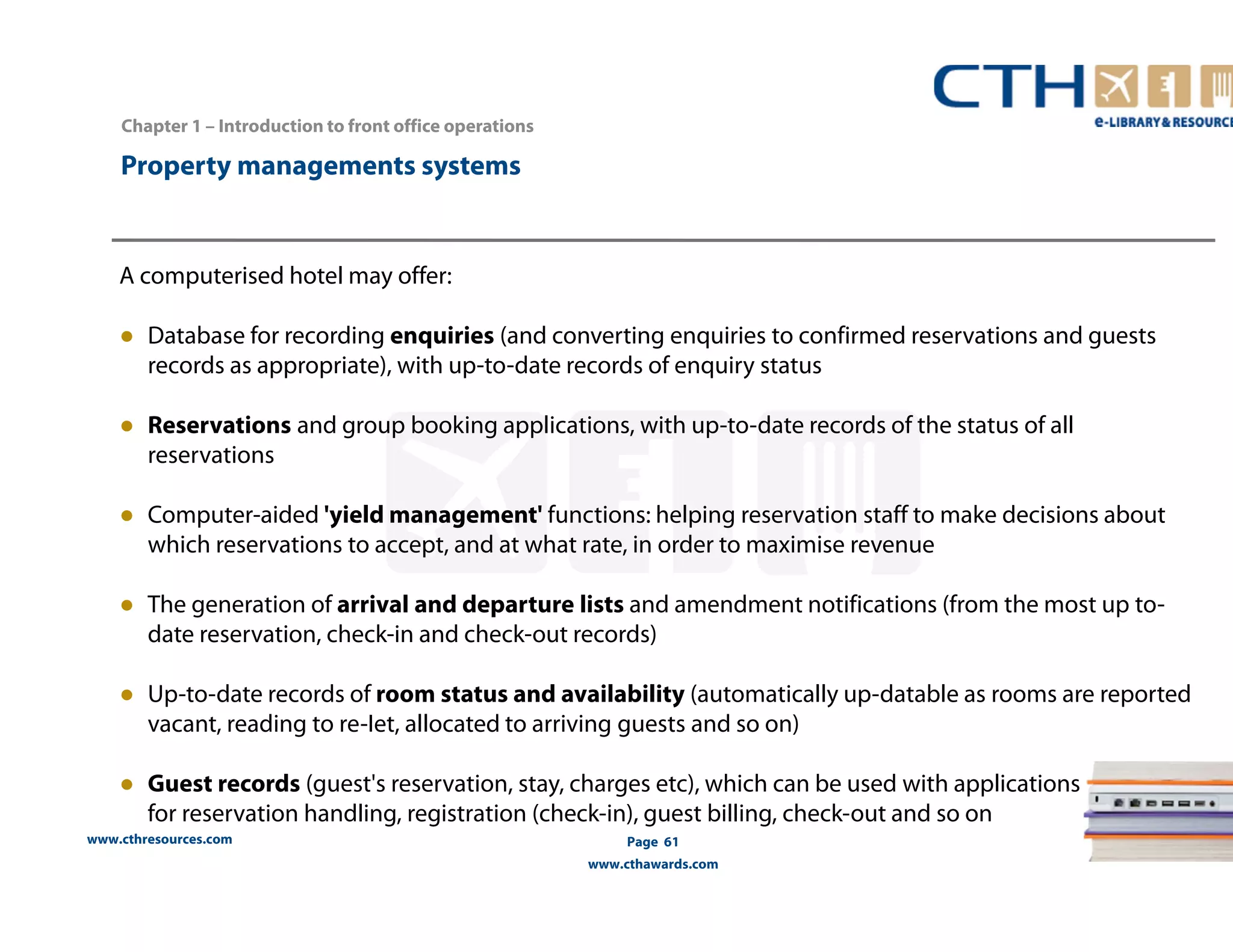
A computerised hotel may offer: 
● Database for recording enquiries (and converting enquiries to confirmed reservations and guests 
records as appropriate), with up-to-date records of enquiry status 
● Reservations and group booking applications, with up-to-date records of the status of all 
reservations 
● Computer-aided 'yield management' functions: helping reservation staff to make decisions about 
which reservations to accept, and at what rate, in order to maximise revenue 
● The generation of arrival and departure lists and amendment notifications (from the most up to-date 
reservation, check-in and check-out records) 
● Up-to-date records of room status and availability (automatically up-datable as rooms are reported 
vacant, reading to re-Iet, allocated to arriving guests and so on) 
● Guest records (guest's reservation, stay, charges etc), which can be used with applications 
for reservation handling, registration (check-in), guest billing, check-out and so on
www.cthresources.com 
Page 62 
www.cthawards.com 
Chapter 1 – Introduction to front office operations 
Property managements systems 
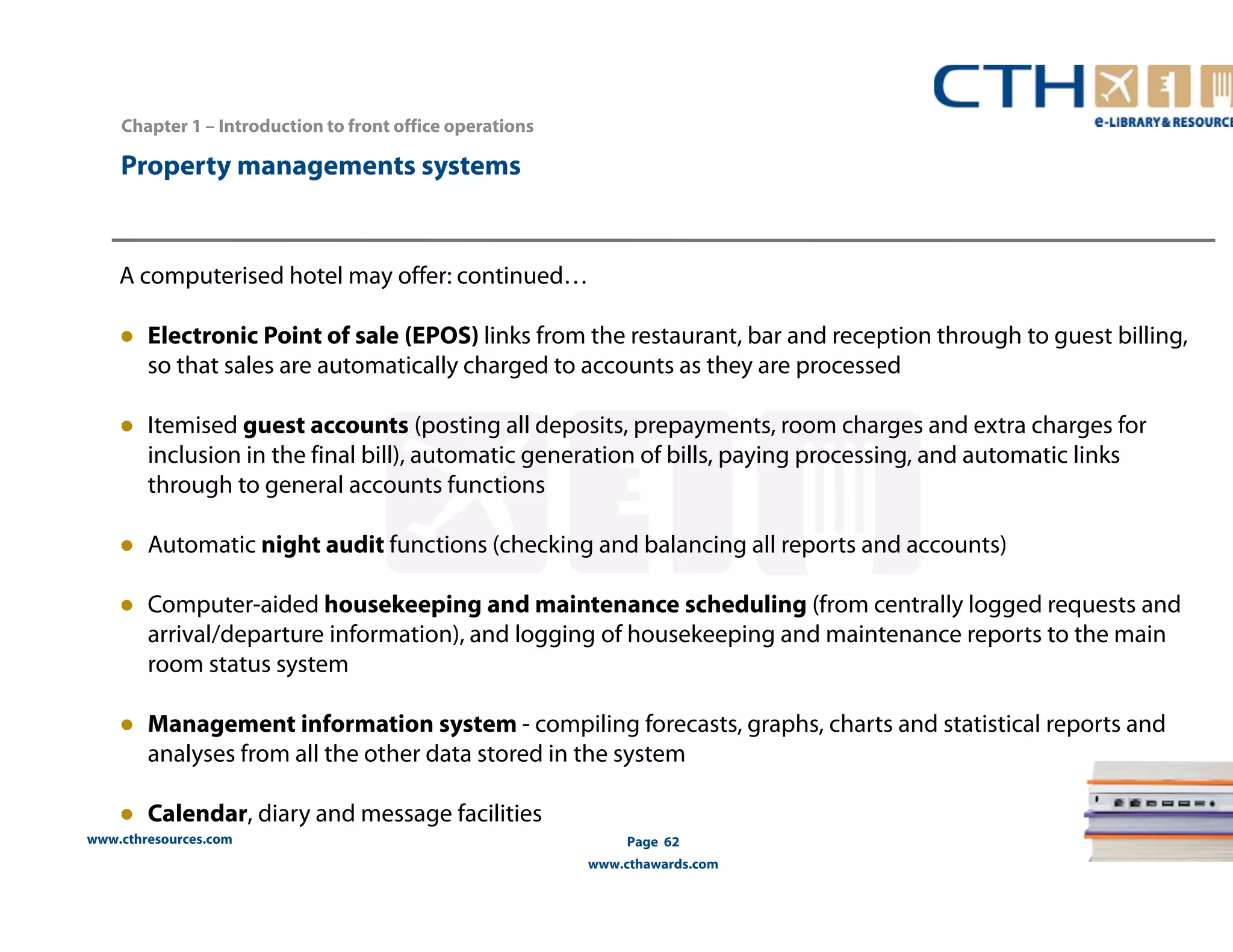
A computerised hotel may offer: continued… 
● Electronic Point of sale (EPOS) links from the restaurant, bar and reception through to guest billing, 
so that sales are automatically charged to accounts as they are processed 
● Itemised guest accounts (posting all deposits, prepayments, room charges and extra charges for 
inclusion in the final bill), automatic generation of bills, paying processing, and automatic links 
through to general accounts functions 
● Automatic night audit functions (checking and balancing all reports and accounts) 
● Computer-aided housekeeping and maintenance scheduling (from centrally logged requests and 
arrival/departure information), and logging of housekeeping and maintenance reports to the main 
room status system 
● Management information system - compiling forecasts, graphs, charts and statistical reports and 
analyses from all the other data stored in the system 
● Calendar, diary and message facilities
www.cthresources.com 
Page 63 
www.cthawards.com 
Chapter 1 – Introduction to front office operations 
Property managements systems 
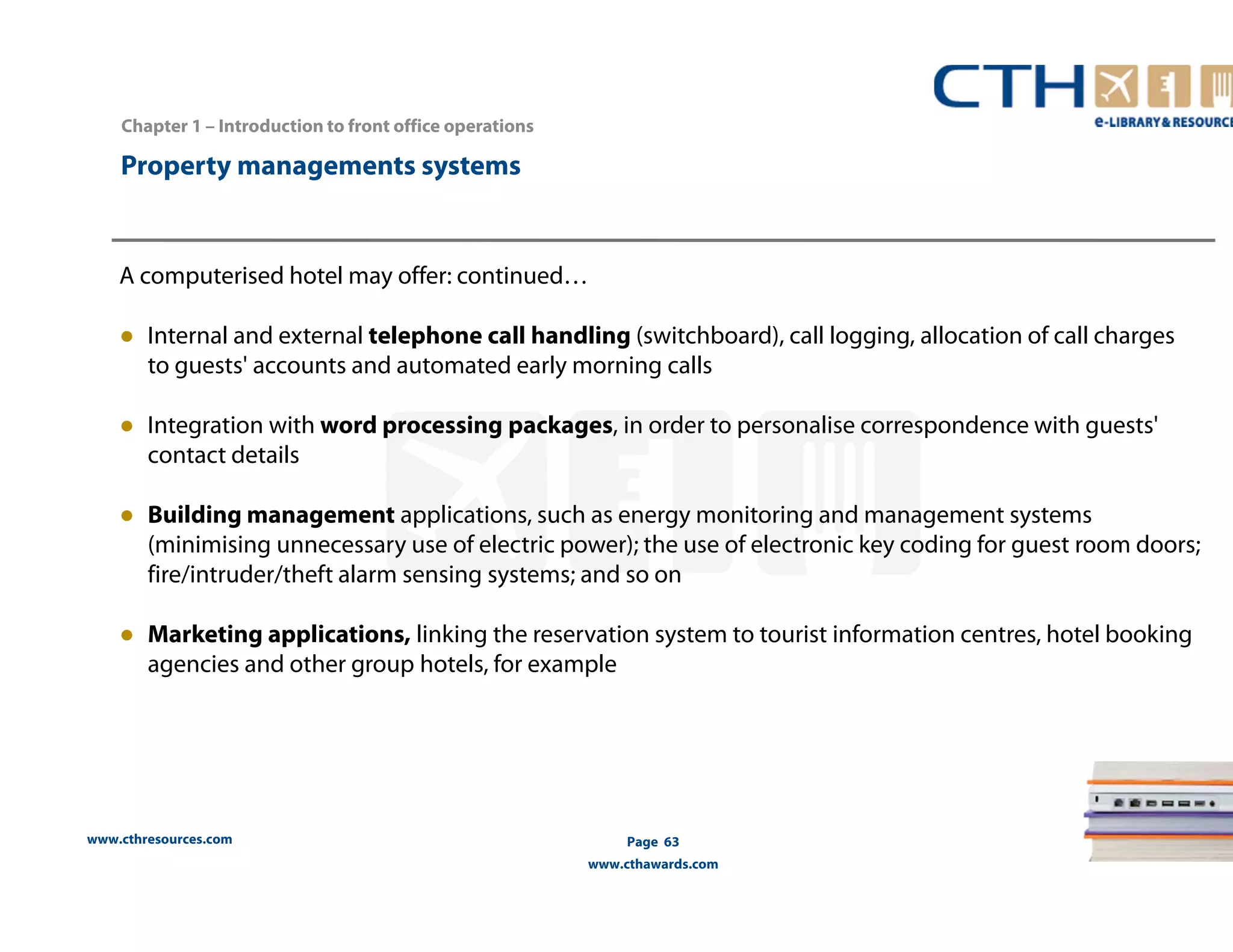
A computerised hotel may offer: continued… 
● Internal and external telephone call handling (switchboard), call logging, allocation of call charges 
to guests' accounts and automated early morning calls 
● Integration with word processing packages, in order to personalise correspondence with guests' 
contact details 
● Building management applications, such as energy monitoring and management systems 
(minimising unnecessary use of electric power); the use of electronic key coding for guest room doors; 
fire/intruder/theft alarm sensing systems; and so on 
● Marketing applications, linking the reservation system to tourist information centres, hotel booking 
agencies and other group hotels, for example
www.cthresources.com 
Page 64 
www.cthawards.com 
Chapter 1 – Introduction to front office operations 
Property managements systems 
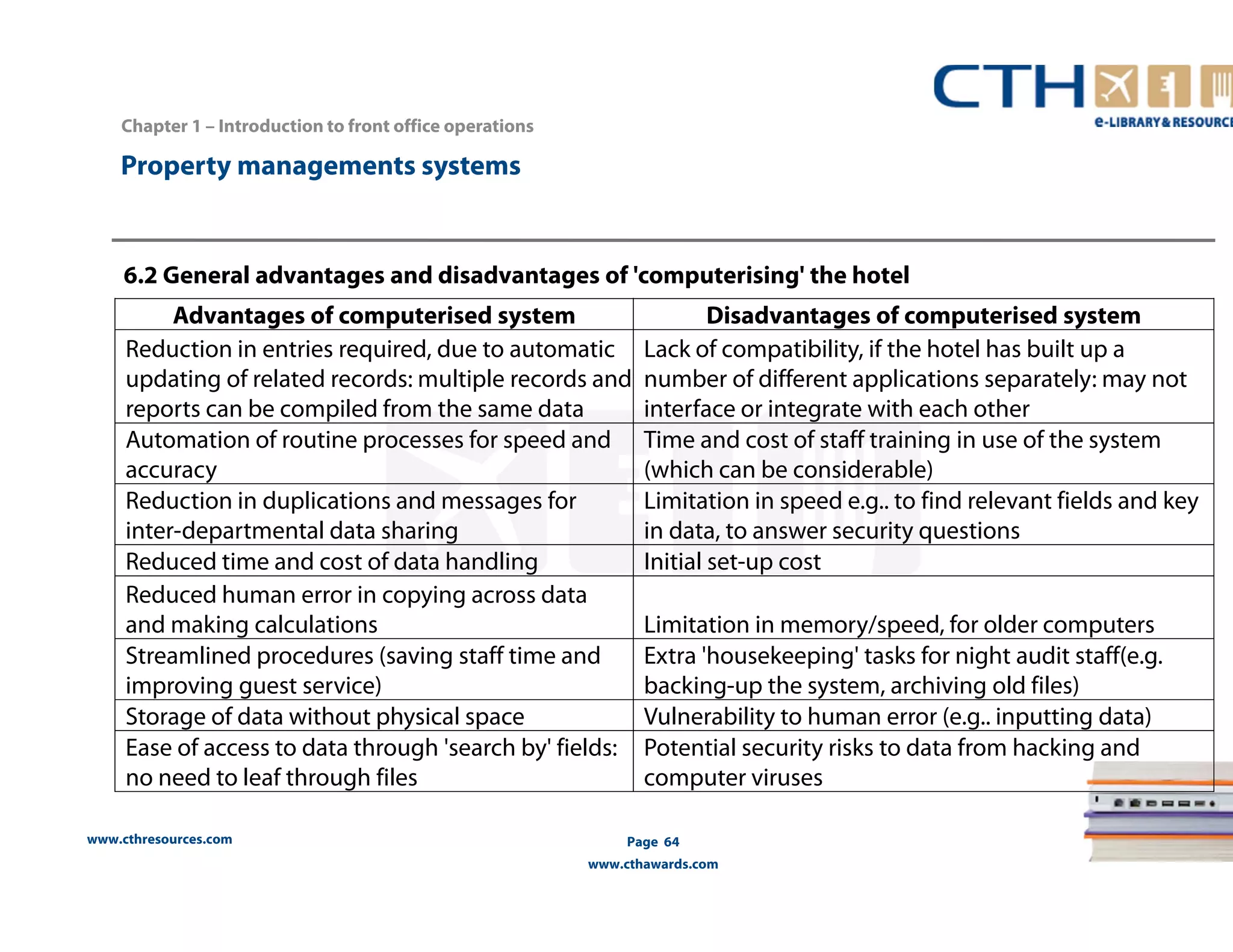
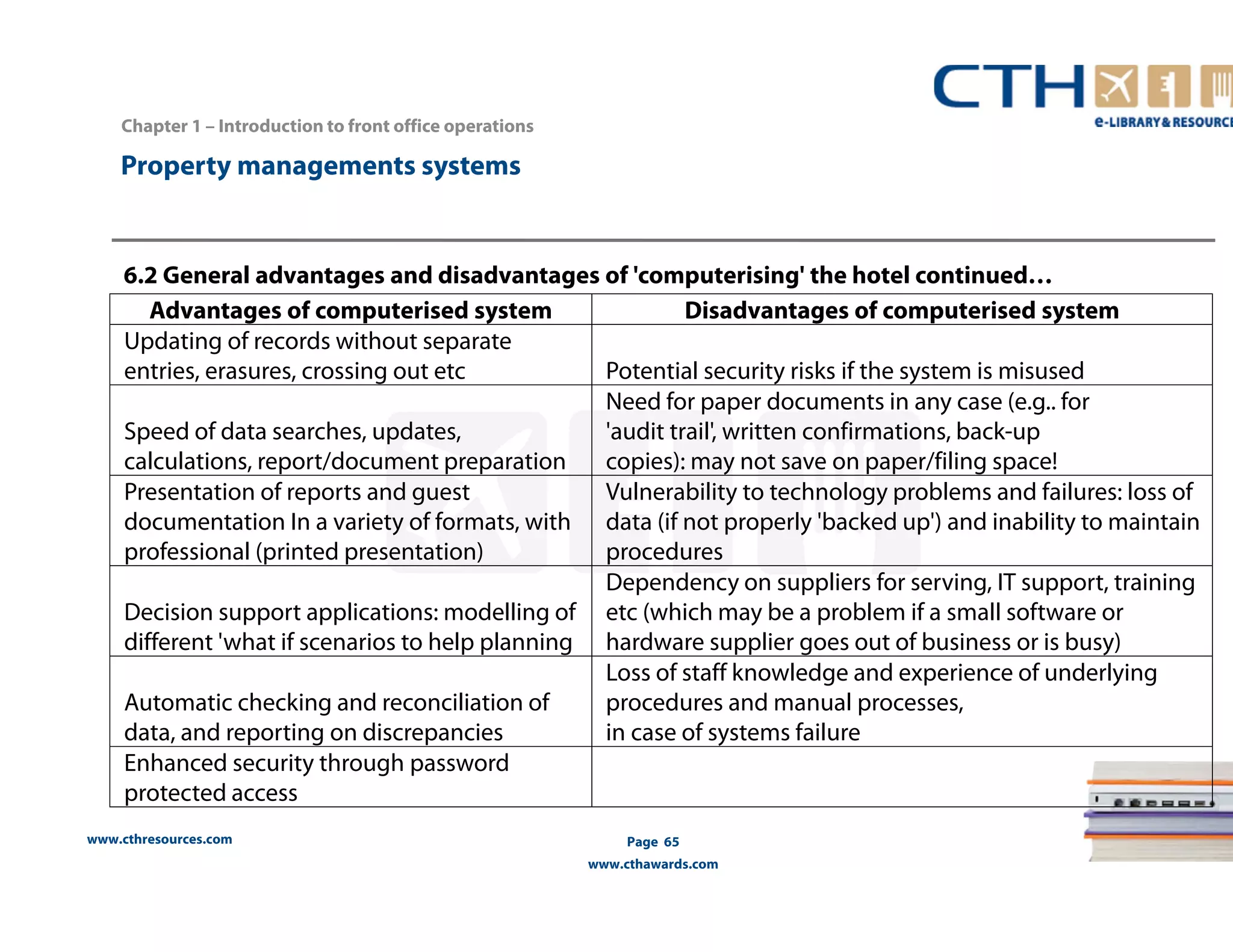
6.2 General advantages and disadvantages of 'computerising' the hotel 
Advantages of computerised system Disadvantages of computerised system 
Reduction in entries required, due to automatic 
updating of related records: multiple records and 
reports can be compiled from the same data 
Lack of compatibility, if the hotel has built up a 
number of different applications separately: may not 
interface or integrate with each other 
Automation of routine processes for speed and 
accuracy 
Time and cost of staff training in use of the system 
(which can be considerable) 
Reduction in duplications and messages for 
inter-departmental data sharing 
Limitation in speed e.g.. to find relevant fields and key 
in data, to answer security questions 
Reduced time and cost of data handling Initial set-up cost 
Reduced human error in copying across data 
and making calculations Limitation in memory/speed, for older computers 
Streamlined procedures (saving staff time and 
improving guest service) 
Extra 'housekeeping' tasks for night audit staff(e.g. 
backing-up the system, archiving old files) 
Storage of data without physical space Vulnerability to human error (e.g.. inputting data) 
Ease of access to data through 'search by' fields: 
Potential security risks to data from hacking and 
no need to leaf through files 
computer viruses
www.cthresources.com 
Page 65 
www.cthawards.com 
Chapter 1 – Introduction to front office operations 
Property managements systems 
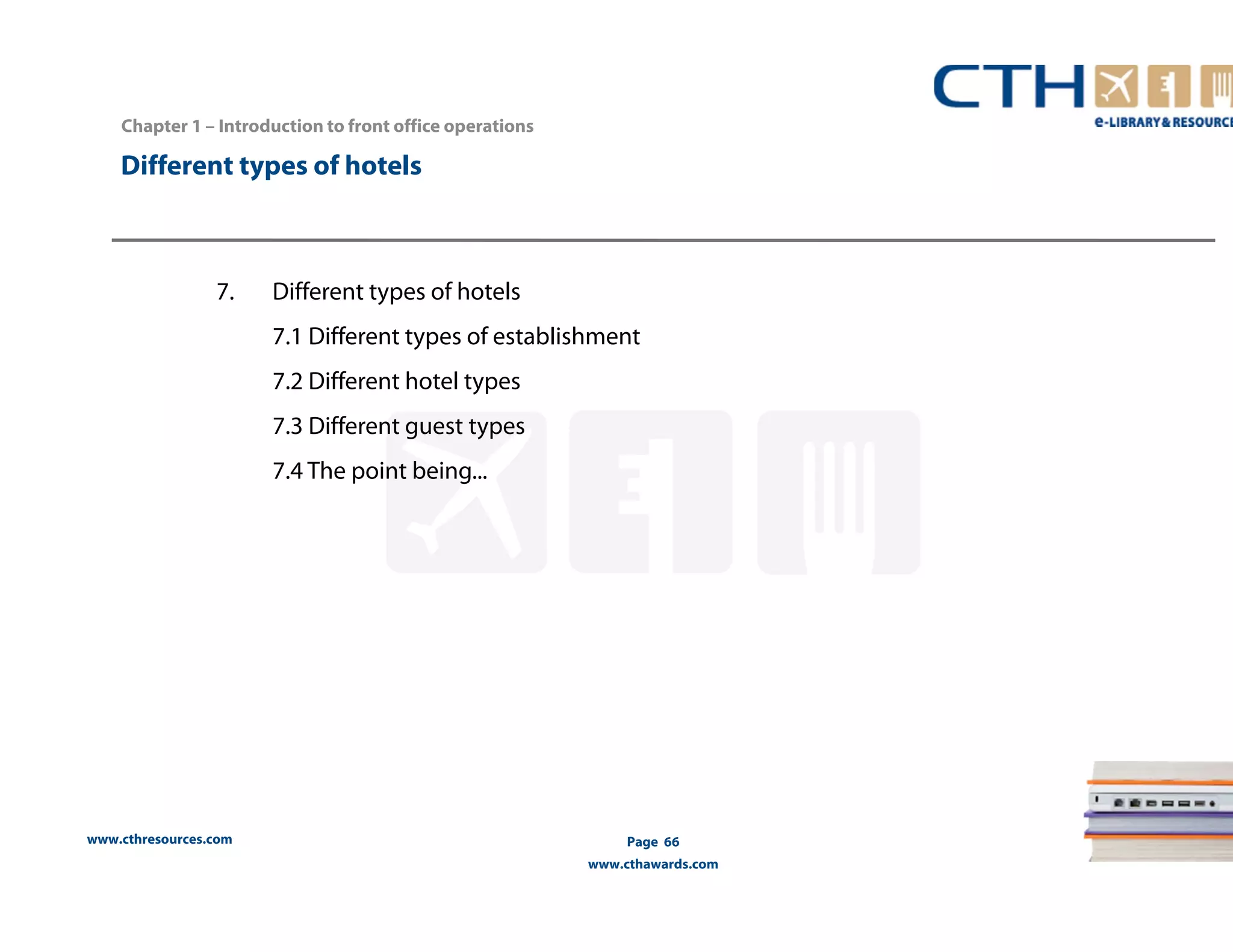
6.2 General advantages and disadvantages of 'computerising' the hotel continued… 
Advantages of computerised system Disadvantages of computerised system 
Updating of records without separate 
entries, erasures, crossing out etc Potential security risks if the system is misused 
Speed of data searches, updates, 
calculations, report/document preparation 
Need for paper documents in any case (e.g.. for 
'audit trail', written confirmations, back-up 
copies): may not save on paper/filing space! 
Presentation of reports and guest 
documentation In a variety of formats, with 
professional (printed presentation) 
Vulnerability to technology problems and failures: loss of 
data (if not properly 'backed up') and inability to maintain 
procedures 
Decision support applications: modelling of 
different 'what if scenarios to help planning 
Dependency on suppliers for serving, IT support, training 
etc (which may be a problem if a small software or 
hardware supplier goes out of business or is busy) 
Automatic checking and reconciliation of 
data, and reporting on discrepancies 
Loss of staff knowledge and experience of underlying 
procedures and manual processes, 
in case of systems failure 
Enhanced security through password 
protected access
www.cthresources.com 
Page 66 
www.cthawards.com 
Chapter 1 – Introduction to front office operations 
Different types of hotels 
7. Different types of hotels 
7.1 Different types of establishment 
7.2 Different hotel types 
7.3 Different guest types 
7.4 The point being...
www.cthresources.com 
Page 67 
www.cthawards.com 
Chapter 1 – Introduction to front office operations 
Different types of hotels 
7.1 Different types of establishment 
In addition to hotels there are a number of other types of organisations letting accommodation, 
including: 
Camp sites may let accommodation in the form of cabins or caravans, or may let space for 
guests to provide their own accommodation (e.g.. tents or caravans). Either way, there are 
reservations, registrations and billing to be processed, and facilities and services to be provided 
and maintained (e.g.. on-site shops, washrooms, utilities). 
Ships and boats may also offer accommodation. Cruise liners are often called 'floating hotels', 
and have much in common with their land-based equivalents. Smaller boats (e.g.. a yacht or canal 
boat) may also be chartered by customers. This is a slightly different scenario, because the 
accommodation and services move off site: nevertheless, reservations, registrations and 
payments (and boat cleaning and maintenance between trips) are still administered from a front 
office.
www.cthresources.com 
Page 68 
www.cthawards.com 
Chapter 1 – Introduction to front office operations 
Different types of hotels 
7.2 Different hotel types 
There is also a wide variety even among hotels and their direct equivalents. Hotels may differ according 
to factors such as: 
Size, or capacity. In the UK: a small hotel would be classed as one with 25 bedrooms or fewer; a 
medium-sized hotel, one with 25-99 bedrooms; a large hotel as one with more than 100 
bedrooms; and a 'major' hotel as one with more than 300 bedrooms. Small hotels might also 
include bed and breakfast (6&6) establishments, public house and farm-stay accommodation. 
Location, influences the type of clientele and style of the hotel. (Business travellers – tend to be 
attracted to hotel close to transport, central business districts and conference facilities, with good 
communications infrastructure. Leisure travellers – attracts to more remote or exotic locations.) Hotels 
may be classed by location as: city centre, main road (motel), airport, suburban, resort or country hotels. 
Grade – depending on the hotel’s location, facilities/amenities and service standards, the price of 
accommodation may vary widely, from budget to luxury. There are a number of schemes
www.cthresources.com 
Page 69 
www.cthawards.com 
Chapter 1 – Introduction to front office operations 
Different types of hotels 
7.3 Different guest types 
Different types of guest may travel at different times of year or week. They may have different needs and 
preferences in regard to the rooms, services and facilities offered by the hotel. They may have different 
budgets available to spend on their stay. 
It will, therefore, be important for hotels to be aware of who their guests are, and to classify them as 
distinct 'market segments', when: planning and selling the facilities to prospective guests; anticipating 
and meeting the needs and wants of guests during their stay; and determining pricing policies that will 
attract the kind of guests the hotel wants (or gets). 
Leisure or pleasure travellers 
Leisure travellers (or tourists) travel for sightseeing, relaxation or entertainment. They are often highly 
seasonal: travelling during school holidays, best-weather periods or attracted by special events in an 
area. Because they are self-funding, they are price-sensitive and attracted by value for money. Their main 
requirements from a hotel may be comfort, entertainment, budget accommodation, convenient location 
(for tourism and transport), foreign currency exchange facilities - and helpful front office staff!
www.cthresources.com 
Page 70 
www.cthawards.com 
Chapter 1 – Introduction to front office operations 
Different types of hotels 
7.3 Different guest types continued… 
Leisure travellers may be classified in any way that is helpful for the hotel, but you may hear the 
following terms: 
● Domestic tourists are local people who stay at a hotel for weekend breaks or special functions. 
● Foreign independent travellers (FITs) are international tourists who have made their own travel 
arrangements. 
● Group inclusive tours (GITs) are groups of tourists travelling together on a 'package' tour, with 
accommodation and meals often booked in advance by the tour operator. Budget is often a 
consideration on such tours, because they may have limited 'spending money' on top of inclusions. 
● Special interest tours (SITs) are smaller groups who are visiting an area with a special interest e.g.. eco-tours, 
adventure tours or cultural tours, seeking particular locations, experiences or activities.
www.cthresources.com 
Page 71 
www.cthawards.com 
Chapter 1 – Introduction to front office operations 
Different types of hotels 
7.3 Different guest types continued… 
Business travellers 
Business travellers are those who travel for the sole purpose of undertaking business: sales 
representatives, people attending meetings and conferences (or on their way to them), etc. Business 
travellers are the largest year-round source of demand for hotel accommodation. 
● Individual business travellers travel independently and alone. 
● Corporate business travellers represent companies which may make regular bookings. They may 
be sub-divided into 'negotiated contract' travellers (who have negotiated a special discounted rate 
and terms with the hotel, based on a guaranteed volume of business) and 'non-negotiated‘ travellers 
(who may be eligible for a standard discounted corporate rate, on the understanding that there may 
be repeat business available). 
● Conference delegates may have accommodation booked in the hotel where (or near to where) a 
conference is being held, perhaps reserved by their company, or by the conference organiser.
www.cthresources.com 
Page 72 
www.cthawards.com 
Chapter 1 – Introduction to front office operations 
Different types of hotels 
7.3 Different guest types continued… 
Groups 
A 'group' generally means five or more people travelling together, or ten or more rooms being booked 
together: the rooms being booked at the same time, the members paying the same rate, and generally 
arriving and departing at broadly the same time. Groups can range from five or six people on a small 
tour to hundreds of people attending a conference at the hotel. 
Groups create certain challenges for hotels, over and above those presented by independent travellers. 
For a start, there are more people to deal with - generally all at once, which can put pressure on 
reception at check-in and check-out time! Groups may also have fixed timetables for their meals, 
activities, arrival and departure times, and this reduces their flexibility, and that of the hotel.
www.cthresources.com 
Page 73 
www.cthawards.com 
Chapter 1 – Introduction to front office operations 
Different types of hotels 
7.4 The point being... 
The procedures and systems of Front Office organisation, which suits one type of hotel may not suit another. 
For example: 
● A small hotel or other accommodation provider may have a simple Front Office structure, with few people 
performing all the tasks, while a large hotel may have a complex structure of inter-related departments and 
specialist service units, to which different types of guest needs will be referred. 
● While larger hotels are likely to operate computerised reservation, check-in and billing systems, a small or 
medium-sized country hotel, inn or bed and breakfast may not (yet) have moved to such a system, and may 
use manual systems. 
● Hotels catering for business travellers (city or airport hotels or motels) are likely to offer a different range of 
guest services (e.g.. internet & e-mail facilities, perhaps an executive lounge, meeting rooms, office services), 
administered from and promoted by Front Office, than hotels catering for leisure or special interest travellers. 
● A four- or five-star hotel will require higher standards of social skills and customer service training 
for its Front Office staff, in order to respond positively and professionally to a range of guest 
needs and wants, than a one-, two- or three-star hotel.
www.cthresources.com 
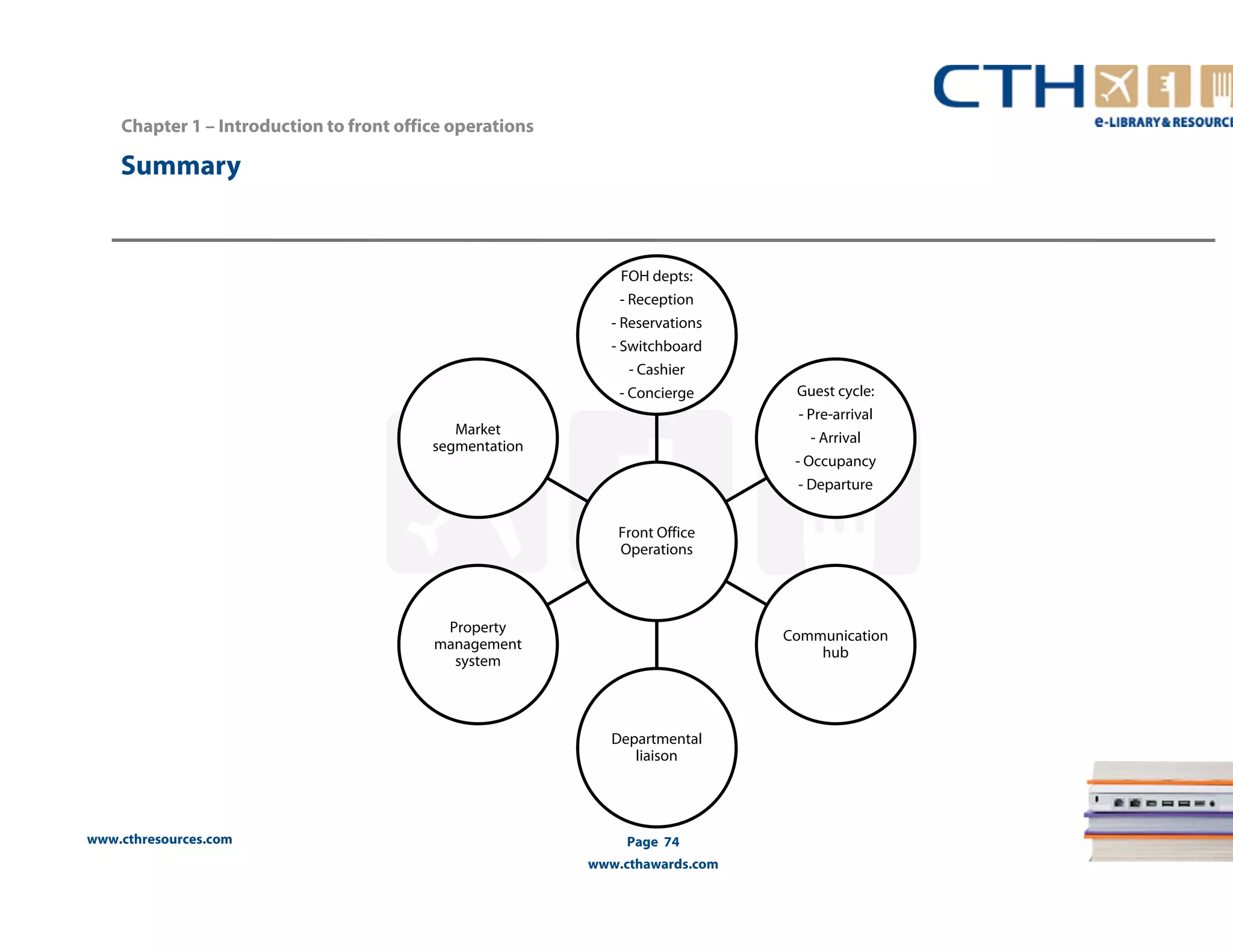
FOH depts: 
- Reception 
- Reservations 
- Switchboard 
- Cashier 
- Concierge Guest cycle: 
Page 74 
www.cthawards.com 
Chapter 1 – Introduction to front office operations 
Summary 
Front Office 
Operations 
- Pre-arrival 
- Arrival 
- Occupancy 
- Departure 
Communication 
hub 
Departmental 
liaison 
Market 
segmentation 
Property 
management 
system
www.cthresources.com 
Page 75 
www.cthawards.com 
Chapters 
1. Introduction to front office operations 
2. Reservation procedures 
3. Check-in procedures 
4. Check-out procedures 
5. Guest accounting 
6. Yield management, statistics and reports 
7. Security and safety responsibilities 
8. Guest services and communications 
9. Interpersonal and selling skills
www.cthresources.com 
Page 76 
www.cthawards.com 
Chapter 2 – Reservation procedure 
Objectives 
In this chapter you will learn 
● How to handle initial enquiries 
● How to receive and record reservation requests 
● How to use manual and electronic systems for recording bookings 
● How to guarantee reservations, using deposits and pre-payments 
● The international terminology for rooms and bed types 
● The different packages and rates offered by hotels 
● How rooms are allocated 
● How to confirm reservations 
● How to monitor the status of reservations 
● How to cancel reservations if required
Handling inquires 
www.cthresources.com 
Page 77 
www.cthawards.com 
Chapter 2 – Reservation procedure 
1. Handling inquiries 
1.1 How do inquiries come in ? 
1.2 What information will be exchanged?
Chapter 2 – Reservation procedure 
www.cthresources.com 
Page 78 
www.cthawards.com 
Handling inquires 
The process of making a hotel booking or reservation: 
Begins with an enquiry from prospective guests, who contact the hotel to ask for a brochure, or to ask 
specific questions about the price and availability of rooms for the period they are interested In. 
Such request is an opportunity to give a good first impression of the hotel: a prompt, positive and 
courteous response will reassure prospective guests that they will receive good service If they book into 
this establishment.
1.1 How do enquiries come in? 
● In person - People may come in 'on the off chance' of immediate accommodation, often because 
they are travelling unexpectedly, or touring (usually in the off season) without making advance 
plans. A local person may also 'drop in' in person, since it is convenient to do so, to make a booking 
on behalf of others: an out-of-town friend, say - or a tour group or conference (e.g.. if the local 
person is the organiser). Enquiries which come in 'off the street’ / ‘walk ins’/face-to-face enquiries 
offer the advantage of interactivity: enquirers and reservation staff can both gather information and 
get their questions answered in real time - and written confirmation of the details can also be 
prepared and handed over on the spot. 
● In writing - A written request for a booking (letter, by mail, facsimile transfer (fax) or booking form - 
from a hotel brochure. Written enquiries are useful for the hotel, as they may set out clearly the 
details of the guest's requirements (room types, number of guests, arrival and departure dates), and 
contact details for the hotel to gather additional information and/or confirm the booking. These can 
be used to confirm bookings made by telephone, so that both parties have written evidence of what 
was discussed and agreed, which they can refer later if they need to. Compared to the postal system, 
the advantage of e-mail and fax is that they can be used to send and receive bookings and 
confirmations almost instantly (via telecommunication links) from one side of the world to 
the other, regardless of distance, time zones and so on. 
www.cthresources.com 
Page 79 
www.cthawards.com 
Chapter 2 – Reservation procedure 
Handling inquires
1.1 How do enquiries come in? 
● By telephone - Is a fast, convenient and cost-effective way of making an enquiry. Its interactive nature 
allows the prospective guest and the hotel to ask questions and exchange information in real time - 
without written , for quick, accurate agreement on details. Because guests can know that their enquiry 
has been received and answered, on the spot, telephone is often used to make last-minute bookings: no 
risk of turning up at the hotel to find that no-one has checked the e-mail / fax machine lately! The 
disadvantage is that it doesn't get the details of the conversation down in black and white: some form 
of note-taking and/or written confirmation (if there is time) is often required to ensure that everyone is 
on the same 'page'. 
● Online - Increasingly, guests and travel agencies gather information about hotel rates and room 
availability via the web sites of individual hotels, centralised booking sites for hotel chains, and agency 
booking sites (some specialising in particular types of travel, or in last-minute discounted packages). 
Bookings can be made online and processed directly by the hotel's or agency's computerised booking 
system: leaving an electronic record for the hotel, and generating an electronic confirmation for the 
guest - without human intervention or involvement. This can be extremely cost effective for a hotel 
with the relevant systems set up, so many such hotels offer incentives for people to book 
online (e.g.. by passing on some of the cost savings in the form of online booking discounts). 
www.cthresources.com 
Page 80 
www.cthawards.com 
Chapter 2 – Reservation procedure 
Handling inquires
www.cthresources.com 
Page 81 
www.cthawards.com 
Chapter 2 – Reservation procedure 
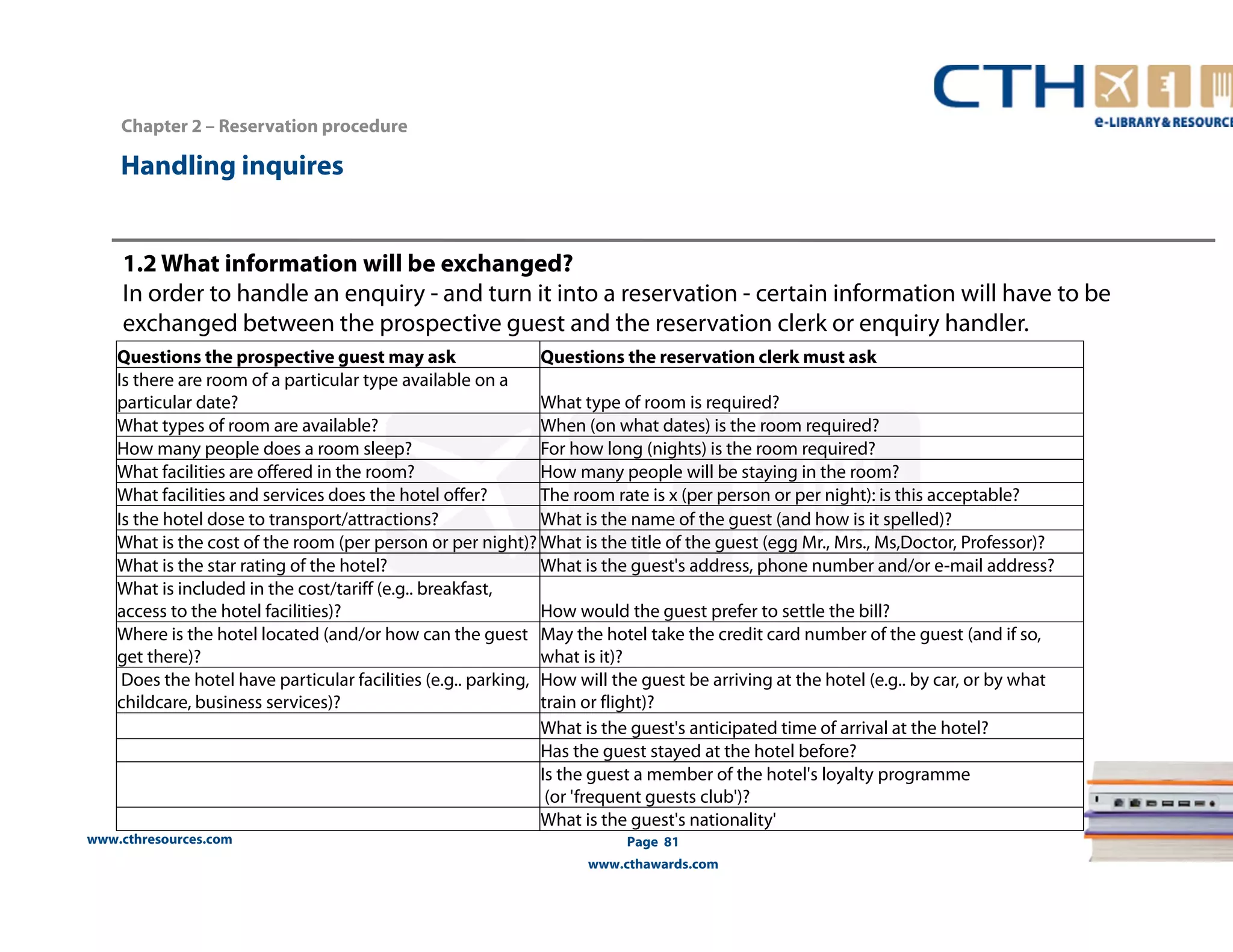
1.2 What information will be exchanged? 
In order to handle an enquiry - and turn it into a reservation - certain information will have to be 
exchanged between the prospective guest and the reservation clerk or enquiry handler. 
Questions the prospective guest may ask Questions the reservation clerk must ask 
Is there are room of a particular type available on a 
particular date? What type of room is required? 
What types of room are available? When (on what dates) is the room required? 
How many people does a room sleep? For how long (nights) is the room required? 
What facilities are offered in the room? How many people will be staying in the room? 
What facilities and services does the hotel offer? The room rate is x (per person or per night): is this acceptable? 
Is the hotel dose to transport/attractions? What is the name of the guest (and how is it spelled)? 
What is the cost of the room (per person or per night)?What is the title of the guest (egg Mr., Mrs., Ms,Doctor, Professor)? 
What is the star rating of the hotel? What is the guest's address, phone number and/or e-mail address? 
What is included in the cost/tariff (e.g.. breakfast, 
access to the hotel facilities)? How would the guest prefer to settle the bill? 
Where is the hotel located (and/or how can the guest 
May the hotel take the credit card number of the guest (and if so, 
get there)? 
what is it)? 
Does the hotel have particular facilities (e.g.. parking, 
childcare, business services)? 
How will the guest be arriving at the hotel (e.g.. by car, or by what 
train or flight)? 
What is the guest's anticipated time of arrival at the hotel? 
Has the guest stayed at the hotel before? 
Is the guest a member of the hotel's loyalty programme 
(or 'frequent guests club')? 
What is the guest's nationality' 
Handling inquires
Chapter 2 – Reservation procedure 
Handling advance reservation 
www.cthresources.com 
Page 82 
www.cthawards.com 
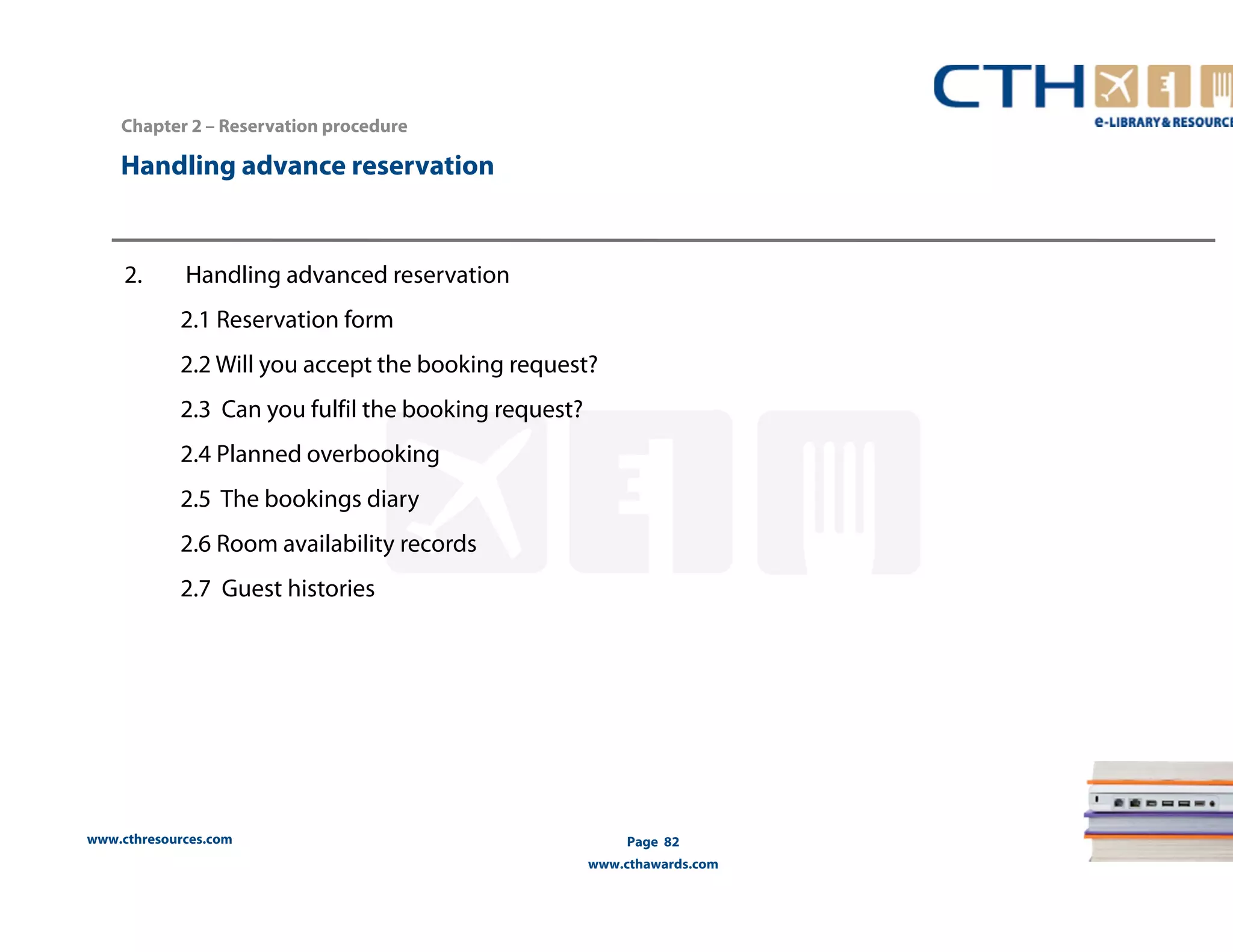
2. Handling advanced reservation 
2.1 Reservation form 
2.2 Will you accept the booking request? 
2.3 Can you fulfil the booking request? 
2.4 Planned overbooking 
2.5 The bookings diary 
2.6 Room availability records 
2.7 Guest histories
www.cthresources.com 
Page 83 
www.cthawards.com 
Chapter 2 – Reservation procedure 
Handling advance reservation 
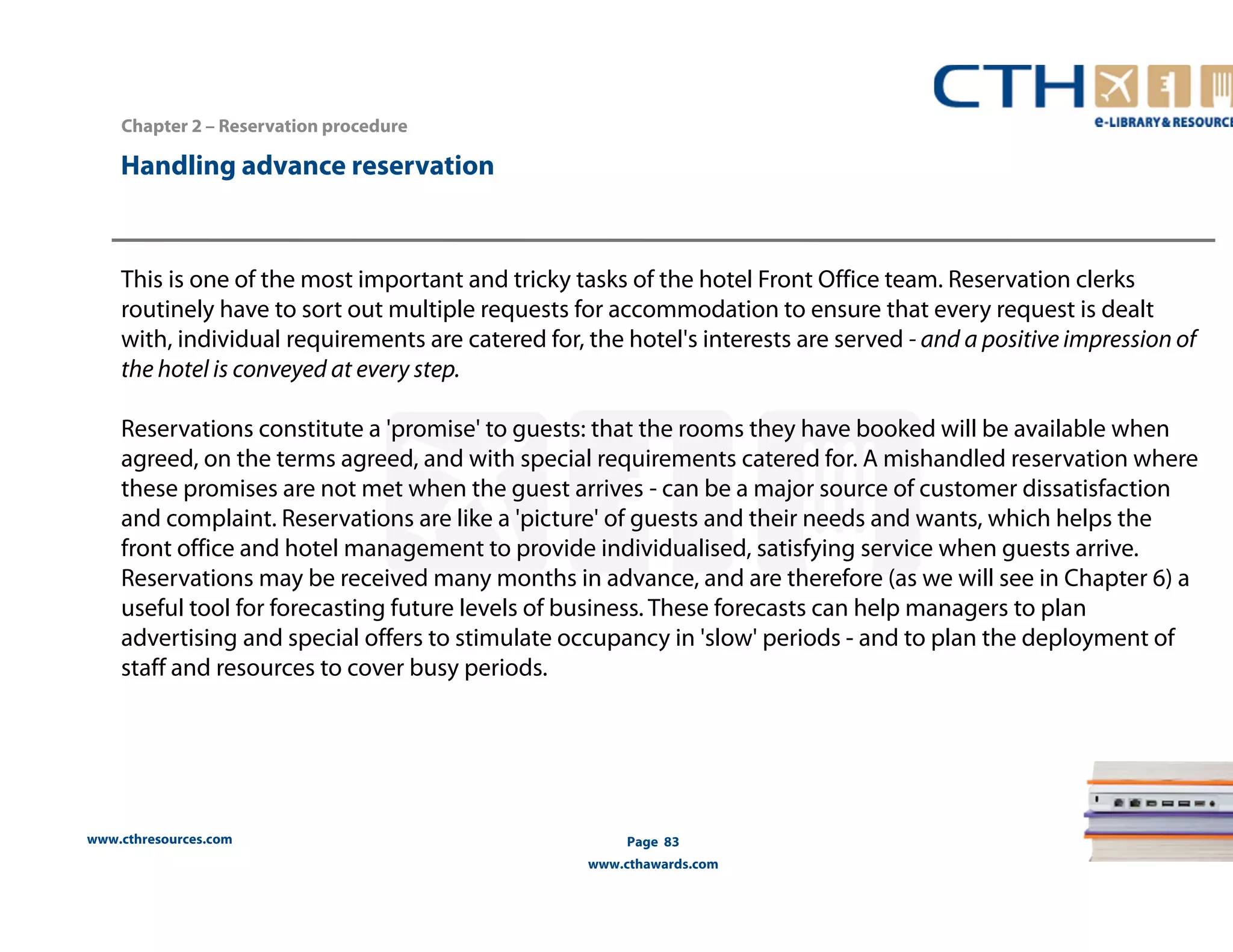
This is one of the most important and tricky tasks of the hotel Front Office team. Reservation clerks 
routinely have to sort out multiple requests for accommodation to ensure that every request is dealt 
with, individual requirements are catered for, the hotel's interests are served - and a positive impression of 
the hotel is conveyed at every step. 
Reservations constitute a 'promise' to guests: that the rooms they have booked will be available when 
agreed, on the terms agreed, and with special requirements catered for. A mishandled reservation where 
these promises are not met when the guest arrives - can be a major source of customer dissatisfaction 
and complaint. Reservations are like a 'picture' of guests and their needs and wants, which helps the 
front office and hotel management to provide individualised, satisfying service when guests arrive. 
Reservations may be received many months in advance, and are therefore (as we will see in Chapter 6) a 
useful tool for forecasting future levels of business. These forecasts can help managers to plan 
advertising and special offers to stimulate occupancy in 'slow' periods - and to plan the deployment of 
staff and resources to cover busy periods.
Handling advance reservation 
www.cthresources.com 
Page 84 
www.cthawards.com 
Chapter 2 – Reservation procedure 
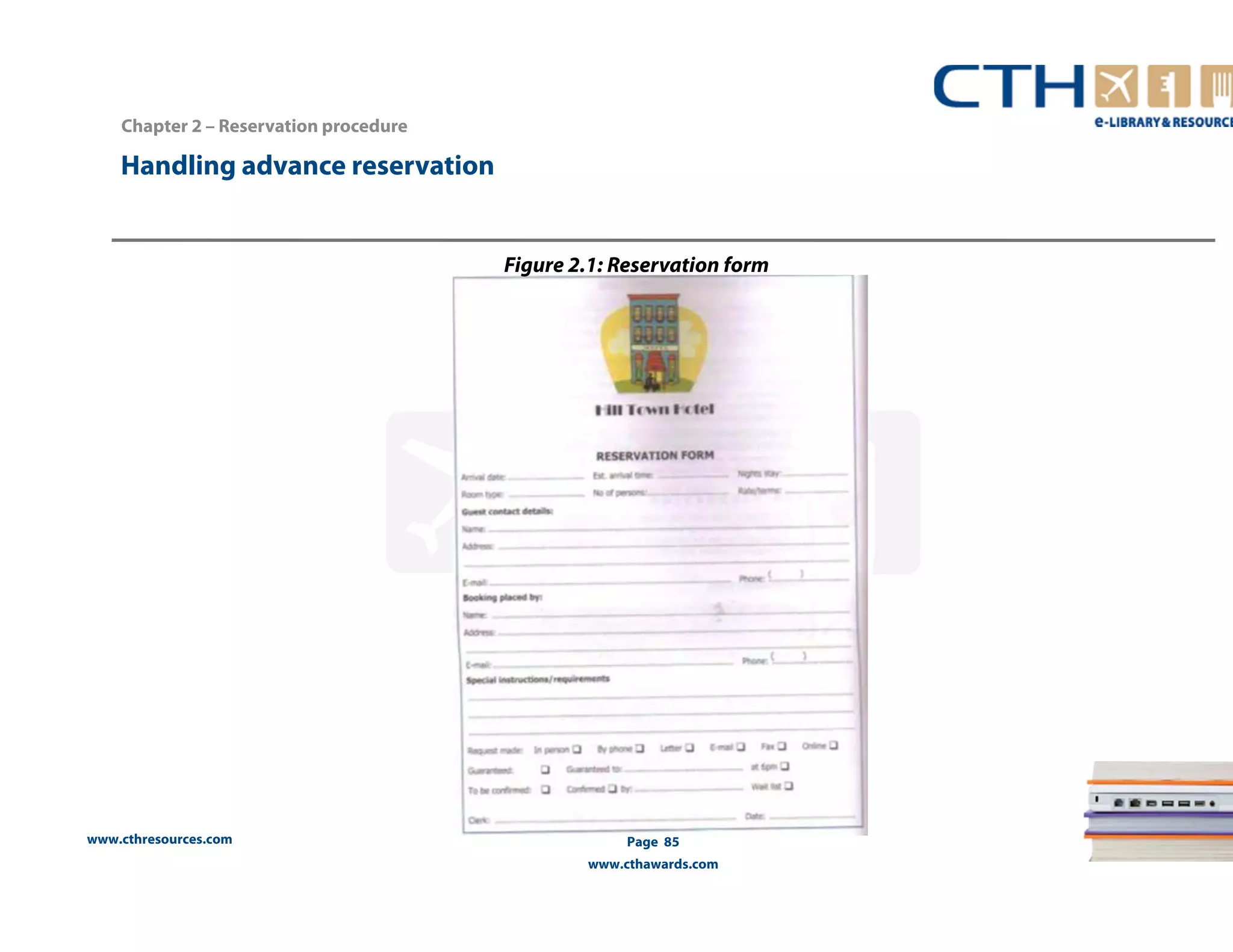
2.1 Reservation form 
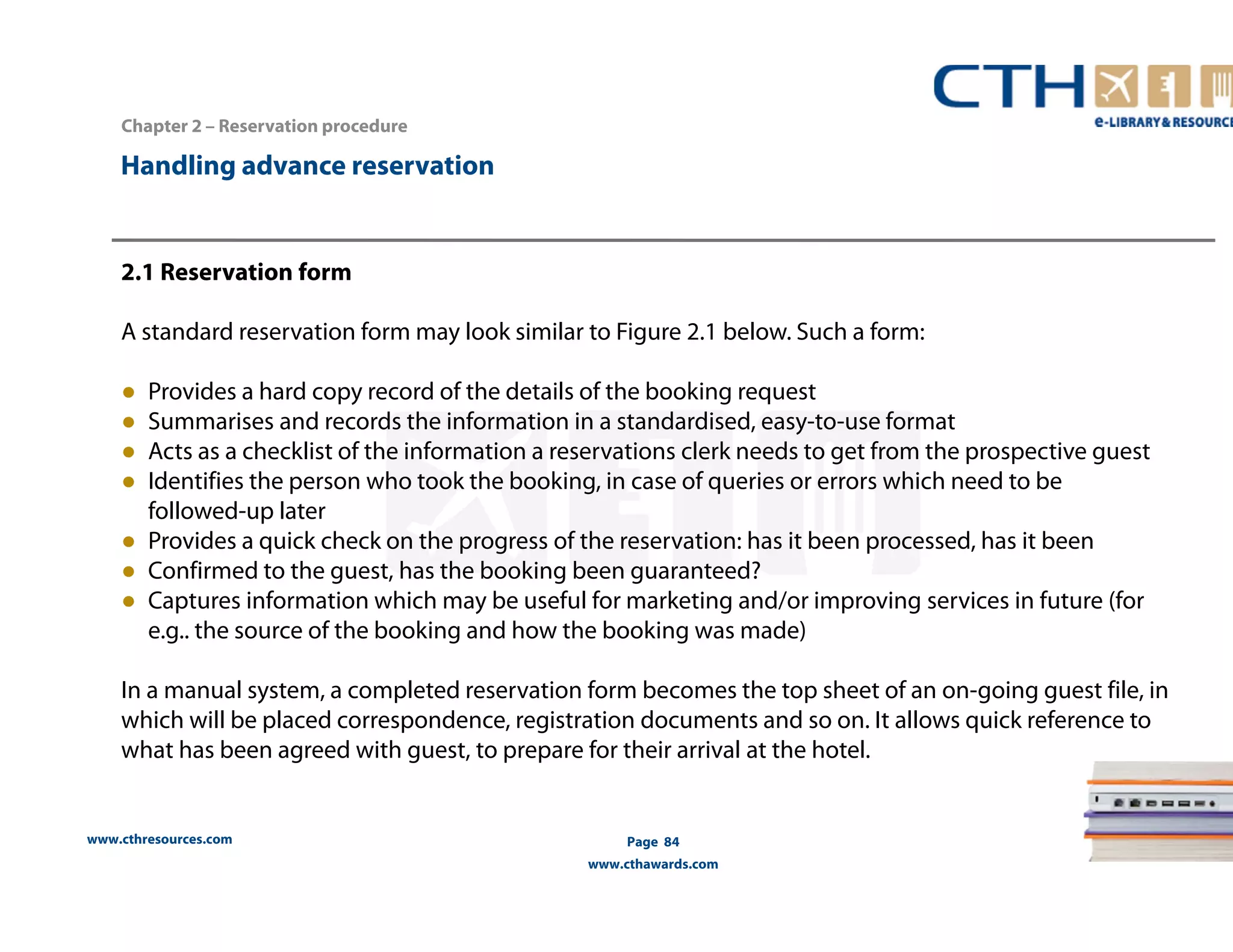
A standard reservation form may look similar to Figure 2.1 below. Such a form: 
● Provides a hard copy record of the details of the booking request 
● Summarises and records the information in a standardised, easy-to-use format 
● Acts as a checklist of the information a reservations clerk needs to get from the prospective guest 
● Identifies the person who took the booking, in case of queries or errors which need to be 
followed-up later 
● Provides a quick check on the progress of the reservation: has it been processed, has it been 
● Confirmed to the guest, has the booking been guaranteed? 
● Captures information which may be useful for marketing and/or improving services in future (for 
e.g.. the source of the booking and how the booking was made) 
In a manual system, a completed reservation form becomes the top sheet of an on-going guest file, in 
which will be placed correspondence, registration documents and so on. It allows quick reference to 
what has been agreed with guest, to prepare for their arrival at the hotel.
www.cthresources.com 
Page 85 
www.cthawards.com 
Chapter 2 – Reservation procedure 
Figure 2.1: Reservation form 
Handling advance reservation
Handling advance reservation 
www.cthresources.com 
Page 86 
www.cthawards.com 
Chapter 2 – Reservation procedure 
2.1 Reservation form 
If the hotel uses computerised reservation system, the details can be input immediately (from the 
enquiry letter, e-mail or phone call) into an on-screen electronic reservation form. This has the advantage 
that the information can be automatically linked to other electronic records and documents, as part of 
the 'history' of the dealings with the guest. However, Abbott & Lewry (Front Office) suggest that there is still 
an argument for using a paper-based reservation form to take the initial enquiry, before transferring the 
details to the computerised system later (during a quiet period). 
● It may be quicker and easier to use a paper form, which allows you to 'skip' to relevant fields as 
required (Without complex on-screen navigation) - especially if you are on the phone with the 
enquirer and do not have a 'hands-free' telephone headset. 
● Using a paper form may enable you to give your full attention to the enquirer - rather than to the 
computer system! 
Transferring the details from the form to the computerised system later may leave the booking records 
temporarily incomplete: if advance bookings look as if they are nearly full, availability should be checked 
carefully, and the details transferred immediately to the computerised system.
2.2 Will you accept the booking request? 
Of course, the whole point of a hotel is to take guests - and most of the Front Office role will be 
concerned with ensuring that the hotel gets as many bookings as possible. However, there may be 
circumstances in which hotel will want to turn down a reservation. 
Some guests are more welcome than others… 
The Hotel Proprietors Act 1956 provides that a hotel has a legal obligation to accept bona fide (genuine) 
travellers who 'appear able and willing to pay a reasonable sum for the services and facilities provided, 
and who are in a fit state to be received', if rooms are available. In the UK, various equal opportunities 
legislation also imposes a duty not to discriminate unfairly against prospective guests on the grounds of 
sex, age, race, religion or disability, in the provision of goods, facilities or services. As the Hotel 
Proprietors Act suggests, a person may legitimately be blacklisted - or refused the services of the hotel - if: 
● (S)he has previously stayed at the hotel and failed or been unable to pay the bill. 
● (S)he has previously stayed at the hotel and behaved in an undesirable way: causing damage, 
disturbing other guests, or being abusive towards staff - perhaps while under the influence of 
alcohol or drugs. 
www.cthresources.com 
Page 87 
www.cthawards.com 
Chapter 2 – Reservation procedure 
Handling advance reservation
2.2 Will you accept the booking request? Continued… 
● (S)he has been suspected of illegal behaviour while in the hotel (e.g.. drug dealing, prostitution, theft 
from the hotel or guests). 
● (S)he turns up at the hotel in a state, or behaving in such a way, as to suggest the likelihood of the 
above problems - even if there is a confirmed booking: such behaviour may be interpreted as breaking 
the implied terms of the contract with the hotel, entitling it to require the guest to leave. 
● The bill will be paid on account by a company which owes the hotel large sums of money, routinely 
pays late, or is otherwise not credit-worthy (e.g.. at risk of insolvency, so that the hotel would not be 
able to recover money owing to it). 
● The individual or company has been reported to the hotel - on any of the above grounds – by other 
hotels who have found them undesirable in the past. Hotels often exchange this kind of information. 
The list of 'undesirables' may be kept in any format that is easy for front office staff to consult - without 
being visible or accessible to the general public! Blacklists and refusals are very sensitive, with the 
potential to offend people and cause awkward conflict situations (especially if the hotel has suspicion 
rather than proof of undesirable behaviour). If a reservation clerk recognises the name of a blacklisted 
individual on a booking request, the best response is probably simply to say that no rooms 
are available 
www.cthresources.com 
Page 88 
www.cthawards.com 
Chapter 2 – Reservation procedure 
Handling advance reservation
2.2 Will you accept the booking request? Continued 
Some bookings are more desirable than others... 
All things being equal, a hotel would prefer to take longer bookings (less costs of guest turnover and 
room preparation), from known guests (less risk), at the best possible room rate (i.e. not at discounted 
rates). Some bookings are, therefore, 'better' for the hotel than others. 
The discipline of yield management, which we will discuss in detail in Chapter 6, helps the hotel to: 
● Forecast how full the hotel is likely to be on a given date in the future (based on previous 
occupancy and booking patterns, projected into the future). 
● Determine how reservations can be 'juggled' to get the fullest possible occupancy at the best 
possible rate. for (e.g.. on a Sunday evening a discounted rate may have to be offered to fill 
a room. However, if the room can be let from the Friday night to the Sunday night at full rate, 
this same room will generate more revenue). 
The hotel may, therefore, turn down a reservation, stating that no rooms are available, because it 
anticipates being able to let the room at a higher rate, or on more beneficial terms, at a later 
date.(Chapter 6 will help furthermore.) 
www.cthresources.com 
Page 89 
www.cthawards.com 
Chapter 2 – Reservation procedure 
Handling advance reservation
Handling advance reservation 
www.cthresources.com 
Page 90 
www.cthawards.com 
Chapter 2 – Reservation procedure 
2.3 Can you fulfill the booking request? 
Availability information should be readily visible, using various diary, chart and/or computerised 
reservations records to fulfil the booking - making it easy to see at a glance what rooms are available. 
● If a suitable room is free on the dates requested, the reservations clerk may offer it to the enquirer, 
quoting any rates and conditions (e.g.. arrival or check-out times) that may influence the decision. If 
the enquirer accepts, the booking can be logged and confirmed. 
● If a suitable room is not free on the dates requested, a number of different options may be available. 
– Offer a different room type for the same dates. 
– The enquirer may be asked whether (s)he is flexible on dates, stating the dates on which the 
requested room type are available. 
If the guest accepts either of these options, the booking can be logged and confirmed. If neither of the 
options fits the enquirer's plans, further options can be proposed depending on the circumstances. 
– Option of going on a waiting list for the room, to be confirmed by a certain date, subject to 
availability (e.g.. in the event of a cancellation, or change in room allocations).
Handling advance reservation 
www.cthresources.com 
Page 91 
www.cthawards.com 
Chapter 2 – Reservation procedure 
2.3 Can you fulfil the booking request? Continued … 
– Option of accommodation at another hotel: often a sister hotel with whom the first hotel has 
reciprocal referral arrangements - or another hotel of similar quality nearby. If the enquirer 
accepts this option, the clerk may make an initial availability enquiry (by telephone) on his or her 
behalf, and transfer the enquirer to the other hotel's reservation desk (or arrange to have the other 
hotel contact the enquirer). 
If the enquirer says no to all the available options, the enquiry is terminated. However, it has hopefully 
been dealt with in such a helpful and positive way that the prospective guest will consider the hotel next 
time (s)he is in the area. 
Once a prospective guest has accepted the offer of a room for specified nights on specified terms, a 
confirmed reservation can be made and recorded. There are various ways of doing this, both manual and 
computerised, as we will see below. But first...
Handling advance reservation 
www.cthresources.com 
Page 92 
www.cthawards.com 
Chapter 2 – Reservation procedure 
2.4 Planned overbooking 
It says that reservation clerk will check whether rooms are available before offering a room to a 
prospective guest. But in practice, Hotels - like airlines and other services - routinely over-book their 
accommodation: that is, they take more bookings than they have rooms available. 
Why you want to over-book your accommodation: risking having to tell a guest that you've double 
booked his room? The economic arguments - and the underlying mathematics - are quite simple. Many 
hotels suffer considerable loss from reserving rooms for people who book and then don't turn up ('no 
shows') or who cancel or shorten their stays at the last minute: it is generally too late to expect 
replacement bookings, and unless the rooms have been paid for in advance, the hotel loses out. No-shows 
are particularly common for hotels which cater to business travellers. Based on their own past, 
and industry, experience (occupancy, no show and cancellation statistics), the hotel can estimate what 
proportion of bookings will be cancelled or cut short, and attempt to minimise their losses by 
overbooking to this percentage. The aim is not to have double-bookings, but for the over-bookings and no-shows 
to cancel each other out.
Chapter 2 – Reservation procedure 
www.cthresources.com 
Page 93 
www.cthawards.com 
Handling advance reservation 
2.4 Planned overbooking continued … 
Permitted overbooking rate may therefore vary from hotel to hotel - since hotels with a high proportion of 
transient trade will have a higher no-show proportion than a long-stay resort, say. The rate may also vary 
from week to week, and should be clearly stated on the reservation charts for any given period. In 
a computerised system, the software will automatically monitor the ratio of reservations to actual 
arrivals, and adjust the overbooking parameters for different periods, bookings and room types.
Handling advance reservation 
2.4 Planned overbooking continued… 
www.cthresources.com 
Page 94 
www.cthawards.com 
Chapter 2 – Reservation procedure 
Advantages of planned overbooking Disadvantages of planned overbooking 
Minimises financial losses from cancellations, no-shows 
and shortened stays 
Based on past statistical trends: may not be reliable, 
and cause double-bookings 
Minimises unnecessary refusals, which may send 
prospective customers to competitors 
Double-bookings and relocations may alienate 
prospective guests: lost opportunity of lifetime 
revenue 
Based on past statistical trends: should not result in 
excessive double-bookings 
Double-bookings and/or confusions over bookings 
can cause unpleasant and stressful conflict for front 
Planned re-Iocations, in the event of double 
bookings, can help 'juggle' bookings for better 
yield management 
As an alternative to overbooking, the hotel may accept bookings on a waiting list, if guests are able to 
be flexible about taking rooms on short-notice when cancellations occur. 
Re-locating guests in the event of double-booking 
Hotel needs to have a contingency plan to re-locate or book out some of its guests, so that their 
dissatisfaction is minimised by having satisfactory alternative arrangements made for them. 
Further more in Chapter 3
Handling advance reservation 
www.cthresources.com 
Page 95 
www.cthawards.com 
Chapter 2 – Reservation procedure 
2.5 The booking diary 
The main purpose of any diary system, is to record what is due to happen on any given day: your 
appointments, tasks, events to remember and so on. A manual bookings diary system can take a variety 
of forms. 
A traditional bookings diary - allows reservations staff to list all the arrivals due on a particular date, 
often on pages in loose-leaf folder (so that pages can be taken out when no longer relevant, leaving 
today's date always at the front). Diary entries are made in chronological order, as they are booked, see 
Figure 2.2. Figure 2.2: A traditional bookings diary page
Handling advance reservation 
www.cthresources.com 
Page 96 
www.cthawards.com 
Chapter 2 – Reservation procedure 
2.5 The booking diary continued… 
In the example they used some of the standard 'shorthand' symbols for different room types here: 
- Single room 
+ Double room 
= Twin room (N or Nt is often used as shorthand for 'nights') 
B With bath 
S With shower 
Note that entries are only made for the date of arrival: the full length of stay (and therefore the status 
of the room) would be separately recorded on some form of room availability record (covered below).
Handling advance reservation 
www.cthresources.com 
Page 97 
www.cthawards.com 
Chapter 2 – Reservation procedure 
2.5 The booking diary continued… 
Whitney system card racks 
For a large hotel, it might be more efficient - instead of making fresh entries in a bookings diary - to 
simply file reservation forms in batches, according to date of arrival (and then in alphabetical order): it’s 
easy if you consult a file for a particular day. A streamlined at-a-glance form of this approach, pioneered 
by the Whitney Corporation, is the Whitney system - which you can still see in some large hotels as a 
manual 'back-up' system to computerised reservation systems. Reservation details are entered on 
standard-sized index cards, which are designed to fit into wall-mounted racks: the cards overlap, just 
showing the top line (arrival date, name, and room type, say, for ease of reference). Sections of the rack 
are labelled (using moveable header slips) with each of the days of the current month, plus each of the 
next twelve months, plus a section for bookings beyond that. 
As new bookings come in, the card can simply be slipped into place under the month, week or day 
concerned, and sorted as required. To make it easy to locate particular bookings, insert in alphabetical 
order /colour, to identify VIP arrivals, group bookings and etc. If the reservations are changed, slips can 
simply be amended and slotted into another arrival date, as required - without messing up 
the record in any way. As each arrival date comes, the relevant rack can be taken out, the others moved 
along, and emptied racks slotted in on the end. A card-rack system thus offers a constantly 
up-to-date, at-a-glance look at expected arrivals for any given period.
Handling advance reservation 
www.cthresources.com 
Page 98 
www.cthawards.com 
Chapter 2 – Reservation procedure 
2.6 Room available records 
Room availability records enable front office staff to assess at a glance whether (and which) rooms are 
available for booking and/or allocation. 
There are three basic manual systems currently in use: 
● A bedroom book or reservations journal (very small hotels) 
● A conventional chart (small to medium-sized hotels) 
● A density chart (medium to large hotels).
www.cthresources.com 
Page 99 
www.cthawards.com 
Chapter 2 – Reservation procedure 
Bedroom book (reservations journal) 
This is much like a bookings diary, except that the entries are made against room numbers, and guests 
names are entered against their allocated room number for each night of their stay. 
Figure 2.3: Bedroom book 
Handling advance reservation
Conventional chart - Is a simple bookings control chart that allows front office staff to see at a glance 
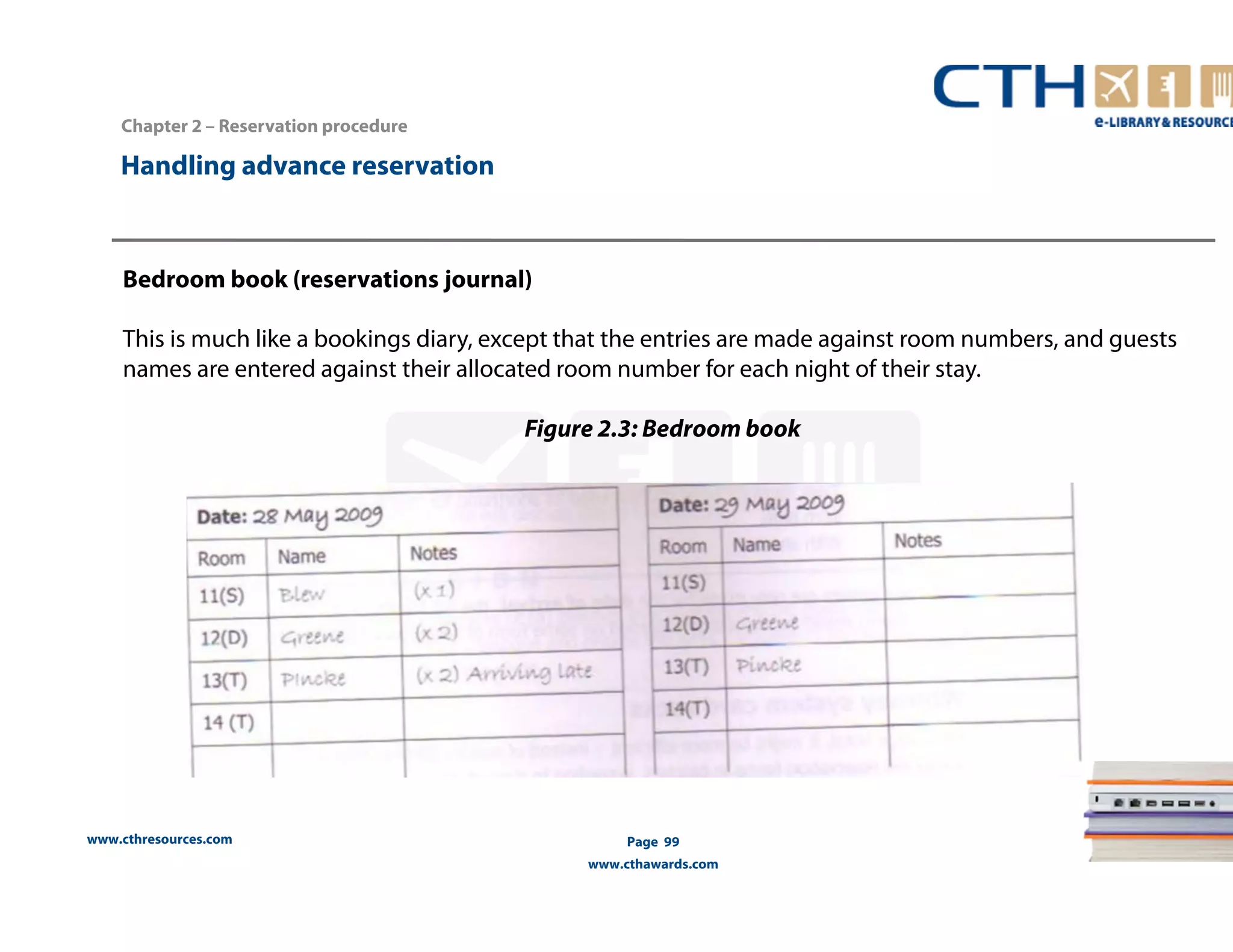
the overall booking position of the hotel. It is a form of Gantt chart. At the same time as an entry is put 
into the bookings diary, another entry is put onto the chart: blocking out reserved rooms with a line 
from the arrival date to the departure date of each guest. 
www.cthresources.com 
Figure 2.4: A conventional bookings control chart 
Page 100 
www.cthawards.com 
Chapter 2 – Reservation procedure 
Handling advance reservation