“The Researcher's Bible”


Debate and Conversation in English

        September, 2011
●   The Researchers' Bible
    Alan Bundy, Ben du Boulay, Jim Howe
    and Gordon Plotkin. 1995


    Gives advices about various aspects of
    getting a Ph.D.
What is a thesis?
●   The Ph.D. Candidate must demonstrate
    that he is capable of pursuing original
    research in his field of study.
●   Must be original work making a significant
    contribution to knowledge.
●   Contain material worthy of publication.
Pitfalls for postgraduate
students

●   Pick research goals which are too
    ambitious.
Source of ideas
●   Further work sections of papers

●   Re-doing bad work
Having chosen a topic
●   Read the literature
●   Talk to people
●   Tackle a simplified version of your
    problem
●   Write down your ideas
●   Give a talk to a small group
Computer bum
●   Your program must be explainable at a
    higher level than code.
●   Plan your program theoretically before
    going to the terminal
●   If people don't understand it is your fault
●   If you really believe that existing
    languages are inadequate then write a
    paper on it
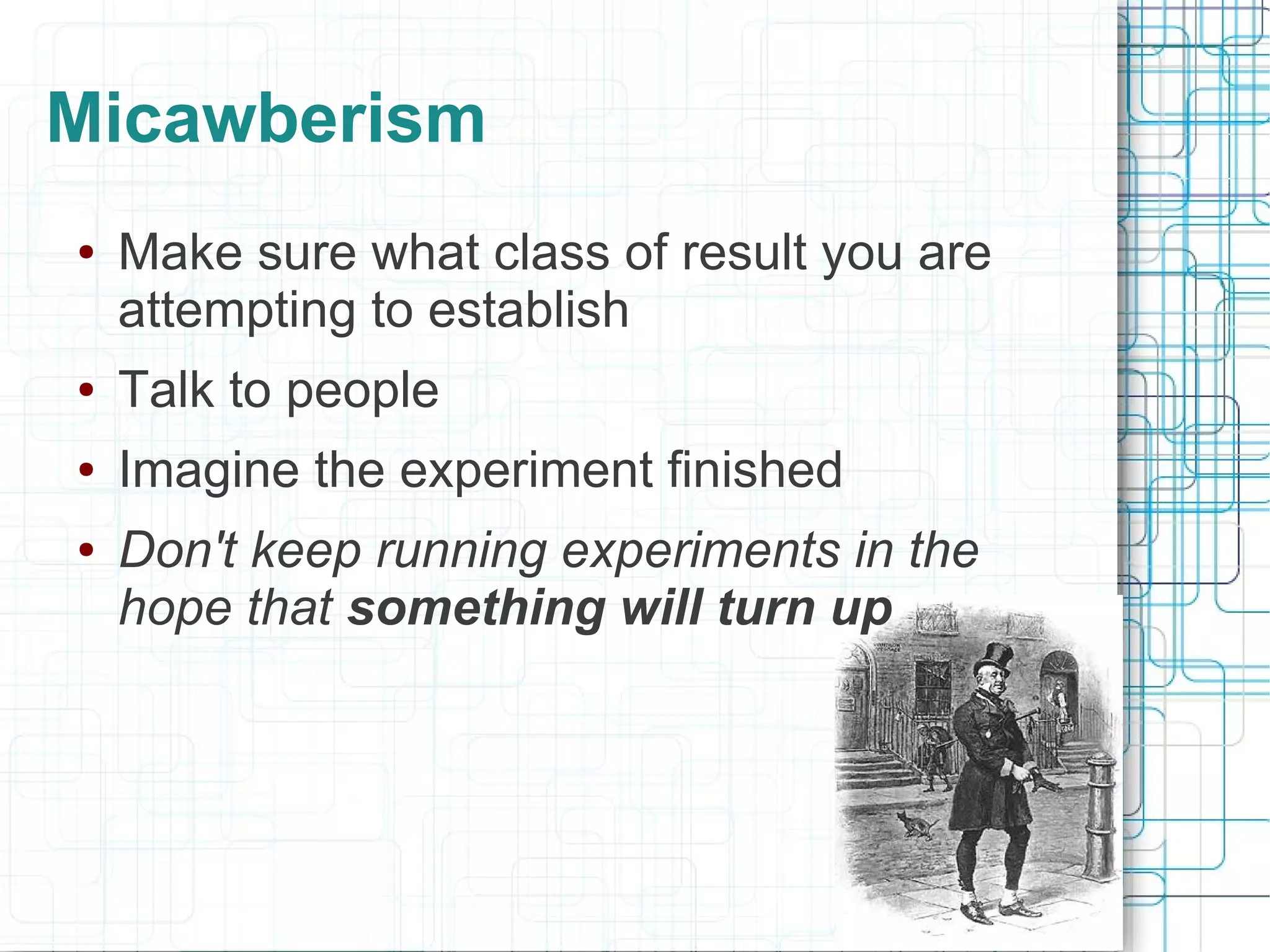
Micawberism
●   Make sure what class of result you are
    attempting to establish
●   Talk to people
●   Imagine the experiment finished
●   Don't keep running experiments in the
    hope that something will turn up
●   Keep in touch with the state of the art in
    releated fields
●   Talk to other people about their research
●   Attend selected seminars and lectures
Misunderstood genius
●   Try to rephrase your ideas using ordinary
    english
●   Your solution won't be trivial to other
    people and should anyway be used as
    basis for further work
●   Motto: Do the easiest thing first, then
    stand on shoulders and do the next
    easiest thing etc.-a better infinite loop
●   Do it the simplest you can
●   Tackle the abstract property in a concrete
    situation
●   Do something simple
●   The readers and examiners are interested
    in the general arguments in favor of the
    idea
Mental attitude
●   Belief in what you are doing
●   You must be prepared to modify your
    ideas if they are wrong
●   Doubts about your own ability can lead to
    research impotence
●   You will have to learn to differentiate
    between valid and invalid criticism
Cold start
●   Make yourself a regular working schedule
●   Make sure you leave some non-
    threatening, attractive task to do first
●   Only try to prove a theorem if it is clearly
    relevant to your overall purpose

●   The sooner you subject your idea to the
    acid test, the sooner you will discover its
    limitations
Choosing a research project
1. You must be enthusiastic about it
2.Solving the problem must be worthy of a
  Ph.D.
3.It must be 'do-able' in three years
4.There must be someone willing to
  supervise it
●   Beware of choosing an area new to you


●   Find someone whose interest lie in this
    area and who is prepared to advise you
Research methodology
1.Think of a scenario
2.Hypothesise what processes ,ight achieve
  such a scenario
3.Think of further scenarios
4.Choose the programming language that
  fits your needs
5.Find some examples you have not
  previously considered – Modify your
  program until is robust
6.Testing it on some examples – Keep
  statistics on its success/faliure
7.Describe your program using language
  independent of your particular
  implementation
Writing papers
●   You should make writing a regular part of
    your life

●   Keep records of everything you do
Guide to writing
●   Your paper should have a message
●   Cannot be misunderstood
●   Stick to the main message and only
    include what is essential to that
●   What is the problem?, what did you used
    to tackle?, what result followed?
●   Have a particular reader in mind
    decide what your reader has to know in
    order to understand the central idea
●   Use worked examples to illustrate a
    procedure
●   Clearly state what is new or better about
    what you have done
●   Do no define a new term unless you really
    need it
●   Ask several people to read the draft
    versions
Relevant to thesis writing
●   Should not be a 'core-dump' of all you
    know about everything related to the topic


●   You should write your ideas and results up
    as a series of notes
●   Build your thesis message:
       –   Should serve as a guide to the title,
            abstract, summary, conclusion and the
            whole body of the thesis
       –   Should answer: what have I done? And
            why does this work deserve a degree?
Guide to reading
    ●   Staying in touch with related research is
        the main subgoals of obtaining a Ph.D.
                                        Middle circle:
                                        Specialized textbooks,
                                        seminars


                          YOU
Inner circle:
Deep understanding,
Get involved in it


                                           Outer circle:
                                           Get familiar with

Researcher's Bible

  • 1.
    “The Researcher's Bible” Debateand Conversation in English September, 2011
  • 2.
    The Researchers' Bible Alan Bundy, Ben du Boulay, Jim Howe and Gordon Plotkin. 1995 Gives advices about various aspects of getting a Ph.D.
  • 3.
    What is athesis? ● The Ph.D. Candidate must demonstrate that he is capable of pursuing original research in his field of study. ● Must be original work making a significant contribution to knowledge. ● Contain material worthy of publication.
  • 4.
    Pitfalls for postgraduate students ● Pick research goals which are too ambitious.
  • 5.
    Source of ideas ● Further work sections of papers ● Re-doing bad work
  • 6.
    Having chosen atopic ● Read the literature ● Talk to people ● Tackle a simplified version of your problem ● Write down your ideas ● Give a talk to a small group
  • 7.
    Computer bum ● Your program must be explainable at a higher level than code. ● Plan your program theoretically before going to the terminal ● If people don't understand it is your fault ● If you really believe that existing languages are inadequate then write a paper on it
  • 8.
    Micawberism ● Make sure what class of result you are attempting to establish ● Talk to people ● Imagine the experiment finished ● Don't keep running experiments in the hope that something will turn up
  • 9.
    Keep in touch with the state of the art in releated fields ● Talk to other people about their research ● Attend selected seminars and lectures
  • 10.
    Misunderstood genius ● Try to rephrase your ideas using ordinary english ● Your solution won't be trivial to other people and should anyway be used as basis for further work ● Motto: Do the easiest thing first, then stand on shoulders and do the next easiest thing etc.-a better infinite loop
  • 11.
    Do it the simplest you can ● Tackle the abstract property in a concrete situation ● Do something simple ● The readers and examiners are interested in the general arguments in favor of the idea
  • 12.
    Mental attitude ● Belief in what you are doing ● You must be prepared to modify your ideas if they are wrong ● Doubts about your own ability can lead to research impotence ● You will have to learn to differentiate between valid and invalid criticism
  • 13.
    Cold start ● Make yourself a regular working schedule ● Make sure you leave some non- threatening, attractive task to do first
  • 14.
    Only try to prove a theorem if it is clearly relevant to your overall purpose ● The sooner you subject your idea to the acid test, the sooner you will discover its limitations
  • 15.
    Choosing a researchproject 1. You must be enthusiastic about it 2.Solving the problem must be worthy of a Ph.D. 3.It must be 'do-able' in three years 4.There must be someone willing to supervise it
  • 16.
    Beware of choosing an area new to you ● Find someone whose interest lie in this area and who is prepared to advise you
  • 17.
    Research methodology 1.Think ofa scenario 2.Hypothesise what processes ,ight achieve such a scenario 3.Think of further scenarios 4.Choose the programming language that fits your needs 5.Find some examples you have not previously considered – Modify your program until is robust
  • 18.
    6.Testing it onsome examples – Keep statistics on its success/faliure 7.Describe your program using language independent of your particular implementation
  • 19.
    Writing papers ● You should make writing a regular part of your life ● Keep records of everything you do
  • 20.
    Guide to writing ● Your paper should have a message ● Cannot be misunderstood ● Stick to the main message and only include what is essential to that ● What is the problem?, what did you used to tackle?, what result followed?
  • 21.
    Have a particular reader in mind decide what your reader has to know in order to understand the central idea ● Use worked examples to illustrate a procedure ● Clearly state what is new or better about what you have done
  • 22.
    Do no define a new term unless you really need it ● Ask several people to read the draft versions
  • 23.
    Relevant to thesiswriting ● Should not be a 'core-dump' of all you know about everything related to the topic ● You should write your ideas and results up as a series of notes
  • 24.
    Build your thesis message: – Should serve as a guide to the title, abstract, summary, conclusion and the whole body of the thesis – Should answer: what have I done? And why does this work deserve a degree?
  • 25.
    Guide to reading ● Staying in touch with related research is the main subgoals of obtaining a Ph.D. Middle circle: Specialized textbooks, seminars YOU Inner circle: Deep understanding, Get involved in it Outer circle: Get familiar with